Archive for Mariners

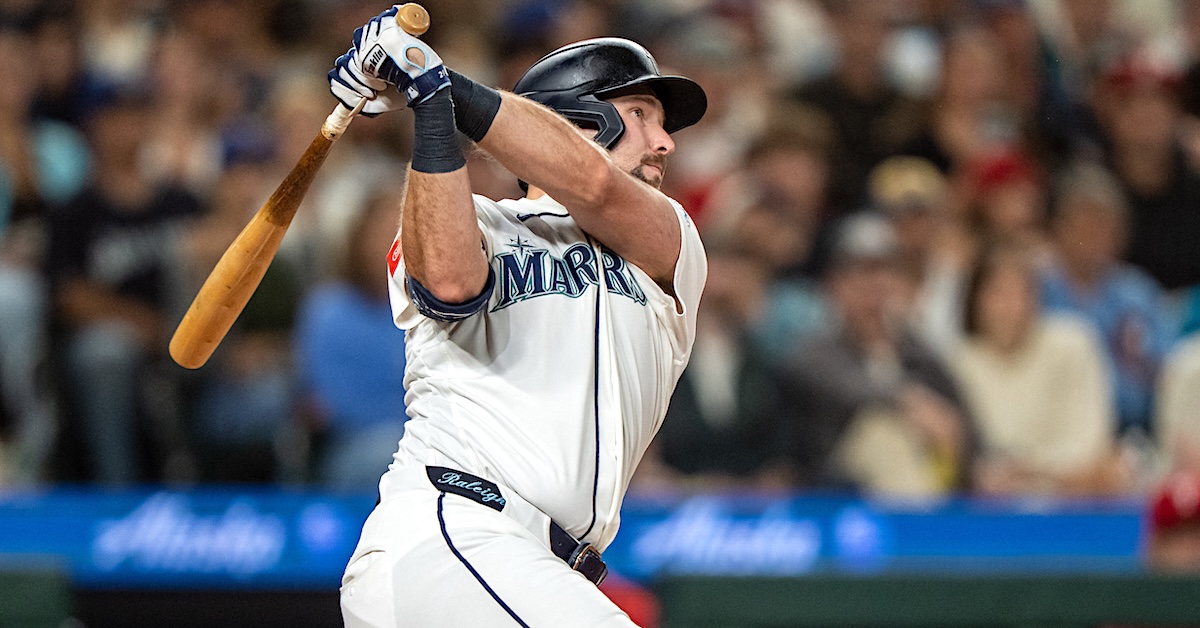
The All or Nothing Luke Raley

Steven Bisig-Imagn Images

Luke Raley took a big hack. Then he took another.

Raley has struck out 36.6% of the time to begin 2026, third most among batters with at least 100 plate appearances. He’s walked just 5.9% of the time, well below the median. His 0.16 K/BB ratio is one of the 10 worst in baseball this year. That’s typically not a recipe for success.

But this is:

Raley has six homers so far in 2026, carrying him to a 132 wRC+. He’s hitting the ball hard (51.8%), to the pull side (50.0%), and in the air (60.7%). His .595 xwOBA on contact is third in the majors. The only batters who have made better contact are Aaron Judge and James Wood, putting Raley ahead of Ben Rice, Munetaka Murakami, Mike Trout, and Yordan Alvarez. It’s impressive company to keep. Read the rest of this entry »


Ronald Acuña Jr. Lands on IL in Weekend of Significant Injuries

Christopher Hanewinckel-Imagn Images

The best team in baseball will be without its biggest star for a few weeks.

The Braves placed Ronald Acuña Jr. on the injured list Sunday with a strained left hamstring. Acuña exited Saturday’s game after pulling up in considerable pain while running out a groundout. Manager Walt Weiss told reporters that imaging revealed a Grade 1 strain, the least severe grade. According to MLB.com, Weiss said:

“It’s not going to be just a couple days. It’s gonna be more than that, so we need to put him on the IL, and hopefully it’ll be sooner than later. No idea with these soft tissue injuries how long they’re gonna take, but I think the silver lining is that the MRI showed it wasn’t too serious.”

While many players return from Grade 1 hamstring strains in just a couple weeks, or even following the 10-day minimum, this is an injury that can linger and delay a return.

This is, obviously, less than ideal for the Braves. Acuña is their best player and was projected in the preseason as the ninth-best position player in baseball with 5.4 WAR, according to our Depth Charts. Though his performance hasn’t been spectacular thus far, with a 111 wRC+ in 152 plate appearances, his .381 xwOBA and 12.2% barrel rate — along with strong strikeout and walk rates — suggest he hasn’t missed a beat this year, coming off his bounce-back 2025 season.

Of course, last year was a comeback campaign because Acuña missed most 2024 (and the early part of 2025) after tearing his ACL. He also missed chunks of 2021 and 2022 with a torn ACL in his other knee. In 2018, he missed about a month with a mild ACL sprain. That means Acuña’s hamstring strain is his fourth lower body injury requiring IL time in his career. Read the rest of this entry »


Five Things I Liked (Or Didn’t Like) This Week, April 17

Denis Poroy-Imagn Images

Another week, another delightful slate of games, which can only mean one thing: It’s time for another edition of Five Things I Liked (Or Didn’t Like) In Baseball This Week. One of my favorite parts of the early season is rediscovering the small pleasures of watching baseball that I’ve forgotten over the winter. I don’t mean watching Shohei Ohtani and Aaron Judge play. That’s obviously very enjoyable, but it’s not something I forget about in the offseason. But the feel of the game, the look on players’ faces when something unexpected happens, the pure happiness I get from seeing a bunch of grown-ups throw a ball around for a job? I only have that experience when the games are on, and the feeling is strongest after a prolonged absence. So no stars today, just stuff I watched that gave me a happy (or, in one case, angry) feeling. As always, a shout out to Zach Lowe of The Ringer, who popularized this article format in his seminal basketball column. And a programming note: Five Things won’t be appearing every week this season, to help balance out my workload and allow me to work on other projects here at the site. I’ll likely be off next week – unless the baseball I watch this weekend is just too enjoyable not to write about.

1. Late-Night Hijinks
I associate West Coast games with wackiness. It’s likely because I grew up out East, and was usually halfway asleep and fully loopy when I turned on late-night baseball (or late-night any sport, really; I have fond memories of silly Pac 10 football games at 1 a.m.). But there’s something thrilling about the last game of the day’s slate going into extra innings, whether you live in Portland, Maine or Portland, Oregon. Last week, the Padres and Rockies did their best to deliver. Read the rest of this entry »


Notes From the Field: Observations on Standouts in the Mariners and Angels Systems

Mark J. Rebilas-Imagn Images

I made it out to Everett a couple of times last week, drawn by the chance to watch three of our Top 100 prospects and a couple of other notable farmhands. My thoughts on seven of the standouts are below.

Tyler Bremner, RHP, Angels
Bremner was as advertised. He’s a loose athlete with, odd front leg swing as he starts his motion aside, a clean and easy delivery. He ticked every number on the gun from 93-98 mph, flashed an above-average slider, and most importantly, missed a half dozen bats with his 70-FV changeup. On the night, he struck out four, walked three, allowed one hit, and only one or two hard-hit balls. It’s what an early first-round pick should do against a decent High-A lineup.

If we’re going to pick nits, I wouldn’t focus on the walks too much, as Bremner was battling a muddy mound on a cold night. He nibbles a bit and likes to entice hitters off the plate. He does this on the changeup especially, and it’s fair to wonder if big leaguers will bite to the same degree college and low minors hitters have thus far. Despite the velo, he only missed two bats with the fastball and none with the slider, which raises questions about where he’ll turn on days when hitters aren’t chasing the cambio. Ultimately, I don’t have long-term concerns. He still projects as a no. 3 or 4 starter, but the night underscored the importance of continuing to develop his slider and fastball command. Whether that’s a job best done at this level or a rung up is above my pay grade.

Jonny Farmelo, CF, Mariners
Farmelo put together two solid at-bats against Bremner. He didn’t reach base, but managed to turn around an upper-90s fastball up and in and line it to right in his first trip up, and then hit a hard line drive to left in his second plate appearance. He got out in front of fastballs a couple times this week and showed enough barrel manipulation to stay competitive on pitches up, even with his fairly long bat path. Perhaps most encouragingly for a player who has battled a lot of injuries as a pro, he still looks like a 70 runner, and he also made a nice read and leaping catch at the wall in center. Read the rest of this entry »


Emerson Hancock Became Less Efficient And More Effective

Jonathan Hui-Imagn Images

Pitchers can do all sorts of things to change their lot in life — launch plyo balls, rig up a Trackman, add a kick change — but motor preferences tend to be a fixed fact. Most pitchers fall into one of two buckets: pronator or supinator. Pitchers with high spin efficiency (say, 95% and up) on their four-seam fastball belong to the pronator class, while those below 90% can be considered supinators. (As a reminder, spin efficiency is the measure of how much spin is “useful;” a fastball thrown with perfect backspin would have 100% spin efficiency.) These mechanical biases tend to remain constant throughout a career. I took 185 pitchers who threw at least 25 fastballs in both 2023 and 2026; over that three-year span, the r-squared between their spin efficiency was 0.65.

On that plot above, you’ll see, as there always are, a few outliers. One is Joe Boyle. The tale of Boyle is relatively well known at this point, at least in certain social media pitching circles. Over the last three years, Boyle went from throwing from an over-the-top arm angle (53 degrees) to a distinct side-arm slot (26 degrees.) The arsenal, in turn, transformed alongside it. This dramatic slot change coincided with his fastball spin efficiency declining from 86% in 2023 to 67% in 2026, one of the largest drops in that span.

Boyle belongs to that collection of dots on the left of the plot that went from low spin efficiency to even lower spin efficiency. And then there’s one little dot all alone on the right side of the plot. That’s Emerson Hancock.

Read the rest of this entry »


Singled Out: Mariners Uncover Truth in Opening Week

Stephen Brashear-Imagn Images

The outcomes are truer than ever.

The Mariners did not record a single in their first two games of 2026. No team had ever done that in major league history. In fact, only eight teams have ever gone back-to-back games without a single, according to MLB.com’s Sarah Langs.

Mariners Box Score March 26-27
Player PA 1B 2B 3B HR K BB
Brendan Donovan 8 0 1 0 1 5 2
Cal Raleigh 8 0 0 0 0 7 1
Julio Rodríguez 8 0 0 0 0 5 1
Josh Naylor 8 0 0 0 0 0 0
Randy Arozarena 8 0 1 0 0 1 3
Luke Raley 8 0 0 0 2 3 0
Dominic Canzone 7 0 0 0 2 0 1
Cole Young 6 0 0 0 1 4 0
Leo Rivas 6 0 0 1 0 2 1
Total 67 0 2 1 6 24 9

The reason is obvious. The Mariners didn’t hit a single because they didn’t put the ball in play very often. And frankly, how could they? Guardians pitchers threw less than 40% of their pitches in the zone, and the Mariners were forced to lay off them, drawing walks in 13.6% of their plate appearances during those two games. When the Guardians did enter the zone, the Mariners struggled to make contact, striking out 35.8% of the time. That means only 34 (50.8%) of their plate appearances ended with a batted ball. And because the Mariners employ a number of sluggers, six of those batted balls flew over the fence. Read the rest of this entry »


Mariners, Top Prospect Colt Emerson Agree on $95 Million Contract

Mark J. Rebilas-Imagn Images

Apparently not wanting to be left out of the flurry of contract extensions handed out over the last two weeks, the Seattle Mariners signed a big one of their own, locking up infield prospect Colt Emerson to an eight-year contract that guarantees him $95 million over the next eight years. This includes a $1 million salary for 2026, meaning that the contract goes through the end of the 2033 season, with the Mariners holding a 2034 club option that could staple another $25 million onto the back of the contract. Emerson’s deal also includes a no-trade clause and bonuses for All-Star selections and Silver Slugger and MVP awards, de rigueur in deals such as this.

Emerson, who doesn’t turn 21 until July, is widely considered Seattle’s top prospect by most sources, whether you prefer our prospect team, Keith Law over at The Athletic, old friend Kiley McDaniel at ESPN, Baseball Prospectus, Baseball America, or mean ol’ ZiPS. That’s no small feat to pull off when you’re in the same organization that has high-end pitching arms like Ryan Sloan and Kade Anderson.

While Emerson doesn’t have one mind-blowing tool that absolutely obliterates the cognitive pathways of watchers, he’s very accomplished at basically everything he does. He’s not going to regularly blast Stantonian shots, but he’ll hit his fair share of home runs, ZiPS thinks 15-20 a year if he played home games at a neutral site rather than T-Mobile Park. Emerson is willing to draw walks, but he still retains a fundamental aggression at the plate; that’s a good thing, as being too passive is a frequent pitfall for prospects who take a good amount of free passes. There’s no whiff problem hiding in his advanced stats, either. He’s not a burner on the basepaths like Trea Turner or Bobby Witt Jr., but at the same time, he’s not me with a belly full of Cool Ranch Doritos, a 32-ounce deli container of beer, and a hamstring that hasn’t gotten a whole lot of use since the Clinton administration. It doesn’t seem like there are any serious concerns about his sticking at shortstop, and the coordinate-based method that ZiPS uses for minor leaguers sees him as a solid B+ defender at the position. Let’s crank out those projections. Read the rest of this entry »


Seattle Catching Prospect Luke Stevenson Doesn’t Mind the Cal Raleigh Comp

Jaylynn Nash-Imagn Images

Luke Stevenson was quoted earlier this month when I wrote about how Ryan Sloan and Kade Anderson profile as Seattle Aces in the Making. My spring training conversation with the 21-year-old backstop also included what he had to say about his own skill set, which in many respects it is similar to what Cal Raleigh’s was in the minors. Stevenson’s FanGraphs scouting report, which included mention of the Mariners’ All-Star slugger, described him as “a power-hitting catcher with strong receiving skills.” Drafted 35th overall last year out of the University of North Carolina, he currently ranks as the eighth-best prospect in the Seattle system, with a 45 FV.

Brendan Gawlowski did the write-ups on our Mariners list, and he sees the potential for more from Stevenson. As Brendan put it, “If there is any jump in Stevenson’s throwing ability or bat-to-ball as he develops, he’ll climb into that [50] tier on subsequent lists.” The Raleigh comparison fits here, as well. Described as having a “power-and-OBP-over-hit profile,” Big Dumper ranked seventh in the system with a 45 FV when he reached the majors in July 2021 at age 24.

Stevenson didn’t shy away from the comp when I brought up their early-career similarities.

“I would love to get compared to him,” said the former Tar Heel, who debuted professionally with Low-A Modesto last summer and slashed .280/.460/.400 over 100 plate appearances “He’s unbelievable. Being able to work with him here in camp has been awesome, and super helpful. What he does… I mean, I definitely would like my game to resemble his.”

My mention of the power-over-hit element of his profile elicited a bit of pushback, but his response was largely a validation of Brendan’s report. Read the rest of this entry »


Sunday Notes: A Power Pitcher Always, Tarik Skubal Commands the Baseball

Tarik Skubal commanded the zone while dominating the San Diego Padres on Thursday. Making his third straight Opening Day start for the Detroit Tigers, the reigning back-to-back Cy Young Award winner threw 49 of 74 pitches for strikes, including 17 of 22 to start an at-bat. Moreover, he mixed with aplomb. Skubal garnered 14 called strikes, 10 of them on either his four-seamer or sinker, as well as 11 whiffs, nine coming on changeups. He departed after six innings having surrendered just three hits, with six strikeouts and nary a free pass.

His M.O. for attacking the strike zone? I asked the 29-year-old southpaw about that following one of his spring training outings earlier this month. As it has become increasingly common for pitchers — particularly power pitchers — to aim middle and let their stuff play from there, I wanted to know how precise he is with intended location.

“My changeup, I throw down the middle, but that’s because when I throw it down the middle, the result is down and away,” replied Skubal. “And when I throw my slider down the middle, the result is glove-side and down. So, there are pitches I throw down the middle, but that’s just visually, as opposed to what I’m actually doing.

“I feel like I do a good job of throwing strikes,” continued Skubal. “As far as really executing every pitch that I throw… I don’t know. There is probably a metric on it. I’d like to think I’m a little bit above average, but I don’t know what the numbers say.“

Measuring command is an imperfect science, so where Skubal ranks depends on your metric of choice. According to our PitchingBot model, he was among the best of the best. Last season, Skubal graded out at 64 (on a 20-80 scale) tying him with Seattle’s Bryan Woo at the top of our botCmd leaderboard. Read the rest of this entry »


The Stars Align for the Mariners in 2026

Joe Nicholson-Imagn Images

The Mariners are favorites in the American League on the back of an all-time duo.

Cal Raleigh and Julio Rodríguez are the best teammates in the AL. They’re each projected to be among the top 10 batters by FanGraphs Depth Charts, and each led their respective positions in our annual positional power rankings series. The only pair of teammates projected for more WAR in 2026 are Shohei Ohtani and Mookie Betts and Ohtani and Kyle Tucker.

Best Projected Teammates (2026)
Team Player 1 WAR Player 2 WAR Total WAR
LAD Shohei Ohtani 8.1 Kyle Tucker 4.8 12.9
LAD Shohei Ohtani 8.1 Mookie Betts 4.8 12.9
SEA Cal Raleigh 6.3 Julio Rodríguez 6.1 12.4
LAD Shohei Ohtani 8.1 Yoshinobu Yamamoto 3.6 11.7
LAD Shohei Ohtani 8.1 Freddie Freeman 3.5 11.6
LAD Shohei Ohtani 8.1 Will Smith 3.2 11.3
NYM Juan Soto 6.1 Francisco Lindor 5.1 11.2
NYY Aaron Judge 7.4 Max Fried 3.8 11.2
KC Bobby Witt Jr. 7.0 Cole Ragans 4.1 11.1
NYY Aaron Judge 7.4 Cody Bellinger 3.6 11 .0
Source: Source: FanGraphs Depth Charts

Since their first season together in 2022, Raleigh and Rodríguez have combined for 44.2 WAR. At 11.1 wins per season, that’s “on pace” for the best duo in team history, just ahead of Ken Griffey Jr. and Alex Rodriguez (65.9 WAR over six years), Griffey and Edgar Martinez (119.3 WAR over 11 years), and all sorts of other combinations from the star-studded squads of the 90s. Raleigh and Rodríguez certainly have much more to achieve before approaching these all-time greats, individually or together. But as the Mariners enter their 50th season, it appears the legacy of the franchise may finally be moving beyond its past. Read the rest of this entry »