Archive for Padres

Chris Paddack’s Relentless Attack

As beef goes, the Chris PaddackPete Alonso back-and-forth wouldn’t make the grade for even the sketchiest ballpark hot dog; Monday night’s Petco Park matchup between Paddack and Jacob deGrom was of a choicer cut. In just his seventh big league start, the 23-year-old rookie dominated a flailing Mets lineup and out-dueled the reigning NL Cy Young winner, continuing a run that has produced some eye-opening numbers.

Paddack and deGrom matched zeroes until the bottom of the fifth inning, with the former, consistently attacking high in the zone, having struck out eight to that point while allowing just a pair of singles, and the latter punching out four while allowing just one single. In the bottom of the fifth, Hunter Renfroe — still basking in the glow of Sunday’s walk-off grand slam against the Dodgers’ Kenley Jansen — hit a solo homer. The Mets put two on base in the top of the sixth to no avail, and the slim margin continued until the bottom of the seventh when the Padres scored again on an Eric Hosmer single, a Renfroe double, and a Ty France sacrifice fly. That was deGrom’s last inning, while Paddack continued until yielding a two-out single to Jeff McNeil in the eighth. He departed having struck out a career-high 11 while allowing just four hits and a walk; he went to a three-ball count just twice. The Padres cruised to a 4-0 win. Read the rest of this entry »


Daily Prospect Notes: 5/2/19 & 5/6/19

These are notes on prospects from lead prospect analyst Eric Longenhagen. Read previous installments here.

I turned last Thursday’s edition in too late for publication (I lost track of time at an Extended game) but certainly won’t deprive you of the notes I have from that day. Here they are:

Xavier Edwards, SS, San Diego Padres
Level: Low-A   Age: 19   Org Rank: tbd   FV: 45+
Line: 5-for-5, 2B

Notes
After 21 Low-A games, X is hitting .390/.450/.455 and has walked more than he has struck out. He has just one extra-base hit and has been caught stealing a bunch, but even for one of the more advanced high school bats from last year’s class, this is a strong start. Gabriel Arias was just put on the IL at Hi-A Lake Elsinore and Edwards has out-performed Justin Lopez and Tucupita Marcano, so he might be in line for a quick move up depending on the severity of Arias’ injury.

Yordan Alvarez, LF/1B, Houston Astros
Level: Triple-A   Age: 21   Org Rank: 7   FV: 50
Line: 6-for-8, 2 2B, HR, BB (double header)

Notes
The use of the major league baseball at Triple-A combined with the PCL hitting environment has had, um, some impact on offensive performance. It’s important to keep this in mind when considering what Alvarez has done so far, though his line through 23 games — .386/.474/.916(!) with 12 homers — is remarkable. Notably, several of those homers have come against breaking balls, which Alvarez is particularly adept at identifying and adjusting to mid-flight. He does not have a sellout, max-effort swing — this power comes easy and it plays to all fields, as seven of Alvarez’s homers this season have been opposite field shots. He was toward the back of our 50 FV group pre-season because of concerns about his body and defensive limitations, but he’s hitting like someone who belongs toward the front of that tier, up near Pete Alonso. Read the rest of this entry »


Guessing the Fate of April’s Underachieving Hitters

For the first month of every baseball season, I’m a bit notorious for simply answering “April” as the convenient, one-stop-shop for questions relating to why someone’s favorite player is hitting .150. Once we start heading into May, telling people to be patient when 1/6th of the season is already over becomes an increasingly unujustifiable task. While rebuilding teams are in a place at which they can be patient, avoiding judgment is tricky for contenders, especially when every division leader is in first place by fewer than three games.

So let’s get out the guillotine and guess who can be saved and who is a lost cause.

Ryan Braun, Milwaukee Brewers

I remain quite torn about the state of doneness of the Hebrew Hammer. On one hand, he can still hit the ball with authority as seen by the fact that his average exit velocity, dipping under 90 mph, isn’t all that different from the numbers in 2016 and 2017, years in which Braun was still a contributor offensively. If you dig deeper into his pitch-by-pitch stats, Braun appears to be going dead-red for fastballs, and despite a career-low contact rate, he is actually making contact with fastballs at better-than-career-average rates (14.6% whiff/swing rate in 2019 vs. 19.8% career). But other than fastballs, he’s making much worse contact, missing almost half the changeups and sliders he’s offered at (career rate under 30%).

It makes me wonder about Braun’s bat speed. To my naked eye, it looks like he’s trying to compensate for decreased bat speed by making contact with his bread-and-butter pitch (Braun was one of the best fastball hitters in baseball in his prime). He also suggested he was changing his swing in order to hit more home runs. It’s unfortunate that swing speed isn’t one of the things you can get easily, but Alex Chamberlain identified stats that correlate with swing speed when reverse-engineering the scanty data available a few years ago. Isolated power, xwOBA, and contact rate all have a relationship, and in each of the three, Braun is at his career’s nadir.

I think there’s still hope for Braun, but if his bat is slowing down, I wonder if he’s taking the wrong approach in trying to hit for more power. A player with slower bat speed but who is also pulling the ball more (57% compared to 38% career) seems like one trying to cheat on the fastballs. I don’t think Braun’s as doomed as some on this list, but I think that he’d be better off not trying to capture his early-career power because it’s making him a one-dimensional hitter. Read the rest of this entry »


Kevin Gausman, Bob Scanlan, and Matt Shoemaker Reflect on Their Splitters

Pitchers learn and develop different pitches, and they do so at varying stages of their lives. It might be a curveball in high school, a cutter in college, or a changeup in A-ball. Sometimes the addition or refinement is a natural progression — graduating from Pitching 101 to advanced course work — and often it’s a matter of necessity. In order to get hitters out as the quality of competition improves, a pitcher needs to optimize his repertoire.

In this installment of the series, we’ll hear from three pitchers — Kevin Gausman, Bob Scanlan, and Matt Shoemaker — on how they learned and developed their splitters.

———

Kevin Gausman, Atlanta Braves

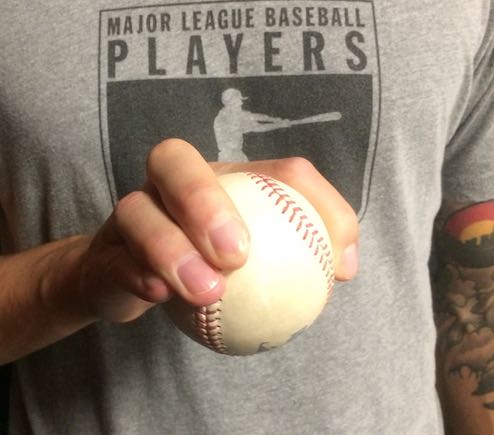
“I want to say I started throwing it my sophomore year of high school. I had a coach at the time who had pitched — his name is Chris Baum — and he had been trying to teach me a circle changeup. I couldn’t really figure it out, so he showed me this fosh, this split-change, that I throw now.

Kevin Gausman splitter grip.

“It was a pretty frustrating pitch at first, because it’s tough to gain consistency with. He kind of told me from Day One, ‘Hey, if you keep throwing it, you’ll eventually have a feel for it.’ I trusted him, and he was right. It’s a big weapon for me.

“The only thing I’ve really changed is where my thumb is on the ball. I’ll kind of mess around with it when I want to throw a strike, or when I don’t want to throw a strike. Moving the thumb affects the speed, and how much break, and tilt, you get on the pitch. If my thumb is under it, it’s going to be a little bit straighter. When my thumb is on the side of it, it might be a little bigger, with more fading action. Read the rest of this entry »


Robbie Erlin, Tommy Hottovy, and Marcus Stroman Expound on Curveballs

Pitchers learn and develop different pitches, and they do so at varying stages of their lives. It might be a curveball in high school, a cutter in college, or a changeup in A-ball. Sometimes the addition or refinement is a natural progression — graduating from Pitching 101 to advanced course work — and often it’s a matter of necessity. In order to get hitters out as the quality of competition improves, a pitcher needs to optimize his repertoire.

In this installment of the series, we’ll hear from three pitchers — Robbie Erlin, Tommy Hottovy, and Marcus Stroman — on how they learned and developed their curveballs.

———

Robbie Erlin, San Diego Padres

“I started throwing my curve when I was nine. Everybody frowns upon that — throwing one that young — but I never had any problems. Basically, my dad put me on one knee and taught me. It was almost like casting a fishing reel. What that does is… when you throw a curveball, you want your elbow to come up a little bit. If your elbow is coming down to throw the curveball, you get exposed. That’s when it’s dangerous [health-wise].

“My dad pitched in high school — he was a righty — and he told me that’s how he was taught. So yeah, he put me on his knee and said, ‘Just flip it to me. Just work on spin. We’re not throwing it hard.’ Eventually I got the feel of it. I started throwing it in games — flipping it out in games — but only once in awhile. Not too much as a kid. Read the rest of this entry »


Daily Prospect Notes: 4/18/2019

These are notes on prospects from lead prospect analyst Eric Longenhagen. Read previous installments here.

Lewis Thorpe, LHP, Minnesota Twins
Level: Triple-A   Age: 23   Org Rank: 12   FV: 40
Line: 5.2 IP, 4 H, 1 BB, 2 R, 12 K

Notes
After two middling starts to kick off his season, Thorpe was dominant yesterday and K’d 12 of the 22 hitters he faced, all on either a fastball at the letters or with a curveball beneath the strike zone. He has quite the injury history (including a two-year stretch where he didn’t pitch at all) and it has impact on how the industry perceives him, which is why he’ll be ranked a bit beneath where he would otherwise be based on his stuff and proximity to the majors. But Thorpe has been consistently healthy since May of 2017, which may begin to allay concerns.

Cody Thomas, OF, Los Angeles Dodgers
Level: Double-A   Age: 24   Org Rank: tbd   FV: 40
Line: 4-for-4, 3 HR

Notes
The Dodgers have done well drafting and developing college power/speed hitters who are athletically stiff, have some swing and miss issues, or both. Thomas, who will be an interesting Rule 5 case this offseason, is one of these. He’s striking out a lot as a 24-year-old at Double-A, but some teams may view the context of his performance differently because Thomas was a two-sport college athlete who hasn’t focused on baseball for as long as other prospects his age. The Dodgers will need to add several other players from Thomas’ draft class to the 40-man (Will Smith, Mitch White, Jordan Sheffield, Tony Gonsolin), so Thomas would seem to be a candidate for trade if a team loves the tools, ability to lift the baseball, and has some 40-man space/time to spare to let him develop further.

Oscar Mercado, CF, Cleveland Indians
Level: Triple-A   Age: 24   Org Rank: 12   FV: 45
Line: 3-for-4, 2B, BB, 4 SB

Notes
Cleveland outfielders, aside from Leonys Martin, are struggling right now. Mercado has begun to heat up at Triple-A with hits in five consecutive games. If he starts seeing more time in a corner, it may be an indication a call-up is imminent, because he’s not supplanting Martin in Cleveland’s center field. He’s only started 23 games in either left or right field during his career, and it might behoove Cleveland to get him more acclimated.

Ty France, 1B/3B, San Diego Padres
Level: Triple-A   Age: 24   Org Rank: tbd   FV: 40
Line: 2-for-5, 2 HR

Notes
The Hosmer and Machado deals almost certainly make France a burgeoning trade chip. He’s exactly the kind of hitter to whom the PCL is extra nice, but he’s hit at every level since college and, save for one season, has also hit for power, and his current SLG% is more caricature than mirage. France also had a great spring with the big league club and is on the 40-man, so he’s likely to debut this year if one of the big league corner bats gets hurt, though San Diego might view that as a way to clear their outfield logjam by playing Wil Myers in the infield again.

Tyler Ivey, RHP, Houston Astros
Level: Double-A   Age: 22   Org Rank: 14   FV: 40+
Line: 5 IP, 2 H, 0 BB, 0 R, 8 K

Notes
A quintessential Houston four-seam/curveball pitching prospect, Ivey at least projects as a good multi-inning reliever and his four-pitch mix gives him a great chance to start. He was ejected two innings into his last start for having a foreign substance on his glove. He’s a sleeper 2020 Top 100 candidate.

More on Keoni Cavaco
There’s background on Cavaco in yesterday’s Notes. I saw him again yesterday against Torrey Pines High School and he had a tough day at the plate, swinging over multiple changeups from TPH’s funky lefty starter. There are going to be questions about his hit tool because of both the swing (inconsistent, arguably ineffectual stride length, odd hand path) and his lack of track record against elite high school pitching, and maybe about what his ultimate defensive position will be, but he’ll be somebody’s toolsy sandwich round pick.

Also of note from the game was Torrey Pines CF Mac Bingham, a 2019 committed to USC. He’s a strong, compact 5-foot-10, 185, and was the football team’s running back in the fall. He made strong contact with two hittable pitches, and ran a 55 time from home to first while legging out a double. The frame makes the power projection less exciting and one area scout told me the general consensus is that Bingham will go to school, but he’s at least an interesting, tools-based follow for 2022 if he does.


Sunday Notes: Amir Garrett’s Slider Is a Slider That Doesn’t Slide (But it’s Good)

When I asked Amir Garrett about his slider last weekend, what I was really doing was asking about a mystery pitch. Which isn’t to say that it’s not a slider. Labelling pitches — especially breaking pitches — can be tricky. If the spin and movement suggests one thing, and the person throwing the baseball calls it something else… what is it?

First things first. Garrett came into pro ball with scant experience on the diamond. Basketball was his sport. The Cincinnati reliever did play baseball growing up, but he stopped at age 14. From there, he “literally didn’t play again until [age] 18.”

A few months after Garrett’s 19th birthday, the Reds — having seen him throw in the mid-90s during a tryout camp — selected the southpaw in the 22nd round of the 2011 draft. Shortly thereafter, they introduced him to a pitch other than a fastball. Whether or not it’s a slider is an exercise in semantics.

“I didn’t know how to pitch, so I was just flicking a ball in there,” explained Garrett. “Curveball, slider, whatever I was calling it is what it was at the time. Kind of the same now. Whatever I throw, that’s what it is. I guess it’s a slider. I don’t know.” Read the rest of this entry »


Daily Prospect Notes: 4/9/2019

These are notes on prospects from lead prospect analyst Eric Longenhagen. Read previous installments here.

Seuly Matias, RF, Kansas City Royals
Level: Hi-A   Age: 20   Org Rank: 1   FV: 45+
Line: 3-for-4, 2B, 3B
Notes
Matias’ 34% career strikeout rate is a sizable red flag that ultimately is what kept him off our overall prospect rankings. With a few exceptions, even the most whiff-prone big leaguers struck out less than that when they were in the minors. But so gifted and physically dominant is Matias that we think he’ll be effective, even if it’s in a streaky, inconsistent way like Domingo Santana or Carlos Gomez. As a teen, he was already posting exit velocities on par with burly, Quad-A type hitters. We hope he learns to take a walk, but “Randal Grichuk with more raw power” is a good player, so we’re cautiously optimistic that the Royals at least have a good big leaguer here, and a potential superstar if there’s contact/approach refinement, which is admittedly easier said than done.

Nolan Gorman, 3B, St. Louis Cardinals
Level: Low-A   Age: 18   Org Rank: 3   FV: 50
Line: 2-for-5, 2 HR
Notes
The Cardinals gave Gorman some reps with the big league team during spring training, and a scout told me they thought it would make Low-A, where Gorman struck out 37% of the time for a month of 2018, appear slower and easier by comparison. He has reached base in each of his 2019 games, and six of his 10 hits have gone for extra bases. We considered Gorman one of the more advanced high school bats in last year’s class (he and Jarred Kelenic were the only two in that top tier) and thought he might move quickly if the strikeout issues that popped up during his senior spring could be remedied. It looks like Gorman is just going to strike out a little more than is ideal, but he also appears poised for a quick move to the upper levels of the minors. When is the right time for promotion? I’d give opposing pitchers the chance to make adjustments to Gorman, and vice versa, which means waiting until mid-May when he sees Beloit, Quad Cities, Wisconsin, and Cedar Rapids for the second time. If he hits until then, and those clubs can’t find a way to get him out the second time they see him, perhaps we see Gorman in Hi-A just after he turns 19.

Joey Bart, C, San Francisco Giants
Level: Hi-A   Age: 22   Org Rank: 1   FV: 55
Line: 2-for-5, HR, 2B, BB
Notes
Nothing to see here as Bart should be expected to hit for power in the Cal League both because of its offensive environment and because last year he teed off on ACC competition, which is second only to the SEC, in my opinion. It’s ironic that the top two picks in last year’s drafts seem likely to be ready for the majors well before their parent club is likely to be competitive, but perhaps it will behoove the Giants to move Bart to Double-A semi-early this summer if for no other reason than to get him working with that pitching staff, which I think has more future big league teammates on it than the group in San Jose does.

Josh Naylor, DH, San Diego Padres
Level: Triple-A   Age: 21   Org Rank: 11   FV: 50
Line: 3-for-6, 2 2B
Notes
Naylor should be monitored closely because he’s the type of hitter who could explode if he makes a relevant approach change. He has both huge raw power and excellent bat control, but his willingness to offer at pitches he can’t drive had limited his power output until 2018, when he homered 17 times at Double-A. If he learns to attack the right pitches, he’ll hit so much that it won’t matter that he doesn’t really have a defensive home. As Naylor is just 21, we’re cautiously optimistic that he will. It’s too early to draw conclusions from his stats but his pull% is currently much higher than is usual.

Trying New Things
I noticed two odd things while combing box scores last night. First, Astros prospect Myles Straw (17th on the Astros list) has been playing shortstop. A quick perusal of the interwebs unearthed this article in the Houston Chronicle, which reports that the Astros will give this a try for a few weeks and see if Straw can actually play there. Their upper levels have been so crowded with outfielders that many of those players have been traded, and seeing as Straw’s best tool (his defense) is made redundant by Jake Marisnick, it makes sense to explore his defensive versatility.

Similarly, the Rangers are trying 1B/LF/3B Andretty Cordero at second base. Unlikely to do enough damage to profile at first (where he’s seen the most time), Cordero’s bat was still notable enough to include him in the Others of Note section of the Rangers list. Should he prove passable at second base, he’ll be much more relevant.

Former shortstop Javy Guerra of the Padres has moved to the mound, and I’ve been told he’s sitting in the upper-90s with natural cut. He’s on the San Diego 40-man.


Daily Prospect Notes: 4/8/2019

These are notes on prospects from lead prospect analyst Eric Longenhagen. Read previous installments here.

Luis Robert, CF, Chicago White Sox
Level: Hi-A   Age: 21   Org Rank: 4   FV: 55
Line: 2-for-4, HR, 2 HBP

Notes
Off to hot start, Robert has multi-hit efforts in each of his first four games and has already stolen three bases and homered three times. After watching LouBob a lot last year (first while he rehabbed multiple injuries, then in the Fall League), I grew concerned about how his bat path might limit the quality of his contact (he sometimes struggled to pull pitches he should have) or his rate of contact, which we don’t have a large-enough sample to properly assess because of his injuries. So far, the pull-side stuff hasn’t been founded, as all but two of Robert’s balls in play so far this year have been to the right side of the field, and those were both pop-ups to the second baseman. He’s one of the more physically-gifted players in pro baseball.

Darwinzon Hernandez, LHP, Boston Red Sox
Level: Double-A   Age: 22   Org Rank: 2   FV: 45
Line: 5 IP, 2 H, 4 BB, 0 R, 10 K

Notes
We do not think Hernandez is a long-term starter and instead think he’ll be an elite bullpen arm. His fastball often sits in the upper-90s when he’s starting so it should at least stay there if he’s moved to relief and, though his feel for it comes and goes, his curveball can be untouchable at times. Maybe the strong early-season performances of Matt Barnes, Brandon Workman, and Ryan Brasier has stifled some of the disquiet about the Red Sox bullpen, but in the event that they need an impact arm, I think it’s more likely to be Hernandez than a piece outside the org. Some of this is due to the quality of the farm system, but Hernandez might also just be better than a lot of the options that will eventually be on the trade market. Read the rest of this entry »


The Day MacKenzie Gore Baptized Mexico’s New Baseball Cathedral

It’s been exactly one year since I moved to Mexico City from my crumbling Caracas, and I have to confess that it has swept me off my feet.

The food is great, the weather is awesome, it’s inexpensive. The people are kind, and every weekend it seems that you have something different to do. Not that I’ve accepted every offer, but there is still something pleasing about turning down opportunities just to get cozy on your couch.

However, this past weekend, Mexico City had an offer too good to pass up.

For the past couple of years, the citizens of this very religious place had been expecting the grand opening of a new cathedral, not for Catholics, but for the church of baseball we are so devoted to in this corner of the web. And on Saturday, that wait finally came to an end.

Located in the eastern part of the city and very near the airport at Puebla metro station, Alfredo Harp Helu Stadium opened its doors and officially became the new home of the Diablos Rojos del Mexico, arguably the most successful team in Mexican League history.

From above, the structure honors the team it was built for by mimicking a massive pitchfork, the weapon of choice of a respected “Diablo.” The name honors the man responsible for all of this: the owner of the Diablos, Guerreros de Oaxaca, and partial owner of the San Diego Padres, Mr. Alfredo Harp Helú. Read the rest of this entry »