Logan O’Hoppe has been one of the bright spots of the Angels’ up-and-down season, but unfortunately, the 23-year-old rookie catcher may have played his last game in 2023. On Sunday, the team revealed that O’Hoppe will need surgery to repair the torn labrum in his left shoulder, an injury that is expected to sideline him for four to six months.
The 23-year-old backstop first injured the shoulder while swinging the bat last Monday in Boston, but he remained in the game and played the next three as well. “It felt fine after it popped back in, in Boston,” he told reporters on Sunday, describing what sounds like a subluxation, not unlike what Fernando Tatis Jr. frequently experienced before undergoing surgery last September. “I mean, you hit three or four balls over 100 [mph], you think you’re fine,” he added.
Alas, O’Hoppe reaggravated the injury while hitting a single in the ninth inning of Thursday night’s 9–3 loss at Yankee Stadium. He fell down in obvious pain after hitting a hot smash down the third base line, recovered to run to first base on what otherwise would have been a double, then exited for a pinch-runner.
The Angels put O’Hoppe on the injured list on Friday, and by Sunday his season was in jeopardy. Only after he undergoes surgery on Tuesday will the prognosis be more clear, though for the moment he and the Angels have some optimism that a return in late August or September will be possible. Read the rest of this entry »
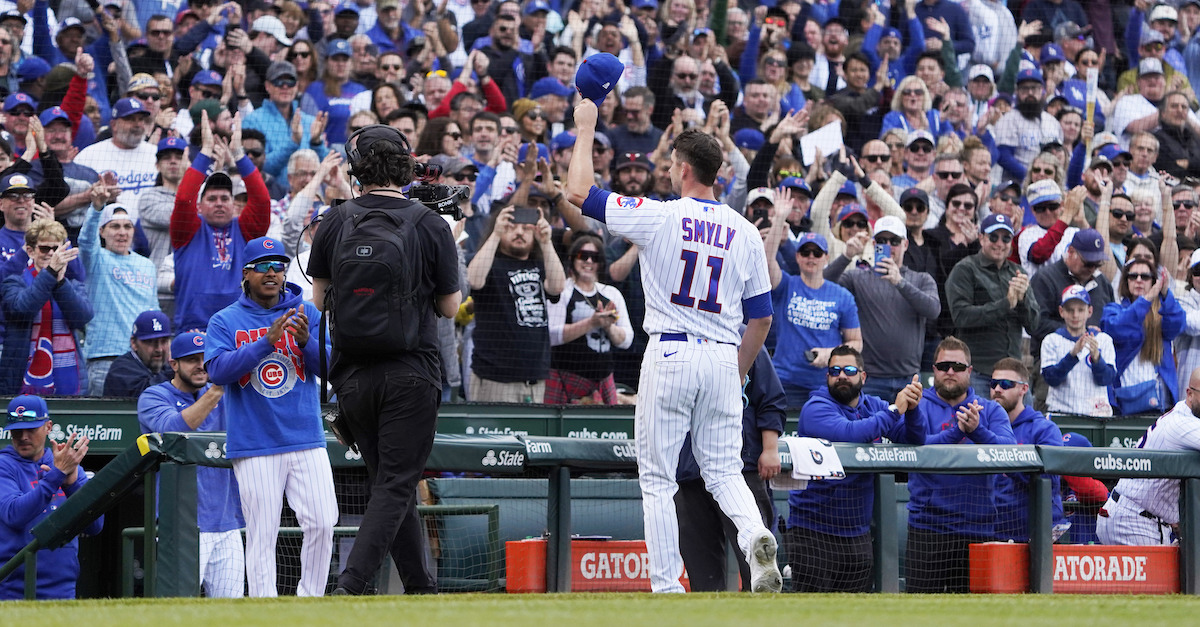
I Drew Smyly is seven innings into a perfect game.
He’s thrown nothing but sinkers and curveballs.
It’s a day game at Wrigley and the ball melts into a swirl of white t-shirts,
Materializes in the catcher’s mitt,
Then says hello-goodbye to each of the infielders in turn
As another Dodger slides his bat back into the bat rack.
Drew Smyly is seven innings into a perfect game.
Drew Smyly is about to be tackled by his catcher.
II Yan Gomes lands and keeps rolling, longer than he needs to,
Eventually settling on his hands and knees, head hanging,
Not remotely like girls who throw their hair
Before them over their heads to dry in the sun.
Smyly comes to rest with his weight on his pitching elbow, legs crossed,
Like Reclining Venus in pinstripes. He shakes his head and smiles, “My bad.” Read the rest of this entry »
The Pittsburgh Pirates have been a pleasant surprise so far this season. Far exceeding the low expectations placed upon them by prognosticators, the Bucs boast a 16-7 record, tops in the senior circuit. Their best hitter has likewise been a pleasant surprise. Sixty-six plate appearances into his fourth big league campaign and his first in the Steel City, Connor Joe is slashing a robust (and obviously unsustainable) .357/.455/.643 with 10 extra-base hits and a 194 wRC+. (His .467 wOBA comes with a .384 xWOBA and a .439 BABIP.) Over his last six games — all Pittsburgh wins — the 30-year-old outfielder has gone 9-for-19 with three doubles, a triple, a home run, and a pair of walks.
Joe talked about his evolution as a hitter, including what he learned from former big league slugger Phil Plantier, when the Pirates visited Fenway Park earlier this month.
———
David Laurila: Let’s start with my favorite icebreaker question: Do you view hitting as more of an art or as more of a science?
Connor Joe: “Oh man. It’s a good mix of both. It’s a combination of everything, right? It’s science, because you need to be educated on what the opponent is trying to do to you. But it’s also not so scientific. It’s more athletic, right? So yeah, it’s a good mixture of a lot of things.” Read the rest of this entry »
One of my favorite articles from the offseason was Ben Clemens’ piece about Gerrit Cole. It’s a thorough explanation of why and how Cole is still one of the league’s best pitchers, this despite a down year and public perception that several others had surpassed him. Through the first few weeks of the season, we’ve gotten strong reassurance that Cole is indeed still one of the best pitchers in the sport.
Cole has been fantastic through five starts and 34 innings pitched, with a 0.79 ERA, a 2.21 FIP and — get this — zero home runs allowed. That last point is the most important one. Last year, no pitcher in the majors gave up more home runs than Cole (33). It was his kryptonite the entire season. He would be coasting through a game, striking out 29.3% of the batters he faced, and then suddenly a ball would find itself in the seats and his start would blow up in front of him. His longest stretch without giving up a long ball in 2022 was three games, a feat he managed on two separate occasions. But this year, he seems to have turned the corner. The key to Cole’s success during this turnaround has been his fastball. There are a few things contributing to this that tie in with one another, but I’ll start with his four-seam fastball location:
Cole has been excellent in keeping the ball up on his arm side both in and out of the zone. You can see that in the heat maps, but if it helps to know, 32.4% of his four-seam fastballs have been in the upper third of the strike zone, or above and to either side of the upper third. Last year, that mark was only 21.1%, the lowest it has been since before his breakout year in 2018 with Houston. Cole has one of the best four-seam fastballs in terms of velocity and stuff; if he locates the pitch in its ideal spot up in the zone, it’s extremely difficult to hit. The following two pitches are great examples of how hard it is for a hitter to get on top of a precisely located, high-velocity fastball with ride:
Vladimir Guerrero Jr. and Matt Chapman have been two of the best hitters in baseball this year in terms of both hard contact and results. Both are routinely crushing fastballs. Yet neither was able to get their best swing off due to Cole’s location. Even the best hitters can’t square up Cole when his fastball command is on. That’s perhaps an obvious statement, but it’s necessary to point out. It’s why he broke out with Houston and why he has been one of the most productive pitchers in baseball over the last five seasons. The question, then, is how he returned to having great fastball command. For that, I’ll turn to some information on his release point and extension.
Gerrit Cole Release and Extension
Year
Vertical Release (ft.)
Horizontal Release (ft.)
Extension
2018
5.66
-2.20
6.2
2019
5.85
-2.02
6.3
2020
5.61
-1.91
6.6
2021
5.68
-1.92
6.6
2022
5.78
-1.79
6.5
2023
5.90
-1.68
6.3
It’s a simple concept. If you want to more precisely target a specific spot in the zone with a pitch you throw half the time, then alter your release point to set yourself up for consistent success. Cole is releasing the ball higher and closer to third base than he ever has in his career, and with the least extension he’s gotten down the mound since his Pittsburgh days. You might be thinking that’s counterintuitive. Typically, a four-seam fastball’s qualities will be the best with more extension and a lower release point, and you’d be right to think so! However, there is some nuance to consider with Cole’s situation.
So far, this is the least amount of induced vertical break (IVB) he has had since joining the Yankees, but a sacrifice in IVB due to an altered release point and decrease in extension has allowed him to have pinpoint command. If you want to learn more about IVB, check out Justin Choi’s incredible piece from last year, but as a quick refresher, it’s essentially the movement that causes a fastball to “rise” relative to a hitter’s expectations. It’s not like Cole’s fastball is suddenly bad — it’s still sitting at 17.6 inches of IVB, a -4.4 degree vertical approach angle (VAA), and 96.8 mph average velocity. The IVB is still well above average. His VAA, the angle at which a pitch enters the zone, is still flat enough to fool hitter’s expectations. And the velo is still top notch! Basically, the sum of the parts still makes for an elite, 99th-percentile pitch, especially when you add the command improvement. The .141 batting average against and -9 run value he’s accrued (-8 last year) prove the sacrifices are paying off.
Cole’s improvements in the top of the zone are having effects elsewhere, too. If I were a hitter facing Cole, I’d be forced to focus my eyes up and nowhere else. You have to pick your spots against a pitcher of this quality. If you don’t hunt the fastball in its most frequent location, you’re going to get beat by it over and over again. Because of that, when Cole does target the bottom of the zone, it’s unexpected — and it’s freezing hitters. He has only thrown 51 total fastballs at or under the bottom third of the zone, but 21 (41.2%) have gone for called strikes. That’s up 10 percentage points from last year and is the highest mark since his 2018 breakout. It doesn’t matter who you are, covering 97 with ride at the top and bottom of the zone is nearly impossible.
Other than the four-seam fastball itself, Cole has made some other tweaks here and there that have contributed to his resurgence. The first is how aggressive he is in 0-0 counts. To put it plainly, he is attacking hitters. The ace has never been within three percentage points of a 70% first-pitch strike rate, but this year, he is at 71.5%. It’s not just from his fastball either; he is using his curve as an 0-0 offering in the zone more frequently than last year. In general, he has continued the uptick in curveball usage that we saw at the end of last year. That’s also in line with Cole’s general willingness to be more adaptable with his pitch usage on a game-to-game basis. This year, he has used his fastball as much as 64.2% of the time and as little as 42.3% of the time. Better command and less predictability keeps hitters honest.
When you’re a great pitcher who hasn’t seen any notable decline in the quality of your stuff, you’re typically a safe bet to regain elite form. At Gerrit Cole’s level of talent, it doesn’t take a dramatic overhaul. A slight adjustment in release point was all he needed to be the top-of-the-zone killer he had been in the previous four seasons. That, along with strategic in-game adjustments, suggests there is no regression coming any time soon.
Let’s start this article with a bold claim: Wander Franco’s first two seasons in the majors were a disappointment. That’s a startling assertion, even if it might not seem that way at first. Franco hit .282/.337/.439, good for a 121 wRC+, while playing league average defense at shortstop; he was 20 years old for the first of those seasons. He played at a 4.3 WAR per 600 PA clip, which the FanGraphs glossary helpfully notes is an All-Star level. That’s all true. For the best prospect of the past decade, though, it still feels like a letdown.
The real thing that has betrayed Franco is playing time. First for nebulous service time reasons, then due to injury, his first two seasons in the majors were both as brief as they were scintillating. He appeared in 70 games in 2021 and 83 in 2022. His counting stats weren’t exactly imposing: 13 homers, 10 steals, and a mere 72 RBI if you’re playing fantasy baseball. I acknowledge that considering that performance a disappointment is grading on a curve, but when you’re as good and hyped as Franco is, that comes with the territory.
Now that we’ve gotten that out of the way, it’s time for the good news: that perception is as stale as the sourdough I bought last Wednesday and didn’t finish (hey, there’s a good bagel shop nearby, and I’m only human). Franco isn’t a young up-and-comer this year. He’s a bona fide star, one of the best hitters in baseball so far and the best player on the best team. It’s only a matter of time before your marginally-baseball-following friends start asking you if you’ve heard about this Wander guy. So allow me to present a gift to you as a baseball fan who wants to sound smart to their friends, a guide to why Franco is one of the best players in baseball and what he changed to get there. Read the rest of this entry »
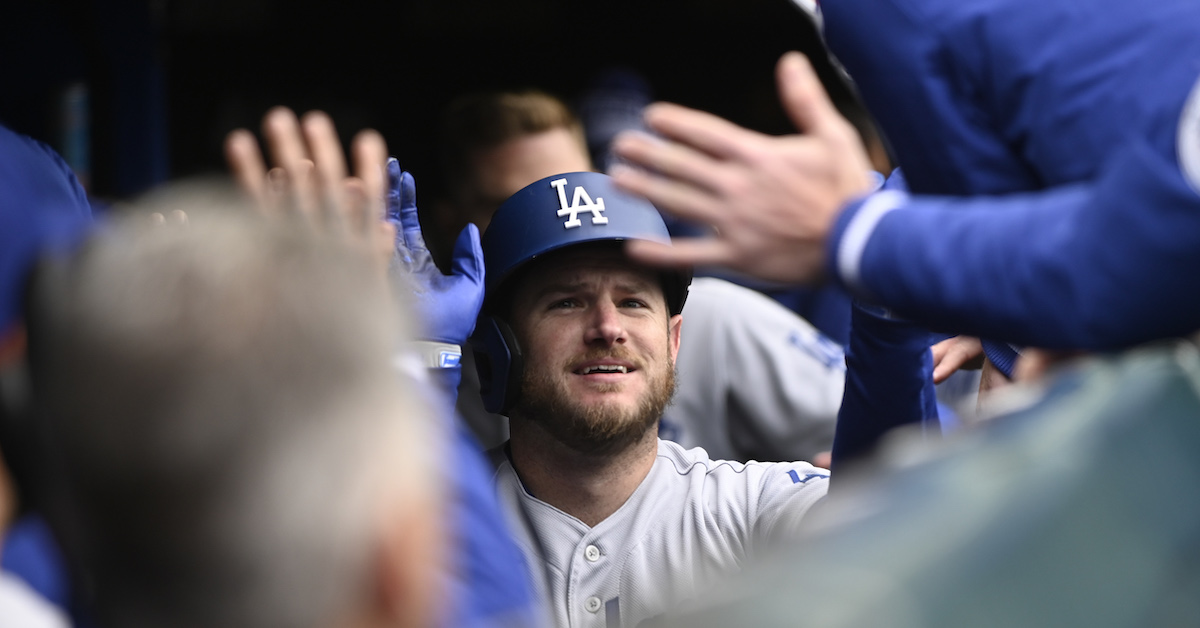
Max Muncy’s career has had its ups and downs in recent years… or steps forwards and backwards, depending upon which plane you prefer for directional metaphors. Lately the slugger has been on a home run binge, one involving a mechanical tweak — a slight step backwards with his left foot at the start of his swing — that he adopted last year and then briefly abandoned this spring.
This weekend, Muncy took over the major league lead in home runs with 11. He went yard four times during the Dodgers’ four-game visit to Wrigley Field from Thursday through Sunday, starting the festivities with a solo shot off starter Javier Assad on Thursday night, adding a pair of late-inning blasts off Mark Leiter Jr. and Brad Boxberger on Saturday (the first of those a two-run homer), and capping his weekend with a two-run drive off Marcus Stroman on Sunday. The last of those gave the Dodgers the lead and helped them take three games out of four from the Cubs.
Muncy’s hot streak didn’t just begin last Thursday; it’s been going on for two weeks. After homering just once while going 4-for-33 in his first nine games, he bookended a three-game series at Oracle Park with a pair of two-homer games, then homered in losing causes in series openers against the Cubs and Mets at Dodger Stadium. Read the rest of this entry »
The St. Louis Cardinals have scuffled in the early going. Even after a win against the Mariners on Sunday, their record stands at a paltry 9-13. Through the weekend, their 2.2-win dip in projected win total has been the sixth-largest decrease since the season began, and among serious contenders, their performance looks even worse: the Cards’ 22.2% decrease in divisional odds has been the league’s largest, bypassing the second-place Yankees (-19.3%), who’ve had to deal with the Rays’ historic start. Further, the Cardinals’ 18.6% drop in playoff odds is second only to the White Sox (-20.1%), who’ve played even worse at 7-15. But what’s plaguing the Redbirds?
We knew that their starting pitching was a weakness coming into the season, and it’s been even worse than advertised. We pegged their starting staff as the 20th-best during our positional power rankings, and they’re 26th in both ERA and WAR, and aren’t much better by FIP (24th), even after a stellar Sunday performance from Jack Flaherty. Though we anticipated his absence at the time, perhaps we underestimated the impact that Adam Wainwright’s early-season injury recovery would have on the staff as a whole. Nevertheless, the Cards’ pitching woes have been within our margin for error. On the other hand, their lack of outfield production has been more surprising.
Going from left to right field, we ranked the Cards 15th, eighth, and ninth in our positional power rankings. Their outfield bats have been solid if unspectacular thus far, with their 104 wRC+ tying for 13th in the league. Yet, their defense has dragged them down: by OAA, UZR, and DRS, they tie for 25th, have sole possession of 26th, and are in a four-way tie for 23rd, respectively. That all adds up to a WAR figure of just 0.3, good (or bad) for 21st in the league. Read the rest of this entry »
Pete Alonso is a specialist. He’s not one of those boring types, though: defensive replacement, pinch-runner, long reliever, LOOGY, the list goes on and on. He’s the kind of specialist that every team would take more of: a home run specialist. You might not notice it, because every star hitter is seemingly also a slugger these days, but Alonso isn’t like the rest of them. He’s out there for the home runs, and everything else about his game simply works in support of that.
That’s a vague statement, but I really think it’s true. To me, there’s no player in baseball today who is a more pure home run hitter. Given that we play in one of the homer-happiest eras in baseball history, and that players today train harder than at any point in the past, he might be the best home run hitter of all time.
Let’s start with a simple fact: since Alonso debuted in 2019, no one has hit more home runs. He’s 13 homers clear of Aaron Judge in second place, with a whopping 156. This isn’t a case of a pile of extra-base hits with some going over the wall, either. Of the top 15 homer hitters in that span, only Judge has a higher proportion of home runs as a share of all extra-base hits. Alonso isn’t up there spraying balls into the gap; he’s up there trying to give fans souvenirs:
Mark Gubicza was a good starting pitcher. Making all but two of his 384 big-league appearances with the Kansas City Royals, the big right-hander logged 132 wins to go with a 3.96 ERA, 42 complete games, and 16 shutouts. His best season came in 1988 when he went 20-8 with a 2.70 ERA and finished third in A.L. Cy Young balloting.
Gubicza also had two saves, both of them in 1993. That was the year he gained a true appreciation for how challenging it is to protect a late-inning lead for a teammate. How he came work out of the bullpen — something he did sparingly outside of that one season — was a matter of circumstance.
“We didn’t have a bridge to get from our starters to Jeff Montgomery,” explained Gubicza, who now serves as a TV analyst for the Angels. “The year before, my shoulder was a little sketchy, so [manager] Hal McRae asked me if I could be the bridge. At first I was hesitant, because I liked starting. But I was building back my arm strength, so I said, ‘You know what? I’ll do whatever it takes to win games. I’ll be that bridge to get to Jeff Montgomery.”
The transition was initially bumpy. Gubicza’s heart would start racing when the bullpen phone rang, and once he began warming, he would be throwing as hard as he could. Moreover, while adrenaline was telling him that he was ready, his stuff wasn’t ready. Much for those reasons, he took his lumps before figuring out what worked for him in the unfamiliar role. Read the rest of this entry »
It’s not often that a 33-year old player still owed $34 million over two years is designated for assignment, but after a three-inning, seven run performance against the Cardinals on Wednesday that ballooned his ERA to 10.26, the Diamondbacks decided to cut bait on Madison Bumgarner. Things certainly didn’t go the way the D-Backs anticipated after inking him to a five-year, $85 million deal, as he closed out his Arizona tenure with a 5.23 ERA, 5.18 FIP, and 1 WAR in 363 innings.
As a Diamondback, Bumgarner seemed like a shell of his former self, the former Giants ace who was the hero of three separate playoff runs. His numbers went from good to terrible almost overnight, but the writing was on the wall long before he signed with Arizona. After a successful 2016 campaign that ended in his second top-five Cy Young finish, he missed about half of ’17 and ’18 with injuries, one of which was sustained in a dirt bike crash. While his surface-level results in those two seasons held steady with his career norms, his FIP climbed by nearly a full run as he lost much of the strikeout potency that made him so dominant in years past. His fastball, which once sat around 93 mph, lost two ticks and much of its whiff capabilities. The slider/cutter hybrid that he threw with near-equal frequency to the heater also started getting hit harder; batters had an xSLG nearing .500 versus both offerings in his final season as a Giant.
Despite these warning flags, the Diamondbacks still handed him a big contract before the 2020 season, where his performance began to tank. His strikeout rates continued to fall, and the good luck he experienced later in his Giants tenure faded away. It doesn’t help that Bumgarner has been characterized as unwilling to make adjustments even with diminished stuff, instead sticking with his old, clearly ineffective gameplan. In his late-30s, Charlie Morton nearly tripled his curveball usage compared to his early Pittsburgh days and had the best years of his career. Justin Verlanderstopped throwing changeups with the Astros and returned to Cy Young form after some middling seasons; his teammate Gerrit Cole started elevating his fastball more, setting strikeout records in the process. Bumgarner, though, stuck with his fastball/cutter diet, despite the fact that in 2022, his four-seamer was the second-worst pitch in baseball, according to Statcast. As hitters adapted to crush his weakened stuff, Bumgarner couldn’t or wouldn’t adapt back, leading to an unceremonious end to his time on the Diamondbacks. Read the rest of this entry »