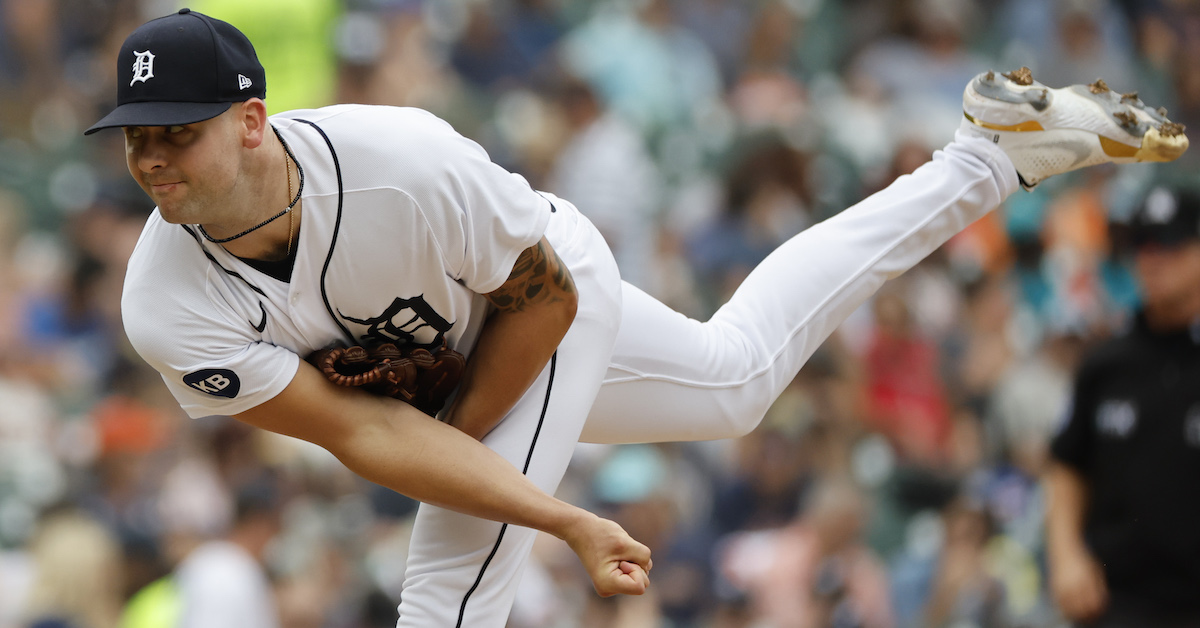
There are a lot of ways to look at the numbers George Springer put up in 2022. Here’s the simplest: He had an All-Star season, posting a 132 wRC+ and piling up 4.2 WAR. That’s excellent. On the other hand, you could argue that he has been slipping for a while now. His wRC+ has declined in three consecutive seasons, and now that Kevin Kiermaier and Daulton Varsho are both Blue Jays, his days as a center fielder are officially over.
Analyzing Springer is tricky because he’s always been a great hitter no matter what was going on under the hood. He reached his offensive peak in 2019, posting a 155 wRC+ with the help of a career-high 43.2% hard-hit rate. Then in 2020 and ’21, his hard-hit rate came back to earth a bit, his pull rate spiked, and he literally doubled his launch angle. Despite the drastic changes, his wRC+ fell by just over 10 points, dropping him from elite all the way down to very nearly elite. Read the rest of this entry »
While the Mariners’ front office has been rather quiet in terms of acquiring new free agents this offseason, they did plenty of work locking up their existing personnel before free agency opened, extending star outfielder Julio Rodríguez and starting pitcher Luis Castillo with combined guarantees up to $578 million. Now, they’ve agreed to a three-year extension with utility man Dylan Moore worth $8.875 million. This contract buys out his final two years of arbitration as well as his first season of free agency, keeping him in Seattle through his age-33 season.
Moore was a late bloomer, first making the Mariners roster in 2019 at the age of 26, and he’s primarily served in a utility and platoon role ever since. While his career wRC+ sits at exactly 100, that mark jumps to 112 against left-handers. The Mariners have done well to maximize his effectiveness by deploying him on his strong side as much as possible, especially last season, when nearly half of his plate appearances came against left-handed pitching, fourth-most among right-handed hitters.
Platoon usage rate often says more about a team than an individual player — plenty of everyday starters arguably should be sitting more against same-handed pitchers — but the Mariners have the right pieces to put Moore in advantageous situations, including a wide variety of left-handed counterparts like Kolten Wong, Jarred Kelenic, and Tommy La Stella.
It’s difficult to thrive exclusively as a right-handed platoon bat, though, given that a significant majority of pitchers are also righties. Players like Moore and Slater only got to face lefty opponents about half the time; sometimes a reliever comes in, sometimes a starter needs the day off regardless of who the other team has on the mound. Luckily, Moore also handles right-handed pitching decently well. His career wRC+ against them sits at 92, and last season, he had a .344 OBP and 117 wRC+ against fellow righties, a good mark for any big league hitter. He definitely has a stronger side, making more contact and drawing more free passes against southpaws, but he’s certainly not helpless on the other side of the platoon either. Read the rest of this entry »
The Rockies are what would happen if a baseball team were run by the guy on your block who raises pygmy goats in his yard. Sure, this is a suburban subdivision outside of Columbus, Ohio, and there’s no real purpose to having goats. But the noise and smell aren’t as bad as you feared, neighborhood kids think the goats are cute (correctly — look at their little ears!), the goats only infrequently climb onto your neighbor’s roof and escape to the street, and apparently nobody had goats in mind when the township zoning ordinances were written because there’s no rule against it. Is it weird? Absolutely. But it’s not hurting anyone, so who cares? The world is a little more interesting with little goats running around.
Carter Hawkins knows the Guardians organization well. Prior to becoming the General Manager of the Chicago Cubs in October 2021, the 38-year-old Vanderbilt University alum spent 14 seasons in Cleveland, serving as a scout, Director of Player Development, and Assistant General Manager. With the Guardians’ well-earned reputation of being a progressive organization with an outstanding pitching-development program, I asked Hawkins a question during November’s GM Meetings:
How similar are the two organizations, and in which ways do they differ?
“I would say the best thing in terms of similarities is that there are a lot of team-first people in both places, as opposed to me-first people,” replied Hawkins. “The obvious market-size difference stands out. There are more opportunities in Chicago to utilize resources — you can have a higher risk tolerance — whereas in Cleveland there is the challenge of having to be very process-oriented to make a decision. If you have a lot of resources, you don’t necessarily have that pressure on you. At the same time, there is no reason that you can’t be just as process-oriented in a larger market.”
The disparity in payrolls is notable. Roster Resource projects the Cubs’ 2023 payroll at $184M, and Cleveland’s at just $91M. Last year those numbers were $147M and $69M. Read the rest of this entry »
The role of the closer is diminishing every year, but it seems like no one told the Tigers. Only five different Detroit relievers recorded a save last season, tied for the lowest total among all 30 teams. Over the past five years, only 13 Tigers have earned a save. No other team has had fewer than 17 different pitchers save a game in that time; the Rays have had 35. In the last ten years, the Tigers have had only 28 players save a game, still the lowest total in the sport. The Rays, for comparison, have had 57 different pitchers record a save since 2013.
In part, this is because Detroit hasn’t been very good. When save situations are few and far between, there is less need to spread around the closing opportunities. Yet it’s not all about the wins and losses. For the past decade, the Tigers have had a go-to closer nearly every year. From veteran relievers like Joaquín Benoit, Joe Nathan, Joakim Soria, and Francisco Rodríguez to younger arms like Shane Greene and Bryan Garcia, the Tigers have shown a tendency to name a singular closer and hand him the ball in the ninth.
It seemed like this trend might finally have come to an end when A.J. Hinch took over as manager, but Gregory Soto recorded the majority of his team’s saves in 2021 and prompted Hinch to name him the closer that October. In 2022, the Tigers had one of the deepest bullpens in baseball and easily could have opted for a closer-by-committee, but Hinch stayed true to his word. Soto earned 30 of their 38 saves and took the mound in the majority of save situations. Read the rest of this entry »
The Rangers are a bit of an odd team. Every offseason, someone does a thought experiment to build the best team solely out of free agents; in fact, some months ago I posed a similar question about the Orioles. But even my hypothetical 2023 O’s had three top-10 prospects to throw into the mix. What does a team look like if it’s starting entirely from scratch?
A little awkward, as the Rangers can attest. When they traded Joey Gallo to New York in 2021, the cupboard was basically empty. Since then, they’ve done an admirable job acquiring talent in trades and on the free-agent market, but they haven’t made much progress on the road back to playoff contention. A 94-loss campaign in 2022 got manager Chris Woodward and longtime baseball ops head Jon Daniels fired, and new manager Bruce Bochy surely would not have come out of retirement so he could compete for third place in the AL West.
The Rangers have plenty of star power, particularly after adding Jacob deGrom in free agency, but plenty of questions remain about their ability to fill out a competitive lineup. And Adolis García might be the player upon whom their success hinges. Read the rest of this entry »
Location: Boston, MA Department: Baseball Operations Status: Full-Time
Description:
The Senior Developer, Baseball Systems position will be a member of the baseball operations software development team, and is responsible for the design, development, and support, of all baseball systems. This individual will work closely with members of baseball operations to understand business requirements that drive the analysis, design, and development of quality baseball systems and solutions. This senior developer will collaborate closely with the Director of Baseball Systems, colleagues on the software development team, and baseball operations personnel from all departments.
Responsibilities:
Create leading-edge baseball solutions together with the software development team and others on new and existing baseball systems
Lead the design and implementation of the software architecture and embrace a software engineering mindset
Lead the software development process of critical baseball applications, including requirements gathering, analysis, effort estimation, technical investigation, software design and implementation, testing, bug fixing, and quality assurance
Responsible for the design and development of databases, web services, graphical user interfaces, and other aspects of web and desktop applications
Actively participate in the architecting, deployment, and maintenance of system solutions in a cloud-based environment
Actively participate with colleagues in design reviews, code reviews, and exercise best practices
Work closely with baseball analysts to design and implement solutions to their modeling and data needs
Respond to and resolve technical problems and issues in a timely manner
Identify and implement creative solutions for technical challenges
Qualifications/Characteristics:
TECHNICAL SKILLS:
Bachelor’s degree in Computer Science, Software Engineering, Computer Engineering, or a related field
6 or more years of development experience using some combination of C#, C++, Python, Typescript, JavaScript, T-SQL, ServiceStack, Angular, React, Vue, or other frameworks, with a focus on responsive & progressive web applications.
Strong database design and development experience, especially with MS SQL Server
Experience integrating systems and data using third-party APIs and web services
Experience with cloud technologies from Azure, AWS, or GCP are a plus
Experience with R is a plus
Design experience with Zeplin, Photoshop, or similar applications, are a plus
Experience with source control tools such as Git, TFS, or similar
GENERAL SKILLS:
Ability to work autonomously and as a team in a fast paced environment
High level of attention to detail with the ability to multi-task effectively
Comfortable working remotely using Zoom, Teams, Slack, Trello, and other tools to communicate with all team members
High degree of professionalism and ability to maintain confidential information
Excellent organizational and time management skills
An understanding of baseball, common terms, and analytic measures, are a plus
The Red Sox (or FSM) requires proof of being up-to-date on COVID-19 vaccination as a condition of employment, subject to applicable legal requirements. Up-to-date means having received all recommended COVID-19 vaccination doses in the primary series and a booster dose(s) when eligible, per CDC guidelines.
Prospective employees will receive consideration without discrimination based on race, religious creed, color, sex, age, national origin, handicap, disability, military/veteran status, ancestry, sexual orientation, gender identity/expression or protected genetic information.
Below is an analysis of the prospects in the farm system of the Baltimore Orioles. Scouting reports were compiled with information provided by industry sources as well as my own observations. This is the third year we’re delineating between two anticipated relief roles, the abbreviations for which you’ll see in the “position” column below: MIRP for multi-inning relief pitchers, and SIRP for single-inning relief pitchers. The ETAs listed generally correspond to the year a player has to be added to the 40-man roster to avoid being made eligible for the Rule 5 draft. Manual adjustments are made where they seem appropriate, but I use that as a rule of thumb.
A quick overview of what FV (Future Value) means can be found here. A much deeper overview can be found here.
All of the ranked prospects below also appear on The Board, a resource the site offers featuring sortable scouting information for every organization. It has more details (and updated TrackMan data from various sources) than this article and integrates every team’s list so readers can compare prospects across farm systems. It can be found here. Read the rest of this entry »
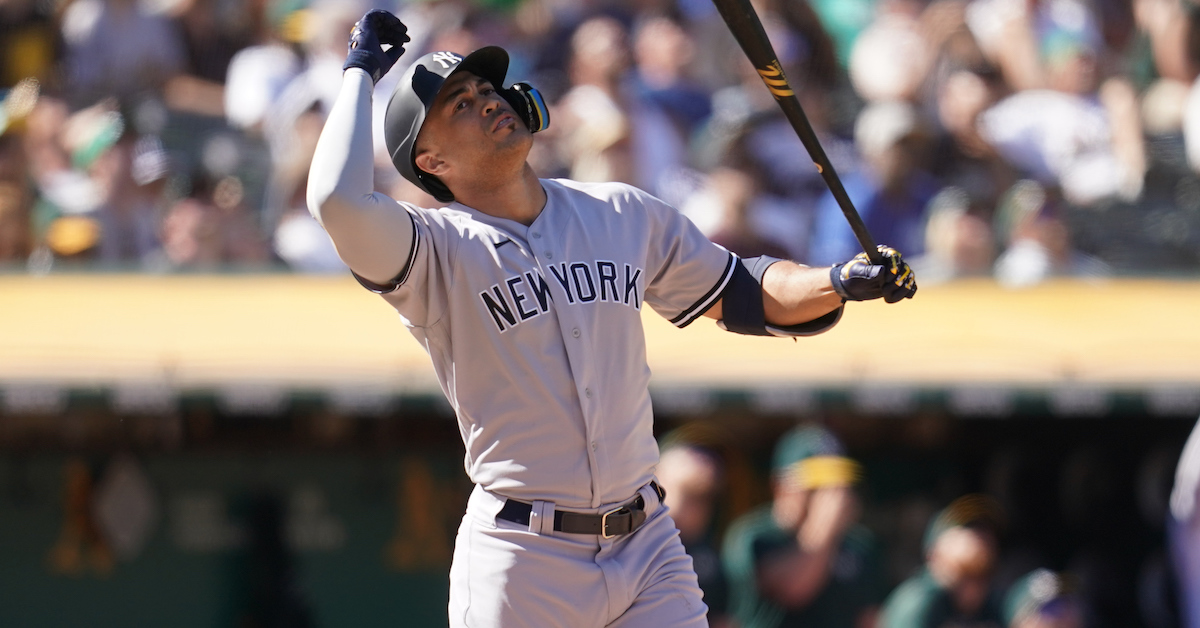
In baseball, there are two sounds that can’t quite be matched: the pop of the catcher’s glove after a sizzling fastball, and the sound of the ball being crushed by the meaty part of the barrel. No one is more familiar with the latter than Giancarlo Stanton. In the Statcast era, no hitter has consistently hit the ball as hard as he has; his otherworldly bat speed leads to some of the most impressive batted balls you’ll ever see.
Stanton’s outlier ability to hit the ball like it came out of a rocket will always raise his floor as a hitter compared to the average player. If you hit the ball like he does, even pounding it on the ground isn’t a huge concern. That doesn’t mean Stanton is impervious, however. You can’t post an exit velocity if you swing through the ball, and if he were to start making less contact, it would be a problem. In 2022, Stanton’s hit tool looked closer to that of Joey Gallo than Aaron Judge, which led to his worst full season in pinstripes by wRC+, and perhaps since his rookie year all the way back in 2010. His .211 batting average and .293 on-base percentage were both more than 50 points off his career marks. And while that decline could be partially attributed to Stanton entering his mid-30s, that’s not the only factor at play here.
Stanton’s season was marred by injury. He constantly dealt with lower leg injuries; ankle tendinitis, a calf strain, and a bruised foot all messed with the way he interacted with the ground, and it showed at the plate. As a rotational athlete, your ability to exude force into the ground is directly tied to the stability of your lower half. When a hitter’s stride foot lands, it sends energy into the ground that shoots back up for the lower half to absorb. If you stomp on the ground, there is a wave of energy that recoils through your legs and hips that you must control if you want to transfer that energy into your swing. Any hitter’s ability to do this would be disrupted by a single lower leg injury. That only worsens when you deal with injuries on both sides of your body like Stanton did, which can lead to multiple energy leakages that completely throw off your swing. For Stanton, those can be seen in the atypical movement of his feet before and during his rotation.
I’m going to show you exactly what that looked like, but first, let’s detail some of the ways Stanton struggled relative to previous seasons from a statistical perspective:
Giancarlo Stanton’s Performance in New York
Year
wRC+
AVG
Zone Contact %
wOBA v. Fastballs
PA
2018
128
.266
76.6
.415
705
2019
139
.288
77.3
.365
72
2020
143
.250
74.7
.428
94
2021
137
.273
76.5
.410
579
2022
115
.211
71.0
.320
452
Stanton’s drop in performance can be seen in his increased whiff rate in the zone and general performance against fastballs. A general rule of thumb is that great hitters crush fastballs. If a pitcher makes a mistake with a heater in the middle of the plate, they will pay the price. That becomes more difficult as velocity rises, but that’s where the great hitters set themselves apart from good hitters. Stanton has never been one to be overwhelmed by high velocity; in fact, he’s always been well above league average. But his injuries compromised his connection to the ground, and as a result, he struggled. The table below details his performance against high-velocity fastballs as a Yankee:
Stanton Against 95+ MPH Pitches
Year
Total Seen
wOBA
2018
397
0.375
2019
63
.374
2020
54
0.640
2021
393
.359
2022
403
.294
Stanton has dealt with soft tissue injuries for his entire tenure in New York, but he has still hit when he’s been on the field, including against high-velocity fastballs. But his .294 wOBA against this group of pitches was .017 points below league average and a big drop from his .359 mark in 2021, which was .049 points higher than the league average. This regression can be zoomed out on a more macro level, too. Stanton’s performance in the heart of the zone against fastballs also changed from 2021 to ’22:
Stanton Against Fastballs In Heart
Year
Overall wOBA/xwOBA
Overall K%
wOBA/xwOBA Behind in Count
K% Behind in Count
2018
.440/.460
13.5
.461/.469
28.9
2019
.261/.310
14.0
> 10 pitches
> 10 pitches
2020
.526/.547
14.7
> 10 pitches
> 10 pitches
2021
.459/.501
15.2
.493/.523
35.7
2022
.444/.382
34.1
.307/.259
56.3
SOURCE: Baseball Savant
There are a few takeaways from this. First, the drop in xwOBA in 2022 tells us Stanton’s expected stats were significantly worse than previous years on fastballs in the heart. He managed to keep his wOBA relatively high, but it seems like there was at least a little bit of luck involved. Next, when we focus in on in-zone fastballs when Stanton was behind in the count, you can see a precipitous drop from previous seasons. Like any great hitter, he would make pitchers pay for mistakes in the heart of the plate even when he was behind in the count, but that wasn’t the case last year. And while he is naturally a guess hitter, he seemed to rely too heavily on those guesses, and it resulted in many poor at-bats. A hitter of this caliber missing fastballs in the heart of the zone this much when behind in the count is a tell-tale sign that something is wrong. Those are the types of things you do when your body feels different and you can’t get to pitches you’ve always crushed.
To understand what I’m talking about, let’s run through a sequence where Stanton just looked off. This at-bat is from mid-July, after he suffered a right calf strain in late May and right around the time when he began missing time due to his left ankle. He started 2–0 on two fastballs out of the zone, then got three straight in the heart of the plate:
Pitch 3 (2–0 count)
Pitch 4 (2–1 count)
Pitch 5 (2–2 count)
This is a perfect in-game example of him letting fastball mistakes go by. One of the reasons Stanton has been such an incredible hitter for so long is that he creates his bat speed with minimal movement; his swing is shockingly quiet for somebody so large. On his two swings in advantage counts, his feet are dancing, especially in the first. He has a natural scissor kick from a closed stride, but it looks like he is losing grip on the ground before his swing gets going. Every hitter guesses or cheats at some point in an at-bat, but if they’re wrong, they can usually fight off a center-cut pitch with two strikes. Despite another fastball in the heart of the plate, Stanton couldn’t get a swing off. When your lower half isn’t properly connected to the ground, it can be difficult to rotate! As he took the pitch down the plate, you can see him enter extreme ankle eversion (ankle collapses inwards). Stand up and try to take a swing like that. Not so comfortable, right?
To illustrate that point further, here are a few swings from earlier in the season when Stanton’s feet are near neutral through the entire swing.
May 12
May 16
May 21
Each of these swings resulted in batted balls with exit velocities over 114 mph, a typical range for Stanton. But more importantly, his movements were quiet from his knees down. Relative to the swings against Cincinnati, there is no exaggeration of movement in any one part of his lower legs. In his home run swing against Dylan Cease, he uses his typical toe tap on his front foot and subtle scissor kick in the back foot to stay closed. There is no back foot slide like in July. These are fully healthy swings where Stanton maintains his connection to the ground from the beginning of rotation through contact.
Unfortunately for him, the compensations he showed in July only got worse through the end of the year.
August 29
September 24
October 1
From August on, Stanton was healthy enough to be on the field as other Yankees hitters faced injuries of their own, but he was clearly not close to 100%. These three swings can either be tied to his injured left ankle being unable to stay connected to the ground, or to his back foot not being strong enough to compensate for the energy leakage in his lead foot/ankle. In the first swing, his back leg slides way out because it’s attempting to do all the work for his body. The second swing is weeks later; he made an adjustment but still leaked into the same early ankle eversion in his back leg that we saw in July. It’s not impossible to hit like this, but when you’re struggling with stabilization, it’s not ideal.
His swing in early August is the most extreme example of how early ankle eversion can impact your lower half. It caused him to lose his back leg entirely, along with his posture. Those movements cut off his swing path, leading to his barrel being unable to cover the outer half. If you go back to Stanton’s swings from earlier in the year, you can see the best ones all come with athletic, straight posture. He’s a big dude, and to have success, he needs a stable base to control his body. This is obvious for any athlete, but as players age and lose a little bit of baseball skill, health and body control become more and more important. I’m not necessarily saying Stanton is losing skill; his first two months show that he seems to be okay. But he might be entering a stage of his career where he has less room for error and injuries like this compromise his skills and expose the biggest hole in his profile: swing and miss. I’m sure Stanton will be conscious of this heading into 2023.
Injuries have plagued Stanton for a while now, but as he heads into his mid-30s, health is more important than it’s ever been. His swing needs to stay quiet to make the most of his outlier strength. None of these injuries were major long-term concerns, but they were enough to compromise his swing and performance. Assuming he enters 2023 fully recovered from these issues, there is no question in my mind he still has the skills to deliver a 130–140 wRC+ season each year. But he will need to be conscious of how any injury impacts his swing as he enters the latter half of his career.
Third basemen have been underrepresented within the Hall of Fame since the institution’s inception, but one of the greats finally gained entry last week, when the BBWAA electedScott Rolen in his sixth year of eligibility. Four days before the Hall called Rolen’s name, the baseball world lost another great third baseman when Sal Bando died at the age of 78 due to cancer. With better luck and timing, Bando might have been enshrined as well, with his passing felt far beyond Oakland and Milwaukee, the two cities where he spent his 16-year major league career.
Plenty of onlookers and even somevoters had a hard time wrapping their heads around the election of Rolen, a great two-way third baseman whose all-around excellence — power, patience, elite defense, good baserunning — and stardom for two Cardinals pennant winners (one a champion) somehow wasn’t enough for those who expected him to measure up to Mike Schmidt, his predecessor in Philadelphia. Or Chipper Jones, his longer-lasting contemporary. Or… Don Mattingly or even Mark Gracebecause, uh, reasons. To them the notion of Bando as a Hall of Famer might seem even more unthinkable, but then they’d merely have a lot in common with the crusty scribes of four or five decades ago who helped to give Hall voting its bad name.
Bando spent 16 years in the majors (1966-81) with the A’s and Brewers, making four All-Star teams while most notably serving as the team captain and regular third baseman for an Oakland powerhouse that won five straight AL West titles from 1971-75 and three straight World Series from ’72 to ’74. An intense competitor with a high baseball IQ and a quiet lead-by-example style, he didn’t have quite the popularity or flair of teammates Reggie Jackson, Catfish Hunter, or Vida Blue, but within the green-and-gold’s three-ring circus, he had those stars’ respect. “Sal Bando was the godfather. Capo di capo. Boss of all bosses on the Oakland A’s,” wrote Jackson in his 1984 autobiography. “We all had our roles, we all contributed, but Sal was the leader and everyone knew it.” Read the rest of this entry »