Archive for Teams

Austin Meadows Is Figuring Things Out Again

I guess if you’re a hitter, there are some pitchers you just see well. Maybe you aren’t fooled by their signature breaking ball or their arm slot is one you happen to be comfortable with. In the case of Austin Meadows, maybe he was able to homer twice in as many at-bats against Angels reliever Ben Rowen on Tuesday because he just likes facing submarine-tossing right handers. Then again, maybe it’s just because Rowen threw him two pitches that looked like this:

A couple of pitches like those can turn a hitter’s night around quickly; for Meadows, it turned an 0-for-3 evening entering the seventh inning into his best game of the year. Even before those two at-bats, though, he had already been having a sneaky-good season. His .208/.323/.462 batting line through 127 plate appearances amounts to a 127 wRC+; he has seven home runs. If you look at his Statcast metrics, he’s been even better. Meadows is in the 86th percentile in xwOBA, despite clocking in at just the 69th percentile in wOBA.

Considering the way Meadows performed last year, seeing those numbers has to be a huge relief for Tampa Bay. After breaking out in his first full season with the Rays to the tune of a 143 wRC+ and 4.1 WAR in 2019, Meadows was below replacement level last year, hitting just .205/.296/.371 with four homers, for a wRC+ of 87 in 152 plate appearances. And while there were inherent sample size issues for everyone in 2020, nothing really suggested he was simply getting unlucky. His strikeout rate climbed more than 10 points over the previous season, his ISO dropped by more than 100 points, and he plummeted into single-digit percentile rankings in xwOBA, xBA and xSLG. There were several possible explanations for his struggles — lingering effects from his bout with COVID-19, an oblique injury that ended his season prematurely, the general upheaval to daily routines caused by the pandemic — but there was still uncertainty surrounding what he might contribute in 2021. Read the rest of this entry »

Daily Prospect Notes: 5/6/21

These are notes on prospects from lead prospect analyst Eric Longenhagen. Read previous installments here.

Brandon Valenzuela, C, San Diego Padres
Level & Affiliate: Low-A Lake Elsinore   Age: 20   Org Rank: tbd   FV: 40
Line: 2-for-3, 2 BB

Notes
Valenzuela was in the honorable mentions section of last year’s Padres list as a notable teenage follow due to his athleticism and physique, both of which are uncommon for a catcher. He’s off to a strong start at Low-A Lake Elsinore with three hits (one a homer), four walks and no strikeouts in his first two games. Valenzuela switch-hits, he tracks pitches well, and the bat-to-ball and strike zone feel pieces were both in place already throughout 2019, but he’s swinging with a little more explosion now. Well-built players with a foundation of skills rather than tools are often a threat to breakout as those more overt physical tools come with maturity, and we may be seeing the early stages of that here.

Jose Salvador, LHP, Los Angeles Angels
Level & Affiliate: Low-A Inland Empire  Age: 21   Org Rank: tbd   FV: 35+
Line: 4.1 IP (relief), 1 H, 1 BB, 1 R, 12 K Read the rest of this entry »


José Iglesias Swings Too Much. Or Too Little. It’s Complicated.

There’s no one way to hit well, but there is one constant in hitting: batters swing too often. The intuition behind that fact isn’t hard to get to: if you swing at a pitch outside the zone, you’re taking a ball and turning it into weak contact (it’s hard to hit pitches outside the zone with authority) or a strike — that’s bad! If you swing at a pitch in the zone, you’re turning a strike into either a strike (if you miss) or contact. Swinging is so bad outside of the zone that it overwhelms the advantages of hacking in it.

I don’t mean to imply that this should extend to logical extremes — you can’t literally never swing — but the numbers are clear. In 2020, batters were worth 3,030 runs below average when swinging. They added the same amount when they didn’t swing. This isn’t a fluke: batters have already added 1,350 runs relative to average by taking pitches this year — you guessed it, they’ve cost themselves as much by swinging. In every full season since the advent of pitch tracking in 2008, swings have cost offenses at least 6,000 runs. It’s just a fact — hitters swing too frequently.

José Iglesias has probably never heard this advice. He’s in the midst of one of the swing-happiest seasons of recent memory, and he’s doing it in exactly the way that worries you — a mountain of chases. There’s just one twist — it hasn’t sunk him just yet, despite everything I said up above, and it’s fascinating seeing him survive.

The top of the chase rate leaderboard is filled with powerful hitters. Salvador Perez leads the way so far, with a 49.1% swing rate on pitches outside the zone. Luis Robert is in second. Javier Báez is in the top 10, as is Nick Castellanos. I don’t mean to say that you can’t be a good hitter when you get fooled that often — all of the batters I named are having good years. They’re producing in a particular way, though: plenty of misses, but loud contact when they do connect. Read the rest of this entry »


John Means Tested the Limits of What a No-Hitter Could Be

2021 must be the year for bizarro no-hitters. First, Joe Musgrove threw the first no-no in Padres history and was just a hit batsmen away from a perfect game. Likewise with Carlos Rodón’s no-hitter — one Roberto Pérez-sized foot away from perfection. Madison Bumgarner threw a seven-inning no-hitter that wasn’t officially a no-hitter. On Wednesday afternoon, John Means became the third pitcher to throw an official no-hitter this year, facing just 27 Mariners and coming oh so close to perfection.

A fan unfamiliar with the minutiae of the baseball rule book might wonder why Means’s dominant start wasn’t considered a perfect game. After all, he faced the minimum number of batters without allowing a walk, hit-by-pitch, or an error. For Means, his dalliance with perfection was thwarted by a wild pitch on a third strike, allowing Sam Haggerty to reach base. He was the 12th pitcher to face 27 batters in a no-hitter without throwing a perfect game. It was the first no-hitter in Major League history where the only baserunner reached on a dropped third strike.

Rule 5.05(a)(2) is an oddity that has lived on in the baseball rulebook for centuries. It’s a relic of a time when strikeout and walks didn’t exist and the batter simply had three attempts to hit the ball. After their third try, the ball was considered in play and the batter could attempt to run to first base to avoid the out. As the game evolved over time, and strikeouts were introduced, this archaic rule lived on, one that, in this author’s opinion, doesn’t really make a lot of sense in the context of the modern game.

That dropped third strike rule was the only thing separating Means from the first perfect game since Félix Hernández threw his in 2012. That it happened in the third inning made it completely innocuous during the run of play. Haggerty was thrown out attempting to steal second a few pitches later and the game moved on. Except Means retired the next 19 batters in a row and that seemingly benign event became the only blemish on his otherwise perfect afternoon. Read the rest of this entry »


The Mets Make a Mess of Their Offensive Struggles

With a revamped lineup, rotation, and front office, the Mets were supposed to rank among the NL’s top teams, ideally while offering at least somewhat less dysfunction than during the Wilpon family’s tenure as owners. Given an offense that has wheezed its way to an NL-low 3.30 runs per game as the team has stumbled to an 11-12 start, however, the Mets’ brass decided to shake things up by firing hitting coaches Chili Davis and Tom Slater after Monday night’s 6-5 loss to the Cardinals. The pair have been replaced by Hugh Quattlebaum, previously the Mets’ minor league director of hitting development, and Kevin Howard, their director of player development. You may be shocked to learn that this move did not come off smoothly.

It’s not the fault of Davis, who was in his third season as the Mets’ hitting coach, or Slater, in his fourth season as the assistant hitting coach, that key newcomers Francisco Lindor and James McCann and holdovers such as Dominic Smith and Jeff McNeil have all underperformed on the offensive side. The latter duo had previously thrived under Davis and Slater, and currently Pete Alonso and Brandon Nimmo are knocking the stuffing out of the ball. Scapegoating coaches is a time-honored tradition by struggling teams, however. If you can’t fire the players…

The timing of the dismissals was curious, to say the least. The Mets had scored 18 runs over their previous three games, two of them wild weekend wins over the Phillies, snapping out of a skid during which they had scored just seven runs over their previous five games against the Nationals and Red Sox. Read the rest of this entry »


Semantics Aside, Rays Prospect Cole Wilcox Has a New Sinker

Cole Wilcox started to say “two-seamer” when bringing up the fastball he threw at the University of Georgia. The 21-year-old Tampa Bay Rays prospect then reversed course and called it a sinker, which it really wasn’t. Featuring mostly arm-side run, the high-velocity offering got only a modicum of depth. Given the grip, that kind of came with the territory. More on that in a moment.

Wilcox was selected in the third round of the 2020 draft by San Diego, who subsequently shipped the right-hander to the Rays as part of the Blake Snell deal. Seen as a potential first-rounder last summer — signability questions caused the sophomore-eligible draftee to drop — Wilcox spent time at the Padres alternate site prior to changing organizations in December. It was there that he restructured an arsenal that now comprises a two-seamer, a slider, a changeup, and a work-in-progress four-seamer.

Which brings us to the heater he’d featured in the SEC. Regardless of how one might define it, it’s now part of his past.

“It used to be a four-seam sinker,” explained Wilcox, who is beginning the current campaign with the Low-A Charleston River Dogs. “Really, the only thing good about it was that it was hard. That’s what I threw in college, but since I’ve been in pro ball, I’ve switched to a two-seam. It gets a lot more movement, a lot more depth.” Read the rest of this entry »


Front Office Conference Call Agendas: National League

Building off of yesterday’s American League conference call agendas, let’s move on to the National League and see what’s on the docket for the teams of the senior circuit.

Arizona Diamondbacks

  • We’re over .500 and we’re banged up. This team is better than people on the outside thought. That said, I don’t think we’ll be exceptionally busy in terms of buying this summer. We’re not catching the Padres or Dodgers, and let’s not forget about the Giants. Let’s stick to the plan and just keep getting better long-term.
  • The rotation has been up-and-down, and Corbin Martin is probably the only minor league piece with a chance to contribute in that area. Let’s get some ideas going as to how we get through 162 games with depth issues in that department.
  • Let’s have some initial talks about draft strategy, as we’re picking sixth. It feels like there is a four-player tier at the top of the draft, so let’s see if there’s a tier-two player we like at six, or if we should be more creative and spread the wealth a bit.
  • The offense overall has been good, but our infield is not hitting. There aren’t any immediate moves to make, but it sure would be nice to see Seth Beer get off to a nice start to gauge whether he can get some at-bats up here as a Christian Walker replacement.
  • We love having the presence of Eduardo Escobar and Asdrúbal Cabrera, but there should be a market for both this July, and we should be listening. Let’s focus on arms in those discussions.
  • The same goes for David Peralta, even though he’s been our second best hitter and is signed for next year as well. That extra year, which is a cheap one at that ($7.5 million), should help generate some interest.

Read the rest of this entry »


I Simply Can’t Get Enough of These Absurd Mets-Phillies Games

It was the first game of the season for the Mets, played in front of an eager, raucous Philly crowd — and for the first six innings, it was a game that belonged to Jacob deGrom. He held the Phillies scoreless, striking out seven, allowing only three hits. He even helped his own cause at the plate, driving in one of the Mets’ two runs — a classically deGrom lack of run support; no wonder he had to do it himself. Even with the number of baserunners the Mets had left stranded, two felt like it could be enough. Even after deGrom left the game, Miguel Castro pitched a clean seventh.

And then came the eighth. Trevor May was on the mound. He struck out Adam Haseley. Then, on his second pitch to Brad Miller, a single. Then Andrew McCutchen drew a walk. A mound visit — it was time for concern — and then, on a pitch well outside the zone, Rhys Hoskins, too, singled. The bases were loaded, and none other than Bryce Harper was coming up to the plate.

May was done. The bleeding needed to stop immediately. So in came Aaron Loup, the veteran lefty whose control has always seemed to be extremely on or extremely off. Harper fouled off Loup’s curveball. Loup’s next pitch hit him in the shoulder. The lead was halved — and, thanks to the three-batter minimum, there was no recourse for Luis Rojas. Loup had to stay in and face J.T. Realmuto. With one more pitch, the lead evaporated. Read the rest of this entry »


Kris Bryant, High Ball Hitter

Let’s not sugarcoat it: Kris Bryant was bad last year. Sure, it was only 147 plate appearances, but the sheer broadness of his struggles made it feel longer. He set career lows in batting average, OBP, slugging percentage, walk rate, barrel rate — you name it, and there’s a good chance he fell short in it. With the Cubs in salary relief mode this offseason, there was talk of a non-tender, and it certainly wasn’t good for Bryant’s free agency hopes.

That feels like less of a worry now. Through the first month of the season, Bryant has been tremendous. April marks don’t compare well to full-season numbers, but far from continuing his swoon, he’s posting the best numbers of his career nearly across the board. He looks like an MVP candidate again, and it’s a good thing for the Cubs, who need all the offensive help they can get given how many of their regulars are struggling.

What changed? As Tom Verducci detailed, Bryant is swinging differently, and it’s paid dividends so far this year. Let’s dig into the numbers and see how that new swing (in fairness, it’s still pretty similar to the old swing) is working so well.

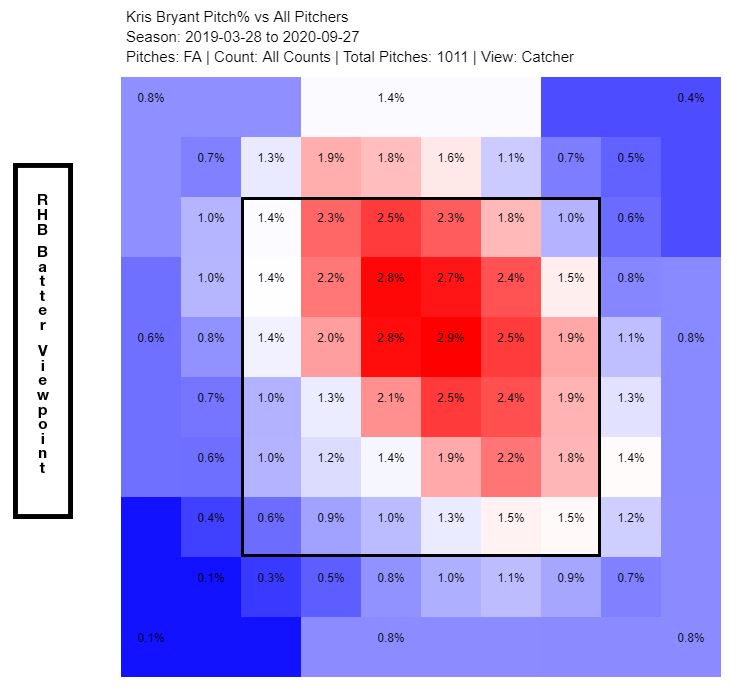
Take a look at this heatmap of the four-seam fastballs Bryant faced in 2015 and ’16:

That’s right: four-seam fastballs low in the zone. Bryant devoured those pitches en route to 14 WAR over the two years. Next, look at the four-seamers he saw in 2019 and ’20:

Read the rest of this entry »


The White Sox Just Lost Their Most Important Player

The White Sox took a giant blow Sunday when young centerfielder Luis Robert injured his right hip flexor running to first while trying to beat out a grounder to third against Cleveland. As it turns out, the injury wasn’t minor, as he was diagnosed with a Grade III strain — a complete rupture of the muscle involved — and will not be able to resume baseball activities for 12–16 weeks.

Chicago hasn’t officially ruled out Robert for the season, but there’s enough uncertainty that senior VP/general manager Rick Hahn did not give a particularly optimistic assessment of when his return could be.

“But it’s safe to say in terms of projecting his possible return, it’s too soon to know. Quite frankly, we are not going to be able to provide you with an educated projection of that for another 12 weeks or so as we see how he progresses.”

The most serious consequence of Robert’s injury is naturally a painful recovery process for last year’s AL Rookie of the Year runner-up. But the White Sox have more than 130 games to play, meaning there will also be consequences for the team and some pivotal decisions to make.

Losing Robert is particularly unwelcome for the Sox, as he represents the second serious loss at a position at which they’re not terribly deep. In an unfortunately timely look I did last month at baseball’s most irreplaceable players, the ZiPS projections pegged him as the seventh-most crucial player in the majors in terms of effect on the playoff race.

From a straight-up projection standpoint, Robert falls short of most of the names on this list. Just on the Sox, ZiPS thinks Lucas Giolito is a significantly more valuable player overall, at least when he’s not pitching in the morning. But if something should happen to Giolito, Chicago has spare arms to patch up the hole. If the team loses Robert, let’s just say ZiPS does not have a case of Leurymania or Engelalia. The race with the Twins is likely going to be a tight one, and the Royals have shown surprising spunk. The White Sox could ill afford an injury to their center fielder.

Read the rest of this entry »