Archive for Teams

Strasburg Returns to DC

As first reported by Jon Heyman of MLB Network, Stephen Strasburg has agreed on Monday afternoon to re-sign with the Washington Nationals. Strasburg’s new seven-year deal will net him $245 million, or a cool $35 million per season. The fancy new contract at least temporarily stands as the largest guaranteed payday in baseball history for a pitcher, eclipsing the $217 million the Red Sox inked with David Price after the 2015 season.

Strasburg and Anthony Rendon are players on the level that any team would have been hard-pressed to replace their production. To not sign at least one of the pair would likely be a strong enough hit to give the World Champion Nats a fairly difficult road to returning to the playoffs in 2020. Making it up in lesser deals for lesser lights has become even more difficult with players like Zack Wheeler, Mike Moustakas, and Yasmani Grandal, all players that could have conceivably helped a post-Rendonburg Nats, already signed.

At $35 million a year, unless the Nats were bluffing about only being able to sign one of their free agents, this likely closes the book on Rendon’s time in Washington. With the team about $32 million from the first luxury tax threshold, Rendon might just barely sneak in. His number would have to be a little less than $30 million, as player benefits also count towards the luxury tax payroll. Unless the team clears payroll elsewhere, they’d have to get extremely creative in order to significantly improve first base, the bullpen, and possibly add another starter at the back of the rotation. It could very likely make them barrel through the $228 million threshold, something they may want to avoid with Adam Eaton, Sean Doolittle, and Max Scherzer nearing free agency and Juan Soto hitting arbitration soon. If the team could truly only sign one of the players, I think Strasburg is the right choice.

Carter Kieboom is unlikely to replace Rendon’s production in 2020 or 2021, but he’s a significant prospect who could become a legitimate plus at the hot corner fairly quickly. I don’t think the upside of whoever would have replaced Strasburg without an additional signing (Austin Voth or Joe Ross) matches what the Nats have in Kieboom. Read the rest of this entry »

A Strong Dodgers Season Again Ends on Sour Note

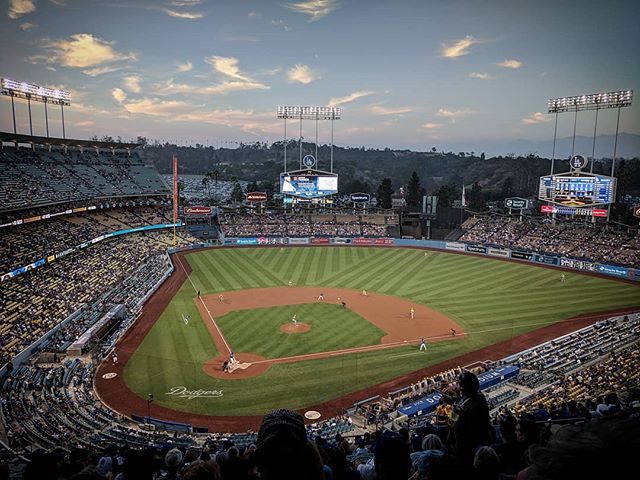
The Dodgers continued to challenge the idea of what a “successful” baseball season is. (Photo: Brendan C)

“This is an unfair thing about war: victory is claimed by all, failure to one alone.” – Tacitus

Fair or not, among the general public, success in baseball means winning the World Series. The baseball-cultural definitions of dynasty and success have not evolved as the playoff system has grown larger and less designed to crown the best team. After seven consecutive division titles and no World Series championships, the Dodgers are perceived in large swathes of baseball fandom as being failures. As baseball is no fairer than the rest of life, the fact that the playoff system will naturally create a lot more failures than successes hasn’t shielded the team from criticism.

So after winning 106 games, the Dodgers find themselves in the awkward position of having to explain to fans that there’s no dark, underlying reason that caused them to win only two games in one particular five-game stretch in early October. There are no more key teaching moments in the NLDS loss any more than there were in any of the other 30 five-game stretches in 2019 during which the Dodgers won two or fewer games. Read the rest of this entry »


Rangers Sign Lyles, Still Need Bats

The three pitching lines below all belong to Jordan Lyles, who just signed with the Texas Rangers for two years and $16 million:

Getting Better All The Time
Years IP K% BB% wOBA ERA FIP
2011-19 909.2 17.4% 7.9% .340 5.11 4.52
2018-19 228.2 23.7% 8.6% .316 4.13 4.43
2019, MIL 58.2 23.5% 9.2% .271 2.45 4.42

Now, maybe you’re not surprised that Lyles, 29, signed for $8 million a year. In our Top 50 Free Agents post, where we ranked Lyles 45th, you predicted two years and $12 million for the righty. $12 million isn’t $16 million, to be sure, but it’s in the ballpark. So perhaps you’re not surprised at this deal. I’m a little surprised, though. That’s because I think Lyles’ 2018-19 performance is far more likely to be indicative of his 2020-21 performance than his excellent run for the Brewers at then end of last season, and thought most teams would agree and offer him an accordingly modest deal this winter. The Texas Rangers, apparently, had other plans. Read the rest of this entry »


You Pick: Anthony Rendon or Stephen Strasburg?

The Nationals just won the World Series thanks in large part thanks to stars Anthony Rendon and Stephen Strasburg. The pair were great for Washington in the regular season, combining for 13 wins; in the playoffs, Rendon posted an excellent 146 wRC+ and Strasburg became a playoff immortal.

The pair also earned around $54 million last season, with $10 million of that amount deferred as part of Strasburg’s contract. With both players now free agents, there are sizable holes for the Nationals to fill, both on the field and in their payroll. After running $200 million payrolls in each of the last three seasons, the club has only $132 million in salaries committed for next season, including arbitration estimates and minimum salaried players. When I looked at the teams with the most money to spend next season, I noted the $80 million gap between the Nationals’ 2020 commitments and 2019 payroll, and had this to say about their potential to spend:

The Nationals have a ton of money to spend coming off a World Series victory, and if they are going to get back to the playoffs, they will need to. If the team wanted, they could bring back both Anthony Rendon and Stephen Strasburg and because they stayed under the competitive balance tax amount last season, the penalties for going over next year are lessened. A big spend by the Nationals seems likely, though it won’t do much to change spending overall given where they were last year.

Read the rest of this entry »


JAWS and the 2020 Hall of Fame Ballot: Billy Wagner

The following article is part of Jay Jaffe’s ongoing look at the candidates on the BBWAA 2020 Hall of Fame ballot. Originally written for the 2016 election at SI.com, it has been updated to reflect recent voting results as well as additional research. For a detailed introduction to this year’s ballot, and other candidates in the series, use the tool above; an introduction to JAWS can be found here. For a tentative schedule and a chance to fill out a Hall of Fame ballot for our crowdsourcing project, see here. All WAR figures refer to the Baseball-Reference version unless otherwise indicated.

Billy Wagner was the ultimate underdog. Undersized and from both a broken home and an impoverished rural background, he channeled his frustrations into throwing incredibly hard — with his left hand, despite being a natural righty, for he broke his right arm twice as a child. Scouts overlooked him because he wasn’t anywhere close to six feet tall, but they couldn’t disregard his dominance over collegiate hitters using a mid-90s fastball. The Astros made him a first-round pick, and once he was converted to a relief role, his velocity went even higher.

Thanks to outstanding lower-body strength, coordination, and extraordinary range of motion, the 5-foot-10 Wagner was able to reach 100 mph with consistency — 159 times in 2003, according to The Bill James Handbook. Using a pitch learned from teammate Brad Lidge, he kept blowing the ball by hitters into his late 30s to such an extent that he owns the record for the highest strikeout rate of any pitcher with at least 800 innings. He was still dominant when he walked away from the game following the 2010 season, fresh off posting a career-best ERA.

Lacking the longevity of Mariano Rivera or Trevor Hoffman, Wagner never set any saves records or even led his league once, and his innings total is well below those of every enshrined reliever. Hoffman’s status as the former all-time saves leader helped him get elected in 2018, but Wagner, who created similar value in his career, has major hurdles to surmount given that he’s maxed out at 16.7% in four years on the ballot, that after receiving a 5.6% jump in this past cycle. Nonetheless, his advantages over Hoffman — and virtually every other reliever in history when it comes to rate stats — provide a compelling reason to study his career more closely. Given how far he’s come, who wants to bet against Billy Wags?

2020 BBWAA Candidate: Billy Wagner
Pitcher Career Peak JAWS WPA WPA/LI IP SV ERA ERA+
Billy Wagner 27.7 19.8 23.7 29.1 17.9 903 422 2.31 187
Avg HOF RP 39.1 26.0 32.5 30.1 20.0
SOURCE: Baseball-Reference

Read the rest of this entry »


Sunday Notes: Dayton Moore’s Royals Aren’t The Flintstones Anymore

The Royals aren’t known for their analytics department. They have one, of course. It’s not as though the organization is the Flintstones while everyone else is the Jetsons. That said, they’re still viewed as being old-school. In the eyes of many, scouting still rules the roost in Kansas City.

Just how true is that perception? According to the team’s longtime general manager, it’s far less accurate than it once was. Which isn’t to say that Dayton Moore has cast aside his roots in an attempt to become something he’s not. What he’s done is adapt to the changing times.

“My background is my background,” Moore told me at last month’s GM Meetings. “I’m not going to be ashamed of that. I grew up in a very traditional way. I grew up as a coach. I grew up as a scout. But the game has changed since I came to Kansas City in 2006.”

Moore remembers meeting with, among others, saber-smart baseball scribe Bradford Doolittle. That “created a pathway to us developing an understanding of analytics.” He went on to hire Michael Groopman as a baseball operations assistant in 2008, then promote him to Director of Baseball Operations/Analytics in 2015. In Moore’s words, Groopman “came in and built our analytics program.” Read the rest of this entry »


2020 ZiPS Projections: Colorado Rockies

After having typically appeared in the hallowed pages of Baseball Think Factory, Dan Szymborski’s ZiPS projections have now been released at FanGraphs for eight years. The exercise continues this offseason. Below are the projections for the Colorado Rockies.

Batters

The 2019 Colorado Rockies ranked fourth in the National League in runs scored, which is actually a rather bleak ranking for a team that plays at Coors Field. “OMGTEHCOORSHANGOVER” has become a convenient excuse for the club’s struggles — at least when they accidentally suggest they’re aware there are struggles — but it’s become a bit of a crutch when talking about the team. There appears to be an effect, but a minor one, unlikely to be worth more than three-to-five points of OPS for Rockies hitters. ZiPS doesn’t take into consideration any “Coors hangover,” and if this were a big deal, then ZiPS would be systematically too optimistic on players going to Coors and too pessimistic on players leaving. But it is not.

I feel like we’ve been over this story a billion times, but very little has changed in Colorado. The team’s offense is largely reliant on having two-to-three players in any given season being MVP candidates, with Nolan Arenado and Trevor Story likely being those two players again in 2020. Ryan McMahon and David Dahl both receive projections that are kinda disappointing, but it’s hard to forget that Dahl’s injury history is long and the Rockies spent two prime development years jerking McMahon around. Read the rest of this entry »


Twins, Pineda Run It Back

It’s been a fast offseason for mid-tier pitchers, and that trajectory continued on Thursday with Michael Pineda signing a two-year contract to return to Minnesota. The actual value of the deal will come out to $17.6 million after pro-rating down the 2020 salary due to his suspension:

The weirdness of signing a suspended player and pro-rating salary aside, this looks like a contender for the most team-friendly contract so far this offseason. Cole Hamels, who Kiley listed exactly one slot ahead of Pineda, is going to make more in 2020 than Pineda will over the next two years, and he was arguably worse than Pineda in 2019.

It’s almost beside the point to explain why this signing makes sense for the Twins, but let’s go through the motions quickly. The team’s winning recipe in 2019 was a combination of home runs at the plate and steady starters on the mound. José Berríos and Jake Odorizzi both had standout years, but the rotation was solid 1 through 5: Read the rest of this entry »


JAWS and the 2020 Hall of Fame Ballot: Bobby Abreu

The following article is part of Jay Jaffe’s ongoing look at the candidates on the BBWAA 2020 Hall of Fame ballot. For a detailed introduction to this year’s ballot, and other candidates in the series, use the tool above; an introduction to JAWS can be found here. For a tentative schedule and a chance to fill out a Hall of Fame ballot for our crowdsourcing project, see here. All WAR figures refer to the Baseball-Reference version unless otherwise indicated.

Bobby Abreu could do just about everything. A five-tool player with dazzling speed, a sweet left-handed stroke, and enough power to win a Home Run Derby, he was also one of the game’s most patient, disciplined hitters, able to wear down a pitcher and unafraid to hit with two strikes. While routinely reaching traditional seasonal plateaus — a .300 batting average (six times), 20 homers (nine times), 30 steals (six times), 100 runs scored and batted in (eight times apiece) — he was nonetheless a stathead favorite for his ability to take a walk (100 or more eight years in a row) and his high on-base percentages (.400 or better eight times). And he was durable, playing 151 games or more in 13 straight seasons. “To me, Bobby’s Tony Gwynn with power,” said Phillies hitting coach Hal McRae in 1999.

“Bobby was way ahead of his time [with] regards to working pitchers,” said his former manager Larry Bowa when presenting him for induction into the Phillies Wall of Fame earlier this year. “In an era when guys were swinging for the fences, Bobby never strayed from his game. Because of his speed, a walk would turn into a double. He was cool under pressure, and always in control of his at-bats. He was the best combination of power, speed, and patience at the plate.” Read the rest of this entry »


Rays, Padres Act to Type in Tommy Pham Trade

It’s a day ending in “Y,” so the San Diego Padres have made another trade involving talented outfielders. This time, it’s a big one: Tommy Pham and Jake Cronenworth will be playing in San Diego next year, with Hunter Renfroe, Xavier Edwards, and reportedly another prospect going to the Rays in exchange.

There’s a lot to unpack in this trade, so let’s take it in sections. First: what are the Rays doing? One option, as always, is that they’re one step ahead of the competition. Trading with the Rays is hazardous for executives’ health. They’re liable to turn a pile of straw into a 3-WAR outfielder, and get you to chip in Shane Baz while you’re at it.

Pham himself was one of these trades a little over a year ago. The Rays traded a shiny marble, two bright red shoelaces, Genesis Cabrera, Justin Williams, and Roel Ramirez to the Cardinals for Pham at the 2018 trade deadline. Pham promptly caught fire, batting .343/.448/.622 through the rest of 2018 before adding a 121 wRC+ 2019. His 3.3 WAR might look low for that offensive line, but it’s largely due to 92 plate appearances at designated hitter, which lowered his defensive value (though Statcast didn’t like his outfield defense in 2019).

When the Rays trade a 31-year-old outfielder for a 27-year-old outfielder, it’s easy to read it as them simply trying to outmaneuver the Padres. But there’s one major complication: salary. Pham is in his second year of arbitration, and he won his case against the Rays last year, securing a $4.1 million salary for 2019. MLB Trade Rumors projects him for $8.6 million in arbitration this year, which would have made him the third-highest-paid Ray, behind only Charlie Morton and Kevin Kiermaier. Read the rest of this entry »