Archive for Teams

Christian Walker is Making the Most of His Opportunities

Christian Walker has always been able to hit well. While he was coming up through the Orioles organization, he compiled a 124 wRC+ across five minor league seasons. Unfortunately, Chris Davis and his massive contract blocked Walker from breaking into the big leagues with Baltimore and they designated him for assignment after the 2016 season. He bounced around that offseason and was claimed by two other teams before finally latching on with Arizona, and he’s continued to hit since joining the Diamondbacks organization. He compiled a 142 wRC+ across two seasons in Triple-A, but was again blocked by Paul Goldschmidt at the major league level.

By 2018, Walker had managed to accumulate just under 100 plate appearances in the majors but couldn’t break through. The dreaded “Quad-A” label was looming. Then the Diamondbacks traded away Goldschmidt this offseason, and suddenly Walker had a path towards regular playing time. He earned a part-time job out of spring training that quickly turned into a full-time job after Jake Lamb injured himself five games into the season. Walker seized the opportunity. He collected seven hits in his first 15 at-bats and continued to produce well through the first month of the season. In April, he collected 17 extra-base hits while posting a 152 wRC+.

Despite the hot start to the season, there were a few warning signs that his performance wasn’t sustainable. He struck out almost 30% of the time in April, and his BABIP was elevated at .393. Unsurprisingly, he came back down to earth in May.
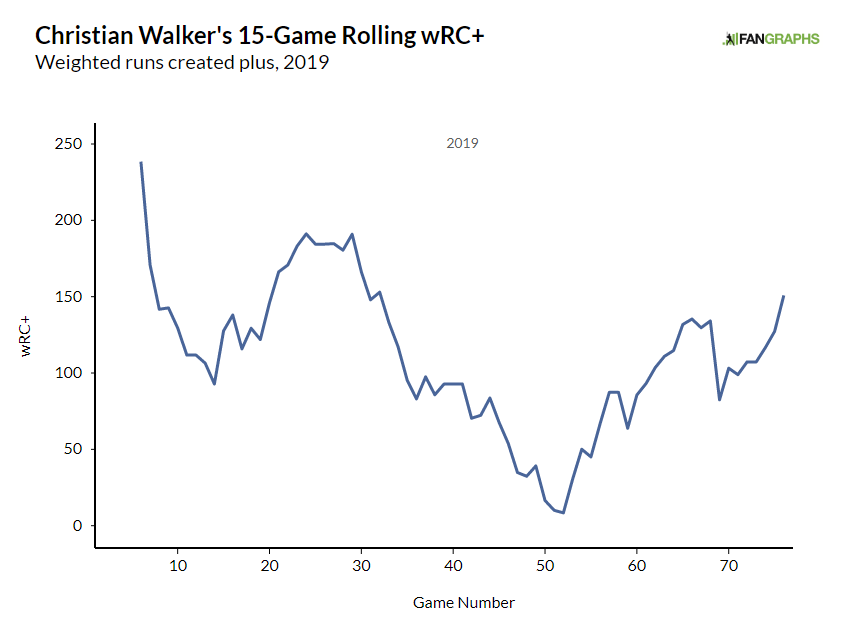
It’s not as if Walker’s success in April was completely BABIP driven. His average exit velocity ranks in the 83rd percentile in the majors and he’s making hard contact nearly half the time he puts the ball in play. His expected wOBA on contact ranks 28th in the majors. Read the rest of this entry »

Edgar: An Autobiography is Yet Another Hit for Martinez

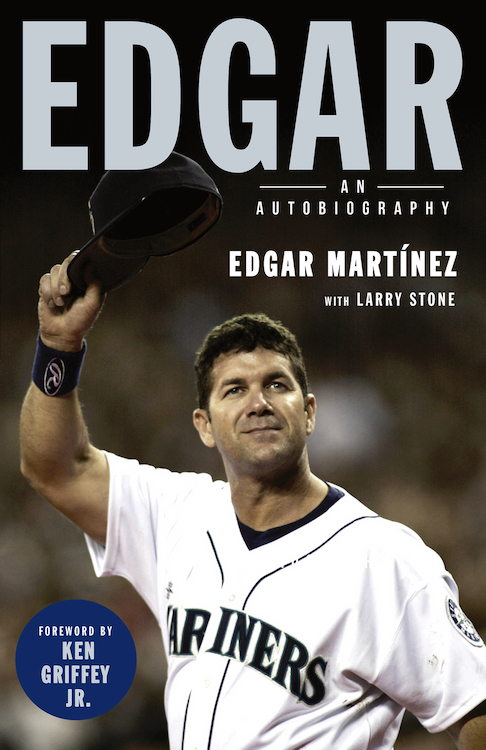
Edgar Martinez’s story — at least as recounted in Edgar: An Autobiography, written with veteran Seattle sports scribe Larry Stone and published by Triumph Books earlier this month — reads like something of a fairy tale. Born in New York City in 1963, he moved to Puerto Rico when his parents split, and was raised in the Maguayo neighborhood of Dorado by his maternal grandparents, whom he chose to stay with at age 11, even after his parents reconciled and returned to New York. Though his love for the game was kindled by the heroics of Roberto Clemente in the 1971 World Series, and his development stoked by his relationship with cousin Carmelo Martinez, who spent nine years in the majors (1983-91), he didn’t sign a professional contract until just before his 20th birthday; putting aside $4-an-hour work on an assembly line, he received just a $4,000 bonus from the Mariners. Despite hitting a homerless .173 in his first professional season (1983), and battling an eye condition called strabismus, in which his right eye drifted out of alignment, the Mariners stuck with him.

While Martinez debuted in the majors in 1987, he spent three seasons trying to surmount the Mariners’ internal competition at third base, wound up shuttling back and forth to Triple-A Calgary, and didn’t secure a full-time job until 1990, his age-27 season. Though he won a batting title in 1992, a slew of injuries — shoulder, hamstring, wrist — threatened to derail his career until the Mariners convinced him to become a full-time designated hitter. Once he did, he became one of the AL’s most dominant players; from 1995-2001, he hit .329/.446/.574 for a 162 wRC+ (third in the majors) and 39.9 WAR (seventh, less than one win behind teammate Ken Griffey Jr.).

His heroics not only helped the Mariners reach the playoffs for the first time in 1995 (a year in which he also won his second batting title), but he became a one-man wrecking crew in that year’s Division Series against the Yankees, capping his .571/.667/1.000 performance with a series-winning double in Game 5 that basically saved baseball in Seattle. Remaining with the team for the duration of his career, which lasted through 2004 and included three other postseason appearances, further endeared him to a city that watched Griffey and fellow Mariners Randy Johnson and Alex Rodriguez depart for greener pastures. When he retired, Major League Baseball renamed its annual award for the best designated hitter in his honor. Earlier this year, in his 10th and final cycle of eligibility, he was elected to the Hall of Fame, that after more than tripling his support from just four years earlier.

Martinez’s arc seems so improbable, and yet it’s all true. Over the course of Edgar’s 352 pages, Martinez candidly details the highlights and lowlights of his career, the big decisions, unlikely events, and tactics that helped him surmount so many obstacles. Stone provides testimony from his former managers, coaches, and teammates in the form of sidebars that offer additional perspectives and enhance the narrative.

Read the rest of this entry »


The Cardinals Lose Their Closer

The St. Louis Cardinals announced Monday afternoon that their closer, Jordan Hicks, has torn the ulnar collateral ligament in his right elbow. The news didn’t immediately come with a prognosis, a course of treatment, or a timetable for his return, some of which we’ll likely find out in the coming days. With a healthy elbow being a highly useful part of the body for a pitcher to have, there certainly isn’t much in the way of optimism that can emerge from this development.

While the news about Hicks has not been highly specific as of yet, I have not seen the word “partial” used to describe the tear. Assuming, for the sake of pessimism, that Hicks’s injury will require Tommy John surgery, the typical recovery time quoted these days is 12-15 months for a pitcher. That quite obviously would put 2019 out of the question and, given that we’re almost into July, would also seriously threaten all of 2020.

A lot of the initial buzz surrounding Hicks’ injury focused on his status as the hardest-throwing pitcher in baseball today, with fingers pointed at his velocity as a key factor in his injury. According to Statcast, of the 100 hardest-thrown pitches in 2019, 94 were thrown by Hicks. The only pitchers to intrude on this list are Tayron Guerrero (Nos. 24, 31, 54, and 70), Aroldis Chapman (No. 87), and Thyago Vieira (No. 61). 45% of all 100 mph pitches this year were thrown by Hicks. The fastball cred is real. Read the rest of this entry »


Shelby Miller, Daniel Norris, and Tyler Olson on How They Cultivated Their Curveballs

Pitchers learn and develop different pitches, and they do so at varying stages of their lives. It might be a curveball in high school, a cutter in college, or a changeup in A-ball. Sometimes the addition or refinement is a natural progression — graduating from Pitching 101 to advanced course work — and often it’s a matter of necessity. In order to get hitters out as the quality of competition improves, a pitcher needs to optimize his repertoire.

In this installment of the series, we’ll hear from three pitchers — Shelby Miller, Daniel Norris, Tyler Olson — on how they learned and developed their curveballs.

———

Shelby Miller, Texas Rangers

“I probably didn’t start throwing a curveball until high school. Growing up, my dad always told me they’re not good for your arm — not at an early age — and that changeups are better. But then there was this guy named Jerry Don Gleaton in my hometown — he played professionally, and was a baseball coach at Howard Payne University and I worked with him. He taught me some mechanical things, showed me some grips, and it kind of went from there. Read the rest of this entry »


Brandon Woodruff Rebuilt Himself as a Starter

Brandon Woodruff did everything he could for the Brewers in 2017 and 2018. When the rotation needed reinforcements at the end of 2017, he started eight games. When the team needed relief arms in 2018, he filled whatever innings they needed — 10 of his 15 relief appearances went more than an inning, and he contributed four spot starts when the Brewers needed an occasional extra starter. This year, the team needs a starter again, and Woodruff has outdone himself. In 16 starts, he’s gone from solid bullpen arm to the best starter on a playoff team. If the team needs a pitcher to start an elimination game, Woodruff is probably the man for the job.

If I had been asked to make a prediction about Woodruff before the season, I think I would have landed somewhere near our Depth Charts projections — 23 starts, a 4.30 ERA and FIP, and peripherals that looked worse than his 2018 relief turn, when he struck out 26.7% of batters he faced and walked 8%. Pitchers who switch from relieving to starting tend to have worse rate stats across the board, and nothing about Woodruff screamed exception. Instead, he’s improved in essentially every category. He’s striking out 29.6% of the batters he faces, and walking only 6.5%. His FIP is 0.23 lower than it was last year. Heck, he’s gained fastball velocity, something you’re not supposed to do when throwing more pitches per game.

Luckily for the purposes of our analysis, however, he’s also made some changes in approach that we can pore over. If all there was to Woodruff’s improvement was a tick on his fastball, there wouldn’t be much to say. But that’s not how Brandon Woodruff’s season has gone. He has overhauled his arsenal and approach in ways that look well thought-out and sustainable to me. Read the rest of this entry »


The Cy Young Award Is Attainable for Jose Berrios

The last two seasons, Jose Berrios has been on the periphery when it comes to considering the best pitchers in baseball. In 2017 and 2018, he put up three-win campaigns and his 6.1 WAR ranked 22nd among pitchers, just behind Blake Snell, Kyle Freeland, and Mike Clevenger, and just ahead of Jon Gray, Charlie Morton, and Kyle Hendricks. It’s a good group to be associated with, and a few of those players have had great seasons, but with Berrios putting up two similar seasons, he’s not viewed in the same way as Snell and he hasn’t been quite good enough to move himself into the top 10 or 15 pitchers in the game. That’s changed this season, as Berrios has been more aggressive, reduced his walk rate, and become more effective against lefties, all of which has resulted in a season that’s put him firmly among the top 10 pitchers in the game.

After an uneven debut season in 2016 at just 22 years of age, Berrios registered solid efforts in 2017 and 2018. Here’s how those seasons compare to what Berrios has been able to do this year:

Jose Berrios’ Step Forward
IP K% BB% ERA FIP WAR WAR/200
2017-18 338 24.1% 7.7% 3.86 3.88 6.1 3.6
2019 104.2 22.9% 4.7% 2.84 3.54 2.8 4.8

The big positive change is the reduction in his walk rate. Berrios has achieved that number mostly by pitching more in the zone. He’s sacrificed his strikeout rate slightly, though he’s made up for that loss by doubling his infield fly rate. Berrios’ FIP this season might not seem drastically altered from the previous two seasons, but with the change in run environment, the three-tenths difference means more than a win over the course of a full season. Berrios did suffer a blister issue in his last start against Kansas City, but currently remains on schedule to start later this week with hopes that the issue is a minor one. Read the rest of this entry »


The Mariners’ Tom Murphy Is Making The Most Of It

Less than a year ago, Tom Murphy was catching in Triple-A Albuquerque, batting eighth for the Isotopes and wrapping up a fourth consecutive season in which he failed to register 100 big-league plate appearances. Now platooning with Omar Narvaez in Seattle, Murphy’s .366 wOBA is sixth among big-league catchers with as many trips to the plate, and he has past the century mark on that count two weeks before the 4th of July. Since June 1, he’s hit five home runs for the Mariners, matching his career high for a single season in a month that’s not over yet.

To hear Murphy tell it, his sustained success in the major leagues this year — he’s always been a good Triple-A hitter — has been driven by three major adjustments, made meaningful by the opportunity he’s getting to play so often. The first is to the pitches he’s hunting. The second is to the way his upper body helps him get to those pitches in time to make contact. The final adjustment is to the physical foundation that lets him do damage when he makes contact.

During his first four seasons in the big leagues, Murphy swung at 74% of the fastballs he saw up in the zone (64 of 86), which was about the same rate at which he swung at fastballs in the middle and bottom thirds, too. (He swung at 70% of those pitches, or 116 of 165 he saw.) This year, by contrast, he’s swinging at pitches in the top third nearly 81% of the time (34 of 42 pitches), and pitches in the bottom two-thirds just 64% of the time (63 of 99). That’s the first adjustment.

But just swinging at different pitches won’t make much of a difference if you can’t hit those pitches when you try to. Murphy told me that this off-season, he switched from taking pitches off a tee to training off an Iron Mike pitching machine almost exclusively. The resultant change in training velocity — from literally zero to something more closely approximating game speed — exposed what, to Murphy, had become an unhelpful amount of “slack” in his upper body. Read the rest of this entry »


Justin Verlander Is Dominating Despite All of the Dingers

It’s been a weird season thus far for Justin Verlander. On the one hand, the 36-year-old righty has enjoyed dominant stretches and generally pitched well enough to put himself in the conversation for another All-Star appearance (perhaps even a start) and that elusive second Cy Young Award, all while advancing his case for eventual election to the Hall of Fame. On the other hand, he’s struggling to keep the ball in the park like never before — but then, that describes most pitchers in a year of record-setting home run rates. The combination has created some very unusual, extreme statistics

On Sunday, Verlander threw seven strong innings against the Yankees in the Bronx, allowing just four hits, two walks, and three runs while striking out nine. The runs all came via a three-run homer by DJ LeMahieu, but the blast was of trivial importance, hit at a time when the Astros owned a commanding 9-0 lead. The trivia was shared by both teams. It was the 26th straight game in which the Yankees homered, a franchise record and one short of the major league record, held by the 2002 Rangers. It was also the first time since April 15, 2017 — back when he was still a Tiger — that Verlander had surrendered a three-run homer.

I’ll get back to the home runs momentarily. The Astros’ 9-4 win gave Verlander his 10th victory of the season and the 214th of his career; he’s second among active pitchers behind only CC Sabathia, who claimed his 250th win last week. His 142 strikeouts trail only teammate Gerrit Cole for the league lead, while his 2.67 ERA is good for fourth. However, because he’s served up 21 homers in 114.2 innings — a career-high 1.65 per nine — his FIP is a less-impressive 3.77, and his ERA-FIP differential of -1.10 ranks third in the AL. Depending upon one’s choice of pitching value metrics, he either looks like a Cy hopeful (second in bWAR at 3.8) or just a solid All-Star candidate (tied for ninth in fWAR at 2.5). Read the rest of this entry »


The Nationals Have a Chance to Save Their Season

For quite some time, it seemed as if the Nationals’ season was going awry.

I could point to a number of games to describe the beginning of their 2019 campaign, but none epitomize it nearly as well as their May 23 matinee versus the Mets. Stephen Strasburg was brilliant for seven innings (three runs, two earned), and after manager Dave Martinezthrew a furious tantrum” in the eighth, the Nationals went on to score three runs to take a 4-3 lead. But in the bottom half, a two-out, three-run home run from Carlos Gomez gave the Mets a 6-4 lead that they wouldn’t relinquish.

This game included all aspects of the beginning of the Nationals’ season. There was a great outing from the starting pitcher. The offense managed to come through at the right time. And, of course, the bullpen blew a late lead. On top of that, the manager let the rumors of his firing get to his emotions, and the team fell to 19-31, a season-high 12 games under .500.

The baseball season is long. Even in spite of the disarray, we put the Nationals’ odds at making the playoffs at 22.2%. That was their season-low. Check out what has happened in the time since. Read the rest of this entry »


The Legal Ramifications of the Two-City Rays

By now, you’re undoubtedly aware that Major League Baseball gave the Tampa Bay Rays the go-ahead to explore playing a divided home schedule between St. Petersburg and Montreal. The plan is certainly ambitious, if nothing else:

Though no details of the overall plan are set, the basic framework is for the Rays to spend the first 2½ months or so of the season, playing about 35 of their 81 home games, in Tampa Bay, then move north by early June to finish the schedule in Montreal.

The Rays can pay the players for the inconvenience, similar to the stipends they get for taking international trips, and as part of a compensation package that also could offset other issues such as taxes, currency exchange (though they’re paid in U.S. dollars) and family travel costs.

But practical issues aside, the idea also faces a series of legal hurdles. First, the team’s use agreement with the city of St. Petersburg simply doesn’t allow it. That’s right – the Rays, unlike most teams, aren’t technically a tenant. They’re legally a licensee, as Eric Macramalla explains for Forbes:

The Rays never signed a traditional lease. Rather, they signed a Use Agreement, which, to say the least, is an onerous agreement that strongly favors St. Petersburg. A Use Agreement is in stark contrast to a traditional lease, where a tenant typically owes the landlord what’s left on that lease after breaking it.

As for sharing games with Montreal, the Use Agreement at Section 2.04 expressly provides that the Rays must “play all its homes games” at Tropicana Field unless St. Petersburg consents to the Rays playing some of its game elsewhere.

Read the rest of this entry »