Archive for Teams

Let’s Take a Look at Yusei Kikuchi’s First Two Major League Starts

It’s been a whirlwind few weeks for Yusei Kikuchi. Not only did he see his first action as a major leaguer, a well-documented dream of his since his high school days, but his father passed away after a long battle against cancer. He is staying in the United States in accordance with his father’s wish that he concentrate on baseball. It is quite hard to imagine what the young pitcher must be feeling, and we wish for the best for him and his family in this difficult time.

Kikuchi has made two starts for the Mariners. While some data exists from his days in the NPB, MLB presents a new challenge. We can’t reach any grand conclusions about him as a major leaguer yet, but we can make observations and possibly, some extrapolations. At this moment, here are the basic numbers: 10.2 innings pitched, five hits, three earned runs, two home runs, eight strikeouts, and one walk. Kikuchi currently has a 2.53 ERA and a 4.25 FIP. It’s too early to make any calls, but Seattle has got to be pleased with the return so far.

Our analysis of this limited sample becomes trickier because we only have Statcast data for one of his starts. His Tokyo start – you know, the one where Ichiro announced his retirement mid-game – is not registered there because the Tokyo Dome isn’t equipped with Trackman or PITCHf/x cameras. So, we have his 91-pitch start against the Red Sox on March 29, which is quite a small sample to work with. Kikuchi’s tendencies could change as he pitches in the majors and adjusts to either his strengths or hitters’ weaknesses (or both). With those the caveats understood, his early efforts still merit examination.

Let’s start with the obvious here: the fastball. Since he was an acclaimed prospect at the Hanamaki Higashi High, Kikuchi has been known in Japan for his fastball velocity. In 2017, he set what was then an NPB record for the fastest pitch recorded by a left-handed pitcher with a 158 kmph (roughly 98 mph), though it should be noted that his average fastball velocity was 148.6 kmph (around 92.3 mph). In 2018, his velocity slipped a bit. According to Delta, an NPB sabermetrics site, it went down to 147.3 kmph (around 91.5 mph) last year. He suffered shoulder tightness that was later diagnosed as decreased functionality of shoulder last year, so that seems to have played a part in the decline in velocity. Of all his pitches, the fastball is the only one that Eric Longenhagen and Kiley McDaniel did not describe as above average in their write up of Kikuchi for in this year’s top 100.

Against the Red Sox, Kikuchi averaged at 93.1 mph. Statcast had him as high as 95.4 mph. It is not Ohtani-esque big velocity, but it is a range that should work in the majors, especially if he can maintain it through starts consistently locate it like this:
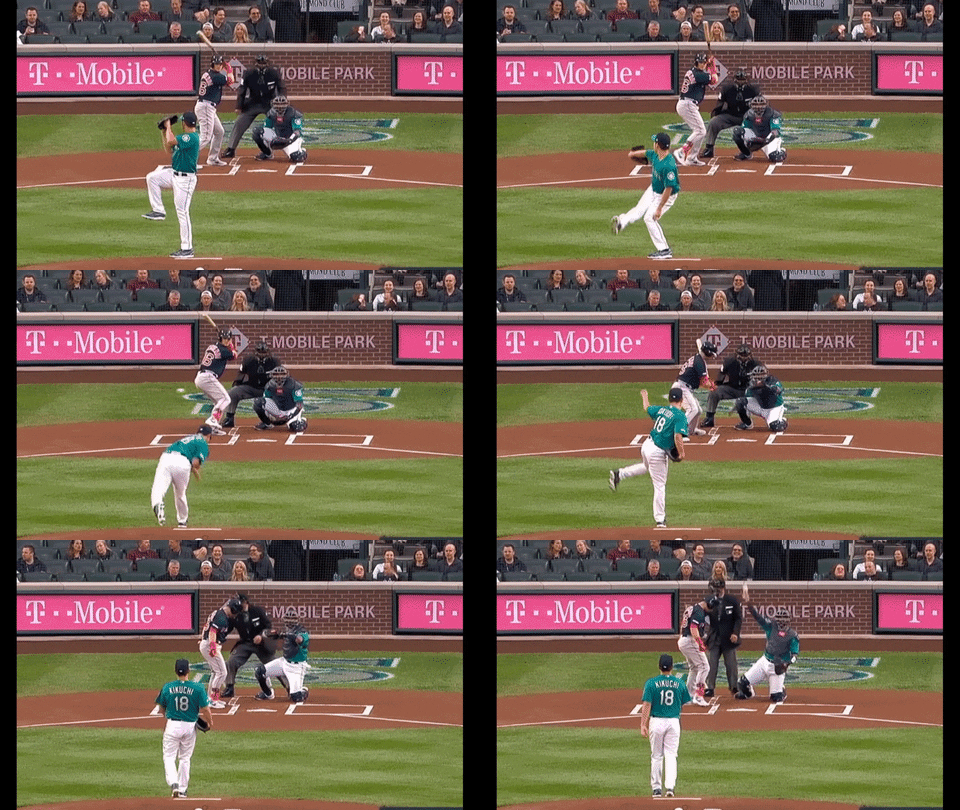
By average velocity, he’s comparable to the likes of David Price and Sean Newcomb. Maybe he’ll gain a tick or two as the season goes on or maybe he’ll get worn down. I don’t know. But as far as the velocity goes, Kikuchi can say he belongs in the majors. One thing of note is that his fastball only induced a whiff once out of the 43 times he threw the pitch. Statcast measured the pitch’s average spin rate at 2,173 rpm. According to Travis Sawchik, an average fastball around 93-94 mph measures out to 2,240 to 2,300 rpm. At least for that one start, his fastball was not seen to be a swing-and-miss weapon, as his velocity would indicate. Obviously, Kikuchi has arm strength, but not all 93 mph fastballs are created equally. Luckily for him, he has another tool in his toolbox that drew many more swings-and-misses: his slider.

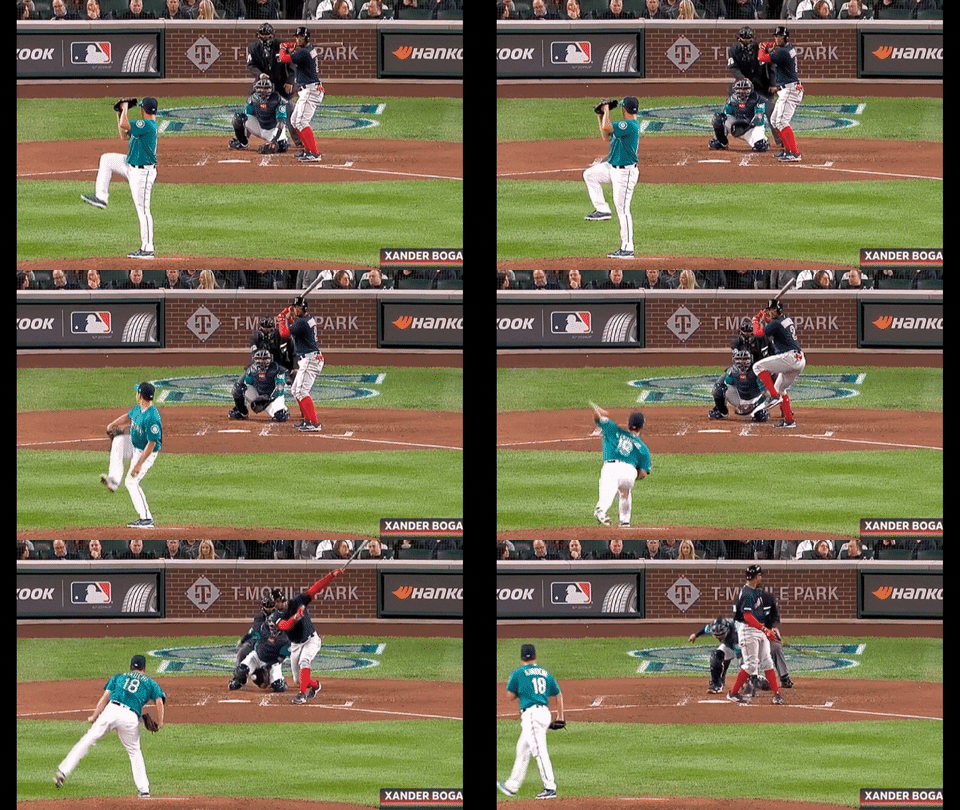
Kikuchi’s slider features a nasty 10-5 tilt. He used it as a swing-and-miss pitch in Japan, and he’s used it as one in his early going in the majors as well. Against Boston, he generated seven whiffs from 22 sliders used, which is pretty good! Here’s one to Xander Bogaerts that I feel is representative of how he likes to use the pitch.
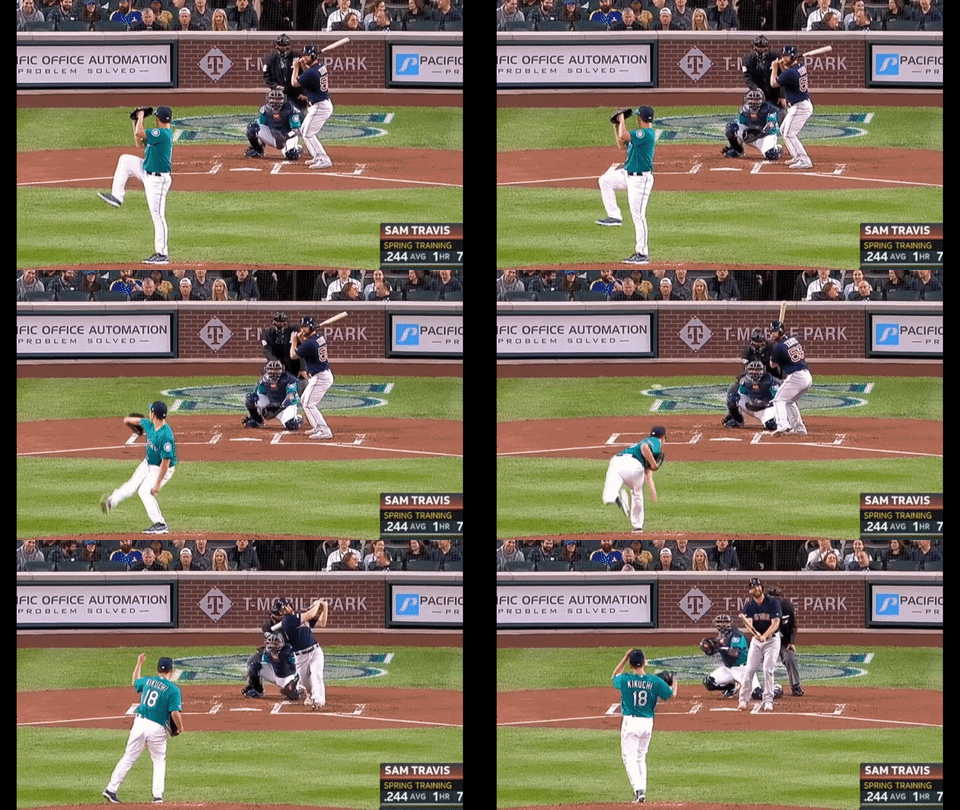
And here’s one to Sam Travis that had a particularly vicious bite.
Looking at Kikuchi’s slider heatmap from that game, we see a lot of low and inside pitches to the right-handed heavy Sox lineup. Being aware of his pitch tendencies from the NPB, I’d assume he meant to locate them that way as well. It’s hard to draw a conclusion at this moment, but Kikuchi’s slider has been rated above-average, as noted by Eric and Kiley. Future value grades don’t always come to fruition, but I would say that Kikuchi’s slider could forecast well in the majors.

As for the bad, Kikuchi did not necessarily avoid the meat of the zone. Here is his pitch heatmap:
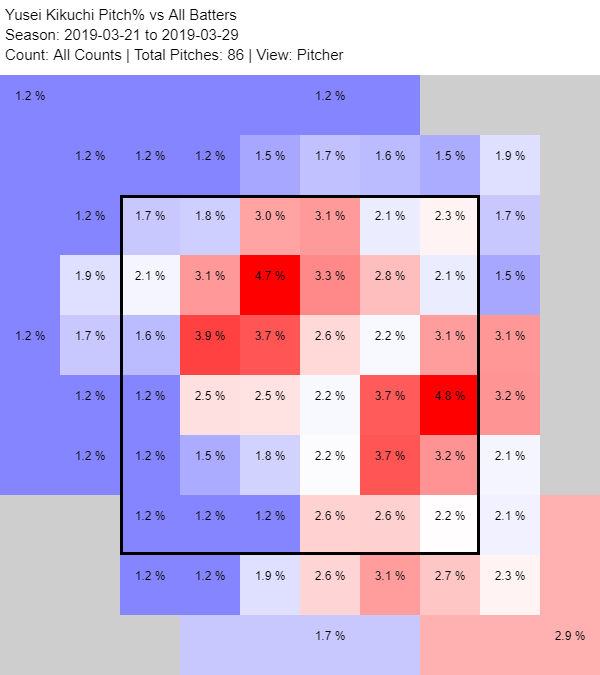
The good here is that Kikuchi located well to the inside edge versus right-handed hitters, and away versus left-handed hitters. However, there’s that big dark and red circle towards the middle-up part of the strike zone that indicates that he was also prone to leaving pitches “up there.” FanGraphs rated his command as a 45-grade, which is just below major league average. As of this moment, Kikuchi has thrown 64% of his pitches for strikes and allowed only one walk in 10.2 innings pitched. Those are good control numbers. Command is a different thing. The Red Sox hitters were much less than forgiving on Kikuchi’s mistake pitches.

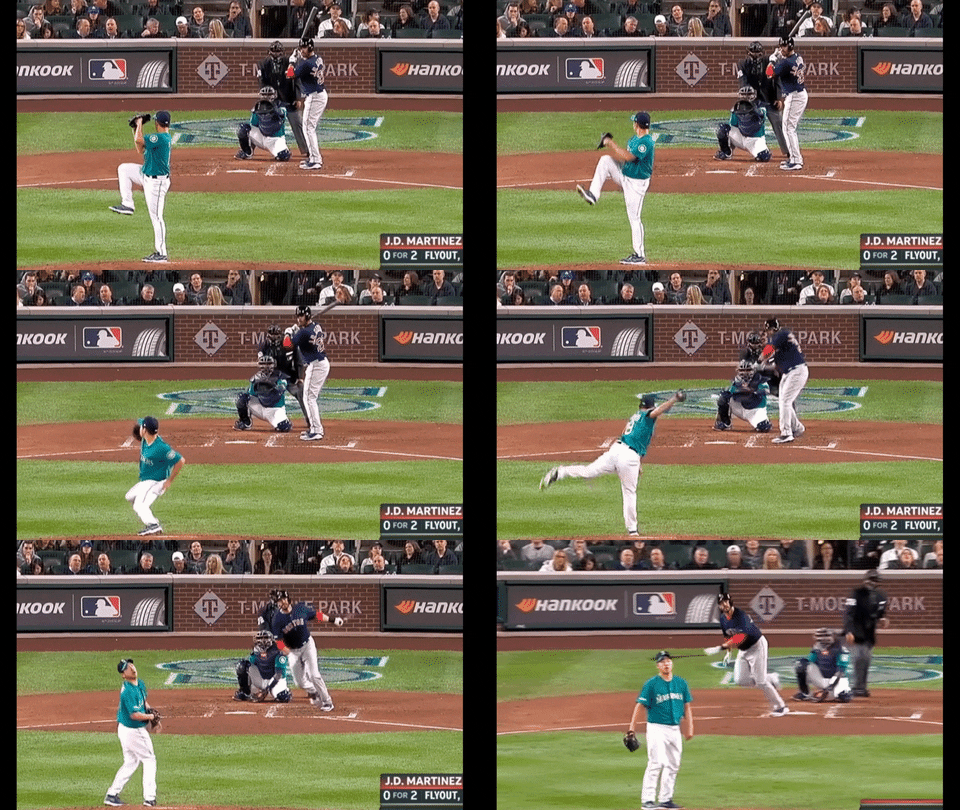
Here’s J.D. Martinez going yard on a fastball right down the middle. The catcher had his glove up and in, but the ball missed the spot and Martinez drove it over the center field fence.
Here’s another home run allowed, this time against Xander Bogaerts. The explanation is simple – the catcher appears to have wanted it down and away but the fastball went right down the middle, which is likely to be punished by many major league hitters.
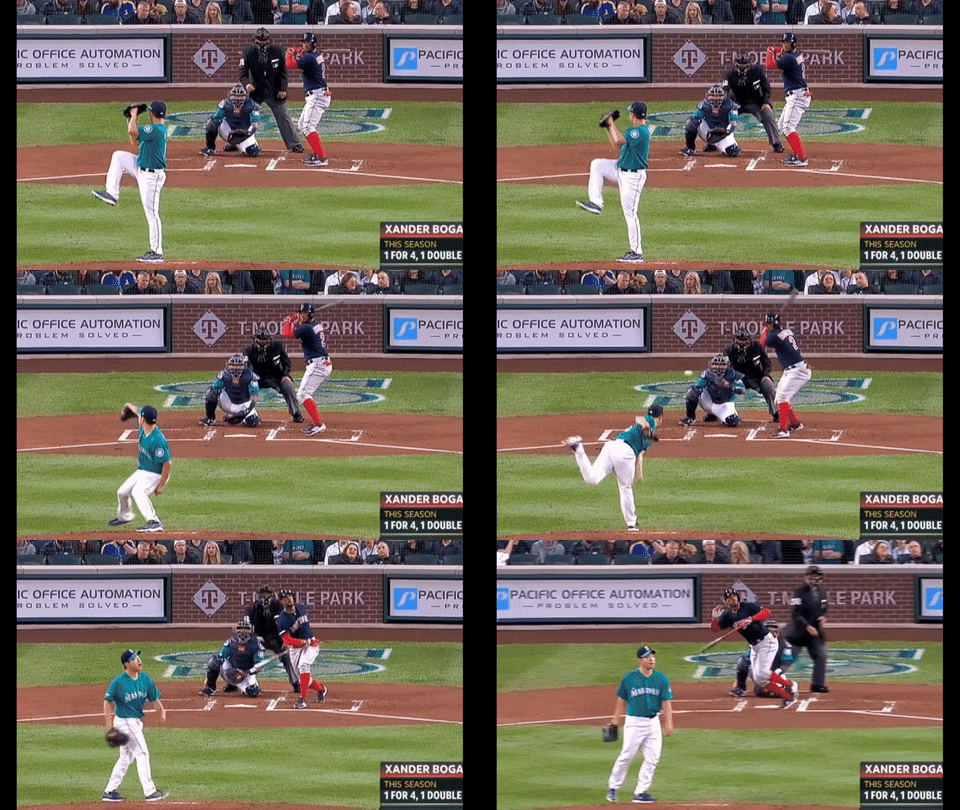
Pitching is extremely hard. You must stand a mark and locate each pitch into a glove size smaller than a pie tin from 60 feet 6 inches away. But it’s also the nature of the business – if you miss even so slightly, major league-caliber hitters can hit it a long way. It is worth noting that every pitcher makes mistakes. It’s the matter of minimizing the amount of them. There will be days when Kikuchi will makes fewer mistakes, and there will probably be days he makes more.

What’s curious for now is that Kikuchi has noticeably bumped up his curveball usage. Here’s the chart of his March 29 start versus his 2018 pitch data with the Seibu Lions, thanks to the NPB sabermetric website Delta.

Yusei Kikuchi Pitch Usage
Fastball % Slider % Curve % Splitter %
2018 48.6% 34.7% 11.1% 5.3%
March 29, 2019 49.2% 26.0% 22.6% 2.3%
SOURCE: FanGraphs and Delta

It’s an interesting bump. He never threw his curve more than 11.1% in a season with the Seibu Lions. He was known for his fastball/slider mix in Japan. The curveball, according to multiple scouting reports, was a third pitch that he would use to give different looks. And it’s not just his start against the Red Sox either. Over at Lookout Landing, Jake Mailhot recorded Kikuchi’s pitch data by hand during the Athletics game in the Tokyo Dome. The chart below indicates that Kikuchi has shown very similar pitch mix for his first two starts as a big leaguer.

Yusei Kikuchi Pitch Usage
Fastball % Slider % Curve %
March 21, 2019 47.3% 27.5% 25.3%
SOURCE: Jake Mailhot of Lookout Landing

One theory on why Kikuchi increased his curveball usage lies in data. Last June, Jim Allen of Kyodo News wrote on how Kikuchi relies on data to make adjustments to things like his release point and extension. I’m not sure how much attention he puts on his pitch metrics, but his curveball does grade out well on Statcast. Take a look at his pitch data from Baseball Savant:

Yusei Kikuchi Pitch Metrics
Velocity Exit Velocity Spin rate
Fastball 93.0 mph 94.2 mph 2,173 rpm
Slider 86.5 mph 80.6 mph 2,370 rpm
Curveball 75.3 mph 74.9 mph 2,593 rpm
SOURCE: Baseball Savant

Not only does an effective curveball give hitters another thing to worry about, but the velocity difference can also make his heater stand out more. Here’s a curveball that he threw to the reigning AL MVP Mookie Betts. Betts reacted like he was not expecting this pitch. He held up a for a microsecond and got his bat head out, but made weak contact that ended up being a groundout.
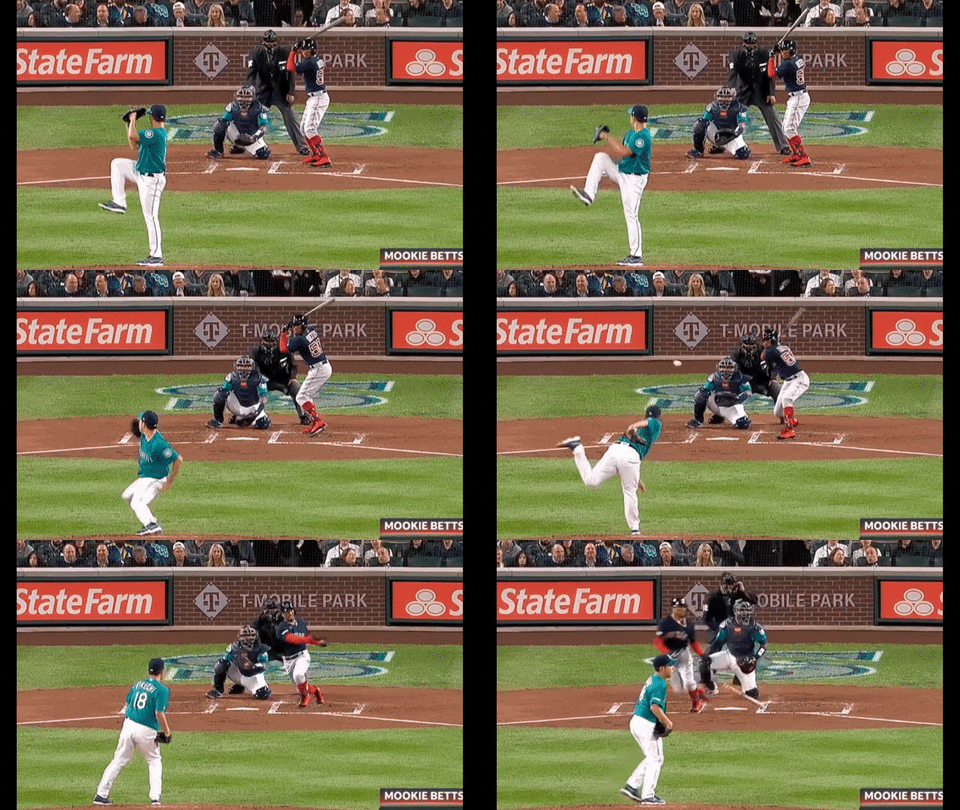
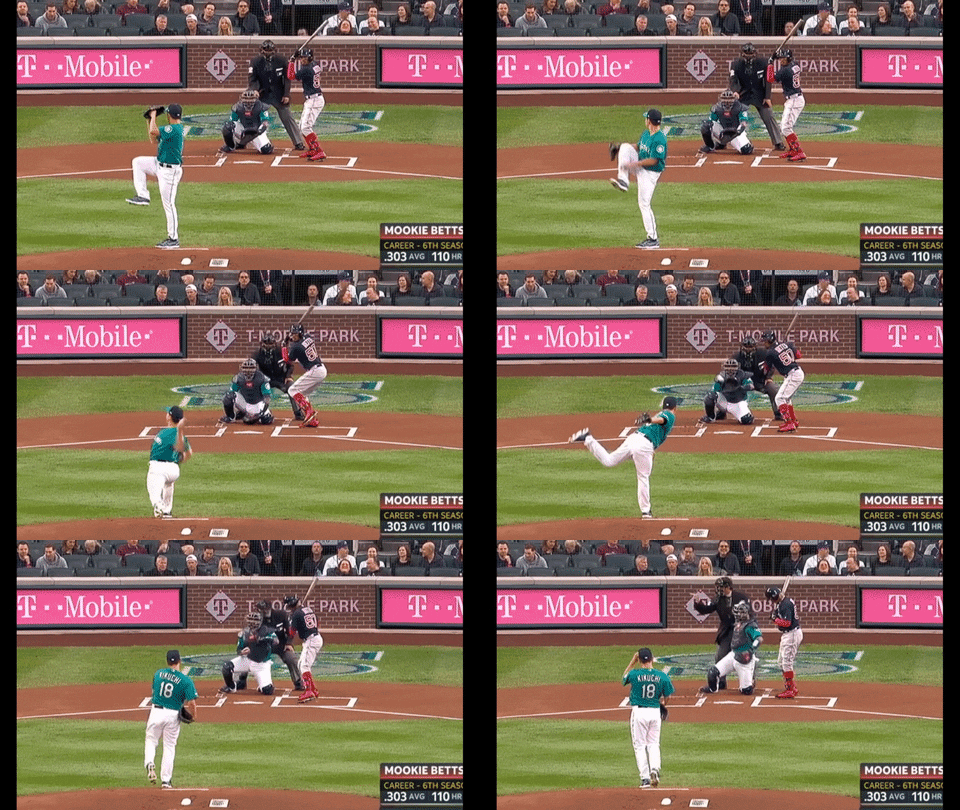
He didn’t generate any whiff with the pitch, but it induced two bits of weak contact for an overall .124 xBA. He also used it to get ahead in counts. Out of 18 curves thrown, nine of them were called strikes. Here’s one of them to Betts.
Kikuchi has had two decent starts and the pitch has worked well, so I don’t anticipate him making drastic changes anytime soon. It will be something to monitor, though. History has shown that many successful pitchers – Tanaka, for instance – have demonstrated the ability to modify their approach to survive in the majors. As time goes on, major league teams will have a book on how to approach Kikuchi. Once they know better what to expect, I don’t know how successful they’ll hit against him, but surviving in the majors involves series of adjustments. If Kikuchi runs into a harder time getting hitters out, I would expect him to take a different approach.

Lastly, it’s worth noting that Kikuchi seemed to struggle when facing the order the third time around. In a very small sample, Kikuchi faced five batters a third time through the order between the A’s and Red Sox games, and allowed two hits, including that aforementioned JD Martinez home run. Again, it is hard to draw conclusions out of five-batter sample, but the concern is not unfounded. The lack of a big fastball could become a problem late in games in instances where he struggles to give hitters different looks. As Bill Petti has written for FanGraphs about how pitchers with a big fastball — who can maintain that velocity late in games — are more likely to pitch deeper.

There will be so much more Kikuchi to watch. Personally, I’ve waited for awhile for him to arrive to the majors, as I’ve written about the lefty a couple of times in the past. Two starts in, Kikuchi gave his team a real chance to win on both occasions. For a starting pitcher, there’s not a lot more you can ask for.


Top 30 Prospects: Chicago White Sox

Below is an analysis of the prospects in the farm system of the Chicago White Sox. Scouting reports are compiled with information provided by industry sources as well as from our own (both Eric Longenhagen’s and Kiley McDaniel’s) observations. For more information on the 20-80 scouting scale by which all of our prospect content is governed you can click here. For further explanation of the merits and drawbacks of Future Value, read this.

All of the numbered prospects here also appear on The Board, a new feature at the site that offers sortable scouting information for every organization. That can be found here.

White Sox Top Prospects
Rk Name Age Highest Level Position ETA FV
1 Eloy Jimenez 22.3 MLB RF 2019 60
2 Michael Kopech 22.9 MLB RHP 2019 55
3 Nick Madrigal 22.0 A+ 2B 2020 55
4 Luis Robert 21.7 A+ CF 2020 55
5 Dylan Cease 23.3 AA RHP 2019 50
6 Dane Dunning 24.3 AA RHP 2021 50
7 Micker Adolfo 22.6 A+ RF 2021 45
8 Luis Alexander Basabe 22.6 AA CF 2019 45
9 Blake Rutherford 21.9 A+ LF 2020 45
10 Luis Gonzalez 23.6 A+ RF 2020 45
11 Zack Collins 24.2 AA 1B 2019 45
12 Jake Burger 23.0 A 3B 2021 40+
13 Steele Walker 22.7 A LF 2022 40+
14 Jimmy Lambert 24.4 AA RHP 2020 40
15 Seby Zavala 25.6 AAA C 2019 40
16 Tyler Johnson 23.6 A+ RHP 2020 40
17 Gavin Sheets 22.9 A+ 1B 2020 40
18 Jordan Stephens 26.6 AAA RHP 2019 40
19 Konnor Pilkington 21.6 R LHP 2021 40
20 Alec Hansen 24.5 AA RHP 2020 40
21 Zack Burdi 24.1 AAA RHP 2019 40
22 Luis Mieses 18.8 R CF 2022 40
23 Codi Heuer 22.7 R RHP 2021 40
24 Zach Thompson 25.4 AA RHP 2020 35+
25 Bernardo Flores 23.6 AA LHP 2020 35+
26 Danny Mendick 25.5 AAA SS 2019 35+
27 Bryce Bush 19.3 R RF 2022 35+
28 Lenyn Sosa 19.2 R SS 2022 35+
29 Ryan Burr 24.8 MLB RHP 2019 35+
30 Ian Hamilton 23.8 MLB RHP 2019 35+
Reading Options
Detail Level
Data Only
Full
Position Filter
All

60 FV Prospects

Signed: July 2nd Period, 2013 from Dominican Republic (CHC)
Age 22.3 Height 6′ 4″ Weight 225 Bat / Thr R / R FV 60
Tool Grades (Present/Future)
Hit Raw Power Game Power Run Fielding Throw
50/55 70/80 60/70 40/40 45/50 60/60

Even before the White Sox acquired Jimenez from the Cubs in the Jose Quintana trade, he had dealt with a multitude of injuries. Hamstring and shoulder issues plagued him while he was still with the Cubs, and limited him to DH duty, or forced him to sit out for a few days at a time, or altogether kept rehabbing him on the Mesa backfields. He has continued to have various issues since the South Siders acquired him. In 2018 alone, Jimenez dealt with patella tendinitis during the early part of spring training, then was left back in extended due to a strained pec. He suffered a strained left adductor in July, and finally a quad strain this winter, which ended his Dominican Winter League season.

But while Eloy has missed considerable time with injuries and sometimes played through them, he has mashed like few other players in the minors. He split 2018 between Double-A Birmingham and Triple-A Charlotte, slashing .337/.384/.577, his strikeout rate plummeting to 13% at the latter stop. Despite his limited speed and at-bats, he somehow managed to net 53 extra-base hits and seemed ready for a big league cup of coffee in September. The White Sox refused to brew him one, and Eloy’s agent threatened to file a grievance against the club, an issue that was resolved during 2019 spring training with a record contract extension. He’ll likely be up all year, and while we think there’s a chance injury or a lack of mobility limit Eloy’s ceiling the way flaws have similarly limited some of Chicago’s other recent prospect graduates, we still think he’ll hit enough to be a star.

55 FV Prospects

Drafted: 1st Round, 2014 from Mt. Pleasant HS (TX) (BOS)
Age 22.9 Height 6′ 3″ Weight 195 Bat / Thr R / R FV 55
Tool Grades (Present/Future)
Fastball Slider Changeup Command Sits/Tops
70/70 50/60 45/55 40/45 94-98 / 101

Just as Kopech seemed to be harnessing his hellacious stuff, he blew out. In the seven minor league starts before his big league debut, Kopech walked just four batters, and he was similarly efficient in his first few big league outings. His velocity was down and the Tigers shelled him in his final start, and an MRI revealed Kopech would need Tommy John. The timing was particularly cruel, not just because things had started to click, but also because late-season TJs usually cost the pitcher all of the next year; Kopech isn’t expected to be back until 2020.

His stuff is great, headlined by a mid-90s fastball that often crests 100 mph. The command inroads Kopech made late in 2018 are especially important for his ability to deal with lefties, because his changeup feel is not very good. He’ll need to mix his two breaking balls together to deal with them, and his slider feel is way ahead of the curveball. So long as Kopech’s stuff returns, he has No. 3 starter ceiling if the command comes with it, and high-leverage relief ability if the latter does not.

Drafted: 1st Round, 2018 from Oregon State (CHW)
Age 22.0 Height 5′ 7″ Weight 160 Bat / Thr R / R FV 55
Tool Grades (Present/Future)
Hit Raw Power Game Power Run Fielding Throw
40/70 45/45 40/45 70/70 55/60 50/50

When Madrigal fractured his wrist during Oregon State’s second series of the year, he was hitting .560 (14-for-25) with two doubles, two homers, and three steals in three attempts. For two long weekends in Arizona, he did everything. He crushed balls in all parts of the strike zone, ran plus-plus times to first base, and made several highlight reel defensive plays at second base. The wrist fracture kept him out for the rest of February, all of March, and most of April. When he returned, Madrigal kept hitting, but not for power, which is consistent with what plagues hitters for several months after they’ve had a break in the hand/wrist area.

That trend continued through his first pro summer, which was interrupted by a hamstring issue, as Madrigal struggled to pull and/or lift the ball at all. He had a downward, slashing swing instead of the dynamic and athletic cut he’d had early in the year, when he could scoop and lift stuff at the bottom of the zone. But he kept making contact. It was a month before a pro pitcher was able to strike Madrigal, who only K’d in 3% of his pro plate appearances last year, out.

It’s fair to make a distinction between prospects who are small, and ones who are just short. Jose Altuve is short, but is built like a little tank. Madrigal is small, a diminutive 5-foot-7, 165 pounds, and this, combined with his total lack of post-draft power, has the pro side of scouting very concerned. He looked tired and sluggish during instructional league, though it wasn’t as if he’d played a whole year and was an obvious candidate to be run down, furthering concerns that his size will be an issue. We’re inclined to believe there’s a substantial bounce-back on the horizon. He was the best draft-eligible hitter we saw last year, a complete player with few, if any, flaws.

Signed: July 2nd Period, 2017 from Cuba (CHW)
Age 21.7 Height 6′ 3″ Weight 185 Bat / Thr R / R FV 55
Tool Grades (Present/Future)
Hit Raw Power Game Power Run Fielding Throw
30/45 65/65 30/55 60/60 50/55 60/60

More than a full year removed from all that intrigue and we still know relatively little about Luis Robert, largely due to a thumb ligament sprain LouBob dealt with throughout 2018. His signing with Chicago marked the end of a more lucrative era for young international players who are now subject to more tight-fisted rules capping bonus amounts. Despite a limited market due to the timing of his deal, Robert signed for $26 million thanks to his all-world physical gifts. The raw power and top-end speed were obvious in workouts, but unless teams scouted him in Series Nacional or during the Cuban National team’s annual CanAm League tour, little was known about his ability to hit big league-quality pitching, or what his instincts were like in center field.

Because his thumb cost him April, May, and July (he re-aggravated it), it was hard to get extended looks during 2018 until Robert’s six-week stint in the Arizona Fall League (which was also interrupted by a hamstring issue). LouBob’s AFL stats were fine, but his swing path left him vulnerable to velocity on the inner half, and he too often expanded the zone. There’s doubt that he’ll get to all of his raw power in games, both due to the swing path and lack of plate discipline, but it isn’t as if he’s had time to make proper adjustments yet, and the pitching he saw in Arizona was the best he’s seen in his life. The ceiling is the same as it was purported to be before he signed: power, speed, offensive performance similar to Carlos Gomez’s best years. There’s just more risk that Robert doesn’t get there.

50 FV Prospects

5. Dylan Cease, RHP
Drafted: 6th Round, 2014 from Milton HS (GA) (CHC)
Age 23.3 Height 6′ 2″ Weight 190 Bat / Thr R / R FV 50
Tool Grades (Present/Future)
Fastball Curveball Changeup Command Sits/Tops
70/70 55/60 45/50 40/45 95-98 / 101

Cease burst onto the scouting scene in 2013 when, as a junior in high school, he hit 96 mph and flashed an above average curveball at the heavily-scouted NHSI tournament in Cary, NC. He mostly held serve in his senior year, occasionally touching a tick or two higher or flashing 60 with his curveball, but was still a stuff over command type. The Cubs went well overslot to get Cease in the sixth round with a $1 million bonus, below what his talent was worth, but appropriate since clubs knew he needed Tommy John surgery right after he signed.

He’s slowly made progress in terms of starter traits during his pro career, while his velocity has increased to where he sits 95-98 mph now. In 2018, he took the biggest step forward, dominating High-A and Double-A at age 22, and some scouts are now projecting him as a No. 2 or 3 starter. We still aren’t completely convinced, as Cease is still control over command, and may fit best in a multi-inning relief role, or as a starter who doesn’t face any hitters a third time.

6. Dane Dunning, RHP
Drafted: 1st Round, 2016 from Florida (WAS)
Age 24.3 Height 6′ 4″ Weight 200 Bat / Thr R / R FV 50
Tool Grades (Present/Future)
Fastball Slider Changeup Command Sits/Tops
45/45 55/60 50/55 50/55 90-93 / 94

Dunning was an intriguing projection arm in high school who flashed average stuff and had some athleticism. Then he took a big step forward in his freshman year at Florida. At his best, Dunning has three pitches that flash plus at times and starter command, but most often has above average stuff and good control, consistent with a No. 4 starter look. The Nationals took him in the late first round in 2016 despite him being the bullpen/midweek/spot starting utility knife on a loaded staff. He was in the Adam Eaton deal in 2018 and missed the second half of 2018 with an elbow strain, before tearing his UCL and having Tommy John during 2019 spring training. He’ll be back midway through 2020 and is likely to be pushed quickly to the big leagues if his stuff is back.

45 FV Prospects

Signed: July 2nd Period, 2013 from Dominican Republic (CHW)
Age 22.6 Height 6′ 3″ Weight 200 Bat / Thr R / R FV 45
Tool Grades (Present/Future)
Hit Raw Power Game Power Run Fielding Throw
30/40 65/65 40/55 50/45 40/40 50/50

When Micker Adolfo (often referred to by scouts as Micker Zapata while he was an amateur) was 14 years old, he moved from the Virgin Islands to the Dominican Republic to train for his future baseball career. Mostly due to his huge raw power, he signed for what was then a franchise IFA-record $1.6 million, a mark that has since been shattered by Luis Robert. Adolfo’s early career was mired in strikeouts and injury. He struck out at a 43% clip in his first season, missed most of 2015 due to a gruesome leg fracture, and then broke his hamate a month into 2016 and hit for no power after he returned.

While he continues to strike out at a somewhat troubling rate (30% combined over the last two seasons), Adolfo has performed each of the last two years despite playing through an elbow injury that required Tommy John in 2018. He’s grown into the power expected of him as an amateur and has slugged just shy of .460 as an age-appropriate regular at Low- and Hi-A. Back from Tommy John during the Spring of 2019, Adolfo looked buff, but stiff. The power is still there, but so too is the risk he ends up as a DH. One has to wonder if, through no fault of his own, the large swaths of inactivity throughout his career have led to an early tumble down the defensive spectrum. We still really like that power potential and are encouraged by the last two years of output. At this point, Adolfo’s tools probably are what they are (though perhaps some arm comes back further removed from surgery) and his statistical performance will drive his stock.

Signed: July 2nd Period, 2012 from Venezuela (BOS)
Age 22.6 Height 6′ 0″ Weight 170 Bat / Thr S / R FV 45
Tool Grades (Present/Future)
Hit Raw Power Game Power Run Fielding Throw
30/40 50/50 45/50 60/60 40/45 60/60

Basabe shredded the Carolina League for the first two and a half months of 2018 — hitting .266/.370/.502 — then had one of the year’s most impressive feats of strength when he turned around a 102 mph Hunter Greene fastball at the Futures Game, and deposited it 10 rows deep to right-center field. His second half with Double-A Birmingham was less successful, and just as Basabe appeared to be adjusting to the better pitching in August, he would again struggle in the Arizona Fall League. Perhaps the most notable takeaway from the AFL is that Basabe’s instincts in center field are not great, and he may be better suited for a corner despite his speed. If that’s the case (it’d be fair to assume Basabe was gassed during the AFL and to just exclude that look from consideration) then the swing and miss aspect of the profile (27% K% last year) becomes a little scary. But Basabe has a potent collection of physical tools, he’s walked at an above-average clip, his modest power plays in games because he lifts the ball, and all of that should enable him to be a second division regular.

Drafted: 1st Round, 2016 from Chaminade Prep HS (CA) (NYY)
Age 21.9 Height 6′ 3″ Weight 195 Bat / Thr L / R FV 45
Tool Grades (Present/Future)
Hit Raw Power Game Power Run Fielding Throw
30/50 50/50 30/45 50/45 40/50 45/45

Famous since his days as a high school underclassman, Rutherford was a likely over-slot target of teams picking early in round two of the 2016 draft, but the Yankees took him 18th overall and signed him for about $800,000 over slot. He had a strong track record of performance in high school, but concerns about his power projection arose during Rutherford’s first full season, when he slugged just .348. One could point to his age (Rutherford was as old as a junior college prospect on draft day) as an indicator that should have been tempered our expectations of his power growth in the first place. But really, Rutherford’s swing, while picturesque, is just geared for all-fields doubles. He has some low-ball, home run power to his pull side, but otherwise does damage peppering the gaps and third baseline. Half of his 2018 doubles were struck to left of center field. It’s not an ideal profile for a corner outfielder, but Rutherford is a likely big leaguer. We have him projected as a low-end regular.

Drafted: 3rd Round, 2017 from New Mexico (CHW)
Age 23.6 Height 6′ 1″ Weight 185 Bat / Thr L / L FV 45
Tool Grades (Present/Future)
Hit Raw Power Game Power Run Fielding Throw
35/55 50/50 30/45 50/50 45/50 50/50

The quick-batted Gonzalez had a breakout 2018, with a 140 wRC+ during half seasons at Low- and Hi-A. He stands way off the dish, which creates some quality-of-contact limitations on pitches away from him in exchange for an ability to open up and turn on inside pitches with authority. It’s an approach that’s typically shiftable, but Gonzalez is also a good bunter and runs well to combat this. Like Rutherford ahead of him, it’s tough to project corner outfielders with middling power as average or better regulars. Rutherford is younger and perhaps has a better shot to grow into more, while Gonzalez has the superior feel for contact and might end up a 6 bat who doesn’t need to hit for power to profile. The two are pretty interchangeable depending on your preference.

Drafted: 1st Round, 2016 from Miami (CHW)
Age 24.2 Height 6′ 3″ Weight 220 Bat / Thr L / R FV 45
Tool Grades (Present/Future)
Hit Raw Power Game Power Run Fielding Throw
30/40 70/70 45/50 20/20 40/40 50/50

We suppose Collins could catch on occasion, but he probably shouldn’t be back there every day due to issues with receiving and mobility. Despite only fitting at 1B/DH, Collins’ combination of power and on base ability make it likely that he finds his way into regular big league at-bats somewhere, especially if the DH is instituted in the National League. His 19% walk rate was among the best in the minors last year, and just 33% of Collins’ balls in play are on the ground. He’s a pretty good three true outcomes prospect, a bat-only 1-2 WAR player à la Josh Bell or Justin Bour, who we’ll likely see in the big leagues by 2020.

40+ FV Prospects

12. Jake Burger, 3B
Drafted: 1st Round, 2017 from Missouri State (CHW)
Age 23.0 Height 6′ 2″ Weight 210 Bat / Thr R / R FV 40+
Tool Grades (Present/Future)
Hit Raw Power Game Power Run Fielding Throw
35/50 60/60 40/55 45/30 40/45 60/60

Thick and tightly wound, Burger was already a tenuous bet to stay at third base for very long before he twice ruptured his Achilles tendon, once during a spring training game and again while rehabbing in late May. The 12 month timetable for return from Achilles tears was reset, and puts Burger on track to come back sometime in June. While there are questions about his defense, Burger was one of the top college bats in the 2017 class. He has quick, explosive hands that generate big bat speed, and he has unusual bat control for someone who swings as hard as he does. He has sizable ceiling, especially if he can find a way to stay at third base, but we just won’t know what kind of toll the injuries have taken until Burger starts playing games again. He’s a good bet to see time in the 2019 Arizona Fall League.

Drafted: 2nd Round, 2018 from Oklahoma (CHW)
Age 22.7 Height 5′ 11″ Weight 190 Bat / Thr L / L FV 40+
Tool Grades (Present/Future)
Hit Raw Power Game Power Run Fielding Throw
30/40 60/60 30/50 50/45 45/50 45/45

It’s rare for there to be a college hitter with this kind of scintillating, violent bat speed, let alone one who’s overshadowed by an even toolsier teammate the way Walker was by Kyler Murray. Perhaps it was concerns about strikeouts, or the vague and mysterious injury bug that bit Walker during the Big 12 tournament, that caused him to fall out of the first round despite hitting .352/.441/.606 in a large conference. He’s an athletic swinger with a natural uppercut swing that seemed likely to help him lift the ball regularly, and the little bit of batted ball data we have from after Walker signed suggests that notion is correct. We’re doubtful that he stays in center field long term, but it’s hard to say that definitively because Walker lost reps there to Murray in college, and may yet develop better feel. He’s likely a big league regular if he can either stay in center or avoid perilously high strikeout rates, a star if he does both, and a corner platoon bat if he does neither.

40 FV Prospects

14. Jimmy Lambert, RHP
Drafted: 5th Round, 2016 from Fresno State (CHW)
Age 24.4 Height 6′ 2″ Weight 170 Bat / Thr R / R FV 40
Tool Grades (Present/Future)
Fastball Slider Curveball Changeup Command Sits/Tops
45/50 50/55 50/55 50/55 45/50 91-94 / 95

Lambert’s strikeout rate exploded from 16% in 2017 to nearly 29% in 2018. The cause? A slight uptick in velocity paired with an arm slot change that has Lambert coming straight over the top, creating more life on his heater. It also creates more vertical action on his breaking stuff. This delivery appears tough to maintain, as Lambert has to contort his body to get to that slot, but he hasn’t been wild since making the change. His well-rounded collection of stuff plays much better like this, and Lambert now projects as a No. 4 or 5 starter.

Drafted: 12th Round, 2015 from San Diego State (CHW)
Age 25.6 Height 6′ 0″ Weight 215 Bat / Thr R / R FV 40
Tool Grades (Present/Future)
Hit Raw Power Game Power Run Fielding Throw
35/40 60/60 40/45 30/30 45/45 50/50

Likely a long-time bat first, backup catcher, Zavala has some power, an average arm, and has worked hard to become a viable defensive catcher. Lauded for his makeup, Zavala got big and strong after he was drafted but appeared more lean and lithe this spring. He could get his first taste of the majors in 2019.

16. Tyler Johnson, RHP
Drafted: 5th Round, 2017 from South Carolina (CHW)
Age 23.6 Height 6′ 3″ Weight 205 Bat / Thr R / R FV 40
Tool Grades (Present/Future)
Fastball Slider Changeup Command Sits/Tops
60/60 50/55 40/45 45/50 93-95 / 97

Yet another South Carolina Gamecock having success in pro ball, Johnson is a physical beast with big velocity. He struck out nearly 40% of opposing hitters in 2018 by relying heavily on the heater. Both his slider and changeup are serviceable, and Johnson projects in a middle relief role.

17. Gavin Sheets, 1B
Drafted: 2nd Round, 2017 from Wake Forest (CHW)
Age 22.9 Height 6′ 4″ Weight 230 Bat / Thr L / L FV 40
Tool Grades (Present/Future)
Hit Raw Power Game Power Run Fielding Throw
30/50 70/70 40/50 30/30 40/50 50/50

Likely in need of a swing change to profile at first, Sheets’ cut too often slices down at the baseball, and he can only get to his considerable raw power in certain parts of the strike zone. He has good bat control and makes mid-flight adjustments to breaking balls, which he has the raw strength to punish even if the timing of his lower half has been compromised. He’s a good hitter, just one we’re skeptical will clear the offensive bar at first base without trading some contact for power. Sheets is also another example of why we should be skeptical of hitters’ power numbers at Wake Forest.

Drafted: 5th Round, 2015 from Rice (CHW)
Age 26.6 Height 6′ 1″ Weight 185 Bat / Thr R / R FV 40
Tool Grades (Present/Future)
Fastball Curveball Changeup Cutter Command Sits/Tops
45/50 55/60 40/45 50/55 45/50 89-93 / 95

In a starter/reliever grey area, Stephens doesn’t have the changeup quality typically desired from a starter, but he can back foot his breaking balls and work cut in on the hands of lefties, so the lack of change may not matter. His curveball, typically in the upper-70s, has premium raw spin; that pitch should alone carry him to a role on a big league staff. He spent 2018 with Triple-A Charlotte and is a strong multi-inning relief candidate.

Drafted: 3rd Round, 2018 from Mississippi State (CHW)
Age 21.6 Height 6′ 3″ Weight 228 Bat / Thr L / L FV 40
Tool Grades (Present/Future)
Fastball Curveball Changeup Command Sits/Tops
45/45 50/50 45/50 45/55 87-91 / 92

Pilkington missed an SEC bat per inning during his stay at Mississippi State, and seemed like a potentially quick-moving, low-variance backend starter prospect when the White Sox made him their third round pick last year. Physically mature and wielding vanilla stuff, Pilkington’s upside is limited, and most of his draft value was in perceived certainty. His stuff was sometimes down in the mid-80s during the 2019 spring, though. Ideally, he’ll move to the upper levels pretty quickly, assuming his velocity rebounds.

20. Alec Hansen, RHP
Drafted: 2nd Round, 2016 from Oklahoma (CHW)
Age 24.5 Height 6′ 7″ Weight 240 Bat / Thr R / R FV 40
Tool Grades (Present/Future)
Fastball Slider Curveball Changeup Command Sits/Tops
60/60 45/50 60/60 40/45 40/40 90-95 / 97

What a roller coaster of a career it has already been for Hansen, who looked like a possible top three pick as a college sophomore, faltered as a junior, appeared reborn once free of seemingly poor college instruction, then collapsed again in 2018 when he was hurt for a time (forearm) and had more walks than innings pitched.

At his best, Hansen will sit 94-97 early in starts and both his breaking balls will be plus. Last year his velo was down, sometimes into the upper-80s. Hansen is built like an Andean Condor, and it’s fair to anticipate mechanical consistency arriving late for an athlete built like that. But he turns 25 this year and even if his stuff bounces back, we think he’ll just end up in a relief role.

21. Zack Burdi, RHP
Drafted: 1st Round, 2016 from Louisville (CHW)
Age 24.1 Height 6′ 3″ Weight 210 Bat / Thr R / R FV 40
Tool Grades (Present/Future)
Fastball Slider Changeup Command Sits/Tops
50/55 45/45 50/50 40/45 92-96 / 101

Burdi’s stuff was way down when he returned from Tommy John last year. He was 97-101 with a plus slider and changeup prior to his injury and at his ranking peak, was one of the few relief-only prospects who we considered a 50 FV prospect. During his AZL rehab outings and in the AFL, Burdi was often throwing just 92-94 and his slider’s spin rate dropped to 2200 rpm after spiraling in at 2700 rpm when he was healthy. He had to be shut down during the spring of 2019 spring and while we’re hopeful for an eventual bounce-back, Burdi’s future is murky.

22. Luis Mieses, CF
Signed: July 2nd Period, 2016 from Dominican Republic (CHW)
Age 18.8 Height 6′ 3″ Weight 180 Bat / Thr L / L FV 40
Tool Grades (Present/Future)
Hit Raw Power Game Power Run Fielding Throw
25/55 50/50 20/50 45/40 45/45 45/45

An 18-year-old leviathan, Mieses is much more physical than his listed 180 pounds, and it’s shocking to watch him use his instincts and first step to close on balls in center field, even though he likely won’t play there for very long. He has exceptional hand-eye coordination and finds all sorts of ways to put the bat head on the ball but too often, he offers at pitcher’s pitches and settles for sub-optimal contact. He has a gorgeous, low-ball left-handed swing that could produce power if Miesis learned to attack the right pitches. The near bottom-of-the-scale walk rates each of his first two years are certainly a red flag, but Mieses’ size and hitting ability make him an intriguing, high-ceiling flier.

23. Codi Heuer, RHP
Drafted: 6th Round, 2018 from Wichita State (CHW)
Age 22.7 Height 6′ 5″ Weight 195 Bat / Thr R / R FV 40
Tool Grades (Present/Future)
Fastball Slider Changeup Cutter Command Sits/Tops
55/55 40/45 50/55 50/55 45/55 92-95 / 96

Heuer spent his first two college seasons in the Wichita State bullpen but was frequently seen by draft room decision makers as a junior because they were in to see Alec Bohm and Greyson Jenista. His arm slot and spotty college fastball command made a bullpen projection popular, but because Heuer is a big-framed, cold weather (Colorado) high schooler who threw limited innings for two years in college, we’re a little more optimistic about him improving. He had a strong fall instructional league during which his mid-90s sinker worked as an effective precursor for a good changeup. He doesn’t have great breaking ball spin but at times his fastballs cut on him, and there might be a viable third pitch here that simply isn’t a traditional breaking ball. He’s likely a two-pitch reliever but in our estimation, there’s room for growth because of the background. He could be a workhorse backend starter.

35+ FV Prospects

24. Zach Thompson, RHP
Drafted: 5th Round, 2014 from Texas-Arlington (CHW)
Age 25.4 Height 6′ 7″ Weight 230 Bat / Thr R / R FV 35+

You could argue Thompson belongs up with Jordan Stephens on this list, especially because Thompson doesn’t yet need to occupy a 40-man spot the way Stephens does, but even though they’re each likely to end up in the bullpen, Thompson is the one who has already moved. He sits 92-95 and has an above-average curveball, a pretty standard two-pitch middle relief mix.

Drafted: 7th Round, 2016 from USC (CHW)
Age 23.6 Height 6′ 3″ Weight 170 Bat / Thr L / L FV 35+

It seems that, after his velocity yo-yo’d throughout college (probably due to inconsistent usage) and early as a pro, Flores’ fastball has settled in 89-92 range. It just means he’ll have to pitch off of his secondaries more, the best of which is a tilting, 2-to-7 curveball that spins in at about 2750 rpm. Flores will throw the curve in the zone for strikes or bounce it in the dirt to his glove side. He can also create good angle in on righties with what looks like a cutter. He’s at least strong rotation depth, if not just a good No. 5 starter.

Drafted: 22th Round, 2015 from UMass Lowell (CHW)
Age 25.5 Height 5′ 10″ Weight 190 Bat / Thr R / R FV 35+

There’s warranted age-based skepticism of Mendick’s numbers at Hi- and Double-A each of the last two years, but it’s encouraging that he had such a strong 2018 after a bad month and a half at Birmingham the year prior. He was similarly excellent during 2019 spring training, though most of his at-bats came against late-inning reserve arms. But as a versatile infielder with terrific control of the strike zone, Mendick is a very rosterable big leaguer who should give you good at-bats off the bench. His career peripherals are strong and may be an indication that we’re sleeping on him a bit because of his age.

27. Bryce Bush, RF
Drafted: 33th Round, 2018 from De La Salle Collegiate HS (MI) (CHW)
Age 19.3 Height 6′ 0″ Weight 200 Bat / Thr R / R FV 35+

A late-round, cold-weather high school flier who signed for $290,000, Bush played in some of the big prep showcases during his final amateur summer, and was clearly overmatched against the better pitching. But he put on an absolute show during batting practice and has one of the best raw power projections among potential future Sox. He had a strong pro debut on paper and continued to look good with the bat during the spring of 2019. The general scouting consensus is that Bush will not stay at his current third base and will have to move to an outfield corner or first, which immediately makes Bush’s high school whiffs troublesome. He’s a high-risk, long-term developmental prospect with some of the louder offensive tools in the system.

28. Lenyn Sosa, SS
Signed: July 2nd Period, 2016 from Venezuela (CHW)
Age 19.2 Height 6′ 0″ Weight 180 Bat / Thr R / R FV 35+

While initial impressions of Sosa were that he had a shot to hit his way to an everyday gig at second base, continued evaluations indicate he may have sufficient instincts and footwork to remain at short despite limited straight-line speed. The bat control required for him to clear the middle infield offensive bar is there, but he’s not physically projectable, and needs to be more selective at the dish.

29. Ryan Burr, RHP
Drafted: 5th Round, 2015 from Arizona State (ARI)
Age 24.8 Height 6′ 4″ Weight 225 Bat / Thr R / R FV 35+

Burr is Arizona State’s all-time saves leader. He was 93-96 with an above-average slider almost every time out as a Sun Devil, but began experiencing wild fluctuations in velocity during his early time in pro ball. But in 2017, his stuff returned to its collegiate form; the Dbacks traded him for International bonus space, and Burr sped to the majors. He profiles as a standard, two-pitch reliever, but the velo fluctuation and 2016 injury dilute his FV a tad.

30. Ian Hamilton, RHP
Drafted: 11th Round, 2016 from Washington State (CHW)
Age 23.8 Height 6′ 0″ Weight 200 Bat / Thr R / R FV 35+

Hamilton has thrown very hard dating back to college and has maintained that kind of velo despite having one of the longer arm actions in baseball. His upper-80s slider is a gravity ball that spins at just 1600 rpm. It seems to work as long as Hamilton locates it, but his delivery is pretty hard to repeat. He profiles in middle relief as long as that weird slider plays against big league hitters.

Other Prospects of Note

Grouped by type and listed in order of preference within each category.

Youth with Some Helium
Amado Nunez, 2B
Cabera Weaver, OF
Anderson Comas, OF
Lency Delgado, 3B
Josue Guerrero, OF

This is the most important group of the Others because any of them might be on the main section of the list by mid-season. Nunez can hit but will be limited to second base and his body is maxed out. He’ll need to develop a 6 bat, but he has a shot to get there. Weaver is a skinny 19-year-old with speed. He needs to get stronger. Comas has a big frame, and good hand-eye and bat control, but his swing is disconcertingly long. Delgado is built like a fullback and has some pop and a shot to stay at third base. Guerrero’s body has gone backwards since his amateur days but he’s still very young and was an interesting $1 million power projection signee not long ago.

A Carrying Tool
Laz Rivera, SS
Jameson Fisher, 1B/LF
Corey Zangari, 1B

Some teams like Rivera at shortstop and he can really swing it, but he’s too aggressive and probably maxes out as a utility guy. Fisher has great feel to hit but the college injury that contributed to his moving out from behind the plate turned out to be significant. Zangari has huge power but hasn’t played much in two years due to Tommy John.

Just a Bunch of Pitchers
Kodi Medeiros, LHP
A.J. Puckett, RHP
Luis Ledo, RHP
Jason Bilous, RHP
Lincoln Henzman, RHP

Medeiros is a low slot lefty with a good slider. That may not be enough once new pitcher usage rules are implemented next year. Puckett has backend stuff but is 24 and had TJ this spring. Ledo has been into the mid-90s and flashes a plus split. Bilous would do that in college but has been more 90-92 as a pro. Henzman could have a 55 slider at maturity and pitch in a bullpen.

System Overview

This system has dealt with an unusual number of severe injuries — with several TJs, including two to positions players, plus Burger’s Achilles and Luis Robert’s thumb injuries — but it’s hard not to note that most of the name prospects the Sox have acquired have fallen a little short of expectations. Most of them are still very young, but Moncada’s contact issues are concerning, Lucas Giolito’s stuff has been all over the place, Reynaldo Lopez has been erratic, and several of the pitchers are throwing a little less hard now than they were in prior years.

That reads like finger pointing at player dev, but Chris Getz has only been running that department since the fall of 2016 and if we don’t count the guys who have been hurt badly during his tenure, there are more stock up players during that span (Lambert for sure, plus Zavala, and we’d say Gonzalez though it seems like he was in some teams’ late first round mix and it’s possible we were just light on him as an amateur) than there are instances of frustration (Sheets would ideally have more lift, and spring looks at Pilkington indicate he may have backed up). With that in mind, the players to watch are the 2017 July 2 signees and the 2018 high schoolers (Mieses, Bush, Delgado, Cabrera, Comas), since it’s the first talent Getz and Co. will get to mold from such an age, as Chicago has been college-heavy in recent drafts.

This system is top-heavy, with potential stars leading the way and very little in the way of depth beyond those few names, though the group of recent high school selections in the 35+ FV tier and Others of Note should yield a gem or two. The third overall pick in the draft will help replace some of the clout lost when Eloy graduates, and it’s possible that some of the veterans on expiring deals (Jose Abreu, Ivan Nova, Yonder Alonso, Welington Castillo) could net something at the trade deadline.


Sox, Bogaerts, Agree on $120 Million Extension

Late Sunday, the Boston Red Sox and Xander Bogaerts agreed on a $120 million extension, keeping the team’s star shortstop in Boston until at least 2025. While the deal is being reported as worth $132 million, that figure already includes the $12 million Bogaerts was going to make in 2019, so it’s kind of cheating for the sake of headline inflation. There are two other significant contract stipulations: a vesting option for 2026 worth $20 million, and an opt-out for Bogaerts following the 2022 season. The opt-out ensures that Bogaerts will at least have the option to test free agency once somewhere near his prime during his career, his first year of free agency otherwise being his age-33 season if the option doesn’t vest.

Bogaerts is in a curious position for a star player at a key position on a very popular team: he might actually be underrated. When people discuss the top shortstops in baseball, the list rightly starts with Francisco Lindor, who is the best shortstop in baseball, but then you’ll generally hear Carlos Correa and Corey Seager’s names, then maybe some talk about Andrelton Simmons because of his glove. It’s only then that Bogaerts might be thrown in as a “oh yeah, him too” selection. Bogaerts still only has one All-Star appearance, one fewer than Scott Cooper, and only received back-end MVP votes in a single season. Even in 2018, a season in which Bogaerts was hitting .284/.353/.535 in the first-half, he failed to be named to the midsummer classic’s roster.

Top 20 Shortstops, 2014-2019
Rank Name WAR G AVG OBP SLG
1 Francisco Lindor 22.8 574 .288 .350 .487
2 Andrelton Simmons 18.0 725 .272 .320 .375
3 Xander Bogaerts 17.7 745 .284 .343 .430
4 Brandon Crawford 16.2 750 .257 .323 .415
5 Carlos Correa 15.4 472 .276 .355 .476
6 Corey Seager 14.9 359 .301 .372 .493
7 Didi Gregorius 14.8 658 .268 .315 .437
8 Asdrubal Cabrera 12.5 715 .266 .325 .439
9 Jean Segura 12.0 713 .286 .327 .404
10 Elvis Andrus 11.6 722 .277 .327 .396
11 Trea Turner 11.3 363 .290 .347 .460
12 Troy Tulowitzki 10.8 419 .279 .347 .467
13 Jed Lowrie 10.7 602 .260 .338 .403
14 Marcus Semien 9.9 628 .250 .313 .405
15 Javier Baez 9.9 530 .268 .310 .473
16 Zack Cozart 9.7 505 .249 .314 .414
17 Eduardo Escobar 9.4 649 .260 .311 .431
18 Trevor Story 9.4 403 .267 .332 .528
19 Starlin Castro 9.1 706 .280 .319 .417
20 Addison Russell 8.8 533 .242 .313 .392

But over the last five years, by WAR, only Lindor has clearly contributed more on-the-field than Bogaerts has among shortstops. So why this lack of recognition? Call it the Curse of the Well-Rounded. Bogie does nothing truly poorly, but like a number of other all-around talents, he doesn’t have that one obvious highlight to point to in a culture that likes the ten-second soundbite. He’s topped out short of 25 homers, and only hit .300 the one-time. His glove is middling as shortstops go — there’s significant disagreement between UZR and DRS here — and in sabermetric language, his WAR hovers between three and five a year, so no crazy season like Lindor’s 2018 as of yet. There’s no signature postseason home run to hang his hat on. Bogaerts has played the enchilada in a world obsessed with tacos and burritos.

At just 26, Bogaerts ranks highly enough among shortstops through the same age that he’s on a realistic Hall of Fame trajectory. He’s not on the “hit by a bus and get in” path that Mike Trout finds himself on, and there are players who also ranked highly who have fallen or will fall well short of the Hall (Hanley Ramirez, Garry Templeton, Donie Bush, probably Elvis Andrus), but it’s still an impressive list of Cooperstownerati.

Top 25 Shortstops Through Age 25
Rank Name WAR G AVG OBP SLG
1 Alex Rodriguez 42.8 952 .311 .378 .571
2 Arky Vaughan 39.4 849 .334 .424 .491
3 Cal Ripken 34.7 830 .289 .351 .483
4 Travis Jackson 28.9 899 .295 .344 .447
5 Jim Fregosi 27.0 844 .277 .341 .412
6 Joe Cronin 25.4 711 .305 .388 .458
7 Lou Boudreau 24.2 656 .278 .370 .402
8 Hanley Ramirez 24.0 618 .316 .386 .531
9 Francisco Lindor 22.8 574 .288 .350 .487
10 Robin Yount 21.8 1084 .274 .311 .391
11 Jose Reyes 21.6 755 .287 .336 .436
12 Donie Bush 21.3 766 .251 .362 .310
13 Vern Stephens 20.9 694 .294 .354 .462
14 Nomar Garciaparra 20.0 455 .322 .367 .566
15 Alan Trammell 19.7 850 .280 .350 .383
16 Joe Tinker 19.6 693 .250 .299 .326
17 Bill Dahlen 19.5 644 .292 .372 .438
18 Derek Jeter 19.4 638 .318 .389 .465
19 Cecil Travis 18.7 814 .321 .375 .418
20 Rabbit Maranville 18.7 771 .245 .310 .325
21 Joe Sewell 18.0 635 .322 .411 .434
22 Woody English 18.0 659 .306 .376 .407
23 Elvis Andrus 17.8 914 .272 .335 .345
24 Xander Bogaerts 17.7 759 .284 .343 .429
25 Garry Templeton 17.0 713 .305 .325 .418

At $20 million, the Red Sox get a particularly good deal. Bogaerts likely left some money on the table given the fact that he’s not a two- or three-year player, but one who was only a single season away from free agency. Indeed, as someone who would have hit the market at age 27 and almost certainly is in the top five at his position, one might even characterize $20 million a year as a steal. But don’t take my word for it; what’s the fun of having the magic computer that makes projections if I’m not going to use it?

ZiPS Projections – Xander Bogaerts
Year BA OBP SLG AB H 2B 3B HR BB SO SB OPS+ DR WAR Cumulative
2020 .285 .350 .478 565 161 38 4 21 54 116 10 118 -2 3.9 $31.0
2021 .283 .350 .475 552 156 37 3 21 54 114 10 117 -3 3.7 $61.6
2022 .281 .349 .471 537 151 36 3 20 53 108 9 116 -4 3.5 $91.6
2023 .282 .351 .474 521 147 34 3 20 52 99 9 117 -5 3.4 $122.2
2024 .281 .349 .470 502 141 32 3 19 49 94 8 115 -5 3.0 $150.9
2025 .277 .345 .450 480 133 29 3 16 46 87 7 109 -6 2.4 $174.9
2026 .272 .335 .441 456 124 26 3 15 41 79 6 104 -7 1.8 $193.6

ZiPS has tended to be fairly close with Red Sox signings this era (for example, it came within $2 million of Dustin Pedroia‘s extension), but this one is a very large aberration. The projections from ZiPS estimate — and this includes the risk of projecting 2020-2025 now rather than after he actually has his 2019 season in the books — that Bogaerts left roughly $50 million on the table. If the projections prove to be accurate, as free agency-year contracts go, Bogaerts’s contract will rank in the upper-echelons of big contracts that worked out well for the team, in the territory of Miguel Cabrera’s first contract. Some of that money comes back to Bogaerts in the form of his opt-out, but his downside is much better than, say, Eric Hosmer, a player with a similar opt-out clause, so it’s less of a hit to the team.

Bogaerts will likely speak more on the subject, but two issues seemed to loom large for him in the decision-making process. By all accounts he enjoys playing for the Red Sox and has shared his concerns about the Bryce Harper/Manny Machado market this winter. Add in uncertainty about baseball’s next collective bargaining agreement and it’s understandable why Bogaerts and other free agents to-be have prioritized getting long-term deals done and in the books.

Does Bogaerts end up in Cooperstown? At this point, ZiPS would say no, projecting him to end up with around 45 WAR with 2429 hits and 264 home runs, a career reminiscent of Toby Harrah’s, who was way better than you think. It’s likely some of that will take place at third base as well, which will probably hurt how he is perceived by voters. But it’s not out of the realm of possibility; ZiPS gives him a 20% chance of passing 65 WAR, a number that would make him a likely Hall of Famer, though not a first-balloter. There are 18 shortstops with 60 WAR and the only ones not in the Hall are Alex Rodriguez (who is not yet eligible and will struggle for non-playing reasons), Bill Dahlen, and Jack Glasscock. I swear I didn’t make up the last guy. A one-in-five chance at a summer speech in Cooperstown ain’t bad.


Corbin Burnes, Ty Buttrey, and Steve Cishek on Developing Their Sliders

Pitchers learn and develop different pitches, and they do so at varying stages of their lives. It might be a curveball in high school, a cutter in college, or a changeup in A-ball. Sometimes the addition or refinement is a natural progression — graduating from Pitching 101 to advanced course work — and often it’s a matter of necessity. In order to get hitters out as the quality of competition improves, a pitcher needs to optimize his repertoire.

In this installment of the series, we’ll hear from three pitchers — Corbin Burnes, Ty Buttrey, and Steve Cishek — on how they learned and developed their sliders.

———

Corbin Burnes, Milwaukee Brewers

“Coming out of high school I was mainly fastball-curveball-changeup. When I got to college, my coach approached me and said, ‘Hey, what do you think about throwing a slider?’ I was all for it. My fastball had a little bit of cutting action, so if we could kind of extend that cut, it would make for a good deception pitch off my fastball.

“I’ve tinkered with grips a little over the years. What I’ve come to is basically … it’s like my four-seam fastball, but with a little pressure adjustment. Originally it was going to be more of an extended cutter — we were going to try to keep it hard — but the more I threw it, the more it turned into a slider. That was more natural for me. Read the rest of this entry »


Banged-up Brewers Bullpen Loses Knebel for the Season

The Brewers came within one win of a trip to the World Series last year thanks in part to the performance of a dominant bullpen that helped to offset a shaky, injury-wracked rotation. Thus far this spring, however, that bullpen has borne the brunt of the Brewers’ injuries. With Jeremy Jeffress having already started the season on the injury list due to shoulder weakness, the team just suffered an even bigger loss, as Corey Knebel revealed on Friday that he will undergo Tommy John surgery.

The 27-year-old Knebel originally suffered a partially torn ulnar collateral ligament in 2014, while pitching for the Rangers’ Triple-A Round Rock affiliate. He was just over a year into his professional career at that point, having been chosen as a supplemental first-round pick by the Tigers out of the University of Texas in 2013, then dealt to the Rangers in a July 2014 trade involving Joakim Soria. The injury wasn’t severe enough to require TJS, so he rehabbed it and kept pitching, establishing himself in the majors after being traded to the Brewers in the Yovani Gallardo deal in 2015, then taking over closer duties from the struggling Neftali Feliz in 2017. That year, he earned All-Star honors while saving 39 games, making an NL-high 76 appearances, and pitching to a 1.78 ERA, 2.53 FIP, and 2.7 WAR; the last mark ranked fourth in the majors among relievers with at least 50 innings.

The 2018 season was a different story for Knebel. He made just three appearances before missing a month due to a left hamstring strain, and pitched so erratically that he was sent back to Triple-A Colorado Springs with a 5.08 ERA and 4.29 FIP in late August. Fortunately for the Brewers, he was thoroughly dominant upon returning, holding batters to a .096/.175/.135 line while striking out 33 of the 57 he faced in 16.1 scoreless innings through the end of the regular season, then striking out 14 out of 33 hitters over 10 postseason innings while allowing just one run. Overall, his 3.58 ERA was more than double his 2017 mark, though his 3.03 FIP wasn’t so far removed; in both seasons, he posted top-five strikeout rates (40.8% in 2017, 39.5% last year) and top 10 K-BB% (27.8% and 29.6%, respectively), with a jump in home run rate (from 0.71 per nine to 1.14) the big difference. Still, between that and a lesser workload (from 76 innings to 55.1), his WAR dropped from 2.7 to 1.0. Read the rest of this entry »


Sunday Notes: Ryan McMahon Heads Into April Having Scorched In March

Spring training numbers need to be taken with a grain of salt, but there’s no denying that Ryan McMahon has been a monster in the month of March. In 59 Cactus League at bats, the Colorado Rockies infielder banged out 25 hits while slashing a behemothic .424/.470/.763. His 1.233 OPS led the leaderboards in Arizona and Florida alike.

No, he isn’t about to approach those numbers in games that count — this isn’t Ty Cobb we’re talking about — but the 24-year-old is being counted on to provide value to the Rockies lineup. Three games into the regular season, he’s done just that. McMahon has four hits, including a pair of doubles, plus two walks, in a dozen plate appearances. Lilliputian sample size? Sure, but it’s nonetheless a nice start for the 2013 second-round pick.

His 2018 rookie season was a disappointment. In 202 big-league PAS, he fanned 64 times, and logged a .683 OPS. That came on the heels of spring training numbers which, while not as heady as this year’s, suggested he was ready to rake at the highest level. Instead, he scuffled.

McMahon is self-aware enough not to have forgotten last year. Asked a few weeks ago about his scorching spring, he reminded reporters that it had only been a few dozen at bats — spring training at bats, no less — and that “Baseball is a very humbling game. You never have it all the way figured out.” Read the rest of this entry »


The Phillies Demonstrate Their Potent Depth

Phillies third baseman Maikel Franco has been with the Phillies since signing as an international free agent in 2010, and since he made his major league debut in 2014, the Phillies haven’t had a winning season. Before this season, he had only 59 career plate appearances batting eighth in the order. During the Phillies’ rebuild, Franco was a middle-of-the-order bat, despite never truly evolving into one. Of his career 2,115 plate appearances, over half of them (1,068) came in either the No. 3 or No. 4 hole.

On Thursday, Franco batted eighth, not because of any personal struggles on his part, but because of the Phillies’ depth up and down their lineup. In the sixth inning, in a 3-2 count (and on the seventh pitch of the at-bat), Franco turned on a Shane Carle fastball and drove a three-run home run into the left field seats. With one swing of the bat, the Phillies’ 3-1 lead became 6-1, with this at-bat serving as the icing on the cake in the Phillies’ eventual 10-4 win.

“Our eight-hole guy hit a three-run homer,” Phillies outfielder Andrew McCutchen told MLB.com. “It just shows you how deep the lineup is. Franco, he’s not an eight-hole hitter. Not the typical one. It just shows you what we can do, one through eight. Yeah, we can do it on a daily basis. It’s not going to be one or two guys that’s picking the team up, we’re going to picking each other up because we have that type of lineup to do it.”

Why did this one at-bat in this one Opening Day game pique my interest? It’s because this at-bat might foreshadow one of the key themes of the 2019 Phillies season: depth. Read the rest of this entry »


Brandon Nimmo Reminds Me of Someone

Earlier this spring training, everyone cringed a bit when it was reported that Brandon Nimmo became sick after eating under-cooked chicken (his own recipe, naturally). I think most people had the same thought about it: what the heck? It turns out that his illness was a result of a virus instead of food poisoning, so now Nimmo is free to eat as many under-cooked chickens as he wants, but the (subjective) fact remains that it is quite gross.

Anyway, this isn’t about Nimmo’s illness or his ill-advised recipe. This is about baseball. Nimmo had one of the biggest breakouts of 2018. Because the Mets were not great last year, I don’t think a lot of people appreciated how well he performed. Nimmo put up a 4.5 WAR, which was 29th-highest among all positional players, coming in his age-25 season. Among all 25-year-old position-player seasons from 2010 to 2018, Nimmo’s campaign ranks 24th. There are some nice names on the list as well — Christian Yelich, Trea Turner, and Nolan Arenado, for instance.

FanGraphs’ own Eric Longenhagen told me that there’s an untapped potential in Nimmo that could be uncovered as he plays more. “There’s always a chance that he grows and changes into a different player as he ages, and that might be especially true here because his amateur background is so bizarre compared to most pro baseball players.” Nimmo is from Wyoming and did not get to play regular high school baseball. He had to drive anywhere between 45 minutes to 10 hours to play American Legion ball to get exposure. Nimmo has a cool story that could get cooler as he gets more playing time in the majors. This invites the question that applies to every young player: who can Nimmo be? Is there a particular role model?

ZiPS expects him to hit .240/.359/.402 (116 wRC+) with a 2.3 WAR, with his No. 1 comparison being Andy Van Slyke. That feels conservative, but that’s the nature of projection systems — Nimmo doesn’t have a long history of being an excellent major league player, and he did put up 89 and 118 wRC+ marks in the previous two seasons.

I became curious and decided to search for someone whose numbers resembled Nimmo’s walk and power tendencies from the 2018 season. Why those two? For one, Nimmo boasted a high walk rate of 15%, which engineered a .404 OBP. The only players who were ahead of him in on-base percentage last year were Mike Trout, Mookie Betts, and Joey Votto. Nimmo was ahead of known superstars such as Bryce Harper, Alex Bregman, and Yelich, which is significant, especially for a youngster playing in his first full major league season. Nimmo also put up a .219 isolated power mark, which is above average and contributed to his 4.5 WAR. It’s not a top-notch number yet, but because of Nimmo’s youth, one might expect it to rise in coming years. I looked up seasons from 2000 to 2018 to find players whose walk and power numbers profiled similarly to Nimmo’s, and one name in particular stood out.

First off, let’s compare Nimmo and the mystery player’s ages 23 to 25 seasons:

Mystery Player vs. Brandon Nimmo (Ages 23-25)
BB% K% ISO wRC+
Mystery Player 14.6% 20.1% 0.188 136
Brandon Nimmo 14.3% 26.5% 0.186 135
SOURCE: FanGraphs

The walk and power numbers aren’t the only similarities. Their batted ball profiles also share a resemblance. We actually don’t have the mystery player’s ages 23-to-25 data for that, so we’ll use his career numbers from 2002 to 2014.

Mystery Player vs. Brandon Nimmo
LD% GB% FB%
Mystery Player (2002-2014) 23.3% 44.1% 32.6%
Brandon Nimmo (career) 22.2% 46.3% 31.5%
SOURCE: FanGraphs

Lastly, here’s an excerpt of one of the mystery player’s scouting reports from 1995:

Physical description: Athletic actions, frame has chance to carry more strength.

Strong points: Outstanding approach to hitting, sweet short compact stroke w/outstanding balance, knowledge of K-zone, good 2-strike hitter, spray ball to all fields. Gap to gap guy, run well especially 1st to 3rd, arm avg to above w/ good carry and rot (rotation?), 4.16 speed to 1B, can play LF-RF fairly well occasionally gets good jumps.

Summation: Young good looking hitter. Mark Grace type and when strength comes he should be able to linedrive some HRs. Defense skills are a little short and experience will help improvement. 3 tool guy now with a high ceiling.

And here’s an excerpt of Brandon Nimmo’s scouting report from Baseball America (subscription required) after the 2015 season:

 On-base ability always has been the bedrock of Nimmo’s game, for he excels at working counts and lining the ball to left field if pitchers work him away. He shows pull-side power in batting practice but prefers to work the entire field in games with a handsy, lefthanded swing geared more for line drives than home runs. Nimmo tracks the ball well in center field and grades as at least an average defender with ordinary running speed. He’s graceful and reliable in the outfield, though his average arm would be stretched in right field, if he has to move. Nimmo hasn’t attempted many stolen bases as a pro, and that probably won’t change.

The scouts’ eyes saw similarities as well. They both point out line-drive power that could develop into more home runs in the future (which it did for the mystery player). The scout from 1995 noted the mystery player’s “outstanding approach to hitting” and “good knowledge of K-zone” while the BA praised Nimmo for his plate discipline.

If you haven’t identified the mystery player yet, the answer is Bobby Abreu. The thing is, there are also quite a lot of differences between these two. As you saw from the first table, Nimmo struck out way more than Abreu did. In 2018, Nimmo’s strikeout rate was 26.2%, which is much higher than Abreu’s career average (18.3%), and his career high in a full season (22.6%). Nimmo could improve there, of course. Young hitters tend to lower their strikeout rate until their peak age. According to research from Jeff Zimmerman, Nimmo is at the age where his strikeout rate might be as low as it will get, but we can give him the benefit of the doubt due to his weird amateur background and relative newness to the majors. When I looked up Nimmo’s walk rate and strikeout rate compared to hitters’ seasons from 2000 to 2018, he profiled closer to Adam Dunn and Jim Thome — two sluggers that had way more power than Nimmo is projected to have. Due to Nimmo’s scouting profile, particularly his walk and power tendencies, I felt Abreu would be a better fit.

It is worth noting that hitters strike out much more now than they did during Abreu’s time. One can assume that Abreu would have struck out more if he were to play today than in the early 2000s. As for Nimmo, there have been instances where players drastically improve their strikeout rate, but it’s not really something to count on. You can expect improvements, but as far as the pure numbers go, Nimmo is likely to stay a bigger strikeout hitter than Abreu was.

I mentioned the batted ball profile before. There’s also a stark difference between those two on that score.

More Batted Ball Numbers
IFFB% Pull% Cent% Oppo%
Bobby Abreu 3.0% 35.6% 34.7% 29.8%
Brandon Nimmo 9.3% 39.9% 33.5% 26.6%
SOURCE: FanGraphs

Something that jumps out here is the infield fly ball rate. Also, Nimmo seems to have a more pull-happy approach, which became more apparent in 2018, when he pulled 44.7% of his batted balls. Travis Sawchik examined this back in June, noting that his new pull approach may have helped his overall power numbers. Perhaps it’s not something Nimmo would like to give up for now — it did help his power breakout last year, after all.

Writing this, I was originally thinking along the lines of “how Nimmo can become Abreu,” because becoming a two-time All-Star who enjoyed a fruitful 18-year career is a heck of a thing. But after realizing that a major difference between those two — Nimmo’s pull tendency — actually helped the youngster’s ascendance to being an exciting major league regular, I’m not so sure anymore. Would he change his swing for a different approach? Longenhagen doubts it.

“I think that kind of thing is harder to change. I’d expect him to be pull-heavy for the duration of his career,” he said.

There are numbers that indicate that he could be the newer-age Abreu while not completely being an Abreu. I’m not guaranteeing that Nimmo will end up a player who will get Hall of Fame consideration, but there are stats that indicate similarities with a player who will certainly be on next year’s HOF ballot. Some things are nice to dream on.


Top 26 Prospects: Detroit Tigers

Below is an analysis of the prospects in the farm system of the Detroit Tigers. Scouting reports are compiled with information provided by industry sources as well as from our own (both Eric Longenhagen’s and Kiley McDaniel’s) observations. For more information on the 20-80 scouting scale by which all of our prospect content is governed you can click here. For further explanation of the merits and drawbacks of Future Value, read this.

All of the numbered prospects here also appear on The Board, a new feature at the site that offers sortable scouting information for every organization. That can be found here.

Tigers Top Prospects
Rk Name Age Highest Level Position ETA FV
1 Casey Mize 21.9 A+ RHP 2019 55
2 Matt Manning 21.2 AA RHP 2021 50
3 Daz Cameron 22.2 AAA CF 2020 50
4 Isaac Paredes 20.1 AA 3B 2021 50
5 Franklin Perez 21.3 AA RHP 2021 45+
6 Christin Stewart 25.3 MLB DH 2019 45
7 Willi Castro 21.9 AAA SS 2020 45
8 Wenceel Perez 19.4 A SS 2023 45
9 Beau Burrows 22.5 AA RHP 2019 45
10 Parker Meadows 19.4 A- CF 2022 40+
11 Kyle Funkhouser 25.0 AAA RHP 2019 40
12 Jake Rogers 23.9 AA C 2020 40
13 Elvin Rodriguez 21.0 A RHP 2021 40
14 Carlos Guzman 20.9 A+ RHP 2022 40
15 Alex Faedo 23.4 AA RHP 2020 40
16 Sergio Alcantara 22.7 AA SS 2019 40
17 Kody Clemens 22.9 A+ 2B 2021 40
18 Spencer Turnbull 26.6 MLB RHP 2019 40
19 Anthony Castro 24.0 AA RHP 2020 40
20 Bryan Garcia 23.9 AAA RHP 2020 40
21 Adinso Reyes 17.4 R 3B 2024 40
22 Derek Hill 23.2 A+ CF 2021 40
23 Reed Garrett 26.2 AAA RHP 2019 40
24 Dawel Lugo 24.2 MLB 2B 2019 35+
25 Matt Hall 25.7 MLB LHP 2019 35+
26 Gregory Soto 24.1 A+ LHP 2021 35+
Reading Options
Detail Level
Data Only
Full
Position Filter
All

55 FV Prospects

1. Casey Mize, RHP
Drafted: 1st Round, 2018 from Auburn (DET)
Age 21.9 Height 6′ 3″ Weight 208 Bat / Thr R / R FV 55
Tool Grades (Present/Future)
Fastball Slider Splitter Cutter Command Sits/Tops
60/60 50/55 55/60 60/65 50/55 92-96 / 97

Mize was a midrange projection arm in high school and broke out on the Cape after his freshman year at Auburn. He looked like a mid-first rounder after his sophomore year and subsequent summer with collegiate Team USA, then took a giant leap forward in his draft spring, which led to Detroit taking him first overall. His command improved and he added an 87-90 mph cutter that quickly became a plus pitch, to pair with his mid-90’s fastball, above average slider, and plus splitter. After pitching for Team USA the summer before the draft, Mize got a PRP injection in his pitching elbow. Some teams had concerns about his shoulder in high school, and he also missed time a sophomore at Auburn with forearm tightness.

Mize has some violence to his delivery and isn’t the prototypical projectable plus athlete you normally see at the top of the draft. There’s also some anecdotal evidence suggesting heavy cutter usage leads to diminished velocity. These are all things to make you wonder how Mize projects, but right now he may be able to pitch in the big leagues, with some mentioning Aaron Nola as the type of pitcher he could become. He’s already made an adjustment to his slider that has given the pitch more verticle depth, like a slurve, which adds a new movement wrinkle to his mix. He doesn’t really fit Detroit’s timeline for contention, and may not be as good in his sixth year of control as he’ll be in his second, so many have openly wondered if Mize becomes a trade chip once he succeeds in the big leagues. That’s a good problem to have for a big league club in need of top shelf talent; Mize may give them that as soon as 2019.

50 FV Prospects

Drafted: 1st Round, 2016 from Sheldon HS (CA) (DET)
Age 21.2 Height 6′ 6″ Weight 190 Bat / Thr R / R FV 50
Tool Grades (Present/Future)
Fastball Curveball Changeup Command Sits/Tops
60/60 55/60 40/50 40/45 93-97 / 98

Manning entered his senior year of high school as a talented two-sport project with a, having size and arm speed, but inconsistent command, offspeed stuff, and somewhat strange east/west elements to his delivery. His superior athleticism shone through in the spring, along with improved direction to the plate, and the Tigers popped him ninth overall in 2016 with an eye toward Manning becoming a frontline starter.

Early in pro ball, Manning had some real trouble with strike-throwing, then slowly settled in. He has two easy plus pitches in his fastball and curveball, but his changeup is almost always below average, and his command comes and goes. His fastball plays up due to his excellent extension, but he gets so much extension that he overstrides and it reduces the amount of feel he has, both in his changeup and command. If Manning can dial down the aggression in his delivery a bit, the starter traits should come to the forefront and give the Tigers a No. 2 or 3 starter.

Drafted: 1st Round, 2015 from Eagle’s Landing Christian HS (GA) (HOU)
Age 22.2 Height 6′ 2″ Weight 195 Bat / Thr R / R FV 50
Tool Grades (Present/Future)
Hit Raw Power Game Power Run Fielding Throw
35/55 50/50 40/45 50/55 50/55 50/50

Cameron stood out as one of the top players in his class as early as a freshman in high school, and the fact that he’s the son of Mike Cameron didn’t hurt, either. Daz was an elite talent early on in his own right, but the rest of his draft class slowly caught up and by his draft year, he was one of the top dozen or so prep bats, rather than the clear top talent. The questions then are still largely the questions now: he’s a plus runner who can play a solid center field with average raw power, but scouts question how much offensive impact there will be. Cameron has already surpassed the expectations that pessimistic scouts had for him as an amateur, but even scouts that like him now say he’s a potential low-end regular, possibly in the Keon Broxton mold, or even a poor man’s version of his father. He just turned 22 and will likely spend 2019 in the upper levels with an eye toward sticking in the big leagues in 2020.

Signed: July 2nd Period, 2015 from Mexico (CHC)
Age 20.1 Height 5′ 11″ Weight 225 Bat / Thr R / R FV 50
Tool Grades (Present/Future)
Hit Raw Power Game Power Run Fielding Throw
45/60 50/50 45/50 40/30 40/45 55/55

It’s hard to quibble with Paredes’ stellar 2018. He hit .278/.359/.456 across two levels, and reached and performed at Double-A Erie as a 19-year-old. He’s been drawing trade interest since the moment he set foot on the Cubs complex in 2016 due to his very mature feel to hit, which belies his age. Despite this, there are concerns about Paredes. He already has a catcherly build as a teenager and though he has spent the bulk of his pro innings at shortstop, he’s not going to stay there and probably won’t end up on the middle infield at all. He may eventually have to try to catch (which would slow his development, or the grind may dilute his offensive production) or move to first base, where he saw some reps in the Mexican League this offseason. The instability on defense is concerning even though everyone loves Paredes’ bat. We think he’ll be an average everyday player for a while but aren’t sure about his longevity.

45+ FV Prospects

Signed: July 2nd Period, 2014 from Venezuela (HOU)
Age 21.3 Height 6′ 3″ Weight 197 Bat / Thr R / R FV 45+
Tool Grades (Present/Future)
Fastball Slider Curveball Changeup Command Sits/Tops
60/60 50/60 45/50 55/60 40/50 93-96 / 97

Perez’s first few pro seasons were notable because of how quickly Houston pushed him through the minors. A polished strike-thrower with four good pitches, he reached Double-A as a 19-year-old back in 2017 before he became the centerpiece of the Justin Verlander deal. Advanced though he was, various injuries have robbed Perez of innings. He has yet to throw more than 86 frames in an entire season, so while he may be fairly advanced for someone his age, and definitely for someone who has pitched so little, the industry has yet to see his stuff hold up for a whole summer of starter’s innings.

In 2016, he had knee trouble; in 2018, it was a lat strain, then shoulder inflammation. An ominous trap issue popped up during the early parts of 2019 spring training but Perez was back on the mound quickly and sitting his usual 93-96 into late-March. A strong-bodied 21-year-old, the cement is likely dry on Perez’s stuff. His high three-quarters slot creates ride to his fastball as well as downward vertical action on his curveball, and those two traits typically pair well together. While Perez’s curveball is his prettiest pitch, his best secondary offering is the changeup. There are times when Perez will come across the baseball and create screwball action on the change, and it runs, sometimes unhittably, onto the glove side corner of the plate. But mostly, it’s used as a swing-and-miss pitch that bottoms out beneath the strike zone just as it reaches the plate. Perez has mid-rotation stuff and strike-throwing ability, but needs a fully healthy season to be valued at that level across the league.

45 FV Prospects

Drafted: 1st Round, 2015 from Tennessee (DET)
Age 25.3 Height 6′ 0″ Weight 205 Bat / Thr L / R FV 45
Tool Grades (Present/Future)
Hit Raw Power Game Power Run Fielding Throw
45/45 65/65 55/60 40/40 30/30 40/40

Stewart has now hit for big power and walked at an above-average clip for five consecutive years, dating back to his junior season at Tennessee. He’s averaged 25 homers annually during that span and there’s lots of other evidence — signs like a consistently low ground ball rate and the raw thump he shows in BP — supporting what seems to be a safe, pretty impactful offensive profile. Stewart will most certainly give back some value on defense as he’s not a good defensive outfielder and probably belongs at DH. The predicament in Detroit is that so too do many of their other hitters, even though Victor Martinez has retired. And so Stewart will likely slowly prowl left field early in his career, and perhaps move to DH once Miguel Cabrera and Nick Castellanos move on. He’s already 25, so while we think Stewart will hit like a good team’s 4-, 5- or 6-hole hitter for a while, this type of profile typically doesn’t age well, which, along with the defensive limitations, had us round down our projections a little bit.

Signed: July 2nd Period, 2013 from Dominican Republic (CLE)
Age 21.9 Height 6′ 1″ Weight 165 Bat / Thr S / R FV 45
Tool Grades (Present/Future)
Hit Raw Power Game Power Run Fielding Throw
40/50 45/45 20/45 55/55 50/55 55/55

Francisco Lindor’s presence in Cleveland made the fast-approaching Castro expendable in trade, and Cleveland sent him to Detroit for Leonys Martin at the 2018 deadline. A 2017 breakout that saw Castro slug .424 at Hi-A Lynchburg seemed to be a mirage when he hit just .245/.303/.350 for three months at Double-A Akron (that power output is closer to career norms), but after the trade Castro slugged .562 and his ground ball rate dropped from 44% to 33% in about a 100 balls-in-play sample, which should be fairly stable. If there’s suddenly more lift here then Castro could be a top 100 prospect by mid year. He’s going to stay at short (plus range, average hands, above-average arm) but the average big league shortstop had a 95 wRC+ last year and Castro is a very aggressive hitter likely to run below-average OBPs. If there’s been a swing change (his swing with Cleveland was not conducive of power) then extra pop might propel Castro toward regular playing time. If not, he’s a low-end everyday player or utility man.

Signed: July 2nd Period, 2016 from Dominican Republic (DET)
Age 19.4 Height 5′ 11″ Weight 170 Bat / Thr S / R FV 45
Tool Grades (Present/Future)
Hit Raw Power Game Power Run Fielding Throw
35/55 40/45 20/40 60/60 40/50 50/55

Perez signed for $550,000 in 2016 and fits the Detroit mold of international signings: shortstops signed for middle-tier bonuses with a tool or two and feel for the game. He had a breakout in 2018 as he gained strength, and it allowed his offensive game to be more well-rounded without costing him a step of speed. He isn’t a slam dunk to stick at shortstop, but will be solid at second base if it doesn’t work out. The upside isn’t enormous as it’s a contact profile with below average power, some speed, and a middle infield position, but those types turn into a 60 PV/FV every now and then (and Jose Ramirez sometimes, too), so we sit up in our chairs when we see a young hitter with this profile. Detroit doesn’t look scared to promote Perez aggressively, so he may play at both A-Ball levels at age 19 with a strong 2019 campaign.

Drafted: 1st Round, 2015 from Weatherford HS (TX) (DET)
Age 22.5 Height 6′ 2″ Weight 200 Bat / Thr R / R FV 45
Tool Grades (Present/Future)
Fastball Slider Curveball Changeup Command Sits/Tops
50/55 45/50 45/50 50/55 45/50 91-94 / 96

Burrows was on the scouting radar early in his prep career when he was hitting the mid-90s at tournaments after his sophomore year of high school. He had an extreme spine tilt at this point, bending his upper body at an almost 45-degree angle toward first base when he released the ball, but his breaking ball was above average and his strike-throwing wasn’t bad. As he entered pro ball, the Tigers worked on fixing this posture issue as they saw their first rounder as a potential mid-rotation starter. Since then, his stuff has ranged from being flat to regressing a bit. We can’t say the lower effort is directly leading to the stuff not holding, but some pitchers have to dial things back a bit to pitch like a starter needs to and Burrows appears to be one of them.

As many power prep arms learning to become starters do, Burrows’ breaker has become closer to average while his changeup is now the superior pitch (Ian Anderson is another example) and the upside is now more of a fourth starter. The just-okay numbers in Double-A indicate that Burrows either shouldn’t be working at the top of the zone or doesn’t yet have the combination of command and sequencing to make it work.

40+ FV Prospects

Drafted: 2nd Round, 2018 from Grayson HS (GA) (DET)
Age 19.4 Height 6′ 4″ Weight 195 Bat / Thr L / R FV 40+
Tool Grades (Present/Future)
Hit Raw Power Game Power Run Fielding Throw
20/45 55/60 20/50 70/65 45/55 55/55

The younger brother of Rays outfielder Austin Meadows, Parker has some similarities to his big league sibling, but his tools are actually compared more often to those of Indians center fielder Bradley Zimmer. Zimmer and the younger Meadows both have deceptively easy speed due to their long frames, each has a plus arm, plus raw power, and long limbs that create contact issues at the plate. Meadows had some track record of hitting elite prep pitching over the summer months of the scouting calendar, but some amateur departments were turned off by his lack of rhythm in the batter’s box, and he slipped to round two on draft day even though he was in the mix for some teams picking in the 20s. He’s a typical high risk/high reward high school prospect, with even more upside than his brother, now a major leaguer.

40 FV Prospects

Drafted: 4th Round, 2016 from Louisville (DET)
Age 25.0 Height 6′ 2″ Weight 220 Bat / Thr R / R FV 40
Tool Grades (Present/Future)
Fastball Slider Changeup Command Sits/Tops
55/55 55/55 45/50 40/50 92-94 / 97

Funkhouser was a classic Louisville recruit who wasn’t touted much at a Midwestern high school, then stood out immediately on campus as an early-round pick. He didn’t sign as a first rounder in 2015, then had a down season and signed as a fourth rounder in 2016. At his best, Funkhouser shows a 55 or 60 fastball and curveball along with an average changeup and command, for a No. 3 or 4 starter type profile. He did that for most of 2015, which led to being a first round pick, then was less consistent from that point forward. We think he’s about as good as Spencer Turnbull, as a stuff-first righty who’s close to the majors and either a depth starter, multi-inning reliever, or high leverage piece, but more a role player piece than a core starter type.

12. Jake Rogers, C
Drafted: 3rd Round, 2016 from Tulane (HOU)
Age 23.9 Height 6′ 1″ Weight 190 Bat / Thr R / R FV 40
Tool Grades (Present/Future)
Hit Raw Power Game Power Run Fielding Throw
30/40 50/50 40/50 40/40 55/60 60/60

A polished receiver and cat-like ball-blocker with a laser arm, Rogers was one of this century’s best defensive amateur backstops while at Tulane. He fell to round three of his draft because of concerns about his bat, concerns that turned out to be well-founded, as Rogers had stark contact issues last year when he was tested at Double-A and the Fall League. A pairing of patience and pull power probably provides Rogers with a shot to approach the low offensive bar at the catcher position. He might hit .220 but still yank out 15 annual homers, walk a bunch, and end up hitting well-enough to play every day for someone. His glove alone makes him a high-probability big leaguer, at least as an uber-gloved backup.

13. Elvin Rodriguez, RHP
Signed: July 2nd Period, 2014 from Dominican Republic (LAA)
Age 21.0 Height 6′ 3″ Weight 160 Bat / Thr R / R FV 40
Tool Grades (Present/Future)
Fastball Curveball Changeup Command Sits/Tops
45/55 50/55 45/55 40/50 89-92 / 94

Acquired in the Justin Upton swap, the wispy Rodriguez has three average pitches that could continue to improve either through reps and improved feel (the changeup), or mature physicality (the fastball). His 11-7 curveball has good shape, depth, and bite, his delivery is graceful, smooth, and repeatable. Stagnant development likely leaves Rodriguez with a collection of 50-grade pitches and command, relegating him to the No. 5 starter realm. But while you can quibble about which areas he’s most likely to improve (at age 21, the body and velocity may be done growing), it seems likely that some of the stuff will due to the frame, delivery, and athleticism.

14. Carlos Guzman, RHP
Signed: July 2nd Period, 2014 from Venezuela (DET)
Age 20.9 Height 6′ 0″ Weight 170 Bat / Thr R / R FV 40
Tool Grades (Present/Future)
Fastball Curveball Changeup Command Sits/Tops
50/55 40/50 50/60 35/50 91-95 / 97

Guzman spent his first two pro seasons hitting .144 before the Tigers decided to move him from the infield to the mound, a decision that now looks brilliant after Guzman’s breakout 2018. With just 25 innings of affiliate experience to his name, Guzman went to the college prospect-laden New York-Penn League as a 20-year-old and struck out a batter per inning over 12 starts, while walking just 14 hitters all summer.

He is an exceptional on-mound athlete, who quickly took to an impact, low-80s changeup, which has bat-missing tail. A narrow, smallish frame and Guzman’s tendency to baby his offspeed stuff into the zone are present issues, but the latter of these should be remedied with time and experience. Guzman has a bad breaking ball, and while breaking ball quality typically isn’t something that improves very much over time, Guzman is so new to pitching that he may not yet have the right feel/grip on his breaker. The spin rate on his low-80s slider is beneath that of his fastball. Typically the inverse is true, and it’s a sign that there’s probably a grip issue, something that can be remedied. We’ll see how the body and stuff develop, but Guzman is pretty exciting and has a shot to eventually be a No. 4 starter if you’re willing to project lots of late-arriving attributes because of his athleticism and background.

15. Alex Faedo, RHP
Drafted: 1st Round, 2017 from Florida (DET)
Age 23.4 Height 6′ 5″ Weight 230 Bat / Thr R / R FV 40
Tool Grades (Present/Future)
Fastball Slider Changeup Command Sits/Tops
45/45 55/55 40/45 50/55 89-92 / 94

While his fastball has bounced back into the low-90s after sitting in the upper-80s at times last year, we still have concerns about how it’s going to play against big league hitters because Faedo is such a short strider. He only gets about five feet worth of extension on all his pitches, impacting his fastball’s perceived velocity quite significantly. There’s a chance it plays like a 40 fastball, even though its velo has rebounded some. Faedo’s funky low slot may flummox hitters enough to counterbalance his lack of extension somewhat, and it no doubt helps him create bat-missing action on his slider, which is excellent. He had several years of success against SEC hitting, and is a crafty sequencer. There are things to like, and some teams think Faedo is a high probability No. 4 or 5 starter, but we consider the velo fluctuation, lack of extension, and Faedo’s multiple knee surgeries, to be long term concerns.

Signed: July 2nd Period, 2012 from Dominican Republic (ARI)
Age 22.7 Height 5′ 9″ Weight 170 Bat / Thr S / R FV 40
Tool Grades (Present/Future)
Hit Raw Power Game Power Run Fielding Throw
35/55 30/30 20/30 50/50 50/60 70/70

It’s easy to fall in love with Alcantara after just watching him take infield. Not only is he coordinated and acrobatic, but his throws to first sizzle through the air, even with just a flick of his wrist. He has one of the best infield arms in the minors and should be an above-average defender at maturity. At the plate, he lacks even a modicum of strength and has near bottom-of-the-scale power from both sides of the plate. He’s a competent slash and dash hitter, but that’s becoming less common, even at shortstop. Tigers fans who visit this site are likely acquainted with Jose Iglesias‘ player page. Iglesias was a better defender than Alcantara (and, well, just about everybody) and had better feel for contact with similar power, and is someone we’d ideally have as a 45 or 50 on prospect lists based on his’ WAR production. Logically, Alcantara needs to be beneath those tiers. He could be a speedy, versatile bench infielder for a long time, though.

17. Kody Clemens, 2B
Drafted: 3rd Round, 2018 from Texas (DET)
Age 22.9 Height 6′ 1″ Weight 170 Bat / Thr L / R FV 40
Tool Grades (Present/Future)
Hit Raw Power Game Power Run Fielding Throw
30/45 50/50 30/50 45/45 40/45 50/50

Clemens got white-hot during the Longhorns 2018 postseason run and hit .419/.536/1.000 in the team’s eight NCAA tournament games, boosting his junior-year line to .351/.444/.726 with 24 homers, which ranked second in the country. The Tigers made him the top pick on Day Two of the 2018 draft and he finished the year with a strong month and a half at Low-A, often against pitching worse than what he faced in college.

He has a very pretty left-handed swing and can move the bat head around the zone, but Clemens doesn’t always track or diagnose pitches well. He may be a swing-and-miss risk against better pro pitching, but what he does may still be enough at second base, assuming Clemens can stay there. At best, teams think he’ll be an inoffensive second baseman, with some projecting Clemens to third base or an outfield corner. One source compared him to current 50 FV prospect Shed Long. That type of outcome — a compact body with power, some issues against breaking stuff, below average defense but at a premium position — would be a good outcome for a third rounder.

Drafted: 2nd Round, 2014 from Alabama (DET)
Age 26.6 Height 6′ 3″ Weight 215 Bat / Thr R / R FV 40
Tool Grades (Present/Future)
Fastball Slider Changeup Cutter Command Sits/Tops
60/60 55/55 45/50 55/60 40/45 93-95 / 97

Turnbull has always thrown hard, been more stuff than command, and had a sturdy workhorse type build. Like Sean Newcomb, his delivery is easy but the command has never quite been there to project as a long-term starter. He’ll start the year in the Tigers rotation, but we think he’ll end up being better suited to a multi-inning or high leverage relief role in the end. Turnbull works in the mid-90s with sink, and his slider and cutter are both above average to plus. But the changeup and command are both average at best, along with a show-me curveball. He’s likely to return some cost-effective value in the next few seasons for the rebuilding Tigers, but we’d expect the contributions of a role player more than those of a potential building block.

19. Anthony Castro, RHP
Signed: July 2nd Period, 2011 from Venezuela (DET)
Age 24.0 Height 6′ 2″ Weight 180 Bat / Thr R / R FV 40
Tool Grades (Present/Future)
Fastball Slider Changeup Splitter Command Sits/Tops
60/65 55/60 40/45 45/55 40/45 91-95 / 98

Castro signed in 2011 but didn’t make his full-season debut until 2017, after a 2015 Tommy John surgery. He’s been a starter that whole time, but it sounds like he’ll move to relief this year, which has always seemed like the best use of his ability. In shorter stints, he sits 95-98 and hits 99 mph with a breaking ball that flashes 60. His changeup will flash 50 at times but it’s too firm and inconsistent. Castro tinkered with a splitter that flashed 55, but he isn’t confident in his feel for it yet and it’ll always be a third pitch, which he may need only occasionally in relief.

20. Bryan Garcia, RHP
Drafted: 6th Round, 2016 from Miami (DET)
Age 23.9 Height 6′ 1″ Weight 203 Bat / Thr R / R FV 40
Tool Grades (Present/Future)
Fastball Slider Changeup Command Sits/Tops
60/60 55/60 50/55 40/45 92-95 / 98

The career saves leader at Miami, Garcia tore through the minors and pitched across four levels, all the way to Triple-A, in his first full pro season. Then he blew out during the spring of 2018 and likely won’t be back on any mound, let alone a big league one, until the middle of 2019. A three-quarters slinger with mid-90s heat, Garcia also has a plus slider, and we think the movement profile on the fastball mimics his changeup in such a way that the cambio will be serviceable, as well. He could be a late-inning, three-pitch reliever, assuming his stuff comes back after the surgery.

21. Adinso Reyes, 3B
Signed: July 2nd Period, 2018 from Dominican Republic (DET)
Age 17.4 Height 6′ 1″ Weight 195 Bat / Thr R / R FV 40
Tool Grades (Present/Future)
Hit Raw Power Game Power Run Fielding Throw
20/50 50/55 20/50 50/45 40/50 50/50

Signed for just shy of $1.5 million in July of 2018, Reyes is a physical projection third base prospect. Of all the players from the 2018 July 2 class who will almost certainly end up in a corner, Reyes was our highest ranked. He has an athletic, rotational swing, plus bat speed, his bat path has some natural lift, and he has a frame that appears destined to add considerable mass and strength. Arm accuracy and mobility issues, especially as he gets bigger, could move Reyes down the defensive spectrum, but he could end up with above or plus hit and power tools.

22. Derek Hill, CF
Drafted: 1st Round, 2014 from Elk Grove HS (CA) (DET)
Age 23.2 Height 6′ 2″ Weight 190 Bat / Thr R / R FV 40
Tool Grades (Present/Future)
Hit Raw Power Game Power Run Fielding Throw
35/45 50/50 20/45 70/70 50/55 50/50

Despite the small balls-in-play sample, Hill’s stark drop in groundball rate from 2016 to 2017 gave us great hope for his offensive potential and had us buying in to his short-lived power output. While he continued to lift the ball more in 2018, the game power returned to career norms, way down in the .079 ISO, .318 SLG area. Hill remains fleet of foot and is a reputable defensive center fielder. That alone should earn him a big league bench outfield role at some point (he’s not on the 40-man yet), but we got ahead of ourselves last year with regards to his bat, which is likely too light for Hill to be an everyday player.

23. Reed Garrett, RHP
Drafted: 16th Round, 2014 from Virginia Military Institute (TEX)
Age 26.2 Height 6′ 2″ Weight 210 Bat / Thr R / R FV 40
Tool Grades (Present/Future)
Fastball Slider Changeup Command Sits/Tops
60/60 60/60 40/45 45/45 95-97 / 98

The team’s Rule 5 pick, Garrett made the club out of spring training and has pretty traditional middle relief stuff. He sits in the mid-90s, has an above-average slider that has vertical depth despite being in the mid-80s, and he spent the last two seasons closing for Texas’ Double and Triple-A clubs. He has erratic fastball command, which might undercut stuff that would otherwise fit in a set-up role, but that stuff might improve with a change of scenery.

35+ FV Prospects

24. Dawel Lugo, 2B
Signed: July 2nd Period, 2011 from Dominican Republic (ARI)
Age 24.2 Height 6′ 0″ Weight 190 Bat / Thr R / R FV 35+

Lugo’s blend of bat speed and bat control has long made him a prospect of note, and at times he’s looked like a future high-contact, multi-positional role player. But at age 24, Lugo’s willingness to swing at most of what he sees is still a problem impacting his ability to reach base, as well as the quality of his contact. He struggles to lay off of breaking balls, he ends up topping pitches into the ground, and the bat control alone may not be sufficient to keep Lugo afloat at second or third. But you also can’t teach this kind of feel for contact, and perhaps a swing change that moves the game power is still a possibility, though the arrow is clearly pointing down.

25. Matt Hall, LHP
Drafted: 6th Round, 2015 from Missouri State (DET)
Age 25.7 Height 6′ 0″ Weight 200 Bat / Thr L / L FV 35+

Hall has a dandy 12-6 breaking ball that spin in at an average of 2850 rpm and while he only throws 88-91, he gets good extension and his fastball plays up enough to be viable. He’s going to pitch heavily off of that plus curveball and likely fit in a middle relief role, though breaking ball-only lefties are an endangered species.

26. Gregory Soto, LHP
Signed: July 2nd Period, 2012 from Dominican Republic (DET)
Age 24.1 Height 6′ 1″ Weight 240 Bat / Thr L / L FV 35+

Three-pitch lefties with mid-90s heat always have a shot, so while Soto’s walk rate remains a disconcerting 13%, the fact that he showed 96 with an occasionally good changeup and breaking ball means he’s still pretty interesting. His arm action is so long that it needs to be split into two movies and while that is probably part of why he so badly struggles to throw strikes, it also makes him really tough on left-handed hitters. The existence of three pitches (the fastball, an upper-80s change, low-80s slurve) better positions Soto for the three-batter minimum rule, but he still needs to throw more strikes or he’s just upper-level depth.

Other Prospects of Note

Grouped by type and listed in order of preference within each category.

Bench Outfield Types
Kingston Liniak, CF
Dustin Peterson, LF
Brock Deatherage, CF
Jacob Robson, CF
Danny Woodrow, CF
Troy Montgomery, CF

Most of these guys can run. Liniak is the youngest and has the best chance to grow into some power. Peterson could impact the big league club this year and might hit enough to be a right-handed bench piece for a while. Deatherage was a college draftee who put up huge numbers in rookie ball, but struck out 25% of the time as a 22-year-old and is due for a huge BABIP regression, so we’re skeptical of his hot pro start. Plate discipline (Robson), speed (Woodrow), and sneaky pop (Montgomery) could propel any of the others into a bench outfield role.

Recent July Twos
Alvaro Gonzalez, SS
Jose De La Cruz, RF

Gonzalez signed in 2017 and is a natural shortstop who likely needs to grow into some offensive ability to profile. De La Cruz is a corner outfield projection bat who makes up for limited athleticism with advanced feel to hit.

Starters
Wilkel Hernandez, RHP
Logan Shore, RHP
Tyler Alexander, LHP
Adam Wolf, LHP

Wilkel came over from the Angels in the Ian Kinsler deal. He’s a somewhat projectable 20-year old with a chance for fifth starter stuff. His curveball has good shape but needs more power. Shore is a changeup artist with a 4 fastball. Alexander throws strikes and eats innings and is a good bet to at least be a sixth starter type of depth arm. A similar role likely awaits Wolf, whose best pitch is a cutter.

Relievers
Jason Foley, RHP
Nolan Blackwood, RHP
Eduardo Jimenez, RHP
Zac Houston, RHP
Sandy Baez, RHP
Gerson Moreno, RHP
Wladimir Pinto, RHP
Tarik Skubal, LHP

Foley is coming back from TJ, and would flash upper-90s heat and a good changeup before his injury. He’s still just 23. Blackwood is a sinkerballing submariner. Jimenez, Houston, and Baez are all possible 55 fastball, 55 slider middle relief fits. Moreno, too, but he’s coming off TJ. Pinto throws really hard — in the mid-90s — but that’s about it right now. Skubal was hurt for his junior year at Seattle University and looked good in bullpens before the draft but nobody would meet his ask. He went back to school and was very wild, then dominated in pro ball after signing by throwing about 80% fastballs. He’s a ground-up rebuild who had third round stuff at his best in college.

System Overview

The Tigers have shifted in recent years from a win-now, trade prospects and spend money approach, to an asset collection, hold prospects, and save money approach. The shift from trading many of their top homegrown talents to keeping them could change the fortunes of the farm eventually, but it hasn’t quite done that yet. Casey Mize will likely get to the big leagues soon, so he’s likely be on this list one more time at most. Matt Manning hasn’t had his breakthrough yet, most industry opinions have Daz Cameron as a low-end regular, and there are still plenty of questions about the ultimate upside of Isaac Paredes and the health of Franklin Perez. For the top of the system of a rebuilding club, that isn’t a particularly strong top of the list. The depth is fine, but depth doesn’t really matter when the first priority is creating the core of your future playoff team.

The fifth and 47th picks in this year’s draft will be nice assets to add, but the big league club isn’t overflowing with core talent, either. Michael Fulmer looked like he could be one, but he’s down for the year with elbow surgery. Nick Castellanos is likely to be traded if and when he performs well. There are some solid complementary pieces in Jeimer Candelario, Matt Boyd, Joe Jimenez and Shane Greene, but the focus here needs to be both adding to the talent base and developing the existing talent better. Clubs like the Dodgers, Brewers, and Yankees seem to be creating contributors out of thin air and those are increasingly the table stakes in player development, with many other teams spending resources to join those leaders. The Tigers appear to be more on the traditional end of things in most departments — not wrong, just more traditional — and the rebuild will need player procurement and development to both take a step forward.


Dan Straily Can Generate Solid Value With This Pitch

Some baseball players are good at everything (looking at you, Mike Trout) and some aren’t good at much (looking at you, Chris Davis, though you did used to be good), but most fall somewhere in the middle. Generally, the average major league player has one or two attributes that make them special and one or two attributes that the opposing hitter or pitcher can attack. That’s just how most populations work; the bell curve exists for a reason. Not everyone can be in the 99th percentile, though it would be fun to see an entire league of Mike Trouts. (But then everyone would be in the 50th percentile, so there’s no real winner here anyway.)

Nonetheless, this idea of one or two special attributes gets me to my main point. On Monday, the Marlins released right-handed pitcher Dan Straily in a move that was something of a surprise. Miami isn’t looking to contend this year, and at a minimum, Straily could have been a decent innings eater for them. Like many other teams, the Marlins are opting to roll with younger players; the average age of their starting rotation is just 27 years old, though at 30, Straily wouldn’t have had the most grey hairs on the staff. That title belongs to Wei-Yin Chen, who the Marlins still owe $42 million over the next two seasons.

Straily is now looking for a new home, and unfortunately, it’s at an inopportune time with Opening Day today. Still, Straily has had a decent seven-year career, reaching a career-high in WAR (2.1) in 181.2 innings as recently as 2017. Last year he made 23 starts, posting a 4.12 ERA and a 5.11 FIP over 122.1 innings. His 19.1 K% and a 10.0 BB% weren’t awful, though both marks were below league-average for a starting pitcher. Putting all of this together, he was worth just 0.1 WAR.

Does this mean that Straily has no positive attributes? Absolutely not. In fact, there is a lot to like about his profile. Well, two thing in particular: he’s really good at generating spin on his fastball (70th percentile), and he throws a potentially deadly changeup. Read the rest of this entry »