Archive for Teams

Dan Straily Can Generate Solid Value With This Pitch

Some baseball players are good at everything (looking at you, Mike Trout) and some aren’t good at much (looking at you, Chris Davis, though you did used to be good), but most fall somewhere in the middle. Generally, the average major league player has one or two attributes that make them special and one or two attributes that the opposing hitter or pitcher can attack. That’s just how most populations work; the bell curve exists for a reason. Not everyone can be in the 99th percentile, though it would be fun to see an entire league of Mike Trouts. (But then everyone would be in the 50th percentile, so there’s no real winner here anyway.)

Nonetheless, this idea of one or two special attributes gets me to my main point. On Monday, the Marlins released right-handed pitcher Dan Straily in a move that was something of a surprise. Miami isn’t looking to contend this year, and at a minimum, Straily could have been a decent innings eater for them. Like many other teams, the Marlins are opting to roll with younger players; the average age of their starting rotation is just 27 years old, though at 30, Straily wouldn’t have had the most grey hairs on the staff. That title belongs to Wei-Yin Chen, who the Marlins still owe $42 million over the next two seasons.

Straily is now looking for a new home, and unfortunately, it’s at an inopportune time with Opening Day today. Still, Straily has had a decent seven-year career, reaching a career-high in WAR (2.1) in 181.2 innings as recently as 2017. Last year he made 23 starts, posting a 4.12 ERA and a 5.11 FIP over 122.1 innings. His 19.1 K% and a 10.0 BB% weren’t awful, though both marks were below league-average for a starting pitcher. Putting all of this together, he was worth just 0.1 WAR.

Does this mean that Straily has no positive attributes? Absolutely not. In fact, there is a lot to like about his profile. Well, two thing in particular: he’s really good at generating spin on his fastball (70th percentile), and he throws a potentially deadly changeup. Read the rest of this entry »


The Day MacKenzie Gore Baptized Mexico’s New Baseball Cathedral

It’s been exactly one year since I moved to Mexico City from my crumbling Caracas, and I have to confess that it has swept me off my feet.

The food is great, the weather is awesome, it’s inexpensive. The people are kind, and every weekend it seems that you have something different to do. Not that I’ve accepted every offer, but there is still something pleasing about turning down opportunities just to get cozy on your couch.

However, this past weekend, Mexico City had an offer too good to pass up.

For the past couple of years, the citizens of this very religious place had been expecting the grand opening of a new cathedral, not for Catholics, but for the church of baseball we are so devoted to in this corner of the web. And on Saturday, that wait finally came to an end.

Located in the eastern part of the city and very near the airport at Puebla metro station, Alfredo Harp Helu Stadium opened its doors and officially became the new home of the Diablos Rojos del Mexico, arguably the most successful team in Mexican League history.

From above, the structure honors the team it was built for by mimicking a massive pitchfork, the weapon of choice of a respected “Diablo.” The name honors the man responsible for all of this: the owner of the Diablos, Guerreros de Oaxaca, and partial owner of the San Diego Padres, Mr. Alfredo Harp Helú. Read the rest of this entry »


Kyle Hendricks Takes a Hometown Discount

The outbreak of extension fever might now be classified as a pandemic. Tuesday brought news not only of Jacob deGrom’s four-year, $120.5 million deal for 2020-23 (bringing his total take over the next five seasons to $137.5 million) but also of that of Kyle Hendricks. The 29-year-old righty has agreed to a four-year, $55.5 million extension with the Cubs for that same four-year period, buying out his final year of arbitration eligibility and what would have been his first three years of free agency at a rather club-friendly price.

Hendricks has been a reliable mid-rotation presence since joining the Cubs in July 2014; the former eighth-round pick out of Dartmouth had been acquired from the Rangers at the July 31 deadline just two years earlier in exchange for Ryan Dempster. He provided his share of magic in Chicago’s epic 2016 season, leading the NL in ERA (2.13), ranking fourth in FIP (3.20), and seventh in WAR (4.1), then placing third in the NL Cy Young voting behind Max Scherzer and teammate Jon Lester. That October, Hendricks posted a 1.42 ERA in five postseason starts, though only twice was he allowed to go even five full innings; his best outing was a 7.1-inning shutout of the Dodgers in the NLCS clincher. In 2018 he threw a career-high 199 innings and delivered a 3.44 ERA, 3.78 FIP, and 3.5 WAR, numbers that respectively ranked 13th, 12th, and 11th in the league. For the 2015-18 period, his 3.14 ERA ranked 14th in the majors, his 13.3 WAR 19th, his 3.54 FIP 28th.

Hendricks has done this not by overpowering hitters but by limiting hard contact, generating a steady stream of groundballs, and rarely walking hitters. Via Pitch Info, his average fastball velocity — whether we’re talking about his four-seamer, which in 2018 averaged 87.7 mph and was thrown 17.5% of the time, or his sinker, which averaged 87.1 mph and was thrown 44.3% of the time — was the majors’ lowest among qualified starters, about two clicks slower than runner-up Mike Leake for either offering. He accompanies those pitches with an excellent changeup, which in 2018 generated a 19.8% swinging strike rate and just a 36 wRC+ (.180/.201/.288) on plate appearances ending with the pitch. According to Statcast, the 85.2 mph average exit velocity he yielded ranked in the 92nd percentile, and his hard hit rate of 30.6% in the 83rd percentile.

Hendricks is already signed for 2019 at a salary of $7.405 million. Under the terms of the new deal, he’s guaranteed $12 million in 2020, and then $14 million annually from 2021-23. If he finishes second or third in the Cy Young balloting, his base salaries for each season thereafter increase by $1 million; if he wins the award, they increase by $2 million. He has a $16 million vesting option for 2024 based upon a top-three finish in the Cy Young voting in 2020 and being deemed healthy for the 2021 season; if it doesn’t vest, it becomes a club option. Per the Athletic’s Ken Rosenthal, the deal can max out at $78.9 million.

(I’m not quite sure how he arrived at that figure, both with respect to the decimal and the slim possibility of multiple Cy Young results that as I understand it, would push his value even higher. Imagine him winning the 2020 Cy Young award — go on, I’ll wait — thereby making each of the next three years worth $16 million and vesting the $16 million option for 2024; that’s $12 million plus four times $16 million, or $76 million all told. If he wins again in 2021, he’s banked $28 million, and then his salary should escalate again, to $18 million for at least the next two seasons, which pushes his total to $80 million even if the vesting option remains unchanged.)

Escalators aside, Hendricks’ four-year, $55.5 million guarantee looks rather light when compared to the four-year, $68 million free agent deal that Nathan Eovaldi, who’s also 29, inked with the Red Sox in December and the four-year, $68 million extension Miles Mikolas, who’s 30, signed earlier this month; the latter covers 2020-23 as well and buys out just one year of free agency. Mikolas was the most valuable of the three in 2018, producing 4.3 WAR in 200.2 innings, but in 91.1 previous major league innings before going to Japan, he was below replacement level (-0.2 WAR). Eovaldi produced 2.2 WAR in 111 innings last year for the Rays and Red Sox, but over the 2015-18 period produced just 6.1 WAR because he missed all of 2017 and time on either side of that due to his second Tommy John surgery. Expand the window back to 2014, when Eovaldi set a career high with 3.3 WAR and Hendricks had 1.6 in a 13-start rookie showing, and the gap closes, but it still favors Hendricks, 15.0 to 9.4.

What’s done is done; the question is what the three players will do going forward. Towards that end, Dan Szymborski provided ZiPS projections for the trio:

Hendricks, Mikolas, and Eovaldi via ZiPS
Year Hendricks Mikolas Eovaldi
2019 3.3 3.1 1.9
2020 3.2 2.9 1.8
2021 2.9 2.6 1.7
2022 2.7 2.4 1.6
2023 2.4 2.1
4-year totals 11.2 10.0 7.0
Yellow shading indicates years covered under four-year contracts.

Even while excluding the upcoming seasons of Hendricks and Mikolas, which project to be the most valuable, to focus on the four-year deals, both project better than Eovaldi due in part to the latter’s injury history; ZiPS projects him for a maximum of 110.2 innings (2019) and a four-year total of 411, compared to 602.2 for Hendricks and 587 for Mikolas. Hendricks projects as the most valuable over the four covered years, yet he’s being paid the least, and the one year of arbitration eligibility doesn’t explain the difference , particularly given that Mikolas’ deal covers three years of arb-eligibility.

(As multiple readers have reminded me, Mikolas’ initial contract included language that made him a free agent following the 2019 season, not subject to the arbitration system.)

Even if I place all three on an equal footing by prorating their projections to a flat 180 innings per year — a level Hendriks has reached three times in the majors, Eovaldi and Mikolas just once (twice if you count his 2017 season in Japan) — the Cubs’ righty gets the performance edge, which only underscores the discrepancy in pay:

ZiPS Per 180 Innings for Our Fair Trio
Year Hendricks Mikolas Eovaldi
2019 3.4 3.2 3.1
2020 3.5 3.3 3.1
2021 3.3 3.0 3.0
2022 3.4 3.0 3.1
2023 3.2 2.8
4-year totals 13.4 12.2 12.3
Yellow shading indicates years covered under four-year contracts.

Even tossing that optimistic scenario aside, reminding ourselves again about Hendricks’ arb-eligible year, and foregoing any assumptions about inflation, we can understand that his contract comes out to about $5 million per win, at a time when we’re debating whether $8 million or $9 million per win is the right assumption. That’s a very club-friendly deal, to say the least.

Hendricks’ deal guarantees that at least one member of this year’s Cubs rotation (which ranks 10th in our depth charts) will be around in 2021, barring a trade. Cole Hamels will be a free agent after this season, and Yu Darvish, whose first year of a six-year, $126-million deal was an injury-shortened mess, can be if he chooses to opt out after the season, which seems like a long shot. Jose Quintana has a very affordable $10.5 million option for 2020, while Lester is signed through 2020 with a $25 million mutual option that can vest if he throws 200 innings in 2020 or 400 innings in 2019-20. Tyler Chatwood is signed through 2020 as well, but he was so bad last year that he doesn’t even project to be part of this year’s starting five, so who knows what happens down the road.

It’s not hard to understand why the Cubs want to keep Hendricks around, particularly given the glowing words team president Theo Epstein used in discussing the extension (“a wonderful representative of the whole Cubs organization… someone who is incredibly dependable, trustworthy, hardworking, thoughtful”). And it’s not hard to understand why Hendricks wants to stick around, given how strong the team has been during his tenure. Still, in light of the prices being paid elsewhere for players foregoing free agency, it’s not hard to think he could have done better, either.


Now in the Bullpen, Chase Anderson Should Change His Repertoire

As the Brewers lined up to open their division-winning 2018 season, right-hander Chase Anderson took the hill. By shutting out the Padres over six innings, allowing just one hit and striking out six, Anderson pitched the Brewers to the Opening Day victory, helping them win their first of 96 games.

Now, almost exactly one year later, Brewers manager Craig Counsell has announced that Anderson will be moving to the bullpen, opting to roll with a rotation of Jhoulys Chacin, Corbin Burnes, Brandon Woodruff, Freddy Peralta, and Zach Davies to begin the season instead.

This move is interesting for a number of reasons. First, it is true that Anderson has pitched poorly this spring, posting a 6.19 ERA across 16 innings. He’s allowed 11 runs, four homers, struck out 13 and walked four. But, for what it’s worth, Davies (7.17 ERA) and Burnes (5.79 ERA) haven’t looked much better, and each of them comes with fewer years of starting experience than Anderson.

The Brewers also have injuries in their bullpen and may need more depth there, something Anderson can provide. Both Jeremy Jeffress (dealing with a sore right shoulder) and Corey Knebel (out indefinitely with a partial tear of his UCL) are expected to begin the season on the Injured List. Still, it’s probably a bit unreasonable to expect Anderson to make this quick of a transition from being a starter to a reliever who can replace either Jeffress or Knebel, both very good backend arms. But maybe this move could be good for him and his performance. Read the rest of this entry »


Jacob deGrom Joins Crowd, Avoids Free Agency

In last season’s awards voting, there were 24 players who finished in the top-six of MVP and Cy Young in their leagues, with Jacob deGrom the only one to finish in the top-six in both categories. Of those 24 players, 10 have signed contract extensions this winter to push free agency further down the road. Ten of the best players in baseball have reached an agreement with their teams on contracts worth roughly $1.2 billion. Five of those players (Nolan Arenado, Paul Goldschmidt, Miles Mikolas, Chris Sale, and Justin Verlander) were set to become free agents after this season. Mike Trout became the first player this offseason to sign a major extension two years from free agency, and now Jacob deGrom has become the second, as first reported by Andy Martino.

The contract is set to pay deGrom a total of $137.5 million over the next five years, but it includes an opt-out after 2022 and a team option for 2024. The deal is further complicated by deGrom’s arbitration status. His 2019 salary was already set at $17 million, and he receives the same amount of money this season but $10 million now comes in the form of a signing bonus, per Joel Sherman’s breakdown, which looks like this.

In one sense, it looks like there is $120.5 million in new money being guaranteed to deGrom, but that $23 million in 2020 is roughly what deGrom would have received in his final year of arbitration. In terms of free agent seasons, the Mets guarantee the equivalent of a $23 million team-option in 2020 and $97.5 million over the following three seasons. Comparing this deal to the one Chris Sale just signed presents some interesting similarities and differences. One interesting similarity is that both deGrom and Sale receive $90 million beginning in 2020 over a three-year period before an opt-out can be triggered. However, Sale has $55 million coming to him after the opt-out compared to deGrom’s $30.5 million, which is a function of two big differences. Read the rest of this entry »


Anthony Rendon and Alex Bregman Are the Same, and Also Different

If you watch enough baseball, players start to blend together in your brain. You know what I’m talking about — Corey Seager is injury-prone Carlos Correa. Ozzie Albies is caffeinated Jose Altuve (no small feat, since Altuve is a Five Hour Energy spokesperson). Newly minted $100 million man Alex Bregman is Anthony Rendon with good hair. The Bregman/Rendon comparison occurred to me even before I saw Bregman play. A highly-drafted college third baseman with an excellent all-around game? More power than you’d think despite a swing that seems designed to put the ball in play? Probably a little better at baserunning than you’d expect, even if he isn’t a burner? Yeah, that pretty much covers both guys.

Nothing Bregman has done since reaching the majors has changed this early comparison in my mind. Between 2017 (Bregman’s first full year in the bigs) and 2018, he’s recorded a 141 wRC+ to Rendon’s 140. Bregman has walked 11.3% of the time, Rendon 11.6%. Bregman has struck out 13.7% of the time to Rendon’s 13.6%. Bregman has a .219 ISO; Rendon’s is .230. Bregman has 50 home runs; Rendon has 49.

You get the general idea — both players have been incredible, and both have done it in really similar ways. Rendon has been worth 13 WAR over the past two years, second-best among third basemen. Bregman has been worth 11.1 WAR, good for fourth. Here’s another thing they have in common — they were both among the most extreme swing-rate changers from 2017 to 2018. Plot twist, though! It was in opposite directions. Bregman decreased his swing rate by the third-most among qualified hitters, while Rendon increased his by the second-most. Yes, we’ve finally found a place where Anthony Rendon and Alex Bregman are different — extremely different.

For Alex Bregman, 2017 must have been a mix of satisfaction and frustration. His 217 PA in 2016 exhausted his rookie eligibility, and while he held his own in his first big league action (114 wRC+), he looked very much like someone struggling to adjust to big league pitching. He struck out in 24% of his plate appearances, light years higher than his 10% career minor league rate (and 7.5% college rate). His swinging strike rate was 11.8%, meaningfully above league average. In short, he didn’t look like the hitter scouts expected him to be. Read the rest of this entry »


Jon Duplantier, Carl Edwards Jr., and Sal Romano Contemplate Their Curveballs

Pitchers learn and develop different pitches, and they do so at varying stages of their lives. It might be a curveball in high school, a cutter in college, or a changeup in A-ball. Sometimes the addition or refinement is a natural progression — graduating from Pitching 101 to advanced course work — and often it’s a matter of necessity. In order to get hitters out as the quality of competition improves, a pitcher needs to optimize his repertoire.

In this installment of the series, we’ll hear from three pitchers — Jon Duplantier, Carl Edwards Jr., and Sal Romano — on how they learned and developed their curveballs.

——

Jon Duplantier, Arizona Diamondbacks

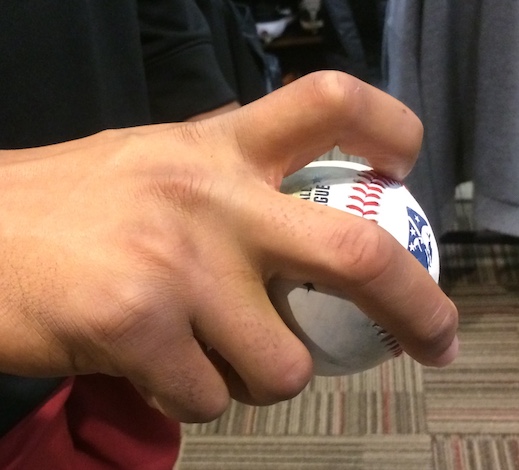
“I learned my curveball in college. Rice is a big breaking ball school — at least it was when I was there — and depending on where you are, you call it a different thing. It’s a spiked curveball, but I know that at Southern Miss, they call it a Rice slider. Essentially, it’s just a concept where you’re looking for this general break. You spike the curveball, with the idea being that you want something hard, with depth.

Jon Duplantier’s spiked curveball grip

“My freshman year, I threw a slurve. The velocity on it was fine — it was 76-78 [mph] — but I would lose feel for it every now and then. When I’d lose feel for it, teams would start sitting on my heater. Read the rest of this entry »


Effectively Wild Episode 1352: Season Preview Series: Red Sox and Orioles

EWFI
Ben Lindbergh and Sam Miller banter about Willians Astudillo making the Twins’ Opening Day roster, whether Astudillo’s uncanny ability to make contact is more mental or physical, and what Oliver Perez and the rest of the remaining LOOGYs can do to preserve their endangered places on major-league rosters when the three-batter minimum goes into effect in 2020, then complete the 30-team preseason series by previewing the 2019 Boston Red Sox (18:40) with Boston Globe reporter Alex Speier, and the 2019 Baltimore Orioles (53:12) with MLB.com Orioles beat writer Joe Trezza.

Audio intro: The Weakerthans, "The Last Last One"
Audio interstitial 1: Guided By Voices, "Alex and the Omegas"
Audio interstitial 2: Chip Taylor, "Nine Soldiers in Baltimore"
Audio outro: Neil Young, "No More"

Link to Rob’s article about endangered LOOGYs
Link to SI article about endangered LOOGYs
Link to Ben on early-season Sale vs. late-season Sale
Link to Ben on champions standing pat and the Boston bullpen
Link to Ben and Baumann on the MLB extension spree
Link to listener’s minor-league free agent tracker
Link to Banished To The Pen’s team preview posts
Link to preorder The MVP Machine

 iTunes Feed (Please rate and review us!)
 Sponsor Us on Patreon
 Facebook Group
 Effectively Wild Wiki
 Twitter Account
 Get Our Merch!
 Email Us: podcast@fangraphs.com


Rick Ankiel, Comeback King?

Baseball is a game of failure, forcing players to find, utilize, and ultimately rely on their strengths. It is hard to find someone who exemplifies that more than Rick Ankiel. He pitched for the Cardinals in 2000 and was so good that he finished second in Rookie of the Year voting. Then the NLDS came along and Ankiel could not throw strikes. He gave up four runs on two hits, four walks, and five wild pitches. It could have been a fluke, just the nerves of his first postseason appearance, pitching against Greg Maddux, no less. Totally understandable, except he could not get through the first inning of his next start. It was the second game of the NLCS and Ankiel was pulled after twenty pitches, five of which went to the backstop.

Things never got much better. In 2001, he threw 24 major league innings and walked 25 batters. He was demoted all the way to Rookie League that year, sat out the 2002 season, then had Tommy John surgery in 2003. He returned as a reliever in 2004 and posted a 4.75 FIP in ten innings. Things were bleak until the Cardinals offered to play him at a different position. Rick Ankiel came back in 2007 as an outfielder and he was good! He was known for making unbelievable throws, but also managed to hit 74 home runs during his seven seasons. Not bad for a former pitcher. He retired after the 2013 season, having made a comeback for the ages.

And he wants to do it again.

Rick Ankiel is working to return to the majors as a left-handed reliever at age 39. He played in one game during the Bluegrass World Series last year, where he racked up two hits and four RBI in four plate appearances, not to mention that he threw out a runner at the plate. But then, he did the one thing few people ever thought he would do again: he took the mound. He only faced one batter, but he struck him out on four pitches. It was enough for Ankiel to wonder whether he could get a chance to once again experience the game from at the position that had been so cruel to him.

All of this is bananas. The astonishingly quick rise and then fall from pitching stardom. Reinventing himself as an outfielder. Succeeding in the major leagues for seven seasons after contemplating retirement. As if that was not challenging enough, last October Rick Ankiel had an ulnar collateral ligament repair with internal brace construction. A UCL tear generally results in Tommy John surgery, which has a 12 to 18 month recovery time. If Ankiel had required another Tommy John, any potential comeback would have been pushed into his age-40 season and, as he mentioned on a recent Cardinals spring training broadcast, likely would not have happened at all. “If it had been a total reconstruction, he said, “I probably would’ve passed and just moved on. I would’ve missed all this year and then we’re all the way to next spring training and that’s just a long time.” When I heard Ankiel’s interview, I wondered whether primary repair surgery would help or hinder his comeback effort, and went searching for an answer.

Primary repair surgery is still fairly new. The first major league pitcher to have it was Seth Maness during the 2016 season. There is very little data about how it compares to Tommy John and not all UCL tears are eligible for primary repair. If a ligament is torn in the middle, a player will require Tommy John which involves creating a new ligament out of tissue taken from another part of the body. If it is torn near the bone, however, primary repair comes into play. It involves minor repairs and providing a sort of abutment around where the ligament is anchored to the bone. The recovery timeline ranges from seven to nine months, or nearly half of what it takes to rehab from the Tommy John procedure.

Seth Maness is the only case study I could find at the major league level. He is not a one-to-one comparison, since his arm had gone through about four major league seasons while Ankiel’s played somewhere around nine. Given Ankiel’s 2003 Tommy John, his surgeon actually repaired a reconstructed ligament. There are a lot of questions and variables to consider.

First, let’s take a look at Maness’s numbers before and after his surgery. He hit the “dead arm” phase in 2016, so the data below includes the 2014 and 2015 seasons, plus the 2017 season following his surgery, which would parallel Ankiel’s planned return. The sample size from the major leagues in 2017 is small, so our conclusions will rely heavily on Maness’s time with the Royals’ Triple-A affiliate.

Seth Maness Pre- and Post-Primary Repair
Season IP K/9 BB/9 AVG FIP GB% FB% Pull% Oppo%
2014 80.1 6.16 1.23 .253 3.38 56.0% 25.1% 37.8% 26.9%
2015 63.1 6.54 1.85 .301 3.78 55.9% 25.0% 37.6% 22.9%
2017 (MLB) 9.2 3.72 1.86 .372 6.99 51.3% 23.1% 38.5% 20.5%
2017 (AAA) 47.0 6.70 1.53 .318 4.74 47.2% 34.6% 37.4% 31.9%

The first thing that pops out are the consistencies. Maness’s strikeout rate in the minor leagues was consistent with what it had been during the 2014 and 2015 seasons. Hitters continued to pull the ball at the same rate, and the number of walks he issued was fairly similar as well. These are good signs.

However, Maness relied heavily on groundballs for his success. It felt like every time he was on the mound, he would induce a double-play. His groundball percentage dropped significantly, 4% in the majors and 9% in the minors. Naturally, his flyball rate jumped, rising to 9% in the minor leagues. His FIP jumped an entire point from 2015 to 2017, as he relied increasingly on the defense behind him. He also lost about two miles per hour on his sinker, slider, and fastball during the 2016 season. He never regained that velocity. If Ankiel wants to be major-league ready, he will need one of these secondary pitches. Can he avoid the slowdown that plagued Seth Maness? Only time will tell.

Maness was released by the Royals in 2018 and currently plays in the Atlantic League. He never quite regained the effectiveness he had prior to the injury. That said, it does not spell disaster for Rick Ankiel.

First, Ankiel relied more on strikeouts than groundballs, which may surprise some given his difficulty throwing strikes. While the outcome Maness relied on took a hit, his strikeout rate held fairly steady. His ability to put the ball in the zone was not impacted, which is obviously great news for Rick Ankiel. Second, Maness relied most heavily on his sinker, then fell back on his changeup or fastball when needed. Ankiel has said he would rely on a curveball and high fastball. Maness did not have a curveball so there is no available data to compare. As for the fastball, there was a dip in velocity which is cause for concern.

Things are looking up since Ankiel hit 89 mph in the Bluegrass World Series last year when he was not even “in pitching shape.” That outing, such as it was, also occurred before the primary repair surgery, so the ligament was weakened. That velocity tops Maness’ fastball average at 88 MPH in 2017. However, because Ankiel has historically been more reliant on this pitch, he will need to achieve a significant uptick in velocity (or undergo a significant change to his repertoire) in order to compete, especially because he wants to compete not only in the minor leagues as Maness did, but in the majors.

Finally, though it is difficult to isolate the surgery’s effect, it did not appear to increase the rate at which Maness walked hitters. He was not suddenly wild, nor did his control evaporate. After the onset of the yips, Ankiel could rarely throw strikes. If he has overcome the anxiety, which he says he has, then it all comes down to his ability to control the location of his pitches. Can he do that as effectively as he did in 2000? The answer is yet to be determined, but using Seth Maness as a case study indicates that the primary repair surgery may not necessarily be what undermines Ankiel’s pitch control.

The only narrative in sports that is better than a comeback story is a second comeback. It’s something fans tend to root for. The first time he was challenged in this sport, Ankiel’s solution was to climb a different mountain, and conquer the outfield instead of the pitching mound. This time, things will likely be harder. There are many questions yet to be answered, questions that we would have even without the additional red flag of a surgery. The chances here are remote. Could this be the year he overcomes the very problem that hindered him in the first place? That remains to be seen, but Seth Maness provides a hopeful if narrow blueprint for Rick Ankiel’s return to the major leagues, or at least, he offers a limited answer on one important part of Ankiel’s journey that could hold him back. I sure hope he makes it.


Justin Verlander Extends into Record Territory

Where Chris Sale’s extension provides a long-awaited windfall for a pitcher who has been significantly underpaid for years, Justin Verlander’s puts him back near the top of the pay scale. The 36-year-old Astros righty, who could have become a free agent after this season, has agreed to a two-year, $66 million extension that will take him through the 2021 season. The deal’s $33 million average annual value surpasses that of every pitcher but Zack Greinke, whose $34.417 million per year actually has an AAV of just $32.5 million for Competitive Balance Tax purposes.

Verlander is currently in the final guaranteed year of a seven-year, $180 million extension that was the largest ever for a pitcher at the time it was signed with the Tigers in March 2013. That deal surpassed the seven-year, $175 million pact of Felix Hernandez, and trailed only Roger Clemens’ one-year, $28,000,022 million contract for 2007 in terms of AAV. Clayton Kershaw, Max Scherzer, David Price, and Greinke have since surpassed both the size of Verlander’s old deal and the AAV of Clemens.

What’s keeping Verlander near the top of the pay scale, of course, is performance. Thanks in part to an increase in slider usage and an accompanying decrease in the pitch’s velocity — producing a larger separation from a fastball that still averages 95.4 mph according to Pitch Info — he’s pitching about as well as he has at any point in his 14-year major league career. In 2018, his 214 innings, 290 strikeouts, 34.8% strikeout rate, 30.4% K-BB%, and 6.7 WAR all led the American League, while both his 2.52 ERA and 2.78 FIP ranked third. His strikeout total set a career high and marked the fifth time he’s led the league, while his strikeout and walk rates (4.4% for the latter), their differential, and his FIP were all career bests. His ERA was his lowest mark since 2011, when he won both his lone Cy Young award and the AL MVP, and his WAR was his highest mark since 2012. For the second time in three years, and the third time in his career, he finished as the runner-up in the Cy Young race.

Over that 2016-18 span, a period that represents a rebound from a two-year dip that suggested his time as an ace had passed, Verlander led the majors in starts (101) while ranking second in innings (647.1), third in strikeouts (763), fourth in WAR (16.3), and fifth in K-BB% (23.1%). His surge has pushed him past the 200-win mark and towards the 3,000 strikeout milestone (he’s at 2,706) while strongly advancing his Hall of Fame case (he could surpass 2019 honoree Roy Halladay in the JAWS rankings this year). His return to ace form helped the Astros win their first World Series in 2017 — Verlander pitched to a 2.21 ERA in five starts and one relief appearance that fall, winning ALCS MVP honors — and set a regular season wins record (103) in 2018 while advancing to the ALCS.

With the Astros geared to contend for another championship, it’s no wonder that they want to keep the pitcher, whose August 31, 2017 arrival from the Tigers helped put them over the top, around for even longer, and it’s no wonder he wants to stay. “I wasn’t scared of free agency or what’s going on. I just thought this was a good situation,” Verlander said on Sunday. “If it ain’t broke, don’t fix it.”

The Astros aren’t broke or broken, but nonetheless, Verlander’s wording is striking, because in February, while the free agencies of Bryce Harper and Manny Machado appeared to be stalled, and so many other players were unsigned, he was openly critical of the current state of affairs, calling the system “broken.”

Verlander isn’t the only star who has expressed concern about the state of free agency this winter on Twitter. Jake Arrieta (here), Sean Doolittle (here), and Evan Longoria (here) come to mind as well, and many more have made their feelings known through reporters when it comes to the inefficiencies in the game’s economic structure. One can read Verlander’s decision to re-sign with the Astros as wariness of entering the free agent market, but as with Sale re-upping in Boston, it’s not hard to imagine either player looking at their current surroundings, seeing a perennial contender awash in resources, and deciding that they were in no hurry to depart, particularly while being well-compensated for staying.

For the players’ union, the decisions of Verlander, Sale, Nolan Arenado, Paul Goldschmidt, and Mike Trout to sign extensions with their current teams means fewer stars are available to raise the bar salary-wise in free agency since no other team is bidding directly on those players’ services. But this isn’t exactly new. According to Cot’s Contracts, 15 of the 30 largest contracts of all time (unadjusted for inflation) were signed as extensions, and the same is true for 15 of the top 29 (or 16 of the top 33, since four players are tied for 30th) in terms of AAV, with the aforementioned players near the top of at least one of the two lists. Adjusted for inflation (by Craig Edwards’ methodology), it’s 10 of the top 25 for the former.

For teams in search of that missing piece in free agency, the thinner inventory means a lower likelihood of wild spending, and could lead to changes in roster management strategies. Hypothetically speaking, if the Astros entertained thoughts of pursuing Sale — a dominant pitcher six years younger than Verlander — after this season, their desire to extend Verlander might be higher once the apple of their eye is off the market. In that light, will be interesting to see, for example, how the Yankees treat Aaron Judge (whom they’re said to want to extend) now that they know they won’t have a shot at Trout.

As it is, the free agent market after this season could still include Verlander’s teammate, Gerrit Cole; while he’s an extension candidate, recent talks between the Astros and his agent, Scott Boras, reportedly didn’t get far. Madison Bumgarner, Rick Porcello, Hyun-Jin Ryu, Zack Wheeler head the pitchers’ list, with Jake Arrieta, Yu Darvish, and Stephen Strasburg all holding opt-outs, and pitchers such as Chris Archer, Corey Kluber, and Jose Quintana having club options.

That actually looks like a deeper market than this winter, where Partrick Corbin, the still-unsigned Dallas Keuchel, Nathan Eovaldi, and Charlie Morton were the top starters on our Top 50 Free Agents List. But if, in theory, a lesser inventory isn’t just a cyclical development, well, it’s difficult to imagine too many fans bemoaning the decline of free agency as we know it, given the tendency of beloved homegrown players to depart for bigger-spending teams. Then again, one can only hear so many Twins fans complain about the salary of Joe Mauer or Reds fans about that of Joey Votto before wishing that those two stars had gotten their chances for even bigger paydays from the likes of the Yankees, Red Sox, Dodgers, or Cubs. Of course, the real issue is the expectation and tendency of teams to pay free agents for what they’ve already accomplished, rather than what they will accomplish; the players’ need to cash in given their vast underpayment (relatively speaking) in their pre-free agency years. Getting back to Verlander’s point, that’s quite clearly a system in need of a fix.

As for Verlander, the $66 million isn’t unreasonable as far as paying for what he might yet accomplish. He’s projected to produce 5.2 WAR this year according to our depth charts projections, and if we simply presume a half-win annual drop-off from there, and apply the conservative assumptions about the market ($8 million per win for this winter, with 3% inflation) that I’ve used in examining other extensions, that’s already an estimate of $74.4 million worth of production via 8.9 WAR. The break-even point under those conditions is about 8.0 WAR, and less if the dollars per win rate is higher. This isn’t that complicated.

For the Astros, retaining Verlander means guaranteeing the presence of at least one front-of-rotation type beyond this season, important given Cole’s pending free agency. The current unit is rounded out by Collin McHugh, Wade Miley, and Brad Peacock, all solid but unimposing, with prospects Forrest Whitley (number four on our Top 100 Prospects list), Joshua James (number 98) and Framber Valdez waiting in the wings, and Lance McCullers Jr. out for the year due to Tommy John surgery. Even with Verlander in the fold, that’s a lot of uncertainty heading into 2020. Meanwhile, Keuchel, a mainstay of the Astros’ rotation from 2012-18, remains a free agent.

So the Astros will have more to sort out regarding their rotation even having taken care of business with Verlander. Nonetheless, they’ve locked up one of the best in the game at a price that he should be pleased with.