At last we reach the end of my annual series spotlighting the weakest positions on contending clubs. While still focusing upon teams that meet that loose definition of contenders (Playoff Odds of at least 10% when this series began), I’ve also incorporated our Depth Charts’ rest-of-season WAR projections into the equation for an additional perspective. Sometimes that may suggest that the team will clear the bar by a significant margin, but even so, I’ve included it here because the team’s performance is worth a look.
At the other positions in this series, I have used 0.6 WAR or less thus far — which prorates to 1.0 WAR over a full season — as my cutoff, but for the designated hitters, I’ve limited the list to the teams below zero, both to keep the length manageable and to account for the general spread of value. In the fifth full season of the universal DH, 0.2 WAR represents the current median, with 11 teams below zero, 12 between zero and 1.0, and just seven with 1.0 or more, with only five reaching 2.0. DHs as a group have hit .244/.325/.422 for a 106 wRC+ this season, down four points from last year’s final mark, the highest since the adoption of the universal DH.
It does appear that an increasing number of teams are investing more playing time in a single DH. From 2022 (the first full-length season with the universal DH) to ’25, the number of players reaching 450 plate appearances in the DH role increased from three to four to seven to nine; this year, they’re on pace for nine, as well. That said, all but one of the teams on this list are the ones that haven’t found that special someone to take the lion’s share of the plate appearances. Read the rest of this entry »
For the second time in his four-month-old major league career, Konnor Griffin is headed to the injured list. On June 26, the Pirates shortstop returned from a month-long IL stint due to a low-grade flexor strain in his right forearm. He didn’t miss a beat, running a 115 wRC+ and recording four two-hit games in an eight-game span.
But the triumphant return was short-lived. On Sunday’s game against the Nationals, Griffin hurt his glove hand trying to make a diving stop on a Keibert Ruiz grounder up the middle. He told reporters after the game that he was fine, but imaging revealed a tear in the sagittal band of his left ring finger. The team expects him to miss eight to 10 weeks, which would put him on track for a return around early September. This is a major bummer for Griffin, whose career is off to a brilliant, but sputtering start. It’s a major bummer for the Pirates, who sit just three games out of the final Wild Card spot. And it’s a bummer for baseball, as Griffin is one of the game’s most exciting and promising young players.
Paul Skenes turned in his last truly dominant start on May 12 at home against the Rockies. He threw eight shutout innings, allowed just two hits and no walks, and notched 10 strikeouts. Since then, Skenes has posted a 5.36 ERA over 47 innings. He’s gone fewer than six innings in six of his last nine starts, and seven of his 11 home runs allowed on the season have come during that same span.
It’s safe to say Skenes has been missing a certain je ne sais quoi on the mound over the last month and a half. And I say je ne sais quoi, which literally translates to, “I don’t know what,” because there are competing theories about what, if anything, is actually wrong with him. Some blame poor defensive play behind him and point to his expected stats as proof of unfortunate batted-ball luck. Some say it’s a mechanical issue, while others fear he’s pitching through a physical ailment.
It’s true that Skenes has been on the mound for several obvious defensive gaffes. Everyone remembers Opening Day and the bases-loaded fly ball that center fielder Oneil Cruz lost in the sun. The misplay turned a would-be sac fly into a bases-clearing triple. Fast forward to last week, when third baseman Nick Gonzales allowed two runs to score after his throw home on a bases-loaded grounder hit the runner, and it’s pretty easy to assume the defense behind Skenes has been letting him down all season. The numbers support the impression left by those glaring blunders. Overall, Pittsburgh’s defense has been worth -18 fielding runs (fifth worst in the majors). With Skenes on the mound, the Pirates have posted -7 FRV, which is tied for the worst defensive showing behind any pitcher this season. Moreover, most of that negative defensive value (-5 FRV) has come during his skid. Read the rest of this entry »
It has not been a good season for Trea Turner. The two-time batting champion is in the midst of a career-worst season at the plate, hitting for a 79 wRC+ (.239/.287/.368) even after homering in three straight games, including a three-run shot off Pirates ace Paul Skenes on Wednesday night. What’s more, after breaking a streak of three straight below-average seasons at shortstop according to both Defensive Runs Saved and Fielding Run Value last year, he’s not only back in the red, but is tied for last at the position with -8 DRS, while being tied for fifth-worst with -5 FRV. All of which once again marks Turner as a fairly typical Phillies player.
Indeed, through ups and downs that have included four postseason appearances, one trip to the World Series, and two in-season managerial firings, one constant of the Dave Dombrowski era of Phillies baseball has been lousy defense. Since the start of the 2021 season, the team is 100 runs below average according to FRV (the majors’ seventh-lowest mark) and 127 below average according to DRS (fifth-lowest). It hasn’t stopped the Phillies from being competitive — or highly entertaining — though it may have cost them seeding here and there, to say nothing of the way last year’s Division Series against the Dodgers ended. But given the choice between good hitters with questionable gloves and slick fielders with subpar bats, the team has generally gone for the offensive boost and lived or died with the consequences.
Thus it was hardly a surprise that the Phillies ranked second-to-last in my recent aggregation of team defensive metrics, even with right fielder Nick Castellanos — who contributed -41 DRS and -45 FRV from 2022–25 before being released in February — no longer on the team, and Kyle Schwarber more or less a full-time designated hitter. The Phillies’ .672 Defensive Efficiency, the rate at which a team turns batted balls into outs, is lower than all but the Rockies (.669), while their -29 DRS is lower than all but the Twins’ -32. Read the rest of this entry »
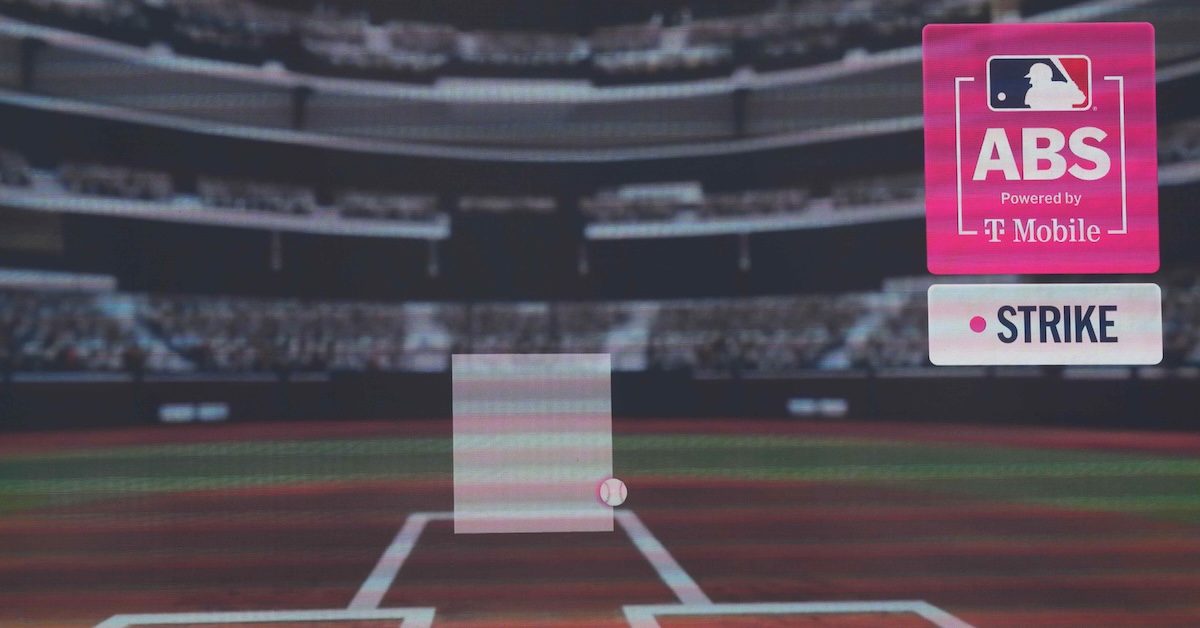
On April 15, Zach Neto was at the plate with one out and nobody on in the top of the fifth inning of the Angels’ game in the Bronx, where his team trailed the Yankees, 3-2. The first two pitches, a low changeup and a high slider, were nowhere near the zone, and Neto laid off easily. The 2-0 pitch from Luis Gil was another slider, this one about belt high and bending away from the right-handed Neto, who kept the bat on his shoulder and watched as the pitch appeared to clip the outside edge of the zone. Home plate umpire Lance Barksdale held up his hand. Strike one. Neto tapped his helmet immediately to challenge the call.
The graphic on the gigantic video board in center field showed that the pitch had missed by 0.4 inches. The call was overturned; the count was now 3-0. Neto walked on the next pitch. Mike Trout stepped in, took a fifth straight ball from Gil, then let a four-seam fastball over the heart of the plate get deep on him. He unloaded, clobbering the cookie 383 feet into the right field seats for a go-ahead two-run blast.
The no-doubt Trout clout would have been the decisive blow in an Angels win if not for a misplayed popup and a Jordan Romano meltdown. The Yankees walked it off on a José Caballero single, relegating Neto’s challenge to a footnote in that night’s game story, if it was mentioned at all. Even so, the gamble was an early example of how the new automated ball-strike challenge system can make the difference between winning and losing a game. Read the rest of this entry »
Once in a while, a player gets to walk off into the sunset at the height of his game. Ted Williams and David Ortiz are two examples of Hall of Famers who retired while still stars. But most players, even many greats, don’t see their careers end on a high note. That much larger list includes Andrew McCutchen, who was released by the Texas Rangers in late May after hitting .197/.277/.260 in 37 games as a part-time designated hitter/outfielder. There’s still a possibility that McCutchen catches on with another team this season as a spare bat off the bench, but in any case, we’re likely seeing the last throes of his career. Time always wins in the end, so this discussion was inevitable, but a decade ago, it looked like this conversation would have Cooperstown-related content.
Going back to early 2016 in the time machine, Andrew McCutchen was a very different player. Still in his 20s, he was a five-time NL All-Star coming off four consecutive Silver Slugger awards and four top-five finishes in the NL MVP balloting, including a win in 2013. It was a better time for the Pittsburgh Pirates as well, having just made the playoffs for the third straight season, winning 98 games in 2015 before being unceremoniously eliminated by the Cubs in the Wild Card game. Always at risk of losing their stars to teams more willing to pay them, the Pirates didn’t have to worry about that yet with McCutchen, who still had three more years to go in Pittsburgh, thanks to the six-year, $51 million extension (with a team option for a seventh year) that he had signed before the 2012 season.
At this stage, McCutchen appeared to be on a pretty good Hall of Fame trajectory. After seven seasons, Cutch was entering his age-29 campaign having already tallied 41 WAR with a .298/.388/.496, 144 wRC+ career line while playing center field. On a historical level, these numbers were quite competitive with some of the best young center fielders in MLB history. Look at how prominently he featured on the leaderboard through his age-28 season:
Note that Mike Trout would eventually move up to third on this list; 2015 was only his age-23 season! It’s also weird to see Rickey Henderson here, but he played mostly center field for the Yankees in 1985-1987, and so he qualified in our database.
Anyway, that’s impressive company, and the vast majority of these players are Hall of Famers or will end up there eventually. ZiPS at the time saw no reason to be particularly suspicious of McCutchen’s performance, and without any red flags, was happy to project him with a fairly typical decline phase for a star outfielder.
ZiPS Time Warp – Andrew McCutchen (Through 2015)
Year
BA
OBP
SLG
AB
R
H
2B
3B
HR
RBI
BB
SO
SB
OPS+
WAR
2016
.293
.392
.493
550
89
161
33
4
23
89
84
118
14
146
5.7
2017
.292
.391
.501
527
85
154
33
4
23
87
80
112
12
148
5.4
2018
.292
.391
.497
511
81
149
31
4
22
84
78
107
12
147
5.2
2019
.287
.384
.486
494
76
142
30
4
20
78
72
101
11
142
4.5
2020
.285
.379
.468
470
70
134
27
4
17
71
67
90
10
136
3.8
2021
.285
.377
.462
446
64
127
25
3
16
65
61
82
9
134
3.4
2022
.279
.366
.446
419
58
117
22
3
14
60
53
71
8
126
2.6
2023
.274
.353
.425
391
50
107
20
3
11
52
43
61
7
117
1.7
2024
.268
.339
.414
362
43
97
17
3
10
46
35
53
6
110
1.0
2025
.261
.328
.387
333
37
87
14
2
8
39
29
45
4
100
0.3
2026
.254
.314
.365
307
32
78
12
2
6
34
23
38
4
90
-0.3
2027
.248
.304
.342
234
23
58
8
1
4
23
16
28
3
81
-0.7
2028
.246
.296
.339
171
15
42
5
1
3
16
10
19
1
78
-0.8
RoC Proj.
.279
.365
.448
5215
723
1453
277
38
177
744
651
925
101
126
31.7
RoC Actual
.248
.344
.420
4558
659
1129
217
11
182
599
649
1136
66
108
10.9
Career Proj.
.287
.375
.469
9080
1362
2604
513
77
328
1302
1194
1704
255
134
72.7
Career Actual
.271
.364
.455
8423
1298
2280
453
50
333
1298
1192
1915
220
124
51.9
As it turned out, 2015 was McCutchen’s last 4-WAR season, and in only one season was he better than 2 WAR (3.6 WAR, 2017) over the next decade. While ZiPS didn’t have any illusions that McCutchen would stay a superstar for another decade, it didn’t expect him to hit a more drastic decline until the early 2020s. Sticking in center for a few more years, with a projected 2,600 hits, 72.7 WAR, and 333 home runs, when combined with his peak, I think this McCutchen would’ve made the Hall of Fame, though it probably would’ve taken him several years on the ballot to creep over the 75% line.
It’s hard to point to the obvious reason for his premature decline. The 2016 campaign was his worst season in the majors at that point, marred by a down June/July while he was playing through a severely jammed thumb. But that wasn’t thought to be a long-term problem, and his offense did bounce back to a degree for the next few seasons. His defense was already trending downward, but he was hardly slow, and, except for 2020 when he was coming back from a torn ACL that prematurely ended his 2019 campaign, he stayed above the 90th percentile in sprint speed through the 2022 season. His contact rate declined, but he still maintained his solid plate discipline and his hard-hit rate remained steady.
I don’t believe McCutchen’s going to do well when he hits the Hall of Fame ballot, but I think the version that we got might be too easily dismissed. He only ranks 30th in Jay Jaffe’s JAWS for center fielders, a place where most players do not get into the Hall. He does fare better using FanGraphs WAR, however, both in seven-year peak fWAR and in fJAWS. McCutchen ranks 13th in peak fWAR among center fielders, compared to 24th in Baseball Reference’s version.
Using FanGraphs WAR, McCutchen ranks 19th among center fielders in JAWS rather than 30th, and that ranking is strong enough that I think you at least need to have a conversation about his Hall of Fame suitability. As noted above, I’m not optimistic; the writers gave very little attention to Jimmy Wynn (19th), Kenny Lofton (12th), and Jim Edmonds (11th), while it took nine ballots to induct Andruw Jones (eighth). McCutchen had a huge peak, but the freshest memories of him will not be of that peak, but of his decade as a middling DH/corner outfielder.
If this is actually the end for Andrew McCutchen, he shouldn’t be remembered for coming up short of Cooperstown. For the better part of a decade, he was one of the very best players in baseball, the biggest name in a Pirates revival that briefly made Pittsburgh feel like a big baseball city again. The second half of his career didn’t dazzle like the first, but he did more than enough to be remembered as something greater than merely a very good player who got old quickly.
I don’t know how much attention Braxton Ashcraft wants in his life, but he must be either fuming at his lack of recognition or thrilled to be left alone. As much ink has been spilled on the Pirates this year, only some of it has gone to their starting rotation, as opposed to Konnor Griffin or the team’s new cadre of veteran bats. Of that fraction, Paul Skenes dominates the headlines, followed by the talented but frustrating Bubba Chandler, the newly returned Jared Jones, and the occasionally truantCarmen Mlodzinski.
But as of this writing, Ashcraft is in the top 10 in baseball in pitcher WAR, trailing Skenes by only a tenth of a win. And this on the heels of Saturday’s loss to the Braves, in which Ashcraft surrendered nine hits and six earned runs in five innings. I wouldn’t be especially worried; it’s only Ashcraft’s second bad start out of 13, and the Braves will do worse to better pitchers before the season’s out.
Ashcraft was a pretty big prospect: A second-round pick out of a Waco, Texas-area high school in 2018, and the no. 60 overall prospect heading into last season. And he pitched quite well as a rookie in 2025, with a 2.71 ERA and 2.78 FIP in 69 2/3 innings, split more or less evenly between the rotation and the bullpen. So it’s not like he came out of nowhere, but he would’ve been third-favorite for the role of Skenes’ sidekick if you’d asked around a year ago. Read the rest of this entry »
Below is an analysis of the prospects in the farm system of the Pittsburgh Pirates. Scouting reports were compiled with information provided by industry sources as well as my own observations. This is the sixth year we’re delineating between two anticipated relief roles, the abbreviations for which you’ll see in the “position” column below: MIRP for multi-inning relief pitchers, and SIRP for single-inning relief pitchers. The ETAs listed generally correspond to the year a player has to be added to the 40-man roster to avoid being made eligible for the Rule 5 draft. Manual adjustments are made where they seem appropriate, but we use that as a rule of thumb.
A quick overview of what FV (Future Value) means can be found here. A much deeper overview can be found here.
All of the ranked prospects below also appear on The Board, a resource the site offers featuring sortable scouting information for every organization. It has more details (and updated TrackMan data from various sources) than this article and integrates every team’s list so readers can compare prospects across farm systems. It can be found here. Read the rest of this entry »
Josh Bell has hit 200 home runs since reaching the majors in 2016, with 198 of them coming in the regular season and the other two coming in October. Which of them is the most memorable? I asked the Minnesota Twins first baseman/DH that question prior to a recent game at Fenway Park.
“The first one [on July 9, 2016] is probably my favorite,” replied Bell, who spent his first five seasons with the Pittsburgh Pirates. “The grand slam. It was my second day in the big leagues, and I’d gotten a hit the night before, pinch-hitting, so I was batting 1.000. Bases loaded, Adam Warren [on the mound], a Cubs-Pirates rivalry game at PNC on a Saturday night. The place was packed. The ball leaves my bat and I know that it’s gone. My parents were there, too — I gave them the ball — so that one was definitely special. It’s something I’ll never forget.”
A first home run, be it a grand slam or a solo shot, is going to be a favorite for most players. But there will be others that stand out as well, and in Bell’s case, a few of them are Statcast outliers. We’ll get to those in a moment. Read the rest of this entry »
I don’t pay too much attention to the standings in April. I look at them, of course, but that’s more a matter of routine than a desire to learn something substantial. It’s hard for teams to pull ahead of the pack this early in the season, and I’d rather not read too much into the fact that, say, the banged-up Blue Jays are a few games below .500, or that none of the five teams in the NL Central has a losing record. It takes time for these things to sort themselves out.
And yet, upon checking the standings Friday morning, I found myself pondering the significance of what I saw: specifically, that only three teams in the American League had a winning record. After a dizzying 20 minutes of digging, I lifted my head from my laptop in a daze, wondering how the heck I ended up staring at Baseball Reference’s playoff odds for the 14-18 White Sox. I think seeing the number 16.1% is what snapped me out of my stupor. (For what it’s worth, our Playoff Odds gave the South Siders a 2.2% chance to make the postseason, double their odds on Opening Day.) Anyway, about those three AL clubs above .500, the Yankees (20-11) were expected to be one of the best teams in baseball, so their place atop the standings wasn’t surprising, but the strong starts of the Rays (18-12) and Athletics (17-14) caught me a bit off guard. I thought Tampa Bay was destined for last place when the season began, and our Playoff Odds agreed, projecting the team to finish with 79.7 wins and giving it a 28.9% shot to reach the postseason. Entering May, the Rays have only added about two wins to their median projection (81.9), but they now have a 45.6% chance of making the playoffs. Meanwhile, I believed the A’s would be better this year, but better meant maybe a third-place finish in the AL West and an outside shot to snag the final AL Wild Card spot. Still, I figured they were more likely still a year or two away from true contention. Our preseason Playoff Odds tabbed them for 78 wins and a 21.4% shot at the playoffs. Now, they’re up to a projected 81.3 wins and 43.1% odds. I still don’t think either team will play postseason baseball this year; according to both their Pythagorean and BaseRuns records, the Rays have played more like a .500 team than one that’s on pace to win 97 games, while the A’s simply don’t have enough pitching. Remember, it’s only the start of May. There’s so much more baseball still to be played.
OK, that’s enough about the Rays and A’s in this week’s mailbag. Today, we’ll be answering your questions about how good Shohei Ohtani would be at basketball, whether James Wood is one of the best lefty batters ever at hitting the ball the other way, which batter has the most hits against a pitcher without recording an out, and what would happen if ZiPS forgot about 2020. But before we get to all of that, I’d like to remind you that this mailbag is exclusive to FanGraphs Members. If you aren’t yet a Member and would like to keep reading, you can sign up for a Membership here. It’s the best way to both experience the site and support our staff, and it comes with a bunch of other great benefits. Also, if you’d like to ask a question for an upcoming mailbag, send me an email at mailbag@fangraphs.com. Read the rest of this entry »