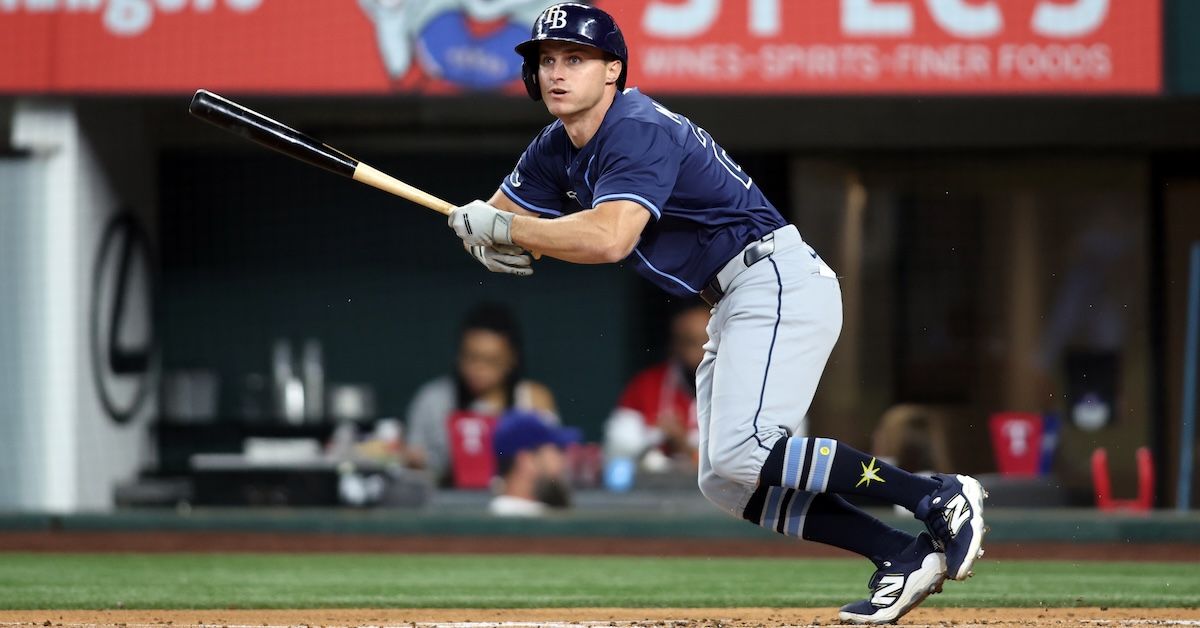
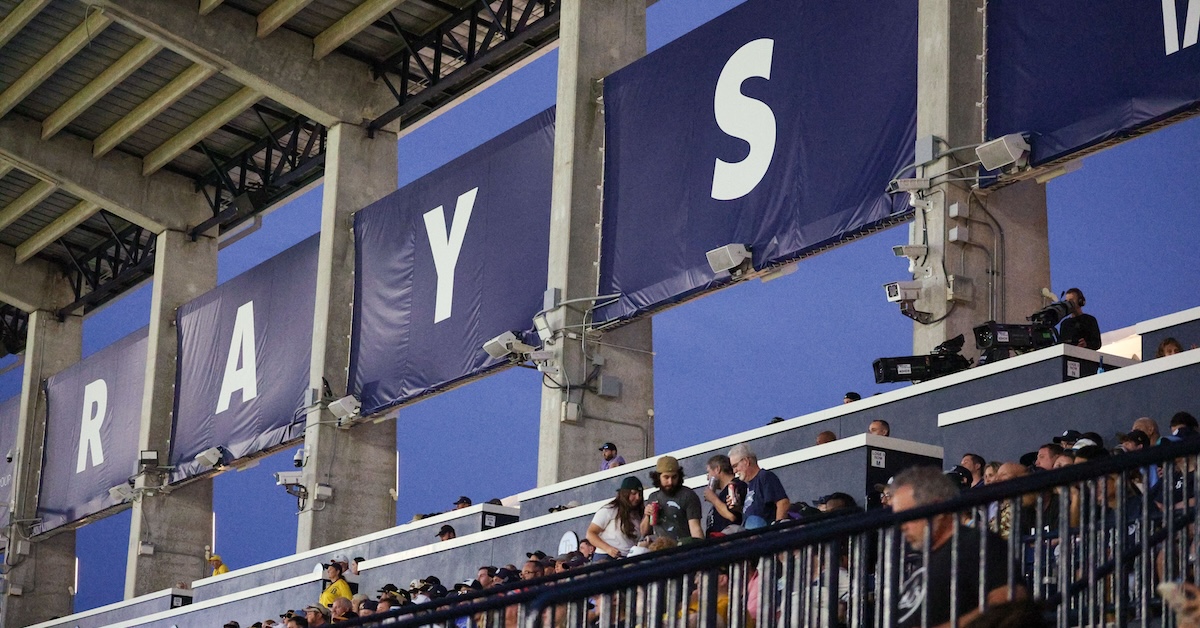
The SEC’s all-time hit king made his major league debut this week, to almost no fanfare. In some respects, the Tampa Bay Rays are a step down for Jake Mangum. The Rays currently play at Tampa’s Steinbrenner Field, capacity just over 11,000, while they await disposition after Hurricane Milton took the roof off the Trop last offseason.
Mangum played his college ball at Mississippi State, whose ballpark, Dudy Noble Field, holds 15,000, with a record attendance of 16,423 cowbell-whacking, barbecue-devouring maniacs. It’s one of the most electrifying (in good times) and demanding (in bad) environments in all of college sports. To someone who’s played at The Dude, as Mangum has, even the most raucous major league crowd probably feels like a Presbyterian church. Read the rest of this entry »
Department: Baseball Systems Location: St. Petersburg, FL/Remote/Hybrid Reports to: Director, Baseball Systems Applications
Description:
The Tampa Bay Rays are looking for an experienced Frontend Developer to contribute to the development of analytics, scouting, and player development software. As part of Baseball Operations, our Baseball Systems team builds the tools that our players, coaches, analysts, scouts and front office personnel use to do their jobs and inform decisions. Our team consists of data engineers, backend developers, frontend developers, and coordinators. Moreover, every line of code we write — and feature we ship — helps contribute to our ability to stay competitive year after year.
We are looking for someone who:
Has a minimum of 5 years’ experience on the frontend.
Possesses expert-level knowledge of JavaScript. (We use Stimulus for interactive elements, and Vue 3 for any SPA-type features)
Has a demonstrated eye for UI/UX and good design.
Prioritizes well-tested code to ensure reliability and maintainability.
Preferred qualifications:
Strong experience with Three.js and / or D3.
Has backend experience. We use Ruby on Rails.
General baseball knowledge.
What will you do each day?
Build new features or maintain existing features in our proprietary software application.
Identify and correct bugs quickly.
Document code and support procedures thoroughly.
Meet with Baseball Operations staff that have requested a new feature to gather requirements and help with feature planning.
Train non-technical users on new features or applications.
Work in an innovative and collaborative front office where your ideas will be heard and valued.
Why work for the Rays?
A top-tier development environment with a company provided laptop, Github Enterprise, frictionless CI/CD, bug tracking, top project management and documentation software, and automated testing to minimize bugs to keep you focused on new features.
Opportunities to choose and work with new technology. We strongly believe in choosing the right tool for the job even if it isn’t part of our current stack.
Exceptional employee benefits and perks including, but not limited to:
Medical, dental, and vision coverage
401(k) program
Volunteer opportunities
Access to lunch options within the office
Resources for mental and emotional wellness
You are a good teammate and like working with other driven and caring teammates.
We embrace a wide range of experiences and perspectives, so please apply if you’re passionate about the role, even if your background looks a little different from what’s listed.
Our interview process:
A ~30-minute introductory phone call to discuss the position in more detail.
A small take-home coding project. We don’t do coding tests or coding on a whiteboard.
Two or three small panel interviews. In addition to covering technical skills, you will also meet other members of Baseball Operations you’d be collaborating with.
All offers contingent on a satisfactory background check.
We are an equal opportunity employer and all qualified applicants will receive consideration for employment without regard to race, color, religion, national origin, sex, sexual orientation, age, disability, gender identity, marital or veteran status, or any other protected class.
Job Questions:
In addition to your resume and cover letter, please describe your level of Javascript experience in 300 words or less.
What are a few of your favorite data-intensive websites or apps that you admire for their usability?
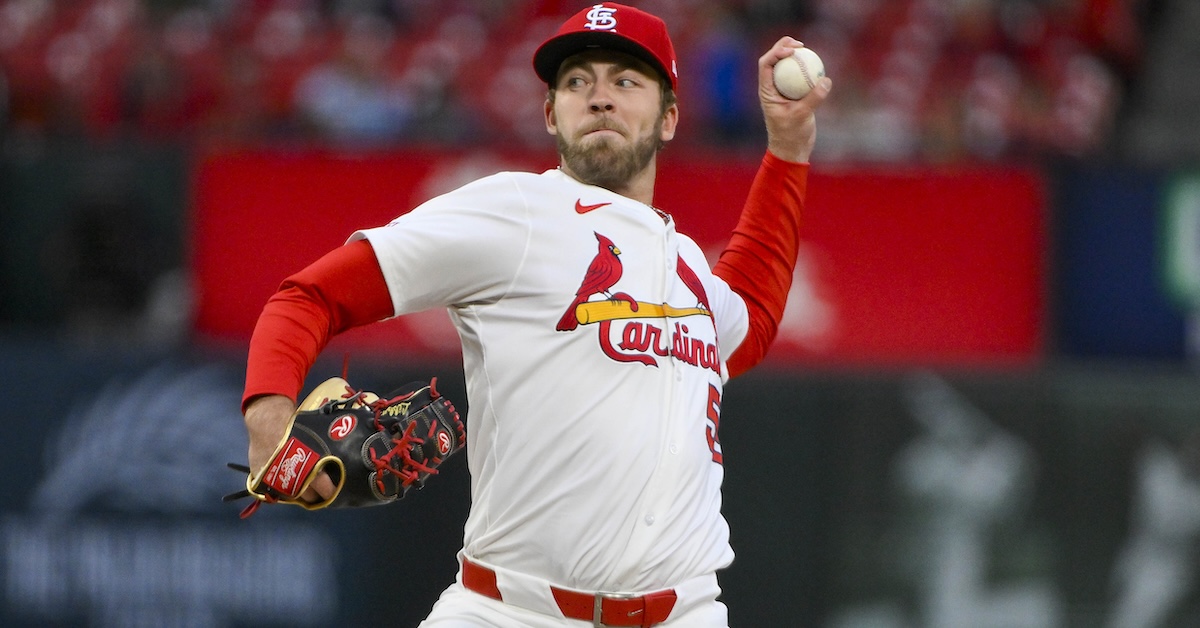
Matthew Liberatore was ranked eighth in one of the game’s top-rated farm systems when our 2019 Tampa Bay Rays Top Prospects list was released that January. Drafted 16th overall the previous summer out of Glendale, Arizona’s Mountain Ridge High School, the now 25-year-old southpaw was assigned a 50 FV by Eric Longenhagen and Kiley McDaniel. Twelve months later, Liberatore was no. 3 — still with a 50 FV — on our 2020 St. Louis Cardinals Top Prospects list, which was published a week after Liberatore was traded to the NL Central club in a multi-player deal that included Randy Arozarena.
What did Liberatore’s 2019 and 2020 scouting reports look like? Moreover, what does he think of them all these years later? Wanting to find out, I shared some of what Eric and Kiley wrote and asked Liberatore to respond to it.
———
January 2019:
“He was arguably the best high school pitcher in the class, evaluated heavily early on by the Giants (who picked second), before settling into the 7-13 range by June.”
“That’s pretty cool,” Liberatore replied. “I was highly scouted in my senior year — I think I had over 100 scouts at my first start — so I wouldn’t say it was one team in particular. I knew that I was going to be scouted through the first round, but there wasn’t necessarily any indication, right up until the draft, as to who was going to take me.”
“When [Kyler] Murray was selected, teams picking behind Oakland suddenly had access to one more player than they had anticipated… Other teams hadn’t considered the possibility that Libby would fall to them and either hadn’t done a lot of background work, or weren’t comfortable with how he might alter their bonus pool math.”
“I definitely thought the A’s were a possibility, and I was also told the Pirates were a possibility,” Liberatore recalled. “A couple minutes before the pick, we got a phone call saying [the A’s] chose to go another direction. I found out it was Kyler Murray. I figured he was probably going to go in the first round of the NFL draft in a couple of months, so I was definitely surprised by that. But I grew up going to Tampa every summer to visit family, and had been to plenty of Tampa Bay Rays games throughout my life, so to end up going to them at 16 ended up working out pretty well for me.”
“When Liberatore was at his best, he’d throw strikes with 93-97 for the first several innings of his starts, show you a 70 curveball, a good change, and alter the timing of his delivery to toy with hitters.”
“Pretty similar to now,” Liberatore opined. “I don’t necessarily quick pitch or do the hesitation to alter the hitter’s timing as much anymore, but that’s definitely not something that I’m crossing off the list. So, pretty similar scouting report to how I pitch now.”
“At other times, he’d sit 88-92 with scattershot command and get too cute with Johnny Cueto shenanigans.”
“Hmm. I mean, I’m not going to agree with that, necessarily,” Liberatore said. “You have days where you feel really good and go out there with your best stuff, and then you have days where you don’t feel so good and have to find other ways to get hitters out. If you look at my numbers in high school, I did a pretty good job of doing that. So, I wouldn’t say I got too cute with anything.”
Asked if he could directly address the Cueto comp — the way the veteran hurler will sometimes shimmy and turn before delivering a pitch — Liberatore said it was all about disrupting timing.
“Why do guys throw a breaking ball or a changeup?” he replied. “It’s all about altering timing, and that’s another way to do that. Some scouts didn’t like it. I had a guy come into my house and tell me to quit doing that. But if it gets outs it gets outs, and Johnny Cueto was doing it at the highest level of the game. And there are other guys that do the same thing. I don’t think that it ever hurt me at all.
“I actually used it as a reset a lot of times. If my regular delivery wasn’t working, I could go to one of those and find the right feel to lock me back in, sync me back up. I never viewed it as trying to trick the hitter outside of it being no different than throwing a changeup or a breaking ball to throw off the hitter’s timing. I mean, I’ve definitely toned it down since then. I do it rarely, but like I said before, it’s certainly not something I’m going to get away from forever.”
———
January 2020:
“Because Liberatore’s fastball has sinker movement, the growth of this changeup is going to be the most important aspect of his development, since those two pitches have similar movement and will theoretically tunnel better.”
“I throw two different fastballs,” Liberatore said. “One of them has sinker movement, and one of them is a little more hoppy. I think the development of the cutter has been bigger than the development of the changeup for me. Being able to own the inner half of the plate is something that has helped me quite a bit.
“I’ve thrown both my whole life. The two-seam, if you look at it in a vacuum, is a pretty average analytical pitch. But it plays off the rest of my arsenal. It doesn’t sink, but it runs into left-handers so I’m able to show them a slight difference in shape without having to change the velocity.”
“His knockout curveball has all-world depth… it’s the type of pitch that’s hard to hit even if you know it’s coming, but it might be easy to lay off of in the dirt, because its Loch Ness hump is easy to identify out of the hand.”
“Yeah. I think it all depends on how you use your other stuff around it,” Liberatore said. “If you throw any pitch every single time, it’s going to be easier to pick up. That’s why I’ve always kept that four-seam fastball, to be able to show guys something up in the zone, to tunnel off of that curveball. Yeah, it can be easy to lay off at times, but if I start landing it for a strike you have to honor it. I think it can definitely be a knockout pitch for me.”
“The total package should result in an above-average big league starter.”
I thought I had it sorted out; it took one batted ball to convince me otherwise. It was the bottom of the seventh inning during the Rays’ first game in their new George M. Steinbrenner (GMS) Field digs. Jonathan Aranda worked his way into a 2-0 count against Rockies reliever Tyler Kinley. With runners on second and third, one out, and the Rays down two runs, Kinley hung a slider. Aranda uncorked his A swing, launching the ball deep to right field. Off the bat, I thought it looked way gone. It didn’t even go 300 feet:
For the Tampa Bay Rays, it was the fearsome power of nature; for the Athletics, the whims of a greedy doofus. But while the cause may vary, the outcome is the same: Both teams will play all 81 of their home games this season in minor league parks. The A’s will set up shop at Sutter Health Park, also known as the home of the Triple-A River Cats; the Rays’ address is now George M. Steinbrenner (GMS) Field, the erstwhile environs of the Single-A Tampa Tarpons. (The River Cats will share custody, while the Tarpons will move to a nearby backfield.)
This is suboptimal and sort of embarrassing for the league. But it does present a compelling research question: How will these parks play? According to the three-year rolling Statcast park factors, the Oakland Coliseum and Tropicana Field both qualified as pitcher-friendly. The Coliseum ranked as the sixth-most pitcher-friendly park, suppressing offense 3% relative to league average, while Tropicana ranked as the third most, suppressing offense around 8%. Where will Sutter Health and GMS Field settle in?
I started by looking at how each park played in their previous minor league season. Over at Baseball America, Matt Eddy calculated the run-scoring environment for each ballpark in the 11 full-season minor leagues. Eddy found that Sutter Health ranked as the most pitcher-friendly Pacific Coast League park by far in 2024, allowing 31% fewer runs than the average PCL park. GMS Field played closer to neutral compared to its Florida State League peers, but it did significantly boost home runs, particularly to left-handed hitters. Read the rest of this entry »
Daphne Lemke/USA TODAY NETWORK-Wisconsin-USA TODAY NETWORK via Imagn Images
Every year, most teams hold some sort of team bonding, social event during spring training. The specifics of the event vary from team to team, but frequently they include renting out a movie theater and showing some cloying, inspirational movie like The Blind Side, Cool Runnings, Rudy, or better yet, a documentary like Free Solo. Regardless of the team’s outlook on the year, the goal is to get the players amped up for the season and ready to compete on the field, even if the competition in question is for fourth place in the division.
But what if instead of taking the clichéd route, teams actually tried to select a movie that fits their current vibe, one that’s thematically on brand with the current state of their franchise? They won’t do this because spring training is a time for hope merchants to peddle their wares, even if they’re selling snake oil to sub-.500 teams. But spring training is over. It’s time to get real. So here are my movie selections for each American League team, sorted by release date from oldest to newest.
Rob Schumacher/The Republic/USA TODAY NETWORK via Imagn Images
The last few years, I’ve had a pre-Opening Day tradition of making five bold predictions about the upcoming season. It’s a good way to talk through some of the players and teams where my opinions are different from the crowd. But bold predictions are a boom industry – the entire FanGraphs staff will be making some tomorrow, and I already drafted 10 of my own on Effectively Wild. So Meg and I came up with a great substitute: five big questions about the season. These aren’t the only big questions I have. They aren’t even necessarily the biggest questions in baseball. But they’re five storylines that I think are unresolved, and their answers will have a lot to say about how the 2025 season goes.
1. Are the Rays still the Rays?
The Rays have been doing the same player-swapping roster construction trick for more than a decade now. They operate on a shoestring budget, they consistently find ways to trade their surplus for great value, and their pitching development is some of the best in the game. They’re constantly churning out top prospects, and even after graduating Junior Caminero, they boast one of the best farm systems in baseball.
That prospect pipeline keeps on delivering, but in 2024, the wins didn’t follow. The team finished below .500 for the first time since 2017, and got outscored by 59 runs in the process. The Rays didn’t do much this winter – trading Jeffrey Springs, and signing Danny Jansen and Ha-Seong Kim were their big moves. We’re projecting them to finish last in the AL East – albeit still above .500. What happened to the 90-win perpetual juggernaut? Read the rest of this entry »
If the winter is a time for dreams, the spring is a time for solutions. Your team may have been going after Juan Soto or Aaron Judge or Shohei Ohtani, depending on the offseason, but short of something going weird in free agency (like the unsigned Boras clients last year), if you don’t have them under contract at this point, they’ll be improving someone else’s club. However, that doesn’t mean that spring training is only about ramping up for the daily grind. Teams have real needs to address, and while they’re no doubt workshopping their own solutions – or possibly convincing themselves that the problem doesn’t exist, like when I wonder why my acid reflux is awful after some spicy food – that doesn’t mean that we can’t cook up some ideas in the FanGraphs test kitchen.
This is the first piece in a three-part series in which I’ll propose one way for each team to fill a roster hole or improve for future seasons. Some of my solutions are more likely to happen than others, but I tried to say away from the completely implausible ones. We’ll leave the hypothetical trades for Bobby Witt Jr. and Paul Skenes to WFAN callers. Also, I will not recommend the same fix for different teams; in real life, for example, David Robertson can help only one club’s bullpen. Today, we’ll cover the 10 teams in the East divisions, beginning with the five in the AL East before moving on to their counterparts in the NL East. Each division is sorted by the current Depth Charts projected win totals. Read the rest of this entry »
Below is an analysis of the prospects in the farm system of the Tampa Bay Rays. Scouting reports were compiled with information provided by industry sources as well as our own observations. This is the fifth year we’re delineating between two anticipated relief roles, the abbreviations for which you’ll see in the “position” column below: MIRP for multi-inning relief pitchers, and SIRP for single-inning relief pitchers. The ETAs listed generally correspond to the year a player has to be added to the 40-man roster to avoid being made eligible for the Rule 5 draft. Manual adjustments are made where they seem appropriate, but we use that as a rule of thumb.
A quick overview of what FV (Future Value) means can be found here. A much deeper overview can be found here.
All of the ranked prospects below also appear on The Board, a resource the site offers featuring sortable scouting information for every organization. It has more details (and updated TrackMan data from various sources) than this article and integrates every team’s list so readers can compare prospects across farm systems. It can be found here. Read the rest of this entry »
Back in the days before Junior Caminero — even in the days before Wander Franco — there was Brandon Lowe, a 5-foot-10 second baseman who anchored the Tampa Bay Rays’ lineup during its most fecund period. As the Rays made the playoffs five years in a row from 2019 to 2023, and won the pennant in 2020, Lowe was at the center of it. He posted a 151 wRC+ in 2020, and a year later he hit 39 home runs.
That’s tied for the second-most homers in a season in Rays history, up among a bunch of guys (Carlos Pena, Logan Morrison, Jose Canseco) who are so big they could fit Lowe in their jacket pocket.
Now, as Caminero is bashing his way into the everyday lineup, Lowe is at an inflection point in his career. He’s struggled to stay healthy the past three years, and he turns 31 in July. And because everything the Rays touch has to be viewed through this lens: Lowe is in the final guaranteed season of his seven-year contract. His 2026 club option is quite affordable, even for Tampa Bay ($11.5 million), but there’s only one option year. Read the rest of this entry »