Archive for Rockies

The Bottom of the Ninth, Down by 19

Before I say anything, take a look at this Raimel Tapia sac fly, which scored Matt Kemp in the bottom of the ninth at Coors Field last night.

It is incredible how the stakes of professional sports manage to be world-shakingly massive and completely meaningless at the very same time. At stake in any given baseball game is millions of dollars of investment, millions of hours of training, the hopes and dreams of millions of fans, the dedication of entire lifetimes. And yet, the only thing physically at stake is how, exactly, a small leather ball will travel through space: whether it will leave the stadium, or land in the catcher’s glove; whether it will be caught, or hit the grass; whether it will stay firm in the grip of a player’s hand, or slide through it, errant, to go off in some unintended direction. If these physical stakes were not so small, to fail when so much is riding on one’s ability to succeed would be, I imagine, unbearably devastating. But even the most horrible loss is reliably followed by another game — because they are, in the end, games.

That reliable continuity in the face of constant failure can be very reassuring for a normal, non-famous-athlete person. Life, to paraphrase a very unwise man, is literally all we have. And though the stakes of the average person’s everyday activities, taken in the context of the world at large, aren’t very high, they are, in another sense, everything. My small, sad everyday failures are just as small and sad and arbitrary as a ball falling from a glove onto a grass field — but because my life is composed entirely of the everyday and the insignificant, even these failures can seem insurmountable. Yet every day, I watch people who have much more to lose than I do somehow rebound from their inevitable failures to play again, and again, and again. Often, I wonder how they do it. Read the rest of this entry »


Rockies Add Kevin Pillar

The Colorado Rockies made a minor outfield upgrade on Monday, acquiring outfielder Kevin Pillar from the Boston Red Sox for a player to be named later and international slot money.

Now, you may be thinking, “Rockies plus Szymborski means the latter is mad about something!” While you’d frequently be accurate, it’s not so in this case. Short of someone mind-blowing like Brendan Rodgers being the player to be named later — Brendan Rodgers will not be the player to be named later — this is a perfectly reasonable upgrade to the roster that is unlikely to cost the team much. Outfield defense has always been one of those awkward problems for a team in Colorado, thanks to the phenomenon, unusual in most locales, of having a massive home run park that also has a gargantuan outfield. Glove-only players tend to not get the same offensive advantages in Coors and the amount of outfield real estate makes it dangerous to have a marginally defensive center fielder man the position, as the team discovered with Charlie Blackmon.

Kevin Pillar had a solid little run with the Blue Jays as a glove wizard who could hit the occasional homer. He’s in his 30s now and there has been some decline, especially defensively, but if push comes to shove, I think he’d be a better defender in center than most of the Rockies’ options. David Dahl, the normal center fielder in 2020, has been out with back issues and I feel that Pillar’s still likely to be better defensively than either Garrett Hampson or Sam Hilliard. With Dahl’s injury history and the Rockies still hovering around .500, a coin-flip to make the playoffs, I think this kind of move — one that doesn’t hamstring future moves — is a good transaction to make.

Pillar hits the ball hard enough that there’s probably some decent offensive upside in Coors as well. He’s hit .274/.325/.470 in 2020 and thanks to Alex Verdugo playing left after Andrew Benintendi’s injury, he’s spent a lot of time in the thankless, awkward task of playing Mookie Betts‘ position in right. Pillar is a free agent after the 2020 season and the Red Sox are at the bottom of the American League, so there was no real reason for the team not to make a trade rather than let him walk for nothing after the season.

The Colorado Rockies have a lot of work to do to right an organization that’s largely pointed in the wrong direction. But picking up Kevin Pillar doesn’t make it any more difficult for the team to (theoretically) do these things in the offseason and gives them a marginally increased chance of making the playoffs this year. A good pickup, so I’ll holster my snark for the moment.


Mychal Givens Is Headed to the Rockies

It seems like new Rockies pitcher Mychal Givens has had a robust trade market each of the last two summers, both because he is a good pitcher and because he has multiple years of team control left. The Orioles finally pulled the trigger on a deal for him and scooped up three prospects from the Rockies: Terrin Vavra, Tyler Nevin, and a player to be named later.

Givens has thrown 336 innings across parts of six seasons with the Orioles and has amassed a 3.32 career ERA (he’s sporting a cool 1.38 ERA this year) and struck out just shy of 11 hitters per nine (roughly 33% K%) during that time. His strikeout rate has climbed each of the last two years as Givens increased the usage of his changeup, which had previously been a distant tertiary pitch behind his fastball and a slider.

But Givens still works heavily with that mid-90s fastball (nearly 70% of the time), which averages 94 mph and tops out at 98. In addition to having a great arm, the right-hander has a unique low-slot delivery that lets him attack hitters in the top half of the zone from an odd angle. For how terse and explosive Givens’ delivery is, he has good feel for locating his secondary stuff to each pitch’s appropriate zip code and he adds stability to a Rockies bullpen filled with pitchers who have a history of being rather wild. Read the rest of this entry »


Charlie Blackmon Is Chasing .500… For Now

In the run-up to the 60-game 2020 season, colleagues Craig Edwards and Dan Szymborski were among the many writers in the industry who weighed in on the possibility of a player hitting .400 or better. They used lots of fancy math and projections to do so, but it’s already clear that both laid down on the job by failing to estimate the odds of a player hitting .500, as Rockies right fielder Charlie Blackmon was through Tuesday night. Can’t anybody here play this game?

Blackmon’s 3-for-4 performance against the Diamondbacks on Tuesday extended his hitting streak to 15 games, which is tied with the Giants’ Donovan Solano for the major league high this year; during that span, he hit .567/.591/.817. The three-hit game also marked Blackmon’s sixth straight with multiple hits, tied with the Mariners’ Kyle Lewis for the big league high; over that span, he hit .739/.778/1.174 — that’s 17 hits in 23 at-bats, and without a single strikeout, to boot.

Blackmon entered Wednesday afternoon’s game against the Diamondbacks — in which he went 0-for-4 with a walk, but don’t let that tangle my yarn — at .500/.527/.721, with 34 hits through 17 games. As best as I can tell using Baseball-Reference’s Stathead service (the updated version of the Play Index), that’s tied for fourth since 1901:

Most Hits Through Team’s First 17 Games
Rk Player Year Team H PA AVG OBP SLG
1 Nap Lajoie* 1901 Athletics 37 70 .578 .614 .938
2T Stan Musial* 1958 Cardinals 36 80 .529 .588 .853
Hank Aaron* 1959 Braves 36 77 .500 .494 .972
4T Carl Reynolds 1934 Red Sox 34 74 .507 .554 .791
Pete Rose 1976 Reds 34 85 .466 .541 .616
Charlie Blackmon 2020 Rockies 34 74 .500 .527 .721
Dante Bichette 1998 Rockies 34 77 .453 .455 .587
Larry Walker* 1997 Rockies 34 79 .507 .582 1.030
Nap Lajoie* 1904 Naps 34 73 .486 .507 .670
SOURCE: Baseball-Reference
*Hall of Famer

That’s some company, with four Hall of Famers — one a repeat customer, topping the list in the American League’s inaugural season (expansion alert!) — and the all-time hits leader, plus the Rockies’ original right fielder (Bichette) as well as the already-counted Hall of Famer who bumped him to left field upon arriving in 1995 (Walker). The one you don’t know about is Reynolds, a well-traveled outfielder from a high-offense era; he played for five teams in 13 years from 1927-39, batting as high as .359 for the White Sox in 1930, the year that offense was off the charts. Read the rest of this entry »


The Rockies are Hot. Is it Time to Re-evaluate?

Heading into this season, the NL West looked like a three-team race. That’s not completely fair — it looked like a one-team race for first with two other solid teams — but with a 16-team playoff field, somewhere between two and three teams from each division are headed to the playoffs, leaving it a three-team race for either two or three playoff spots.

Fifteen-ish games later, there are indeed three NL West teams in playoff position. The Dodgers are there, of course, and the Padres — no surprises here. But then there are the Colorado Rockies, 11-4 and leading the National League. It’s early — although with a quarter of the season already in the books for many teams, how early is up for debate. But regardless of the time of year, the Rockies are in first place, and I wanted to learn more.

One thing I could do to learn more is look at the Rockies’ individual performances, particularly on the pitching side. Charlie Blackmon is off to a hot start, though looking at a player with a .500 BABIP is rarely compelling 15 games into his season. For whatever reason, neither of those paths grabbed me. I thought I’d take a look at whether we could have expected this, and how surprised we should be. Read the rest of this entry »


Analyzing the Prospect Player Pool: NL West

Below is my latest in a series discussing each team’s 60-man player pool with a focus on prospects. Previous installments of these rundowns, including potentially relevant context for discussion, can be found here:

AL East and Intro
NL East
AL Central
NL Central

Arizona Diamondbacks

Prospect List / Depth Chart

Remember that, Greinke trade aside, the Diamondbacks have been operating like buyers for the last little while, and only four of their projected regulars/rotation members are under 29. It’s unknowable whether the shortened, but more condensed season will be good or bad for their veteran’s productivity and health, but the DH spot will probably help in that regard. It means little breathers for Kole Calhoun and David Peralta, and extra at-bats for Kevin Cron and Jake Lamb without the defensive drawbacks.

Some of the same benefits could result from rostering Daulton Varsho, especially if Carson Kelly gets dinged and suddenly 36-year-old Stephen Vogt and John Hicks are platooning. Varsho could caddy for any or all of Vogt, Calhoun and Peralta, keeping the older guys fresh while getting plenty of reps so his development isn’t stifled even though he’s technically playing a bench role. This is the type of move that might help Arizona catch Wild Card lightning in a 60-game bottle, but I don’t think their current catching depth allows for it right now. The club only has four backstops in their pool, and even if they eventually add spring NRI Dominic Miroglio they still have fewer catchers than most teams and probably not enough for sticking three on the big league active roster. Perhaps Wyatt Mathieson will put on the gear at the campsite.

The next-highest ranked prospect likely to debut this year is righty J.B. Bukauskas. Some of the Arizona bullpen pieces need to really pop if the team is going to compete (perhaps Archie Bradley truly returns to form, or Yoan López takes a leap, or Hector Rondón bounces back, etc.) and Bukauskas has the stuff to be part of a contingent that helps win coin-flip games. Aside from some other backend/middle relief prospects who might play a role this year (Jon Duplantier and Taylor Widener could usurp Merrill Kelly as the fifth starter, and Kevin Ginkel is a bullpen lock) and a couple likely role players perhaps debuting (bat-first infielder Andy Young and bat-only 1B/DH types Seth Beer and Pavin Smith), the other, more exciting D-backs prospects are young guys just getting reps in camp (Alek Thomas, Corbin Carroll, Blake Walston, Geraldo Perdomo, Levi Kelly, Luis Frias). It’s possible the roster clocks of Josh Green (who doesn’t have to be 40-man’d until 2021) or even 2020 draftee Bryce Jarvis are punched early but Arizona would really need to be in the thick of the postseason picture for that to happen. It’s more likely spot-starter types Jeremy Beasley and Keury Mella are called upon if they need to dip into the campsite for starters. Read the rest of this entry »


A Minor Matt Kemp Move Illuminates Major Obstacles to a 2020 Season

It was a mundane transaction, one that ordinarily wouldn’t have required 500 words to explain to a baseball-starved readership, let alone 1,800. Matt Kemp, a 35-year-old former All-Star who played just 20 major league games last year, signed a minor-league deal with the Rockies. Given the move’s timing and the circumstances that surround it, however, Kemp-to-Colorado leaves a whole lot to unpack, and so here we are.

Kemp is on a minor-league deal, but he won’t play in the minors this year because there won’t be any minor league season, news of which was officially announced on Tuesday, though the outcome had long been apparent. Kemp may not play in the majors, either, not only because it’s unclear whether he’s good enough to do so anymore, but because the coronavirus pandemic that delayed Opening Day by nearly four months is still running rampant, and because the precautions designed to keep players and associated staff healthy may not be enough.

Even before the official green-lighting of the season, the Rockies were among the first teams to feel the impact of the coronavirus. Last Tuesday, the Denver Post’s Kyle Newman reported that four-time All-Star outfielder Charlie Blackmon was among three Rockies who had tested positive for COVID-19, along with pitchers Ryan Castellani and Phillip Diehl, all of whom had been informally working out at Coors Field in recent weeks. News of their illness followed reports of at least half a dozen teams being hit by the virus, though the players and staffers who tested positive on those teams weren’t identified. Blackmon and company were, but that’s not supposed to happen. While MLB has created a COVID-19-related injured list among its many new roster rules, on Tuesday ESPN’s Marly Rivera reported that both Yankees general manager Brian Cashman and Cubs general manager Jed Hoyer said that teams are not allowed to divulge the names of players who tests positive, in accordance with the Health Insurance Portability and Accountability Act (HIPAA). Read the rest of this entry »


A Look at Some NL Designated Hitter Candidates

The universal designated hitter will be a reality in 2020, assuming that the Major League Baseball Players Association agrees to the health and safety protocols connected to the March 26 agreement, which is to say, that it will be part of the revised rules for this weird, short season. But because the league and the union were unable to agree to any of the subsequent proposals that have been batted back and forth in recent weeks, the status of the universal DH for 2021 and beyond — with the expectation that it would slip smoothly into the 2022 Collective Bargaining Agreement — is not a done deal, after all. Rather, it’s something that will have to be revisited within discussions over rules changes for next year, which typically begin at the November owners’ meetings.

Even so, as it’s the rare point upon which both sides agreed amid the otherwise rancorous negotiations, I think I’m still on solid ground in discussing the longer-term changes that could come with such a move. On Friday, I discussed the apparent end of pitchers’ often-pathetic attempts at hitting, and last month, Craig Edwards took an initial stab at how NL teams might handle their DH slots given their roster construction, with special consideration given to the Mets’ situation. This time around, I’d like to consider which players might stand to benefit in the longer run.

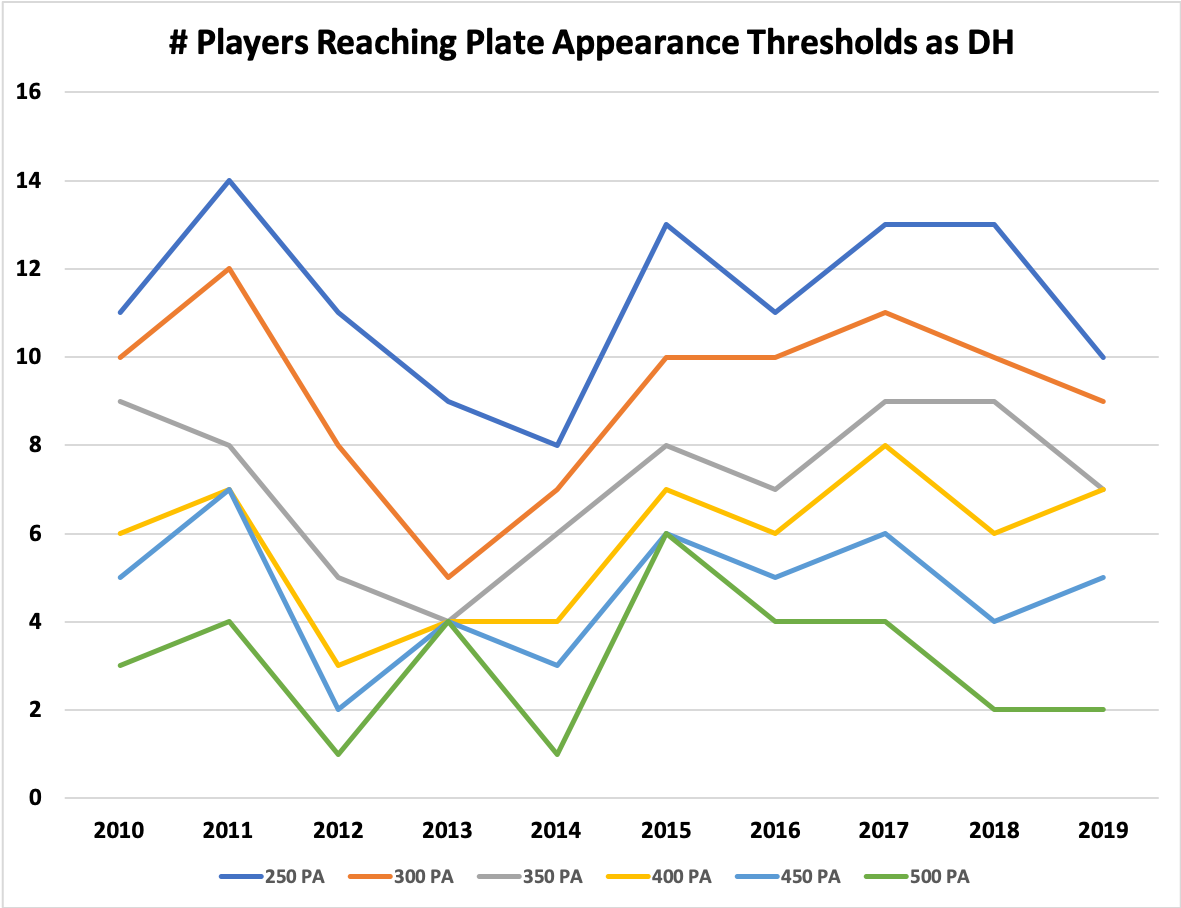
For starters, it’s worth noting that the demise of the DH has been somewhat exaggerated. Several years back, the AL saw a notable decrease in the number of players reaching significant thresholds of plate appearances at the spot, but those totals have largely rebounded:

Read the rest of this entry »


A Conversation With Colorado Rockies 2019 Second-Rounder Aaron Schunk

Earlier this week we heard from Minnesota Twins 2019 second-round pick Matt Canterino about his draft-day experience and his introduction to professional baseball. Today, we’ll hear from Aaron Schunk, whom the Colorado Rockies tabbed eight picks later, with last year’s 62nd-overall selection. The now 22-year-old third baseman out of the University of Georgia saw his draft stock skyrocket during a junior campaign when he crushed 15 home runs while putting up a .973 OPS; in his two previous SEC seasons, the Atlanta native left the yard just four times.

A two-way player with the Bulldogs, Schunk went on to slash .306/.370/.503 with six home runs in 192 plate appearances with short-season Boise. Now exclusively a position player, he’s No. 8 on our Rockies Top Prospects list.

———

David Laurila: You were drafted one year ago. What have the last 12 months been like?

Aaron Schunk: “[The draft] was pretty cool. It was also a stressful night. Since then, the last 12 months have been a bit of a blur. All in all, this whole thing has been a dream come true for a kid who grew up watching the Atlanta Braves on a tube TV, begging his dad to watch John Smoltz and Chipper Jones. So it’s been amazing. Hopefully this will last a long time.”

Laurila: Draft day itself was stressful?

Schunk: “It was a little bit. For much of my baseball life I’ve been kind of an underdog-type player, and in my junior year I wanted to prove a lot of people wrong. I wanted to go out there and try to be a first-day guy. So knowing that my name had floated out there for the [first round] was a little stressful.”

Laurila: Did you have reason to believe you might go earlier than you did? Read the rest of this entry »


Sunday Notes: From Chiba, With Concern; Frank Herrmann on NPB and MLB

The NPB season is currently slated to start on June 19th, with hopes of playing a 120-game schedule followed by a condensed playoff docket. The 120 isn’t arbitrary. Per the league’s bylaws, that’s the number required for a season to be considered official. In a normal year, each NPB team plays 143 games.

The MLB season? That remains an unanswered question. It is also an angst-inducing question. As everyone reading this knows all too well, there may not even be a season.

Frank Herrmann knows baseball on both sides of the planet.The Harvard-educated hurler is heading into his fourth NPB season after playing professionally stateside from 2006-2016. As you might expect, he’s monitoring not only what’s happening in Japan, but also what’s happening back home.

“The schedule alignment here is essentially the opposite of what is being proposed by MLB clubs, who want fewer regular season games with longer playoffs,” Herrmann told me via email from Chiba, Japan. “Like most things, the motivation in both cases is money. NPB doesn’t have the lucrative TV deals that MLB does. Japanese teams rely heavily on ticket sales, merchandise, and concessions to generate income and offset salaries. There have been discussions to incrementally allow fans into games starting as soon as July 10. More regular season home gates for each team, stretching into mid-November, affords teams the best chance to cover losses.”

Salary structures and legal language weigh heavily into that equation. As Herrmann pointed out, high-end salaries in Japan are “more in the $7-8 million a year range, as opposed to the $30Ms in MLB.” Moreover, NPB contracts differ from those in MLB in that they “lack a specific clause for national emergencies, therefore players have been receiving their full salaries since February.” Herrmann expects NPB will add such a clause once the season is completed. Read the rest of this entry »