These are notes on prospects from lead prospect analyst Eric Longenhagen. Read previous installments here.
Luis Robert, CF, Chicago White Sox Level: Hi-A Age: 21 Org Rank:4FV: 55 Line: 2-for-4, HR, 2 HBP
Notes
Off to hot start, Robert has multi-hit efforts in each of his first four games and has already stolen three bases and homered three times. After watching LouBob a lot last year (first while he rehabbed multiple injuries, then in the Fall League), I grew concerned about how his bat path might limit the quality of his contact (he sometimes struggled to pull pitches he should have) or his rate of contact, which we don’t have a large-enough sample to properly assess because of his injuries. So far, the pull-side stuff hasn’t been founded, as all but two of Robert’s balls in play so far this year have been to the right side of the field, and those were both pop-ups to the second baseman. He’s one of the more physically-gifted players in pro baseball.
Darwinzon Hernandez, LHP, Boston Red Sox Level: Double-A Age: 22 Org Rank:2FV: 45 Line: 5 IP, 2 H, 4 BB, 0 R, 10 K
Notes
We do not think Hernandez is a long-term starter and instead think he’ll be an elite bullpen arm. His fastball often sits in the upper-90s when he’s starting so it should at least stay there if he’s moved to relief and, though his feel for it comes and goes, his curveball can be untouchable at times. Maybe the strong early-season performances of Matt Barnes, Brandon Workman, and Ryan Brasier has stifled some of the disquiet about the Red Sox bullpen, but in the event that they need an impact arm, I think it’s more likely to be Hernandez than a piece outside the org. Some of this is due to the quality of the farm system, but Hernandez might also just be better than a lot of the options that will eventually be on the trade market. Read the rest of this entry »
Below is an analysis of the prospects in the farm system of the Detroit Tigers. Scouting reports are compiled with information provided by industry sources as well as from our own (both Eric Longenhagen’s and Kiley McDaniel’s) observations. For more information on the 20-80 scouting scale by which all of our prospect content is governed you can click here. For further explanation of the merits and drawbacks of Future Value, read this.
All of the numbered prospects here also appear on The Board, a new feature at the site that offers sortable scouting information for every organization. That can be found here.
Mize was a midrange projection arm in high school and broke out on the Cape after his freshman year at Auburn. He looked like a mid-first rounder after his sophomore year and subsequent summer with collegiate Team USA, then took a giant leap forward in his draft spring, which led to Detroit taking him first overall. His command improved and he added an 87-90 mph cutter that quickly became a plus pitch, to pair with his mid-90’s fastball, above average slider, and plus splitter. After pitching for Team USA the summer before the draft, Mize got a PRP injection in his pitching elbow. Some teams had concerns about his shoulder in high school, and he also missed time a sophomore at Auburn with forearm tightness.
Mize has some violence to his delivery and isn’t the prototypical projectable plus athlete you normally see at the top of the draft. There’s also some anecdotal evidence suggesting heavy cutter usage leads to diminished velocity. These are all things to make you wonder how Mize projects, but right now he may be able to pitch in the big leagues, with some mentioning Aaron Nola as the type of pitcher he could become. He’s already made an adjustment to his slider that has given the pitch more verticle depth, like a slurve, which adds a new movement wrinkle to his mix. He doesn’t really fit Detroit’s timeline for contention, and may not be as good in his sixth year of control as he’ll be in his second, so many have openly wondered if Mize becomes a trade chip once he succeeds in the big leagues. That’s a good problem to have for a big league club in need of top shelf talent; Mize may give them that as soon as 2019.
Drafted: 1st Round, 2016 from Sheldon HS (CA) (DET)
Age
21.2
Height
6′ 6″
Weight
190
Bat / Thr
R / R
FV
50
Tool Grades (Present/Future)
Fastball
Curveball
Changeup
Command
Sits/Tops
60/60
55/60
40/50
40/45
93-97 / 98
Manning entered his senior year of high school as a talented two-sport project with a, having size and arm speed, but inconsistent command, offspeed stuff, and somewhat strange east/west elements to his delivery. His superior athleticism shone through in the spring, along with improved direction to the plate, and the Tigers popped him ninth overall in 2016 with an eye toward Manning becoming a frontline starter.
Early in pro ball, Manning had some real trouble with strike-throwing, then slowly settled in. He has two easy plus pitches in his fastball and curveball, but his changeup is almost always below average, and his command comes and goes. His fastball plays up due to his excellent extension, but he gets so much extension that he overstrides and it reduces the amount of feel he has, both in his changeup and command. If Manning can dial down the aggression in his delivery a bit, the starter traits should come to the forefront and give the Tigers a No. 2 or 3 starter.
Drafted: 1st Round, 2015 from Eagle’s Landing Christian HS (GA) (HOU)
Age
22.2
Height
6′ 2″
Weight
195
Bat / Thr
R / R
FV
50
Tool Grades (Present/Future)
Hit
Raw Power
Game Power
Run
Fielding
Throw
35/55
50/50
40/45
50/55
50/55
50/50
Cameron stood out as one of the top players in his class as early as a freshman in high school, and the fact that he’s the son of Mike Cameron didn’t hurt, either. Daz was an elite talent early on in his own right, but the rest of his draft class slowly caught up and by his draft year, he was one of the top dozen or so prep bats, rather than the clear top talent. The questions then are still largely the questions now: he’s a plus runner who can play a solid center field with average raw power, but scouts question how much offensive impact there will be. Cameron has already surpassed the expectations that pessimistic scouts had for him as an amateur, but even scouts that like him now say he’s a potential low-end regular, possibly in the Keon Broxton mold, or even a poor man’s version of his father. He just turned 22 and will likely spend 2019 in the upper levels with an eye toward sticking in the big leagues in 2020.
It’s hard to quibble with Paredes’ stellar 2018. He hit .278/.359/.456 across two levels, and reached and performed at Double-A Erie as a 19-year-old. He’s been drawing trade interest since the moment he set foot on the Cubs complex in 2016 due to his very mature feel to hit, which belies his age. Despite this, there are concerns about Paredes. He already has a catcherly build as a teenager and though he has spent the bulk of his pro innings at shortstop, he’s not going to stay there and probably won’t end up on the middle infield at all. He may eventually have to try to catch (which would slow his development, or the grind may dilute his offensive production) or move to first base, where he saw some reps in the Mexican League this offseason. The instability on defense is concerning even though everyone loves Paredes’ bat. We think he’ll be an average everyday player for a while but aren’t sure about his longevity.
Signed: July 2nd Period, 2014 from Venezuela (HOU)
Age
21.3
Height
6′ 3″
Weight
197
Bat / Thr
R / R
FV
45+
Tool Grades (Present/Future)
Fastball
Slider
Curveball
Changeup
Command
Sits/Tops
60/60
50/60
45/50
55/60
40/50
93-96 / 97
Perez’s first few pro seasons were notable because of how quickly Houston pushed him through the minors. A polished strike-thrower with four good pitches, he reached Double-A as a 19-year-old back in 2017 before he became the centerpiece of the Justin Verlander deal. Advanced though he was, various injuries have robbed Perez of innings. He has yet to throw more than 86 frames in an entire season, so while he may be fairly advanced for someone his age, and definitely for someone who has pitched so little, the industry has yet to see his stuff hold up for a whole summer of starter’s innings.
In 2016, he had knee trouble; in 2018, it was a lat strain, then shoulder inflammation. An ominous trap issue popped up during the early parts of 2019 spring training but Perez was back on the mound quickly and sitting his usual 93-96 into late-March. A strong-bodied 21-year-old, the cement is likely dry on Perez’s stuff. His high three-quarters slot creates ride to his fastball as well as downward vertical action on his curveball, and those two traits typically pair well together. While Perez’s curveball is his prettiest pitch, his best secondary offering is the changeup. There are times when Perez will come across the baseball and create screwball action on the change, and it runs, sometimes unhittably, onto the glove side corner of the plate. But mostly, it’s used as a swing-and-miss pitch that bottoms out beneath the strike zone just as it reaches the plate. Perez has mid-rotation stuff and strike-throwing ability, but needs a fully healthy season to be valued at that level across the league.
Stewart has now hit for big power and walked at an above-average clip for five consecutive years, dating back to his junior season at Tennessee. He’s averaged 25 homers annually during that span and there’s lots of other evidence — signs like a consistently low ground ball rate and the raw thump he shows in BP — supporting what seems to be a safe, pretty impactful offensive profile. Stewart will most certainly give back some value on defense as he’s not a good defensive outfielder and probably belongs at DH. The predicament in Detroit is that so too do many of their other hitters, even though Victor Martinez has retired. And so Stewart will likely slowly prowl left field early in his career, and perhaps move to DH once Miguel Cabrera and Nick Castellanos move on. He’s already 25, so while we think Stewart will hit like a good team’s 4-, 5- or 6-hole hitter for a while, this type of profile typically doesn’t age well, which, along with the defensive limitations, had us round down our projections a little bit.
Signed: July 2nd Period, 2013 from Dominican Republic (CLE)
Age
21.9
Height
6′ 1″
Weight
165
Bat / Thr
S / R
FV
45
Tool Grades (Present/Future)
Hit
Raw Power
Game Power
Run
Fielding
Throw
40/50
45/45
20/45
55/55
50/55
55/55
Francisco Lindor’s presence in Cleveland made the fast-approaching Castro expendable in trade, and Cleveland sent him to Detroit for Leonys Martin at the 2018 deadline. A 2017 breakout that saw Castro slug .424 at Hi-A Lynchburg seemed to be a mirage when he hit just .245/.303/.350 for three months at Double-A Akron (that power output is closer to career norms), but after the trade Castro slugged .562 and his ground ball rate dropped from 44% to 33% in about a 100 balls-in-play sample, which should be fairly stable. If there’s suddenly more lift here then Castro could be a top 100 prospect by mid year. He’s going to stay at short (plus range, average hands, above-average arm) but the average big league shortstop had a 95 wRC+ last year and Castro is a very aggressive hitter likely to run below-average OBPs. If there’s been a swing change (his swing with Cleveland was not conducive of power) then extra pop might propel Castro toward regular playing time. If not, he’s a low-end everyday player or utility man.
Signed: July 2nd Period, 2016 from Dominican Republic (DET)
Age
19.4
Height
5′ 11″
Weight
170
Bat / Thr
S / R
FV
45
Tool Grades (Present/Future)
Hit
Raw Power
Game Power
Run
Fielding
Throw
35/55
40/45
20/40
60/60
40/50
50/55
Perez signed for $550,000 in 2016 and fits the Detroit mold of international signings: shortstops signed for middle-tier bonuses with a tool or two and feel for the game. He had a breakout in 2018 as he gained strength, and it allowed his offensive game to be more well-rounded without costing him a step of speed. He isn’t a slam dunk to stick at shortstop, but will be solid at second base if it doesn’t work out. The upside isn’t enormous as it’s a contact profile with below average power, some speed, and a middle infield position, but those types turn into a 60 PV/FV every now and then (and Jose Ramirez sometimes, too), so we sit up in our chairs when we see a young hitter with this profile. Detroit doesn’t look scared to promote Perez aggressively, so he may play at both A-Ball levels at age 19 with a strong 2019 campaign.
Drafted: 1st Round, 2015 from Weatherford HS (TX) (DET)
Age
22.5
Height
6′ 2″
Weight
200
Bat / Thr
R / R
FV
45
Tool Grades (Present/Future)
Fastball
Slider
Curveball
Changeup
Command
Sits/Tops
50/55
45/50
45/50
50/55
45/50
91-94 / 96
Burrows was on the scouting radar early in his prep career when he was hitting the mid-90s at tournaments after his sophomore year of high school. He had an extreme spine tilt at this point, bending his upper body at an almost 45-degree angle toward first base when he released the ball, but his breaking ball was above average and his strike-throwing wasn’t bad. As he entered pro ball, the Tigers worked on fixing this posture issue as they saw their first rounder as a potential mid-rotation starter. Since then, his stuff has ranged from being flat to regressing a bit. We can’t say the lower effort is directly leading to the stuff not holding, but some pitchers have to dial things back a bit to pitch like a starter needs to and Burrows appears to be one of them.
As many power prep arms learning to become starters do, Burrows’ breaker has become closer to average while his changeup is now the superior pitch (Ian Anderson is another example) and the upside is now more of a fourth starter. The just-okay numbers in Double-A indicate that Burrows either shouldn’t be working at the top of the zone or doesn’t yet have the combination of command and sequencing to make it work.
Drafted: 2nd Round, 2018 from Grayson HS (GA) (DET)
Age
19.4
Height
6′ 4″
Weight
195
Bat / Thr
L / R
FV
40+
Tool Grades (Present/Future)
Hit
Raw Power
Game Power
Run
Fielding
Throw
20/45
55/60
20/50
70/65
45/55
55/55
The younger brother of Rays outfielder Austin Meadows, Parker has some similarities to his big league sibling, but his tools are actually compared more often to those of Indians center fielder Bradley Zimmer. Zimmer and the younger Meadows both have deceptively easy speed due to their long frames, each has a plus arm, plus raw power, and long limbs that create contact issues at the plate. Meadows had some track record of hitting elite prep pitching over the summer months of the scouting calendar, but some amateur departments were turned off by his lack of rhythm in the batter’s box, and he slipped to round two on draft day even though he was in the mix for some teams picking in the 20s. He’s a typical high risk/high reward high school prospect, with even more upside than his brother, now a major leaguer.
Funkhouser was a classic Louisville recruit who wasn’t touted much at a Midwestern high school, then stood out immediately on campus as an early-round pick. He didn’t sign as a first rounder in 2015, then had a down season and signed as a fourth rounder in 2016. At his best, Funkhouser shows a 55 or 60 fastball and curveball along with an average changeup and command, for a No. 3 or 4 starter type profile. He did that for most of 2015, which led to being a first round pick, then was less consistent from that point forward. We think he’s about as good as Spencer Turnbull, as a stuff-first righty who’s close to the majors and either a depth starter, multi-inning reliever, or high leverage piece, but more a role player piece than a core starter type.
A polished receiver and cat-like ball-blocker with a laser arm, Rogers was one of this century’s best defensive amateur backstops while at Tulane. He fell to round three of his draft because of concerns about his bat, concerns that turned out to be well-founded, as Rogers had stark contact issues last year when he was tested at Double-A and the Fall League. A pairing of patience and pull power probably provides Rogers with a shot to approach the low offensive bar at the catcher position. He might hit .220 but still yank out 15 annual homers, walk a bunch, and end up hitting well-enough to play every day for someone. His glove alone makes him a high-probability big leaguer, at least as an uber-gloved backup.
Signed: July 2nd Period, 2014 from Dominican Republic (LAA)
Age
21.0
Height
6′ 3″
Weight
160
Bat / Thr
R / R
FV
40
Tool Grades (Present/Future)
Fastball
Curveball
Changeup
Command
Sits/Tops
45/55
50/55
45/55
40/50
89-92 / 94
Acquired in the Justin Upton swap, the wispy Rodriguez has three average pitches that could continue to improve either through reps and improved feel (the changeup), or mature physicality (the fastball). His 11-7 curveball has good shape, depth, and bite, his delivery is graceful, smooth, and repeatable. Stagnant development likely leaves Rodriguez with a collection of 50-grade pitches and command, relegating him to the No. 5 starter realm. But while you can quibble about which areas he’s most likely to improve (at age 21, the body and velocity may be done growing), it seems likely that some of the stuff will due to the frame, delivery, and athleticism.
Signed: July 2nd Period, 2014 from Venezuela (DET)
Age
20.9
Height
6′ 0″
Weight
170
Bat / Thr
R / R
FV
40
Tool Grades (Present/Future)
Fastball
Curveball
Changeup
Command
Sits/Tops
50/55
40/50
50/60
35/50
91-95 / 97
Guzman spent his first two pro seasons hitting .144 before the Tigers decided to move him from the infield to the mound, a decision that now looks brilliant after Guzman’s breakout 2018. With just 25 innings of affiliate experience to his name, Guzman went to the college prospect-laden New York-Penn League as a 20-year-old and struck out a batter per inning over 12 starts, while walking just 14 hitters all summer.
He is an exceptional on-mound athlete, who quickly took to an impact, low-80s changeup, which has bat-missing tail. A narrow, smallish frame and Guzman’s tendency to baby his offspeed stuff into the zone are present issues, but the latter of these should be remedied with time and experience. Guzman has a bad breaking ball, and while breaking ball quality typically isn’t something that improves very much over time, Guzman is so new to pitching that he may not yet have the right feel/grip on his breaker. The spin rate on his low-80s slider is beneath that of his fastball. Typically the inverse is true, and it’s a sign that there’s probably a grip issue, something that can be remedied. We’ll see how the body and stuff develop, but Guzman is pretty exciting and has a shot to eventually be a No. 4 starter if you’re willing to project lots of late-arriving attributes because of his athleticism and background.
While his fastball has bounced back into the low-90s after sitting in the upper-80s at times last year, we still have concerns about how it’s going to play against big league hitters because Faedo is such a short strider. He only gets about five feet worth of extension on all his pitches, impacting his fastball’s perceived velocity quite significantly. There’s a chance it plays like a 40 fastball, even though its velo has rebounded some. Faedo’s funky low slot may flummox hitters enough to counterbalance his lack of extension somewhat, and it no doubt helps him create bat-missing action on his slider, which is excellent. He had several years of success against SEC hitting, and is a crafty sequencer. There are things to like, and some teams think Faedo is a high probability No. 4 or 5 starter, but we consider the velo fluctuation, lack of extension, and Faedo’s multiple knee surgeries, to be long term concerns.
Signed: July 2nd Period, 2012 from Dominican Republic (ARI)
Age
22.7
Height
5′ 9″
Weight
170
Bat / Thr
S / R
FV
40
Tool Grades (Present/Future)
Hit
Raw Power
Game Power
Run
Fielding
Throw
35/55
30/30
20/30
50/50
50/60
70/70
It’s easy to fall in love with Alcantara after just watching him take infield. Not only is he coordinated and acrobatic, but his throws to first sizzle through the air, even with just a flick of his wrist. He has one of the best infield arms in the minors and should be an above-average defender at maturity. At the plate, he lacks even a modicum of strength and has near bottom-of-the-scale power from both sides of the plate. He’s a competent slash and dash hitter, but that’s becoming less common, even at shortstop. Tigers fans who visit this site are likely acquainted with Jose Iglesias‘ player page. Iglesias was a better defender than Alcantara (and, well, just about everybody) and had better feel for contact with similar power, and is someone we’d ideally have as a 45 or 50 on prospect lists based on his’ WAR production. Logically, Alcantara needs to be beneath those tiers. He could be a speedy, versatile bench infielder for a long time, though.
Clemens got white-hot during the Longhorns 2018 postseason run and hit .419/.536/1.000 in the team’s eight NCAA tournament games, boosting his junior-year line to .351/.444/.726 with 24 homers, which ranked second in the country. The Tigers made him the top pick on Day Two of the 2018 draft and he finished the year with a strong month and a half at Low-A, often against pitching worse than what he faced in college.
He has a very pretty left-handed swing and can move the bat head around the zone, but Clemens doesn’t always track or diagnose pitches well. He may be a swing-and-miss risk against better pro pitching, but what he does may still be enough at second base, assuming Clemens can stay there. At best, teams think he’ll be an inoffensive second baseman, with some projecting Clemens to third base or an outfield corner. One source compared him to current 50 FV prospect Shed Long. That type of outcome — a compact body with power, some issues against breaking stuff, below average defense but at a premium position — would be a good outcome for a third rounder.
Turnbull has always thrown hard, been more stuff than command, and had a sturdy workhorse type build. Like Sean Newcomb, his delivery is easy but the command has never quite been there to project as a long-term starter. He’ll start the year in the Tigers rotation, but we think he’ll end up being better suited to a multi-inning or high leverage relief role in the end. Turnbull works in the mid-90s with sink, and his slider and cutter are both above average to plus. But the changeup and command are both average at best, along with a show-me curveball. He’s likely to return some cost-effective value in the next few seasons for the rebuilding Tigers, but we’d expect the contributions of a role player more than those of a potential building block.
Signed: July 2nd Period, 2011 from Venezuela (DET)
Age
24.0
Height
6′ 2″
Weight
180
Bat / Thr
R / R
FV
40
Tool Grades (Present/Future)
Fastball
Slider
Changeup
Splitter
Command
Sits/Tops
60/65
55/60
40/45
45/55
40/45
91-95 / 98
Castro signed in 2011 but didn’t make his full-season debut until 2017, after a 2015 Tommy John surgery. He’s been a starter that whole time, but it sounds like he’ll move to relief this year, which has always seemed like the best use of his ability. In shorter stints, he sits 95-98 and hits 99 mph with a breaking ball that flashes 60. His changeup will flash 50 at times but it’s too firm and inconsistent. Castro tinkered with a splitter that flashed 55, but he isn’t confident in his feel for it yet and it’ll always be a third pitch, which he may need only occasionally in relief.
The career saves leader at Miami, Garcia tore through the minors and pitched across four levels, all the way to Triple-A, in his first full pro season. Then he blew out during the spring of 2018 and likely won’t be back on any mound, let alone a big league one, until the middle of 2019. A three-quarters slinger with mid-90s heat, Garcia also has a plus slider, and we think the movement profile on the fastball mimics his changeup in such a way that the cambio will be serviceable, as well. He could be a late-inning, three-pitch reliever, assuming his stuff comes back after the surgery.
Signed: July 2nd Period, 2018 from Dominican Republic (DET)
Age
17.4
Height
6′ 1″
Weight
195
Bat / Thr
R / R
FV
40
Tool Grades (Present/Future)
Hit
Raw Power
Game Power
Run
Fielding
Throw
20/50
50/55
20/50
50/45
40/50
50/50
Signed for just shy of $1.5 million in July of 2018, Reyes is a physical projection third base prospect. Of all the players from the 2018 July 2 class who will almost certainly end up in a corner, Reyes was our highest ranked. He has an athletic, rotational swing, plus bat speed, his bat path has some natural lift, and he has a frame that appears destined to add considerable mass and strength. Arm accuracy and mobility issues, especially as he gets bigger, could move Reyes down the defensive spectrum, but he could end up with above or plus hit and power tools.
Drafted: 1st Round, 2014 from Elk Grove HS (CA) (DET)
Age
23.2
Height
6′ 2″
Weight
190
Bat / Thr
R / R
FV
40
Tool Grades (Present/Future)
Hit
Raw Power
Game Power
Run
Fielding
Throw
35/45
50/50
20/45
70/70
50/55
50/50
Despite the small balls-in-play sample, Hill’s stark drop in groundball rate from 2016 to 2017 gave us great hope for his offensive potential and had us buying in to his short-lived power output. While he continued to lift the ball more in 2018, the game power returned to career norms, way down in the .079 ISO, .318 SLG area. Hill remains fleet of foot and is a reputable defensive center fielder. That alone should earn him a big league bench outfield role at some point (he’s not on the 40-man yet), but we got ahead of ourselves last year with regards to his bat, which is likely too light for Hill to be an everyday player.
Drafted: 16th Round, 2014 from Virginia Military Institute (TEX)
Age
26.2
Height
6′ 2″
Weight
210
Bat / Thr
R / R
FV
40
Tool Grades (Present/Future)
Fastball
Slider
Changeup
Command
Sits/Tops
60/60
60/60
40/45
45/45
95-97 / 98
The team’s Rule 5 pick, Garrett made the club out of spring training and has pretty traditional middle relief stuff. He sits in the mid-90s, has an above-average slider that has vertical depth despite being in the mid-80s, and he spent the last two seasons closing for Texas’ Double and Triple-A clubs. He has erratic fastball command, which might undercut stuff that would otherwise fit in a set-up role, but that stuff might improve with a change of scenery.
Signed: July 2nd Period, 2011 from Dominican Republic (ARI)
Age
24.2
Height
6′ 0″
Weight
190
Bat / Thr
R / R
FV
35+
Lugo’s blend of bat speed and bat control has long made him a prospect of note, and at times he’s looked like a future high-contact, multi-positional role player. But at age 24, Lugo’s willingness to swing at most of what he sees is still a problem impacting his ability to reach base, as well as the quality of his contact. He struggles to lay off of breaking balls, he ends up topping pitches into the ground, and the bat control alone may not be sufficient to keep Lugo afloat at second or third. But you also can’t teach this kind of feel for contact, and perhaps a swing change that moves the game power is still a possibility, though the arrow is clearly pointing down.
Drafted: 6th Round, 2015 from Missouri State (DET)
Age
25.7
Height
6′ 0″
Weight
200
Bat / Thr
L / L
FV
35+
Hall has a dandy 12-6 breaking ball that spin in at an average of 2850 rpm and while he only throws 88-91, he gets good extension and his fastball plays up enough to be viable. He’s going to pitch heavily off of that plus curveball and likely fit in a middle relief role, though breaking ball-only lefties are an endangered species.
Signed: July 2nd Period, 2012 from Dominican Republic (DET)
Age
24.1
Height
6′ 1″
Weight
240
Bat / Thr
L / L
FV
35+
Three-pitch lefties with mid-90s heat always have a shot, so while Soto’s walk rate remains a disconcerting 13%, the fact that he showed 96 with an occasionally good changeup and breaking ball means he’s still pretty interesting. His arm action is so long that it needs to be split into two movies and while that is probably part of why he so badly struggles to throw strikes, it also makes him really tough on left-handed hitters. The existence of three pitches (the fastball, an upper-80s change, low-80s slurve) better positions Soto for the three-batter minimum rule, but he still needs to throw more strikes or he’s just upper-level depth.
Other Prospects of Note
Grouped by type and listed in order of preference within each category.
Most of these guys can run. Liniak is the youngest and has the best chance to grow into some power. Peterson could impact the big league club this year and might hit enough to be a right-handed bench piece for a while. Deatherage was a college draftee who put up huge numbers in rookie ball, but struck out 25% of the time as a 22-year-old and is due for a huge BABIP regression, so we’re skeptical of his hot pro start. Plate discipline (Robson), speed (Woodrow), and sneaky pop (Montgomery) could propel any of the others into a bench outfield role.
Gonzalez signed in 2017 and is a natural shortstop who likely needs to grow into some offensive ability to profile. De La Cruz is a corner outfield projection bat who makes up for limited athleticism with advanced feel to hit.
Wilkel came over from the Angels in the Ian Kinsler deal. He’s a somewhat projectable 20-year old with a chance for fifth starter stuff. His curveball has good shape but needs more power. Shore is a changeup artist with a 4 fastball. Alexander throws strikes and eats innings and is a good bet to at least be a sixth starter type of depth arm. A similar role likely awaits Wolf, whose best pitch is a cutter.
Foley is coming back from TJ, and would flash upper-90s heat and a good changeup before his injury. He’s still just 23. Blackwood is a sinkerballing submariner. Jimenez, Houston, and Baez are all possible 55 fastball, 55 slider middle relief fits. Moreno, too, but he’s coming off TJ. Pinto throws really hard — in the mid-90s — but that’s about it right now. Skubal was hurt for his junior year at Seattle University and looked good in bullpens before the draft but nobody would meet his ask. He went back to school and was very wild, then dominated in pro ball after signing by throwing about 80% fastballs. He’s a ground-up rebuild who had third round stuff at his best in college.
System Overview
The Tigers have shifted in recent years from a win-now, trade prospects and spend money approach, to an asset collection, hold prospects, and save money approach. The shift from trading many of their top homegrown talents to keeping them could change the fortunes of the farm eventually, but it hasn’t quite done that yet. Casey Mize will likely get to the big leagues soon, so he’s likely be on this list one more time at most. Matt Manning hasn’t had his breakthrough yet, most industry opinions have Daz Cameron as a low-end regular, and there are still plenty of questions about the ultimate upside of Isaac Paredes and the health of Franklin Perez. For the top of the system of a rebuilding club, that isn’t a particularly strong top of the list. The depth is fine, but depth doesn’t really matter when the first priority is creating the core of your future playoff team.
The fifth and 47th picks in this year’s draft will be nice assets to add, but the big league club isn’t overflowing with core talent, either. Michael Fulmer looked like he could be one, but he’s down for the year with elbow surgery. Nick Castellanos is likely to be traded if and when he performs well. There are some solid complementary pieces in Jeimer Candelario, Matt Boyd, Joe Jimenez and Shane Greene, but the focus here needs to be both adding to the talent base and developing the existing talent better. Clubs like the Dodgers, Brewers, and Yankees seem to be creating contributors out of thin air and those are increasingly the table stakes in player development, with many other teams spending resources to join those leaders. The Tigers appear to be more on the traditional end of things in most departments — not wrong, just more traditional — and the rebuild will need player procurement and development to both take a step forward.
Ben Lindbergh and Sam Miller banter at length about Mike Trout’s extension, why he may have wanted to stay with the Angels, what makes him different from other players, and why he’s underpaid despite his record contract, then preview the 2019 Houston Astros (44:38) with The Athletic’s Astros beat writer Jake Kaplan, and the 2019 Detroit Tigers (1:15:05) with Detroit Free Press Tigers beat writer Anthony Fenech.
We’re just a week away from actual major league baseball games and two weeks from Opening Day, and the free agent market is about spent. Dallas Keuchel and Craig Kimbrel remain free agents for now, the only two available players projected for two or more WAR on our depth charts. Even lowering the bar to a single win only adds two additional names in Carlos Gonzalez and Gio Gonzalez.
Unless your team is willing to sign Keuchel or Kimbrel, any improvements will have to be made via a trade. And since pretty much every team could use an improvement somewhere, it’s the best time of the year for a bit of fantasy matchmaking until we get to post-All Star Week.
Note that these are not trades I predict will happen, only trades I’d like to see happen for one reason or another. Until I’m appointed Emperor-King of Baseball, I have no power to make these trades happen.
One of the reasons the Kluber trade rumors so persistently involved the Padres this winter is because it made so much sense. The idea was that Cleveland had a deep starting rotation and an offense that looked increasingly like that of the Colorado Rockies, with a couple of MVP candidates and abundant quantities of meh elsewhere.
On the Padres side, the team’s lineup looked nearly playoff-viable in a number of configurations with the exception of a hole at third base. The team was awash in pitching prospects but had a drought of 2019 rotation-ready candidates.
These facts have largely stayed unchanged with the obvious exception of San Diego’s hole at third base. The Padres aren’t far away from contending, and while signing Keuchel is cleaner, revisiting Kluber is a bigger gain.
At four years and $28 million guaranteed after the trade’s cash subsidy, Myers actually has some value to the Indians, who have resorted to fairly extreme measures like seriously considering Hanley Ramirez for a starting job. Most contenders aren’t upgraded by a league-average outfielder/DH, but the Indians would be. Cleveland can’t let Kluber get away without taking a top 50ish prospect, and Naylor is a lot more interesting on a team like the Indians, which has a lot of holes on the easy side of the defensive spectrum, than he is on one that wants to be in the Eric Hosmer business for a decade.
Unfortunately, in the end, I expect that Cleveland wasn’t as serious about trading Kluber as they were made out to be and would likely be far more interested in someone who could contribute now, like Chris Paddack. And Paddack makes the trade make a lot less sense for the Padres, given that they have enough holes in the rotation that they ought to want Kluber and Paddack starting right now.
The relationship between Castellanos and the Tigers seems to oscillate between the former wanting a trade and both sides wanting to hammer out a contract extension.
Truth is, trading Castellanos always made more sense as the Tigers really aren’t that close to being a competitive team yet, even in the drab AL Central. Castellanos is not a J.D. Martinez-type hitter, and I feel Detroit would be making a mistake if lingering disappointment from a weak return for Martinez were to result in them not getting value for Castellanos.
While one could envision a future Indian infield where Jose Ramirez ends up back at second, and Chang is at third (or second), I think the need for a hitter, even if the first trade proposed here were to happen, is too great. Oviedo is years away and Cleveland’s window of contention can’t wait to see if Bradley turns things around.
I suspect that if the Mets were willing to sign Dallas Keuchel, he’d already be in Queens. In an offseason during which the Mets lit up the neon WIN NOW sign, they’ve confusingly kept the fifth starter seat open for Jason Vargas for no particular reason.
Rather than wait for Vargas to rediscover the blood magicks that allowed him to put on a Greg Maddux glamour for a few months a couple of years ago, I’d much rather the Mets use their fifth starter role in a more interesting way. Bundy has largely disappointed, but there’s likely at least some upside left that the Orioles have shown little ability to figure out yet.
Toffey would struggle to get at-bats in New York unless the team’s plethora of third-base-capable players came down with bubonic plague, and given that the team isn’t interested in letting Lockett seriously challenge Vargas’ role, better to let him discover how to get lefties out on a team that’s going to lose 100 games.
Boston’s bullpen was a solid group in 2018, finishing fifth in FIP and ninth in bullpen WAR. But it’s a group that is now missing Kimbrel and Joe Kelly, two relievers who combined for 2.2 of the team’s 4.9 WAR. The Red Sox haven’t replaced that lost production, and while they talk about how they really think that Ryan Brasier is great, they already had him last year. Now he’ll throw more innings in 2019, but that will largely be balanced by him not actually being a 1.60 ERA pitcher.
The Red Sox have dropped to 22nd in the depth chart rankings for bullpens, and although ZiPS is more optimistic than the ZiPS/Steamer mix, it’s only by enough to get Boston to 18th.
The Orioles are one of the few teams who might possibly be willing to part with bullpen depth at this point in the season and Givens, three years from free agency, gives the Red Sox the extra arm they need. Mata is a fascinating player, but he’s erratic and Boston needs to have a little more urgency in their approach. The O’s have more time to sort through fascinatingly erratic pitchers like Mata and Tanner Scott.
You know that point at a party when the momentum has kinda ended and people have slowly begun filtering to their cars or Ubers, but there’s one heavily inebriated dude who has decided he’s the King of New Years, something he proclaims in cringe-worthy fashion to the dwindling number of attendees?
That’s the Giants.
The party is over in San Francisco, with the roster not improved in any meaningful way from the ones that won 64 and 73 games in each of the last two seasons. The Giants are probably less likely to win 90 games than George R. R. Martin is to finish The Winds of Winter before the end of the final season of Game of Thrones.
You can’t trade Bumgarner expecting the return you would for 2016-level Bumgarner, but you can get value from a team that could use a boost in a very competitive National League.
An innings-eater doesn’t have great value for the Mariners, who are unlikely to be very October-relevant. The Reds seem like they’ll happily volunteer to pick up the money to keep from trading a better prospect; they can’t put all their eggs into the 2019 basket.
With Alex Wood having back issues, a Leake reunion feels like a good match to me, and with Stephenson out of options, he’d get more time to hit his upside in Seattle than he would with a Reds team that really wants to compete this year.
Washington keeps trading away highly interesting-yet-erratic relievers midseason in a scramble to find relief pitching. Why not acquire one of those guys for a change and see what happens? Stop being the team that ships out Felipe Vazquezes or Blake Treinens and be the team that finds and keeps them instead.
The Giants have a bit of a bullpen logjam and realistically, a reliever who can’t help them right now isn’t worth a great deal; relief is a high-leverage role and by the time Adon is ready, the Giants will likely be a poor enough team that it won’t matter. They may already be! Antuna gives them a lottery pick for a player who could help the team someday in a more meaningful way.
Shohei Ohtani won’t be pitching this season as he recovers from Tommy John surgery, and 2017 first-round picks Hunter Greene and Brendan McKay are a long way from reaching the majors, but this spring, several teams are experimenting with the possibility of two-way players — enough that it’s worth taking a closer look. If spring is a time to dream on lefty knuckleball pitchers who have been woodshedding in South Korea, then we can certainly spare a few thoughts for what might become a new breed of the 25th man.
Mind you, we’re not talking about a new generation of Ohtani clones. For these position players getting more serious about pitching, and the pitcher getting more serious about position play, the model is probably something closer to Brooks Kieshnick. A two-time winner of the Dick Howser Trophy in college for his double-duty work at the University of Texas, and then the 10th overall pick of the 1993 draft by the Cubs, Kieschnick more or less flopped in 113 games played for Chicago, Cincinnati, and Colorado from 1996-2001. He returned to the mound with the White Sox’s Triple-A Charlotte affiliate in 2002, and then with the Brewers in 2003-2004, where he livened up a pair of 94-loss seasons by hitting .286/.340/.496 with eight homers in 144 PA, and pitching to a 4.59 ERA and 4.13 FIP in 96 innings of relief work. He was more successful in the former year than the latter, totaling 0.8 WAR in his dual capacity overall.
The parallels of this quartet to Kieschnick aren’t exact, as each player has taken his own path, and each of these teams has its own vision of how this will work. In an age of longer pitching staffs and shorter benches, this nonetheless rates as a very interesting innovation, even if the returns don’t yield an Ohtani-level star.
Speaking of Ohtani, on the heels of a remarkable season in which he hit .285/.361/.564 with 22 homers and a 152 wRC+, and pitched to a 3.31 ERA and 3.57 FIP in 51.2 innings, he underwent surgery on October 1. The Angels are hoping to get his bat back in May, but he won’t pitch in 2019, which doesn’t rule out the possibility that they will have a two-way player on the roster at some point this season. Jared Walsh, a 25-year-old former 39th-round pick out of the University of Georgia, where he pitched regularly — most teams liked him more as a hurler than as a position player — in addition to playing first base, right field, and DH, is in camp on a non-roster invitation and pulling double duty.
Walsh, who bats and throws left-handed, hit a combined .277/.359/.536 with 29 homers while splitting his season almost evenly between the Halos’ Hi-A, Double-A ,and Triple-A affiliates. He played both outfield corners and first (he’s considered a plus defender at the latter position), and also made eight relief appearances — at least two at each stop — totaling 5.2 innings, striking out seven while allowing six hits and walking two. He pitched in some close games as well as some blowouts, taking an extra-inning loss at Inland Empire and notching a save at Salt Lake. Not that minor league reliever won-loss records mean anything, but he also went 1-1 in two appearances for the team’s A-level Burlington affiliate in 2016.
The Angels liked what they saw of Walsh on the mound enough to send him to the instructional league last fall. He received a crash course in mechanics and arm care, and reported to camp with the pitchers last week and began throwing bullpens. He sports an 88-91 mph fastball that can touch 93 or 94 mph (reports vary) and a slurvy breaking ball that he’s working to improve. The Angels believe he can pitch at the major league level in a relief capacity, though if he moves directly to the mound from a position (as he did in three games for Salt Lake), the team loses its designated hitter for the remainder of the game according to Rule 5.11(a)(14). Thus, that gambit might be saved for interleague games in NL parks.
“We feel like he can do both [roles] at the Major League level, especially with what he did last year offensively,” said new manager Brad Ausmus earlier this month.
“It’s exciting, but I’m trying to keep it simple,” said Walsh. “If I overthink it, things get too complicated. Just hit and pitch and have fun. I’m on the pitchers’ arm care program, so I’ll be doing that every day, but I’ll also be talking to the hitting coaches about hitting and all that stuff. Whatever the schedule is, I just figure it out that day.”
Walsh isn’t even the Angels’ only two-way experiment. They also sent Bo Way, a 2014 seventh-round pick who plays center field, to the instructional league, though he did not get an NRI to the big league camp this spring. Way, who’s another lefty/lefty, hit .312/.383/.376 last year, split between Double-A and Triple-A and made six appearances on the mound, whiffing five in 6.1 innings while allowing six hits, two walks, and two earned runs; twice he pitched in the same game as Walsh. Much further down the system, 2018 fifth-round pick William English was chosen as an outfielder and right-handed pitcher, though he didn’t make any game appearances in the Arizona League last season.
The Angels also planned to let former first-round pick and Baseball America Top 100 prospect Kaleb Cowart try pitching, because let’s face it, the hitting thing wasn’t working (.177/.241/.293 in 380 career PA, with even worse numbers last year). They lost him on waivers to the Mariners in December, however, and then in January, the Mariners lost him to the Tigers, who considered drafting him as a pitcher in 2010. He was considered a first-round pitching talent coming out of Cook High School in Adel, Georgia, where his fastball “sat in the low 90s with sink,” according to The Baseball America Prospect Handbook 2011.
Cowart has played every infield position and left field in the majors, and added right field to his resume while in Salt Lake City. He hasn’t pitched in a professional game yet, but as Tigers manager Ron Gardenhiresaid earlier this week, “We want him to get more involved in the pitching part of it right now. We know what he can do defensively… But he’s going to pitch for now. That’s the main reason we brought him in.”
Cowart has thrown bullpens in camp, but thus far, his control has been spotty. “He threw a pitch right over the hitter’s head and I was behind the screen. But it was right at my lips. I ducked and almost fell off the wheel,” said Gardenhire. “The ball came out of his hand really good, though. He has a nice breaking ball. But it’s going to be a process. He’s got arm strength, though.”
Speaking of former Baseball America Top 100 prospects, now-27-year-old corner infielder Matt Davidson made the list four times from 2011-2014, but has found major league success harder to come by, both with the Diamondbacks (2013) and White Sox (2016-18). He did show considerable improvement last year, hitting .228/.319/.419 with 20 homers, a 104 wRC+ and 0.8 WAR in 434 PA — not great, but big steps forward from his 84 wRC+ and -0.9 WAR in 2017. Though he struck out 165 times in each season, his walk rate climbed from 4.3% to 10.5%, with his strikeout rate dipping from 37.2% to 33.3%.
Last year, Davidson proved to be the most effective and plausible choice among position players to take up more regular pitching duty. Amid a season that saw a record 65 pitching appearances by position players (not including Ohtani), he threw three scoreless innings in three appearances, allowing one hit and one walk while striking out two (Rougned Odor and Giancarlo Stanton). At Yucaipa High School in California, he served as a pitcher/DH and wore no. 51 in tribute to Randy Johnson. Fitting, as he was chosen by Arizona as a 2009 supplemental first-round pick.
Beyond Davidson’s results, which amount to small-sample success in very low leverage situations, he showed an average fastball velocity of 89.9 mph, and maxed out at 92.3 mph. According to Pitch Info, he also threw a curve and a changeup, though Statcast classified some of those changeups as sliders and others as split-fingered fastballs, and various reports confirm that he does have a splitter in his repertoire.
The White Sox nontendered Davidson in November, and while the Rays and Orioles showed interest, he eventually signed a minor league deal with a non-roster invitation with the Rangers earlier this month, so he’ll get to rib Odor, whom he whiffed on a slider on June 29. He’s not aiming to be the next Ohtani. Instead he’s planning to reprise last year’s mop-and-bucket duty, and will work his way to throwing bullpen sessions. Via MLB’s T.R. Sullivan:
“I don’t want to make it sound like I am going to the big leagues and be a good pitcher,” Davidson said. “I’m not trying to be one of the seven or eight relievers. I want to be the pitchers’ best friend. Nobody wants to go in when it is a 7-0 blowout. I want to be the guy that helps them out.”
Finally, moving in the other direction is the Reds’ Michael Lorenzen, a 27-year-old righty who doubled as a center fielder and closer while attending Cal State Fullerton. He was considered draftable in the former capacity, though concerns about his ability to hit for average led him to be favored as a pitcher — favored enough to be a supplemental first-round pick in 2013.
After starting 21 games in 2015, Lorenzen has made just three starts from among his 150 appearances over the past three seasons, all of them last year. In 45 total appearances, he threw 81 innings with a 3.11 ERA and 4.16 FIP; he struck out just 15.7% while walking 9.9%. While he can dial his fastball into the high-90s, it’s generally a sinker he’s throwing (40.8% of all pitches last year, according to Pitch Info) rather than a four-seamer (10.7%); his expansive repertoire also includes a cutter, changeup, curve and slider — enough pitches to start.
On the other side of the ball, after homering once apiece in 2016 and ’17 while making a combined total of 17 plate appearances, Lorenzen bashed four homers last year, one of them a grand slam; in 34 PA, he hit .290/.333/.710. Two of last year’s homers, and his 2017 long ball, came as a pinch-hitter, a capacity in which he’s been used 22 times in his four years. Overall, he’s hit .250/.276/.500 for a 101 wRC+ in 92 PA.
All of which is to say that the Reds had an inkling of the possibilities before. Now they’re looking to take advantage of that to a greater degree, and, with the support of new manager David Bell, have let Lorenzen help craft a plan, which takes a lot of coordination across the coaching and training staff to prevent him from overexerting himself. On the pitching side, they’re stretching Lorenzen out to be either a starter or a multi-inning reliever, while on the position playing side, he’ll be available as a center fielder, though he’s not vying for the starting job, for which top prospect Nick Senzel, an infielder blocked at both second base and third base, is competing. Via MLB.com’s Mark Sheldon:
“It’s fantastic, the effort they’re putting in,” Lorenzen said. “A lot of the excuses were, ‘You know, we don’t want to overwork him.’ Well, let’s just sit down and talk about it then. They were willing to sit down and talk about it, which is one of the reasons why I love this staff so much and why I think the front office did a great job [hiring] this staff. They’re willing to find solutions for problems.”
…”We have the plan laid out. Everyone knows what I’m doing. When I need my rest, I will take my rest because I’m getting the work I need to get in, vs. me going out and getting extra work in all the time and wearing on my body.”
Said Bell, “I have to slow myself down, because I think it’s cool that he’s preparing himself the way he is … it’s very unique and pretty special that he can do it. I love his approach to it. He’s truly preparing himself to give as many options to our team to help us win. It’s nice.”
Because novelty — pitchers hitting home runs, position players taking the mound — enlivens the grind of the long season, rest assured that we’ll be following the progress of all of these players’ attempts to pull double duty, hopefully with some up-to-date scouting detail.
When publishing our lists — in particular, the top 100 — we’re frequently asked who, among the players excluded from this year’s version, might have the best chance of appearing on next year’s version. Whose stock are we buying? This post represents our best attempt to answer all of those questions at once.
This is the second year that we’re doing this, and we have some new rules. First, none of the players you see below will have ever been a 50 FV or better in any of our write-ups or rankings. So while we think Austin Hays might have a bounce back year and be a 50 FV again, we’re not allowed to include him here; you already know about him. We also forbid ourselves from using players who were on last year’s inaugural list. (We were right about 18 of the 63 players last year, a 29% hit rate, though we have no idea if that’s good or not, as it was our first time engaging in the exercise.) At the end of the piece, we have a list of potential high-leverage relievers who might debut this year. They’re unlikely to ever be a 50 FV or better because of their role, but they often have a sizable impact on competitive clubs, and readers seemed to like that we had that category last year.
We’ve separated this year’s players into groups or “types” to make it a little more digestible, and to give you some idea of the demographics we think pop-up guys come from, which could help you identify some of your own with THE BOARD. For players who we’ve already covered this offseason, we included a link to the team lists, where you can find a full scouting report. We touch briefly on the rest of the names in this post. Here are our picks to click:
Teenage Pitchers
Torres was young for his draft class, is a plus athlete, throws really hard, and had surprisingly sharp slider command all last summer. White looked excellent in the fall when the Rangers finally allowed their high school draftees to throw. He sat 92-94, and his changeup and breaking ball were both above-average. Pardinho and Woods Richardson are the two advanced guys in this group. Thomas is the most raw but, for a someone who hasn’t been pitching for very long, he’s already come a long way very quickly.
The “This is What They Look Like” Group
If you like big, well-made athletes, this list is for you. Rodriguez was physically mature compared to his DSL peers and also seems like a mature person. The Mariners have indicated they’re going to send him right to Low-A this year. He could be a middle-of-the-order, corner outfield power bat. Luciano was the Giants’ big 2018 July 2 signee. He already has huge raw power and looks better at short than he did as an amateur. Canario has elite bat speed. Adams was signed away from college football but is more instinctive than most two-sport athletes. Most of the stuff he needs to work on is related to getting to his power.
Advanced Young Bats with Defensive Value
This is the group that produces the likes of Vidal Brujan and Luis Urias. Edwards is a high-effort gamer with 70 speed and feel for line drive contact. Marcano isn’t as stocky and strong as X, but he too has innate feel for contact, and could be a plus middle infield defender. Perez has great all-fields contact ability and might be on an Andres Gimenez-style fast track, where he reaches Double-A at age 19 or 20. Ruiz is the worst defender on this list, but he has all-fields raw power and feel for contact. He draws Alfonso Soriano comps. Palacios is the only college prospect listed here. He had three times as many walks as strikeouts at Towson last year. Rosario controls the zone well, is fast, and is a plus defender in center field.
Corner Power Bats
Nevin will probably end up as a contact-over-power first baseman, but he might also end up with a 70 bat. He looked great against Fall League pitching despite having played very little as a pro due to injury. Lavigne had a lot of pre-draft helium and kept hitting after he signed. He has all-fields power. Apostel saw reps at first during instructs but has a good shot to stay at third. He has excellent timing and explosive hands.
College-aged Pitchers
It’s hard to imagine any of these guys rocketing into the top 50 overall. Rather, we would anticipate that they end up in the 60-100 range on next year’s list. Gilbert was a workhorse at Stetson and his velo may spike with reshaped usage. Singer should move quickly because of how advanced his command is. Lynch’s pre-draft velocity bump held throughout the summer, and he has command of several solid secondaries. Abreu spent several years in rookie ball and then had a breakout 2018, forcing Houston to 40-man him to protect him from the Rule 5. He’ll tie Dustin May for the second-highest breaking ball spin rate on THE BOARD when the Houston list goes up. We’re intrigued by what Dodgers player dev will do with an athlete like Gray. Phillips throws a ton of strikes and has a good four-pitch mix.
Bounce Back Candidates
The Dodgers have a strong track record of taking severely injured college arms who return with better stuff after a long period of inactivity. That could be Grove, their 2018 second rounder, who missed most of his sophomore and junior seasons at West Virginia. McCarthy was also hurt during his junior season and it may have obscured his true abilities. Burger is coming back from multiple Achilles ruptures, but was a strong college performer with power before his tire blew.
Catchers
We’re very excited about the current crop of minor league catchers. Naylor is athletic enough that he’s likely to improve as a defender and he has rare power for the position.
Potentially Dominant Relievers
These names lean “multi-inning” rather than “closer.” Gonsolin was a two-way player in college who has been the beneficiary of sound pitch design. He started last year but was up to 100 mph out of the bullpen the year before. He now throws a four seamer rather than a sinker and he developed a nasty splitter in 2017. He also has two good breaking balls. He has starter stuff but may break in as a reliever this year.
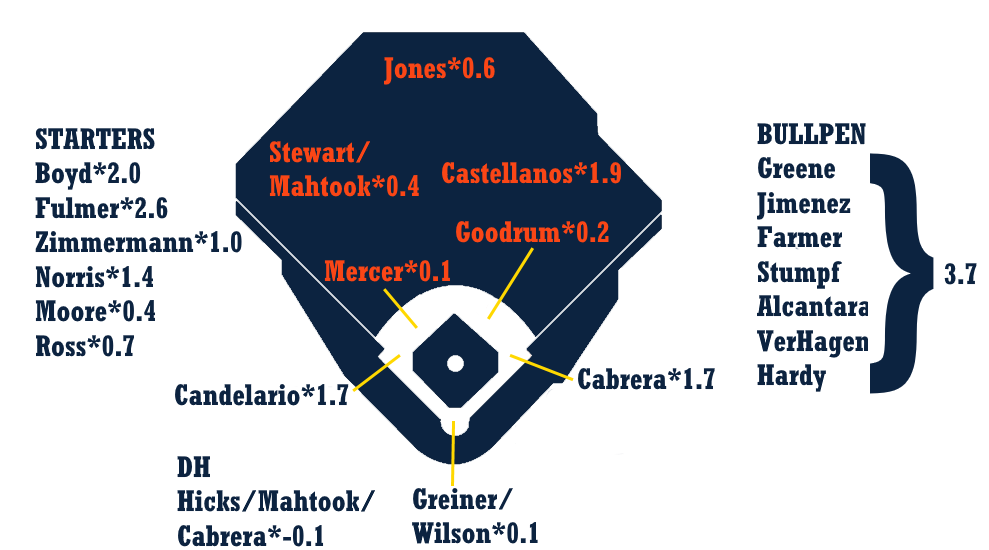
After having typically appeared in the hallowed pages of Baseball Think Factory, Dan Szymborski’s ZiPS projections have now been released at FanGraphs for more than half a decade. The exercise continues this offseason. Below are the projections for the Detroit Tigers.
2014 sure seems a long time ago when you look at these offensive projections, doesn’t it? What’s especially troubling when you consider them is that as a whole is there just isn’t all that much upside. It wasn’t so long ago that Miguel Cabrera was hitting at an All-Star level, but the reality is that he’s only played in 168 games over the last two seasons and hit an un-Miggy-like .260/.344/.410. It’s good news of a sort that his back wasn’t one of the injury culprits in 2018, but for a 36-year-old (in April) still just a year removed from having two herniated discs, I may be searching for good news.
Nicholas Castellanos has developed into a very good hitter, but like his predecessor, J.D. Martinez, he’s one who really shouldn’t play the field. It was a good idea to give Castellanos a chance in the outfield, but it turns out he’s not much better as an outfielder than he was as a third baseman. If the Tigers want to win a few more games in 2019, I’d just stick him at designated hitter. That is, assuming he’s not traded in the next few weeks as he hopes. Castellanos is likely the only player on the roster who ought to be a trade target; Cabrera’s contract makes him unmovable without eating an obscene amount of cash and the Tigers shouldn’t deal Jeimer Candelario.
Otherwise, the amount of offensive talent, with the exception of Castellanos and Candelario, is almost shockingly scant. With Jose Iglesias not counting since he’s a free agent, minor-league defensive wizard Jake Rogers projects as the fourth-most valuable Tiger given a whole season of play. It’s unusual for a replacement-level offensive player to project so well. ZiPS projected the Marlins and Orioles to have, respectively, nine and 10 position players in their organizations worth 0.6 WAR or better, a murderers’ row compared to Detroit’s four.
ZiPS could, of course, be wrong. The Steamer projections are far more positive. If you’re a fan of the Tigers, that’s the system you’re hoping will be right this year, at least when it comes to the starting lineup.
Pitchers
This is a bit of a flip from the batters, in that ZiPS likes the pitching more than Steamer does. Now, the top-end projections in the rotation don’t even sniff at All-Star level, but there’s a lot more of interest here than there is with the hitters. ZiPS projects a rebound season from Michael Fulmer, but one in which he looks like a solid No. 2 starter rather than the ace the Tigers believed they had after his 3.06 ERA, AL Rookie of the Year debut in 2016. Rating Fulmer’s abilities too highly is what made Detroit so reluctant to trade him absent an enormous return, and I still believe they’ll come to regret it. Don’t get me wrong, Fulmer still has trade value, but as a good-not-great pitcher who still hasn’t proven to be much of a workhorse, the Tigers would get less now than they would have after 2016 or 2017.
There’s a bit of a trap here for Detroit. With Matt Moore, Tyson Ross, and Jordan Zimmermann under contract, to go along with Fulmer and Matt Boyd, the Tigers could very well start the season without any of the mildly interesting prospects and hangers-ons they have haunting Comerica Park roaming the field. I’m not even talking about the organization’s top four or five pitching prospects, which seem to be some combination of Casey Mize, Franklin Perez, Matt Manning, Beau Burrows, and Alex Faedo (stay-tuned to Kiley McDaniel and Eric Longenhagen for more on this than this brief little writeup). I’m talking about Daniel Norris; the Tigers really need to figure out whether or not he is a bust rather than let another rebuilding team do so. I’m talking about exploring Blaine Hardy’s potential as a starter more. Matt Hall isn’t a top prospect, but his curve keeps getting batters out as he moves up the ladder and he was excellent in 10 starts for Triple-A Toledo. Even an extended look at a non-prospect like Spencer Turnbull strikes me as more productive than the current rotation plan; there’s little flip potential in Moore, Ross and Zimmermann.
You don’t find Corey Klubers or Dallas Keuchels without taking chances on lesser prospects and non-prospects. Being able to get an extended look at these kinds of players is one of the advantages a rebuilding team has over contenders.
Bench and Prospects
The general hope is that the pitching will largely take care of itself. There’s a lot of truth to this; if two of the five pitching prospects named in the last section are good major leaguers, the Tigers are a long way towards becoming contenders again. The chances of building an offense from the minor leagues, on the other hand, look quite low, even if, for the sake of argument, we accept that Christin Stewart meets Steamer’s significantly higher expectations. Daz Cameron has very high variance in the projections, enough to make him a far better prospect than one would initially think from his fairly ugly 2019 projection, but after that, the quality drops off tremendously. Now, a projection system doesn’t really have much to say — yet — about players with limited professional experience like Kody Clemens or Parker Meadows, but every team has several prospects they can say that about. Detroit needs some real wins from the position players or when the pitching is playoff-ready, they’ll likely have to write some big checks to assemble a lineup to match.
One pedantic note for 2019: for the WAR graphic, I’m using FanGraphs’ depth chart playing time, not the playing time ZiPS spits out, so there will be occasional differences in WAR totals.
Disclaimer: ZiPS projections are computer-based projections of performance. Performances have not been allocated to predicted playing time in the majors — many of the players listed above are unlikely to play in the majors at all in 2019. ZiPS is projecting equivalent production — a .240 ZiPS projection may end up being .280 in AAA or .300 in AA, for example. Whether or not a player will play is one of many non-statistical factors one has to take into account when predicting the future.
Players are listed with their most recent teams, unless I have made a mistake. This is very possible, as a lot of minor-league signings go generally unreported in the offseason.
ZiPS’ projections are based on the American League having a 4.29 ERA and the National League having a 4.15 ERA.
Players who are expected to be out due to injury are still projected. More information is always better than less information, and a computer isn’t the tool that should project the injury status of, for example, a pitcher who has had Tommy John surgery.
Both hitters and pitchers are ranked by projected zWAR — which is to say, WAR values as calculated by me, Dan Szymborski, whose surname is spelled with a z. WAR values might differ slightly from those which appear in full release of ZiPS. Finally, I will advise anyone against — and might karate chop anyone guilty of — merely adding up WAR totals on a depth chart to produce projected team WAR.
Taylor Guerrieri is a Texas Ranger now, having signed a free-agent contract with the A.L. West club on Tuesday. His MLB experience is scant. Originally in the Tampa Bay organization — the Rays drafted him 24th overall in 2011 — he debuted with the Toronto Blue Jays last September and tossed nine-and-two-thirds innings over nine relief appearances.
Guerrieri features a high-spin-rate curveball, but what he throws most often is a sinker. Per StatCast, the 26-year-old right-hander relied on the pitch 47.1% of the time during his month-long cup of coffee. I asked him about it in the waning weeks of his maiden campaign.
“The main thing with the two-seam is to stay on top of it and drive it downhill,” Guerrieri told me. “That way you get the depth you’re looking for. Horizontal movement isn’t a very good play. Guys can see side to side. They struggle with up and down, so the more depth, the better.”
Natch. The goal for a sinker is to make it sink, and what Guerrieri explained is part of Pitching 101. As for grips… well, those are more nuanced. In Guerrieri’s case, they can also be a bit of a moving target. Read the rest of this entry »
It was 84 degrees in Cleveland by the time Michael Fulmer, Detroit’s starter for a September 15 rumble with Cleveland, hit the showers without recording an out for the Tigers. Cleveland won that game 15-0, and Fulmer missed his last two scheduled starts of the season with a knee injury, apparently sustained in-game, that put him in surgery five days later. It was a fitting end to the 25-year-old’s 2018 campaign. Detroit had hoped, at the very least, that Fulmer would be effective enough to stabilize an aging rotation, one in which he and 27-year-old Matthew Boyd were the only starters under 30. At best, they’d reportedly hoped he’d be good enough to spin off to a contender at the trade deadline. He was neither, and instead posted the worst season of his three-year career.
Michael Fulmer Had a Bad Year
Season
Age
IP
K%
BB%
ERA-
FIP-
WAR
2016
23
159.0
20.4%
6.5%
72
87
3.0
2017
24
164.2
16.9%
5.9%
87
83
3.5
2018
25
132.1
19.7%
8.2%
110
105
1.4
I’d like to focus on Fulmer’s disappointing 2018 campaign for a moment because its presumptive cause — injury — means that a resurgent Fulmer, if he indeed rebounds next year, will probably look quite different than the young man who won 2016’s AL Rookie of the Year award and was an All-Star in the next season. If baseball’s beauty lies in part in the opportunities it gives its players to reinvent themselves, then Michael Fulmer is a prime candidate for reinvention, and with his success or failure rides some portion of the future success or failure of the Tigers. Other pitchers have reinvented themselves after early-career injuries effectively, and I’m always curious to see how they choose to fight their way back. Read the rest of this entry »
It wouldn’t be accurate to say that Chavez Young came out of nowhere to become one of the hottest prospects in the Toronto Blue Jays organization. But he is following an atypical path. The 21-year-old outfielder grew up in the Bahamas before moving stateside as a teen, and going on to be selected in the 39th round of the 2016 draft out of Faith Baptist Christian Academy, in Ludowici, Georgia.
Since that time he’s become a shooting star. Playing for the Lansing Lugnuts in the Low-A Midwest League this past season, Young stroked 50 extra-base hits, stole 44 bases, and slashed a rock-solid .285/.363/.445.




 iTunes Feed
 Sponsor Us on Patreon
 Facebook Group
 Effectively Wild Wiki
 Twitter Account
 Get Our Merch!