In the first of a six-part series — one piece for each division — I’ll be highlighting each team’s most notable free agents and how it could fill the resulting void on the roster. A player’s rank on our recently released Top 50 Free Agents list, along with Kiley McDaniel’s contract estimates from that exercise, are listed where relevant. In some cases, the team already has a capable replacement ready to step in. In others, it’s clear the team will either attempt to re-sign their player or look to the trade or free agent markets for help. The remaining cases are somewhere in between, with in-house candidates who might be the answer, but aren’t such obvious everyday players to keep the team from shopping around for better options.
Here’s a look at the American League East.
Mark Trumbo, DH/1B
Trumbo’s expected departure is only notable because it marks the end of a disastrous three-year run that resulted in an 87 wRC+ and 40 homers in 248 games at a total cost of $37.5 million. In his debut season with Orioles in 2016, he had a 125 wRC+ with 47 homers, which led to the contract extension. The particular role Trumbo was supposed to fill, primarily as a designated hitter who could occasionally fill in at first base and the corner outfield spots, now belongs to 25-year-old Renato Nuñez, who will make slightly above the minimum salary next season, is under contract through 2025, and had a 99 wRC+ with 31 homers in his first full big league season.
Total WAR: -0.3
Rick Porcello, SP
FanGraphs Top 50 Free Agent Ranking: 31
Kiley McDaniel’s contract projection: 2 years, $18M
Chris Sale, David Price, and Nathan Eovaldi combined to make 59 starts in 2019 and there’s not much reason to believe that any of them are likely to give the Red Sox anywhere near 30 starts or 180 innings in 2020. That’s why the potential loss of Porcello, who has made at least 31 starts in eight of his 11 seasons and has never had less than 27, could be a major blow to a team with limited starting pitching depth behind Eduardo Rodriguez and the aforementioned trio.
Badly in need of an innings-eater, it’s possible that the best fit for the Red Sox rotation in 2020 is Porcello, even if he’s nowhere near the pitcher he was when he won the AL Cy Young award in 2016. But even if they cut his 2019 salary of $21.25 million by more than half — Kiley predicted a two-year, $18 million contract for Porcello in our Top 50 Free Agents — Boston is attempting to shed payroll and might be looking for much cheaper options.
Brock Holt, INF/OF
FanGraphs Top 50 Free Agent Ranking: 33
Kiley McDaniel’s contract projection: 2 years, $15M
After a 1-for-16 start to the season followed by a six-week stint on the Injured List, Holt returned to slash .313/.380/.424 in his final 276 plate appearances while making starts at six different positions. The 31-year-old should be rewarded by a team that can offer him more playing time, which could open the door for Tzu-Wei Lin or one of a handful of prospects, including Chad De La Guerra and C.J. Chatham, to become the team’s next super-utilityman.
Mitch Moreland, 1B
Coming off one of his most productive season at the plate, the 34-year-old Moreland’s price tag could still be less than the two-year, $13 million deal that just expired. Still, the Red Sox have bigger voids to fill than at first base. Some combination of Michael Chavis and possibly an inexpensive veteran — think Yonder Alonso or Logan Morrison — could do the job, with prospect Bobby Dalbec, who slashed .239/.356/.460 with 27 homers between Triple-A and Double-A in 2019, a possibility to help out later in the season.
Andrew Cashner, SP/RP
Since an impressive performance as a relief pitcher with the Padres way back in 2012, Cashner worked almost exclusively as a starter over the next six-and-a-half years. He was very good at times, but was also very bad at others, leading at least some people — well, mostly me — to wonder whether it was time to move him back to the bullpen. That time finally came after he posted an 8.01 ERA and 6.81 FIP in six starts after being acquired from the Orioles in July. Excluding his final appearance of the season, which was disastrous, Cashner had a 2.38 ERA and 3.52 FIP out of the ‘pen with four holds and a save while limiting opponents to a .160 batting average over 22 and two-thirds innings.
It’s unclear what kind of market Cashner would have as a reliever, or if there are still teams interested in him as a starting pitcher, but a return to Boston as a setup man to Brandon Workman could be a nice fit for the 33-year-old.
Total WAR: 3.7
Didi Gregorius, SS
FanGraphs Top 50 Free Agent Ranking: 10
Kiley McDaniel’s contract projection: 3 years, $48M
With Gregorius out of the picture, Gleyber Torres could move to shortstop, DJ LeMahieu could get most of his starts at second base, and the corner infield spots should be covered by some combination of Miguel Andujar, Greg Bird, Mike Ford, Gio Urshela, and Luke Voit. It really could be as simple as that.
That doesn’t mean the 29-year-old Gregorius, who was 20th in AL MVP voting in 2017 and 2018, is on his way out. The Yankees don’t have many holes to fill. If they prioritize keeping Gregorius, there’s a good chance he’ll stay put. But the fact that they didn’t give him a qualifying offer, making him much more valuable on the open market, probably means that they’re ready to move on and will focus their offseason efforts elsewhere, possibly in the starting pitching market.
Brett Gardner, OF
FanGraphs Top 50 Free Agent Ranking: 21
Kiley McDaniel’s contract projection: 1 year, $13M
When Gardner re-signed with the Yankees for the 2019 season, it appeared that his days as a starting outfielder were behind him. Coming off one of his least productive seasons, he was set to fill a part-time role behind Aaron Hicks, Aaron Judge, and Giancarlo Stanton. A year later, things have changed substantially.
The 36-year-old Gardner just had what was one of his best offensive seasons as a major leaguer. He could still be very valuable to the Yankees, who will be without Hicks for at least half of the season as he recovers from Tommy John surgery. If they fail to re-sign Gardner without making a competitive offer, it’s a sign that they believe Mike Tauchman’s breakout season (128 wRC+, 13 HR in 296 plate appearances) wasn’t a fluke and that he’s ready to be penciled in as their Opening Day center fielder.
Edwin Encarnación, DH/1B
FanGraphs Top 50 Free Agent Ranking: 25
Kiley McDaniel’s contract projection: 1 year, $11M
After a season in which nearly every position player in the Bronx missed time due to an injury, the Yankees might be better off rotating their lineup regulars in and out of the designated hitter spot to keep them well-rested and healthy. Or they could use it early in the season to ease Andujar back into action as he returns from rotator cuff surgery. In either case, Encarnación’s time with the Yankees is likely over even if he still has a lot left in the tank as he enters his age-37 season.
Dellin Betances, RP
FanGraphs Top 50 Free Agent Ranking: 22
Kiley McDaniel’s contract projection: 1 year, $12M
Betances didn’t make his 2019 debut until September 15, striking out both batters he faced before he was shut down for with a partially torn Achilles’ tendon. The Yankees’ bullpen was still very good without him. Zack Britton and Adam Ottavino both posted sub-2.00 ERAs and Tommy Kahnle bounced back from a disappointing 2018.
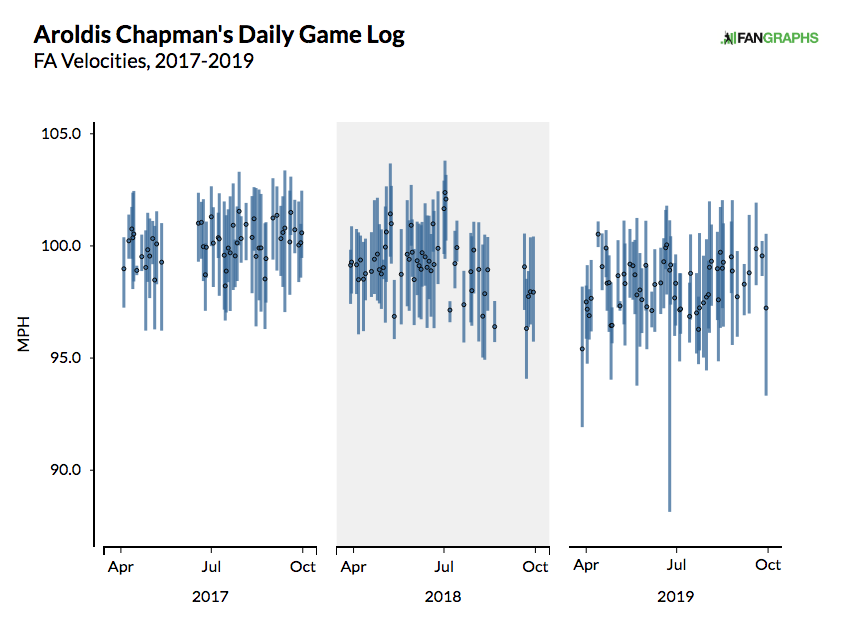
The 31-year-old, who had over 15.0 K/9 in three consecutive seasons prior to 2019, could pursue both a multi-year deal and an opportunity to be another team’s closer. But if other teams aren’t willing to offer either of those because of health concerns, he could opt to stay with the Yankees and rebuild his value on a one-year deal in hopes of a big payday next winter. If the Yankees are unwilling to spend much more on their bullpen — Aroldis Chapman, Britton, and Ottavino will make a combined $38 million in 2020 — they could move one of their young starting pitchers to relief. Jonathan Loaisiga or Deivi Garcia would be options.
Cameron Maybin, OF
Like Gardner and Tauchman, the 2019 Yankees brought out the best in the 32-year-old Maybin. After having to settle for a minor league contract last offseason, he’s all but certain to land a major league deal this time around after slashing .285/364/.494 with 11 homers in 269 plate appearances on team that won 103 games.
Total WAR: 7.0
Eric Sogard, INF/OF
FanGraphs Top 50 Free Agent Ranking: 39
Kiley McDaniel contract projection: 1 year, $6M
Acquired in July to help pick up the slack with several key players banged up, Sogard had injury troubles of his own late in the season and was shut down in mid-September. He did return for the post-season, making one start and homering against Gerrit Cole. With a deep Rays team expected to return to full health, the 33-year-old Sogard probably won’t be back. Finding a major league deal shouldn’t be a problem, though, after he finished the season with a .290/.353/.457 slash line in 442 plate appearances while making starts at five different positions.
Avisaíl García, OF
FanGraphs Top 50 Free Agent Ranking: 30
Kiley McDaniel’s contract projection: 1 year, $10M
With three starting outfielders who don’t figure to sit much in 2020 and Guillermo Heredia in line to be the defensive replacement off the bench, García will likely look elsewhere to cash in on a strong bounce-back season. At age 28, he’s one of the youngest free agents on the market.
Travis d’Arnaud, C/1B
FanGraphs Top 50 Free Agent Ranking: 27
Kiley McDaniel’s contract projection: 2 years, $14M
d’Arnaud was acquired from the Dodgers to help fill the void shortly after Mike Zunino went on the Injured List with a strained quad in early May. By the end of August, he was the primary catcher on a Rays team that was headed for a 96-win season and a playoff appearance. He also made 16 starts at first base because the Rays didn’t want his bat out of the lineup when he wasn’t catching. After Zunino’s offensive production dipped drastically for the second consecutive year, the Rays could bring back the 30-year-old d’Arnaud to pair with him once again. Or they could make room to re-sign him by non-tendering Zunino, who is entering his final year of arbitration eligibility.
Total WAR: 4.1
Clay Buchholz/Clayton Richard, SP
To fill their rotation needs in 2019, the Blue Jays took a chance on a pair of oft-injured right-handers, Buchholz and Matt Shoemaker, as well as veteran lefty Richard, who made 59 starts over the previous two seasons. While Shoemaker pitched brilliantly out of the gate, he suffered a season-ending knee injury in his fifth start while the other two battled injuries throughout the season and combined for only 22 mostly mediocre starts.
In the same boat a year later, looking for veteran starting pitchers that can help bridge the gap to the team’s young pitching prospects, Toronto moved quickly to acquire Chase Anderson in a trade with the Brewers and will likely add at least one more starter who is a safer bet than any of last year’s additions.
Total WAR: -0.1