The Yankees Don’t Spend Like They Used to

After a season that saw the Yankees win 103 games, an AL East title, and get within two victories of reaching the World Series, Aaron Judge called the season “a failure.” Brian Cashman was a little more diplomatic, saying “we failed in our ultimate goal but we did not have a failed season.” If winning the World Series is the only path to satisfaction for a team, failure is almost inevitable. That hasn’t always been true for the Yankees and their 27 titles — even after going a whole decade without a championship, the Yankees’ five World Series wins in 25 years is still the most in the sport. Only the Red Sox, Giants, Cardinals, and Marlins have multiple titles in that time span, with eight franchises boasting a single title and 17 franchises without a ring since the strike.

The Yankees are often known for operating in another financial stratosphere. Forbes put a $4.6 billion valuation on the club, roughly 40% higher than the Los Angeles Dodgers and essentially the same as the White Sox, Mariners, and Blue Jays combined. While the Yankees’ YES Network is valued at around $3.5 billion, 14 other teams’ networks combined recently sold for about one-fifth that cost on a per team basis. Forbes estimates that only two teams (Dodgers and Red Sox) have annual revenues within $200 million of the Yankees. Financially speaking in baseball, there’s the Yankees up top, then 50 feet of swimming pools full of gold, then there’s everyone else. But lately, when it comes to spending on the major league roster, the Yankees haven’t operated as a behemoth and have instead opted to swim in that gold. Such is their choice.

The Yankees don’t have to spend like they used to in order to be successful. They’ve been better with player development, better at holding on to top prospects, better with trades, and better at identifying diamonds in the rough. Getting there cost them several years of playoff baseball, but they are coming off consecutive 100-win seasons, and though those teams didn’t win the World Series, they put themselves in position to have a really good shot. Strengthening the organization overall has allowed them to spend on payroll like they are a run-of-the-mill rich team. They could do more to win even more games and provide a better chance at a title, but it is difficult to know how great the motivation is to do so when they are already winning a lot. It’s also hard to put into perspective just how much they could be spending when they have one of the top payrolls in the game. Read the rest of this entry »


RosterResource Free Agency Roundup: AL East

In the first of a six-part series — one piece for each division — I’ll be highlighting each team’s most notable free agents and how it could fill the resulting void on the roster. A player’s rank on our recently released Top 50 Free Agents list, along with Kiley McDaniel’s contract estimates from that exercise, are listed where relevant. In some cases, the team already has a capable replacement ready to step in. In others, it’s clear the team will either attempt to re-sign their player or look to the trade or free agent markets for help. The remaining cases are somewhere in between, with in-house candidates who might be the answer, but aren’t such obvious everyday players to keep the team from shopping around for better options.

Here’s a look at the American League East.

Baltimore Orioles | Depth Chart | Payroll

Mark Trumbo, DH/1B

Trumbo’s expected departure is only notable because it marks the end of a disastrous three-year run that resulted in an 87 wRC+ and 40 homers in 248 games at a total cost of $37.5 million. In his debut season with Orioles in 2016, he had a 125 wRC+ with 47 homers, which led to the contract extension. The particular role Trumbo was supposed to fill, primarily as a designated hitter who could occasionally fill in at first base and the corner outfield spots, now belongs to 25-year-old Renato Nuñez, who will make slightly above the minimum salary next season, is under contract through 2025, and had a 99 wRC+ with 31 homers in his first full big league season.

Total WAR: -0.3

Boston Red Sox | Depth Chart | Payroll

Rick Porcello, SP
FanGraphs Top 50 Free Agent Ranking: 31
Kiley McDaniel’s contract projection: 2 years, $18M

Chris Sale, David Price, and Nathan Eovaldi combined to make 59 starts in 2019 and there’s not much reason to believe that any of them are likely to give the Red Sox anywhere near 30 starts or 180 innings in 2020. That’s why the potential loss of Porcello, who has made at least 31 starts in eight of his 11 seasons and has never had less than 27, could be a major blow to a team with limited starting pitching depth behind Eduardo Rodriguez and the aforementioned trio.

Badly in need of an innings-eater, it’s possible that the best fit for the Red Sox rotation in 2020 is Porcello, even if he’s nowhere near the pitcher he was when he won the AL Cy Young award in 2016. But even if they cut his 2019 salary of $21.25 million by more than half — Kiley predicted a two-year, $18 million contract for Porcello in our Top 50 Free Agents — Boston is attempting to shed payroll and might be looking for much cheaper options.

Brock Holt, INF/OF
FanGraphs Top 50 Free Agent Ranking: 33
Kiley McDaniel’s contract projection: 2 years, $15M

After a 1-for-16 start to the season followed by a six-week stint on the Injured List, Holt returned to slash .313/.380/.424 in his final 276 plate appearances while making starts at six different positions. The 31-year-old should be rewarded by a team that can offer him more playing time, which could open the door for Tzu-Wei Lin or one of a handful of prospects, including Chad De La Guerra and C.J. Chatham, to become the team’s next super-utilityman.

Mitch Moreland, 1B

Coming off one of his most productive season at the plate, the 34-year-old Moreland’s price tag could still be less than the two-year, $13 million deal that just expired. Still, the Red Sox have bigger voids to fill than at first base. Some combination of Michael Chavis and possibly an inexpensive veteran — think Yonder Alonso or Logan Morrison — could do the job, with prospect Bobby Dalbec, who slashed .239/.356/.460 with 27 homers between Triple-A and Double-A in 2019, a possibility to help out later in the season.

Andrew Cashner, SP/RP

Since an impressive performance as a relief pitcher with the Padres way back in 2012, Cashner worked almost exclusively as a starter over the next six-and-a-half years. He was very good at times, but was also very bad at others, leading at least some people — well, mostly me — to wonder whether it was time to move him back to the bullpen. That time finally came after he posted an 8.01 ERA and 6.81 FIP in six starts after being acquired from the Orioles in July. Excluding his final appearance of the season, which was disastrous, Cashner had a 2.38 ERA and 3.52 FIP out of the ‘pen with four holds and a save while limiting opponents to a .160 batting average over 22 and two-thirds innings.

It’s unclear what kind of market Cashner would have as a reliever, or if there are still teams interested in him as a starting pitcher, but a return to Boston as a setup man to Brandon Workman could be a nice fit for the 33-year-old.

Total WAR: 3.7

New York Yankees | Depth Chart | Payroll

Didi Gregorius, SS
FanGraphs Top 50 Free Agent Ranking: 10
Kiley McDaniel’s contract projection: 3 years, $48M

With Gregorius out of the picture, Gleyber Torres could move to shortstop, DJ LeMahieu could get most of his starts at second base, and the corner infield spots should be covered by some combination of Miguel Andujar, Greg Bird, Mike Ford, Gio Urshela, and Luke Voit. It really could be as simple as that.

That doesn’t mean the 29-year-old Gregorius, who was 20th in AL MVP voting in 2017 and 2018, is on his way out. The Yankees don’t have many holes to fill. If they prioritize keeping Gregorius, there’s a good chance he’ll stay put. But the fact that they didn’t give him a qualifying offer, making him much more valuable on the open market, probably means that they’re ready to move on and will focus their offseason efforts elsewhere, possibly in the starting pitching market.

Brett Gardner, OF
FanGraphs Top 50 Free Agent Ranking: 21
Kiley McDaniel’s contract projection: 1 year, $13M

When Gardner re-signed with the Yankees for the 2019 season, it appeared that his days as a starting outfielder were behind him. Coming off one of his least productive seasons, he was set to fill a part-time role behind Aaron Hicks, Aaron Judge, and Giancarlo Stanton. A year later, things have changed substantially.

The 36-year-old Gardner just had what was one of his best offensive seasons as a major leaguer. He could still be very valuable to the Yankees, who will be without Hicks for at least half of the season as he recovers from Tommy John surgery. If they fail to re-sign Gardner without making a competitive offer, it’s a sign that they believe Mike Tauchman’s breakout season (128 wRC+, 13 HR in 296 plate appearances) wasn’t a fluke and that he’s ready to be penciled in as their Opening Day center fielder.

Edwin Encarnación, DH/1B
FanGraphs Top 50 Free Agent Ranking: 25
Kiley McDaniel’s contract projection: 1 year, $11M

After a season in which nearly every position player in the Bronx missed time due to an injury, the Yankees might be better off rotating their lineup regulars in and out of the designated hitter spot to keep them well-rested and healthy. Or they could use it early in the season to ease Andujar back into action as he returns from rotator cuff surgery. In either case, Encarnación’s time with the Yankees is likely over even if he still has a lot left in the tank as he enters his age-37 season.

Dellin Betances, RP
FanGraphs Top 50 Free Agent Ranking: 22
Kiley McDaniel’s contract projection: 1 year, $12M

Betances didn’t make his 2019 debut until September 15, striking out both batters he faced before he was shut down for with a partially torn Achilles’ tendon. The Yankees’ bullpen was still very good without him. Zack Britton and Adam Ottavino both posted sub-2.00 ERAs and Tommy Kahnle bounced back from a disappointing 2018.

The 31-year-old, who had over 15.0 K/9 in three consecutive seasons prior to 2019, could pursue both a multi-year deal and an opportunity to be another team’s closer. But if other teams aren’t willing to offer either of those because of health concerns, he could opt to stay with the Yankees and rebuild his value on a one-year deal in hopes of a big payday next winter. If the Yankees are unwilling to spend much more on their bullpen — Aroldis Chapman, Britton, and Ottavino will make a combined $38 million in 2020 — they could move one of their young starting pitchers to relief. Jonathan Loaisiga or Deivi Garcia would be options.

Cameron Maybin, OF

Like Gardner and Tauchman, the 2019 Yankees brought out the best in the 32-year-old Maybin. After having to settle for a minor league contract last offseason, he’s all but certain to land a major league deal this time around after slashing .285/364/.494 with 11 homers in 269 plate appearances on team that won 103 games.

Total WAR: 7.0

Tampa Bay Rays | Depth Chart | Payroll

Eric Sogard, INF/OF
FanGraphs Top 50 Free Agent Ranking: 39
Kiley McDaniel contract projection: 1 year, $6M

Acquired in July to help pick up the slack with several key players banged up, Sogard had injury troubles of his own late in the season and was shut down in mid-September. He did return for the post-season, making one start and homering against Gerrit Cole. With a deep Rays team expected to return to full health, the 33-year-old Sogard probably won’t be back. Finding a major league deal shouldn’t be a problem, though, after he finished the season with a .290/.353/.457 slash line in 442 plate appearances while making starts at five different positions.

Avisaíl García, OF
FanGraphs Top 50 Free Agent Ranking: 30
Kiley McDaniel’s contract projection: 1 year, $10M

With three starting outfielders who don’t figure to sit much in 2020 and Guillermo Heredia in line to be the defensive replacement off the bench, García will likely look elsewhere to cash in on a strong bounce-back season. At age 28, he’s one of the youngest free agents on the market.

Travis d’Arnaud, C/1B
FanGraphs Top 50 Free Agent Ranking: 27
Kiley McDaniel’s contract projection: 2 years, $14M

d’Arnaud was acquired from the Dodgers to help fill the void shortly after Mike Zunino went on the Injured List with a strained quad in early May. By the end of August, he was the primary catcher on a Rays team that was headed for a 96-win season and a playoff appearance. He also made 16 starts at first base because the Rays didn’t want his bat out of the lineup when he wasn’t catching. After Zunino’s offensive production dipped drastically for the second consecutive year, the Rays could bring back the 30-year-old d’Arnaud to pair with him once again. Or they could make room to re-sign him by non-tendering Zunino, who is entering his final year of arbitration eligibility.

Total WAR: 4.1

Toronto Blue Jays | Depth Chart | Payroll

Clay Buchholz/Clayton Richard, SP

To fill their rotation needs in 2019, the Blue Jays took a chance on a pair of oft-injured right-handers, Buchholz and Matt Shoemaker, as well as veteran lefty Richard, who made 59 starts over the previous two seasons. While Shoemaker pitched brilliantly out of the gate, he suffered a season-ending knee injury in his fifth start while the other two battled injuries throughout the season and combined for only 22 mostly mediocre starts.

In the same boat a year later, looking for veteran starting pitchers that can help bridge the gap to the team’s young pitching prospects, Toronto moved quickly to acquire Chase Anderson in a trade with the Brewers and will likely add at least one more starter who is a safer bet than any of last year’s additions.

Total WAR: -0.1


Kiley McDaniel Chat – 11/6/19

12:19

Avatar Kiley McDaniel: Hello from ATL! Scout is sunbathing on the porch and the grout for the backsplash should be going in later today. Big changes to the chat as I figured out how to add a picture so you can tell me apart from people that ask questions as me. To your questions:

12:21

Archer: As a recent home purchaser whose kitchen  could use a slight face lift, I’d love to see the pictures of your new backsplash! Did you install yourself?

12:21

Avatar Kiley McDaniel: I knew this would be the backsplash chat

12:21

Avatar Kiley McDaniel:

12:22

Avatar Kiley McDaniel: that’s mid installation, it’ll eventually go to the ceiling behind the vent

12:22

Avatar Kiley McDaniel: Had the contractor’s guys do it. 5th contractor was the charm!

Read the rest of this entry »


Steve Garvey is Modern Baseball Ballot’s Ballast

This post is part of a series concerning the 2020 Modern Baseball Era Committee ballot, covering executives and long-retired players whose candidacies will be voted upon at the Winter Meetings in San Diego on December 8. For an introduction to JAWS, see here. Several profiles in this series are adapted from work previously published at SI.com, Baseball Prospectus, and Futility Infielder. All WAR figures refer to the Baseball-Reference version unless otherwise indicated.

2020 Modern Baseball Candidate: Steve Garvey
Player Career WAR Peak WAR JAWS
Steve Garvey 38.1 28.8 33.4
Avg. HOF 1B 66.8 42.7 54.8
H HR AVG/OBP/SLG OPS+
2,599 272 .294/.329/.446 117
SOURCE: Baseball-Reference

From his matinee-idol good looks as he filled out his red, white, and Dodger blue uniform to the round-numbered triple-crown stats on the back of his baseball card, Steve Garvey looked like a Hall of Famer in the making for much of his 19-year playing career (1969-87). A remarkably consistent and durable player, he had a clockwork ability to rap out 200 hits, bat .300 with 20 homers, and drive in 100 runs, all while maintaining perfectly-coiffed hair and never missing a game. He holds the NL record for consecutive games played (1,207 from September 3, 1975, to July 29, 1983), a streak that’s still the majors’ fourth-longest after those of Cal Ripken Jr., Lou Gehrig, and Everett Scott. He was the most heralded member of the Dodgers’ legendary Longest-Running Infield alongside second baseman Davey Lopes, shortstop Bill Russell, and third baseman Ron Cey, earning All-Star honors in each of the eight full seasons (1974-81) the unit was together while helping the team to four pennants and a championship. After moving on from Los Angeles, Garvey made two more All-Star teams while helping the Padres to their first pennant.

As the most popular player on my favorite childhood team, and the one who seemed to shine most brightly on the biggest stages, Garvey felt larger than life. An Adidas poster of him standing upon what was supposed to be the moon, captioned, “The harder you hit it, the further it goes,” hung on the wall of my younger brother’s bedroom. Yet when I began reading Bill James in the early 1980s, I was struck by the extent to which the new numbers took Garvey down a peg, though to be fair, he’d entered his mid-30s already beginning his decline, postseason heroics aside. Likewise, when I began writing about the Hall of Fame in early 2002, Garvey’s lack of traction on the ballot in his nine previous tries stood out. While I don’t think particularly highly of his chances or his case, I felt it was worth expanding beyond the two or three paragraphs I’ve devoted to him countless times over the years (he was on the writers’ ballot through 2007, and this is his fourth committee appearance).

Born in Tampa, Florida in 1948, Garvey connected with the Dodgers when he was just seven years old. In 1956, his father Joe, a Greyhound bus driver, was assigned to drive charter buses for the defending world champions at their Vero Beach spring training base, and arranged for his son to serve as a bat boy for the team, a position he occupied for the next six springs. Garvey idolized first baseman Gil Hodges and dreamed of playing for Los Angeles. Though small for a high school athlete (5-foot-7, 165 pounds; he would grow to 5-foot-10, 192 pounds), he excelled at baseball and football. Bypassing a chance to join the Twins after being drafted in the third round in 1966, he drew a scholarship to Michigan State University. Read the rest of this entry »


Will Harris Played Well, Didn’t Get Rewarded

When Will Harris entered Game 7 of the World Series, the Astros were in the driver’s seat. There was only one out in the seventh, and Houston was up by a lone run, but teams in that position usually win — per our Win Expectancy chart, that situation ends in victory 68.7% of the time.

68.7% is notably not 100%, however. When Harris threw Howie Kendrick an 0-1 cutter, Kendrick demonstrated why:

The game wasn’t over after that home run, but it proved decisive nonetheless. The Nationals never relinquished the lead, tacking on insurance runs in the eighth and ninth, and sharked their way to a World Series title. Harris gave up a single to Asdrúbal Cabrera before Roberto Osuna replaced him; after the game, he became a free agent, and may never pitch for the Astros again. Read the rest of this entry »


Arizona Diamondbacks Start Rebuild and Accidentally Contend

Despite trading their biggest names, the D-backs held on to enough talent to stay competitive, and should be again in 2020. (Photo: Hayden Schiff)

“How ridiculous and how strange to be surprised at anything which happens in life.” – Marcus Aurelius, (translated from The Meditations)

The Arizona Diamondbacks didn’t enter last offseason with a plan to burn everything to ashes and then burn the ashes. After all, being able to choose how to rebuild is one of the benefits of not waiting until circumstances have eliminated more appealing options. Arizona remained in contention despite trading Paul Goldschmidt last offseason and shedding Eephus god Zack Greinke in July, and the club looks like a viable Wild Card contender entering 2020.

The Setup

The D-backs faced a Goldschmidt-sized conundrum after the 2018 season. The longtime middle-of-the-order slugger was a year from free agency, and the team couldn’t have been thrilled at the prospect of an extension for an aging first baseman, a deal likely to eclipse $25 million a year. The 2018 team went just 82-80 with Goldschmidt, and the improving farm system was still far from elite, so it made the decision to trade a single year of America’s First Baseman if the right package came along. The Cardinals made the winning offer in the form of Carson Kelly, Luke Weaver, Andy Young, and a Competitive Balance Round B pick; in Weaver and Kelly, Arizona received two players with the potential to contribute immediately in crucial roles, softening the loss Goldschmidt.

While there was some concern from the fan base that this move heralded the start of an old-fashioned fire sale, nothing quite so dramatic actually materialized. Endless rumors swirled around Greinke, but Arizona wasn’t, and the team was more than happy to have its ace return for the 2019 season. Arizona saw Christian Walker as the best candidate to replace Goldschmidt at first, and with Walker out of options, the team hoped he’d make a case for a starting job in spring training (he did). Read the rest of this entry »


Effectively Wild Episode 1452: Play It Again, Sam

EWFI
Meg Rowley and Sam Miller banter about Ben Lindbergh’s vacation-induced absence, an unusual umpire Wikipedia entry, and the acceptability of failure, before turning their attention to a few listener emails answered during the Jeff Sullivan era, including what would happen if Giancarlo Stanton only tried to hit home runs, how they would prefer to consume baseball if they could only do so through either twitter or a livestream, and whether baseball would be better if it were played in masks.

Audio intro: Death Cab for Cutie “I Dreamt We Spoke Again
Audio outro: Dashboard Confessional “Living in Your Letters

Link to Sam’s Giancarlo Stanton home run piece
Link to the Effectively Wild Email Question Database
Link to order The MVP Machine

 iTunes Feed (Please rate and review us!)
 Sponsor Us on Patreon
 Facebook Group
 Effectively Wild Wiki
 Twitter Account
 Get Our Merch!
 Email Us: podcast@fangraphs.com


Braves Ask Markakis to Step Back, Flowers to Step Forward

After breaking a four-year mini-drought of division titles by winning the National League East in 2018, the Atlanta Braves have been hesitant to make any long-term commitments to improve their roster. Their biggest signing of last winter, Josh Donaldson, was brought in on a one-year deal. They replaced starting catcher Kurt Suzuki with Brian McCann, who also signed on a one-year deal. By the time they brought in Dallas Keuchel, the contract covered less than four months of baseball, and when they made upgrades at the 2019 trade deadline, they did so by adding a pair of relievers with a year and a half of team control left. So far, it’s hard to say the plan hasn’t worked — they added seven wins in 2019 — but there’s little doubt Braves fans will be looking for more serious investments this winter. The free agency period is less than 24 hours old, so there’s plenty of time for Atlanta to make those bigger moves in the coming weeks and months. On Day 1, however, the team stuck with the same plan of short-term roster maintenance.

The Braves signed both outfielder Nick Markakis and catcher Tyler Flowers to one-year, $4 million contracts on Monday. Each move carried with it some payroll trickery; Markakis and Flowers each had $6 million options for 2020, but Atlanta declined them in favor of paying $2 million buyouts to each. Both players still make $6 million in 2020, but the Braves can direct the $4 million in buyouts onto their 2019 payroll, according to MLB.com’s Mark Bowman. Atlanta also declined a $12 million club option to Julio Teheran — who hasn’t reached an agreement to remain with the team — and issued a $17.8 million qualifying offer to Donaldson.

The two signings are identical in length and value, but could come with different expectations for each player. Markakis turns 36 in a couple of weeks. This is the third-straight contract he’s signed with Atlanta. The first came before 2015, a four-year commitment worth $44 million. That deal was something of a dud for the first three years, but in 2018, he turned in his best season in years. He hit .297/.366/.440, with a 115 wRC+ and 2.6 WAR that made him a pleasant surprise for the resurgent Braves. It was his most valuable season since 2008 and his best offensive season since 2012, and was enticing enough for Atlanta to bet $4 million that he would continue to hit well enough to merit a starting corner outfield spot on a contending team.

Instead, Markakis looked like, well, a 35-year-old version of Markakis. His wRC+ dipped to 102, his already-mediocre defense took an extra step back, and he missed six weeks with a wrist injury, culminating in a career-low 0.4 WAR in 116 games. His walk and strikeout rates remained excellent, but his power slid backwards, as did his batted ball luck. The biggest decline came in his performance against lefties. An up-and-down performer in the split throughout his career, he went from a 104 wRC+ against southpaws in 2018 to a 71 this year. His success against righties dropped as well, but only from a 120 wRC+ to 112. There’s some good news in Markarkis’ underlying data — his average exit velocity (91.2 mph) and xwOBA (.349) were both his best marks posted in the Statcast era — but his low launch angle and expected slugging marks put a limit on just how dangerous he can be with his bat, which is clearly the only thing keeping him employed at this age. Read the rest of this entry »


Chase Anderson Brings An Improved Cutter to the Blue Jays

Yesterday, the Toronto Blue Jays added former Milwaukee Brewers starting pitcher Chase Anderson to their pitching rotation in exchange for first base prospect Chad Spanberger. Anderson, who had an $8.5 million dollar club option for 2020, was not a compelling choice for the Brewers given how steeply his performance dropped off after his standout 2017 campaign.

The Blue Jays get a middle-to-back of the rotation pitcher who started at least 25 games and pitched more than 141 innings through four seasons in Milwaukee, and struck out at least 105 batters in each of his six seasons in the majors. Despite not being able to replicate his performance from two seasons ago, Anderson was able to triple his pedestrian 0.3 WAR in 2018, posting 1.2 WAR in 2019 with an ERA and FIP in the fours. While the National League Central is no slouch, the American League East will produce a much stiffer level of competition for Anderson, who will need one of his best pitches from 2019 if he wishes to improve in 2020.

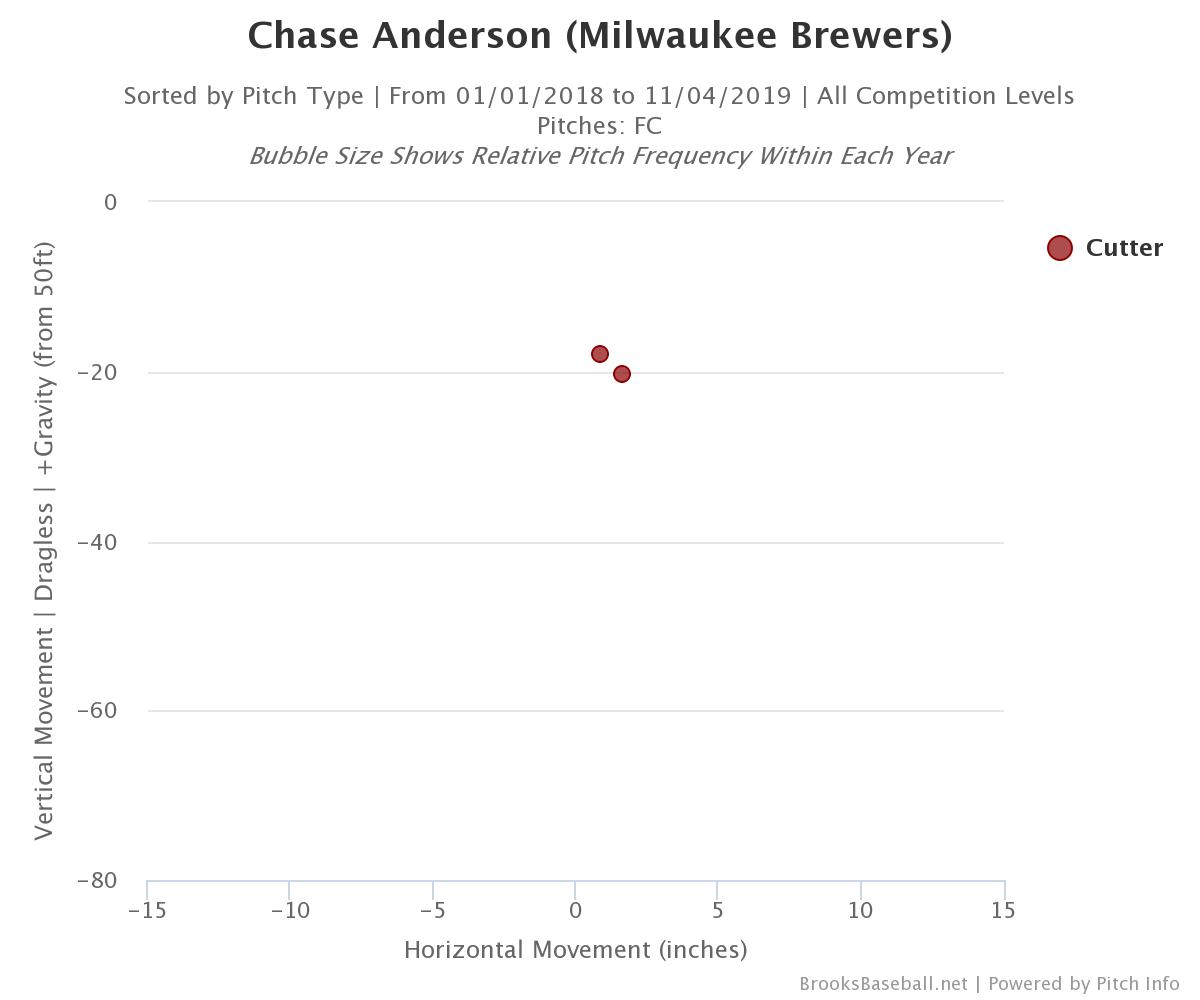
Last season, Anderson used his cutter more than he had in his previous five, throwing it harder than he ever had. It was his most improved pitch in 2019 and a very handy one at that. He cut his wOBA on the cutter by 100 points while drawing more swings out of the zone. Anderson also saw an increase in his cutter swinging-strike rate, and his contact in the zone went down:

Chase Anderson’s Cutter
Year wOBA GB% O-Swing% Z-Contact% SwStr% pVal/C
2017 .329 35.4% 23.5% 88.4% 7.8% -0.3
2018 .335 23.7% 29.7% 93.1% 7.0% -1.1
2019 .238 42.4% 31.1% 85.3% 10% 1.7

Anderson’s cutter is more of a complementary pitch, meaning it’s not an out pitch and he doesn’t necessarily throw it when he needs strikes. He mixes it well with his four-seam fastball to left-handed hitters in almost every count, with two-strike counts the exception, while to righties, Anderson typically goes four-seamer heavy (at least 50% across all counts) with his cutter usage is divvied up with the changeup and curve.

Of pitchers who threw a cutter at least 14% of the time (minimum 110 IP), Anderson’s was rated second-best in 2019:

2019 Cutter Pitch Values
Name IP FC% (pi) wFC/C (pi)
Jeff Samardzija 181.1 22.7% 1.93
Chase Anderson 139.0 14.8% 1.70
Cole Hamels 141.2 18.7% 1.68
Martin Perez 165.1 30.9% 1.62
Ryan Yarbrough 141.2 36.9% 1.45
Lance Lynn 208.1 16.1% 1.03
Anibal Sanchez 166.0 27.8% 0.97
Dakota Hudson 174.2 25.6% 0.89
Walker Buehler 182.1 13.6% 0.89

Pitch Info valued the pitch at -1.1 in 2018 and he was able to increase its effectiveness to a 1.7 last season.

Here’s a glance at Anderson’s cutter metrics and pitch action:

So what’s behind the significant improvement this year? Anderson made no adjustments to the cutter’s spin axis, his grip, or arm slot. The extra velocity with a slightly elevated spin rate, from 2340 in 2018 to 2382 in 2019, helped add an additional two inches of ‘rise’ to the pitch.

The two pitches Anderson paired with his cutter the most were the changeup to left-handed hitters and his four-seamer to righties. The changeup to cutter sequence creates a pretty decent tunnel, as seen in the GIF below.

Given that the velocity spread between the four-seamer and cutter was only around 4 mph, it wasn’t an ideal combination and likely didn’t do much to boost the cutter’s effectiveness.

Anderson’s cutter isn’t dominant but it’s a valuable asset in his arsenal. It helps pick up the slack on his changeup and curveball, and can create a nice pitch-shape change when subbed in for his fastball. Anderson is moving to a division that hit the cutter with essentially the same success (.313 wOBA) as the NL Central (.319 wOBA) did in 2019, so it’s reasonable to think the pitch can still be effective so long as he uses it the same way next season as he did in Milwaukee.


The $17.8 Million Answer

Last week, I discussed a few of the qualifying offer decisions facing teams and players this offseason. Yesterday, we learned which players found themselves on the receiving end of a QO. What happened and, given my analysis last week, what are the potential consequences? Let’s take a look.

Received a Qualifying Offer

The Obvious Ones
Anthony Rendon, Gerrit Cole, Josh Donaldson, and Stephen Strasburg all received offers. I think I’m on fairly safe ground by assuming all four will be turned down and that none of these players will have their markets seriously altered or damaged by the loss of a draft pick.

José Abreu
José Abreu is the one player I didn’t address last week who I probably should have. I didn’t actually expect there was much chance of the White Sox making this offer. Abreu should absolutely accept this contract; Nelson Cruz was considerably older last winter, but was had just had a better season and came with no loss of a draft pick, and received just a one-year, $14.3 million deal with a team option.

ZiPS Projection – Jose Abreu
Year BA OBP SLG AB R H 2B 3B HR RBI BB SO SB OPS+ DR WAR
2020 .269 .322 .462 587 72 158 34 2 25 98 36 136 2 109 -3 1.3

ZiPS suggests Abreu could fetch a one-year, $10 million contract, considerably less than the qualifying offer; that also doesn’t account for the value of the lost of a draft pick. I suspect Abreu accepts, lest he becomes one of the top candidates this winter for the free agent who doesn’t sign until June.

Madison Bumgarner
Madison Bumgarner was an obvious recipient of a qualifying offer, but he’s worth noting separately due to the likely consequences it will have for his next contract. I didn’t include Bumgarner’s projection in the previous piece, but given that Steamer just came out with a 2.1 WAR forecast for the left-hander in 2020, it’s probably worth demonstrating that Steamer’s not an outlier:

ZiPS Projections – Madison Bumgarner
Year W L ERA G GS IP H HR BB SO ERA+ WAR
2020 9 8 4.13 30 30 180.7 175 31 41 171 100 2.3
2021 8 7 4.23 28 28 166.0 166 29 38 152 98 1.9
2022 8 7 4.35 27 27 158.0 161 28 36 142 95 1.6
2023 7 7 4.36 25 25 145.0 148 26 33 130 95 1.5
2024 6 6 4.46 22 22 130.7 135 24 31 118 93 1.2
2025 5 6 4.60 20 20 115.7 121 23 28 104 90 0.9

This projection is for a neutral park, which matters for Bumgarner more than most. Bumgarner is more of a fly baller now than he was during his best years and doesn’t throw particularly hard, which is risky in a park that isn’t death to home runs. For his career, Bumgarner has a 58% higher HR/9 on the road than at home and with nearly a decade in the majors, that’s enough of a sample to declare it a concern instead of mere noise. ZiPS doesn’t explicitly use home/road data for individual players but it does see Bumgarner’s tendencies, valuing him at about 0.7 WAR per season more in San Francisco than in a neutral park. When you take the value of the draft pick into account, I’m not sure that Bumgarner is an obvious choice over Wade Miley given otherwise identical contracts.

Jake Odorizzi
The Twins made the smart move and extended a qualifying offer to Jake Odorizzi. The loss of a draft pick for the signing team adds risk to Odorizzi’s decision. The ZiPS projection for the right-hander’s next four years (8.7 WAR) is better than Dallas Keuchel’s four-year projection was entering free agency last winter (8.5 WAR). The situations aren’t identical, but the experiences of Keuchel and other second-tier free agents with compensation attached ought to at least serve as a warning to Odorizzi.

Perhaps I’m being too optimistic, but I still think Odorizzi can get a contract in the four-year, $70 million range, even with the lost draft pick. I’d rather have Odorizzi now than Jake Arrieta after his final season with the Cubs and while it took until March, Arrieta still squeezed a three-year, $75 million deal out of the Phillies. If Odorizzi wants to roll the dice, it may not be the worst idea to take Minnesota’s offer and bet on himself to match 2019’s 4.3 WAR. If he does that two seasons in a row and enters free agency without any strings attached, he might be able to pass the $100 million mark.

Marcell Ozuna
The Cardinals gave Marcell Ozuna his QO and even though I don’t think his next deal will get within spitting distance of $100 million, the market for interesting, young-ish corner outfielders isn’t exactly deep, making Ozuna one of the more compelling options. I’d be surprised if he accepted.

Will Smith
I think the Giants’ decision to make Will Smith an offer was the right one. The question now whether Smith accepts and in this case, I think he should. It’s a fair one-year salary for an excellent closer and if 2019’s crazyball returns, Oracle Park is one of the safest places to be. Playing for the Giants will affect his save totals going into free agency, but really, how many teams are using save totals for evaluation purposes anymore?

Zack Wheeler
There was no trademark Mets unpredictability here, with the team extending a qualifying offer to Zack Wheeler just as it should have. It’s extremely unlikely that Wheeler accepts and, at least based on the ZiPS projections, appears headed for a deal somewhere in the five-year, $100 million range. I would personally have ranked Wheeler as the third-best starting pitcher available after Cole and Strasburg in our 2020 Top 50 Free Agent Rankings rather than Bumgarner, as Wheeler projects better over the next four years, in both their respective home parks and in a neutral one.

Did Not Receive a Qualifying Offer

The Yankees Trio
Suggesting that thrift will remain the watchword in New York, the Yankees did not extend qualifying offers to Didi Gregorius, Brett Gardner, or Dellin Betances. I still think the Yankees ought to have at least made an offer to Gregorius, who averaged 3.7 WAR in his first four seasons in New York. Gregorius will be just 30 for the entirety of the 2020 season and has to be tempting for a team with a short-term shortstop problem.

Kyle Gibson

As expected, the Twins did not extend a QO to Kyle Gibson, though the right-hander will still likely end up with a one-year deal. It might surprise you, but Gibson’s 2.6 WAR in 2019 was identical to his 2018 WAR. ERA-influenced perceptions are still a thing! Like Lance Lynn last winter, I think there’s a chance that Gibson is one of the best value signings for a team this winter.

Cole Hamels
I think Chicago made a mistake by not extending a QO to Cole Hamels. I know the Cubs have decided to do a whole song-and-dance routine about their so-called budget constraints, but they should have jumped at the chance to bring Hamels back so cheaply. There are no internal options that are better bets for 2020 than Hamels, and a better option in free agency will cost more. Would the Cubs be so curiously cheap if they didn’t already have the World Series win?

Rick Porcello
Despite my speculation as to what the case for an offer for Rick Porcello would consist of, I didn’t think there was ever a real chance the Red Sox would take this risk. With J.D. Martinez not opting out of his contract, the Red Sox may not have made the offer even if Porcello was a considerably better pitcher.

Wade Miley
Without a draft pick encumbering Wade Miley, I’d expect him to get a decent-sized, one-year deal in the range of $8-$12 million. Considering the last six weeks of the season, I don’t think he’ll get a multi-year deal.