Eric Longenhagen Chat: 7/26/19

12:02
Eric A Longenhagen: Hi hello good morning

12:05
Eric A Longenhagen: I have one link to share with you for now, that’s the announcement that our farm rankings (which are, aside from the player evals that drive the FV values, objective) are now live on the board at all times.

12:05
Eric A Longenhagen: it’s pretty cool

12:06
Eric A Longenhagen: I’ll have another link for you later in the chat as Meg is working on editing it right now and that’ll just be the weekly ‘propsects who moved’ post

12:06
Eric A Longenhagen: I have a day AZL game today so I’m gonna try to keep this short

Read the rest of this entry »


Broadcasters’ View: Who Have Been the Top Players in the Midwest League?

Who have been the best players in the Midwest League so far this season? I recently posed that question to some of the circuit’s broadcasters, with an important qualifier: I requested that they base their selections on what they’ve seen with their own eyes, and not on players’ reputations. I also asked for snapshot observations on each player named, which the respondents graciously took the time to provide.

As noted in last season’s survey, the Midwest League comprises two divisions, with an unbalanced schedule. Couple that with the fact that this is a midseason look, and the respondents will have seen some players more than others (or not at all). For that reason, notable prospects may not appear on a particular list.

Six broadcasters participated — four from the Eastern Division and two from the Western Division. Their respective lists were put together within the past couple of weeks.

———

Nathan Baliva, Peoria Chiefs (Cardinals)

1. Wander Franco: A generational talent. Hitting and fielding. Sadly we only got to see him for one series with the Midwest League crossover schedules, but you could tell he was special, with baseball instincts and natural ability. Hits the ball hard and has everything you could want. Will be fun to watch him go up the ladder.

2. Alek Thomas: This kid has crushed us all season. Had a series in early July where he was 9-for-10 and very nearly had cycles on back-to-back days. Hit the ball all over Dozer Park with power, using all fields and [showing] his speed. No matter what was tried, we couldn’t get him out that series. Read the rest of this entry »


A Different Way of Looking at Home Run Rate

Recently, I’ve been pondering the strange way I think about HR/FB ratio. On one hand, it’s a way to explain away a hot or cold stretch from a hitter. When Joc Pederson got off to a blazing start this year, I looked at his HR/FB, a spicy 33.3% through the end of April, and told myself it was a small sample size phenomena. That’s the first way I use HR/FB for hitters — as a sanity check.

At the same time, HR/FB is something we’ve all used to explain someone’s power. Joey Gallo is powerful, obviously. How do we know that? Well, he hits the ball really hard, which gets expressed by more of his fly balls turning into home runs. Gallo had a 47.6% HR/FB at the end of April, and even though I didn’t expect that to continue, I was willing to accept high numbers for Gallo’s HR/FB much more easily than I was for Pederson.

This leaves HR/FB in a weird spot. It’s a number we use to see if players are getting lucky or unlucky relative to average, but it’s also a number we use to look for underlying skill. Problems arise when it’s unclear what is noise and what is signal. Is David Fletcher unlucky to have a 5.4% HR/FB? Surely not — he’s a contact hitter. Is Jose Ramirez unlucky to have a 6.5% HR/FB? I assume so, but I only assume so because he hit 39 home runs with a 16.9% HR/FB last year. What if last year was the outlier, not this one?

Another way to think about this conundrum is that HR/FB contains an inherent contradiction we have to work around mentally. Putting fly balls as the bottom of the ratio implies that all fly balls are created equal, and that’s clearly untrue. Gallo is unloading on the ball, crushing many of the fly balls he hits into orbit. Fletcher, meanwhile, sports one of the lowest average exit velocities in the game. Even though a home run counts the same for each, the population of fly balls is tremendously different. How do we handle this contradiction? Read the rest of this entry »


Job Posting: Minnesota Twins Baseball Systems Data Quality Engineer

Position: Data Quality Engineer, Baseball Systems

Location: Minneapolis, MN

Description:
The Minnesota Twins are seeking a Data Quality Engineer to join the Baseball Research and Development group. This position offers wide-ranging exposure to current programming methods and frameworks in a fast-paced agile environment. With creativity and passion, this candidate will collaborate with the Baseball Operations staff to ensure good data hygiene across a growing set of disparate data sources. This position requires an intuitive and exacting passion for data detective work. By identifying patterns that affect data quality and by working directly with data scientists, the candidate will help to develop, deliver, and maintain tools to enhance model and decision accuracy. This position requires independent curiosity and a commitment to achieving excellence within a team framework. Strong communication and interpersonal skills will enable the candidate to enjoy engaging relationships with product users.

Essential Duties and Responsibilities:

  • Build data quality assurance tools and procedures to identify and correct data inaccuracies.
  • Design, maintain, and support data warehouses for reporting and analysis.
  • Develop, optimize, and automate data workflows and pipelines ensuring data integrity and quality from external data integrations.
  • Support the individuals of the Baseball Operations team by providing assistance and education on best practices when querying the data warehouse.
  • Work with data scientists to ensure models and analyses follow best practice for accessing the data and are properly integrated into scheduled data processing workflows.
  • Explore emerging technologies and recommend new tools and techniques for collecting and processing data.
  • Develop visualization tools and reports that showcase research findings in creative, effective ways for a variety of different end users and use cases.
  • Use an agile software development approach for quick roll-outs combined with incremental improvement process to existing systems and environments.
  • Provide courteous and timely first-level contact and problem resolution for all Baseball Department users.

Qualifications, Skills, and Abilities:

  • Bachelor’s Degree in Computer Science, Data Engineering, or a related field or equivalent work experience.
  • Software development experience, including requirements definition, design, development, testing, implementation, and iterative improvement.
  • Expertise with SQL, relational databases, database design, and data cleaning techniques.
  • Ability to process and transform data from a variety of sources and formats.
  • Experience with C#, Java, Python, R or other similar language that interacts with data.
  • Knowledge of data visualization packages such as Plotly or ggplot is a plus.
  • Proficiency evaluating and improving the performance of SQL queries.
  • Understand software development best practices and long-term maintainability of code.
  • 2+ years of relevant work experience.
  • Strong work ethic, curiosity, initiative, and problem-solving skills.
  • Open mindedness to learn new technologies and embrace different ways of thinking.
  • Passion for baseball is preferred; passion for problem solving is required.

Physical Requirements:

  • Ability to lift and transport items up to 55 lbs.
  • Must be able to sit for extended periods of time.
  • Must be able to move throughout all areas and levels of the ballpark.
  • Ability to relocate to the Twins Cities area.

To Apply:
External applicants should apply using the application found here.

The content in this posting was created and provided solely by the Minnesota Twins.


Josh Donaldson Has Finally Settled In

After a surprise first-place finish in the National League East last year, the Atlanta Braves entered this offseason searching for an offensive threat to bolster their lineup. After being shutout twice in their Division Series matchup against the Dodgers, they probably had good reason to be on the lookout for a new bat to add to their roster. They quickly struck a one-year deal with Josh Donaldson worth $23 million in the hopes that he would rekindle some of the magic that made him the second-most valuable player in baseball from 2013-2017.

Through the first two months of the season, it seemed like a worst-case scenario was playing out for the Braves’ biggest offseason acquisition. Through May 31, Donaldson had posted a 118 wRC+ and 1.2 WAR in 217 plate appearances. Above average, yes, but a far cry from his 148 wRC+ he averaged annually in the five years prior to 2018. With a lengthy injury history since at least 2016, you had to wonder if all that wear and tear had caught up with his 33-year-old body.

A shoulder injury sapped him of his power last year, so it was a little worrisome that his ISO was just .186 through the first two months of the season. That would have been his lowest power output since 2012, the year before he broke out with the Athletics. But more concerning was the 28.1% strikeout rate, higher than any other season in his career except for the brief cup of coffee he received way back in 2010. In his prime, he had always been able to combine reasonable strikeout rates with his massive power.

Since June 1, however, Donaldson has put together a vintage performance. He’s matched his previous offensive output exactly, posting a 148 wRC+ and 1.8 WAR across 198 plate appearances. He’s tied for the National League lead in home runs during this period with 16. That puts him on pace to launch more than 30 home runs for the fourth time in five years. So what happened to his power early this season and why has it come on so strong recently? Read the rest of this entry »


Small Adjustments and Glenn Sparkman

This is an unusually sunny era in which to write about player development. Seemingly every other month, someone new finds their power stroke, optimizes their curveball, or writes a best-selling book about how players are embracing technology to improve. I don’t know if any one player embodies the face of the movement, if only because so many people have jump-started their careers with a swing change or weighted ball program.

It’s easy to forget that these kind of career-altering breakthroughs are still somewhat uncommon. Ballplayers are constantly tinkering — a new grip or arm slot here, a different stance or hand position there — and the vast majority of those developments will never break a projection system. Sometimes, they’re just meant to get a struggling player back on track. In many other cases, guys make changes that give them an edge, albeit a fleeting one. These adjustments generally don’t make headlines, but under the microscope, they offer a fascinating window into the game.

Consider the case of Glenn Sparkman. Sparkman, a 27-year-old clinging to a job in Kansas City’s rotation, is the kind of guy who constantly needs to be at the top of his game to succeed. He’s a righty with slightly above average arm strength; his secondaries are competent but unremarkable. His stats are as bland as the previous sentence:

Glenn Sparkman’s Career Numbers
Year Games Innings SO/9 BB/9 HR/9 GB% ERA- FIP-
2018 15 38.1 6.34 3.52 0.7 47% 103 97
2019 19 79 4.9 2.28 1.82 38.50% 100 125

Read the rest of this entry »


Craig Edwards FanGraphs Chat–7/25/2019

Read the rest of this entry »


The 2019 Replacement-Level Killers: Corner Outfielders

The A’s corner outfield spots could use an upgrade, with Chad Pinder often pressed into service in left. (Photo: Keith Allison)

Traditionally, the outfield corners are home to heavy hitters. This year’s crop of right fielders has combined for a 110 wRC+, one point ahead of first basemen for the current major-league high as well as the highest mark at the position since 2011. The left fielders’ collective mark of 106 is the majors’ third-highest, one point ahead of that of third basemen, and the position’s second-best mark since 2011.

Even so, several contenders — which for this series I’ve defined as teams who are above .500 or have playoff odds of at least 10.0%, a definition that as of today currently covers 17 teams — are getting meager offensive production at one corner or another, by which I mean receiving less than 1.0 WAR at the spot, which makes them eligible for a place among the Replacement Level Killers. As the July 31 trade deadline approaches, they may want to do something about that, particularly since there’s no August waiver period during which they can tweak the roster. Having said that, I’m somewhat less focused on these teams’ eventual solutions, whether via trades or internal options, than I am in pointing out the problems.

Also, note that I’ve ruled out including the Angels among the left fielders, since the mid-June return of Justin Upton, who had been sidelined for nearly three months by turf toe, has already provided the team a substantial upgrade; even while slumping lately, he’s accounted for 0.3 of the team’s 0.6 WAR in 25 games, a 2.0 WAR pace over 162.

Read the rest of this entry »


The Curious Case of the Rays’ Eighth Inning

If you looked at the eighth inning play-by-play of Wednesday’s game between the Boston Red Sox and Tampa Bay Rays, you might have spotted something unusual, though not that unusual:

The unusual part is that Adam Kolarek pitched to two batters in the inning but did not do so consecutively. This isn’t that unusual. The Rays have employed a similar strategy before. Joe Madden has done it with the Cubs. Whitey Herzog did it with the Cardinals back in the 1980s. It may be unconventional, but it isn’t against the rules. It should not cause great delays in games. It did, however, cause an issue in this game. After Kolarek had moved to first base, Chaz Roe got Mookie Betts to fly out for the second out of the frame. Then Kolarek moved from first back to the mound, and trouble ensued.

Instead of seeing baseball on their screens, fans saw baseball types standing around.

The umps are befuddled:

Alex Cora is mad:
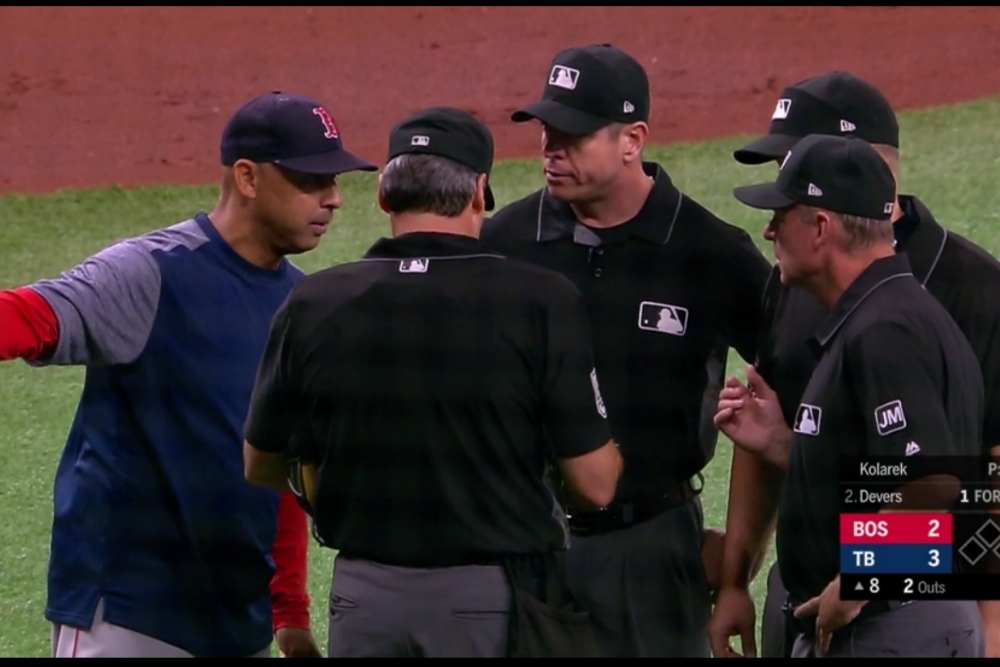
Kevin Cash isn’t mad, he’s just disappointed:

The umps don’t want to hear anymore from either manager and start a silent disco:

Finally, Angel Hernandez goes to the Red Sox dugout to see if Alex Cora really does have BINGO:

The switch was a little tricky, but come on. It shouldn’t have taken this long. To give some sense of how lengthy the delay was, go read my piece where I predicted what will happen at the trade deadline with scenarios for all 30 teams. Back? Good. Now listen to one of your favorite songs of standard radio single length, let’s say “American Girl” by Tom Petty and the Heartbreakers. Finished? Okay, now back to the game action:

One pitch and one out to end the inning. Commercial break and then back to more game action, right? I have bad news:
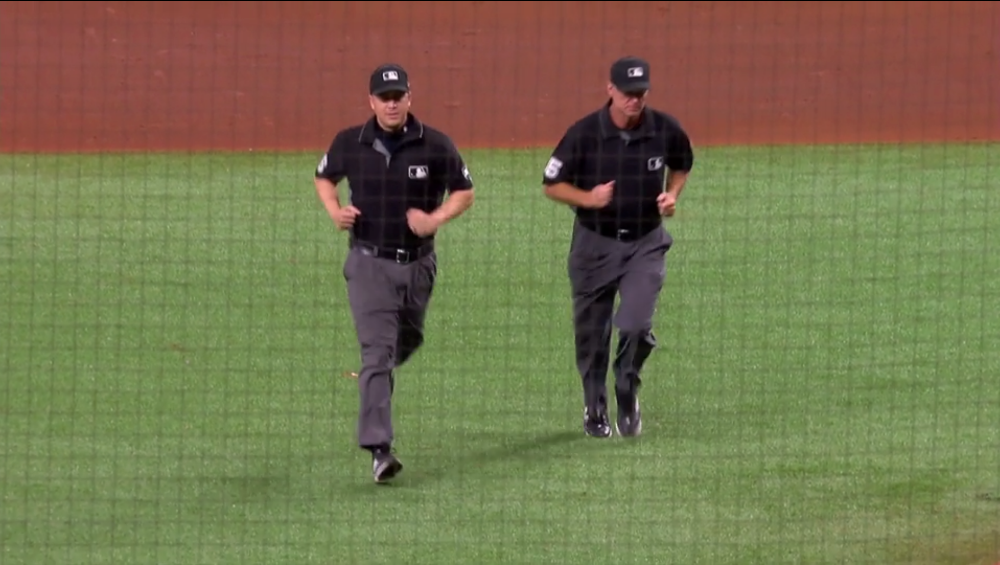
So what did everyone think of the silent disco?
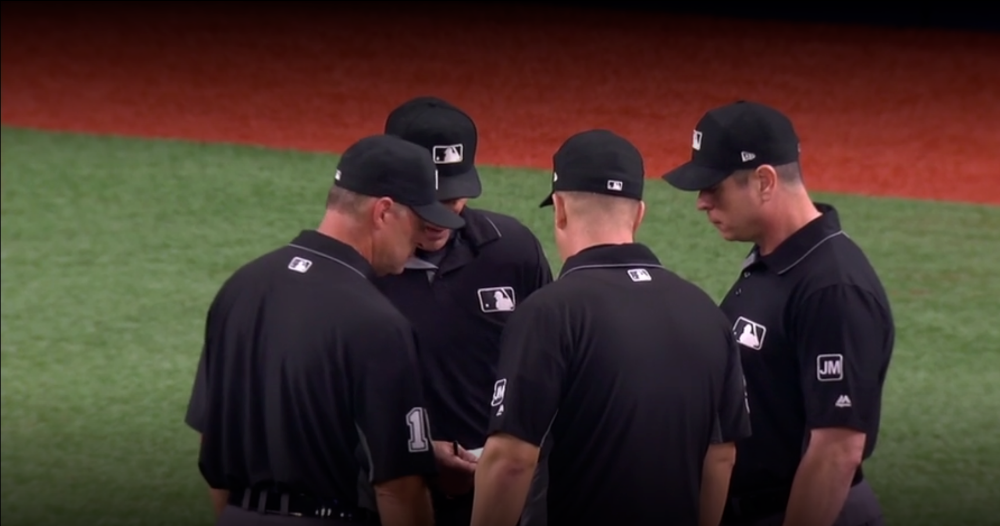
Some spicy lineup card action:

Someone just asked Alex Cora if his refrigerator was running:
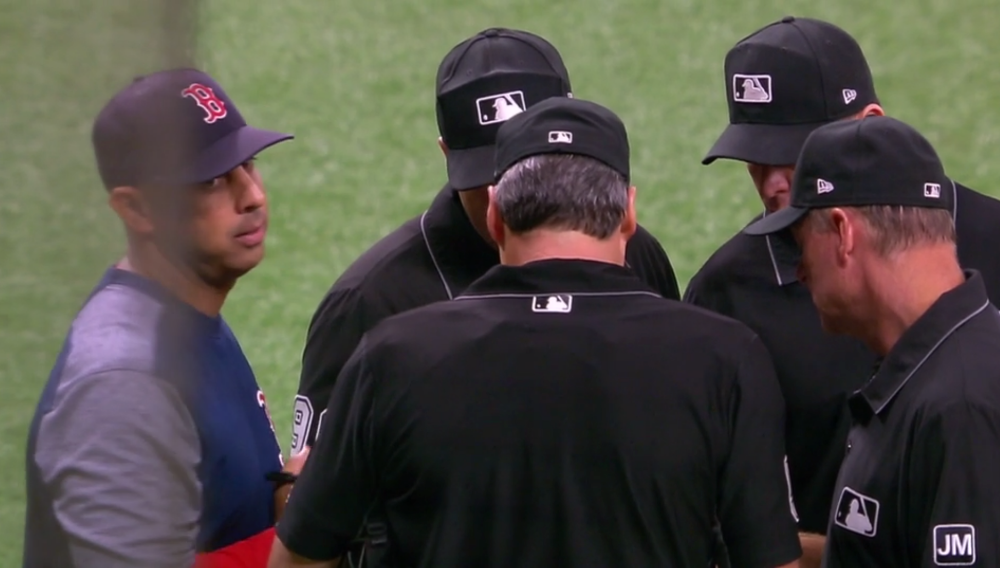
Can I interest you in a different lineup card?
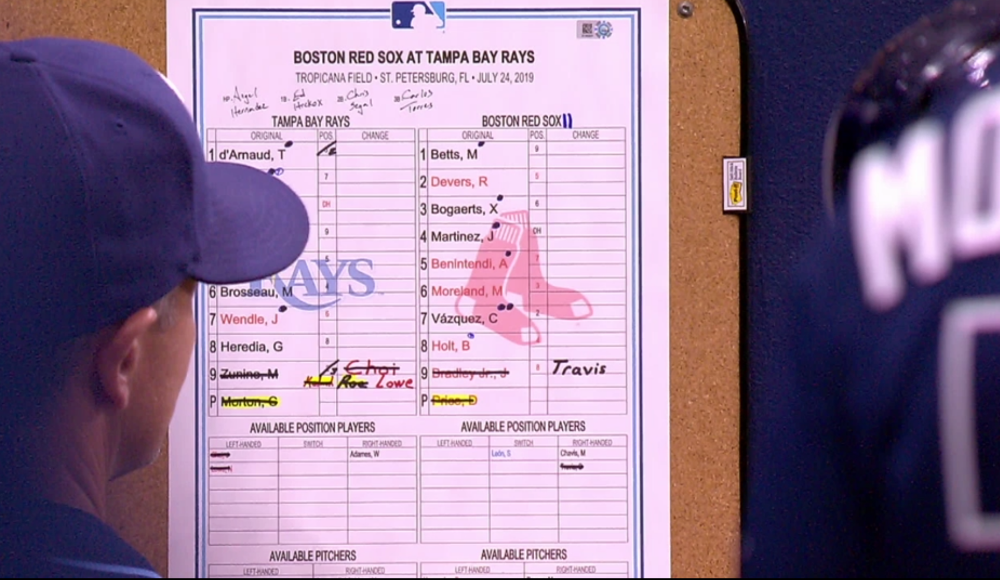
The Rays dugout is absolutely riveted:

Maybe they missed seeing the lineup card the first time?
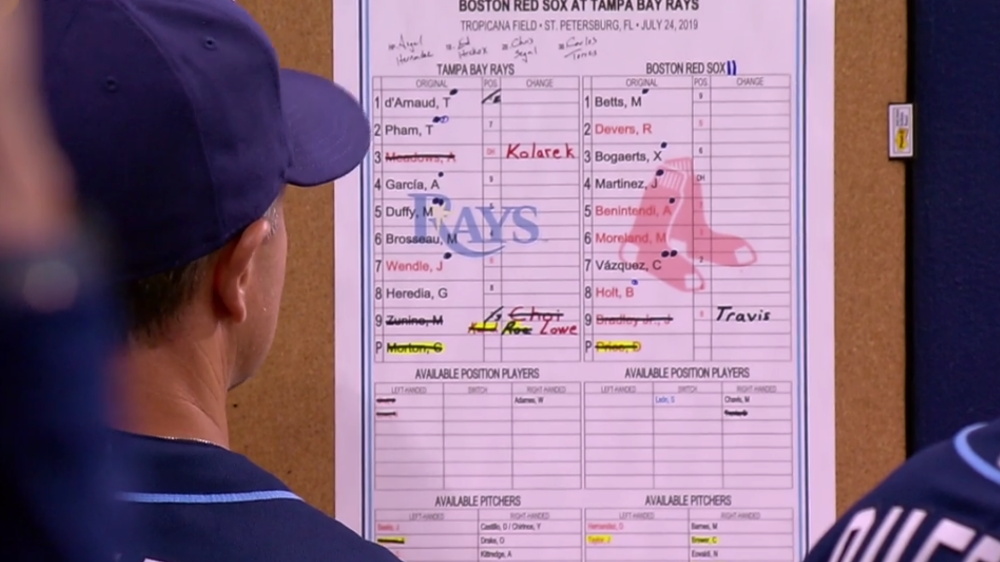
In the time between when the pitch that ended the top of the eighth was thrown and the action in the bottom of the eighth actually commenced, you could have read Eric Longenhagen and Kiley McDaniel’s announcement that farm system rankings are now on THE BOARD and this Ben Clemens piece on Andrew Miller. In all, fans saw one pitch in about 23 minutes. The delay was not caused by an illegal move per se, but by the umpire’s lineup card not reflecting quickly enough which spot Adam Kolarek was taking in the lineup. That decision would have been up to Kevin Cash if he so chose; otherwise the umpire gets discretion. But Alex Cora believed the umpire didn’t put Kolarek in the lineup at the time of the change and protested the game.

The Rays won 3-2. The rest of us weren’t so lucky.


Jay Jaffe FanGraphs Chat – 7/25/19

12:01
Avatar Jay Jaffe: Howdy folks, good afternoon and welcome to another edition of my Thursday chat. I’m still digesting my amazing weekend at the Hall of Fame inductions in Cooperstown and neck deep in Replacement Level Killers, the fifth installment of which — corner outfielders — should be up soon. Obviously, there are a lot of questions about the July 31 trade deadline, so let’s get to it.

12:02
Fry: Is pressure building up in the market that’s going to explode before the 31st or is this going to be an uneventful deadline?

12:04
Avatar Jay Jaffe: I think we’ll see a lot of deals in the coming days. This breakdown from last year, compiled by the great Eric Stephen of True Blue LA, is worth bearing in mind:

Last year:

4 trades during the All-Star break
1 trade on July 21
1 trade on July 22
1 trade on July 24
2 trade on July 25

Then the floodgates, 35 trades over the final 6 days (18 on July 31)

Thus I suspect we’ll start seeing a trickle of deals soon, and then a flood.

12:05
Niles: When it comes to acquiring Bauer, how much does his possible effect on the clubhouse come into play? The MVP Machine really spells out how much the Indians had to accommodate him and how he still alienated teammates, but on the flip side it also spelled out how helpful he was when it came to preaching his craft.

12:07
Avatar Jay Jaffe: I would imagine it’s a factor but one individualized to each team — he’s obviously not going to the Astros given the presence of Alex Bregman and Gerrit Cole, for example. I suspect that the execs of any teams who are serious about acquiring him are discreetly discussing his potential reception with a few clubhouse leaders for some added input. But talent still carries the day, and his is considerable, particularly in a market that’s stretched pretty thin and one in which some of the other top targets — Bumgarner, Syndergaard — might not be dealt after all.

12:09
gashouse gorilla : Which teams do you think might me opportunistic at deadline, both buying low and selling? Teams with economic capacity to perhaps get into a 3-team trade to take salary in return for prospects

Read the rest of this entry »
