Job Posting: Sports Info Solutions Video Internships

Please note this posting contains two positions.

Company Background:

Former Sports Info Solutions interns have risen rapidly through major league front offices after getting their start watching two to three games per day at SIS. In the words of one former intern and current Vice President of Baseball Operations, “My summer at [BIS] was the best baseball experience of my life.” Major league teams frequently come to us for recommendations when they need to fill a position within their organization, and SIS’ top interns each year routinely land team internships and/or full-time jobs.

SIS takes pride in making their internships great development opportunities for those looking to get their start in baseball. In addition to gaining invaluable experience watching thousands of players across different levels, they offer introductory classes that cover writing scouting reports and using the database management language, SQL. We also provide insight and advice from previous SIS interns who have branched out into a variety of areas in the sports industry.

Position: 2019 Minor League Video Editing Internship

Location: Coplay, PA

Description:
Sports Info Solutions is looking for highly motivated individuals with a desire to work in the baseball industry. In a new position for the 2019 season, SIS is looking for Minor League Video Editors, who will watch and clip video from Minor League games while validating the accuracy of pitch by pitch information. The end result of each Video Editor’s work will allow professional teams and other SIS clients to conduct advanced player and team analysis, specifically relating to advanced scouting and player development. Video Editors will have the opportunity to watch thousands of players across multiple levels of Minor League baseball, while also learning the ins and outs of the baseball statistics industry.

Responsibilities:

  • During overnight shifts, edit video from minor league games, properly marking in and out points for each pitch, ensuring all meaningful action is captured
  • Validate the accuracy of minor league pitch-by-pitch data
  • Assist with the production of the 2020 Bill James Handbook
  • Provide administrative support to the full-time staff

Time Frame:

  • The start date for this position is March 11th, 2019. This position will run through the end of the minor league season, with the last day of employment being Monday, September 2nd, 2019 (Labor Day).
  • This position will require relocation to Coplay, Pennsylvania; working remotely is not an option at this time.

Compensation:
A starting hourly rate of $8.00 and/or college course credit will be offered.

To Apply:
Click here to apply for the 2019 Minor League Video Editing Internship.

Position: 2019 Baseball Video Scouting Internship

Location: Coplay, PA

Description:
Sports Info Solutions is looking for highly motivated individuals with a desire to work in the baseball industry. Video Scouts will have a chance to make an immediate impression on the company. Each Video Scout will be collecting data that is directly used by SIS clients (including major league teams) for advance scouting and evaluation purposes. Not only will the Video Scouts become more familiar with the strengths and weaknesses of hundreds of amateur and professional players, but they will also learn the ins and outs of the baseball statistics industry.

Responsibilities:

  • Score and pitch chart MLB, MiLB and amateur games using specialized computer software
  • Check the accuracy and validity of data
  • Prepare and analyze statistical data for delivery to customers
  • Assist with the production of the 2020 Bill James Handbook
  • Provide administrative support to the full-time staff

Time Frame:
SIS offers two unique start dates for this position. The first begins February 4th, 2019. It will last for a period of four to five months into early June, with the possibility of extending further based on company workload and the Video Scout’s performance. The second begins on March 6th, 2019. This will last five to six months into early September, again with a possibility of extending longer.

Compensation:

  • A starting hourly rate of $7.75 and/or college course credit will be offered.
  • Each Video Scout will also be eligible for regular raises based on performance.
  • There will also be opportunities to sign up to work overtime to earn extra income (opportunities will depend on work levels throughout the year).

To Apply:
Click here to apply for the 2019 Baseball Video Scout position.

The content in this posting was created and provided solely by Sports Info Solutions.


Job Posting: Tampa Bay Research and Development Intern

Position: Research and Development Intern

Location: St. Petersburg, FL

Description:
The Tampa Bay Rays are in search of their next Research and Development Intern. Their R&D group helps shape their Baseball Operations decision-making processes through the analysis and interpretation of data. They are seeking those with a passion for baseball and a desire to contribute through mathematics, data analysis and computation. Their next intern will be an intellectual contributor who can work both individually and collaboratively, come up with interesting research questions to explore, find ways to answer those questions with the data at their disposal, communicate the results of their research, and work to apply their research outcomes to improve how the Rays organization operates. The Rays want to work with people who care about being a good teammate, want to make a positive impact on their organization, have an innovative spirit, and will explore new ways to make the Rays better. Does this describe you?

Responsibilities:

  • Develop strong skills in statistical modeling and quantitative analysis of a variety of data sources, for the purpose of player evaluation, player development and strategic decision-making
  • Learn methods for communicating complex research findings to a variety of Baseball Operations audiences
  • Design research inquiries with the potential to yield immediately actionable findings within the Rays organization
  • Work collaboratively with and assist other members of the department with your areas of expertise
  • Collect in-game data to support operational needs of the department
  • Ad hoc research and analysis in support of general Baseball Operations tasks

Qualifications:

  • A solid foundation in mathematics, physics, statistics, computer science, engineering and/or related fields
  • Advanced computational skills
  • Experience with R, Python, and/or Stan preferred
  • Experience solving complex problems
  • Creativity to discover new avenues of research

To Apply:
To apply, please visit this site and complete the online application.

This position is paid.

The content in this posting was created and provided solely by the Tampa Bay Rays.


Sunday Notes: Can the Astros’ Secret Sauce Spice Up Orioles’ Pitching?

Pitchers in the Astros organization were K-happy this past season. Thanks to a bevy of power arms and analytics-based attack plans, each of Houston’s full-season minor league affiliates led its respective league in strikeouts. So did their short-season and, most notably, their big-league club.

Given that he’d spent the last six seasons as a high-ranking member of Houston’s front office, I asked Mike Elias if that’s something that could maybe be replicated in Baltimore.

“We’re very much hoping to replicate even a semblance of that success here,” answered the Orioles Executive Vice President and General Manager. “The fact that we have (Assistant GM, Analytics) Sig Mejdal here, and Chris Holt, who was our assistant pitching coordinator in Houston, makes me feel really good about our chances of doing so. There is a little bit of a secret sauce behind that. I’m not going to explain it fully, but we had a great program there. We took a lot of time developing it, and we want to get it in place here as well.”

Hoping to glean at least a little insight into the secret sauce’s ingredients, I suggested that both draft and player development strategies are involved in the process. Read the rest of this entry »


Russell Martin Fetches Two Fringe Prospects

In a trade that sent Russell Martin back to Los Angeles, the Blue Jays acquired two interesting, but drastically different, prospects in teenage second baseman Ronny Brito and Double-A righty Andrew Sopko.

Sopko is the more likely of the two to wear a major league uniform, as his skills are constantly desired among teams seeking to build starting pitching depth at Double and Triple-A in the event of big league injuries. He’s an efficient strike-thrower with spot starter’s stuff; a fastball that resides in the 88-92 range, an average changeup that flashes above, and a slurvy breaking ball with enough depth that it will be an issue for hitters who struggle to square up break.

Pitchers with this kind of stuff are typically found at the very back of the rotation or waiting to pick up a start due to injury. The frequency with which pitchers get hurt makes teams’ 6th-8th starters very important, as they may have to make meaningful starts at some point during the year. Sopko projects to be a very competent version of this.

Brito is more boom or bust. After dealing with injury and struggling badly throughout his first full pro season, Brito had a monster year in the offense-friendly Pioneer League, slashing .288/.352/.489 with 11 homers in 53 games at age 19.

While the dizzying elevations of the Pioneer League drastically inflate offensive performance, Brito does have legitimate, above-average raw power, and he’s capable of hitting balls out to all fields, even as a teenager, something not typical of middle infield prospects.

What eyeball scouts are skeptical of, though, is Brito’s bat. He’s free-swinging and prone to the strike out. His swing has gone through several iterations — a leg kick was implemented and then uninstalled for a while last fall, for one — and all of this mechanical variability makes it harder to evaluate Brito as a hitter. But a lack of plate discipline makes Brito’s contact profile high risk, even if there’s natural feel for contact here once his swing gets dialed in.

He has a chance to stay at second base, but he hasn’t really improved there since signing, and some scouts think his defense has actively gone backwards as his frame has thickened. His body is also pretty much maxed out, so he’s not likely to grow into much more power as he ages, though he already has enough to profile at any infield spot provided he becomes a competent defender and takes better at-bats. If that stuff comes, Brito will be an everyday player, but scout-to-scout optimism for improvement is highly variable.


Effectively Wild Episode 1321: You Are the Boss of Me

EWFI
Ben Lindbergh and Jeff Sullivan banter about Willians Astudillo being plunked in reprisal for his home-run pimp, the surprisingly small contract of Yasmani Grandal and the state of the Brewers and the NL Central, Jed Lowrie and the Mets’ positional logjam, DJ LeMahieu joining the Yankees and the ramifications for Manny Machado, the latest in teams trying to lure Machado by recruiting Machado mentors, the Dodgers signing Russell Martin, the latest on A’s first-rounder Kyler Murray, and a real-life analogue to a listener hypothetical about running the bases clockwise. Then (26:47) they bring on FanGraphs founder and overlord David Appelman to discuss his history at AOL and the site’s origin story, how he could have ended up building a database for a team, his philosophy of acquiring and providing data, gambling and baseball, balancing the site’s stats and writing, the secret to making a stats site work well, losing writers to teams, whether he wants the site to be acquired, the state of public baseball analysis, what’s on the horizon for FanGraphs, the future of sports media, and more.

Audio intro: Bob Dylan, "Lord Protect My Child"
Audio interstitial: Arkells, "Oh! The Boss is Coming"
Audio outro: Paul Simon, "When Numbers Get Serious"

Link to Astudillo buzzing and beaning
Link to weird Willians hit
Link to Jeff’s Grandal post
Link to Jeff’s Nelson post
Link to Murray interview episode

 iTunes Feed (Please rate and review us!)
 Sponsor Us on Patreon
 Facebook Group
 Effectively Wild Wiki
 Twitter Account
 Get Our Merch!
 Email Us: podcast@fangraphs.com


The Dodgers Have a New Old Catcher

Because the Dodgers have two of the best young catching prospects in baseball, we knew they didn’t necessarily need a long-term solution behind the plate. But because the Dodgers lost Yasmani Grandal to free agency — and, ultimately, the Brewers — we knew they needed at least short-term help, to pair with Austin Barnes. One name that was frequently connected to Los Angeles was Francisco Cervelli, who the Pirates have considered moving. The Dodgers have gone in another direction, bringing back a familiar face, albeit a face that’s displaying more wrinkles.

Dodgers get:

Blue Jays get:

Martin was available. Martin was obviously available. He’s almost 36 years old, and the Blue Jays like Danny Jansen. They also have Luke Maile, Reese McGuire, and, if he still deserves to be included, Max Pentecost. Martin was out of room to play in Toronto, so the team looked to shed some of his $20-million final-year salary. I don’t think that much of the salary is being shed here at all, but then, any savings count. The Jays are out from underneath at least a little bit of money. And the Dodgers have their veteran stopgap.

Read the rest of this entry »


Yankees Go a Different Route on the Infield

The Yankees signed a free agent infielder. He’s been an All-Star and has won Gold Gloves, and there are considerable differences of opinion over how much he might be worth, but the Yankees found the player for whom it was worth going over the competitive balance tax threshold. That player is not Manny Machado. Signing DJ LeMahieu will cost the Yankees $24 million. Not per season, but total over the next two years, per Jack Curry and Ken Rosenthal.

The Yankees’ infield is an intriguing one. With shortstop Didi Gregorius set to miss some of next season, the team signed Troy Tulowitzki to play shortstop. Tulowitzki has barely played the last two seasons and at 34 years old, it isn’t clear he has much left, but with Gregorius coming back at some point and Gleyber Torres able to play short, the team didn’t necessarily need Tulowitzki to earn a starting role. The club still has Miguel Andujar penciled in at third base with some hope that he will improve his defense, while over at first base, the team has late-season wonder Luke Voit and perpetually hurt Greg Bird.

The logic for adding Manny Machado was pretty sound. Beyond his obvious talent at the plate, the Yankees had a potential hole at shortstop and a long term opening there after next season. This year, Machado could have played third base, with Andujar moving to first base, designated hitter, or another team. That would leave Torres at second base, and first base as is. It would also likely provide the team a five-win upgrade over its present situation. As to how things will fit with LeMahieu, Jack Curry provides some insight.

LeMahieu has started 882 games in the field in his career and 857 of those have come at second base. He’s started 24 games at third base, the last one coming in 2014, and he also started one game at first base for the Cubs during the 2011 campaign. It would seem that this signing is an insurance policy of sorts for the shortstop situation. If Torres needs to move to short, the organization doesn’t have anyone capable of playing at an average level at that spot. If Andujar completely bombs out on defense at third base, the team could move LeMahieu or Torres there and hope to get decent play. Of course, LeMahieu is a very good defensive second baseman, and it would be odd to move him from that spot given how well he fits there.

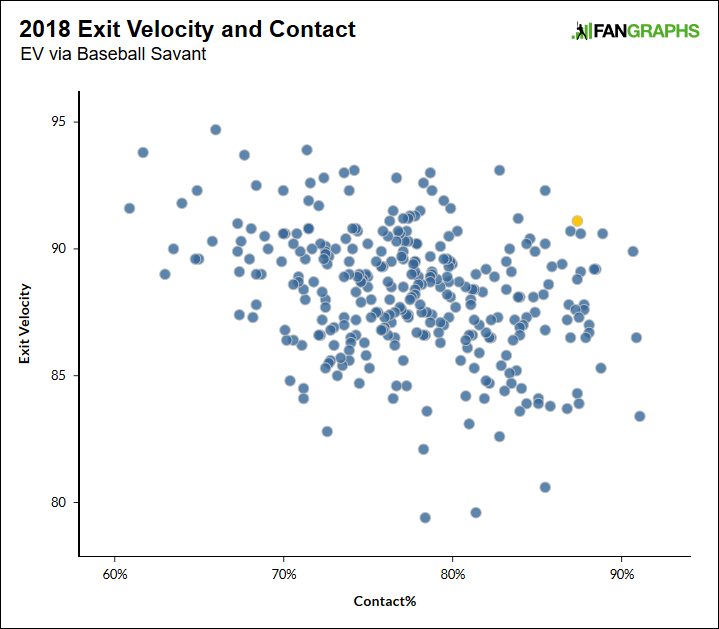
There’s also the question of LeMahieu’s bat. The now-former Rockies’ second baseman has played essentially six full seasons in the majors and been above-average offensively in exactly one of them. In 2016, Leamhieu posted a double-digit walk rate, a strikeout rate of just 13%, an ISO of .147 and a sky-high .388 BABIP on his way to a 130 wRC+. The last two seasons, his walk rate has dropped to 8%, his strikeout rate increased slightly to 14%, his ISO has been .123, his BABIP .326, and his wRC+ has been 10% below league-average. Combined with solid defense, this has made him a roughly average player. Jeff Sullivan noted that LeMahieu does have some hidden upside as a player who hits the ball hard and makes a lot of contact, and used the graph below to illustrate those two skills, with LeMahieu’s spot highlighted.

If LeMahieu could take that hard contact and put it in the air more often, he might hit for more power and have better overall numbers. As Sullivan (along with Travis Sawchik) noted, there might have been some attempts by LeMahieu to achieve a change. In 2018, he posted a GB/FB rate below 2.0 for the first time in his career, while his 30% pull-rate was a career-high. It likely helped cause his career-high .152 ISO. If that power came at the expense of hits — LeMahieu had a career low .298 BABIP, as well as fewer walks, with just a 6% walk rate — it isn’t clear the trade-off has helped yet.

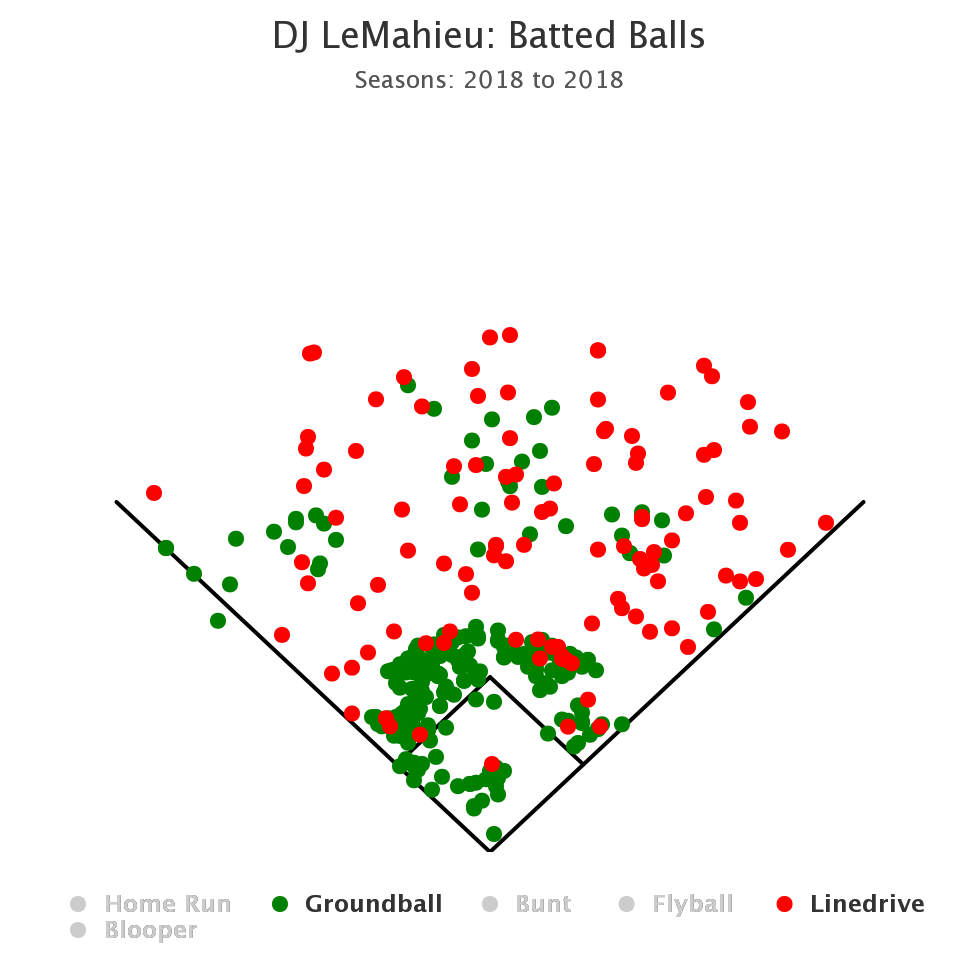
The problem for LeMahieu is that he just hasn’t been able to translate his hard ground balls into hard fly balls. On ground balls last season, LeMahieu put up an average exit velocity of 89.6 MPH, well above the 84.5 mph league average and in the top 10% in all of baseball. On fly balls, LeMahieu put up an average exit velocity of 91.3 mph, which is harder than his grounders, but below the league average of 91.6 mph last year. His exit velocity ranks so highly overall because he hits balls on the ground very hard, which is generally what allows him to post high BABIPs and come close to a league-average player. This is what his spray chart looked like last year.

That’s a lot base hits from a player who can’t be effectively shifted against. LeMahieu might have some untapped power, but he hasn’t yet been able to get to it. At 30 years old, he probably isn’t getting any better than the useful player we see right now. In any event, the Yankees aren’t bringing LeMahieu in for his untapped power. They are bringing him in to raise the team’s floor should their other infield options fail to work out, and to add a solid glove with good contact ability.

In a world where LeMahieu was one of very limited options, the move would make sense, albeit not all that much sense if LeMahieu is a utility player. We don’t live in that world, though. We live in a world where Manny Machado exists, wants to play in New York, and doesn’t seem to have a whole lot of bidders for his services. By signing LeMahieu, the Yankees are essentially committed to going over the competitive balance tax next season. The last time the Yankees passed on a $200-plus million infielder who really wanted to play for the Yankees, the team missed the playoffs in two of the next three seasons and didn’t play in a playoff series during that time. Robinson Cano averaged five wins per season over those three years in Seattle, as the Yankees opted to spend their money on Jacoby Ellsbury, Brian McCann, and Carlos Beltran. The Yankees should be better the next three seasons than they were from 2014 to 2016, and D.J. LeMahieu should help them, but it’s easy to see how the Yankees might end up regretting passing on a 26-year-old star so they can save a little money. Unless they still sign Machado, in which case the last paragraph is moot.


Jed Lowrie Joins Mets’ Overcrowded Infield

In the abstract, the Mets’ signing of infielder Jed Lowrie to a two-year, $20 million contract is a nice little move. The team gets a versatile, well-regarded veteran who’s coming off such a strong enough year that he might have received double that guaranteed money in a more hospitable free agent market. In the real world, the signing of Lowrie raises more questions than it answers, questions for new general manager Brodie Van Wagenen about how the Mets plan to allocate playing time throughout not just their infield but their outfield, and about how they value the futures of the promising youngsters within both groups.

The switch-hitting Lowrie, who turns 35 in April, has spent the last three seasons with the A’s and is coming off career bests in home runs (23), wRC+ (122, with a .267/.353/.448 line), and WAR (4.9). That comes on the heels of a previous career high of 3.6 WAR in 2017, accompanied by 14 homers and a 119 wRC+. Before that, he had his ups and downs — we’ll get to those — and he has a long history of playing all over the infield, but during this two-year surge, 95% of his defensive innings have come at second base.

Of course, less than six weeks ago, the Mets traded for an eight-time All-Star second baseman in Robinson Cano, and just this past summer, in the second half of an otherwise lost season, they stumbled upon a productive, homegrown second baseman in Jeff McNeil. As with their outfield of the past two seasons — a collection light on capable center fielders, and populated with more lefty-swinging corner outfield bats than any reasonably assembled roster needs — it’s not at all clear how they intend to fit all of the parts together into a coherent whole. They do intend to play Lowrie every day, according to Newsday’s Steven Marcus, but with position(s) to be determined.

I’ll attempt to sort all of that out below, but first, Lowrie is worth a closer look. Before his big 2017 and ’18 seasons, you’d have to go back to 2013 to find a similarly strong campaign on his resumé. He was below replacement level in 2016 before missing the final two months of the season due to surgery to remove a bunion and repair a ligament in his left big toe, and from 2014-2016 hit for just an 89 wRC+ with 2.2 WAR in 292 games while missing additional time due to a fractured right index finger (2014) and a torn ligament in his right thumb (2015).

Lowrie, who lists at a modest 6-foot and 180 pounds, has cited improved lower body conditioning and late-2016 surgery to repair a deviated septum — a procedure that improved the quality of his sleep and his ability to recover from workouts — as reasons for his recent improvement. He speaks like a man aware of the flood of data available to players these days. “I look back at the success I’ve had in my career hitting, and the focus has always had to be on my legs, getting the most out of my legs as I can,” Lowrie told the San Francisco Chronicle’s Susan Slusser last April. “Some guys are strong enough to manipulate their mechanics and get an ideal launch angle. I’m trying to maximize bat speed to maximize exit velocity.”

As he told Sports Techie’s Joe Lemire in September:

“I check [Statcast] regularly. We have our system upstairs in the clubhouse, so if you see me leaving the dugout, 99 percent of the time it’s to go up and look at either video or exit velocity and launch angle. I use that information more as a debriefing. I can figure out that if I take the swing that I wanted to mechanically on a pitch that I know I can hit hard, but the exit velocity wasn’t what I expected it to be, then maybe it’s because my legs aren’t underneath me.”

By and large, Lowrie’s 2017 and ’18 Statcast numbers are better than his 2015 and-16 ones:

Jed Lowrie Via Statcast, 2015-2018
Season GB/FB Exit Velocity Launch Angle wOBA xwOBA
2015 0.80 89.0 16.2 .305 .310
2016 1.33 85.7 11.3 .282 .294
2017 0.68 88.8 18.6 .347 .375
2018 0.76 89.0 17.1 .348 .333
SOURCE: Baseball Savant

He’s elevating the ball more consistently and hitting it harder, which explains why he’s been more successful at ages 33 and 34 than earlier in his 11-year major league career, which began with the Red Sox (2008-2011) and has included multiple stays with both the Astros (2012, 2015) and A’s (2013-2014, 2016-2018). That should mitigate some fears about an expected fall-off in his mid-30s.

On the defensive side, Lowrie made 132 starts at second base in 2017, and 133 in 2018; he was above average there in the latter season (6.1 UZR, 1 DRS) after three straight years in the red by both metrics (-5.5 UZR, -12 DRS). He last played shortstop in 2016, and that was for just three innings, with 16 starts in 2015; his metrics had slipped far enough into the red prior that he’s best regarded as an emergency solution at the position these days. He’s played only a smidgen of third base recently (three innings in 2017, 14 starts in 2018); his most extensive work at the hot corner came in 2015, when he played 47 games and was within a run of average via both UZR and DRS.

In terms of his recent usage, Lowrie doesn’t look like the second coming of Ben Zobrist, Kiley McDaniel’s admiration notwithstanding, but the Mets, who lost out on the real Zobrist in December 2015, when he signed with the Cubs, are planning to move him around. Not only is second base overpopulated, but third baseman Todd Frazier is under contract for one more season and $9 million. Oh, and Lowrie, like Cano and Frazier, is a former Van Wagenen client. Things could get awkward as these guys fight for playing time, and in the meantime, it’s fair to raise an eyebrow regarding this agent-turned-GM’s penchant for collecting his aging former clients.

Indeed, right now, it’s hard to make sense of how Van Wagenen and manager Mickey Callaway plan to piece this together. Not only did they trade for Cano, they just added utilityman J.D. Davis for a rather steep prospect price. They got a nice 63-game rookie season out of McNeil and a not-so-nice sophomore campaign from shortstop Amed Rosario. They have last year’s first base prospect, Dominic Smith, and next year’s first base prospect, Peter Alonso. I don’t even dare crack wise about another reunion with Jose Reyes, as his 2018 season and the Mets’ justifications for keeping him were both terrible.

Let’s put these guys in a table:

Mets’ Infield Logjam
Player Bats 2019 Age Primary Pos Secondary Pos 2018 WAR 2019 Proj
Peter Alonso R 24 1B N/A 1.5
Dominic Smith L 24 1B LF (LOL) -0.5 0.0
Robinson Cano L 36 2B 1B 2.9 3.3
Jed Lowrie S 35 2B 3B, 1B? 4.9 2.1
Jeff McNeil L 27 2B 3B?, OF? 2.7 1.1
Amed Rosario R 23 SS 1.5 2.1
Todd Frazier R 33 3B 1B 1.5 0.9
J.D. Davis R 26 3B 1B -0.6 0.2
Projections via Depth Charts

Alonso, Smith, and Davis all have minor league options; so does Rosario, but lacking a ready alternative at shortstop, we can ignore that. Worth adding to the picture is the knowledge that Smith’s stock is very low, that Davis is a bench piece for now, that McNeil didn’t seem to have any problems against southpaws as a rookie (124 wRC+, albeit in 62 PA), that Frazier suddenly struggled against lefties in 2018 (52 wRC+ in 129 PA), which may just be a fluke, and that Lowrie’s been about average versus lefties over the past two years while mashing righties. That still leaves a fierce game of musical chairs.

If the Mets go around the horn with Ye Oldest Lineup, Frazier-Rosario-Lowrie-Cano, then not only are they playing their marquee offseason acquisition at a position where he’s got just 14 games under his belt — and he’s still quite playable at second base (2.8 UZR in 2018) — but they need to figure out how to get enough playing time for McNeil, who hit .329/.381/.471 (137 wRC+); they clearly aren’t calling up Alonso (.285/.395/.579 with 36 homers split between Double-A and Triple-A) anytime soon in this scenario. If they go Lowrie-Rosario-McNeil-Cano, they’ve got two corner guys playing their lesser positions, a second baseman on whom the jury is still out defensively (0.4 UZR, -2 DRS), a bench player making $9 million, and again no clear path for Alonso. McNeil-Rosario-Lowrie-Cano trades a comparatively minor question about second base for a major one about whether McNeil can handle third, something the Mets appeared reluctant to find out in 2018. McNeil-Rosario-Cano-Lowrie? The new guy has a total of 28 major league innings at first base, all of them in Boston in 2010-2011; that’s 11 more innings than McNeil has played at first in the minors, lest you think about swapping those corners. Frazier-Rosario-Cano-Lowrie may as well be Lowrie-Rosario-Cano-Frazier; the Toddfather might be the better defender at both positions.

All of this is reminiscent of the Mets’ mismatched outfield of the past two seasons, with Jay Bruce, Curtis Granderson, Yoenis Cespedes, Michael Conforto, Brandon Nimmo, and no true center fielder besides the oft-injured Juan Lagares. Granderson was traded to the Dodgers in late 2017, Bruce went to Seattle in the Cano trade, Cespedes may not play at all in 2019 after surgery to remove bone spurs in both heels, Nimmo has established himself as one of their top hitters, and they just acquired Keon Broxton in a 3-for-1 deal, so it’s a stretch to say they’ve got things sorted out there beyond some kind of Conforto-Lagares/Broxton-Nimmo arrangement. Reportedly, they plan to find time for McNeil in the outfield, though he has just nine minor league appearances totaling 65.1 innings out in the pasture. At whose expense will that playing time come?

I don’t know those answers, and right now, I’m not sure the Mets do, either. The fear is that they’re now overly stocked with infielders in their mid-30s who are cutting into the playing time of infielders and outfielders in their 20s, but it’s worth acknowledging that Opening Day is 2 1/2 months away (gah) and that this move probably means others are in store. Perhaps they trade Frazier in a salary dump, or deal Conforto for another young, controllable player who fits their lineup better.

For all of the above hand-wringing, the good news is that Van Wagenen continues to add useful players, and that the Mets are projected to win 85 games, which should put them in the thick of the NL East fight. Van Wagenen’s vision of a competitive 2019 squad may not be my vision or your vision, but it’s certainly more visionary than what we’ve seen in Queens in the past couple of seasons, and that counts for something.



Jeff Sullivan FanGraphs Chat — 1/11/19

9:04

Jeff Sullivan: Hello friends

9:04

Jeff Sullivan: Welcome to Friday baseball chat

9:04

Syndergaardians of the Galaxy : I keep hearing that the NL central is the best division in baseball. I didn’t believe it, but I added up the projected WAR OF every division, and I’ll be danged but sure nuff, it really was the best. But what really blew my mind was the tiny separation in projected WAR between the #1 team and the #5 team in that division–11.5 WAR, barely half of the next best division. Has there ever before been a divisional projection that tight in the FG era?

9:06

Jeff Sullivan: Let me say this: it’s too early to perform this kind of analysis, because the offseason still has a long way to go, and our projections right now are just Steamer instead of Steamer and ZiPS

9:06

Jeff Sullivan: And I think what people probably mean is that the NL Central might have five at least decently competitive teams. In the NL East, there should be four competitive teams and the Marlins

9:07

Jeff Sullivan: I don’t know what more the Reds are going to do. I don’t know if the Pirates are going to do anything. But it’ll be fun. The whole NL should be fun — a lot crazier than this year’s upcoming AL

Read the rest of this entry »


Dan Otero on Baseball History and Being a Fan of the Game

Dan Otero has quietly had a successful big-league career. In 333 relief appearances covering 374 innings, the 33-year-old right-hander has a 3.27 ERA and a 3.39 FIP pitching for three teams over seven seasons. On the off chance that win-lost records are your cup of tea, Otero is 10-2 (with a 3.09 ERA) since joining the Cleveland Indians in 2016. He’s 22-8 overall.

Otero knows every one those numbers, but not for narcissistic reasons. An avowed stat geek, the Duke University graduate knows a plethora of numbers. He’s been perusing box scores and leader boards ever since he was knee high to a grasshopper. And he knows the stories behind them, as well. Thanks in large part to his father and grandfather, he’s well-versed in the exploits of bygone legends like Babe Ruth, Sandy Koufax, and Minnie Minoso. Moreover, he has a deep appreciation for both those who came before him, and his contemporaries. Otero isn’t just a big-league pitcher. He’s a devoted fan of the game of baseball.

———

Dan Otero: “Growing up, I watched baseball all the time. My dad is a huge fan, so it was always on at the house. I remember waking up in the morning before school and opening the newspaper, which is where all the box scores and stats were back then. I would memorize the standings and the stats every day. I collected cards, organizing them alphabetically in binders. Even my sister got into it. It was kind a family affair. We loved sports, and we loved following baseball.

“I grew up in Miami. My dad came over from Cuba in 1960, when he was 10 years old. He followed my grandfather’s lead in following the Yankees. His older brother was a rebel; he was a Dodgers fan. I wasn’t a rebel. I followed my dad, who even though he kept up with the Yankees was a hometown guy. Being in Miami, he was a Dolphins fan, a Heat fan, a Marlins fan, a Hurricanes football fan. We were embedded in the Miami sports fanbase. Read the rest of this entry »