We have some movement in the race between immovable objects.
The Rangers on Monday capped a four-game, wraparound series win over the Mariners to take what feels like a commanding 2 1/2-game lead over them and a two-game lead over the Astros in the AL West. Texas followed that up by dropping a series to the AL-best Rays, while Seattle dropped a series from the NL-best Dodgers and Houston swept the Angels. Entering Friday’s action, the Rangers lead the Astros by a half game and the Mariners by 2 1/2 games. That’s how it’s gone for the league’s most languid division in 2026.
Monday’s win gave the Rangers a 7-3 record against the Mariners on the year, securing Texas the tiebreaker should that become relevant in late September. Meanwhile, the Rangers head to Houston this weekend for a three-game set with the Astros currently holding the tiebreaker, 6-4. A Texas sweep in the road series would give it the head-to-head advantage against both of its AL West rivals. If not, things could get even more interesting come the final week of the season.
Even so, our Playoff Odds aren’t expecting the Texas-Houston tiebreaker to matter too much. That’s because, for the first time in 2026, the 55-54 Rangers look like the favorites to win the division.
Eric A Longenhagen: Hi hello how are you, it’s another 115+ degree day here in Tempe, time to chat.
12:17
Big Fan: Philosophically, do you feel like contenders value their prospects too much? Not enough? The right amount? I’m sure the answer varies by team, but it’d be interesting to hear which teams typically fall in which bucket.
12:19
Eric A Longenhagen: It varies by executive even more than team. The small market teams covet the surplus value, and the way GM trees have grown the last 20 years has made it so the folks who helm those teams have migrated to the bigger markets, and those philosophies are then employed by the Dodgers, Mets, etc. One’s need to hug prospect is inversely related with their ability to draft and make more. WHen you’re a well-oiled machine like the Rays, you should be more aggressive and push the chips in now and then.
12:20
aglossman: I have no interesting or original questions to ask. Do you think the Sox will trade Arias? I hope not
12:20
Eric A Longenhagen: Nah, if they do it’d have to be for someone so good you might feel otherwise after it’s done.
12:20
Big Fan: The Braves have recently promoted a handful of prospects. Do you think the timing was to juice their value in models without giving a player long enough to be exposed at a new level?
Hello. While on paternity leave, I kept a journal about baseball and my daughter, who is not named Derek Jr., but who will henceforth be referred to as Derek Jr. You can read all of the entries here.
May 25
After nearly five hours of sleep, Derek Jr. wakes up a bit past one in the morning. She’s clearly struggling with some gas issues. I try to soothe her without taking her out of the crib, bicycling her little legs to help her through it, but it doesn’t help at all. She displays every sign of ravenous hunger, so I change her and start her on a bottle, but the milk just won’t go down. Something is going on. She’s clamoring for the bottle, she’s pulling milk into her mouth, and she’s riotously upset every time I take the bottle away, but she keeps letting all the milk run right down her chin. She doesn’t need to burp. It’s not her diaper. I’m not sure what else could be wrong, so after awhile, I give up on the bottle and get her into what has become my standard soothing-a-gassy-baby position. It’s basically a human swaddle.
I settle Derek Jr.’s shoulder in the crook of my right arm, my hand reaching down to grab hold of her right thigh and pull her knee up toward her belly. With my left hand, I give her a pacifier and press her right arm across her chest, then I turn my right arm to press her into my body so that her face is buried in my chest, which holds the pacifier in place. When it works, this position soothes her instantly, though she still pulls frantically at the pacifier. It takes a good 20 minutes for her to work through the gas, and then, suddenly, she relaxes. Not only is she hungry, but she wolfs down the entire the bottle and falls promptly to sleep. I settle her on my shoulder to burp her gently, and I pull out my phone to check what happened in baseball today.
Tomorrow — well, today I guess — is my first official day back at work. I spent the morning preparing this journal’s introduction and first installment for editing, then going through my wife’s camera roll looking for images I could use. I found pictures of myself from the day Derek Jr. was born. Parents are strongly encouraged to give the baby as much skin-to-skin contact as soon as possible. It’s good for bonding and it promotes the release of oxytocin, so there I am in the hospital room wearing my FanGraphs hoodie with no shirt underneath, feeling supremely silly, the zipper cold against my chest. It never really worked out, though. Derek Jr. just wasn’t comfortable being against my chest that way, and I felt like I’d failed. I’d forgotten about that until I saw the pictures this morning.
Tonight, my wife and I only had an hour or so of free time between getting Derek Jr. down to sleep and going to bed ourselves. My going back to work will be enough of an adjustment, so I didn’t want to force her to spend her one hour of relaxation time watching baseball. We put something else on the TV while I perused the leaderboards looking for something to write about tomorrow. As a result, I still have no idea what happened during tonight’s games. What I missed was Houston’s Tatsuya Imai, Steven Okert, and Alimber Santa combining to no-hit the Rangers. With Derek Jr. still asleep on my shoulder, I pull up the highlights. They are hilarious.
It’s got to be one of the sillier no-hitters in history. The highlight package starts in the first inning, with no outs and two Rangers already on base, because apparently Imai walked the first two batters of the game. He only strikes out two, and aside from a couple popups, every ball in play seems to fall into one of two categories. Either center fielder Jake Meyers is running down what looks off the bat like a surefire double in the gap, or a middle infielder is standing on his head to corral a hard-hit grounder that appears destined either to fracture Imai’s tibia or end up in center field.
Imai started the season (and his MLB career) in disastrous fashion. He went on the IL with arm fatigue, got shelled in one of his two rehab appearances, then got shellacked in his first start back in Houston. He came into the game with an 8.31 ERA and -0.2 WAR. Tonight, he walked twice as many as he struck out and had a 50% hard-hit rate. The Rangers walked fewer batters and allowed only one more hard-hit ball than Imai did, and they got lit up for nine runs. The Astros didn’t throw a single offspeed pitch or curveball all night. Aside from four sinkers from Imai, every pitch was either a four-seamer or a slider. Somehow, that didn’t help the Rangers much. Maybe this is what I should write about tomorrow.
A minute or so into the highlights, Derek Jr., still asleep, does sort of a reverse bear crawl from my shoulder down to my chest. She settles with her knees on my lap and her torso pressed against mine, her head resting sideways just below my chin. It’s a position both the teachers of a parenting class and the nurses at the hospital encouraged us to use, as it allows for maximal skin-to-skin contact. They made it sound special, and I was excited for it. I’d seen other people hold their babies that way. It’s why we have those dumb pictures of me holding Derek Jr. with no shirt under my hoodie. But I couldn’t make her comfortable that way, and I gave up. All of a sudden, two months later, it’s where she wants to be. After a rough afternoon and night, she’s finally comfortable and happy, her warm little body pressed against me. She gets so tense when she’s upset; sometimes we lift her up from the crib and her whole body is stiff as a board. But she’s relaxed now. The highlight package is long, and as I watch the Rangers smash the ball every which way except into some grass, I’m overwhelmed by gratitude for the chance to have this moment with Derek Jr. melted against me. Maybe it’s the oxytocin.
I shouldn’t be up writing this. I’ve mortgaged two hours of sleep to document this moment, and I have to be up in three-and-a-half more to write about how James Wood can’t seem to figure out which pitches to challenge. If Derek Jr. wakes up right now — which could absolutely happen — I’ll be doing so on very, very little sleep. That’s been the tradeoff of this whole project, though. I can make sure we never forget all of these special moments, but only if I’m willing to lose some sleep in the night and be a bit more of a zombie during the day. I don’t know how much longer I can keep it going now that I’m going to be spending my days writing. It’s certainly felt worth it so far, and I’ve been so lucky to have had this time, to have such an amazing job that lets me write this journal at all.
Here’s one thing that I haven’t been able to document, that I don’t think I’ll be able to document fully. I’ve written a lot about what it feels like to have Derek Jr. asleep in my arms in the rocking chair in the middle of the night. It’s the most special thing I have. It’s my time to be close to her, to share my warmth, and to know that I’m taking care of her as well as I possibly can. I sing to her. I tell her how loved and beautiful she is. I crane my head down to look at her perfect face, and then I tilt my head back until I’m looking at the ceiling (my God, does that hurt, by the way) and try to burn the image into my memory. But I can’t do it. My brain just doesn’t work that way. I can’t hold onto it, and there’s no way to take a picture of it. I know I’m going to forget this image. It is the most precious thing to me, and I’m going to lose it. In some sense, I’ve lost it several times already; too slowly for me to notice, it must have changed so much as Derek Jr. has grown and grown over the past two months. No matter how tightly I hold her, so much slips away. So I stay up late. I put it into words as best I can. I get through the day.
As August 3 draws closer, we’re continuing to update the farm systems of some of the clubs we expect to be buyers at the trade deadline. These teams are both contending for a playoff berth and in clear need of a significant upgrade, the kind that will likely require parting with a top farmhand or two. Today, we’re evaluating the Milwaukee Brewers.
In tandem with an evaluation of team needs and posture, we’ve also updated Milwaukee’s Top Prospect list. The new list accounts for the graduations of Brandon Sproat, Logan Henderson, and Craig Yoho, and offers a fresh valuation on several notable farmhands. The big news is that Alexander Frias, Brady Ebel, and Tyson Hardin have moved onto our Top 100, while Jett Williams has fallen off. We’ll cover them, and a couple of the other big changes, in more detail below.
The Situation
The Brew Crew is at it again. Milwaukee has the second-best run differential in baseball and a 5.5-game lead in the NL Central. As of Thursday afternoon, our Playoff Odds give them an 83.4% chance to win the division and all but guarantee a spot in the tournament. Enviable pitching depth has helped them weather absences from Quinn Priester, Brandon Woodruff, and Kyle Harrison without missing a beat. The club’s big divisional lead has even afforded them the luxury of letting Sproat work through some kinks in the big league rotation. Offensively, they’ve mostly been healthy this year, and are again working miracles with a modern version of small ball. Last in baseball in homers, the Brewers are nonetheless fifth in runs and sixth in wRC+. They take their walks, don’t strike out much, steal efficiently, and otherwise run the bases well. Potential upgrades to this unique club make most sense viewed through the prism of who can help them win a series against the Dodgers rather than who can help them clinch a playoff spot. Read the rest of this entry »
Ben Lindbergh and Meg Rowley banter about the end of Ben’s jury duty and Meg’s first colonoscopy, then discuss an investigation into Dodgers owner Mark Walter’s finances, Roki Sasaki’s big glove, Munetaka Murakami’s performance against good velocity, a squirrel sighting (and top prospect Max Clark’s arrival) in Detroit, baseball’s animal kingdom, who gets to claim Jimothy, the frustrating Mariners, Curtis Mead’s im-mead-iate injury, and pre-deadline unrest in Philly. Then (1:05:16) FanGraphs contributor Kiri Oler joins to preview the Women’s Pro Baseball League’s inaugural season and consider its prospects for long-term success.
On Wednesday afternoon, Tarik Skubal threw what looked for all the world to be his last pitch as a member of the Detroit Tigers.
Skubal fanned six Orioles — including his 1,000th career strikeout — and held the Orioles scoreless into the seventh inning. Tigers manager A.J. Hinch, wanting his ace to finish on a valedictory note, let Skubal pitch himself into some trouble in the seventh, but lifted him once Leody Taveras singled in Baltimore’s first run. Read the rest of this entry »
As August 3 nears, we are taking a fresh look at the farm systems of some of the clubs we expect to be buyers at the trade deadline. These teams are both contending for a playoff berth and in position to make a buyer’s-style trade for a star big leaguer, the kind that will likely require parting with a top farmhand or two. Today, I’m covering the Philadelphia Phillies.
In tandem with an evaluation of the team’s needs and deadline posture, I’ve updated Philly’s prospect list to account for graduations, incorporate the team’s new draftees, and reflect developments on the farm. The Phillies have a top-heavy system with a few key, arrow-up pitching prospects. Read the rest of this entry »
Over the weekend, the Red Sox decided to go for it. They traded exciting young pitcher Connelly Early to Washington in exchange for less-exciting, less-young, but playing-very-well-right-now infielder Curtis Mead. The move elicited strong reactions. Early is a genuinely promising lefty starter who will be under team control until 2032. Mead is only one year older with one less year of team control. He’s had a wonderful breakout season at the plate, and his offensive profile fits Fenway Park beautifully. But he’s a poor defender whose track record of success at the plate is extremely short. Even Boston’s chief baseball officer Craig Breslow went out of his way to spell out exactly why the team pulled the trigger, telling reporters, “Our goal wasn’t to win the trade. It was to make the team better.”
I had my own strong reaction to the deal, but that was mainly because I really wanted to be the one to write it up so I could title the article, “Red Sox Go For It Now by Giving Up Early.” But the reactions to the deal are now more or less irrelevant. Mead did make the team better, but for a very, very short time. He struck out in his first plate appearance with the Red Sox, then got hit by a pitch and broke his wrist in his second. According to Baseball Prospectus’ Recovery Dashboard, the average recovery time for a fractured wrist is 52 days and the median is 47. Mead may or may not return before the regular season ends, but he’s certainly not going to be powering the Red Sox down the stretch, and they’re already out looking for more infield help.
You have to feel for Mead. He was in the midst of a true breakout season. After putting up a combined 0.1 WAR in his first three major league seasons, he was already at 1.6 this year. He was traded to a contender that also happened to be the hottest team in baseball. What an exciting time for the 25-year-old, and then one pitch took it all away.
You can also imagine how Boston’s front office must feel after putting in all the work to make this trade happen. Breslow stuck his neck out for this high-risk, win-now move, and just like that, it’s gone. I don’t think there’s much I could do to cheer up Mead right now, but I can take a crack at cheering up Breslow. I’d like to remind him that although this may seem like the worst case scenario for his bold challenge trade, things could have gone much, much worse. In order to see that, you just have to look at things like a chief baseball officer, removing the human element and focusing solely on pure, unadulterated on-field production. Let’s lift our spirits by acting like soulless robots. Read the rest of this entry »
John E. Sokolowski and Nick Turchiaro, Imagn Images
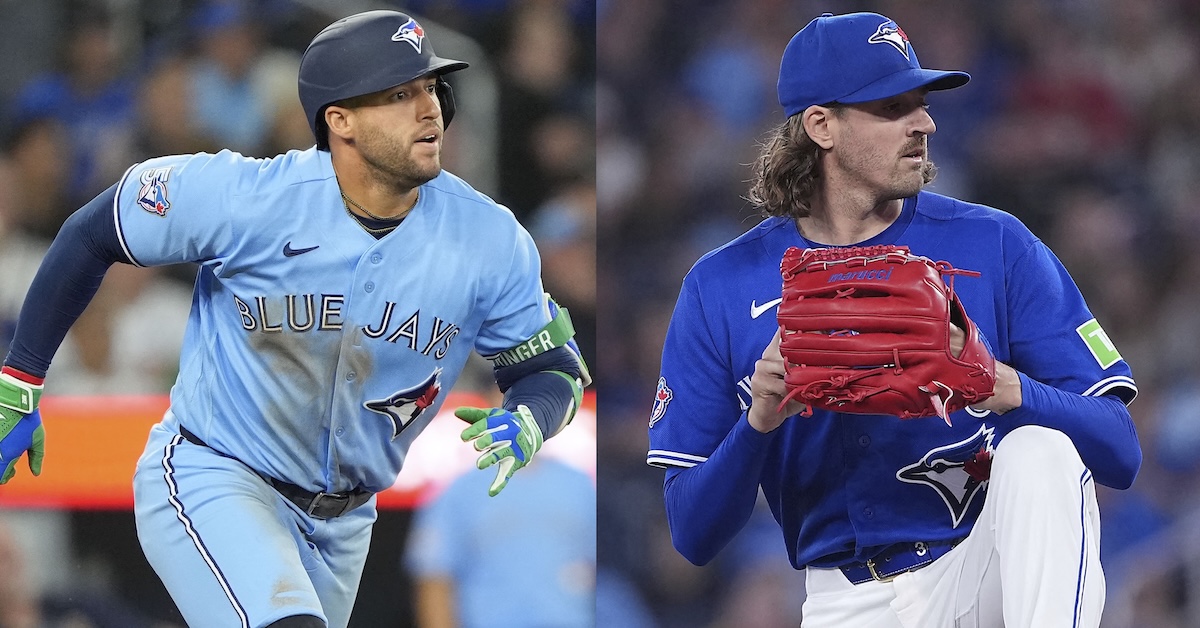
The Blue Jays came agonizingly close to winning the World Series last fall, but this season has been a much different story. They haven’t had a winning record since April 4, and haven’t played above .500 in any full month besides May (15-14). While they clawed their way back to .500 on May 29 (29-29) and June 22 (39-39), an 11-20 skid since then has buried them in the AL East cellar, 14 games behind the Rays. Ten American League teams either occupy a playoff spot or are within 2.5 games of one at this writing, but the Blue Jays aren’t one of them; they’re 5.5 games out of the third Wild Card spot, with playoff odds around 7%. As the August 3 trade deadline approaches, several of their players could be on the move to contenders and are worth a closer look.
So little has gone right for Toronto this year. Last season, the team had four regulars with a wRC+ of 116 or higher in George Springer, Vladimir Guerrero Jr., Bo Bichette, and Alejandro Kirk, each of whom topped 3.0 WAR, as did defensive whiz Ernie Clement. Four part-timers (Joey Loperfido, Davis Schneider, Daulton Varsho, and Tyler Heineman) also met that offensive threshold. But Bichette, Heineman, and Loperfido are now elsewhere, and the rest have been far less productive. No Blue Jay with more than 25 plate appearances has a wRC+ higher than newcomer Kazuma Okamoto’s 113, while Guerrero, Kirk, Schneider, and Varsho are all below 100. Vladito even landed on my Replacement-Level Killers list, which isn’t great news for a player whose contract runs through 2039. Okamoto is the only Blue Jays position player on pace for 3.0 WAR. Ouch.
In 2025, the Blue Jays’ offense ranked second in the AL in scoring and WAR, and third in wRC+, but this year, the team has fallen to second-to-last in scoring and WAR, and last in wRC+:
A Tale of Two Seasons: Blue Jays Offense, 2025–26
Season
R/G
HR/G
BB5
K%
AVG
OBP
SLG
wRC+
WAR
2025
4.93
1.18
8.4%
17.8%
.265
.333
.427
112
32.6
2026
3.94
0.98
7.3%
19.5%
.243
.304
.380
92
10.2
By comparison, Toronto’s run prevention has been nothing to write home about, whether we’re considering last year (4.45 runs per game, 10th in the league) or this year (4.50 runs per game, ninth). It’s easy to forget that the club’s near-miss happened despite a makeshift October rotation that included just one of the three pitchers who took at least 18 starts for the team (Kevin Gausman) and featured a rookie with three regular-season starts (Trey Yesavage), a deadline acquisition who had just returned from Tommy John surgery (Shane Bieber), and a 40-year-old veteran who missed the first three months of the season with right thumb inflammation (Max Scherzer). Read the rest of this entry »




 Sponsor Us on Patreon
 Give a Gift Subscription
 Effectively Wild Subreddit
 Effectively Wild Wiki
 Apple Podcasts Feed
 Spotify Feed
 YouTube Playlist
 Facebook Group
 Bluesky Account
 Twitter Account
 Get Our Merch!