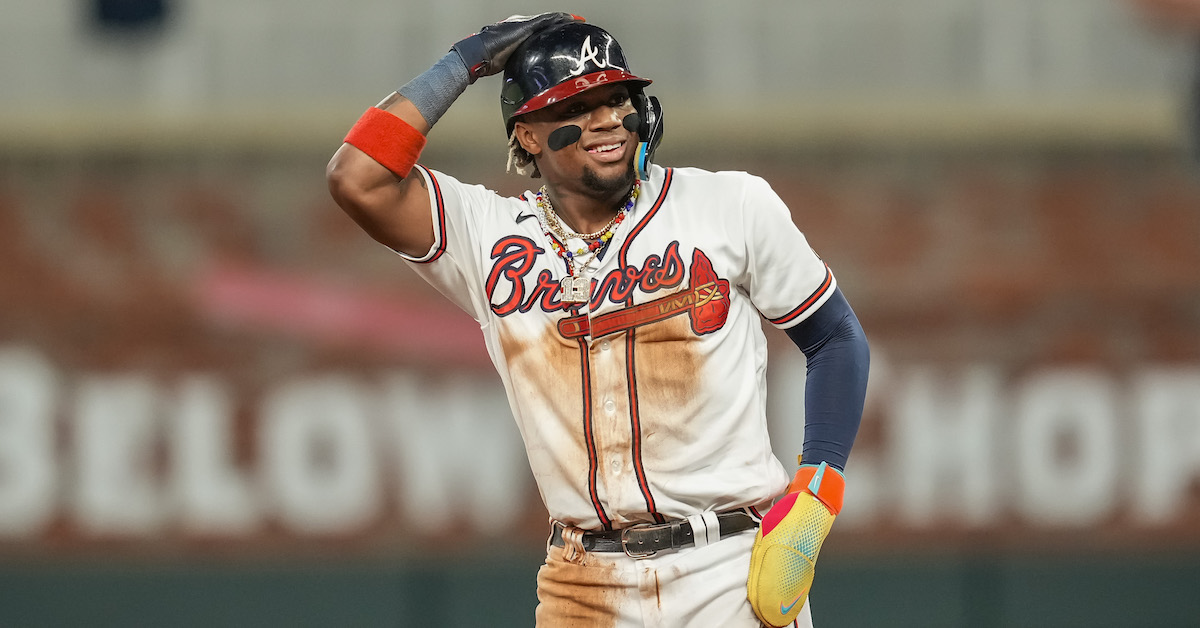
Effectively Wild Episode 2017: The 26-Under-25 Draft

EWFI
Ben Lindbergh and Meg Rowley banter about the Mets, the Padres, and the AL Central, Jacob deGrom’s UCL, Mike Trout’s slow (by his standards) start, and a Phillies pitch-clock controversy, then (23:32), in honor of Elly De La Cruz, draft the 26 best MLB players under 25 years old (see link below to vote!), followed by a Past Blast from 2017 (1:13:54), closing banter about the Blue Jays and Red Sox DFAing Anthony Bass and Matt Dermody, respectively (1:17:22), and updates.

Audio intro: The Gagnés, “Effectively Wild Theme
Audio outro: Liz Panella, “Effectively Wild Theme

Link to Rosenthal on the Mets
Link to story on Phillies pitch clock
Link to Sam Blum on Trout
Link to Jay on Trout
Link to Ben on deGrom
Link to Baby Gronk explainer
Link to giant baby meme
Link to Elly’s prediction
Link to Statcast on Elly
Link to EW drafts/competitions
Link to listener voting form
Link to MLBTR on Bass
Link to Toronto Star on Bass
Link to The Athletic on Dermody
Link to Bloom on Dermody
Link to Dermody’s Twitter likes
Link to 2017 Past Blast source
Link to other Past Blast source
Link to David Lewis’s Twitter
Link to David Lewis’s Substack
Link to Blaseball EW episode
Link to article on end of Blaseball
Link to Greinke EW episode
Link to new Greinke stories
Link to Diekman EW episode
Link to BP on Diekman
Link to Judge fence article
Link to Yankees super-error
Link to Ohtani vs. RHP sweepers
Link to Ohtani vs. LHP sweepers

 Sponsor Us on Patreon
 Facebook Group
 Twitter Account
 EW Subreddit
 Effectively Wild Wiki
 iTunes Feed (Please rate and review us!)
 Get Our Merch!
 Email Us: podcast@fangraphs.com


Noah Syndergaard Is Getting a Reset to His Dismal Season

Gary A. Vasquez-USA TODAY Sports

Officially, Noah Syndergaard went on the injured list on Thursday due to a blister on his right index finger. Unofficially, it might be said that he’s been blistered by opposing hitters, and sidelined by a wounded psyche. The once-mighty 30-year-old righty doesn’t have the velocity, stuff, or confidence of his early heyday, and he’s been frank about the mental toll of his struggles, which have turned him into one of the majors’ least effective starting pitchers. It’s time for a reset.

Signed to a one-year, $13 million deal under the expectation that with another year of distance from his 2020 Tommy John surgery, he could reclaim some of his lost velocity and stabilize the back of the Dodgers rotation, Syndergaard has been a shadow of his former self. In 12 starts totaling 55.1 innings, he’s been hit for a 7.16 ERA, which ranks as the highest among the 63 NL starters with at least 40 innings. His 5.54 FIP is the fifth-worst out of that group, and his 5.55 xERA is tied for seventh-worst. Both his 15.4% strikeout rate and 1.95 homers per nine are among the league’s seven worst as well. Read the rest of this entry »


Hitter zStats Through the First Week of June

Dan Hamilton-USA TODAY Sports

One of the strange things about projecting baseball players is that even results themselves are small sample sizes. Full seasons result in specific numbers that have minimal predictive value, such as BABIP for pitchers. The predictive value isn’t literally zero — individual seasons form much of the basis of projections, whether math-y ones like ZiPS or simply our personal opinions on how good a player is — but we have to develop tools that improve our ability to explain some of these stats. It’s not enough to know that the number of home runs allowed by a pitcher is volatile; we need to know how and why pitchers allow homers beyond a general sense of pitching poorly or being Jordan Lyles.

Data like that which StatCast provides gives us the ability to get at what’s more elemental, such as exit velocities and launch angles and the like — things that are in themselves more predictive than their end products (the number of homers). StatCast has its own implementation of this kind of exercise in its various “x” stats. ZiPS uses slightly different models with a similar purpose, which I’ve dubbed zStats. (I’m going to make you guess what the z stands for!) The differences in the models can be significant. For example, when talking about grounders, balls hit directly toward the second base bag became singles 48.7% of the time from 2012 to 2019, with 51.0% outs and 0.2% doubles. But grounders hit 16 degrees to the “left” of the bag only became hits 10.6% of the time over the same stretch, while toward the second base side, it was 9.8%. ZiPS uses data like sprint speed when calculating hitter BABIP, because how fast a player is has an effect on BABIP and extra-base hits. Read the rest of this entry »


How Are Each of These Pitchers Throwing Harder This Year?

Kenley Jansen
Ken Blaze-USA TODAY Sports

Each season, there is a group of pitchers across the league who have notable velocity increases. In the age of hard throwers, it’s important to make sure you’re keeping up with the rest of the league. Every pitcher has a different situation, too. Some will adapt their body to increase how fast they move, and others will make a slight mechanical adjustment to clean up their kinetic chain — or a pitcher can do a combination of both those things.

For this piece, the focus will be on slight mechanical adjustments that three specific pitchers have made this year that have allowed them to gain velocity. The interesting thing about this group is the difference in size variation and mechanical traits. There isn’t one single way to throw hard, and this group is a great way to highlight that. Read the rest of this entry »


No Extra Extras! Nine Innings Appears to Be Plenty in 2023

Andrew Chafin
Scott Taetsch-USA TODAY Sports

On Wednesday night in our hazy nation’s capital, Nationals shortstop CJ Abrams came to the plate looking to extend his team’s last-ditch rally, down four runs to the visiting Diamondbacks with two on and two out. The Nats had dropped three straight and six of their last eight but were looking for a series victory against a surging Arizona team that had taken 11 of its last 16 and first place in the NL West. With Abrams ahead 2–1, a mulleted and mustachioed Andrew Chafin delivered a fastball low in the zone; the 22-year-old drove the ball hard into the dirt and right at Ketel Marte, who flipped to Nick Ahmed for a force out to end the rally and the game.

It was a game more notable for the atmosphere it was played in – one so clouded by wildfire smoke that Thursday’s series finale would be postponed — than for anything in the box score. But just by its unremarkable nature, the close of Wednesday’s contest kept alive a streak that is reaching historic length: 61 straight games — the entire season so far — without extra innings. Read the rest of this entry »


Five Things I Liked (Or Didn’t Like) This Week, June 9

Scott Galvin-USA TODAY Sports

Five Things was off last week while I gallivanted around the country on vacation. Well, I’m back, and I’ve been furiously watching baseball to make up for the time I missed on the road. As such, some of these items are going to be amalgams of a few games because the same themes kept calling out to me. As always, this column was inspired by Zach Lowe of ESPN, whose basketball columns are some of the best in the business. We’ve got plenty to cover, so let’s get started.

1. Unexpected Pitching Duels
Last Thursday, the Rockies and Diamondbacks faced off in Arizona. The pregame forecast: runs galore. Zach Davies brought his 5.68 ERA to bear for the Diamondbacks (with a 5.65 FIP, it’s not like he’d been catastrophically unlucky) while Connor Seabold took the mound for the Rockies (5.94 ERA, 5.79 FIP).

Naturally, both pitchers came out in fine form. Davies started shakily but recovered to post three straight scoreless innings. Meanwhile, Seabold couldn’t miss; well-located fastballs helped him escape his first jam of the game to complete five scoreless innings:

The good times didn’t keep going – both teams scored two runs in the sixth to chase the opposing starter – but just for a moment, Davies and Seabold did their best impressions of aces. I love that kind of game, where you show up expecting a shootout and get a tense duel instead. Read the rest of this entry »


Investigating the Interaction Between Scoring Environment and NCAA Regional Upsets

Jake Crandall / USA TODAY NETWORK

Let’s pull back the curtain a little. I’ve been covering baseball full-time for about 10 years now, and in that time I’ve basically written five types of article over and over. Every sportswriter cranks out game stories and interview-based features, and at least two or three times a week, every FanGraphs writer pens a focused topical analysis punctuated by charts and jokes. I’m no different. Category no. 4 involves Political/social/economic commentary, since our sport is governed by the society it exists within, and should be analyzed accordingly.

Which brings up category no. 5: I become fixated on something weird or trivial that nobody else in the world cares about. And rather than throw out a joke tweet and forget about it like a normal person, I spend days and days finding, compiling, and analyzing data in a vain attempt to discover the truth. If a truth as such even exists. Then, indifferent to whether the readers of FanGraphs Dot Com — i.e. all of you fine folks — give a tinker’s damn about the subject, I post the results on this little corner of the internet.

Be warned, this is a category no. 5 post. Read the rest of this entry »


Houston Astros Top 38 Prospects

D. Ross Cameron-USA TODAY Sports

Below is an analysis of the prospects in the farm system of the Houston Astros. Scouting reports were compiled with information provided by industry sources as well as our own observations. This is the third year we’re delineating between two anticipated relief roles, the abbreviations for which you’ll see in the “position” column below: MIRP for multi-inning relief pitchers, and SIRP for single-inning relief pitchers. The ETAs listed generally correspond to the year a player has to be added to the 40-man roster to avoid being made eligible for the Rule 5 draft. Manual adjustments are made where they seem appropriate, but we use that as a rule of thumb.

A quick overview of what FV (Future Value) means can be found here. A much deeper overview can be found here.

All of the ranked prospects below also appear on The Board, a resource the site offers featuring sortable scouting information for every organization. It has more details (and updated TrackMan data from various sources) than this article and integrates every team’s list so readers can compare prospects across farm systems. It can be found here. Read the rest of this entry »


Job Posting: New York Mets – Biomechanical Analyst, Baseball Analytics

Biomechanical Analyst, Baseball Analytics

Location: Citi Field – Queens, New York
Status: Full Time

Summary:
The New York Mets are seeking a Biomechanical Analyst in Baseball Analytics. The Biomechanical Analyst will work in conjunction with the Sports Science department to answer a variety of questions relating to biomechanics and baseball. The analyst will be the primary bridge between Baseball Analytics and the Performance Technology group and will need a strong statistical background as well as some level of prior experience with biomechanical data. Prior experience in baseball is a plus but is not required.

Essential Duties & Responsibilities:

  • Design and implement statistical models to answer a variety of questions relating to biomechanics and baseball
  • Work in conjunction with the Sports Science department to integrate biomechanical research into Baseball Analytics models and pipelines
  • Interpret data and report conclusions drawn from their analyses to support and improve decisions
  • Serve as primary educational resource on biomechanical data within Baseball Analytics as well as a strong statistical modeling presence within Sports Science/Performance Technology
  • Effectively communicate statistical concepts and the results of models to both technical and non-technical audiences
  • Provide advice on technical requirements for the Data Engineering team, and guidance to the Baseball Systems team on how best to present model results
  • Evaluate potential new data sources and technologies to determine their validity and usefulness
  • Consistently analyze recent research in analytics and biomechanics that can help improve the modeling work done by the Baseball Analytics department
  • Assist with recruiting, hiring, and mentoring new analysts in the Baseball Analytics department

Qualifications:

  • At a minimum, BS in statistics or a related field, with post-graduate degrees a plus
  • Professional experience in a quantitative position is a plus
  • Biomechanics background or experience working with biomechanical data. Sports or baseball-specific experience is a plus
  • Prior knowledge of motion capture and other technologies is a strong plus but not required
  • Strong background and real-world data applications of a wide variety of statistical techniques. Machine Learning and/or Computer Vision modeling is a plus.
  • Strong proficiency in R, Python, or similar, as well as strong proficiency in SQL
  • Basic knowledge of data engineering and front-end development is a plus, for the purpose of communicating with those departments
  • Strong communication skills
  • Ability to work cooperatively with others, and to take control of large-scale projects with little or no daily oversight
  • Prior experience in or knowledge of baseball is a plus, but is not required

To Apply:
To apply, please follow this link.

The content in this posting was created and provided solely by the New York Mets.


A Splash of History: Looking Back on 20-Plus Years of McCovey Cove Homers

John Hefti-USA TODAY Sports

LaMonte Wade Jr. is having a wonderful season. As Michael Baumann wrote a few weeks ago, the step forward he’s taken in his swing decisions have fueled a career high 156 wRC+ and .429 OBP, both significant improvements from his 2021 breakout campaign. And while much of his development is the result of him reducing his swing rate, he’s still doing more damage on contact than his previous self. Last Friday, the man nicknamed “Late Night LaMonte” (due to his .975 career OPS in high leverage situations) inserted himself into the record books early in the evening, sending Dean Kremer’s first pitch of the game deep to right field for the 100th splash hit in Oracle Park history:

Since its opening in 2000, the right field wall has been one of the most distinctive features of Oracle Park. Despite measuring just 309 feet down the line (the second shortest of any big league park), it has been one of the most difficult to clear for a home run, with the wall’s 24-foot height and wind from the neighboring San Francisco Bay helping to suppress long balls. According to Statcast, Oracle Park is among the most difficult parks for left-handed hitters to hit homers despite grading out neutral overall. But on 100 occasions, hitters managed not just to clear the right field wall, but also to leave the stadium entirely. Read the rest of this entry »