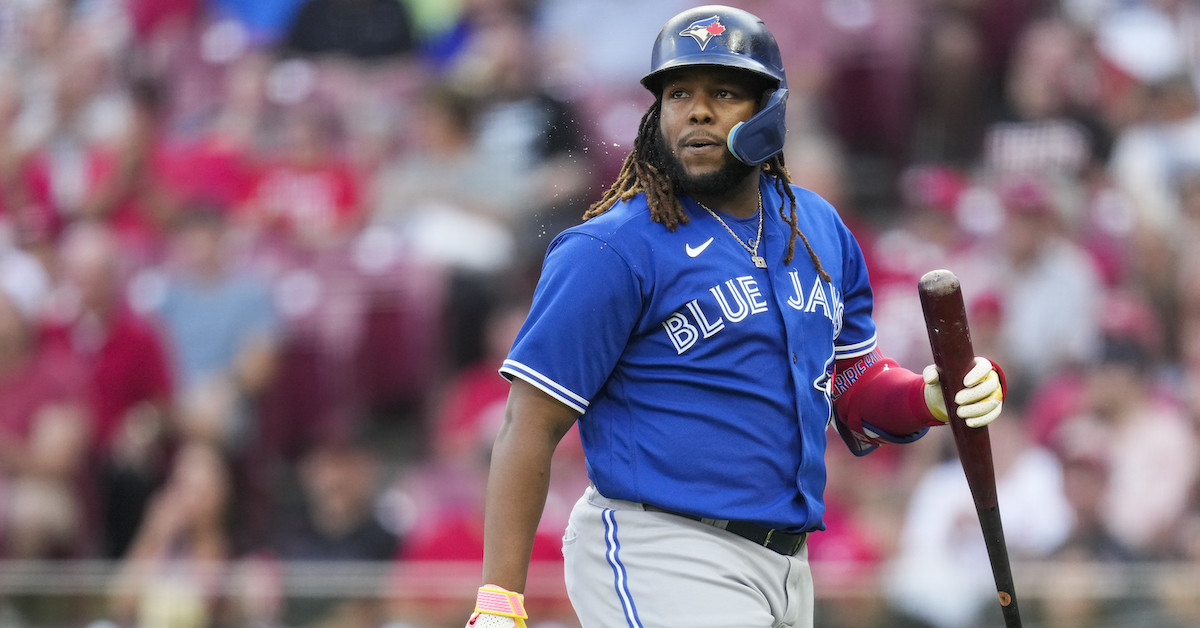
The Cubs are in playoff contention at the end of August, and Kyle Hendricks is getting hitters out with a tasting menu of exquisitely located mid-80s funk. (Grabs nearest passerby) “The date! I need you to tell me the date!…God Almighty, my time machine works!”
For most of the late 2010s, Hendricks was not quite an ace but was a bankable no. 2 or no. 3 starter. Even in his relative youth, he never threw hard; the fastest pitch of Hendricks’ entire career was 93.1 mph, and he hasn’t even hit 91 since 2016. People who apparently never watched Greg Maddux loved to stamp a “next Greg Maddux” label on any bookish right-hander with great command, and of those, Hendricks probably came the closest to living up to the comparison. Read the rest of this entry »
Two weeks ago, we updated our Major League Leaderboards. We appreciated all the feedback and feature requests. One of those requests was to add a way to filter by the handedness of the player, and we’ve done just that!
The filter looks at whether the batter is right-handed, left-handed or a switch hitter, and filters on that value. It works the same for pitchers. We even have a switch pitcher filter, although it’s functional for just one player.
Similar to the position player filter, the handedness filter will not create a subset of data. For example, if you select switch-hitters, it will show you their stats from all their plate appearances, regardless of the side of the plate they batted from.
We still have the handedness splits in the “Split” menu, and these splits can be combined with the handedness filter. So you could look at all right-handed pitchers (Handedness Filter) while facing right-handed hitters (Split):
As always if you encounter any issues or bugs, please contact us at support@fangraphs.com.
Ben Lindbergh and Meg Rowley banter about classifying throws by infielders that are actually made in the outfield, imagine a multi-sport two-way Shohei Ohtani, and belatedly acknowledge Scott Cooper’s singular cycle, discuss Kyle Schwarber’s possible sub-replacement-level 40-homer season, break down the NL MVP race featuring Ronald Acuña Jr., Mookie Betts, and Freddie Freeman, pat Kyle Barraclough on the back for wearing one, note that regression has come for Mickey Moniak, and offer another hosana to Julio Rodríguez. Then they follow up on the previous episode’s mystery about why wild pitches and passed balls have declined, first (1:06:51) by interviewing Yankees quality control and catching coach Tanner Swanson about improvements in catching technique and the evolution of catcher defense, and then (1:37:13) by presenting additional data and theorizing, followed by (1:47:29) a Future Blast from 2052.
Hey there. Are you a major league general manager or president of baseball operations? Do you work in a front office role for a playoff-contending team? Do you wish you had another starter, a good closer, or maybe an outfielder? Well, I’ve got great news for you, my friend. Operators are waiting now for your call: the Los Angeles Angels just yelled “Everything must go!” and threw their roster on the waiver wire like a miffed fantasy owner.
More specifically, the Angels placed Lucas Giolito, Matt Moore, Reynaldo López, Dominic Leone, Hunter Renfroe, and Randal Grichuk on waivers. For the next 47 hours, any team in baseball can place a claim on any or all of their services. It’s an unprecedented maneuver that could inject talent into playoff races across the league, and in an unpredictable fashion. If you’re on the fringes, you’ll get the first bite at the apple, but there are so many players here that even some teams currently in playoff position might end up with someone. If you’re looking for more specifics on the waiver process, Jon Becker wrote a nice explainer here.
Let’s talk about the way this works for the Angels first. Coming into yesterday, we projected them for a competitive balance tax payroll of $234,398,925. The first CBT threshold for this year is $233 million. That means they need to save around $1.5 million to duck under that threshold. The players put on waivers are owed around $6.44 million over the remainder of the year, and a similar amount even when CBT tax calculations are applied. The total tax savings will be slightly less than that, because the Rockies are paying a portion of Grichuk’s salary, but assuming most of these players find takers, the Angels will end up below that threshold. Read the rest of this entry »
By now, you’ve probably seen that the Angels put what we in the business call “Darn Near a Whole Roster Of Players” on waivers. Per ESPN’s Jeff Passan, Lucas Giolito, Matt Moore, Reynaldo López, Hunter Renfroe and Randal Grichuk are all free for the salary relief taking; USA Today’s Bob Nightengale reports that Dominic Leone is on waivers as well. Meanwhile, Ken Rosenthal of The Athleticreports that Harrison Bader, Carlos Carrasco, Mike Clevinger and José Cisnero have also been placed on waivers by their respective clubs. What does this mean for those players? What about the teams waiving or claiming them? What about you, the reader? Let’s dive in to some of the common questions I’ve seen since the news broke.
Q: What does “being placed on waivers” even mean anyway?
In the context of post-trade deadline transactions, being placed on waivers is similar to the waiver action that occurs when a player is designated for assignment. However, since the trade deadline has passed, the option to trade a player who has been placed on waivers is gone. The only option for a claiming team is to claim the player straight-up, paying all of his remaining salary for the rest of the season. Read the rest of this entry »
While Bryce Harper made the quickest return from Tommy John surgery of any position player on record, it came with a cost. Not surprisingly, he didn’t hit the ball as hard as usual in the early months of his return, or do as much damage because he wasn’t elevating it with consistency. At one point, he went 166 plate appearances without a home run, the longest drought of his career, but even then, he remained a reasonably productive hitter. Lately he’s been heating up, crushing the ball while helping the Phillies climb to the top of the NL Wild Card race.
In the fourth inning of Monday night’s game against the Angels in Philadelphia, Harper demolished a Lucas Giolito fastball that was playing in the middle of the road:
The homer — a 111.9-mph scorcher with a projected distance of 429 feet — was Harper’s fourth in a seven-game rampage, during which he’s hit .500/.613/1.037. It was his eighth homer of the month, his highest total since he hit nine in September/October 2021 (and 10 in August of the same season) en route to his second MVP award. He maxed out at seven homers in May of last season, the month he was diagnosed with a torn ulnar collateral ligament in his right elbow. Read the rest of this entry »
Jay Jaffe: Good afternoon folks, and welcome to the last August edition of my chat for 2023!
2:03
Jay Jaffe: I’m a bit giddy because as of 20 minutes ago, we have accepted offers on our current and future homes in Brooklyn
2:04
Jay Jaffe: it’s been a journey, folks
2:05
Jay Jaffe: anyway, yesterday I ran a piece on Félix Bautista’s UCL injury https://blogs.fangraphs.com/a-great-summer-ends-with-a-bummer-as-the-o…. Still no word on the severity of it, but I wouldn’t really read into that as good news. The Orioles aren’t the most transparent bunch when it comes to injuries or… other matters
2:06
Jay Jaffe: I’ve got a piece on Bryce Harper’s resurgence that’s about to go live
Some of the most frustrating arguments involving baseball statistics revolve around the use of expected stats. Perhaps the most frequently cited of these metrics are Statcast’s xStats, which use Statcast data for hitters to estimate the batting average, on-base percentage, slugging percentage, and wOBA you’d “expect” a hitter to achieve. Investigating how predictive xStats are compared to their corresponding actual stats has been a common research exercise over the last few years. While it depends on the exact dataset used, xStats by themselves generally aren’t much better than the actual stats at predicting the next year’s actual stats. But that doesn’t mean we should simply discard expected stats when trying to evaluate players.
While I’m not going spend too much time talking about how predictive xStats are versus the actual ones, I do want to briefly touch on some of the existing work on the subject. Jonathan Judge at Baseball Prospectus examined many of the expected metrics back in 2018. He also spoke with MLBAM’s Tom Tango about the nature of expected stats and their usage:
Earlier this week, we reached out to BAM with our findings, asking if they had any comment.
MLBAM Senior Database Architect of Stats Tom Tango promptly responded, asking that we ensure we had the most recent version of the data, due to some recent changes being made. We refreshed our data sets, found some small changes, and retested. The results were the same.
Tango then stressed that the expected metrics were only ever intended to be descriptive, that they were not designed to be predictive, and that if they had been intended to be predictive, they could have been designed differently or other metrics could be used.
Gavin Stone was credited with his first big league win on Sunday. Working in a bulk role behind opener Caleb Ferguson, the 24-year-old rookie right-hander went six solid innings as the Los Angeles Dodgers topped the Boston Red Sox 7-4 at Fenway Park. His changeup played a predictably prominent role. Stone threw the pitch that our lead prospect analyst Eric Longenhagen has assigned a 60/70 FV (current/projected) on the 20-80 scouting scale a total of 22 times, with a vertical break averaging 30 inches and diving as low 39 inches. Velocity-wise, it ranged from 82.6 mph to 87.7 mph.
Stone was making his fifth major league appearance (and his first since July 4) when he took the mound in Boston. His earlier outings had been on the rocky side — his ERA and FIP are now 10.50 and 6.72 respectively — but there is no denying his potential. The 2020 fifth-round pick out of the University of Central Arkansas is currently no. 40 on The Board with a 50 FV.
The .300 hitter is dying, Ian Crouch wrote in The New Yorker in 2014. And Bradford Doolittle on ESPN.com in 2019. And Barry Svrluga in the Washington Post just last month. If the .300 hitter is dying, it’s dying the same way you and I are, a little bit each day. Maybe the .300 hitter is just sick.
Why do these stories keep getting written? Well, last week I was checking in on Luis Arraez (come on, dude, I thought you were going to make a serious run at .400!) and came to the startling realization that only nine qualified hitters are on pace to hit .300. Nine! I can’t imagine being a baseball writer, seeing that fact, and not being freaked out enough to write about it.
Baseball is a sport that got its tentacles into the American popular vernacular something like 100 years ago, dropping idioms like eggs. “Three strikes,” “home run,” “lost his fastball,” and dozens of others. “Batting 1.000” is probably a more popular phrase than “batting .300” or “hitting .300,” but the latter is still legible to people who think Christian Walker is what you call pilgrims on the Camino de Santiago. Read the rest of this entry »




 Sponsor Us on Patreon
 Facebook Group
 Twitter Account
 EW Subreddit
 Effectively Wild Wiki
 iTunes Feed
 Get Our Merch!


 Jay Jaffe