Kevin Jairaj-USA TODAY Sports
“Jose Altuve will be an Astro for life,” read the club’s announcement on Tuesday afternoon. Under different circumstances, that could be construed as a threat. But Altuve will be well-remunerated for the remainder of his time in Houston: His new contract extension will run for five years, starting in 2025, and pay him a guaranteed $125 million.
This is the third long-term contract Altuve has signed with the Astros, the club that signed him as a 16-year-old out of Venezuela all the way back in 2007. By the time it’s over, he will have spent some 23 seasons in the organization, 19 of them in the major leagues. The phrasing of the announcement is a little more concrete than any prediction about 2029 ought to be. It’s possible that Altuve will continue playing once his deal expires. But when it does, he’ll be seven months short of his 40th birthday. That seems like as good a time as any to plan on wrapping things up. Read the rest of this entry »
Hey there, FanGraphs reader. Great news! Our playoff odds just went up for the 2024 season. These odds, as always, are mostly enlightening, but also a tiny bit mystifying. The model itself remains simple: We take projections for each player, aggregate them up to the team level based on playing time projections, and then use that to create expected team run scoring and prevention numbers. From there, we simulate out the season 20,000 times and note what happened in each instance. The odds are just a summary of those simulations.
As simple as the process is, it’s also inscrutable. How good are the projections? We think they’re very good, as they’re a combination of ZiPS and Steamer. But those projections inevitably differ from people’s perceptions of both individual players and teams. So in what’s become an annual tradition, I’m going to give you a guided tour through the projections and point out the notable points in each division, then explain how our model got there and what I think of it. Read the rest of this entry »
On Monday night, just four days after the Brewers traded perennial Cy Young candidate Corbin Burnes to the Orioles for a package of promising young players and a competitive balance draft pick, Milwaukee signed a pitcher with an even better FIP to take his spot at the front of their rotation.
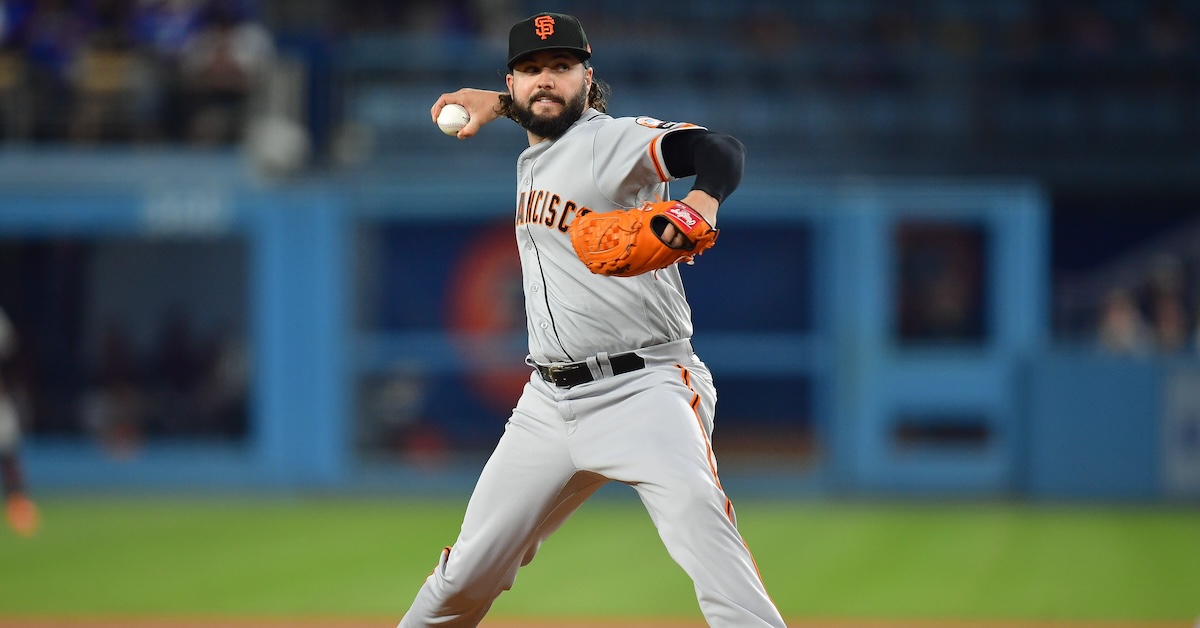
Sorry, that was misleading. Let’s try this again: After spending five years in Kansas City and two years in San Francisco, right-handed pitcher Jakob Junis has agreed to a one-year, $7 million deal with the Milwaukee Brewers. Kiley McDaniel reported the signing, which according to Ken Rosenthal includes a $4 million salary in 2024 along with a $3 million buyout on a mutual option for the 2025 season. While the Giants moved Junis to the bullpen in 2023, the 31-year-old is expected to join Milwaukee’s starting rotation. After the team non-tendered the injured Brandon Woodruff and traded Burnes, the rotation was looking particularly threadbare, relying on Freddy Peralta and a series of other pitchers with question marks surrounding their health, stuff, age, or some combination of the three.
Peralta, who was worth 3.0 WAR over 30 starts and 165.2 innings in 2023, had excellent stretches last season, including taking home NL Pitcher of the Month honors in August. Still, his 3.86 ERA, 3.85 FIP, and 1.41 HR/9 were all the worst marks he’d put up since the shortened 2020 season. Wade Miley, back on a one-year deal, has been fantastic over the last three seasons, but the Brewers will need him to continue his contact suppression sorcery at age 37. Colin Rea put up 0.8 WAR in 2023; the Brewers are hoping he can post back-to-back seasons with a sub-5.00 ERA for the first time since 2015 and 2016. DL Hall, who came over in the Burnes trade, is a truly exciting young pitcher, but he’s also dealt with injuries over the last two years and ended up in Baltimore’s bullpen in 2023. After a shoulder injury, Aaron Ashby pitched just seven minor league innings last year, while Joe Ross, coming off his second Tommy John surgery, threw 14 minor league innings and hasn’t pitched in the majors since 2021. Read the rest of this entry »
Charles LeClaire-USA TODAY Sports
The Pirates have an above-average farm system that includes a number of high-ceiling pitching prospects. Paul Skenes is the most notable — the 21-year-old right-hander was selected first overall in last summer’s draft — but he’s far from the only electric arm in Pittsburgh’s pipeline. As many as half a dozen hurlers will populate the first 10 names when our Pirates top prospects list comes out this spring. Whether any of them will help propel the Bucs to playoff contention remains to be seen, but in terms of potential, the group presents a tantalizing mix of talent.
I asked Pirates General Manager Ben Cherington about a few of those promising young arms during November’s GM Meetings.
———
David Laurila: How happy are you with your pitching pipeline?
Ben Cherington: “We’re excited about it. We also know that pitching development never stops and there are things ahead of all those guys. Part of the reason we’re excited is the talent, but the truth is, no matter how well you do in pitching development there is usually attrition of some kind. You need some volume to make it work, and we think we’re starting to develop some volume. So again, we’re excited. Every one of those guys has targets that we’re working on this offseason, and we’re anxious to see where they’re at come spring training.”
Laurila: Has your pitching program evolved in the last few years?
Cherington: “We believe so. We’ve got some signal on that. It’s improving in some areas, and in other areas we still need to be better. We can’t ever be satisfied with it. But we’ve made some strides with things like breaking ball pitch design, pitch usage, sequencing in the minor leagues. We’ve made some strides with deployment, getting better at identifying what skills fit in different roles and getting guys into those roles. At the same time, there are more things to get better at. All of it is important.”
Laurila: Which of your pitching prospects most stands out for his stuff? I’m thinking pitch metrics. Read the rest of this entry »
Ben Lindbergh and Meg Rowley introduce the 12th annual Effectively Wild season preview series, then banter about the Royals extending Bobby Witt Jr., the Dodgers reuniting with Clayton Kershaw (and Ryan Brasier), the Red Sox (sort of) reuniting with Theo Epstein, and the latest hitter who’s converting to pitching. Then they preview the 2024 Miami Marlins (33:33) with Fish on First’s Kevin Barral and the 2024 New York Mets (1:09:12) with The Athletic’s Tim Britton.
Kiyoshi Mio-USA TODAY Sports
The reliever merry-go-round rarely stops spinning, and one team’s castoff might be another’s potential cog. Case in point: on Monday the Dodgers re-signed righty Ryan Brasier, whom they plucked from the scrapheap in mid-2023, to a two-year deal. To add him, they dealt lefty Caleb Ferguson to the Yankees for itinerant lefty Matt Gage and righty prospect Christian Zazueta Jr.
The 36-year-old Brasier, who made $2 million last year, his final one before free agency, is guaranteed $9 million for 2024–25, with a maximum of $4 million in incentives possible as well. At this writing, the specifics of the annual breakdowns and the benchmarks for those bonuses aren’t known, but suffice to say, this represents a big upgrade in his standard of living. The Angels, Cardinals, Red Sox, and Yankees all showed interest in him this winter as well, according to The Athletic’s Fabian Ardaya.
Such an outcome would have been almost unthinkable back in May, when Brasier lost his job with the Red Sox, for whom he’d pitched since 2018 with varying degrees of success. Though he made 68 appearances for Boston in 2022, he posted a 3.61 FIP but a 5.78 ERA in 62.1 innings, with a .335 BABIP — owing to too many hard-hit balls — playing a significant role in the discrepancy between those two run prevention figures. Through the first six weeks of his 2023 season with the Red Sox, it was more of the same: a 7.29 ERA, a 4.35 FIP, and a .344 BABIP in 21 innings.
On May 15, a day after Brasier had allowed three runs in a season-high 2.1 innings of garbage-time duty against the Cardinals, the Red Sox designated him for assignment; six days later, they released him. The Dodgers signed him to a minor league deal in early June, with Rob Hill, the team’s director of minor league pitching, and Brent Minta, their pitching analytics coordinator, suggesting he add a cut fastball to a repertoire that also includes a four-seamer that averages almost 96 mph and mid-80s slider.
Brasier spent about two weeks working on the new pitch at Camelback Ranch, then made two appearances for Triple-A Oklahoma City, during which he struck out five of nine hitters without allowing a baserunner. The Dodgers called him up, and he was outstanding, pitching to a 0.70 ERA and 2.48 FIP in 38.2 innings the rest of the way. Throwing the new pitch to lefties 46.8% of the time (though just 6.2% to righties), he held batters to a .152 average and .273 slugging percentage with a 16.4% whiff rate. Meanwhile, he cut his four-seam fastball usage in half, got better results on contact and higher whiff rates on all of his pitches:
Ryan Brasier Pitch Comparison, Red Sox vs. Dodgers
Pitch Type
Team
Pitch %
PA
BA
xBA
SLG
xSLG
wOBA
xwOBA
Whiff
Cutter
LAD
23.2%
35
.152
.232
.273
.371
.208
.281
16.4%
4-Seam
BOS
51.9%
43
.342
.311
.605
.547
.434
.401
21.6%
4-Seam
LAD
25.5%
30
.231
.193
.269
.295
.282
.275
30.2%
Slider
BOS
38.4%
39
.171
.238
.200
.307
.216
.283
27.5%
Slider
LAD
33.2%
52
.083
.147
.125
.224
.109
.191
41.7%
Sinker
BOS
9.7%
13
.455
.465
.455
.628
.451
.514
4.5%
Sinker
LAD
18.1%
25
.136
.192
.136
.223
.162
.240
10.4%
SOURCE: Baseball Savant
Brasier had been scorched at a .389/.463/.611 clip by the 41 lefties he faced with the Red Sox, striking out just three of them while walking five. Once he joined the Dodgers, lefties hit just .123/.167/.211 in 60 plate appearances, with three walks (one intentional) and 18 strikeouts.
Overall, Brasier’s strikeout-walk differential doubled, and his results on contact improved dramatically:
Ryan Brasier Results Comparison, Red Sox vs. Dodgers
Split
K%
BB%
K-BB%
EV
Barrel%
HardHit%
xERA
BOS
18.9%
9.5%
9.5%
92.4
3.0%
53.0%
5.10
LAD
26.6%
7.0%
19.6%
87.4
4.3%
35.1%
1.89
All of which is to say that we can add Brasier to the ever-growing list of pitchers — Tyler Anderson, Andrew Heaney, Evan Phillips, Alex Wood — whom the Dodgers were able to get far more out of than other teams thanks to various tweaks in mechanics and repertoire. Noah Syndergaard and Lance Lynn are proof that they’re not always successful at doing so, but they’ve helped enough hurlers to justify their effort. As Phillips, the owner of a 7.26 ERA and 5.37 FIP in 57 innings at three previous stops before arriving in mid-2021, told the Los Angeles Times’ Mike DiGiovanna earlier this month, “When the Los Angeles Dodgers come calling and say, ‘Hey, we think you can be great,’ you tend to listen. They really forced the envelope and said, ‘You’re gonna need to do these things to pitch well,’ and I was in no position to argue with them.”
Phillips is now the closest thing the Dodgers have to a regular closer; he led the team — which had the majors’ third-best bullpen ERA (3.42), second-best FIP (3.73) and best WAR (7.6) last season — with 24 saves. Brasier is now in the mix for a late-inning role, along with fellow righties Brusdar Graterol and Joe Kelly. The latter, whom the Dodgers reacquired in the Lynn trade with the White Sox on July 28, then re-signed to a one-year, $8 million deal in December, has a notoriously spotty health history, as does Blake Treinen, who’s hoping to return to action after throwing just five innings in 2022 and none last year due to labrum and rotator cuff tears that required surgery. A healthy Brasier offers some insurance within that group.
The Dodgers haven’t cleared a roster spot yet for Brasier; they’ll likely just wait until Thursday, the first day that the team can move Tommy John surgery recipients Tony Gonsolin and Dustin May — not to mention newly re-signed Clayton Kershaw — to the 60-day injured list, where they won’t count against the 40-man roster limit. The team did already make a bit of room for Brasier within the bullpen and on the payroll by trading Ferguson to the Yankees. The 27-year-old lefty, who had been in the Dodgers organization since being drafted out of high school in 2014, set career highs in appearances (68), innings (60.1), and WAR (1.3) in 2023 while posting a 3.43 ERA and 3.34 FIP. As Davy Andrews pointed out in August, he restored a cutter to his arsenal in 2023. In his case, he ditched a reasonably effective curveball to do so, though it didn’t work too well against lefties:
Caleb Ferguson Pitch Comparison, by Handedness
Season
Pitch Type
Batter Hand
Pitch %
PA
BA
SLG
wOBA
Whiff
2022
4-Seam
RHH
66.1%
65
.140
.246
.229
31.3%
2022
Curve
RHH
33.9%
33
.207
.276
.268
20.8%
2023
4-Seam
RHH
68.5%
126
.294
.367
.335
24.0%
2023
Cutter
RHH
27.9%
50
.217
.326
.270
30.9%
2022
4-Seam
LHH
68.8%
29
.261
.391
.366
23.6%
2022
Curve
LHH
31.2%
15
.214
.214
.223
18.2%
2023
4-Seam
LHH
62.2%
60
.240
.280
.308
30.6%
2023
Cutter
LHH
36.6%
30
.310
.586
.388
20.7%
In fact, Ferguson has yielded a higher wOBA to same-side hitters than he has to those of the opposite hand in each of the last two seasons and three out of five in a career that’s been interrupted by the pandemic and a late-2020 Tommy John surgery, his second. (His first was in 2014, just a week before he was drafted.)
Caleb Ferguson Splits by Handedness
Season
LH TBF
LH wOBA
RH TBF
RH wOBA
2018
77
.317
125
.284
2019
85
.303
119
.350
2020
26
.278
49
.287
2022
44
.317
98
.242
2023
90
.334
180
.315
Total
322
.315
571
.300
For the Yankees, who last week lost stalwart lefty Wandy Peralta to the Padres, that’s something of step backwards. Peralta had been very effective against lefties (.217 wOBA in 174 PA in 2022–23) while also being pretty effective against righties (.300 wOBA in 276 PA over those two seasons), though that composite masks a 70-point year-to-year jump (from .266 in 2022 to .336 in ’23) against the latter. Ferguson, who will make $2.4 million in 2024, his last year before free agency, is less expensive, so there’s that for the Yankees.
Interestingly enough, Ferguson will join another former Dodgers lefty, 28-year-old Victor González, in New York’s bullpen; he was traded to the Yankees on Dec. 11 along with infield prospect Jorbit Vivas in exchange for another infield prospect, Trey Sweeney. Ferguson figures to be the higher of the two in the pecking order, in the setup mix along with righties Jonathan Loáisiga and Tommy Kahnle, ahead of closer Clay Holmes. It’s worth noting that Loáisiga and Kahnle combined for just 58.1 innings last year amid injuries, so manager Aaron Boone could call Ferguson’s number with some frequency.
As for the more experienced of the two pitchers the Dodgers received in exchange for Ferguson, the 30-year-old Gage is now in his eighth organization since being drafted by the Giants in the 10th round in 2014. He’s passed through the hands of the Mets, Rockies, Diamondbacks, Blue Jays, Astros, and Yankees while totaling just 16 games in the majors, 11 with Toronto in 2022 and five with Houston last year; he was optioned four times for his trouble. He’s pitched pretty well in his limited major league opportunities using a fastball-cutter combo with an occasional slider in the mix, posting a 1.83 ERA and 3.97 FIP in 19.2 innings while striking out 26% of hitters. He got knocked around at Triple-A Sugar Land last year, however, posting a 4.58 ERA and 5.29 FIP with a 23.4% strikeout rate; though he held lefties to a .203/278/.328 line in 73 PA, righties hit .333/.425/.559 in 121 PA against him. If you’re getting the sense that he’s a guy on the fringe of the 40-man roster who’s likely to change addresses multiple times in 2024, you’re probably right. He might be one free agent signing or a couple of bad — or even long — outings away from being sent down or out at any moment. It’s not entirely out of the question that he could be DFA’d to make room for a more experienced lefty reliever, as Alex Vesia and Ryan Yarbrough, the pair currently penciled in for the active roster, don’t exactly strike fear into anyone.
As for Zazueta, he’s the 19-year-old son of Christian Zazueta Sr., a still-active 15-season veteran of the Mexican League who spent last year with El Aguila de Veracruz. The younger Zazueta, also a native of Mexico, is listed at 6-foot-3 and 163 pounds. He’s spent the past two seasons in the Dominican Summer League, where last year he posted a 3.29 ERA and 4.59 FIP while striking out 23.6% of all hitters in a team-high 52 innings. He earned an honorable mention spot on the Yankees’ Top 36 Prospects List in December, where Eric Longenhagen lumped him among the swingmen while noting, “He has the pitch movement foundation to break out if he can throw harder as he matures. He currently has a rise-and-run upper-80s fastball, a shapely mid-70s curveball, and a precocious changeup, all of which have bat-missing promise.”
Bringing Brasier back is a nice move for the Dodgers, but by trading Ferguson, they still have a significant number of higher-leverage innings to fill, and may need another addition to the bullpen. Likewise, Ferguson probably shouldn’t be the last move the Yankees make in what’s been a rather underwhelming winter when it comes to patching their pitching staff.
Brad Penner-USA TODAY Sports
Last year’s Mets were a bit of a mess. After entering the season as a projected powerhouse, things fell apart quickly. They jettisoned their twohighest-paid pitchers at the deadline for prospects and finished with a lackluster 75 wins. There were multiple reasons for such a disappointing season — their bats stalled and only one starting pitcher reached 130 innings — but perhaps no loss was more devastating than that of closer Edwin Díaz. Before the season, his injury dropped the Mets from second to 19th in projected bullpen WAR; they ended up 29th.
The Kansas City Royals committed to the largest contract in franchise history on Monday, signing shortstop Bobby Witt Jr. to an 11-year extension worth $288.8 million. In addition to the guarantee, which runs through the 2034 season, there’s a three-year club option worth $89 million that would bring the total value of the deal to $377 million if exercised. Witt gets some options of his own, with four opt-out opportunities from 2030 to 2033 (the seventh, eighth, ninth, and 10th seasons of the deal). The 23-year-old Witt had a breakout 2023 season, hitting .276/.319/.495 with 30 homers and 49 stolen bases, good for 5.7 WAR, a mark that ranked third among shortstops behind only Corey Seager and Francisco Lindor.
Suffice it to say, I was floored when news of this deal hit Monday afternoon. Money may not go as far as it used to, but a nearly $300 million commitment is still a pretty large one, with fewer than 20 contracts in league history exceeding $250 million in guaranteed cash. A contract this big would still be a massive story in New York or Los Angeles; in the context of Kansas City baseball, the discovery of extraterrestrial life would probably get booted from the front page in favor of this deal. To say the Royals don’t typically enter into pacts like this would be an epic understatement. We’re talking about a franchise that had never given out even a $100 million contract, with the largest previous deal being Salvador Perez’s 2021 extension that guaranteed him $82 million over four years. Triple the size of Perez’s bag of cash and you still have enough left over to make a stack of hundred dollar bills about 140 feet high.
The Royals picked the right player to play Rich Uncle Pennybags with. Witt is the team’s best young player since Carlos Beltrán about 20 years ago. Back then, the Royals valued him so highly that after agreeing in principle to a three-year, $25 million contract, ownership decided to blow up the deal by trying to pull back a million dollars. A year later, Beltrán was traded in a three-way swap that netted the organization Mark Teahen, Mike Wood, and John Buck, who combined for about seven total WAR as Royals. Two decades later, Beltrán has a good shot at making the Hall of Fame — the biggest obstacle is his involvement in Houston’s trashcananigans — and if he gets a plaque, it may be with NY on the cap, not KC.
Witt isn’t some stathead favorite who snuck in a great season on the back of a spike in walks and crazy one-year defensive numbers (though we’ll get to his defense in a minute) — he was one of the top amateurs in the country, and as a pro prospect, he was one of those rare players who the scouts, the numbers crowd, and the computers all relished. He so electrified the atmosphere in spring training in 2021 that the Royals might have given serious thought to having him basically skip the whole upper minors.
While the Royals were probably right to develop Witt traditionally, assigning him to Double-A in 2021, they cleared the decks to get him a full-time spot in the lineup for 2022. Adalberto Mondesi’s presence resulted in Witt starting off at third base, but Mondesi’s ACL tear opened up the shortstop job, which Witt has mostly held since. A .254/.294/.428 line in his rookie campaign wasn’t phenom material, but as a 22-year-old shortstop, it was still enough to place him around average at the position, with a whole lot of unexplored ceiling remaining. Let’s crank up the time machine and jump back to his long-term ZiPS projections before last season:
ZiPS Projections – Bobby Witt Jr. (Pre-2023)
Year
BA
OBP
SLG
AB
R
H
2B
3B
HR
RBI
BB
SO
SB
OPS+
DR
WAR
2023
.265
.313
.462
565
88
150
35
5
22
86
35
134
25
110
-6
2.6
2024
.269
.320
.470
583
94
157
37
4
24
91
39
131
24
114
-5
3.1
2025
.273
.325
.475
598
99
163
38
4
25
95
42
129
24
116
-5
3.4
2026
.276
.329
.482
608
103
168
39
4
26
97
44
127
22
120
-5
3.7
2027
.278
.332
.484
608
104
169
39
4
26
97
45
125
20
121
-5
3.9
2028
.277
.334
.480
602
104
167
38
3
26
95
47
122
18
121
-5
3.8
2029
.277
.333
.478
592
101
164
38
3
25
94
46
121
17
120
-5
3.6
2030
.277
.334
.477
577
98
160
37
3
24
91
45
118
15
120
-6
3.5
2031
.277
.333
.476
578
97
160
37
3
24
91
44
119
14
119
-7
3.3
2032
.276
.332
.473
558
93
154
35
3
23
86
43
116
13
118
-7
3.0
2033
.276
.331
.467
537
87
148
34
3
21
82
41
112
11
117
-8
2.7
2034
.274
.329
.460
511
81
140
32
3
19
76
38
108
9
114
-9
2.3
Assuming the reduced salary figures for his pre-free agency years, ZiPS would have offered 11 years and $282 million to cover Witt through the 2034 season, though without the opt-out years, which do add significant value for most players. And remember, that projection isn’t what the computer suggests knowing how last season went — this is before 2023.
While this projection did a decent job of pegging Witt’s 2023 offense (with a projected OPS+ of 114 vs. an actual OPS+ of 120 and a wRC+ of 115), the computer didn’t see his defensive improvements coming. Originally, it was up for debate whether Witt’s future in the majors would be at shortstop or third base; the Royals originally starting Mondesi at short over Witt wasn’t necessarily some bit of undue veteran deference. Per Statcast’s RAA, Witt improved by 17 runs at shortstop from 2022 to 2023, ranking as the top defensive shortstop in the American League last season. Even Sports Info Solutions’ Defensive Runs Saved, a relative skeptic on Witt, saw a 12-run improvement.
Defense is notoriously hard to measure, but Witt’s numbers improved both in terms of range and avoiding errors. The latter is a relatively small part of defense, but it’s also one that’s much easier to measure, and Witt netted six runs of his improvement just from avoiding errors, going from six non-throwing errors to only two in 2023 despite 50% more innings. Last August, Jake Mintz went into detail on Witt’s defensive instruction at shortstop:
For a crash course in rewiring his defensive approach, Witt’s personal hitting coach Jeremy Isenhower invited well-known private infield coach Nate Trosky out to his hitting facility in Tomball, Texas, for two days of intensive training with the young shortstop. In the nippy mid-December chill, Trosky, an eccentric, fast talking, sun-hat wearing, country-song singing, infield mental skills expert, ran Witt through nearly six straight hours of instruction.
[…]
A close review of Witt’s 2022 errors confirms this hypothesis. Most of his fielding mistakes appeared to stem from a hesitant first step that led to issues with Witt’s timing and rhythm toward the ball. But if Trosky made things incredibly complicated on purpose, Royals first-year infield coach José Alguacil has taken an opposite yet complementary approach.
Let’s spin up the computer one more time and get Witt’s current projection, through the team option years:
ZiPS Projections – Bobby Witt Jr.
Year
BA
OBP
SLG
AB
R
H
2B
3B
HR
RBI
BB
SO
SB
OPS+
DR
WAR
2024
.275
.323
.481
615
97
169
35
7
26
97
41
127
35
119
1
4.1
2025
.279
.329
.488
613
100
171
35
6
27
98
43
122
32
122
1
4.3
2026
.279
.330
.485
612
101
171
35
5
27
98
44
119
30
122
1
4.3
2027
.280
.333
.487
610
102
171
35
5
27
98
46
116
28
123
1
4.4
2028
.281
.335
.484
609
103
171
35
4
27
97
47
115
25
123
1
4.5
2029
.280
.335
.478
607
102
170
34
4
26
95
48
113
23
122
1
4.2
2030
.279
.334
.475
591
98
165
33
4
25
92
46
110
21
121
0
4.0
2031
.279
.333
.476
569
93
159
32
4
24
88
44
107
18
121
-1
3.7
2032
.279
.333
.471
569
92
159
32
4
23
87
44
107
17
119
-2
3.5
2033
.277
.332
.464
541
86
150
30
4
21
81
42
103
15
117
-3
3.1
2034
.276
.330
.458
515
81
142
28
3
20
76
39
99
13
115
-3
2.7
2035
.273
.325
.450
484
73
132
26
3
18
69
36
94
10
112
-4
2.2
2036
.271
.323
.438
447
66
121
24
3
15
62
33
87
8
108
-5
1.6
2037
.268
.322
.431
406
58
109
21
3
13
55
30
80
7
106
-5
1.3
How good is this projection? ZiPS would happily throw another $100 million Witt’s way, meaning the Royals still have a lot of room for this deal to be absolutely fabulous from their point of view. Note that ZiPS isn’t even assuming Witt is a +10 defensive shortstop; 2023 was only enough for it to believe that he’s league average. If I tell ZiPS to assume he’s a -10 shortstop with the glove right now, it still thinks $240 million would be a fair deal. In other words, liking this contract from Kansas City’s perspective does not require you to abandon all skepticism about his defense.
Outside of the bottom line figure, it’s encouraging to see the Royals invest in a young star to this degree. It’s hard to remember now, but at one point, the Royals were one of baseball’s model franchises. Founded with the late Ewing Kauffman as the owner, the Royals managed to pass the .500 mark in just their third year of existence, and following their breakout 1975, they were one of the top teams in baseball for 15 years, a whole generation of baseball:
Franchise Wins, 1975-1989
Team
W
L
WPct
Yankees
1323
1043
.559
Red Sox
1286
1083
.543
Royals
1286
1084
.543
Dodgers
1277
1099
.537
Orioles
1267
1096
.536
Reds
1261
1111
.532
Phillies
1245
1128
.525
Cardinals
1217
1152
.514
Tigers
1214
1156
.512
Astros
1207
1171
.508
Pirates
1198
1167
.507
Brewers
1193
1179
.503
Expos
1187
1184
.501
Angels
1180
1195
.497
Mets
1177
1192
.497
Athletics
1174
1201
.494
Giants
1162
1215
.489
Rangers
1139
1230
.481
Blue Jays
983
1064
.480
White Sox
1131
1233
.478
Twins
1133
1239
.478
Cubs
1125
1241
.475
Padres
1127
1249
.474
Indians
1091
1267
.463
Braves
1045
1319
.442
Mariners
860
1190
.420
Kauffman mostly kept Kansas City’s stars together and put the team’s cash back into the roster. From 1985 to 1994, the Royals were only out of the top 10 in payroll once, in 1992, and even led the league in 1990. But Kauffman passed away in 1993 and so did the team’s Golden Era. Outside of the Royals’ brief period of relevance in the mid-2010s, they spent so much time in the basement that someone should have checked them for a Vitamin D deficiency. The team’s success in 2014-2015 energized the locals for the first time in decades, but the organization showed little inclination to actually try and keep those fans, and as the team’s core aged and/or moved on, so did the KC faithful. Paid attendance in the championship 2015 season was over 33,000 per game. The Royals haven’t even done half that since 2019.
Does signing Bobby Witt Jr. bring back the Royals as a dynasty? Of course not — the team has still more holes than Clyde Barrow’s 1934 Ford DeLuxe Fordor. But Witt’s signing is a callback to a happier time, when Royal blue held more than just temporary apparel for superstars. Whether or not the Royals solve their other problems, for the next decade, shortstop probably won’t be one of them.
You’ve seen this movie a million times. The Rays make some innocuous transaction, adding a reliever you’ve heard of but perhaps forgotten about in trade or free agency. You remember that guy – but now? Him? Surely they can’t be serious. But of course, they are serious, and it ends up working out better than anyone expected, and next thing you know that guy is getting key outs against great hitters.
You might think the team’s most recent reliever transaction fits both parts of this trope: an obscure(ish) pitcher who will no doubt become good. But you’d only be half right about Phil Maton, who has reportedly agreed to a one-year deal for $6.5 million, with a $7.5 million team option for 2025, per Mark Feinsand and Robert Murray. A physical is still pending, and the contract isn’t expected to become official until next week, per Marc Topkin. Will Maton lock down key innings for Tampa Bay this year? I’d bet on it. But where you’d go wrong is in thinking that Maton came to the Rays to get better. While you weren’t looking, he’s already become a great reliever, and the Rays are in fact engaging in another of their favorite offseason pastimes: seeing a great performance before the rest of the league and capitalizing.
I can hear your skepticism, and that’s perfectly okay. Phil Maton is a great reliever? How come our Depth Charts project him for a 4.10 ERA next year? How come his best season produced a 3.00 ERA and peripherals on either side of four? How come he signed this deal in February? Am I thinking, perhaps, of a different Phil Maton? Read the rest of this entry »
With the news that Byron Buxton is eyeing up a return to center field, the Minnesota Twins have quite a bit of flexibility at the heavy end of the defensive spectrum. When they need some thump and don’t care much about the defensive consequences, the Twins can choose from a variety of designated hitters, left fielders, and first basemen: Matt Wallner, Alex Kirilloff, Trevor Larnach, and most recently Carlos Santana.
Santana, who will turn 38 just after Opening Day, has been around so long he’s the only reason anyone remembers Casey Blake. By now, you know what he’ll provide: Lots of walks, a little power, and decent defense at first base. Santana’s last season of 2.0 WAR or more was 2019, and after spending 10 of his first 11 seasons in Cleveland, he’s bounced around quite a bit; this is his fifth team since the start of the 2022 season. Read the rest of this entry »






 Sponsor Us on Patreon
 Facebook Group
 Twitter Account
 EW Subreddit
 Effectively Wild Wiki
 iTunes Feed
 Get Our Merch!


