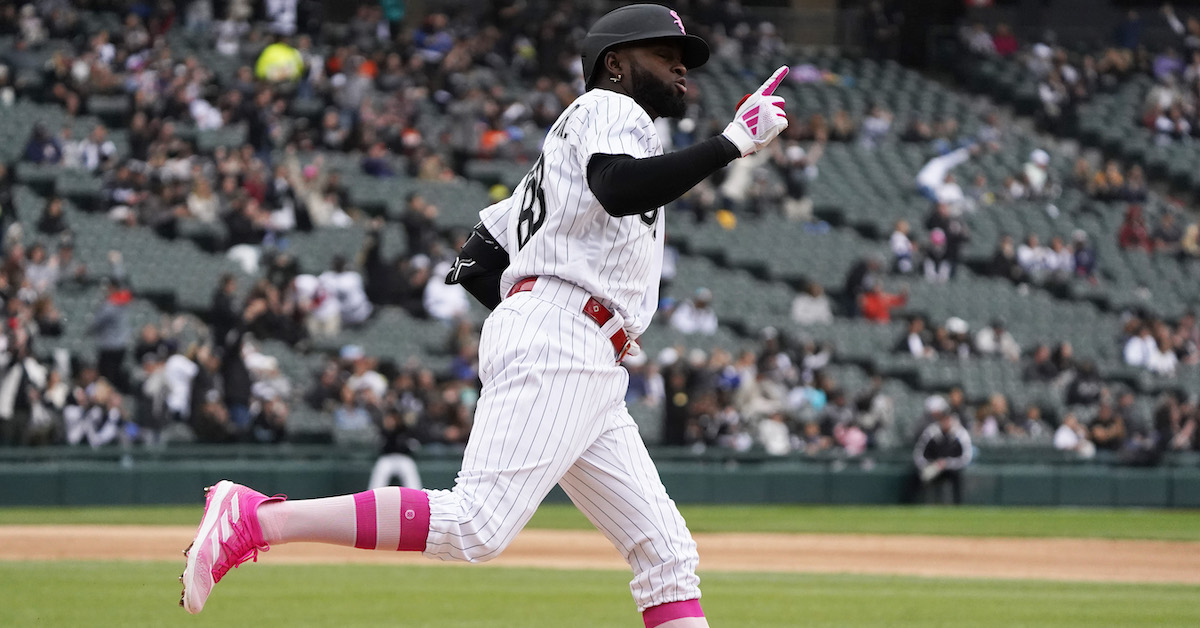
As contractual blunders go, the seven-year, $70 million extension to which the Yankees signed Aaron Hicks in February 2019 is hardly the worst of general manager Brian Cashman’s 26-season tenure. It’s not even the franchise’s worst contract to an outfielder during the 2010s, not when Jacoby Ellsbury’s deal for more than twice that amount was still on the books when the Yankees extended Hicks. As with Ellsbury, however, Hicks’ ongoing series of injuries left the Yankees hamstrung and prevented the switch-hitting center fielder from playing to the potential he’d once shown. On Saturday, the team finally cut bait, designating the 33-year-old for assignment with more than two full seasons remaining on his deal.
Hicks started just five games in center field this year, along with 15 in left field, but he came into the season unclear about his role, and lately his playing time was on the wane. With the return of center fielder Harrison Bader from an oblique strain that cost him all of April, Hicks had made just two spot starts in middle pasture and one in left since May 10, with Isiah Kiner-Falefa and Jake Bauers filling the latter spot, though not to any great effect. No matter Hicks’ role, he was unable to provide much of an offensive spark, hitting just .188/.263/.261 with one homer and a 49 wRC+ in 76 plate appearances. His 2% barrel rate and 22.4% hard-hit rate both placed in single-digit percentiles among batters with at least 70 PA, and his xwOBA is the majors’ lowest at that cutoff:
All statistics through May 21. Minimum 70 plate appearances.
Hicks actually had his first three-hit game of the season in last Thursday’s 4–2 win over the Blue Jays, in his penultimate game as a Yankee; that output matched his previous hit total for May, spread over nine games and 23 PA. But even with that big game, Yankees left fielders ranked dead last in the majors with a 63 wRC+ through Sunday, though Hicks only accounted for a little less than one-third of the plate appearances there:
It’s hard for me to explain how much I enjoy watching Mookie Betts hit. He has an air of quiet confidence that reminds me of how I feel when I’m at my very best. That slider, low and tight? He doesn’t need it, so he’s ignoring it. Fastball away? Eh, he’ll find something better to attack. Then that perfect pitch comes by, and he springs into action, trading his air of barely concealed boredom for ferocity.
Luis Robert Jr. is a joy to watch as well, but for completely different reasons. He’s a coiled spring at the plate, waiting to burst into action. He’s one of the best athletes in all of baseball and at times one of the best players, period. His phenomenal bat control and speed let him feast on pitches all over the plate and even off of it, and you can see it in his statistical record: few walks, huge swing rates, and a minor strikeout problem that was minor only because of his rare combination of power and contact.
Betts and Robert have been very different players in their respective major league careers. But they share one distinction this year: they’re the two players who have cut back on their fastball swing rates the most. They’re numbers one and two with a bullet:
Only 62 men and 20 women have scored a goal in a FIFA World Cup Final. It’s a rare achievement that holds a sacred place in sports history. Being the starting pitcher in a World Baseball Classic final is a bit less prestigious — at least for now, check back with me in 60 years to know for sure — but only 10 people can say they’ve done it.
Among them, Diamondbacks right-hander Merrill Kelly. “I’ve said it a million times before, but I’m super grateful I was able to be a part of it. Just the clubhouse in general, the quality of players on that team — by far the best team I’ve ever been on and it isn’t close,” he says. “Obviously, we would’ve liked it to go a different way in the last game.”
The circumstances that led to Kelly starting that game are interesting. When Team USA was setting up its rotation for the group stage, Kelly lobbied manager Mark DeRosa for the toughest assignment of pool play: Mexico. That start went to Padres right-hander Nick Martinez, who got crushed in an 11-5 loss. (This result led to Kelly being on the receiving end of some good-natured trash talk when he and Team Mexico center fielder Alek Thomas returned to Diamondbacks camp.)
When Kelly picked up a crucial win in the pool finale against Colombia three day days later, there was a silver lining to not getting his preferred rotation spot.
“One of the things DeRosa told me to console me was if I pitched against Colombia at home, that would line me up for the championship as well,” he says. Read the rest of this entry »
A lot of my job involves spinning a story I don’t completely believe in. I know, I know, you’re shocked! You mean I don’t actually think that the four to five players I highlight every week are each breaking out by doing something they’ve never done before? And I don’t think that each of them is doing it sustainably? What are the odds?
Some of that comes with the territory. If you’re looking across the universe of major league players for something interesting, some portion of what you find interesting will have happened by random chance. That pitcher who’s striking everyone and their mother out? He might just be on a hot streak. The hitter who’s currently smashing high fastballs? There’s some chance he just felt really good for a week and then will stub his toe when walking out of the clubhouse tomorrow.
I know all that. One thing I wasn’t sure about, though, was how often false signals pop up. Even without searching them out, you might end up seeing a breakout around every corner. There’s a famous quote from Nobel Prize winning economist Paul Samuelson: “The stock market has predicted nine out of the last five recessions.” Is the same general idea true of batted ball data? I came up with a simple experiment to investigate. What follows is a breakdown of the exact method I used, but if you’re just interested in the conclusion, it won’t surprise you: When hitters put up hot streaks of a reasonable length, it’s a good but not infallible sign that they will finish the year as above-average hitters.
I took every batted ball from the 2022 season and broke it out by player. From there, I put them all in chronological order and calculated each player’s best stretch of 50 batted balls. I calculated it for a variety of “advanced” metrics: average exit velocity, xwOBA, and barrels per batted ball. Those are some of the most commonly used underlying statistics – if I’m citing someone who’s really hitting, I’d likely use batted ball outputs like this to assess the validity of their performance, so I excluded things like batting average on contact or wOBA on contact, which might be quite noisy in 50-ball samples. Read the rest of this entry »
From entertainment to finance to sports, every category of human endeavor has its own benchmark for incompetence. There are a lot of candidates to this title in MLB, but one of the most common invocations for ineptitude is the 1962 Mets. Sure, you can find better examples of hilarious failure in the 19th century, such as the Wilmington Quicksteps, who folded while warming up for a game in 1884 when attendance was zero, with the players having to find their own way home from Delaware. You can find teams that won fewer games, like the Cleveland Spiders. But 19th-century baseball was essentially one step above a traveling medicine show, and by the time the 1962 Mets came into existence, MLB was a thoroughly professional league which would be recognizable by today’s fans.
An expansion team that year, the Mets started off losing their first nine games. Things only got slightly better from there: they finished with 120 losses, the most in modern MLB history. Over 60 years later, the A’s, after a 10–38 start, seem poised to become the new true north of failure. Through the first 48 games (as of Sunday’s games), this year’s Oakland squad is actually two games behind (or ahead of, depending on your point of view) the ’62 Mets, who won 12 of their first 48 games.
In some ways, the A’s are already a sadder case than the Mets are. The Mets were an expansion team, hampered by very miserly rules for the expansion draft which left them (and the Houston Colt .45s) with long roads to putting talented players on the field. By all accounts, the team was trying to win, and fan interest was high relative to the performance, with a million fans putting New York in the middle of the pack, attendance-wise. The A’s, on the other hand, are desperately trying to move to Las Vegas or whatever other city without baseball is willing to throw a billion dollars their way and are averaging under 9,000 paying fans — not attending fans — per game. The Mets may have had one of the worst first basemen in the league in “Marvelous” Marv Throneberry, but at least media didn’t have to evacuate an area because of possum urine. Combine the possums with a few dozen cats and whatever else is lurking, and the WhateverItsCalledThisYear Coliseum may be best described as an open-air wildlife refuge that sometimes has baseball games.
But what are the odds that the A’s lose 120 games or even more by the end of the 2023 season? To get an idea, I fired up the ZiPS projection system to get the latest tales of woe from the AL West. Read the rest of this entry »
The Yankees and Cardinals have surged up the standings — and these rankings — behind some outstanding performances from their superstars. That suggests it’s not too late for a big turn around from those early strugglers, especially since the best teams really haven’t been able to separate themselves from the pack so far.
A reminder for how these rankings are calculated: first, we take the three most important components of a team — their offense (wRC+), their pitching (a 50/50 blend of FIP- and RA9-, weighted by starter and reliever IP share), and their defense (RAA) — and combine them to create an overall team quality metric. I also add in a factor for “luck,” adjusting a team’s win percentage based on expected win-loss record. The result is a power ranking, which is then presented in tiers below.
Tier 1 – The Best of the Best
Team
Record
“Luck”
wRC+
SP-
RP-
RAA
Team Quality
Playoff Odds
Rays
34-14
-1
138
74
105
9
172
95.3%
Rangers
29-17
-3
120
83
106
6
164
69.3%
Braves
29-17
0
114
78
89
-15
144
98.7%
The Rays lost a hard fought series against the Mets last week before taking two of three from the Brewers over the weekend. Their pace has definitely slowed recently, though they’re still on track to challenge the 2001 Mariners’ win record. The injuries are piling up and their entire division is sitting above .500, with the Orioles just 2.5 games behind them. On Sunday, they lost just their fourth game at home this season; they’ll host the Blue Jays and Dodgers this week. Read the rest of this entry »
No sooner had the Dodgers surged to the NL’s best record with a 14–2 run keyed by the return of Will Smith than the wheels started falling off their rotation. Over a seven-game span that began on May 15, their starters eked out just 25.2 innings, only twice lasting five frames. Not only was the bullpen tapped to the extreme, but Clayton Kershaw also made dubious personal history with a pair of early exits, and both Dustin May and Julio Urías landed on the injured list. The whole mess is forcing the organization to test its depth at a less-than-optimal time.
For the week, Los Angeles starters were cuffed for a 5.96 ERA and 5.05 FIP in those 25.2 innings, and the team’s overtaxed relievers were lit up for a 6.99 ERA and 5.73 FIP in 29 appearances totaling 37.1 innings. Because the Dodgers’ league-best offense bashed out 40 runs in those seven games, they managed to go 3–4, but their three-game division lead over the Diamondbacks was cut in half, and at 29–19, they fell behind the Braves (29–17), whom they’ll face for three games in Atlanta starting on Monday, for the NL’s best record. Read the rest of this entry »
So far this year, there have been two ejections and suspensions for sticky stuff, along with two notable non-ejections. In all four instances — two of them just in the last week — the umpires involved made themselves available to a pool reporter for comment after the game. I cannot for the life of me imagine that the umpires want to be making these statements, but here’s the thing: So far as I can tell, they’re not required to. There’s no way that on an umpire’s list of favorite things to do after a game, Describe How Sticky Max Scherzer’s Hand Was ranks anywhere near the top 10. And yet, whether to justify their actions or out of a sincere belief that sunshine is the best disinfectant, the umpires have dutifully attempted to answer that impossible question. Not that I’m complaining. I adore these explanations. I don’t know how anyone could actually do a good job of explaining how sticky a hand was, but watching big league umpires give it their best shot is a truly rewarding experience.
I spent a morning trying to look up how tackiness is measured. It turns out there’s no one answer, but there is an ocean of scientific debate to dive into. I can now tell you the difference between probe testing, loop tack testing, the rolling ball test, and the peel adhesion test. Each test needs to account for variables like dwell time, contact pressure, temperature, and test speed. There’s also something called the finger test, which isn’t as gross as it sounds (but also probably is). Read the rest of this entry »
There are a few star shortstops off to slow starts with the bat this season. Trea Turner and Willy Adames are two of them, but the one I want to focus on for this piece is Carlos Correa. Through Saturday’s games, he ranked 11th among qualified shortstops with a 90 wRC+. The good news is that his defense and speed look great! But 2023 represents the slowest start at the plate of his career. Over a quarter of the way through the season, Correa is still looking to turn it around with the stick.
Like many of the Padawans of the Astros’ hitting development system over the last 10 years, Correa has always run above-average whiff and strikeout rates. That’s the M.O. of the core of hitters who came up in Houston – they don’t strike out too much and still hit for good power. Correa has typically paired that with above-average walk rates as well, and this year is no different. But for the first time since 2016, Correa is running a 39th-percentile whiff rate and a 38th-percentile strikeout rate. So what’s going on?
My first thought was to see if Correa has experienced any deterioration in his bat speed. Sometimes hitters lose a bit of bat speed and take a second to adjust; while that adjustment is ongoing, their whiffs tick up. But Correa’s bat speed indicators are all fairly typical for him. Here are some peripherals showing where Correa stands relative to his peers over the last few seasons:
Carlos Correa Batted Ball Percentiles
Season
HardHit%
Barrel%
Max EV
Avg. EV
2021
63rd
60th
97th
71st
2022
74th
81st
96th
67th
2023
67th
80th
94th
50th
Nothing out of the ordinary! Other than a slight downtick in average exit velocity, everything still looks darn good for Correa. The decrease in average exit velocity is probably indicative of more mishits than usual, but it’s a good sign that he is still capable of hitting the ball as hard as anybody. The next step is to check in on my hunch of him producing more mishits. Below are some additional details on his batted ball profile:
Carlos Correa Directional Rates
Season
Pull%
Straight%
Oppo%
GB%
FB%
PU%
2021
33.5
38.2
28.3
42.5
23.4
8.1
2022
38.5
39.5
22.0
42.0
25.9
6.4
2023
36.8
30.8
32.5
43.6
23.1
10.3
Right away, my eyes are drawn to Correa’s opposite field and popup rates. Correa has had the greatest success when he has kept his opposite field mark under 30%; the uptick here is worth looking into. It doesn’t appear to be related to Correa’s swing decisions — his chase and swing rates are in line with career norms. That makes me think it could be related to his contact point, which is tied into his swing mechanics. We might expect this type of change if his contact has gotten a little too deep and Correa isn’t impacting the ball on the upswing as frequently; we’d also expect more mishits, as seen in the increase in popup rate. Making deeper contact isn’t always a bad thing, but it seems like Correa’s bat angle is being thrown off by the change in depth. While we don’t have public access to contact point (the depth in the strike zone at contact), we can look at Vertical Bat Angle (VBA) courtesy of SwingGraphs.
VBA is the angle of a player’s bat at impact. A player’s average VBA doesn’t always tell the entire story because the number is highly dependent on pitch height. But it can help inform our understanding of fluctuations in a player’s bat path and contact point. If a player swings at higher pitch heights on average, their VBA should decrease. If they swing at lower pitch heights on average, it should increase. It’s about a hitter matching their barrel to the pitches they see. If they’re making deeper contact than usual, you’d expect their VBA to decrease because they haven’t gotten to their peak upswing. Typically, a hitter is better able to get their bat on an upswing farther out in front of the plate.
First, I’ll try to control for pitch height to make sure my hunch is valid. Using Baseball Savant, I searched for the average height of the all pitches Correa made contact with last season and this season. In 2022, that mark was 2.54 feet, while this year, it’s 2.52 feet – a negligible difference. Because of that, you’d expect that his VBA year-over-year would be somewhat close as well. In 2022, his average VBA was 33.6 degrees, and fluctuated between 33.5 and 34.1 degrees in the final three months of the season. This year, that number is 30.6 degrees. Basically, his swing is flatter at impact than it was last year, which perfectly tracks with making deeper contact, adding popups, and increasing his oppo rate.
Correa may be expecting his barrel to be in one place when it’s actually in another. For a hitter with fantastic barrel accuracy, this difference might well be enough to throw off his sense of how his body is moving. In this case, his increased whiff rate and career-high popup rate make sense. To provide even more context, we can look at how Correa fares when pulling the ball. If he’s making deeper contact than usual to the pull side, I’d expect there to be a change from previous seasons. The below table focuses on Correa’s hard-hit balls (>= 95 mph) to the pull side from 2021 through this season:
Carlos Correa Pulled Hard-Hit Batted Balls
Season
xwOBA
EV
LA
2021
.634
103.1
11.6
2022
.705
103.0
10.3
2023
.553
103.6
7.1
Well that’s interesting! Correa isn’t getting nearly as much out of these batted balls as he has in the past. His average launch angle has decreased by over 4.2 degrees since last year, and his xwOBACON has shot down as a result. This tracks with the theory of him having a deeper contact point than in the past and explains why Correa’s overall xwOBACON sits at .385 despite an overall barrel rate of 80%. That’s still pretty good, but for a player who routinely runs an xwOBACON greater than .415, it’s a bit underwhelming. If Correa can adjust his timing to be earlier and move his impact point further in front of the plate, I’d expect this to turn around quickly. He is still hitting the ball as hard as ever has. Sometimes a hitter takes a little more time than usual to get their timing down, and that’s what I’m leaning towards here. What’s more, against fastballs this year, Correa’s xwOBA is .372, but his actual wOBA is .292. On top of his timing being slightly off, he has gotten a bit unlucky.
All of this is to say, we shouldn’t be too worried about Correa’s profile. His 107 wRC+ and .224 ISO in the month of May suggest that he is working his way back to his career norms. This is still a very good hitter, one we should expect to continue to be as successful at the plate as he always has been.
All statistics are through May 20. An edit was made to reflect that the relationship between VBA and pitch height is inverse.