This holiday season, everybody wants a new catcher. Between free agency and the trade market, over a third of the league’s teams have added to their catcher mix this offseason, with most of those moves coming in the last few weeks. Catchers are finding new homes so fast that yesterday, my colleague Leo Morgenstern covered the Mets signing Omar Narváez and dealing James McCann to Baltimore, and Austin Hedges inking a one-year deal with Pittsburgh – and then two more backstops signed that afternoon. In Cincinnati, the Reds announced an agreement with Curt Casali (as well as first baseman/outfielder Wil Myers), designating Mike Moustakas for assignment in the process. And elsewhere in the NL Central, former Red and Tiger Tucker Barnhart got set to continue his tour of the teams closest to his home city of Indianapolis, joining the Chicago Cubs on a two-year, $6.5 million contract with a player option after the coming season. The two-time Gold Glover will pair with Yan Gomes to form a catching platoon after the Cubs lost three-time All-Star Willson Contreras to the rival Cardinals in free agency.
Barnhart did well to secure himself a two-year guarantee with the player option – of the eight free agent catchers who have signed major league deals this offseason, Contreras (five years), Christian Vázquez (three), Narváez (two), and Barnhart have earned multi-year commitments. Those other three are much more significant adds, as is reflected in their significantly higher total contract values. But Barnhart may have had extra motivation to lock down a second year – with a couple of months over eight years of service, he heads into this contract within reach of the 10-year service threshold that the Players Association calls the “holy grail for players.” Of course, while the money is guaranteed, the service time isn’t, but if Barnhart can remain healthy and productive enough to reach 10 years of service, his MLB pension will fully vest and he will notch a coveted milestone. The option adds another layer of player friendliness – if Barnhart bounces back from a down year in 2022, he’ll have a shot to test free agency again next winter, when, to be fair, the catcher market may once again be busy. Read the rest of this entry »
On Thursday, the Reds broke the silence hanging over their quiet offseason with three notable moves. The club inked both former Rookie of the Year Wil Myers and veteran backstop Curt Casali to one-year deals with mutual options. The former is guaranteed $7.5 million; the latter will take home at least $3.25 million. To make room for Casali, the Reds DFA’d Mike Moustakas, who was heading into the last season of a four-year, $64 million contract he signed prior to 2020.
After blowing it up when their previous rebuild resulted in merely a Wild Card contender, Cincinnati’s current reconstruction period is entering just its second season; at best, the team has an outside shot at the playoffs. That said, these moves don’t strike me as pure roster-filler or eye-toward-July transactions. Instead, they make real sense as supplements to a young team, potentially aiding in the development of up-and-comers in concrete ways. Read the rest of this entry »
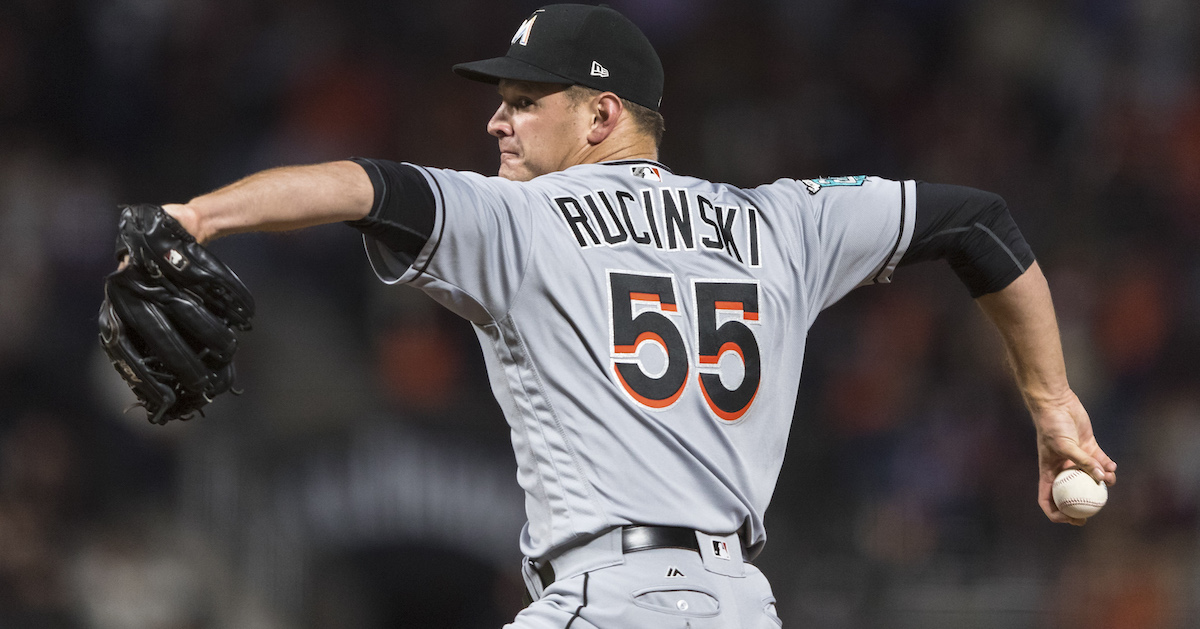
There have been a lot of transactions this past week. There’s been a lot of drama, too, involving a top free agent, a medical issue, and boatloads of cash. The long weekend is just around the corner. It’s been an exhausting year, and we’d all like to get on with our lives. Between relaxing on the sofa and reading up on Drew Rucinski, deciding on which is the more appealing option doesn’t seem like a difficult task.
Which, fine, I understand. My livelihood isn’t affected by page views, so we’re cool here. But Rucinski isn’t just some random starter the Athletics chose as their annual innings-eater. When he last appeared in a major league game, he was a lackluster middle reliever for the Marlins. Since then, he’s undergone quite the transformation. Four years later, there’s an argument to be made that he was the best starting pitcher during his time in Korea. That’s a testament to how much he’s improved, in terms of stuff, command, and durability. Read the rest of this entry »
The following article is part of Jay Jaffe’s ongoing look at the candidates on the BBWAA 2023 Hall of Fame ballot. Originally written for the 2018 election at SI.com, it has been updated to reflect recent voting results as well as additional research. For a detailed introduction to this year’s ballot and other candidates in the series, use the tool above; an introduction to JAWS can be found here. For a tentative schedule and a chance to fill out a Hall of Fame ballot for our crowdsourcing project, see here. All WAR figures refer to the Baseball-Reference version unless otherwise indicated.
Content warning: This piece contains details about alleged domestic violence and sexual harassment. The content may be difficult to read and emotionally upsetting.
In the eyes of many, Omar Vizquel was the successor to Ozzie Smith when it came to dazzling defense. Thanks to the increased prevalence of highlight footage on the internet and on cable shows such as ESPN’s SportsCenter and Baseball Tonight, the diminutive Venezuelan shortstop’s barehanded grabs, diving stops, and daily acrobatics were seen by far more viewers than Smith’s ever were. Vizquel made up for having a less-than-prototypically-strong arm with incredibly soft hands and a knack for advantageous positioning. Such was the perception of his prowess at the position that he took home 11 Gold Gloves, more than any shortstop this side of Smith, who won 13.
Vizquel’s offense was at least superficially akin to Smith’s: He was a singles-slapping switch-hitter in lineups full of bigger bats and, at his best, a capable table-setter who got on base often enough to score 80, 90, or even 100 runs in some seasons. His ability to move the runner over with a sacrifice bunt or a productive out delighted purists, and he could steal a base, too. While he lacked power, he dealt in volume, piling up more hits (2,877) than all but four players who spent the majority of their careers at shortstop and are now in the Hall of Fame: Derek Jeter (3,465), Honus Wagner (3,420), Cal Ripken Jr. (3,184), and Robin Yount (3,142). Vizquel is second only to Jeter using the strict as-shortstop splits, which we don’t have for Wagner (though we do know the Flying Dutchman spent 31% of his defensive innings at other positions). During his 11-year run in Cleveland (1994–2004), Vizquel helped his team to six playoff appearances and two pennants.
To some, that has made Vizquel an easy call for the Hall of Fame, but by WAR and JAWS, his case isn’t nearly as strong as it is on the traditional merits. Even before he reached the ballot, his candidacy had become a point of friction between old-school and new-school thinkers, as though he were this generation’s Jack Morris. For the first three years of his candidacy, it appeared as though he was well on his way to Cooperstown nonetheless, with showings of 37.0% in 2018, 42.8% in ’19, and 52.6% in ’20. Read the rest of this entry »
Ryan Smith is a left-handed pitching prospect in the Los Angeles Angels system. Taken in the 18th round of the 2019 draft as a senior out of Princeton University, he is, and always has been, an intellectual player. In fact, he spends time in the offseason tutoring high schoolers preparing for the SAT, a rather unorthodox job for a minor league player. After a 25.1-inning rookie ball debut his draft year, he lost out on a key developmental season due to the pandemic but came prepared for the 2021 season with increased velocity and a hunger to perform.
That year, Smith threw 129.1 innings across four different levels. A workload like that in your first full professional season is extremely uncommon. Indeed, coming off the lost 2020 campaign, many pitchers decreased their workloads. For that reason, Smith has had a unique path. His performance was good enough to rise all the way up to Triple-A in his first full season, but his adjustment to the Pacific Coast League has been a work in progress. I spoke to him about that adjustment, its impact on his game, and his repertoire earlier this month.
…
Esteban Rivera: What does your pitch mix look like right now, and how has it changed since rookie ball?
Ryan Smith: “I throw a four-seamer with slightly above-average vertical break, but the velo range has been all over the place in pro ball. In rookie ball, the average was around 92 with a couple of outings in the 95-96 range. 2021 it was up to 97-98 in spring, but mostly sat 92-95 the first couple of months, then dropped down to 91-94 in the second half. This past year, my carry was down a bit playing mostly at high altitude, and my velo was 91-93. I’m hoping for it to come back after a velo program I’m on for the winter. I think it was down after the high workload in 2021 after no innings in 2020.” Read the rest of this entry »
The Mets are changing the game. They’re spending too much, too fast. $800 million in a single offseason! Give us back our agreed-upon salary structure! (So to speak: “There’s no collusion. But … there was a reason nobody for years ever went past $300 million. You still have partners, and there’s a system,” an unnamed team official told Evan Drellich of The Athletic. Which is the kind of thing you say when there’s actually no collusion.)
Everyone’s freaking out about the Mets’ signing of Carlos Correa, news of which broke in the wee hours of Wednesday morning, hours after the Giants postponed their own official Correa rollout. Snatching the top remaining free agent away from a competitive rival in the middle of the night is a flashy move, as is signing a $300 million shortstop to play third base so as not to displace Francisco Lindor, the Mets’ incumbent $300 million shortstop.
The Mets’ projected 2023 payroll is currently at $376 million, not including tax penalties. At least for now, because the Mets’ 2023 projected payroll has been scrolling up all offseason like the scoreboard at the Jerry Lewis telethon. But here I feel compelled to borrow an observation from Tom Verducci: Before Correa, the Mets’ biggest free agent signings were mostly in service of either retaining or replacing outgoing free agents. Correa was the first real upgrade to a team that won 101 games in 2022.
Even then, the contract was not out of line with his market. He’ll make less money per year than Trea Turner or Manny Machado, and far less than Lindor. His AAV is only about $800,000 more per year than what Xander Bogaerts got from San Diego. Correa will make less money per year, over fewer years, than he stood to make had the Giants not reneged on their original 13-year, $350 million pact.
Less than 24 hours after they purloined Correa, the Mets signed another infielder at an hour when respectable people are trying to get another round in before last call instead of closing lucrative business deals. This time, it was Danny Mendick, inked to a one-year, $1 million deal.
Danny Mendick. A million bucks. One million of George Washington’s dollars. One million American simoleons.
I first became aware of Mendick many years ago while listening to an episode of FanGraphs Audio in which Carson Cistulli tried to say his last name and burst into laughter. But Mendick has evolved into a useful big leaguer. His career was probably hampered at the start because everyone saw a short White Sox second baseman and assumed he was Nick Madrigal. But after Madrigal got traded, we learned that Mendick can hold his own defensively at any infield position, and last season he hit .289/.343/.443 in 106 plate appearances.
There’s almost certainly quite a bit of batted-ball luck that went into Mendick’s 125 wRC+ in 2022. Surely the White Sox agree, otherwise they wouldn’t have non-tendered him. Let’s say he regresses all the way to his true talent wRC+, call it somewhere around 80. That’s still a perfectly acceptable backup infielder for $1 million. Of the 90 Opening Day starting second base, third base, and shortstop positions in the majors, I’m all but certain at least one will be occupied by a worse player than Mendick.
Here’s the thing: Mendick isn’t going to be the Mets’ utility infielder. He’s going to be the starting second baseman for the Triple-A Western New York Garbage Plates. (Which is what they should be called, instead of the Syracuse Mets.)
While Mendick is a serviceable, even slightly-north-of-replacement-level utility infielder, the Mets currently have that position covered. Many times over. Do you know how many people would have to be traded or incapacitated in order for Mendick to see meaningful playing time? Because I do. At least four: Eduardo Escobar, Luis Guillorme, Brett Baty, and at least one of New York’s All-Star infield starters (Correa, Lindor, and Jeff McNeil).
Escobar is the incumbent starting third baseman, and he would’ve remained so had Correa not become available. He’ll be making $9.5 million in 2023, after a season in which he posted a 106 wRC+ and 2.3 WAR. If he’s actually going to start the season as the utility infielder, he’s got to be the best utility infielder since Gil McDougald. Guillorme is what an elite utility infielder would look like on a normal team, someone who can back up the trickier defensive positions while also putting up excellent on-base numbers against right-handed pitching (.367 OBP, 118 wRC+).
Baty was the Mets’ third baseman of the future until the instant Giants owner Charles Johnson came over all Wayne Huizenga and San Francisco backed out of the Correa deal. If he’s not traded, he’s as exciting a backup third baseman as you’ll ever find. And even beyond Mendick, there’s more depth: non-roster invitee José Peraza, Jonathan Araúz, and Mark Vientos all saw big league action last year. (Though Vientos is more of a break-glass-in-case-of-emergency third baseman.) Top shortstop prospect Ronny Mauricio might not be ready now, but he might be before the season is over.
I have a recurring nightmare in which I’m back in high school and, despite having washed out of Little League as a preteen, I’m called upon to play third base in a high-stakes varsity baseball game. (To all the “You never played the game” guys: I did play the game, and I was terrible at it so I quit.) Every year, some version of this nightmare plays out on a major league field: A team with injury problems is forced to start an infielder who, upon encountering Double-A breaking stuff for the first time, started wondering if he’d have been better off going to law school.
That won’t happen to the Mets, because they can pay and have paid a premium for Danny Mendick, who has a remaining minor league option and can therefore be stashed in Triple-A until the Mets have need of him.
The normal cost for such a player is a split contract with a non-roster spring training invite. The major league minimum is $720,000 this year; such players would make at least $117,400 a year while in the minors, usually a little more if the team really wants them. But if the Mets can spend lots of money to make big, splashy improvements, they can also spend a comparative rounding error to fortify their organization further down the pecking order.
I’d argue that the Mets, by dint of their immense financial reserves, are the last team that needs to make these marginal improvements. That a team that’s committed to running bottom-third payrolls would get the most bang for its buck in the long-term by spending on minor league depth, facilities improvements, minor league salaries, coaches, and so on.
But there are 29 owners whose entire position in society is defined by having money. To spend or share it any more than necessary is to imperil their entire conception of self. Cohen is rich enough to know something his brothers in the cartel don’t: Money isn’t real to a man who’s worth tens of billions. Why are the Mets doing this? Because they can.
Correa is the splashier deal, the more expensive, and will ultimately be the more impactful. But by going out of their way to lock Mendick down, the Mets have truly shown their contempt for the other owners’ hysterical cries of poverty. They will not be outbid, anywhere on the depth chart.
As of sundown on December 18, Chanukah has officially begun. Meanwhile, barring any more surprises from Steve Cohen, the peak of the hot stove season is winding down. There are still several talented players up for grabs, but the top 10 of our top 50 free agents are all off the board, and only three remain from the top 25. After a busy month, things are starting to settle into place.
Thus, as the holidays begin and the busiest part of the offseason comes to a close, now seems like the perfect time to share a couple of minute and trivial statistical tidbits with a Chanukah connection. Here is a close look at grounding into double plays, the three true outcomes, and baseball miracles in honor of the Jewish festival of light. (No prior knowledge of Chanukah, Judaism, or the Talmud required.) Read the rest of this entry »
For the 18th consecutive season, the ZiPS projection system is unleashing a full set of prognostications. For more information on the ZiPS projections, please consult this year’s introduction and MLB’s glossary entry. The team order is selected by lot, and the next team up is the Texas Rangers.
Batters
The Rangers undergo rebuilding with a refreshing urgency you don’t always see, though that’s hardly surprising since they’re not actually a small-market team. While their previous rebuild kinda struck out, that one, which I always refer to as the “skinny rebuild,” wasn’t quite as focused as this go-around. This time, while they’re developing their talent from within, they’re also going after top free agents, guys who are likely to still be good the next time the Rangers are a contending team, and who are of a caliber that’s hard to develop yourself. A lot of teams blunder this approach, deciding to gird their rebuilding loins with quantity rather than actual quality. That’s kind of what the Padres did in the early going, first acquiring Matt Kemp as if he were a foundational talent and then giving an absurdly large deal to the very ordinary Eric Hosmer. The Rangers haven’t made a bunch of confusingly gigantic commitments to middling players; they signed average players to fairly short, sensible deals (Jon Gray, Martín Pérez, Andrew Heaney) while going all-out for the players who can really make a difference (Jacob deGrom, Corey Seager, and Marcus Semien).
Now, as a contender, the Rangers are still an incomplete squad, as you can see when looking at the offensive projections. The middle infield is absolutely elite and while Nathaniel Lowe isn’t likely to hit .300 again, he’s an adequate starter who won’t reach free agency for another four years, even though it feels like he’s more of a veteran than that. Josh Jung’s cup of coffee was a bit bitter, but ZiPS believes he’s of a similar quality vintage as Lowe. Jonah Heim took a big step forward offensively and while nobody’s going to confuse him with J.T. Realmuto, his bat has improved enough to make his excellent defense matter quite a bit. Mitch Garver is a useful role player who can provide some additional pop while being able to more than fake it at catcher. Read the rest of this entry »
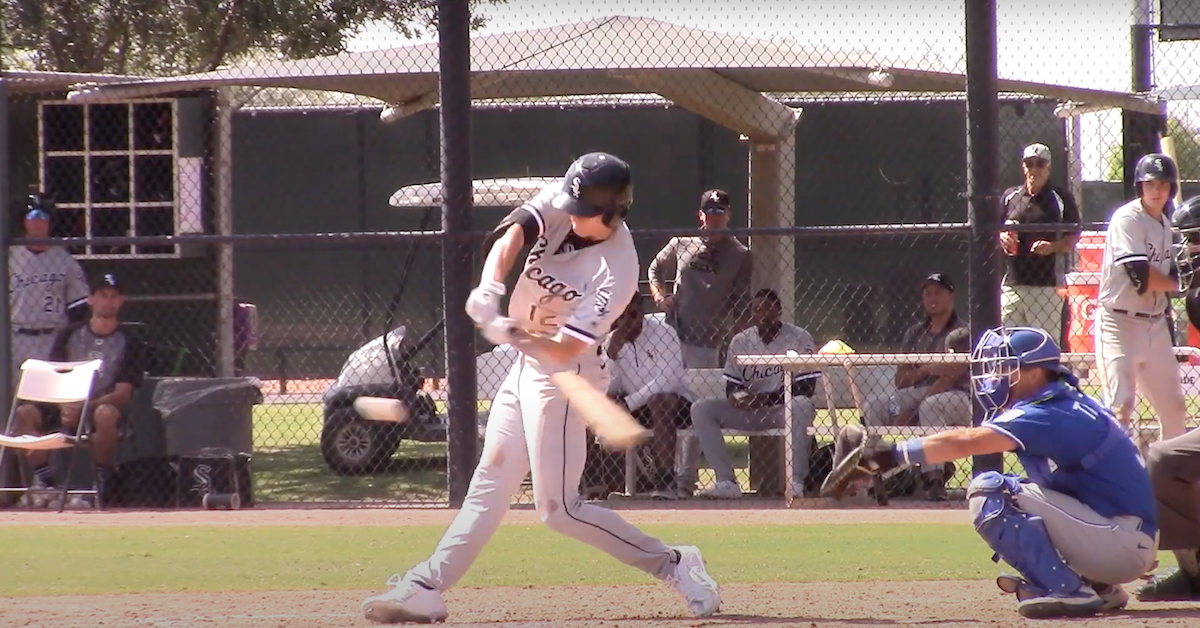
Below is an analysis of the prospects in the farm system of the Chicago White Sox. Scouting reports were compiled with information provided by industry sources as well as my own observations. This is the third year we’re delineating between two anticipated relief roles, the abbreviations for which you’ll see in the “position” column below: MIRP for multi-inning relief pitchers, and SIRP for single-inning relief pitchers. The ETAs listed generally correspond to the year a player has to be added to the 40-man roster to avoid being made eligible for the Rule 5 draft. Manual adjustments are made where they seem appropriate, but I use that as a rule of thumb.
A quick overview of what FV (Future Value) means can be found here. A much deeper overview can be found here.
All of the ranked prospects below also appear on The Board, a resource the site offers featuring sortable scouting information for every organization. It has more details (and updated TrackMan data from various sources) than this article and integrates every team’s list so readers can compare prospects across farm systems. It can be found here. Read the rest of this entry »
This episode, we welcome back another old friend who is casting their first Hall of Fame ballot, then talk about the most surprising free agent move in recent memory.
We begin with Jay Jaffe and David Laurila continuing their new annual tradition of discussing their Hall of Fame ballots on the podcast, and this time they are joined by Travis Sawchik, baseball author and writer at theScore. Travis is voting for the first time, and he consults with Jay and David about how to navigate issues like PEDs and players whose late-career struggles might tarnish their overall body of work. The trio also ponder the philosophy of a large Hall vs. a small Hall while discussing players like Bobby Abreu, Jeff Kent, Andy Pettitte, and more. [3:00]
After that, Dan Szymborski and Michael Baumann get together to talk about the whole Carlos Correasigning with the Mets thing. The news was obviously a huge shock, and Dan and Michael ponder where the San Francisco Giants go from here after a dismal offseason. We also hear about the Mets going in the opposite direction thanks to an owner who is making the other billionaires look bad, how thrilling Correa should be at the hot corner, and what bears really do when they hibernate. [43:33]
To purchase a FanGraphs membership for yourself or as a gift, click here.
To donate to FanGraphs and help us keep things running, click here.
Don’t hesitate to direct pod-related correspondence to @dhhiggins on Twitter.