Starting Pitching Is Suddenly the Mariners’ Weak Link

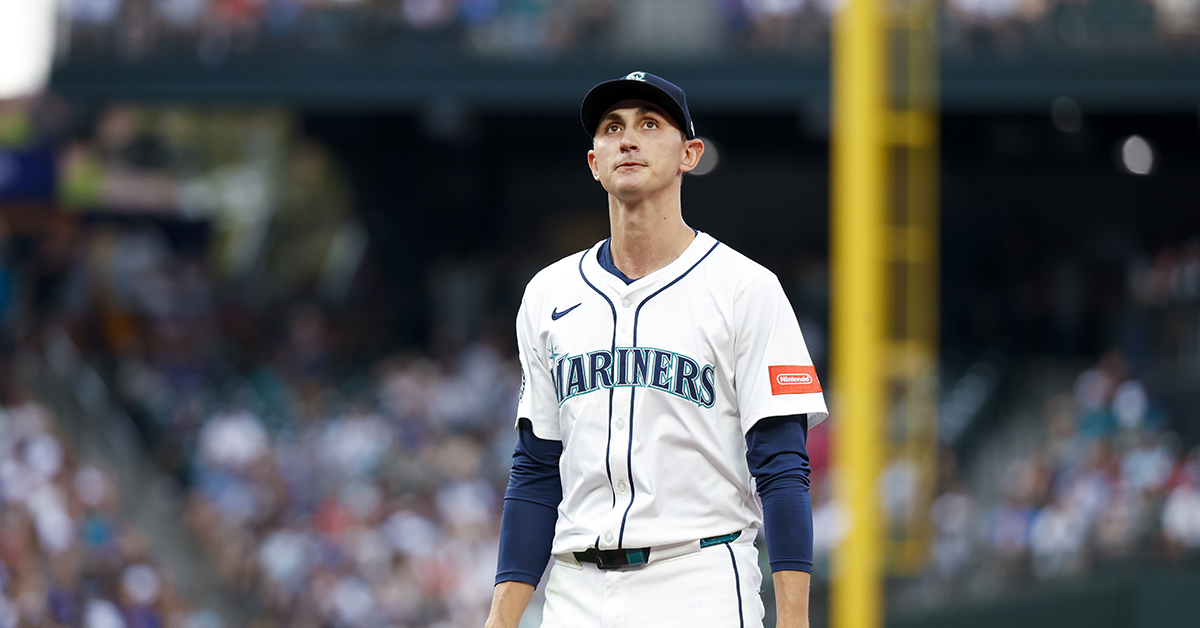
The Mariners entered the season with a starting rotation that was the envy of nearly every other team in baseball, with four young homegrown pitchers in Logan Gilbert, George Kirby, Bryce Miller, and Bryan Woo, and Luis Castillo as the veteran ace to lead the group. Our preseason projections had Seattle’s rotation as the seventh best in baseball, only held back by its lack of depth behind the top five starters. Three of those young starters appeared on Ben Clemens’ midseason Trade Value list, ranked 23rd (Kirby), 34th (Woo), and 36th (Gilbert). The M’s rotation has been the key to their success over the last few years, but lately, that same highly regarded group has been the weakest link for the Mariners as they fight to maintain a playoff spot.
Since the All-Star break, Seattle’s rotation has put up a 4.55 ERA and a 4.27 FIP, 19th and 16th in the majors, respectively. It’s been even worse over the last 30 days: a 4.94 ERA (20th) and a 4.66 FIP (21st). Kirby has allowed seven or more runs in two of his last four starts, and was knocked around for 10 hits and eight runs (seven earned) in two innings in his start against the Rays on Wednesday. Castillo has allowed five or more runs in three of his last four starts. Gilbert suffered through an ugly six-run blowup in Philadelphia a few weeks ago. Miller is sporting a 5.63 ERA since being activated off the IL on August 19. Even the metronomic Woo had his streak of 25 starts of at least six innings snapped on August 27.
These problems becomes even more stark when you compare their performance inside the confines of the extremely pitcher friendly T-Mobile Park to their struggles on the road. This season at home, the rotation is putting up a 3.40 ERA and a 3.82 FIP, fourth and ninth best in the majors, respectively. On the road, those marks drop to a 4.69 ERA (26th) and 4.44 (22nd). The Mariners have a 32-40 record on the road this year, and these pitching issues are a big reason why.
All of these struggles are showing up in the standings, too. The M’s are 22-22 during the second half, but since a 9-1 homestand to start the month of August, they’re 7-14, with four of those seven wins coming at home. Seattle has had two long East Coast road trips during this stretch, which have included sweeps by the Phillies and Rays, and a combined 3-12 record with three more games to play in Atlanta this weekend. Despite all this, the M’s currently hold the final AL Wild Card spot, just 1.5 games ahead of the Rangers and 3.5 games behind the Astros in the AL West.
It’s worth noting that three of the Mariners’ starters have spent a significant amount of time on the IL this year: Kirby was sidelined during spring training with a shoulder injury and wound up missing nearly two months of the season; Gilbert missed all of May and half of June with a flexor strain in his elbow; and Miller has had two separate IL stints due to inflammation in his elbow stemming from a bone spur. Seattle’s starters have thrown the most innings in baseball since the beginning of the 2022 season, and it’s possible that heavy workload over these past few years is catching up with them.
Here’s how the performance of the team’s five starters has changed from the first half to the second half:
| First Half | Second Half | |||||||
|---|---|---|---|---|---|---|---|---|
| Player | IP | ERA | FIP | K-BB% | IP | ERA | FIP | K-BB% |
| Luis Castillo | 108.1 | 3.41 | 3.89 | 13.1% | 47 | 5.17 | 4.61 | 17.0% |
| George Kirby | 54 | 4.50 | 3.82 | 19.8% | 50.2 | 4.44 | 3.28 | 15.6% |
| Logan Gilbert | 61 | 3.39 | 3.01 | 29.3% | 42.2 | 4.22 | 3.56 | 26.2% |
| Bryan Woo | 114.2 | 2.75 | 3.45 | 19.6% | 55 | 3.60 | 4.08 | 21.1% |
| Bryce Miller | 48.2 | 5.73 | 4.47 | 7.4% | 16 | 5.63 | 7.39 | 10.9% |
It’s at least a little encouraging to see that the peripherals for Kirby and Gilbert look solid during the second half, even if their top line results have suffered. There are some red flags for Woo and Castillo, however; the former is 20 innings past his previous career high set last year and the latter is showing some worrying signs of fatigue. I think it’s worthwhile to take a closer look at Kirby, Gilbert and Castillo, and try to see what might be causing their issues and if there’s any hope of a turnaround in the final month of the season.
It’s been a really up-and-down season for Kirby. Maybe because of the shoulder injury, he’s never really looked like he’s settled in since being activated off the IL. The biggest clue he hasn’t been feeling like himself is his walk rate. From his debut in 2022 through the end of 2024, Kirby had exactly two starts where he allowed three walks; this year, he’s already had five starts where he’s allowed three walks. His walk rate has nearly doubled, though when it’s going from 3.0% to 5.9%, it’s still an above-average mark compared to the league.
I have a hunch that his command issues stem from a pretty significant change to his arm angle. Kirby had been throwing from a pretty standard three-quarters arm slot for his entire career, but it suddenly dropped eight degrees this year. I’m not sure if that change in mechanics stemmed from his shoulder injury — it’s possible he’s compensating for a still slightly damaged shoulder by dropping his arm slot, or that his body found a new “natural” arm slot during his rehab. Whatever the cause, the new mechanics have had a pretty dramatic effect on the characteristics of his pitches. Here’s what a few of Kirby’s key physical metrics look like for his four-seam fastball:
| Year | Velocity | Arm Angle | Vertical Release Angle | Vertical IVB | Vertical Approach Angle | Vertical Dead Zone Delta | Stuff+ |
|---|---|---|---|---|---|---|---|
| 2023 | 96.1 | 36.0° | -1.9° | 15.2 | -4.5° | +0.2 | 99 |
| 2024 | 96.0 | 37.1° | -1.7° | 15.8 | -4.3° | +0.3 | 103 |
| 2025 | 96.1 | 29.4° | -1.2° | 13.5 | -4.2° | -1.5 | 88 |
His heater lost some raw carry (IVB), but it gained a much flatter approach angle and now sits well outside the fastball “dead zone.” The results the pitch is generating haven’t changed all that much; Kirby is still garnering a whiff more than a quarter of the time, and the expected wOBA allowed off of his fastball is right around his career norms. But he’s throwing the pitch in the strike zone just 51.6% of the time, down from 53.2% last year and 58.0% in 2023.
Along with a flatter fastball, a lower arm angle has given Kirby’s entire arsenal a lot more horizontal movement. His slider is moving three inches more to his glove side and his curveball has an extra inch of break. His sinker and splitter both have a bunch more arm-side movement as well. That break has definitely benefitted his breaking balls, as both are running career-high whiff rates. Kirby has struggled to find a consistent breaking ball he can use to earn those swings-and-misses, and it finally looks like he’s got two of them.
Unfortunately, the new arm slot seems to have caused Kirby to ditch his splitter. He added that pitch in 2023 in an effort to find an offspeed offering to use against left-handed batters, and it’s been an important piece of his arsenal since then. He was throwing his split like normal in May when he first returned from his shoulder injury, but quickly ditched it after his second start in favor of a changeup. The new offspeed pitch is coming in a little harder than the splitter, with less drop and more arm-side break. Batters are having trouble putting the new changeup in play with any authority — it has a .155 expected wOBA — but its 11.1% whiff rate leaves a lot to be desired when compared to the near 30% whiff rate the splitter had.
It’s fair to wonder if all these changes to his mechanics and pitch shapes have caused Kirby’s usually pinpoint command to waver a bit as he gets used to his new norm. It’s also possible that he’s just been the victim of some really poor luck; his peripherals all look pretty solid, with his 3.56 FIP nearly a run lower than his 4.47 ERA. All his other ERA estimators — a 3.52 xFIP, a 3.69 SIERA, and a 4.10 xERA — point to some improvement to come as well.
Kirby isn’t the only starter on the Mariners whose mechanics have undergone a dramatic change this year: Gilbert has dropped his arm angle from a high, over-the-top delivery to a three-quarters arm slot. Mikey Ajeto detailed this change in a piece for Baseball Prospectus back in June, writing:
Gilbert’s fastball has gotten flatter, and his splitter steeper. Now his fastball is flatter than the average fastball, and his splitter is not only steeper than the average splitter, it’s getting forkball depth. Now he’s throwing strikes again with his fastball, and his splitter is one of the deadliest two-strike pitches in MLB.
Among all pitchers with at least 100 innings pitched, Gilbert leads the way in strikeout rate at 34.2%. And like Kirby, his ERA is half a run higher than his FIP, though his issue is a little easier to pinpoint. His 2.64 xFIP tells you almost everything you need to know: Gilbert is allowing far too many home runs despite all those swings and misses.
Interestingly, it’s not his fastball that’s the culprit. The flatter approach angle has helped him tone down the damage allowed off his heater. Instead, it’s Gilbert’s slider that’s causing some of these issues. The breaking ball is still generating plenty of whiffs, but when batters put the pitch in play, they’re crushing it. He’s allowed a .719 slug and a .445 expected wOBA with the breaker, which means that even though batters whiff against it more than a third of the time, it’s returned a negative run value this year.
Like the rest of his repertoire, the slider’s physical shape has changed with Gilbert’s lower arm slot. It’s a near perfect gyro slider, but this year, it has slightly less drop and a bit less horizontal break. We’re talking a half inch difference in both directions, but that could be enough to throw off Gilbert’s location with the pitch. Here’s a heat map of his slider locations this year:
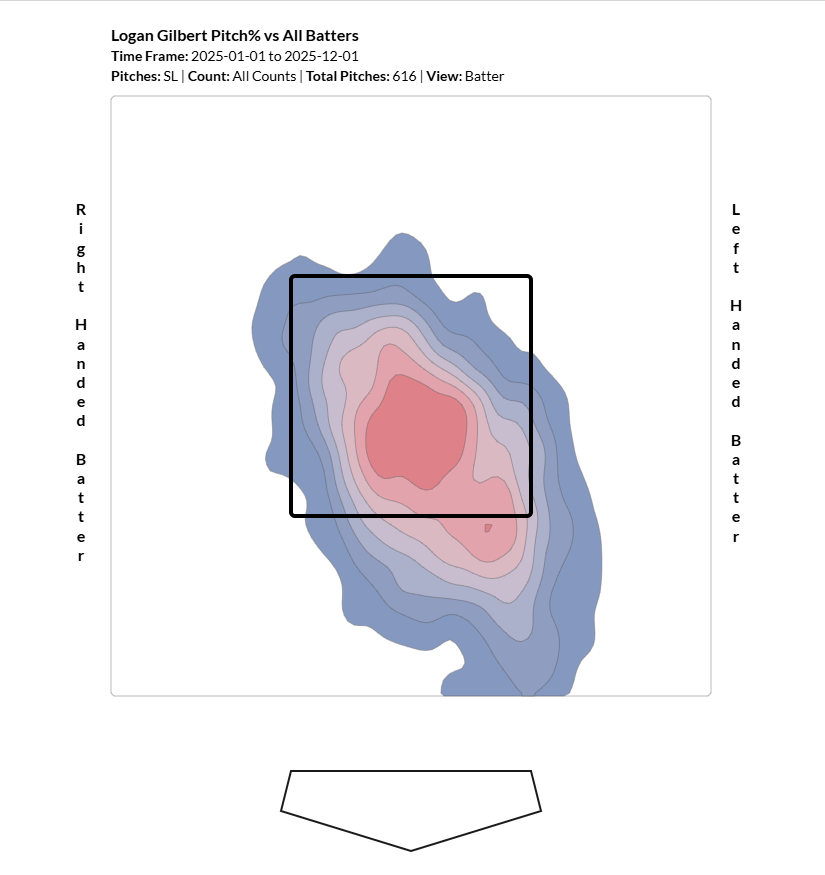
Right down the heart of the plate isn’t the ideal location for a slider. If he’s throwing his breaking ball expecting it to drop an extra half inch, those locations could make a little more sense. He just hasn’t made the adjustment to his target yet and continues to leave those breaking balls in a very dangerous part of the zone.
As for Castillo, the issue is pretty easy to spot:
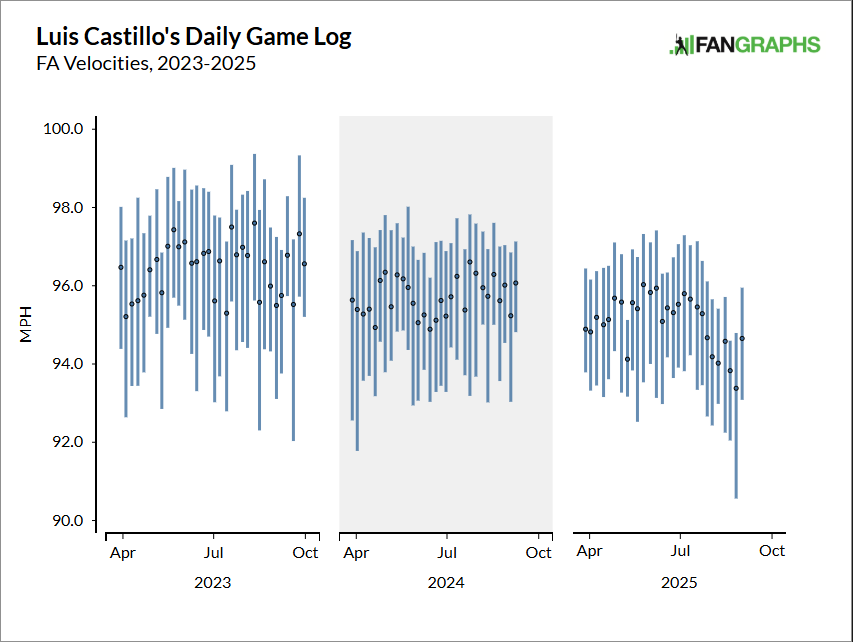
Castillo’s fastball velocity was right around 95 mph for most of the season, not too dramatically different from where it was last year and in 2023. But in August, his fastball was suddenly averaging 94 mph, and his ERA ballooned to 7.31 with the diminished velocity. Castillo’s heater has been his primary weapon since joining the Mariners, a pretty significant change from his time with the Reds, when his changeup was his best pitch. With Seattle, he has emphasized the hard stuff at the expense of the offspeed pitch, but that’s become a liability in these last seven starts with the lost velocity:
| Time Period | Velocity | wOBA | xwOBA | Hard Hit% | Barrel% |
|---|---|---|---|---|---|
| Prior to July 28 | 95.2 | 0.323 | 0.375 | 51.7% | 14.6% |
| After July 28 | 94.2 | 0.620 | 0.361 | 61.1% | 16.7% |
Batters were already hitting Castillo’s fastball pretty well earlier in the season, but he was mostly mitigating the damage. Since his July 28 start, however, his fastball has been getting crushed. He’s responded by throwing his sinker and slider a bit more often, but his sinker gets hit almost as hard as his four-seamer without the potential for swings and misses.
Castillo has been a durable and very effective starter for most of his career, but he’s suddenly facing a future with a diminished version of one of his best weapons. I’m not sure simply changing up his pitch mix to feature more sinkers is the answer either. I think he’s going to need to lean on his secondary pitches a lot more heavily to succeed; his slider is an excellent breaking ball and his changeup is largely unchanged from its peak with Cincinnati. I’m not sure if Castillo can make a switch to his approach in time to salvage the rest of this season, but I’m sure it will be one of the top priorities for the Mariners’ pitching lab this offseason.
For all their recent issues, the Mariners rotation still possesses a tremendous amount of talent. Both Kirby and Gilbert seem like they’ve been victims of some bad luck even as they try to navigate new pitching mechanics. Woo has continued to look fantastic despite running up against some workload concerns. Castillo and Miller have some big question marks going forward, and you’d think that one or both of them would be relegated to the bullpen in a potential playoff series. And for what it’s worth, our Depth Charts projections think the Mariners will have the third-best rotation in baseball for the remainder of the regular season. They’ll need all that talent to show up over these next few weeks as they fight for their spot in a tight AL playoff race.

 Sponsor Us on Patreon
 Give a Gift Subscription
 Effectively Wild Subreddit
 Effectively Wild Wiki
 Apple Podcasts Feed
 Spotify Feed
 YouTube Playlist
 Facebook Group
 Bluesky Account
 Twitter Account
 Get Our Merch!