Author Archive

How Worried Should the White Sox Be?

Tony La Russa
Matt Marton-USA TODAY Sports

On May 1, the Twins beat the Rays while the White Sox saw a late-inning comeback attempt against the Angels foiled. There was nothing particularly newsworthy about these games, but they did have a significant impact in the ZiPS projections: for the first time since early 2021, the White Sox were no longer the favorite to win the division.

Before the season started, ZiPS saw the AL Central as Chicago’s to lose, a calculation that was not going against the conventional wisdom. With a 61.9% projected chance of winning the division, ZiPS had the White Sox with the second-best divisional crown probability of any team in baseball on Opening Day, just below the Astros and their 62.8% chance of winning the AL West. And that projection had been even sunnier a month prior. When the lockout ended and we started Hot Stove League II: The Legend of Manfred’s Gold, ZiPS gave the White Sox a 10-game lead in the division and a 70.7% chance of finishing first in the Central. The team ZiPS was most worried about, from the point of view of the Pale Hose, wasn’t the Twins, but the Guardians, a team that didn’t even project to reach the .500 mark.

Amid the flurry of moves leading up to the lockout, Minnesota was very quiet, with Dylan Bundy as the club’s “big” signing. But once the lockout lifted, the Twins got into gear, picking up Sonny Gray, Gio Urshela, Gary Sánchez, Chris Paddack, Emilio Pagán, and Isiah Kiner-Falefa and trading away Josh Donaldson, Taylor Rogers, various prospects, and… Isiah Kiner-Falefa. The Twins also shocked the baseball world by getting Carlos Correa, one of the winter’s prime free agents, to sign a three-year contract worth $105.3 million, with opt-outs.

By the time all the roster shakeups and offseason moves finished, ZiPS had Minnesota’s 13-win shortfall against the White Sox down to just five wins. That’s a respectable cushion, but not one that will provide padding for all butts in all situations. And as I noted above, said cushion was all but gone by the beginning of May, though after two losses by the Twins and a win (and an off-day) for the White Sox, Chicago has narrowly taken back the lead in the projections:

ZiPS Projected Standings – AL Central (5/6)
Team W L GB Pct Div% WC% Playoff% WS Win%
Chicago White Sox 85 77 .525 44.8% 12.2% 57.0% 4.2%
Minnesota Twins 85 77 .525 41.1% 12.9% 53.9% 2.8%
Cleveland Guardians 80 82 5 .494 13.1% 8.0% 21.1% 0.7%
Detroit Tigers 71 91 14 .438 0.8% 0.6% 1.4% 0.0%
Kansas City Royals 68 94 17 .420 0.2% 0.2% 0.4% 0.0%

Chicago is the very slight favorite right now, but that can hardly be taken as a victory considering it represents basically a quarter-of-a-division crown that has evaporated in the last two months.

Some, but not all of the differences can be attributed to injury. Yoán Moncada was injured the day I ran the projections, though it didn’t look significant at that point. Eloy Jiménez is out as well, likely for a couple of months at least, and Lance Lynn is yet to make a start. Andrew Vaughn, one of the team’s few offensive bright spots, is also out with a bruised hand, though that looks far less serious than Jiménez’s hamstring.

But the Twins have their own recent injuries as well, in Gray, Bailey Ober, Jhon Romero, Miguel Sanó, and now Correa, who left Thursday’s game with a potentially fractured finger on his right hand. You always expect some injuries in the course of play; everyone being healthy isn’t the baseline expectation for anyone being realistic. The White Sox have good pitching depth that’s helped them survive Lynn’s absence and a brief IL stint by Lucas Giolito, but some of the offensive struggles (13th in the AL in runs scored) have to be chalked up to poor planning by the organization, and that’s not something you can attribute to poor luck.

Entering the season with a major hole at second base was a choice, not something fate thrust upon them. I thought at the time of the Craig Kimbrel trade that giving up Nick Madrigal was reasonable, something that many of you disagreed with at the time (and so far, it’s looking like I’m the loser in that debate). But my feelings about that trade would have been very different if you told me in advance that the White Sox were basically going to shout “Pass!” when it came to finding a replacement and would roll with a Leury García/Josh Harrison combination. No team we projected with a winning record had a worse depth chart projection at second entering the season.

Similarly, in right field, our preseason depth charts had the Sox above only two other squads projected to finish above .500. Picking up AJ Pollock was a good development, but the rest of the outfield consisted of two young players who missed a lot of time in 2021 with serious injuries (Jiménez and Luis Robert), Pollock has a lengthy injury history himself, and Vaughn was still a bit of a question mark. It only took a few injuries to stretch the team’s depth in both the infield and outfield.

Baseball’s new playoff system should have the White Sox determined to do more than coast to the divisional crown; with the weakest division winner put into a short wild-card round, ZiPS projected them as being the biggest loser in a 12-team playoff format. The good news is that, despite the problems so far, ZiPS sees Chicago’s decline in rest-of-season roster strength as a small one, from .531 to .527 before the strength of schedule is taken into consideration; the Twins have only improved from .508 to .509. The problem is that the good news is also bad news: ZiPS thinks that the relative strengths of the two teams aren’t drastically different than a month ago and still sees the division as a coin flip. To get the White Sox a comfortable division lead, you now have to think the White Sox are considerably better than their preseason projection.

White Sox Divisional Wins by Roster Strength
White Sox Roster Strength 2022 Division %
.480 17.4%
.490 22.2%
.500 27.7%
.510 33.7%
.520 40.1%
.527 (Current Projection) 44.8%
.530 46.6%
.540 53.2%
.550 59.7%
.560 66.1%
.570 72.2%
.580 77.6%

In short, the White Sox need to be better than they are now to regain the projected ground they lost. Even with a second wild card, that’s not necessarily a simple fallback position; ZiPS sees the average second AL wild card being an 89-win team and the average AL Central victor an 88-win team. What this means is that the Sox ought to be incentivized to be aggressive rather than reactive. Robinson Canó may be toast, but the chance that he isn’t is certainly worth the risk of a minimum salary. Don’t wait for another team to acquire Ramón Laureano in July before making an underwhelming counter-move; be the team that snags him in the first place, as quickly as possible. Get away from the idea that the contributions from any position are “enough” and adopt the mindset of brutally grabbing any opportunity that arises in the coming months. That’s what the Dodgers do.

The White Sox didn’t expect to be in a tight divisional race in 2022. They are now, and it’s time for them to act like it.


Dan Szymborski FanGraphs Chat – 5/5/22

12:01
Avatar Dan Szymborski: Happy Cinco de Mayo! I hope you’re all recovered from Cinco de Cuatro.

12:01
The guy who asks the lunch question: What’s for lunch?

12:01
Avatar Dan Szymborski: Heh. Nothing, I’ve got a stomach ache.

12:01
Dave: Is the highlight of the Cubs’ season going to be the return when they trade David Robertson?

12:02
Avatar Dan Szymborski: A lot of their highlights are likely going to be Suzuki related!

12:02
Avatar Dan Szymborski: Plus, not being the Reds is very nice.

Read the rest of this entry »


Robinson Canó Reaches the End of the Road in Queens

Robinson Canó
Wendell Cruz-USA TODAY Sports

Forced to squeeze their roster down to a 26-man limit on Monday, the Mets decided to say goodbye to veteran second baseman Robinson Canó, designating him and the two years left on his contract for assignment. Canó, who will turn 40 this year, struggled greatly in 12 games in 2021, going 8-for-41 with just a single extra-base hit, a solo homer off of Zach Davies. While he could theoretically be claimed on waivers before being released, any team adding him by this route would commit to the $40 million still owed him through 2023, which is, let’s just say, unlikely to happen.

The decisions both to play Canó and to cut him this year were surprisingly easy. He did play very well the last time we saw him, in the COVID-shortened 2020 season, hitting .316/.352/.544 with 10 homers for a 142 wRC+ and 1.3 WAR in just 49 games. The problem is that the last time we saw him was 2020 thanks to a PED suspension that November, his second positive steroid test under MLB’s drug-testing regimen and one that cost him the entire ’21 campaign.

I wasn’t really worried about the suspension itself; I’ve spent the last decade trying to find some kind of discernible pattern, short- or long-term, of over- or under-performance for the group of players busted for PED use and have yet to find anything actually useful. But what did worry me was the missed time coming on the back of an artificially short season for a 39-year-old player playing a premium defensive position. While Canó was quite good in 2020, his 2019 season was by far his worst season in a long time.

While I think it made perfect sense for the Mets to open the season with Canó and see what he had left, there was no particular reason for them to give him a very long leash. Jeff McNeil is playing well, and the team should roll with him starting most games at second. And with the need to cut the roster from 28 to 26 players, who would have been a better idea to cut? Luis Guillorme has been a rock-solid role player during the last few years, and even if he were struggling, he’s the backup shortstop. Dominic Smith hasn’t had a great start, but he’s contributed more than Canó has. Optioning Tylor Megill or Drew Smith would have have been completely absurd.

Mets owner Steve Cohen certainly ought to know a sunk cost when he sees one, and there’s no psychological need to salvage the Canó trade, as it was something this régime inherited from the Wilpons and former general manager Brodie Van Wagenen, not a transaction that they masterminded. The Mets expect to contend this year and are in first place by three games, so this is a team that ought to be more interested in certainty rather than chasing the chance that Canó turns things around.

Is Canó done? I wouldn’t necessarily shovel that last bit of dirt onto his career quite that quickly. Neither ZiPS (.254/.298/.393) nor Steamer (.249/.298/.385) are all that optimistic, but the margin of error here is absolutely huge. For a team that’s actually desperate at second base or a lousy one that can afford to absorb such a risky player, there’s still an argument for Canó as an addition to the roster. It wouldn’t be preposterous for the White Sox, for example, to take a look given that the combination of Leury García and Josh Harrison has been positively dreadful at second.

Whether or not Canó bounces back to close out his 10-year, $216 million contract, there’s no denying that his career is coming to an end. And overall, it’s a sad one, particularly given the friendly rivalry between Canó and another of the great second basemen of that era: Dustin Pedroia. Which player was the better second baseman was a hotly debated topic a decade ago and a fun part of the usual Red Sox-Yankees rivalry. While I don’t want to name any names, a couple of huge fans I know on Twitter spent a long time arguing that question, frequently roping me in the conversation to settle a particular aspect of the argument.

It would have been crazy to say in 2012, but I assume now that neither will make the Hall of Fame. Knee injuries basically ended Pedroia’s career at age 33, and his counting numbers are likely too light for him to get 75% of Hall voters on his side. Canó’s numbers are closer, but he’s unlikely to reach 3,000 hits. More importantly, if the first PED suspension didn’t slam the door shut in Cooperstown, the second one certainly did. While I intend to check Canó’s box someday, I’m confident I’m in the minority.

ZiPS Career Projection, Before 2017
Player BA OBP SLG AB R H 2B 3B HR RBI BB SB OPS+ WAR
Robinson Canó .296 .343 .477 10774 1515 3188 642 43 406 1581 710 64 121 64.7
Dustin Pedroia .295 .356 .426 8314 1190 2449 512 20 180 939 785 160 108 56.9

Is Robinson Canó done? Maybe, maybe not. The Mets rightly decided that they didn’t want to be the ones who needed to find out the answer to that question.


Is This the End for Joey Votto?

Joey Votto
Gary A. Vasquez-USA TODAY Sports

“If something cannot go forever, it will stop.” Credited to economist Herb Stein, this tautology, sometimes known as Stein’s law, has broad application past the field of economics: the Earth will end, the sun will end, the ability of the universe to sustain life will end, all the non-Top Chef shows on Bravo will end (hopefully), and we’ll end. Joey Votto does not exist outside of the space-time universe, and his 2022 season so far makes it look like his career will end before all of these things. Or will it?

Votto’s career has looked shaky at times before, but he has made comebacks before: from a leg injury that cost him half a season, a mid-career power outage, and a huge dropoff in play at age 35. He’s had enough successful comebacks to become a rarity in baseball: a highly paid star first baseman who doesn’t make his team regret a very large contract covering his 30s. But while he’s gotten off to slow starts before, a .122/.278/.135 line is something else.

Perhaps even worse is that so many of his non-baseball card stats look abysmal as well. Votto is striking out at nearly triple the rate of his 2017 peak. His soft-hit and hard-hit percentages of 22% and 20%, respectively, are closer to Ben Revere than a slugger, and those numbers are twice and half his career rates, respectively. Votto’s average exit velocity of 86.4 mph is six ticks off last year’s 92.9 mark, and his 70% contact rate is the lowest of his career. Read the rest of this entry »


The Angels’ Hot Start Is Partially Taylor-Made

© Richard Mackson-USA TODAY Sports

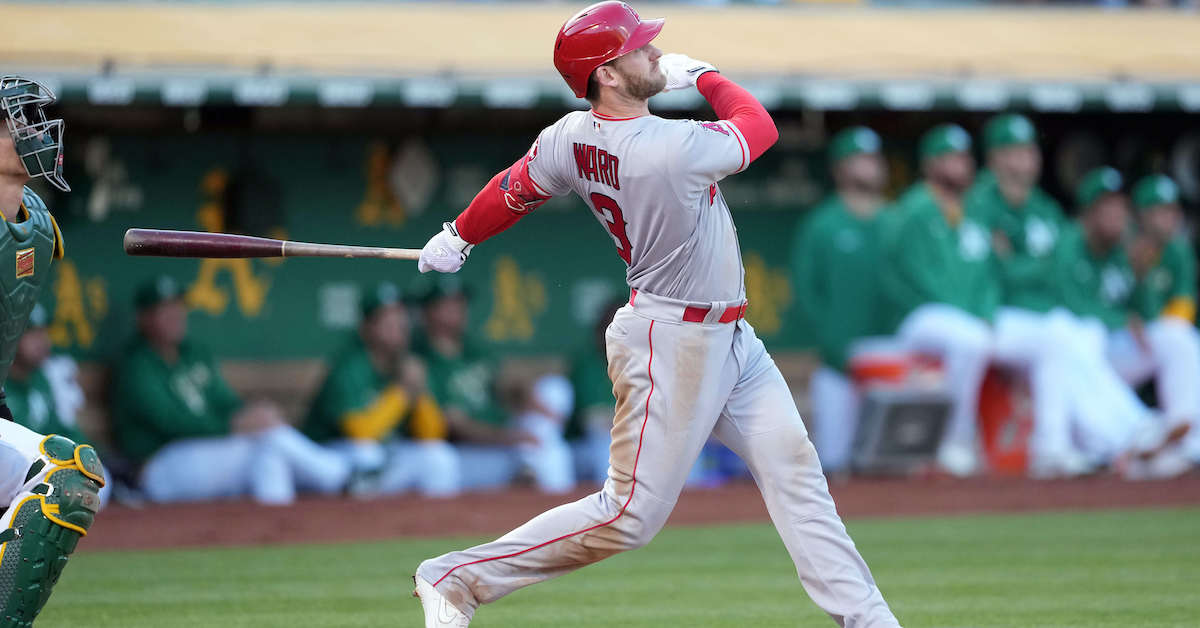
The Los Angeles Angels are off to a 13-7 start. A couple of the big reasons for that are not unexpected. Mike Trout, who hadn’t played in a regular-season game in 11 months, is off to a blazing start even by his robust standards, sporting an OPS north of 1.200 and already nearing the sort of WAR we expect a league-average player to post over six months. Shohei Ohtani isn’t torching the league to quite the same degree but he’s also on a 6-WAR pace when you combine his hitting and pitching. Still, in the past, the team has struggled even with two superstars at the top of their game. What’s working for Los Angeles now is truly unusual compared to recent years: getting lots of contributions from the other guys. And none of “the other guys” have stood taller so far than Taylor Ward.

I’m always one of the first to yell “April!” about small-sample-size stars, but Ward’s performance has still been stunning. His .381/.509/.762 line calculates out to a 269 wRC+, besting his teammate Trout and everyone else with at least 50 PA this season. What makes it even more impressive is that some of the numbers fueling that line are of the sort that are meaningful in a small sample.

There’s a bit of a fallacy with extreme data in small samples (if it has a name, I don’t know it). In baseball, when a .280 hitter hits .300, people accept it as normal, but when a .280 hitter hits .500, it is generally written off as a fluke. But while the “hitting .500” part is, the .280 hitter who is hitting .500 is more likely to have improved than the one posting .300. Read the rest of this entry »


Dan Szymborski FanGraphs Chat – 4/28/22

12:01
BettsBellingerCaruso: East Coasters that send 8AM meeting requests I hope they metaphorically get hit with terrible BABIP luck for the rest of their lives that is all

12:02
Avatar Dan Szymborski: Good afternoon to people with righteous time zones! Good morning to the rest of you.

12:03
Ryan Breynolds: When is it time to start panicking with Nick Gonzales? The K-rate seems to be a real problem.

12:03
Avatar Dan Szymborski: Nick Martinez?

12:03
Avatar Dan Szymborski: Certainly more than three games. Especially because his plate discipline numbers suggest a lower walk rate.

12:03
Avatar Dan Szymborski: I’d actually be more worried that he’s not throwing as hard as he was overseas.

Read the rest of this entry »


Dan Szymborski FanGraphs Chat – 4/14/22

12:01
Avatar Dan Szymborski: April.

12:01
Nate: I know it’s still early, but are we starting to worry about Jared Kelenic again?

12:01
Avatar Dan Szymborski: April.

12:01
James: Can you give the devil’s advocate explanation for a lineup where Niko Goodrum bats third and Kyle Tucker 6th?

12:01
Avatar Dan Szymborski: A good one?

12:01
Avatar Dan Szymborski: No

Read the rest of this entry »


Szymborski’s 2022 Bust Candidates: Pitchers

Gary A. Vasquez-USA TODAY Sports

On Wednesday, I looked at the hitters I’m bearish on, so it’s time to finish the series for 2022 with the pitchers that are causing me worries. (If you’re wondering about my breakout picks, wonder no more.)

So what exactly is a bust? I don’t take it to mean that a player is awful or has no value. For me, a bust is a player who will step down a tier in performance or who is in a down cycle and has passed the window to get back to what they used to be. None of the players involved are literally without value, and some of them are still really good. But they’re all players I think will be well below their best, usually in a manner that makes me sad as a baseball fan.

Before getting to the 2022 candidates, here are my ’21 bust choices and how they performed:

Nobody really shone here, but by the same token, nobody was legendarily awful (I had expected Lester to go down that route and he didn’t really). We obviously didn’t get a ton of Kluber, but he was definitely much more effective than I expected. My concern with May was that he was still rather awkward at punching out batters, despite the explosiveness of his stuff, so I was happy that he spent April proving me very wrong about where he was as a pitcher — then very unhappy as he tore his UCL in early May and required Tommy John surgery.

As a reminder, I selected all of these players by Opening Day, so there’s no knowledge of anything that happened after Opening Day. It would have been really awkward if someone on my list had surprise Tommy John surgery this week! Read the rest of this entry »


Szymborski’s 2022 Bust Candidates: Hitters

© Rick Scuteri-USA TODAY Sports

Earlier this week, I ran down my favorite breakout candidates. Now it’s time for the darker side: the busts.

So what exactly is a bust? I don’t take it to mean that a player is awful or has no value. For me, a bust is a player who will step down a tier in performance or who is in a down cycle and has passed the window to get back to what they used to be. None of the players involved are literally without value, and some of them are still really good. But they’re all players I think will be well below their best, usually in a manner that makes me sad as a baseball fan.

Let’s start things off with a look at last year’s list of possible hitter busts and check how things worked out:

As you can see, I did much worse here than with the pitcher breakouts. I’m especially happy to have been wrong about Votto last year — my feeling was that there wasn’t another comeback left in him, but there was! I’m also quite pleased that Abreu didn’t slump back to league-average as I expected, staying a bit above instead, though well off his MVP performances. Lewis gets a pass since he was injured most of the year, and Grossman remained legitimately good, if below his 2020 rates. Read the rest of this entry »


Szymborski’s 2022 Breakout Candidates: Pitchers

© Kim Klement-USA TODAY Sports

One of my favorite yearly preseason pieces is also my most dreaded: the breakout list. I’ve been doing this exercise since 2014, and while I’ve had the occasional triumph (hello, Christian Yelich), the low-probability nature of trying to project who will beat expectations means that for every time you look smart, you’re also bound to look dumb for some other reason. Yesterday, I highlighted my breakout candidates among the league’s hitters. Today, I consider the pitchers.

Let’s start things off with a brief look at last year’s breakout pitcher list and see how they fared:

Seven of the eight players here either tied (Musgrove) or beat their previous career best in WAR, so it would be greedy to complain that Means only had a good bounce rather than finding a truly new plateau. While I’d like to attribute this showing to some brilliance on my part, I’d also call these results luckier than average and certainly above any reasonable mean expectation of my perceptiveness. Read the rest of this entry »