Archive for 2019 Trade Value

A Florida Trade: The Marlins and Rays Make an Intriguing Swap

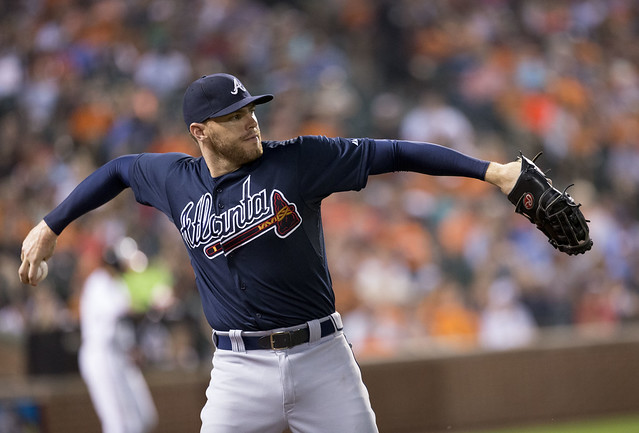
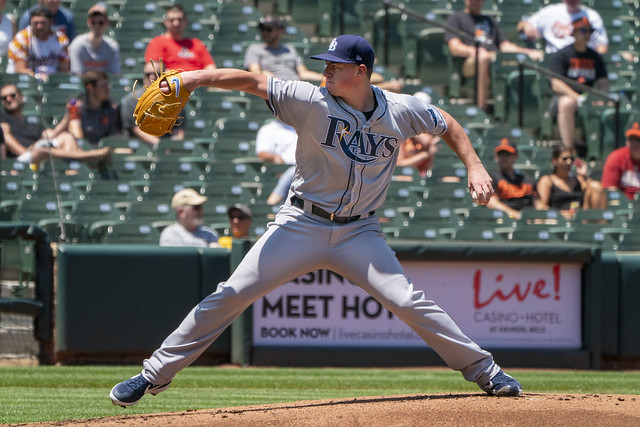
The Tampa Bay Rays are in the thick of a playoff hunt. The Miami Marlins are not. Both teams behaved accordingly today, with the Rays sending Ryne Stanek and Jesús Sánchez to the Marlins in exchange for Nick Anderson and Trevor Richards. This trade, as many trades do, seems to favor the Rays, though all four players changing sides are interesting in one way or another. I wouldn’t fault you for thinking the Marlins might come out ahead in the end.

To my eyes, the gem of the trade is Nick Anderson. An out-of-nowhere success this season, Anderson is the kind of high-octane pitcher modern bullpens covet. He also won’t reach free agency until 2025, which means that he’s doubly attractive to the cost-conscious Rays. A rate monster, he boasts an eye-popping 37.1% strikeout rate, ninth-best among relievers this season, courtesy of a spinny four-seam fastball and devastating breaking ball.

While his results have been inconsistent this year, it’s not for lack of underlying numbers. He surrenders hard contact, with a 6th-percentile exit velocity allowed and 4th-percentile hard contact rate, but makes up for it with the aforementioned heaps and bales of strikeouts. It’s too early in his career to know how much of a problem the contact will be, but if his underlying talent there is close to league average, he’s immediately one of the best relievers in baseball.

Want a best-case comparison for Anderson? Think of Ken Giles. His fastball doesn’t boast quite the same top end as Giles, but they’re both four-seam/breaking ball pitchers who mix the two pitches almost equally and post ludicrous swinging strike rates. Anderson is at 17.4% for the year, while Giles is at 17.1% over his career. Giles has also had intermittent struggles with hard contact, though he seems to have worked through them en route to a 1.6 FIP this year. Anderson’s upside might not be quite that high, but his stuff is tremendous. Read the rest of this entry »

Angels Acquire Stassi, Still Have Trout

When Jay wrote up the Martín Maldonado deal earlier, he called it “a minor move.” This deal, which sends Max Stassi to the Angels in exchange for minor-league outfielders Rainier Rivas and Raider Uceta, is the minor move attendant to that minor move.

With Maldonado in-house, the Astros simply didn’t have room for the 28-year-old Stassi, and so some sort of deal for his services was inevitable. This is that deal. Angels catching has been bad this year, what with Jonathan Lucroy out with a broken nose (and not playing terribly well before that), and Kevan Smith and Dustin Garneau, while pulling hard, not coming up with much but air against their oars. Smith, with his 105 wRC+, has been the bright spot, but he’s 31 and trending down in July after a strong May and June. Stassi isn’t anything to write home about with the bat either, but he’s got a good reputation with the glove and, unlike Lucroy, is under control until 2022. That’ll have to do until the Angels figure out how to develop a catcher (Jack Kruger, their best catching prospect, is still in Double-A).

Going back to Houston are two rookie-league outfielders: Rivas (18, in his second rookie league season and first stateside) and Uceta (18, ditto). Neither were listed among the Angels’ top 31 prospects, but Eric, who’s seen them in Arizona, reports both as big-bodied guys (particularly Uceta) with little physical projection and reasonably powerful bats. Uceta is unlikely to be able to stay in the outfield long-term, and Rivas is likely destined for a corner spot if he does. Both are about 35 FV organizational types. These are the kinds of prospects you get when you’re trying to trade for Max Stassi. They could make the majors, but they probably won’t, and if they will we probably won’t know about it for another year or two. At least the Angels still have Mike Trout.


Putting The “Trade” in the Trade Value Series

Last week, FanGraphs wrapped up our annual Trade Value Series. As a window into teams’ valuation of players, it’s an invaluable resource, built as it is from a mixture of industry sources. One thing it isn’t, though, is a list of players we realistically expect to be traded. The top 10 players on the list, for example, have an average of six years of team control remaining, and all of them except Vladimir Guerrero Jr. play for teams that are currently contending. They’re great theoretical trade pieces, in other words, but not likely to actually be traded.

That conundrum, the fact that the most valuable players are among the least likely to be traded, has always been a feature of the exercise. Mike Trout topped the list for five straight years at one point, for example, and was quite literally too valuable for teams to be able to acquire, even if the Angels had been willing to deal him. Evan Longoria, likewise, was a repeat Trade Value champion, but his first extension with the Rays made him so valuable to the team that they couldn’t even contemplate moving him.

Most of the time, then, the Trade Value Series is more of a Theoretical Value Series. Most isn’t all, however, and that’s where this article comes in. One of the benefits of having 12 years of trade values is that we can look at things that don’t happen all that often. If only 1% of top-50 players get traded, we should still have six results in our sample. With the benefit of aggregation, then, let’s take a look at how often the trade in trade value comes into play.

The first question you probably have is how often a player on the Trade Value list gets traded at all. The answer to that is tricky. For example, here are the number of Top-50 and honorable mention players traded within the next year after appearing on a FanGraphs Trade Value list:

Read the rest of this entry »


Kiley McDaniel Trade Value Chat – 7/19/19

12:34

Kiley McDaniel: Hello from ATL! Scout is sitting in her bed next to me, resting after we Trade Valued so hard it affected our sleep patterns.

12:35

Kiley McDaniel: Check out the series via the widget at the top of any page to see the whole deal https://blogs.fangraphs.com/2019-trade-value-1-to-10/

12:37

Kiley McDaniel: some other pieces that have come out in the last week to check out if you haven’t already:

12:38

Kiley McDaniel: Craig on some meta stuff with the Trade value list: https://blogs.fangraphs.com/the-trade-value-series-skews-young-again/

12:38

Kiley McDaniel: Eric on a weird TBR-TEX trade: https://blogs.fangraphs.com/the-rays-and-rangers-swap-prospects/

12:38

Kiley McDaniel: Herzenberg on some Cape looks: https://blogs.fangraphs.com/prospect-dispatch-cape-cod-league/

Read the rest of this entry »


2019 Trade Value: #1 to #10

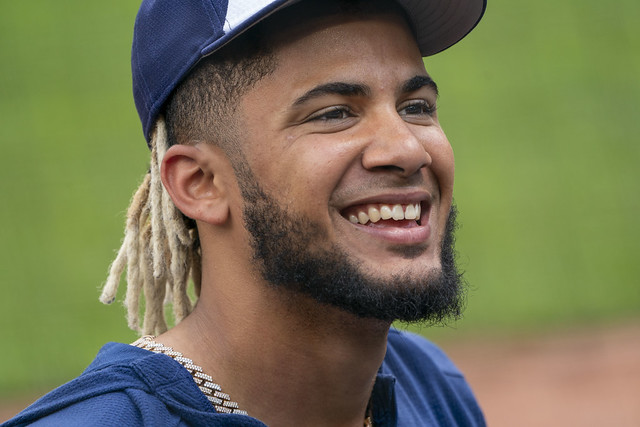
Fernando Tatis Jr. rocketed onto this year’s list and into the top 10. (Photo: Keith Allison)

As is the annual tradition at FanGraphs, we’re using a week around the All-Star Game — when the industry pauses to take a metaphorical breather — to take stock of the top-50 trade chips in the sport. For more context on exactly what we’re trying to do here, see the Honorable Mentions post linked at the top of the page.

For this post, I’ll present a graphic (by way of the wizard Sean Dolinar) breaking down each player’s objective skill level (represented, in this case, by a five-year WAR projection from ZiPS), contract/team-control details, rank in last year’s series, and then year-by-year details of age, WAR, and contract through the end of 2023, although a couple players have control beyond those five years, and some, you’ll notice, show projections for fewer years to reflect when those players reach free agency. For those readers who are partial to spreadsheets rather than blocks of text, I’ll also include all of the players we’ve ranked so far in grid format at the bottom of the post.

It should be noted that the ZiPS WAR forecasts influenced the rankings a bit. For players who were bunched together, it acted as an impartial tiebreaker of sorts, but the industry opinions I solicited drove the rankings.

With that said, let’s get to the final 10 spots on this year’s Trade Value list.

Five-Year WAR +22.1
Guaranteed Dollars
Team Control Through 2025
Previous Rank #18
Year Age Projected WAR Contract Status
2020 21 +3.3 Pre-Arb
2021 22 +3.8 Pre-Arb
2022 23 +5.0 Arb1
2023 24 +5.1 Arb2
2024 25 +4.9 Arb3
Pre-Arb
Arb

Vladito hasn’t been the otherworldly hitter many were hoping for or expected during his first taste of the big leagues, but no one I spoke with is worried. First of all, he’s running a .270 BABIP and underperforming his xwOBA by 17 points, suggesting he “deserves” to have a wRC+ over 100, which is still below his lofty pre-season projections, but not by much. And also, it’s been 66 games and he’s 20 years old.

Given his size and eventual move to first base, Vlad needs to mash, so his profile will be more sensitive to offensive performance than others might be, but the track record of the “that guy looks like a generational hitter” and “gets to the big leagues at 20” profiles is really strong. Vlad has an extra year of control over Gleyber Torres and Walker Buehler, so the projected five-win peak seasons are a push, and I lean to the extra year. Interestingly, there were concerns raised by executives about how all three of these guys will age; history tells us (I mean it feels like it does?) that at least one of them will turn out a good bit worse than we’re expecting. Read the rest of this entry »


2019 Trade Value: #11 to #20

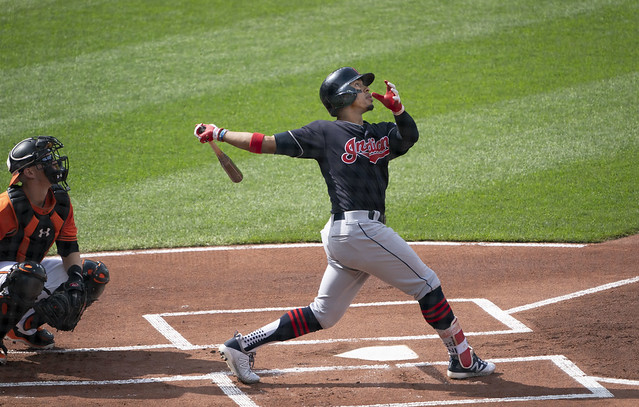
Francisco Lindor’s production (and smile) continue to rank highly throughout the industry. (Photo: Keith Allison)

As is the annual tradition at FanGraphs, we’re using a week around the All-Star Game — when the industry pauses to take a metaphorical breather — to take stock of the top-50 trade chips in the sport. For more context on exactly what we’re trying to do here, see the Honorable Mentions post linked at the top of the page.

For this post and the top 10 to follow, I’ll present a graphic (by way of the wizard Sean Dolinar) breaking down each player’s objective skill level (represented, in this case, by a five-year WAR projection from ZiPS), contract/team-control details, rank in last year’s series, and then year-by-year details of age, WAR, and contract through the end of 2023, although a couple players have control beyond those five years, and some, you’ll notice, show projections for fewer years to reflect when those players reach free agency. For those readers who are partial to spreadsheets rather than blocks of text, I’ll also include all of the players we’ve ranked so far in grid format at the bottom of the post.

It should be noted that the ZiPS WAR forecasts influenced the rankings a bit. For players who were bunched together, it acted as an impartial tiebreaker of sorts, but the industry opinions I solicited drove the rankings.

With that said, let’s get to the next 10 spots on this year’s Trade Value list.

Five-Year WAR +18.5
Guaranteed Dollars $46.0 M
Team Control Through 2023
Previous Rank #35
Year Age Projected WAR Contract Status
2020 27 +4.0 $7.0 M
2021 28 +4.0 $10.5 M
2022 29 +3.7 $12.5 M
2023 30 +3.5 $16.0 M

Snell signed an extension this winter that locks him up through his age-30 season, which would’ve been his first year of free agency. He really belongs as the last guy in the previous article, so you can see him on the tier with fellow possible/current aces German Marquez, Shane Bieber, Jacob deGrom, Jose Berrios, Chris Paddack, Aaron Nola and (given the late revelations I’ve since added to his blurb about the details of his contract) Max Scherzer. All of these guys rank from 20th to the low-30s, and could be put in almost any order. Most sources I spoke with moved them as a group and generally kept the same names at the top/bottom as I have, shuffling the order in the middle a bit. Once you take Scherzer off the table as the best pitcher in baseball, ZiPS essentially has Snell, Jacob deGrom, Marquez, Bieber, and Nola tied for second among those pitchers over the 2020-2024 term. Snell is the only lefty in the group, he’s on pace for his fourth straight year of 31 regular season starts, his velo has been stable year-to-year at an average of 95.7 mph, his 3.12 FIP over his last 58 starts is a sustained run of elite performance, and his extension is for reasonable money, for exactly as long as I’d be predicting No. 2 or 3 starter performance from him. Read the rest of this entry »


2019 Trade Value: #21 to #30

Like Max Scherzer, deGrom’s contract has deferrals that affect his trade value. (Photo: Keith Allison)

As is the annual tradition at FanGraphs, we’re using a week around the All-Star Game — when the industry pauses to take a metaphorical breather — to take stock of the top-50 trade chips in the sport. For more context on exactly what we’re trying to do here, see the Honorable Mentions post linked at the top of the page.

For this post and the two to follow, I’ll present a graphic (by way of the wizard Sean Dolinar) breaking down each player’s objective skill level (represented, in this case, by a five-year WAR projection from ZiPS), contract/team-control details, rank in last year’s series, and then year-by-year details of age, WAR, and contract through the end of 2023, although a couple players have control beyond those five years, and some, you’ll notice, show projections for fewer years to reflect when those players reach free agency. For those readers who are partial to spreadsheets rather than blocks of text, I’ll also include all of the players we’ve ranked so far in grid format at the bottom of the post.

It should be noted that the ZiPS WAR forecasts influenced the rankings a bit. For players who were bunched together, it acted as an impartial tiebreaker of sorts, but the industry opinions I solicited drove the rankings.

With that said, let’s get to the next 10 spots on this year’s Trade Value list.

Five-Year WAR +12.6
Guaranteed Dollars
Team Control Through 2024
Previous Rank
Year Age Projected WAR Contract Status
2020 24 +2.5 Pre-Arb
2021 25 +2.5 Pre-Arb
2022 26 +2.7 Arb1
2023 27 +2.6 Arb2
2024 28 +2.3 Arb3
Pre-Arb
Arb

Paddack was acquired from the Marlins in 2016 for Fernando Rodney, a move that looks like highway robbery in hindsight. Paddack blew out his elbow three starts after the trade and wasn’t a big prospect at that time; he’d had gaudy numbers in Low-A at that point, but had signed for $400,000 in the eighth round and was a fastball/changeup type with feel and a below average breaking ball. Paddack has come on a lot since then and is basically a No. 3 starter in his age-23 rookie season, and looks like he’s traveling the James Shields path. Read the rest of this entry »


2019 Trade Value: #31 to #40

Freddie Freeman gives you the coveted option of accumulating a lot of wins quickly. (Photo: Keith Allison)

As is the annual tradition at FanGraphs, we’re using a week around the All-Star Game — when the industry pauses to take a metaphorical breather — to take stock of the top-50 trade chips in the sport. For more context on exactly what we’re trying to do here, see the Honorable Mentions post linked at the top of the page.

For this post and the three to follow, I’ll present a graphic (by way of the wizard Sean Dolinar) breaking down each player’s objective skill level (represented, in this case, by a five-year WAR projection from ZiPS), contract/team-control details, rank in last year’s series, and then year-by-year details of age, WAR, and contract through the end of 2023, although a couple players have control beyond those five years, and some, you’ll notice, show projections for fewer years to reflect when those players reach free agency. For those readers who are partial to spreadsheets rather than blocks of text, I’ll also include all of the players we’ve ranked so far in grid format at the bottom of the post.

It should be noted that the ZiPS WAR forecasts influenced the rankings a bit. For players who were bunched together, it acted as an impartial tiebreaker of sorts, but the industry opinions I solicited drove the rankings.

With that said, let’s get to the next 10 spots on this year’s Trade Value list.

Five-Year WAR +12.1
Guaranteed Dollars $28.0 M
Team Control Through 2024
Previous Rank
Year Age Projected WAR Contract Status
2020 27 +3.0 $6.3 M
2021 28 +2.8 $6.5 M
2022 29 +2.6 $6.8 M
2023 30 +2.1 $8.5 M
2024 31 +1.6 $10.0 M
Team Option

I get the impression that the average baseball fan might not realize that Max Kepler is good now, and may only have a vague awareness of him as the prospect from Germany who ended up being more than just a generic baseball player who hails from a country off baseball’s beaten path. Now that we have a bigger sample of UZR and StatCast defensive metrics, we know that Kepler is a well above average defender. He’s 11th in outs above average among all outfielders this year and his UZR in the last season and a half is +21.4 runs, making him tops amongst major league outfielders in that span. The tidbit everyone repeated when Kepler initially signed out of Germany at age 16 was that both of his parents were ballet dancers; to be the top outfield defender in baseball at 6-foot-4 and 205 pounds suggests Kepler may be light on his feet as well. He’s having an offensive breakout in his age-26 season while also running a .258 BABIP, and he also signed a pretty team-friendly extension before the season. Read the rest of this entry »


2019 Trade Value: #41 to #50

Max Scherzer proved to be the most difficult player to place on this year’s list. (Photo: Keith Allison)

As is the annual tradition at FanGraphs, we’re using a week around the All-Star Game — when the industry pauses to take a metaphorical breather — to take stock of the top-50 trade chips in the sport. For more context on exactly what we’re trying to do here, see the Honorable Mentions post linked at the top of the page.

For this post and the four to follow, I’ll present a graphic (by way of the wizard Sean Dolinar) breaking down each player’s objective skill level (represented, in this case, by a five-year WAR projection from ZiPS), contract/team-control details, rank in last year’s series, and then year-by-year details of age, WAR, and contract through the end of 2023, although a couple players have control beyond those five years, and some, you’ll notice, show projections for fewer years to reflect when those players reach free agency. For those readers who are partial to spreadsheets rather than blocks of text, I’ll also include all of the players we’ve ranked so far in grid format at the bottom of the post.

It should be noted that the ZiPS WAR forecasts influenced the rankings a bit. For players who were bunched together, it acted as an impartial tiebreaker of sorts, but the industry opinions I solicited drove the rankings.

With that said, let’s get to the bottom 10 spots on this year’s Trade Value list. Read the rest of this entry »


2019 Trade Value: Intro and Honorable Mentions

The industry has placed Brendan McKay just outside the top-50 players by trade value. (Photo: Keith Allison)

All-Star week has come and gone, which means a lot of things, like that the races for the 2019 postseason have begun to take shape (only a few seem over at this point) and also that many of those who work in baseball just finished taking rushed, abbreviated vacations. Around here, though, it means it is time for a different tradition — namely, the start of our annual Trade Value series.

The inimitable Dave Cameron conducted this exercise for 13 years, 10 of which were for this website. He’s since moved on to the Padres, so FanGraphs has to settle for me in his stead, now for the second year. This list wouldn’t be possible without the model established by Cameron, or the help Sean Dolinar, Dan Szymborski, and Meg Rowley provided in putting together this year’s entry. A special thanks is also due to the industry friends who put up with much rougher early versions of this list, were generous with their time, and helped whip it into shape.

For those new to the series, it represents an attempt to answer the question “Who would bring back the most in trade if he were put on the market before the deadline?” What’s notable about this list — as opposed to the prospect lists I assemble with Eric Longenhagen — is that my opinion doesn’t matter. The goal here isn’t for me to project anyone’s future value but rather to capture the opinions of the industry and express how it values players in reality, right now.

Read the rest of this entry »