When David Morgan was profiled in last year’s rankings of the San Diego Padres’ top prospects, it was pointed out that the 26-year-old right-hander had joined the organization as a non-drafted free agent in 2022. Moreover, he’d barely taken the mound. A two-way player at Hope International University — an NAIA school in Fullerton, California — Morgan had thrown just nine-and-a-third innings. At the time he signed, he was playing for the Portland Pickles in the summer collegiate West Coast League (for which Rob Neyer is the commissioner).
Morgan’s backstory sets him apart him from his MLB brethren, but what about from a pitch-specific standpoint? Are there any differentiating characteristics?
“My ability to pick stuff up and kind of run with it is probably the most unique thing about me,” said Morgan, who made his big-league debut last May and has since logged a 3.41 ERA and a 4.15 FIP over 52 appearances comprising 60-and-two-thirds frames. “Last year, when I had to throw a sinker, it wasn’t really a learning process. It was in-between innings. I came into the dugout, grabbed a new grip, and threw it the next inning.”
The outing, his sixth in the majors, came on June 10 with the Padres holding a commanding late-inning lead against the Los Angeles Dodgers. When Morgan returned to the dugout after working the eighth, pitching coach Ruben Niebla pulled him aside and asked if he’d ever thrown a sinker. The answer was yes and no. Morgan had toyed around with one, but that was about it.
With the game not in doubt — San Diego led 11-1 — Niebla “gave [him] a grip and said to go out and throw it next inning.” Morgan did, the pitch “danced around a little bit,” and the rest is history. By season’s end, he’d thrown his sinker at a 21.5% clip, and this year the usage is up to 34.7%. Read the rest of this entry »
The Houston Astros have a knack for disappointing Aprils. Despite usually being projected as the favorite or second favorite in the AL West every year for the last decade, the last time the Astros didn’t have a losing record at some point in the second half of April was 2019. But year after year, they’ve tended to get a powerful second wind. Excluding 2020, for obvious reasons, they haven’t finished with fewer than 87 wins in a season since 2016; overall, Houston has the second-most wins in baseball since the start of the 2017 season. During those previous mediocre starts, the projections have stood by the Astros. This time… not so much.
To see the last time the Astros started this dreadfully, you don’t have to go back very far. In 2024, they hit their nadir after 26 games, at 7-19. I wrote then, as I do now, about the hole they were digging for themselves. Though it was still an uphill battle to come back in the AL West — they in fact did, handily — the projections never turned sour. ZiPS projected the Astros to win 88 games going into that season, and despite their 7-16 record at the time I wrote that article, the computer still thought they’d continue to win games at the previously predicted rate.
ZiPS Median Projected Standings – AL West (4/22/24)
Team
W
L
GB
Pct
Div%
WC%
Playoff%
WS Win%
80th
20th
Texas Rangers
86
76
—
.531
41.0%
18.3%
59.3%
5.1%
94.1
79.2
Seattle Mariners
85
77
1
.525
30.7%
19.2%
50.0%
3.8%
92.1
77.4
Houston Astros
83
79
3
.512
23.1%
17.9%
41.0%
3.5%
90.3
75.2
Los Angeles Angels
75
87
11
.463
5.1%
7.1%
12.2%
0.4%
82.3
67.3
Oakland A’s
61
101
25
.377
0.1%
0.1%
0.2%
0.0%
68.6
53.6
SOURCE: Me
ZiPS does not have the same optimism that it had in 2024.
ZiPS Median Projected Standings – AL West (4/27/26)
Team
W
L
GB
Pct
Div%
WC%
Playoff%
WS Win%
80th
20th
Seattle Mariners
87
75
—
.537
48.9%
18.2%
67.1%
7.0%
93.5
80.3
Texas Rangers
83
79
4
.512
28.3%
20.2%
48.5%
2.7%
90.3
76.5
Athletics
79
83
8
.488
15.8%
15.6%
31.3%
0.9%
87.0
72.5
Houston Astros
75
87
12
.463
5.0%
8.0%
13.0%
0.5%
81.7
68.1
Los Angeles Angels
72
90
15
.444
1.9%
3.5%
5.4%
0.1%
78.1
65.0
Source: Yeah, still me
This time around, ZiPS doesn’t even think Houston is a .500 team the rest of the way, let alone one that’ll end up close to its projected record in the preseason. The Astros had a relatively deep rotation in 2024, especially compared to today, and at the time, basically all of their starters were injured. But ZiPS thought enough pitching would filter back in over the coming weeks to get the team back on track. However, in 2026, ZiPS only loves one Houston pitcher, Hunter Brown, and just a few days ago, general manager Dana Brown said Brown won’t be back until June, and that’s if there are no setbacks.
Projecting the Astros to have a sub-.500 record isn’t something that ZiPS does often. While I don’t have rest-of-season projections for every calendar date ever, I do have monthly updates, and the last time they were projected to finish with a losing record was the 2015 preseason, when they had a 77-85 projection for the year. Pinpointing the actual date by running a few more simulations, the last time before 2026 that Houston was projected to be a losing team over the rest of a season was almost exactly 11 years ago, on April 26, 2015, when a win over the Oakland Athletics improved the team’s record to 10-7 and its rest-of-season projected winning percentage to .49927.
The 2026 Astros have been this bad even as their offense has performed extremely well. They lead the American League with 5.21 runs per game, and their 118 wRC+ ranks fourth in baseball, to go along with 5.7 WAR from their position players, also good for fourth in the majors. Considering this, the Astros shouldn’t bank on an offensive surge to turn their season around. Instead, if Houston is going to make up ground in the standings, its pitching is going to have to improve.
If you’ve ever had the misfortune to follow election night coverage, you might have seen the various news desks give benchmarks for a particular candidate to beat in counties or in states to be on target to win. I can do the same kind of thing with ZiPS, so I asked it to benchmark what ERAs Houston’s pitching staff would have to hit to give the team a 50% chance of making the playoffs.
ZiPS Rest-of-Season ERA Benchmarks – Houston Astros
TLDR: To be a coin flip to make the playoffs, if the offense performs as expected, the Astros need their pitching staff to collectively outperform their projected ERAs by about half a run per nine innings. This is true whether or not you use the ZiPS projections or the combined Steamer/ZiPS Depth Charts projections. Just to illustrate how hard that is for a team to do, I prorated the preseason 2025 ZiPS projected ERAs to the actual innings pitched, and compared those to the final team ERAs for that year.
ZiPS 2025 Team ERA Projections, Projected vs. Actual
Team
Team ERA
Projected ZiPS ERA
Diff
Texas Rangers
3.49
4.33
-0.83
Milwaukee Brewers
3.59
4.07
-0.48
Cincinnati Reds
3.86
4.35
-0.48
Kansas City Royals
3.73
4.17
-0.43
Chicago White Sox
4.28
4.63
-0.35
Pittsburgh Pirates
3.76
4.09
-0.33
San Diego Padres
3.64
3.91
-0.26
Chicago Cubs
3.81
4.00
-0.19
Boston Red Sox
3.72
3.91
-0.19
Cleveland Guardians
3.70
3.88
-0.18
Philadelphia Phillies
3.79
3.96
-0.17
New York Yankees
3.91
4.01
-0.11
Houston Astros
3.86
3.88
-0.02
Tampa Bay Rays
3.94
3.94
0.00
San Francisco Giants
3.84
3.80
0.04
New York Mets
4.04
3.94
0.10
Detroit Tigers
3.97
3.85
0.13
Los Angeles Dodgers
3.95
3.81
0.14
Seattle Mariners
3.87
3.68
0.19
Miami Marlins
4.60
4.34
0.26
St. Louis Cardinals
4.30
4.04
0.26
Toronto Blue Jays
4.19
3.87
0.32
Athletics
4.71
4.28
0.43
Los Angeles Angels
4.89
4.44
0.45
Baltimore Orioles
4.62
4.00
0.62
Minnesota Twins
4.55
3.88
0.67
Arizona Diamondbacks
4.49
3.81
0.68
Atlanta Braves
4.36
3.65
0.71
Washington Nationals
5.35
4.55
0.80
Colorado Rockies
5.99
4.85
1.14
Only a single team, the Texas Rangers, outperformed its ERA projections by more than half a run. The Brewers and Reds came close, but they fell a bit further back when adjusting for the fact that ZiPS thought the league-wide ERA would be 0.12 higher than it actually was.
Now, consider the very real possibility that the Houston offense doesn’t merely perform as expected, but hits its 75th-percentile projection instead. The pitching would still have to beat its projections by 0.33 runs per game, meaning that even in a rosy scenario like this for the lineup, this team would still be an underdog.
On a fundamental level, the Astros need to find better pitchers from among the guys who aren’t currently envisioned by Depth Charts as contributors, and they need to find them right now. Ethan Pecko is the most interesting of the internal options, and as a fellow Towson native, I can’t help but root for him. He’s currently working back from thoracic outlet syndrome, and though he’s been very good on his minor league rehab assignment, he’s not likely to be up until later this summer. When he does return, he wouldn’t be enough by himself to fix this pitching staff, even if he had a Chase Burns-esque debut. AJ Blubaugh and Colton Gordon don’t project as instant game-changers, either. Houston would likely need to acquire some pitching, but from where? This has been an odd season so far, in that many of the worst teams (Astros, Red Sox, Mets, Phillies, Blue Jays, Royals) were expected to be contenders. That means there aren’t a lot of teams looking to be early sellers. But even if there were, these other underperforming clubs would likely be fierce competition for those players on the block.
Time is not on Houston’s side, in the short or long term. The short-term challenge is obvious, but the long-term one is nearly as daunting. The Astros are second in baseball in wRC+ from players over 30 years old (129), with Jose Altuve and Christian Walker both at ages when imminent decline is highly likely. Their two key offensive players in their 20s, Jeremy Peña and Yordan Alvarez, are free agents after 2027 and 2028, respectively. At the end of last season, our prospect team ranked Houston’s farm system 29th out of 30 teams. The best solution might be to do a bit of retooling, perhaps by trading anyone unsigned past this year. Then, assuming there’s a pre-lockout window to make some free agent signings as there was in 2021, absolutely blitz the top guys available with extremely generous one-year offers, with the hope that many of those players will want to get a second look at free agency in a hopefully normal winter after the 2027 season. But truth be told, this doesn’t really feel like something the Astros would do.
However it shakes out, this may be the most crucial period of Brown’s stint as GM. The Houston Astros are in a precarious position, and none of the options look particularly appealing. Some problems simply don’t have good solutions, and if they can’t conjure one up, we may be looking at the end of a moderately successfully dynasty in Houston.
A question popped into my head as I edited Ryan Blake’s column on the Nationals Friday morning. In the piece, shortly after noting that James Wood ranked third in the majors with a 170 wRC+, Ryan mentioned that Wood’s teammate, CJ Abrams, was sixth with a mark of 168. Upon reading this, I pulled up our leaderboards to see if the Nationals were the only team to have two players in the top 10. Turns out that, yes, they are. I thought about that for all of two seconds before something else caught my eye. Just below Abrams on the list was Mike Trout, who also had a 168 wRC+. This prompted me to wonder: Can Trout return to form? Can he both stay healthy and produce this year?
I’m hardly the only one who spent the bulk of the 2020s dreaming on a fully healthy season from Trout, just as I’m not alone in having abandoned that hope as the injuries piled up. But after watching him blast home run after home run last week from the Yankee Stadium pressbox, I felt the pull of the past encroach upon the present, and perhaps against my better judgment, I started dreaming again. He sure looked as healthy as ever as his broad body barreled up baseballs and roamed center field. The best way to describe the way Trout moves — really, the way he has always moved — is that he lumbers and boulders; for all of his natural athleticism and breathtaking blend of speed and strength, he does not glide gracefully. I put that dream of a Trout renaissance on ice when the Angels left town, only for it to come back a week later. This time, though, I considered whether, at 34, he still has one more MVP season in him. He entered this weekend slashing .239/.417/.557 with eight home runs, and has posted 1.2 WAR in 25 games. He’s walking more than he’s striking out, and he’s already stolen four bases. His BABIP is a mere .228, 111 points below his career mark, so we should expect his batting average to see some positive regression. (Even if we know batting average isn’t all that indicative of player performance, it still matters for MVP voters.) His .483 xwOBA is second in the majors and 62 points above his wOBA. His defense has been below average so far, but if Trout keeps hitting like this, his glove won’t matter much for his MVP case. The narrative would certainly be in his favor.
I just answered two of my own questions from Friday in this mailbag, so I guess it’s time to get to yours. What if the Astros blow it all up? How might the Pirates benefit from a Houston fire sale? Why don’t teams develop bench players to be knuckleballers? What the heck was Austin Warren doing in the game with the bases loaded in the Mets’ 12th straight loss? We answer all these questions and more in this week’s mailbag. Plus, Jay Jaffe remembers Garret Anderson. But first, I’d like to remind you that this mailbag is exclusive to FanGraphs Members. If you aren’t yet a Member and would like to keep reading, you can sign up for a Membership here. It’s the best way to both experience the site and support our staff, and it comes with a bunch of other great benefits. Also, if you’d like to ask a question for an upcoming mailbag, send me an email at mailbag@fangraphs.com. Read the rest of this entry »
These are not good times for the Astros. The team has stumbled to an 8-15 start, and while slow starts themselves are nothing new for Houston, this Astros’ roster has been particularly depleted by injuries. Including All-Stars Hunter Brown, Josh Hader, and Jeremy Peña, they currently have a major league-high 14 players on the injured list. In the grand scheme, one of the few thing going right for the club is the return of Yordan Alvarez, who’s back to being healthy and unstoppable. Limited to just 48 games by injures last year, the 28-year-old slugger has not only played every game, but has hit a major league-high 10 homers.
During Sunday’s game against the Cardinals at Daikin Park, the Astros trailed 4-1 with two outs and nobody on when Alvarez stepped in against lefty JoJo Romero in the eighth inning. In running the count to 2-2, he fouled off three pitches, including a sweeper that was well off the plate. Romero then threw him a changeup that sank below the bottom edge of the zone, and Alvarez went down and got it, hitting a towering solo homer to right field:
The Astros then added two more runs in the inning as Jose Altuve and Isaac Paredes sandwiched singles around a Christian Walker walk and a wild pitch from incoming reliever Riley O’Brien. That tied the game, which went to extra innings, where the Astros couldn’t do enough to counter the three runs the Cardinals scored against reliever Bryan King; they lost 7-5. Read the rest of this entry »
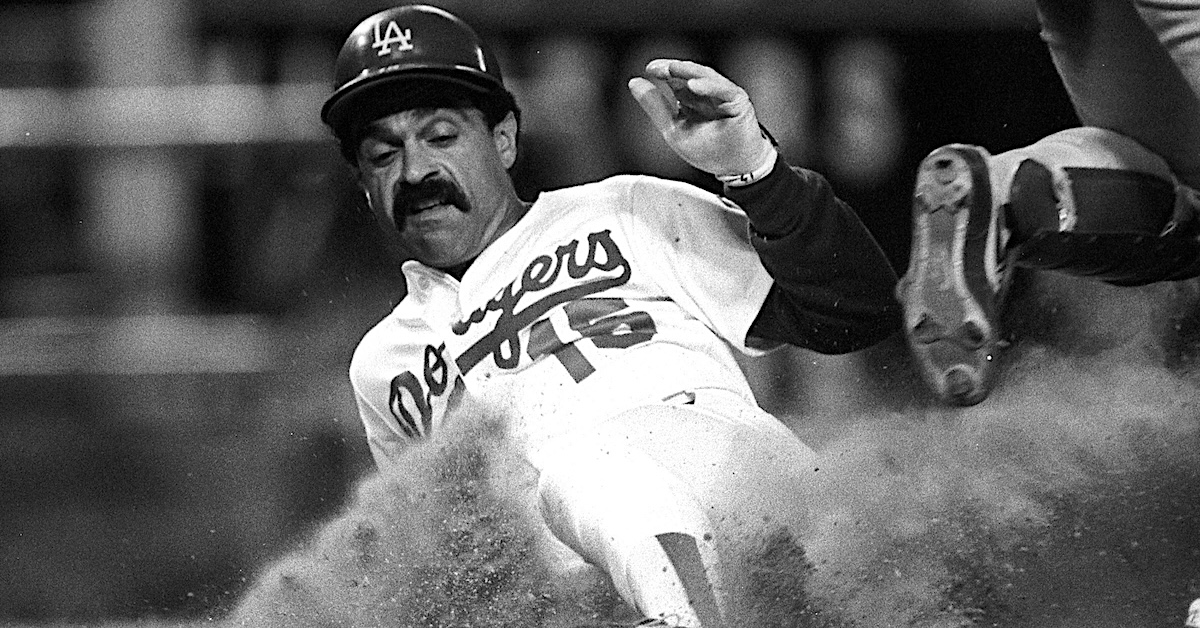
Davey Lopes was my first favorite ballplayer. In retrospect, I’m not sure how my eight-year-old self settled upon Lopes in a star-laden lineup featuring power hitters Dusty Baker, Ron Cey, Steve Garvey, and Reggie Smith, who the year before (1977) had become the first quartet of teammates to homer 30 times apiece in a season. I have a much better grasp of how Bill James helped my teenage self appreciate Lopes for his combination of high on-base and stolen base rates with mid-range power, but James wasn’t communicating those ideas via mass-market paperbacks circa 1978. Perhaps it was Lopes’ position atop the lineup I memorized while learning to decode box scores (my theory) or the Topps baseball card set that began my collection. Maybe it was simply his instantly recognizable, bushy mustache (my friends’ theory), but one way or another, even before laterheroes such as Fernando Valenzuela and Jim Bouton, Lopes was my guy.
The news that Lopes passed away on April 8 at age 80 due to Alzheimer’s and Parkinson’s diseases — a brutal double bill — reached me while I was traveling in Austria with my own 84-year-old parents and additional family as we tracked down the Vienna addresses of my long-deceased paternal grandparents. I had no shortage of thoughts regarding mortality, and yet the hits kept coming. Lopes wasn’t even the most recent former All-Star-second-baseman-turned-manager to pass away, as Phil Garner, his National League rival and then predecessor in managing the Brewers, died of pancreatic cancer on April 11. So it goes.
Though he didn’t debut until well past his 27th birthday, Lopes spent 16 seasons in the majors (1972-87), the first 10 with the Dodgers, whom he helped to four pennants and a championship while making four All-Star teams, winning a Gold Glove, and becoming team captain. From 1973–81, he manned the keystone in the longest running infield in major league history, along with Garvey at first base, Cey at third, and Bill Russell at shortstop — a unit that formed the foundation of those pennant-winning teams under managers Walter Alston and Tommy Lasorda. “He was the catalyst of the engine. It was 700 horsepower with the four of us, and the equation was his ability to get on base,” Garvey told CBS LA in the wake of Lopes’ death. Read the rest of this entry »
The normal flow of a baseball season inevitably includes injuries. The dog days of summer usually come with a star or two on the shelf. It’s a long year, and roster depth matters more and more as the months advance. But sometimes, injuries don’t occur at predictable intervals. Sometimes it’s April 14 and half your roster is on the IL. Just ask the Astros.
On Monday, Houston placed Tatsuya Imai and Jeremy Peña on the IL. That followed two moves from last Friday, when Cristian Javier and Jake Meyers both hit the IL. Five days before that, staff ace Hunter Brownlanded on the IL himself with a shoulder strain that will keep him from throwing for at least two weeks, and likely prevent him from appearing for far longer than that. And that’s just the in-season injuries. Josh Hader, Zach Dezenzo, Bennett Sousa, and Nate Pearson all started the year on the IL. Brandon Walter, Ronel Blanco, and Hayden Wesneski are still working their way back from elbow injuries sustained in 2025. That’s 12 players on the IL if you’re counting at home, and a number of stars among them.
It’s not like every injury matters the same. Pearson has never appeared for the Astros and has a negative career WAR. Dezenzo is a fifth outfielder. The core missing names for Houston are Brown, Imai, Peña, Hader, Javier, and, to a lesser extent, Meyers. If the Astros can’t replace the production from those five, all of whom are key parts of their roster, 2026 will be a long year. So let’s consider how each affects Houston’s prognosis in isolation, and then consider them all in concert.
Peña’s injury is the one the Astros are best-equipped to deal with. Thanks to last season’s Carlos Correa trade and a quiet offseason, Houston came into this year with an infield logjam. Peña, Correa, Isaac Paredes, and Jose Altuve gave the team four good players for only three spots. None could reliably flex to DH because of the presence of Yordan Alvarez. Altuve spent some time in the outfield last year, even before Correa arrived. Read the rest of this entry »
Jacob Misiorowski has a fastball that consistently reaches triple digits, and he augments it with an effective curveball-slider combination. Usage-wise, the 24-year-old Milwaukee Brewers right-hander is throwing his high-octane heater at a 62.3% clip, while his breaking-ball percentages are 16.6 and 17.3 respectively. Given the lethality of those pitches — his xBA is a paltry .168, and his K-rate an MLB-best 41.8% — he has little need for a changeup…
… but there is one in his arsenal. From time to time, he will even show it to a batter. Of the 289 pitches Misiorowski has delivered so far this season, 11 (3.8%) have been changeups. The story behind his only-sporadically-used weapon?
“I’ve had a changeup my whole career,” Misiorowski told me prior to throwing three of them in a 101-pitch start at Fenway Park on Tuesday. “That was one of the first pitches I truly learned. But then as I started throwing harder, I began going away from it, and it obviously got worse and worse the less I threw it. By the time I got drafted [63rd overall in 2022], I basically didn’t have a changeup any more. I had to relearn it, re-figure it out. So, yeah, it’s always been there, but it hasn’t always been there.”
Misiorowski went on to tell me the grip was originally a more conventional four-seam circle, but that he now has his pointer and middle fingers together, and his thumb underneath. He also said that he likes the amount of horizontal he gets on it, which is generally around 18 inches and has been up to 20. When I told him that the movement profile sounds a little like a two-seam sinker, he agreed that it does.
A few more things Misiorowski told me about the pitch are unfortunately lost, due to glitches I’ve recently encountered on my iPhone’s recording app (I mentioned this teeth-gnashing, hopefully-resolved-soon, issue in Monday’s piece on Padres’ broadcaster Mark Grant.) Fortunately, I was able to grab a few minutes with Brewers pitching coach Chris Hook, who made up for the missing words with his own perspective.
Robert Edwards, Rick Scuteri, Thomas Shea-Imagn Images
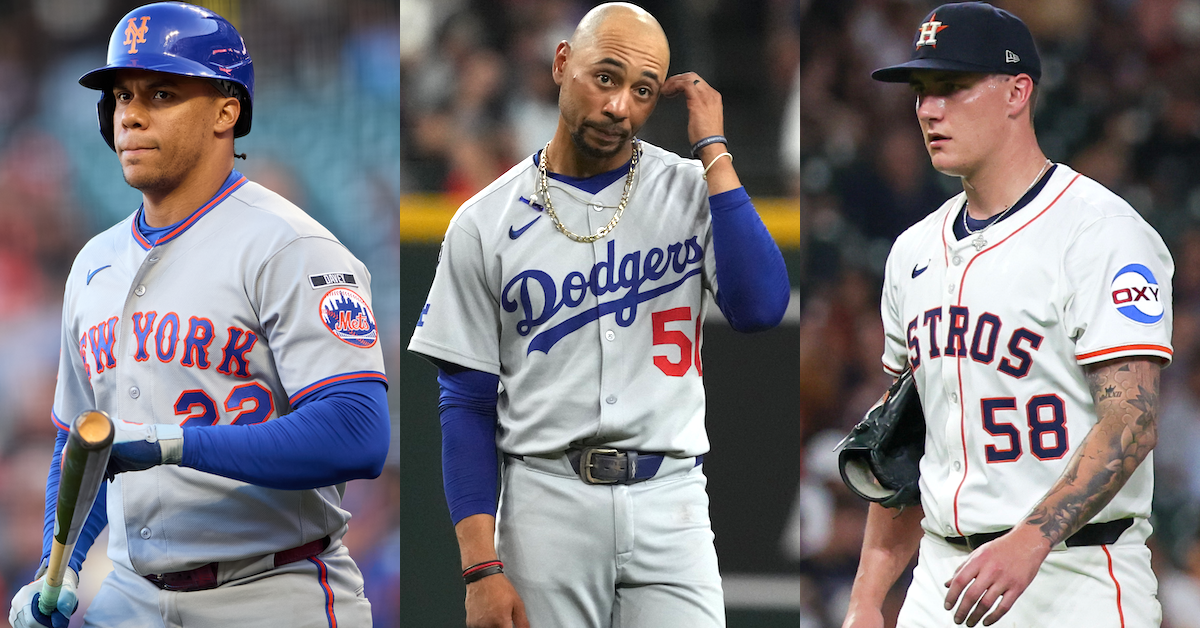
Until this weekend, baseball’s injured list was noticeably bare to start the 2026 season. Then, beginning with Blue Jays catcher Alejandro Kirk on Friday, the stars went down in rapid succession. The Cubs lost two of their top starting pitchers, Cade Horton and Matthew Boyd, in consecutive days. Joining them on the IL are two of the top players in the National League, Mets left fielder Juan Soto and Dodgers shortstop Mookie Betts, and one of the best pitchers in the American League, Astros ace Hunter Brown. Each of those three teams has a share of first place at the moment, making these especially high-leverage injuries. Read the rest of this entry »
Kevin Sousa, Benny Sieu, Eric Hartline, Troy Taormina-Imagn Images
Cody Ponce left his first start on a cart with a trainer.
Ponce collapsed in considerable pain Monday after making an awkward attempt to field a grounder in the third inning against the Rockies. He appeared to twist his right knee in a direction it’s not meant to go. He stood and limped to the cart on his own before exiting. Blue Jays’ manager John Schneider said after the game that Ponce will get an MRI.
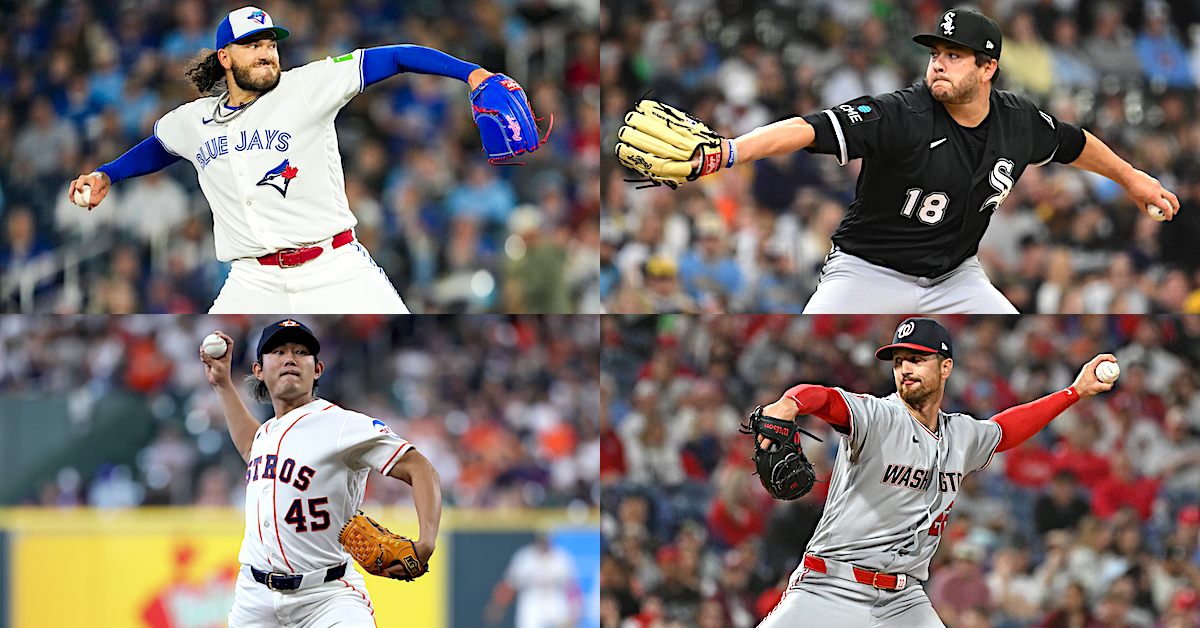
The injury is an unfortunate setback for Ponce, who was making his first start in the majors since 2021. He was perhaps the most anticipated in a quartet of free agent pitchers who signed out of the KBO or NPB this winter. I’d already planned to write about each of them, leading with Ponce for the reasons he displayed before the injury. And while I don’t want to overreact to one start, I think there are interesting takeaways from each that could inform the shape of their respective seasons to come. Read the rest of this entry »
Below is an analysis of the prospects in the farm system of the Houston Astros. Scouting reports were compiled with information provided by industry sources as well as my own observations. This is the sixth year we’re delineating between two anticipated relief roles, the abbreviations for which you’ll see in the “position” column below: MIRP for multi-inning relief pitchers, and SIRP for single-inning relief pitchers. The ETAs listed generally correspond to the year a player has to be added to the 40-man roster to avoid being made eligible for the Rule 5 draft. Manual adjustments are made where they seem appropriate, but we use that as a rule of thumb.
A quick overview of what FV (Future Value) means can be found here. A much deeper overview can be found here.
All of the ranked prospects below also appear on The Board, a resource the site offers featuring sortable scouting information for every organization. It has more details (and updated TrackMan data from various sources) than this article and integrates every team’s list so readers can compare prospects across farm systems. It can be found here. Read the rest of this entry »