Archive for Daily Graphings

The Worst Called Ball of the First Half

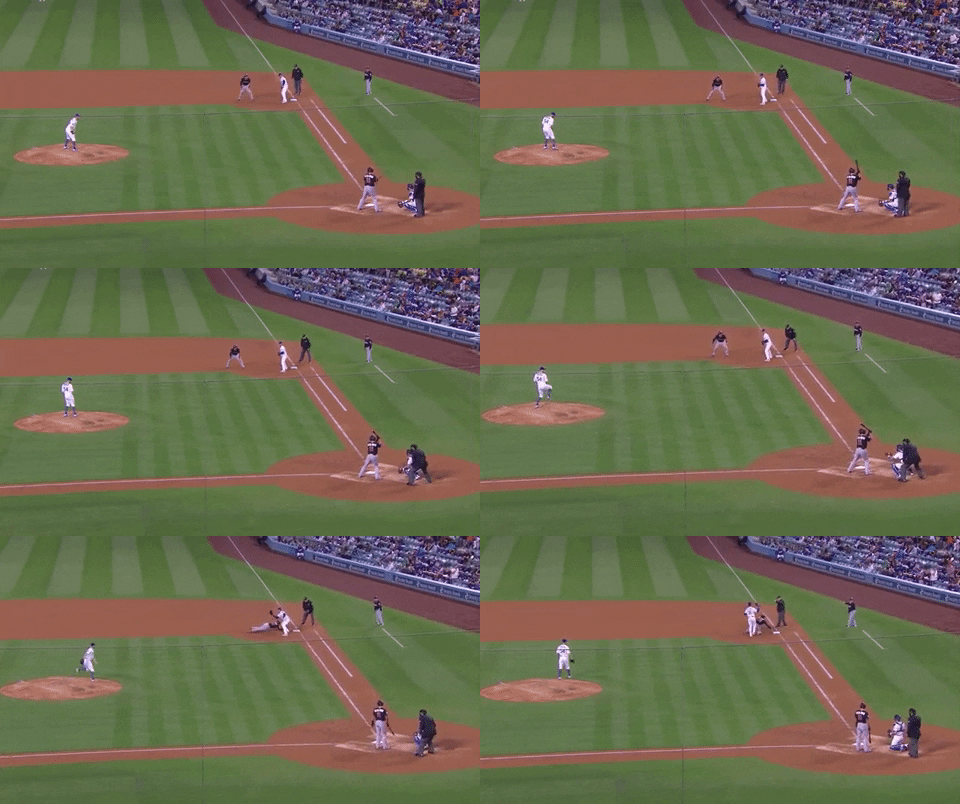
Only days ago, the Red Sox trailed the Blue Jays 8-7 going into the top of the eighth. The Blue Jays might be long past the point of playing for anything, but the Red Sox are still actively trying to hold off the Yankees, and so, with that in mind, every game of theirs is important. The eighth inning was given to Joe Kelly, and with his first pitch, he hit the first batter. With his third pitch, he allowed a single to the second batter. The third batter was Justin Smoak, and consecutive changeups ran the count to 1-and-1. Catcher Sandy Leon expected a breaking ball. Kelly threw a changeup instead.

The pitch — that pitch — was called a ball, with Leon ducking out of surprise. The pitch, of course, was down the middle of the plate, but instead of 1-and-2, the count became 2-and-1. Also, because the ball got away, the runner on second moved up to third. Two pitches later, Smoak hit an RBI single. On the very next pitch, Kendrys Morales hit an RBI double. The Blue Jays pulled away, eventually winning by six. Kelly and Leon were left to wonder how they got crossed up. They were left to wonder, as well, how an obvious strike became a critical ball.

That was almost the worst called ball of the season’s first half. The actual worst called ball, however, came only three days before. Leading up to the All-Star break, we had a little run of these things.

Read the rest of this entry »


Players’ View: Learning and Developing a Pitch, Part 17

Pitchers learn and develop different pitches, and they do so at varying stages of their lives. It might be a curveball in high school, a cutter in college, or a changeup in A-ball. Sometimes the addition or refinement is a natural progression — graduating from Pitching 101 to advanced course work — and often it’s a matter of necessity. In order to get hitters out as the quality of competition improves, a pitcher needs to optimize his repertoire.

In the seventeenth installment of this series, we’ll hear from three pitchers — Matt Barnes, Cam Bedrosian, and Jesse Chavez — on how they learned and/or developed a specific pitch.

———

Matt Barnes (Red Sox) on His Curveball

“I was in Double-A (Portland) with Brandon Workman and Anthony Ranaudo, and I think we were in Trenton, playing the Yankees at their place. I’d just pitched the day before and my curveball wasn’t good. They were like, ‘Try using a spiked grip.’ I was like, ‘I’ve never done it before.’ They said, ‘We both use it,’ and the rest is history. We started playing catch with it and I’ve had that grip ever since.

“Why did it work better for me than a conventional grip? I don’t know. There are little things in baseball. People could be saying the same thing to you, but one verbiage just latches on and allows you to understand it. The grip just felt natural to me. It felt easier to spin the baseball. What you’re trying to do is spin it as fast as you can, downward, to create the action, yet still be able to command it. I wasn’t able to do that with the grip I had before that, and what they showed me worked. Read the rest of this entry »


Why the Cubs and Yankees Should Swap Tyler Chatwood and Sonny Gray

I know what you’re thinking even before you complete the first paragraph of this post: Sheryl’s trade proposal probably sucks.

I don’t blame you. Most trade proposals suck. As we pass the All-Star week contemplating trade value, though, I thought I’d take an opportunity to indulge myself by imagining a deal that makes too much sense (in my head, at least) not to happen. I contend that, before this year’s July 31 trade deadline, the Chicago Cubs should trade Tyler Chatwood to the New York Yankees for Sonny Gray.

One flaw is immediately apparent: contending clubs rarely make trades with other contenders. Why would they? Teams bound for the postseason are typically looking to add present talent while surrendering players with future value. Both the Cubs and Yankees are contenders. Both Chatwood and Gray are major leaguers. So already this is improbable. Because of their struggles, though, Chatwood and Gray actually possess unlocked future value, though — future value that another club, in my opinion, is more likely to unlock.

I’ve written about both pitchers this year. Both have struggled. Let’s start with Chatwood. When I examined his season back on May 22, he had a 3.14 ERA despite an 18.3% walk rate and 102 FIP-, the latter figure mostly on the back of an unsustainable 3% HR/FB. Since then, his walk rate has actually increased; since May 22, he’s recorded an 18.8% walk rate. That’s bad. Not only has Chatwood produced the highest walk rate among pitchers with 30 or more innings this season, but his 18.6% mark would actually represent the second highest among qualifiers* since the integration of baseball.

*The highest mark since integration is 20.3%, produced by Tommy Byrne in 1949. Improbably, Byrne still managed to record a 92 ERA- that year — that is, he prevented runs 8% better than a league-average pitcher. Overall, Byrne made 170 starts in the majors and logged 1362.0 innings, posting a career walk rate of 16.8% but still managing a 103 ERA-.

Read the rest of this entry »


The All-Star Game Is the Worst Part of All-Star Week

Of all those 1970s disaster movies, the worst one for me has always been The Swarm. Featuring an impressive cast, with names such as Michael Caine, Henry Fonda, Richard Chamberlain, José Ferrer, and Olivia de Havilland (along with many others), the film’s stars muddle their way through roughly three uninteresting hours, all the time looking like they had accidentally wandered in from other, more interesting movies. Every star gets his or her own cameo, and typically a random death, like when the bees destroy a helicopter or when the bees derail a train or when Henry Fonda decides to test a vaccine by giving himself a large dose of it and crossing his fingers. I’ll leave any connection between that last misfortune and the Orioles’ most recent offseason to the reader.

Despite the ambition of the film, what it lacked was any sense of fun, any sense of purpose for having assembled such talent. And that’s why it works as an able metaphor for the All-Star Game. There are a lot of great things about All-Star Week. The Futures Game gives the wider public what is, for many, their first look at players like Hunter Greene or Peter Alonso. As used to be the case for the All-Star Game, many of the players involved in the Futures Game are facing off each other for the first time — in this case, thanks to rosters constructed of players from across the minor leagues. That kind of unfamiliarity is rare to see at the major-league level, both because of free agency and also interleague play, the latter of which is now a daily occurrence. But my colleague Travis Sawchik has more on that!

The Home Run Derby is nonsense in a lot of ways, but it’s fun, glorious nonsense, which takes one important aspect of baseball (hitting for power), fills it with helium and cotton candy, and then sends it on its merry way. While cotton candy oughtn’t be the foundation of a every meal, it’s fine for an occasional celebration. As Jay Jaffe noted this morning, last night’s Home Run Derby captured this atmosphere perfectly. The participants were all clearly having a blast and that kind of feeling is infectious. Watching Bryce Harper come from behind in the finals, smacking nine consecutive homers to pass Kyle Schwarber is one of those Big Moments© you remember 10 years later, the kind of thing that makes watching baseball a joyful experience.

Read the rest of this entry »


How Realignment Could Improve the All-Star Game

During FanGraphs’ editorial weekend in Denver last month, this correspondent excused himself to spend some time in the Rockies clubhouse and Coors Field press box. There I found MLB.com Rockies beat writer Thomas Harding realigning baseball in his reporter’s notebook.

This contributor finds playing expansion czar to be an interesting thought exercise. Soon that afternoon, some Mets beats writers also joined the discussion, sharing their thoughts. Anytime there is a realignment-based post on this Web site or elsewhere, it tends to generate interest. Many of us like to play commissioner.

We’re almost certainly headed toward a future of 32 teams. MLB is in its longest expansion drought in the modern era. Rob Manfred has expressed a desire to expand — and preferably to add at least one international location. One of the major benefits Manfred has cited in the move to 32 teams is the ease of scheduling it would create. Namely, the game would not have to schedule a constant, rotating interleague series.

In fact, it would allow MLB to dramatically reduce the need for interleague play altogether.
Read the rest of this entry »


The American League’s All-Star Roster Has More Talent

The National League has won more games than the American League this season in interleague play, but you wouldn’t know it by looking at our individual leaderboards. The top seven position players by WAR this season reside in the American League and 10 of the best 11 — as long as Manny Machado remains in the AL — also play in that league. The parity when it come to interleague record is more likely a function of the National League’s relative parity, while the American League is very top and bottom heavy. The best teams in the AL can only do so much, as the bulk of the NL overwhelms the bottom-feeders in the opposite league.

As for the All-Star rosters, they more closely resemble the leaderboards. The graph below shows the WAR totals for every player on the All-Star Game roster, including those on the active roster but excluding those who have been replaced due to injury or a Sunday start.

Last year, both leagues featured a collective WAR similar to the NL’s mark this season, though the AL was missing Mike Trout. This year, Trout is back and acting like himself, while Mookie Betts and Jose Ramirez seem to be acting a lot like Trout, as well. If we removed the top three players from each roster, the collective WAR totals would be pretty close. That said, the All-Star Game would be also be less entertaining.

Read the rest of this entry »


A Derby That Delivered the Goods

Walk-off. Walk-off! WALK-OFF! Bryce Harper won the 2018 Home Run Derby at Nationals Park in dramatic and impressive fashion, needing less than the full complement of time to beat his opponents in all three rounds. At ease in front of the hometown fans showering him with cheers, the Derby’s No. 2 seed and the only contestant with previous experience rose to the occasion each time. After dispatching seventh-seeded Freddie Freeman and third-seeded Max Muncy in the quarter- and semifinals, the 25-year-old Nationals superstar did have his back to the wall in the final round against fifth-seeded Kyle Schwarber, but with nine homers in the final minute — on 10 swings by my count, though ESPN’s broadcast said nine in a row — he tied the Cubs slugger’s total of 18. On the second pitch of the 30-second bonus period, he lofted a 434-foot drive to center field, then did a two-handed bat flip as the crowd went wild, and quickly handed the trophy to his barrel-chested father, Ron, who had pitched to him:

In a field that was somewhat lacking in star power, with no Mike Trout (who’s never participated), no Aaron Judge (who did not defend the title he won as a rookie in 2017), no Giancarlo Stanton (who won in 2016 but then was upset in his home park last year), and no player from among the season’s top five home-run totals for the first time since at least 2008, Harper — the biggest name from among the eight participants, even if he has struggled by his own standards this season — took center stage. He became just the third player to win the Home Run Derby (which began in 1985) in his home park, after the Cubs’ Ryne Sandberg in 1990 and the Reds’ Todd Frazier in 2015.

Frazier’s win came in the first year of a format that has turned the event from a three-hour slog into a vastly more entertaining spectacle that ran just over two hours. Instead of swinging until having made 10 “outs” (non-homers), players have four minutes to hit as many homers as possible, with the caveat that a ball can’t be pitched until the last one landed. Each player gets one 30-second timeout in the first two rounds and two timeouts in the finals. A player hitting two homers projected by Statcast to have traveled at least 440 feet unlocks an extra 30 seconds of bonus time.

Read the rest of this entry »


The A’s Are Being Led From the Back

Last Tuesday, the A’s played probably the most frustrating game of their season. Facing the first-place Astros in Houston, the A’s erased a 4-0 deficit in the top of the ninth. In the 11th, they pulled ahead on a two-out home run, getting the chance to hand a lead to Blake Treinen. The tying run scored on a fielder’s choice, with Jonathan Lucroy unable to handle a throw home. The losing run scored on a tapper that went about five feet, after Lucroy threw the ball away. It was a tough inning for Lucroy, and it was a rough game for Oakland to stomach, because they’d had the Astros just where they’d wanted them. While the A’s had been hot, you never know which loss might get under a team’s skin.

The A’s came back and beat the Astros the next day. They beat them again the day after that, and then they took two of three in San Francisco. Where just weeks ago it looked almost impossible, we’ve gotten to the All-Star break and now we have a wild-card race. The A’s are catching up to the Mariners, and while every run is a function of a number of players, Oakland’s two standouts are at the back of the bullpen.

Read the rest of this entry »


Previewing the 2018 Home Run Derby

With apologies to the 1960 television show that became a staple of ESPN Classic, the Home Run Derby has been around since 1985, but it wasn’t until the last few years that Major League Baseball found a format that was vastly entertaining: a head-to-head single-elimination bracket setup with timed, four-minute rounds and 30 seconds of bonus time added for hitting two 440-foot homers, as measured by Statcast. In 2015, the first year of that format, Todd Frazier, then of the Reds, became just the second player in Derby history to win in his home park; the Cubs’ Ryne Sandberg was first in 1990. In 2016, the Marlins’ Giancarlo Stanton won at Petco Park, and last year, rookie Aaron Judge beat Stanton on his home turf in Marlins Park — a pair of ideal results that will be tough to top.

Indeed, one of the big drawbacks of the Derby has been its failure to attract a full complement of the game’s elite sluggers; to the extent that complaints about MLB’s failure to market its stars to full advantage rings true, here’s a very good example. Mike Trout has never participated, and Bryce Harper has just once, in 2013. With the Derby and the All-Star Game at Nationals Park in Washington, DC, Harper is back, but he’s the only member of the eight-player field who has participated in a previous Derby. There’s no Judge this year, no Stanton, and no J.D. Martinez or José Ramiréz either. In fact, according to the Washington Post, this is the first year since at least 2008 without a player from among the majors’ top five in homers participating. Just two of the current top 10, the Brewers Jesus Aguilar (sixth with 24, but leading the NL) and Harper (tied for seventh with 23) are involved, and of the eight contestants, just one is from an AL team, the Astros’ Alex Bregman. Let’s call it what it is: a comparatively weak field.

Perhaps that’s because the myth of a post-Derby curse persists; what fall-off there is generally owes to regression in players’ rate of home runs per fly ball, which can owe something to luck. Anyway, these dinger displays are still fun, even in this homer-saturated age, and the timed format is much, much, much better — so much so that I’d even be willing to call Chris Berman out of retirement to repeat that phrase — than the previous slog, during which a batter might take pitch after pitch looking for the right one, and an hour in the competition might go by before somebody was eliminated. That wasn’t compelling television.

Read the rest of this entry »


2018 Trade Value: #41 to #50

Max Scherzer’s contract renders him an option only for big-market clubs.
(Photo: Keith Allison)

As is the annual tradition at FanGraphs, we’re using the week of the All-Star Game — while the industry pauses to take a metaphorical breather — to take stock of the top-50 trade assets in the sport. For more context on exactly what we’re trying to do here, see the honorable-mentions post linked at the top of the page.

For this post and the four to follow, I’ll present a graphic (by way of the wizard Sean Dolinar) breaking down each player’s objective skill level (represented, in this case, by a five-year WAR projection from ZiPS), contract/team-control details, rank in last year’s series, and then year-by-year details of age/WAR/contract through 2023, although a couple players have control beyond those five years. For those readers who are partial to spreadsheets rather than blocks of text, I’ll also include all the players we’ve ranked so far are in grid format at the bottom of the post.

The ZiPS WAR forecasts did influence the rankings a bit: for players who were bunched together, it acted as an impartial tiebreaker of sorts, but the industry opinions I solicited drove the rankings.

With that said, let’s get to the final 10 spots on the Trade Value list this year.

Five-Year WAR +16.3
Guaranteed Dollars
Team Control Through 2024
Previous Rank
Year Age Projected WAR Contract Status
2019 22 +2.2 Pre-Arb
2020 23 +3.0 Pre-Arb
2021 24 +3.7 Pre-Arb
2022 25 +3.7 Arb1
2023 26 +3.7 Arb2
Pre-Arb
Arb

This last spot, as I’m sure was true on all of the versions of the list Dave did, was a tough to decide upon. As you can see from the honorable mentions, basically every type of player has a solid candidate for this spot. One could argue on behalf of Matt Olson, for example, that he’s a similar player to Tucker, has just one fewer year of control, and has already posted 3.6 WAR in his first 167 games. That said, Tucker seems to get a bit of a boost from the industry because of his recent call-up and that isn’t all nonsense: calling a top prospect up to a contending team before there’s any incentives by way of service time suggests the things non-Astros people know about Tucker (mental makeup, etc.) are positive.

Read the rest of this entry »