Archive for Featured

Choose Your Own Lineup Adventure: On-Base vs. Slugging

Let’s get right down to the question that all baseball analysis is asking at its core: Which of these two players would you rather have on your team, all else being equal?

Two Mystery Players
Player AVG OBP SLG wOBA
Player A .319 .387 .469 .371
Player B .267 .328 .556 .372

It’s a close one, right? That’s largely because I decreed it to be so; these aren’t real players, just stat lines I made up that have the same wOBA. Who would you rather have? They’re extremely different, of course; one gets a ton of value from walks and singles, with some doubles sprinkled in for good measure. You can surmise that the other gets a ton of value from home runs — look at that slugging percentage — but does worse elsewhere.

Oh yeah, a few other caveats. These are underlying talent levels; you might look at Player A and say that the BABIP can’t continue, or Player B and say the HR/FB rate can’t be real, but for our purposes, these are the lines they’ll put up over 1,000 PA, or 10,000, or 1,000,000. This is their real skill level. Given that, in most cases, it doesn’t matter much which one you choose, because they’re about the same. That’s the point of wOBA, after all.

That’s not a very interesting answer, so I decided to go deeper. I constructed a generic American League lineup. I removed intentional walks so that we’re comparing apples to apples. The result looks like this:

Generic Batting Order
Order BA OBP SLG wOBA
1 .261 .328 .423 .325
2 .256 .324 .423 .323
3 .255 .332 .458 .339
4 .255 .325 .453 .333
5 .248 .319 .431 .323
6 .240 .308 .408 .309
7 .233 .294 .399 .299
8 .227 .289 .371 .287
9 .228 .293 .360 .285

I threw that lineup into a lightly modified version of my lineup simulator, a short snippet of code that lets you put in a lineup (based on the probability of each outcome every time they bat) and get an estimate of how many runs they’d score per game. This one comes out to 4.53 runs per contest, which is close enough to the actual AL average for my purposes. Read the rest of this entry »

The Best Bunts of the Year, Part Two

Yesterday, I compiled the worst bunts of the season. They were bad in various ways — poor execution, great defense, a spot where failing was particularly painful — but they all cost their team dearly. Today, we’re looking at the opposite: the bunts that have added the most value.

As a refresher, this absolute gem was the best bunt of the first third of the season:

That perfect execution of an audacious plan is the platonic ideal of a bunt. If every successful bunt this season was like that, this would be a really fun series to write. A well-placed bunt is art; post five of those, and I could skate by with almost no commentary and let the GIFs do the talking.

Sadly, that’s not quite the case. There’s quite a bit of bad defense this time around — plenty of errors in the top five. That’s just how bunts work: they’re designed to force the defense to make a play, and while defenders are excellent, they’re not automatons. A sacrifice bunt that works as planned is never going to be one of the best plays a team can make — it’s designed to minimize variance, neither as bad as a strikeout nor as good as a single. The best bunts of the year by WPA, then, need to either score runs without surrendering outs or feature dubious fielding.

So yeah, some of these bunts aren’t perfectly placed gems that the defense has to eat. Some of them are just players making bad throws or bad decisions. As a palate cleanser, though, take a look at this beautiful honorable mention. Read the rest of this entry »


The Worst Bunts of the Year, Part Two

Earlier this year, I took a look at the worst (and best) bunts of the year. I couldn’t help myself. It’s simply too much fun to watch the best-laid bunting plans go down in flames, while a perfectly executed bunt is one of the most exciting plays in baseball.

Originally, I planned on waiting until the end of the season to update both lists. I forgot something, though: the end of the season is really busy and fun as it is. Playoff races, individual awards, wondering where the Mets went so wrong. There are already innumerable annual traditions to write about at season’s end. Instead, I decided to get a head start on these standout bunts, and circle back if one improbably beats them out for the worst (or best) bunt of the year.

As a reminder, here was the worst bunt of the first third of the season:

That one was really bad, both in execution and outcome. It cost the Cardinals dearly — more than a quarter of a win by WPA. It’s not easy to lose so much value in a single play on offense. With that in mind, I’ll be answering a bonus question for each bunt in this list: was it worse than José Rondón’s ill-fated attempt? Without further ado, let’s get bunting. Read the rest of this entry »


Team Entropy 2021: Let’s Get Wild

This is the second installment of this year’s Team Entropy series, my recurring look not only at the races for the remaining playoff spots but the potential for end-of-season chaos in the form of down-to-the-wire suspense and even tiebreakers. Ideally, we want more ties than the men’s department at Macy’s. If you’re new to this, please read the introduction here.

Heading into July 4, at the exact midpoint of their season, the Yankees were just 41-40. Beset by injuries and underperformance, they even scraped .500 before the fireworks could go off, losing the first game of a holiday doubleheader to the Mets before rebounding to take the nightcap. From July 4 until now, they’ve gone 39-24, good for the second-best record in the entire American League, and good enough to vault them back into contention for a playoff spot, though not enough to catch the Rays, who have gone 42-19 in that stretch.

Within that impressive hot streak are two shorter, diametrically opposed streaks, however. From July 4 through August 27, the Yankees went 35-11, the hottest 46-game span of any team in the majors all season, and one capped by a 13-game winning streak, tied for the majors’ longest. The tear vaulted them from sixth in the AL Wild Card race, five games out of the second spot, and into the Wild Card lead, three games ahead of the second Wild Card team (the Red Sox), and 6 1/2 games ahead of the race’s third-place team (the A’s). Since then, however, the Yankees have skidded to an AL-worst 4-12 record, and they’ve now got company; at 80-64, they’re a game behind the Wild Card-leading Blue Jays (81-63) and in a virtual tie with the Red Sox (81-65).

That skid — aided by the Jays going 38-25 from July 4 through Monday, and 15-2 while the Yankees have gone 4-12, a situation that Ben Clemens detailed on Monday — has created quite a pileup in AL Wild Card race, where five teams are separated by just 2 1/2 games from top to bottom. The NL Wild Card race is similarly tight; while the second-place team in the NL West (currently the Dodgers) is head and shoulders above the rest of the group, five other teams are separated by just 3 1/2 games top to bottom. The chances of getting bonus baseball in each league — a do-or-die game just for the right to play in the do-or-die Wild Card game — are a bit better than one in six. As to how the various scenarios will be disentangled, that’s a job for the latest Team Entropy 2021 installment. Read the rest of this entry »


Are Hitters Who Swing At More Strikes and Fewer Balls Actually Better?

If you’ve read any of my articles of late, you would know that I am currently fixated on plate discipline. My piece on Jarred Kelenic sparked an article on take value and hitter approach. After that, a discovery that Darin Ruf is succeeding with one of the lowest swing rates in baseball despite not having phenomenal plate discipline on the surface inspired research into zone-swing differential and what it may tell us about a hitter.

Under the plate discipline section of player pages and on our leaderboards, we list both O-Swing% and Z-Swing%. On a handful of occasions, though, writers here have used zone-swing differential. Chet Gutwein defined this stat as D-Swing% in his piece about the NL West, and Justin Choi wrote about it in an article on the Blue Jays’ aggressiveness in early counts. In my most recent piece on Ruf, I cited zone-swing differential to conclude that while his overall swing rate is low, his discipline might not actually be that good, as he’s still swinging at a fair amount of pitches outside the zone, which you can see when you look at his below-average D-Swing rate.

The idea behind D-Swing% is simple: Hitters should be better when they swing at strikes and take balls. This isn’t the only way to succeed at the plate, but you would think that better hitters would have higher D-Swing rates on average. There were a couple comments about D-Swing rate on my Ruf piece, and that inspired me to look into it further. Is this a stat that tells us more about hitters than what we already have with the standalone O-Swing% and Z-Swing% stats?

This exact question was actually explored on the FanGraphs community blog back in 2017, where user Dominikk85 broke hitters into top- and bottom-30 groups by wRC+, ISO, OBP, and BABIP to see if O-Swing%, Z-Swing%, or what they referred to as Z-O-Swing% had the biggest impact in explaining the difference between the groups. They found that being more aggressive in the strike zone “helps the power but seems to slightly hurt the OBP,” but overall, they saw an advantage in using D-Swing% over the individual components.

I ran a similar study, but I wanted to control for more variables — zone rate and contact rate — to isolate the effect of D-Swing%, as many plate discipline metrics are interrelated. You may swing less at pitches in the strike zone if you are seeing more pitches outside, or you may choose to swing at pitches in the strike zone with which you can make contact (preferably hard), which may lower your Z-Swing% but raise your Z-Contact%. Without at least attempting to adjust for some of these variables, we may be missing out on conscious hitter tendencies that may be more the result of the pitches that they are seeing rather than their inherent swing choices. Read the rest of this entry »


The Blue Jays Soar Into Playoff Position

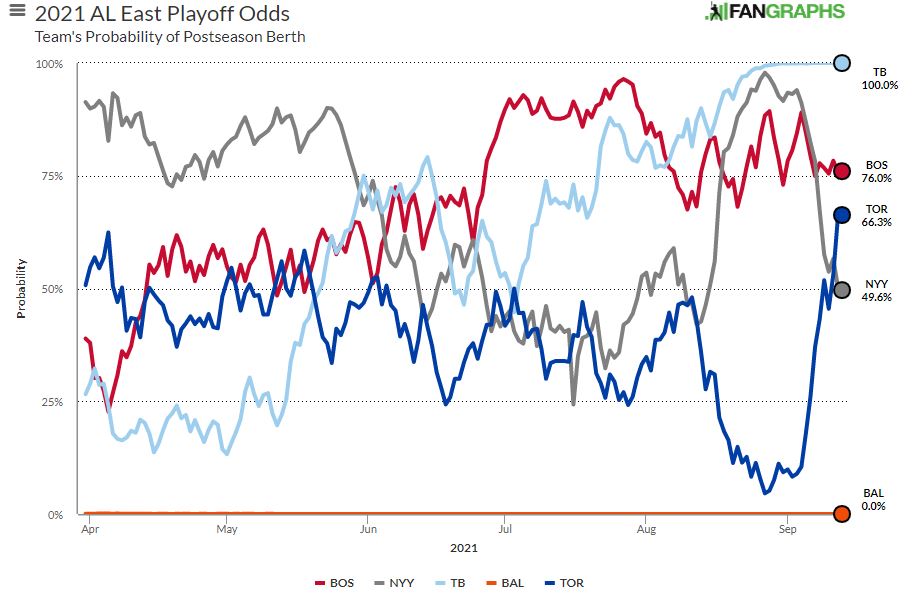
Mere weeks ago, the Toronto Blue Jays were 66-61, the last of five teams in contention for two Wild Card spots. They looked the part — their +112 run differential led those five, and adding José Berríos at the deadline helped stabilize their rotation. That’s all well and good, but they were 6.5 games out of the second Wild Card, and their bullpen was undoing a lot of the rotation’s good work, especially new acquisition Brad Hand’s 8.22 ERA and 8.12 FIP.

Despite their evident talent, our playoff odds game them only a 4.7% chance of reaching the playoffs at their nadir on August 27. A one-in-20 shot isn’t impossible — less than 5% of plate appearances end in a home run, and yet we see tons of those every day — but things didn’t look good for Toronto. But here we are, three weeks later, and the Jays are in the first Wild Card spot (in a tie for it, but still). How did those rampaging Jays do it? Let’s take a look. Here’s a graph of what we’ll be talking about:

First things first: if you want to overcome a big deficit quickly, stop losing. The Jays have gone 14-2 in their past 16 games, scoring a comical 7.5 runs per game while allowing just over four themselves. That’s good for a Pythagorean record of .774 (using the Pythagenpat formulation of it), or in regular English, “Stop using a record estimator when a team is scoring twice as many runs as they allow, of course they’re doing well.” Read the rest of this entry »


Max Scherzer Chases Perfection and Collects Milestones

Max Scherzer couldn’t quite pull off a trifecta for the ages on Sunday, but he was utterly dominant nonetheless. Facing the Padres in Los Angeles, he entered the history books with a flourish by becoming the 19th pitcher to reach 3,000 strikeouts, and just the third to record three immaculate innings — nine pitches, nine strikes, three strikeouts — in a career. Along the way, the 37-year-old righty retired the first 22 batters he faced, giving chase to a perfect game and his third career no-hitter, but he couldn’t complete that feat, as Eric Hosmer, who earlier in the game had become his 3,000th strikeout victim, broke up his bid with an eighth-inning double into the right field corner.

Not that the hit put a damper on the afternoon given what Scherzer accomplished. Making his eighth start for the Dodgers and needing six strikeouts to reach the milestone, he simply dominated the Padres all afternoon. He got to work quickly, striking out leadoff hitter Trent Grisham and needing just 12 pitches to get through the first, before mowing down Fernando Tatis Jr., Hosmer, and Tommy Pham consecutively on three-pitch strikeouts in the second.

The immaculate inning made Scherzer the third pitcher and the first right-hander to total three such innings in his career, joining lefties Sandy Koufax and Chris Sale. Scherzer previously threw immaculate innings against the Phillies (May 14, 2017) and Rays (June 5, 2018). Read the rest of this entry »


The Past, Present, and Future of International Scouting

“I was at dinner with our scout in Japan and he made a comment that even truck drivers throw 95 over here,” said Oakland’s Assistant General Manager Dan Feinstein. “That caught my attention. I said, ‘If that’s true, maybe we should be trying out some of these truck drivers.'”

Feinstein soon decided to run an experiment. Oakland advertised an open tryout for pitchers and invited players with a college pedigree to send video to the A’s scouting department. From there, the team invited 60 of them to throw in front of scouts. One of them, right-hander Shohei Tomioka, bumped 95 on the gun, which impressed Oakland enough to offer him a contract then and there. “We call it the truck driver tryout,” Feinstein said with a chuckle.

Tomioka’s story was only possible because of a brilliant combination of scouting and technology, with a dash of luck mixed in. His signing is also an indication that the international talent market is laden with players just waiting to be discovered. See, Tomioka wasn’t simply a truck driver with a live arm. He was an experienced pitcher, a graduate of one of Tokyo’s top baseball programs — he was just never seen at the right time by the right people. By the time Oakland discovered him, he was loitering in a small local league. “There’s a lot of independent ball over there,” Feinstein says, “and he had been pitching in one of these kind of obscure leagues. He was free to try out and was throwing 95 so we signed him.”

For anyone lamenting the rise of big tech in baseball or the demise of the scout, Tomioka is living proof that, for good and for ill, an element of the unpredictable remains in the game. His signing demonstrates the value of having a robust international department, while also highlighting how fertile the international market is today, and how teams that invest abroad now stand to reap a competitive advantage in the years to come. To get a better sense of how that might develop, let’s take a deeper dive into how teams scout internationally today. Read the rest of this entry »


Sunday Notes: Xzavion Curry is Commanding Attention

Xzavion Curry is a prospect-on-the-rise in the Cleveland organization. A seventh-round pick in 2019 out of Georgia Tech, the 23-year-old right-hander is 8-1 with a 2.23 ERA in 18 starts between Low-A Lynchburg and High-A Lake County. With the lion’s share at the latter, Curry has allowed just 65 hits in 93 innings. Moreover, he’s fanned 118 batters and issued just 16 free passes.

Command is Curry’s forte, but it’s not his only attribute. As our own Eric Longenhagen wrote in early June, the 5-foot-11, 195-pound hurler’s “vertical arm slot creates angle and carry on a fastball that plays well at the letters.” Augmenting Curry’s 91-94 mph four-seamer are a curveball, a slider, and a changeup.

He’s only been a full-time pitcher for a handful of years. Curry came to Georgia Tech as a two-way player, having excelled both on the mound and at short as an Atlanta-area prep. That his college coaches made him a full-time pitcher is a testament to changing times. Curry is African-American, and Black players have historically been channeled into position-player roles. Black pitchers have been at a premium.

“That does enter my mind,” said Curry, who had a 17-inning scoreless streak come to an end earlier this week. “As I go around to different places, and play different teams, I don’t really see a lot of Black pitchers. So that is something I’ve noticed, but as the younger generation goes forward, those guys just keep getting better and better. We have a couple in our organization, and I’m pretty sure we’ll start to see more and more Black pitchers.”

Curry cited a different sport when addressing his plus command. Read the rest of this entry »


Team Entropy 2021: Back to (Somewhat) Normal

Less than four weeks remain in the 2021 regular season, and while the coronavirus pandemic continues due to the Delta surge, MLB is back to some semblance of normalcy (though don’t tell that to the Red Sox). We’ve got a 162-game regular season, a comprehensible 10-team postseason format, the possibility of actual tiebreaker games being played if necessary — all of which were off the table last season — and no neutral sites. We’ve got some real playoff races as well, with the potential to produce end-of-season chaos.

Welcome back to Team Entropy. If you’re new here, don’t worry, I’ll catch you up.

A decade ago, during the wild 2011 races that resulted in the Rays and Cardinals snatching spots away from the collapsing Red Sox and Braves, respectively, on the season’s final day, I coined the phrase “Team Entropy” — taking a page from the Second Law of Thermodynamics, which states that all systems tend toward disorder — to describe the phenomenon of rooting for scenarios that produced such mayhem. I’ve returned to the concept annually, tracking the possibilities for end-of-season, multi-team pileups that would require MLB to deviate from its previously scheduled programming.

The idea is that if you’re a die-hard fan of a team trying to secure (or avoid blowing) a playoff spot, flag-waving for your squad of choice takes precedence, but if you’ve embraced the modern day’s maximalist menu of options that allow one not just to watch scoreboards but also to view multiple games on multiple gadgets, you want more. More baseball in the form of final-weekend division and Wild Card races. More baseball in the form of extra innings and tiebreaker scenarios topped with mustard and sauerkraut (though alas, the dastardly Manfred Man will still be mucking up those tiebreakers if they go past nine innings). You have TVs, laptops, tablets, and phones stacked like a Nam June Paik installation so you can monitor all the action at once. You want the MLB schedule-makers to contemplate entering the Federal Witness Protection Program instead of untangling once-far-fetched scenarios. If all that sounds familiar, you’re one of us. Read the rest of this entry »