Archive for Featured

Pablo López Is One of Baseball’s Most Overlooked Starters

© Orlando Ramirez-USA TODAY Sports

Last week, I talked about a few young players who teams should be itching to sign to long-term contracts. Due to public demand, another set of projections is on the way, but I’ll admit I intentionally omitted one pitcher, Pablo López, from the first look because I wanted more space to talk about him.

Unlike a lot of pitchers the Marlins have accumulated during their various fire sales, López wasn’t a highly touted arm in the minors. Prior to 2017 — the season during which he and three other players were traded by the Mariners to the Marlins for reliever David Phelps — he was basically a non-entity among prospect-watchers. He didn’t receive an official ZiPS projection that year, but if he had, it would have been similar to the projection he received before the 2018 season, which essentially saw him as a below-average innings-eater at his peak. At no time did he rank on a ZiPS Top 100 prospect list.

His first couple of campaigns with the Marlins featured decidedly mixed results. While López was essentially a league-average pitcher thanks to exit velocities that ranked towards the top of the league (the good kind of top of the league), he lacked the ability to finish off batters. From 2018-19, he basically threw four pitches: a relatively straight fastball, a sinker, a curve, and a changeup. None them were whiff-makers, and none of them had even a 20% put-away rate, resulting in a mediocre 7.5 K/9 combined over those two seasons. Read the rest of this entry »


Sunday Notes: Sergio Romo Doesn’t Plan to Pitch Forever (Really)

Sergio Romo moved past Walter Johnson on the all-time pitching appearances list a few days ago. Now in his fifteenth season, and his first with the Seattle Mariners, the 39-year-old right-hander has taken the mound 804 times, a number that only 49 others have reached. Also in front of Tyler Clippard following yesterday’s outing in Boston, Romo was at 798 games to begin the campaign.

I asked the bearded-and-tattooed reliever when he started becoming aware of his place in history.

“This season, really,” Romo told me on Friday. “Earlier in my career, it had been more of a blur. But coming into this year, it was kind of, ‘Hey, man…’ My wife, too. She was aware of it. She was, ‘You’re two away from 800,’ so I started paying attention.”

Asked for his thoughts on having just passed a legendary Hall of Famer, Romo responded with a smiling, “Take that, Walter!”

Romo knows his history. “The Big Train” pitched long before he was alive — from 1907 through 1927 — but his legacy is no mystery.

“He was an infamous flame-thrower, and a guy who commanded a lot of respect,” said Romo. “He pitched a lot of innings, and he did it throwing gas. I actually play with Walter Johnson every now and again in MLB: The Show, The’ve got a lot of greats in that game. Hank Aaron, Willie McCovey… a lot of those guys.”

Nolan Ryan pitched in 807 games on his way to immortality.R omo will soon pass “The Ryan Express” on the all-time appearances, as well. I asked the owner of 137 saves, and a career 3.09 ERA, what it feels like — obvious caveats aside — to be in such company. Read the rest of this entry »


What Does Max Scherzer’s Injury Mean for the Mets?

© Wendell Cruz-USA TODAY Sports

The Mets lost another starting pitcher on Thursday, as the team announced that the pain that forced Max Scherzer from his start Wednesday has been diagnosed as a moderate to high grade oblique sprain; the anticipated timetable for Scherzer’s return is six to eight weeks. After throwing a slider to Albert Pujols, Scherzer was in visible discomfort and quickly pulled the plug himself, sparing Buck Showalter the most dangerous part of a manager’s job: telling Max Scherzer to hit the showers:

The loss of Scherzer comes at a time the Mets are already down two other starting pitchers (three if you count Joey Lucchesi‘s loss to Tommy John surgery, which I’m not). Most notably, Jacob deGrom’s 2022 season has yet to begin due to a stress reaction in his right scapula. Tylor Megill is also currently on the IL due to biceps tendinitis diagnosed after the worst start of his professional career. Luckily, there’s reason to be hopeful in both cases. The most recent imaging of deGrom’s scapula indicated it is healing effectively, raising hopes that the ace’s return isn’t too far off. Meanwhile, Megill’s MRI didn’t reveal anything darker than a case of tendinitis, and he’s already scheduled to play catch today:

Read the rest of this entry »


The New and Improved Corbin Burnes, Now With More Pitches per Start!

© Michael McLoone-USA TODAY Sports

This Wednesday, Corbin Burnes had a forgettable start. In six innings, he allowed four runs and struck out five while walking none. The scoring came courtesy of two home runs, a three-run shot by Austin Riley and a solo homer by Marcell Ozuna. Burnes lasted six innings, and while the Brewers ended up winning the game 7-6 in extras, it wasn’t exactly the kind of start you expect from the defending NL Cy Young winner.

Last year, Burnes was downright electric en route to winning the award. He led the NL in ERA at 2.43, and his ERA was significantly higher than his 1.63 FIP. He struck out 35.6% of the batters he faced while walking only 5.2%. He did it in only 28 starts and 167 innings, which raised questions about the trade-off between transcendent pitching and bulk innings.

If you only looked at his first and most recent starts of 2022, you might think the same thing was happening again. You’ve already heard about the most recent one; in his first start, he went five innings against the Cubs, allowed three earned runs, and struck out only four while walking three. Sure, the runs were uncharacteristic, but five and six inning starts? We’ve seen that before. Read the rest of this entry »


San Diego Padres Top 35 Prospects

© Rick Scuteri-USA TODAY Sports

Below is an analysis of the prospects in the farm system of the San Diego Padres. Scouting reports were compiled with information provided by industry sources as well as my own observations. This is the second year we’re delineating between two anticipated relief roles, the abbreviations for which you’ll see in the “position” column below: MIRP for multi-inning relief pitchers, and SIRP for single-inning relief pitchers.

A quick overview of what FV (Future Value) means can be found here. A much deeper overview can be found here.

All of the numbered prospects below also appear on The Board, a resource the site offers featuring sortable scouting information for every organization. It has more details than this article and integrates every team’s list so readers can compare prospects across farm systems. It can be found here. Read the rest of this entry »


The (Lack of A) Conspiracy Against Pitcher Wins

© Gregory Fisher-USA TODAY Sports

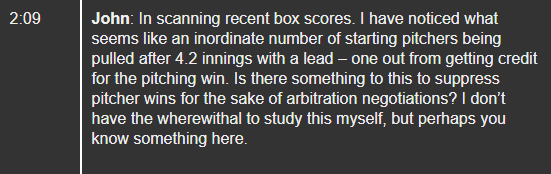
Yesterday, a reader in my chat asked me a question I had no idea how to answer: Are teams increasingly pulling pitchers from games after 4 2/3 innings, even with the lead, in an attempt to cut down on wins and arbitration payouts? Here’s the question in its entirety:

My snap judgment was “probably not.” After thinking about it for a while longer, my answer is still no – but now I have some neat graphs and charts that will hopefully make the point clear. Without further ado, let’s dive into the shape of league-wide starting pitching trends since 1974, the first year in our database of game logs.

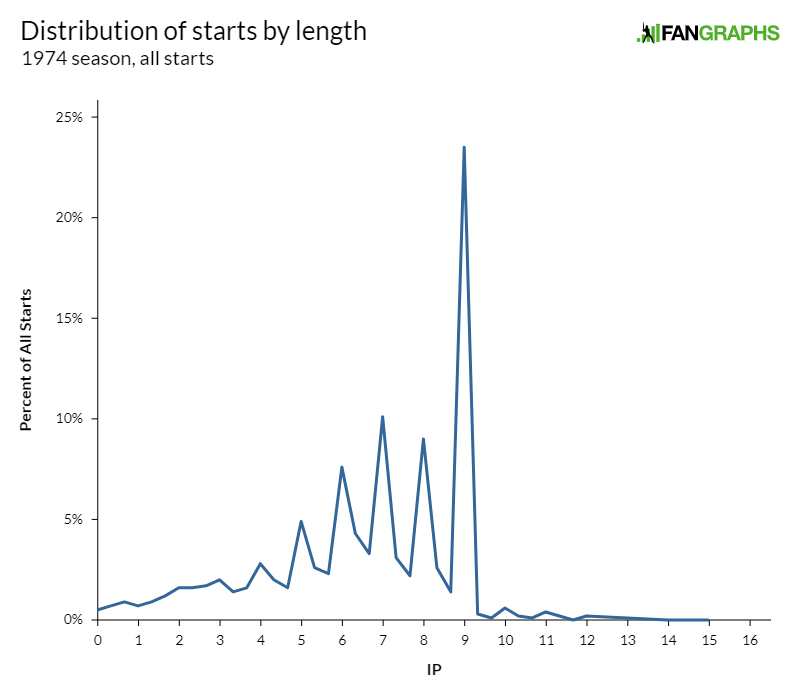
In 1974, the concept of a five-inning start existed, but it was almost an insult. More than a quarter of starts went nine or more innings. That’s hard to do, particularly when that’s an impossible feat for a visiting team that trails after the top of the ninth inning. If that’s roughly a quarter of games (it’s not every game the visiting team loses, but road teams lose more than half of the games they play), that means that roughly a third of eligible starts went at least a full nine. That’s downright wild. Here’s a graph of that wildness:

There were a few short starts, even back in the 1970s – 21% of starts went fewer than five innings. More importantly, a pattern we’ll see repeated again and again is immediately evident. Managers like leaving their pitchers in for a whole number of innings. It’s a natural endpoint to the day, mid-inning pitching changes can be tricky, it’s a way of boosting your starter’s confidence – there are plenty of reasons for this to be the case, and I’m not sure which is most true, but that’s just a fact of baseball. Managers like to pull their starters between innings rather than partway through. Read the rest of this entry »


Hunter Greene and the No-Hitter That Wasn’t

Hunter Greene
Charles LeClaire-USA TODAY Sports

It was weird, it was wild, it was perhaps a bit irresponsible, and it was certainly bittersweet. On Sunday in Pittsburgh, Reds rookie Hunter Greene was dominant, setting a career high for strikeouts and combining with reliever Art Warren to hold the Pirates hitless for the entire afternoon. Yet when it was all said and done, Cincinnati — which had won six out of its last nine after starting the season 3–22 — found a new way to lose, 1–0. Greene and Warren didn’t even get credit for an official no-hitter, combined or otherwise.

The game’s only run scored in the bottom of the eighth inning. After Greene issued a pair of one-out walks to Rodolfo Castro and Michael Perez to push his pitch count to 118 — oh, we’ll get to that — manager David Bell pulled him in favor of Warren, who walked Ben Gamel, then induced a chopper by Ke’Bryan Hayes. Second baseman Alejo Lopez briefly bobbled the ball, and while he still threw to shortstop Matt Reynolds in time to force Gamel, Reynolds’ throw to first base was too late to complete the double play.

The Reds themselves managed just four hits against starter José Quintana and relievers Chris Stratton and David Bednar, the last of whom set down the side 1-2-3 in the ninth. Thus they joined a short and dubious list, becoming just the fifth team to hold their opponents hitless for eight innings but lose because they were nonetheless outscored. Such efforts used to be considered no-hitters, but in 1991, MLB’s Committee for Statistical Accuracy tightened the official definition of the feat, ruling that those falling short of nine innings would not receive such a designation. That put the Reds in this company:

Eight No-Hit Innings But Lost
Pitcher(s) Team Opponent Date Score
Silver King Chicago (PL) Brooklyn (PL) 6/21/1890 0-1
Andy Hawkins Yankees White Sox 7/1/1990 0-4
Matt Young Red Sox Cleveland 4/12/1992 1-2
Jered Weaver (6), Jose Arredondo (2) Angels Dodgers 6/28/2008 0-1
Hunter Greene (7.1), Art Warren (0.2) Reds Pirates 5/15/2022 0-1
SOURCE: nonohitters.com
PL = Players League

The most infamous of such games is that of Hawkins, who allowed four eighth-inning runs via a combination of three errors and two walks, all with two outs; he did walk five overall, so his outing was kind of a mess to begin with. Greene and Warren combined to walk six, but they were the only one of the five teams above to lose after eight hitless innings without being charged with an error as well. Congrats on discovering that new way to lose, I guess. Read the rest of this entry »


Dallas Keuchel’s Changeup Has Stayed the Same, While Brent Suter’s Has Evolved

© Matt Marton-USA TODAY Sports

The Learning and Developing a Pitch series is back for another season, and once again, we’re hearing from pitchers on a notable weapon in their arsenal. Today’s installment features a pair of southpaws — White Sox starter Dallas Keuchel and Brewers reliever Brent Suter — on their changeups.

———

Dallas Keuchel, Chicago White Sox

“A changeup was the first pitch I learned growing up. My dad never let me throw a breaking ball. He just had me split my fingers and try to throw a fastball as hard as I could. That was probably … let me think for a moment with my Rolodex here. I was maybe eight years old? Regardless, I don’t know how many miles per hour it was off, but it had some good deception and movement, so that’s what I rolled with through a lot of my childhood.

“I didn’t grip it like a palm ball, but a kid’s fingers are obviously smaller than the baseball, so we just tinkered with splitting the two fingers. What stuck was splitting three fingers together, instead of a circle change. It’s more of a three-finger prong changeup. When I say prong, what I mean is like a fork. But it worked well for me. It just kind of rolled off, and I’d get some whiffs and some weak contact. Read the rest of this entry »


Sunday Notes: Taylor Davis Wants To Manage (or Work in a Front Office)

Taylor Davis plans to stay in the game once his playing days are over. Currently on the roster of the Indianapolis Indians — Pittsburgh’s Triple-A affiliate — the 32-year-old catcher intends to become a coach, a manager, or a decision-maker in a front office. He’s already received overtures for one of those positions.

“The question does get asked,” said Davis, whose resume includes 22 MLB games over parts of four seasons. “It’s something that started even before I got to the big leagues. The first time I got asked if I wanted to coach was in 2017. That was early in the year, and then I ended up making my debut later that season. Obviously, I want to play for as long as I can, but after it’s done, doing something within the game is what I want.”

Managing might be his primary down-the-road goal, but the erstwhile Chicago Cub would also be well-suited for a corner-office role. Asked about that possibility, Davis said that he’d be equally happy wearing a polo shirt or a uniform. Roster construction and “the whole business side of the game” are among his interests. So is the data that influences, and often dictates, the decisions that are made.

“I dive into analytics probably more than the average player,” the veteran catcher explained during spring training. “I try to understand where teams are coming from, where agents are coming from, and where a player is going to come from in terms of analytics. It’s a piece of the puzzle that’s become increasing important.” Read the rest of this entry »


Seattle Mariners Top 31 Prospects

© Stephen Brashear-USA TODAY Sports

Below is an analysis of the prospects in the farm system of the Seattle Mariners. Scouting reports were compiled with information provided by industry sources as well as my own observations. This is the second year we’re delineating between two anticipated relief roles, the abbreviations for which you’ll see in the “position” column below: MIRP for multi-inning relief pitchers, and SIRP for single-inning relief pitchers.

A quick overview of what FV (Future Value) means can be found here. A much deeper overview can be found here.

All of the numbered prospects below also appear on The Board, a resource the site offers featuring sortable scouting information for every organization. It has more details than this article and integrates every team’s list so readers can compare prospects across farm systems. It can be found here. Read the rest of this entry »