On the strength of his monster home run and an additional RBI groundout, Vladimir Guerrero Jr. took home MVP honors from the All-Star Game at Coors Field on Tuesday night. In doing so, the 22-year-old slugger — who also nearly decapitated National League starter Max Scherzer with his hardest-hit ball of the evening — became the youngest player ever to win that award. The performance was just the latest chapter of Guerrero’s breakout, as he lives up to the high expectations set by his pedigree and his precocious development.
If for some reason you haven’t seen his highlights from Tuesday night, here’s Guerrero’s first-inning plate appearance, where his 111.1 mph rocket back through the box produced such a close call that Guerrero felt obliged to apologize to Scherzer, who remarked after the game, “I’m alive… that’s the success story… I’m just grateful I still have a blue eye and a brown eye”:
And here’s Guerrero’s third-inning homer off Corbin Burnes:
The 468-footer was the longest All-Star Game homer of the Statcast era, surpassing Kris Bryant’s 2016 shot by a good 58 feet. With it, Guerrero became the second-youngest player to go yard in an All-Star Game, after Johnny Bench did so in 1969 at the age of 21 years and 228 days. In winning MVP honors, Guerrero, at 22 years and 119 days, surpassed Ken Griffey Jr., who was 117 days older when he won in 1992. Meanwhile, Guerrero and dad Vlad joined the Griffeys and Bobby and Barry Bonds as the only father/son combinations to homer in the All-Star Game.
With the single-game spotlight and honors behind him, Guerrero is now angling to become the youngest position player to win a regular season MVP award; he won’t surpass pitcher Vida Blue, who was 22 years and 64 days old on the final day of the 1971 season, but would surpass Bench, who was 22 years and 298 days on the final day of the ’70 season. He and his father, the AL MVP in 2004, would be the first pair to win the award. Of course, the competition for Guerrero to win is daunting given the ongoing tour de force of Shohei Ohtani. A month ago, Guerrero led the AL in all three Triple Crown categories and WAR, kindling a debate over the merits of that combination relative to Ohtani’s pitching. At that point, Dan Szymborski estimated Vladito’s chances of winning the Triple Crown at 19.1%, but the five-homer lead he held over Ohtani has become a five-homer lead for Ohtani (33-28) thanks to the Angels’ superstar’s recent flurry. Guerrero’s .332 batting average and 73 RBI both still leads the AL, as does his .439 on-base percentage, 189 wRC+, and 4.6 position player WAR, though Ohtani has taken over the combined WAR lead at 5.5, and has a slugging percentage 40 points higher than Guerrero’s .658.
Regardless of whether he’s first or second in any category, Guerrero has taken a massive leap forward from his performances in 2019 and ’20, which were solid enough for a 20- or 21-year-old, but hardly All-Star caliber. After batting .272/.339/.433 (105 wRC+) in 2019, he showed more power last year, hitting .262/.329/.462 (112 wRC+); his ISO jumped by 37 points, and his home run rate rose from 2.9% to 3.7%, a gain of about 28%.
Guerrero is showing even greater in-game power this year — his display in the 2019 Home Run Derby provided more evidence of raw power than anyone this side of Iggy and the Stooges — as you can see from the basic numbers, but before discussing that, it’s worth acknowledging his improved plate discipline. He’s cut his rate of swinging at pitches outside the strike zone from 31.6% as a rookie to 27.4% last year and then 25.3% this year; among qualifiers, he’s climbed from the 46th percentile to the 70th and now the 83rd. As a result, he’s posted the majors’ fifth-largest gain in walk rate from 2020 to ’21, jumping 5.7 percentage points to 13.9%; only Starling Marte (+7.9%,), Joey Gallo (+7.7%), Carlos Correa (5.9%), and Andrew McCutchen (+5.8%) have gained more. While Guerrero is striking out more as well (up two points to 17.6%), he’s still in the 70th percentile in that category.
The biggest difference in his performance relative to 2020, though, is how much harder he’s hitting the ball:
Vladimir Guerrero Jr. Batted Ball Profile
| Season |
GB/FB |
GB% |
EV |
Barrel% |
HardHit% |
AVG |
xBA |
SLG |
xSLG |
wOBA |
xwOBA |
| 2019 |
1.50 |
49.6% |
89.5 |
6.9% |
37.9% |
.272 |
.254 |
.433 |
.433 |
.329 |
.326 |
| 2020 |
1.96 |
54.6% |
92.5 |
8.7% |
50.8% |
.262 |
.260 |
.462 |
.437 |
.338 |
.331 |
| 2021 |
1.35 |
44.8% |
95.2 |
16.7% |
55.6% |
.332 |
.318 |
.658 |
.625 |
.453 |
.436 |
Guerrero’s exit velocity already ranked in the 93rd percentile last year, but he was hitting grounders about twice as often as fly balls. He still hits more grounders than flies, but his 9.8 percentage point drop in groundball rate is the majors’ fourth-largest behind Jonathan Villar (-14.0%), Kyle Schwarber (-10.6%), and Kevin Pillar (-9.9%). He’s nearly doubled his average launch angle (from 4.6 degrees to 8.4), and with it, has nearly doubled his barrel rate while increasing his already-high hard-hit rate. A picture is worth a thousand words:
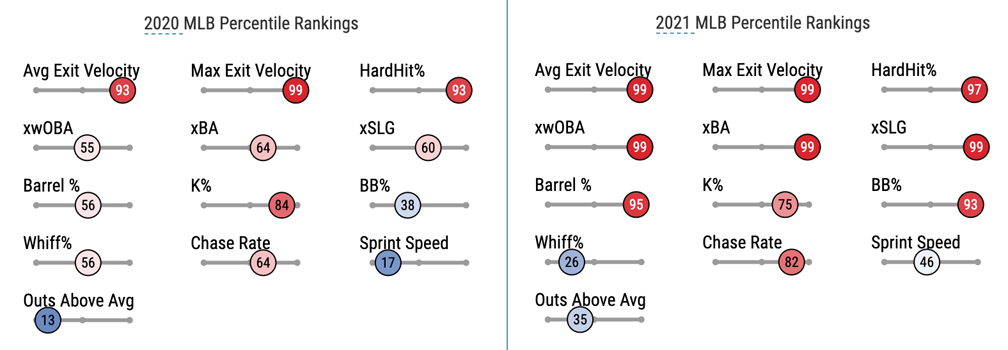
Guerrero has improved in every Statcast-tracked category here — even the ones that pertain to his speed and defense, the evidence of the better conditioning and work he’s put into learning a new(ish) position — except for maximum exit velocity, where he already ranked in the 99th percentile. In case you were worried that he was stagnating, he has actually shown improvement there nonetheless, from last year’s 116.1 mph to 117.4 (for what it’s worth, he topped both with a 118.9 mph single in 2019). Fittingly, where last year’s hardest-hit ball was a lineout to second base, this year’s was a home run off the Rays’ Ryan Yarbrough, the first of the two he hit on May 24 at the team’s temporary Dunedin home:
That first one had a projected distance of 461 feet, four short of his regular season career long, set just eight days earlier off the Phillies’ Brandon Kintzler, also in Dunedin:
Guerrero’s All-Star Game homer topped that, albeit with an assist from Coors Field’s altitude (which added 32 feet, according to Weather Applied Metrics’ Ken Arneson) if not the wind (which took away 10).
On the subject of harnessing his incredible bat speed towards improving his ability to get the ball in the air, in April our own Carmen Ciardiello wrote about the possibility of Guerrero improving what he called his attack angle to better launch the ball. Using an approximation based upon the top 5% of each player’s hardest-hit batted balls, Ciardiello compared Guerrero to the other mighty sluggers with similar maximum exit velocities and estimated his attack angle at 8.71 degrees. Only Giancarlo Stanton (8.74 degrees) had one nearly as flat, while Ronald Acuña Jr. had the highest angle at 17.86 degrees, followed by Trout at 16.94. In my attempt to track this as a potential explanation for Guerrerro’s year-to-year improvement, I calculated that based upon his top 5% of hard-hit balls, his attack angle has actually dipped to an average of 6.69 degrees; five of his 13 hardest-hit balls thus far have negative launch angles, meaning that they were hit on the ground, while only four are double-digit positives, all of them homers. I’ll leave it to Ciardello for further interpretation of those results.
Looking at Guerrero’s year-to-year improvement by pitch type what quickly becomes apparent is that he’s now a serial murderer of four-seam fastballs; he’s gone from a .254 AVG, .465 SLG, and .356 wOBA against them last year to a .386 AVG, .830 SLG, and .538 wOBA. Among players with at least 100 PA ending in four-seamers, only Juan Soto has a higher average, while those other two figures are tops. Guerrero’s 18 runs above average against four-seamers is the highest of any player against any pitch, and represents a full 18-run gain relative to last year as well. His other big improvements are against sliders, where he’s gained eight runs (from +1 to +9) primarily by improving from .576 SLG to .633, and sinkers, where he’s gained six runs (from +3 to +9) primarily by improving from .485 SLG to .614.
Using 200-PA cutoffs for both last year and this one, Guerrero owns the majors’ biggest gains in both slugging percentage and wRC+. Here’s the top 15 for the former:
Largest Gains in Slugging Percentage, 2020-21
Minimum 200 plate appearances in both seasons.
And here’s the latter:
Largest Gains in wRC+, 2020-21
| Player |
Team |
2020 |
2021 |
Dif |
| Vladimir Guerrero Jr. |
TOR |
112 |
189 |
78 |
| Bryan Reynolds |
PIT |
72 |
146 |
74 |
| J.D. Martinez |
BOS |
77 |
145 |
69 |
| Joey Gallo |
TEX |
86 |
153 |
67 |
| Max Muncy |
LAD |
100 |
165 |
65 |
| Jose Altuve |
HOU |
77 |
138 |
61 |
| Adam Frazier |
PIT |
80 |
137 |
57 |
| Yuli Gurriel |
HOU |
79 |
136 |
57 |
| Nick Castellanos |
CIN |
102 |
156 |
54 |
| Eduardo Escobar |
ARI |
56 |
108 |
53 |
| Matt Olson |
OAK |
103 |
156 |
53 |
| Carlos Correa |
HOU |
98 |
149 |
52 |
| Javier Báez |
CHC |
57 |
107 |
50 |
| Kyle Schwarber |
CHC/WAS |
91 |
140 |
49 |
| Nolan Arenado |
COL/STL |
76 |
120 |
44 |
Minimum 200 plate appearances in both seasons.
I should point out that my somewhat arbitrary choice of 200 PA as a cutoff for both seasons — made in part because I wanted batting title qualifiers for 2020, but then 186 PA just looked weird — meant leaving Ohtani off the tables given that he had just 175 PA last year. His 332-point gain in slugging percentage (from .366 to .698) and 98-point gain in wRC+ (from 82 to 180) dwarf the gains of Guerrero and the rest, so if you want to imagine a version of the tables with him on top, you’re free to do so.
So long as we’re talking improvements, it’s worth noting Guerrero’s progress on the defensive side. After a rough introduction to the majors at third base in 2019 (-9.4 UZR, -3 DRS, and -19 OAA in just 824 innings), he split last season between first base (-1.8 UZR, -4 DRS, -2 OAA in 324 innings) and DH. Particularly given his weight and conditioning issues — he showed up to summer camp somewhere in the vicinity of 285 pounds — his future appeared to tilt towards the latter slot, limiting his ceiling. After apologizing to his teammates for showing up out of shape last summer, he lost 42 pounds this past winter and appears to have kept the weight off. His mobility and flexibility have improved and so have his defensive numbers, which are now within hailing distance of average (-0.5 UZR, -2 DRS, and 0 OAA in 576.2 innings).
Even for a player who was so heavily touted as a prospect — recall that he was the consensus number one heading into 2019 — Guerrero has come a long way in a short time, and what he’s doing at such a young age puts him alongside the likes of Soto and Fernando Tatis Jr., not to mention some of the game’s other recent prodigies:
Highest WAR by Position Players 22 & Under Since 2012
| Rk |
Player |
Team |
Season |
Age |
G |
PA |
HR |
AVG |
OBP |
SLG |
wRC+ |
WAR |
| 1 |
Mike Trout |
LAA |
2013 |
21 |
157 |
716 |
27 |
.323 |
.432 |
.557 |
176 |
10.2 |
| 2 |
Mike Trout |
LAA |
2012 |
20 |
139 |
639 |
30 |
.326 |
.399 |
.564 |
167 |
10.1 |
| 3 |
Bryce Harper |
WSN |
2015 |
22 |
153 |
654 |
42 |
.330 |
.460 |
.649 |
197 |
9.3 |
| 4 |
Mike Trout |
LAA |
2014 |
22 |
157 |
705 |
36 |
.287 |
.377 |
.561 |
167 |
8.3 |
| 5 |
Corey Seager |
LAD |
2016 |
22 |
157 |
687 |
26 |
.308 |
.365 |
.512 |
136 |
6.9 |
| 6 |
Manny Machado |
BAL |
2015 |
22 |
162 |
713 |
35 |
.286 |
.359 |
.502 |
135 |
6.6 |
| 7 |
Rafael Devers |
BOS |
2019 |
22 |
156 |
702 |
32 |
.311 |
.361 |
.555 |
133 |
5.9 |
| 8 |
Ronald Acuna Jr. |
ATL |
2019 |
21 |
156 |
715 |
41 |
.280 |
.365 |
.518 |
126 |
5.6 |
| 9 |
Francisco Lindor |
CLE |
2016 |
22 |
158 |
684 |
15 |
.301 |
.358 |
.435 |
109 |
5.5 |
| 10 |
Jason Heyward |
ATL |
2012 |
22 |
158 |
651 |
27 |
.269 |
.335 |
.479 |
121 |
5.3 |
| 11 |
Carlos Correa |
HOU |
2016 |
21 |
153 |
660 |
20 |
.274 |
.361 |
.451 |
123 |
5.2 |
| 12 |
Manny Machado |
BAL |
2013 |
20 |
156 |
710 |
14 |
.283 |
.314 |
.432 |
102 |
5.0 |
| 13 |
Juan Soto |
WSN |
2019 |
20 |
150 |
659 |
34 |
.282 |
.401 |
.548 |
142 |
4.9 |
| 14 |
Mookie Betts |
BOS |
2015 |
22 |
145 |
654 |
18 |
.291 |
.341 |
.479 |
120 |
4.8 |
| 15T |
Xander Bogaerts |
BOS |
2015 |
22 |
156 |
654 |
7 |
.320 |
.355 |
.421 |
111 |
4.6 |
| 15T |
Ozzie Albies |
ATL |
2019 |
22 |
160 |
702 |
24 |
.295 |
.352 |
.500 |
116 |
4.6 |
| 15T |
Vladimir Guerrero Jr. |
TOR |
2021 |
22 |
87 |
374 |
28 |
.332 |
.430 |
.658 |
189 |
4.6 |
| 18 |
Bryce Harper |
WSN |
2012 |
19 |
139 |
597 |
22 |
.270 |
.340 |
.477 |
121 |
4.4 |
| 19 |
Christian Yelich |
MIA |
2014 |
22 |
144 |
660 |
9 |
.284 |
.362 |
.402 |
118 |
4.1 |
| 20T |
Fernando Tatis Jr. |
SDP |
2021 |
22 |
74 |
313 |
28 |
.286 |
.364 |
.656 |
168 |
4.0 |
| 20T |
Cody Bellinger |
LAD |
2017 |
21 |
132 |
548 |
39 |
.267 |
.352 |
.581 |
138 |
4.0 |
Right now, Guerrero has the highest slugging percentage and wRC+ of any of the bunch, though preserving that distinction is no small challenge given the amount of season remaining. Our rest-of-season projections forecast him to add another 2.3 WAR, which would tie him with Seager for fifth on the list. At the rate he’s going, it would hardly be a surprise if he climbs higher.