Archive for Featured

The 40-Man Situations That Could Impact Trades

Tampa Bay’s pre-deadline activity — trading bat-first prospect Nick Solak for electric reliever Peter Fairbanks, then moving recently-DFA’d reliever Ian Gibaut for a Player to be Named, and sending reliever Hunter Wood and injured post-prospect infielder Christian Arroyo to Cleveland for international bonus space and outfielder Ruben Cardenas, a recent late-round pick who was overachieving at Low-A — got us thinking about how teams’ anticipation of the fall 40-man deadline might impact their activity and the way they value individual prospects, especially for contending teams.

In November, teams will need to decide which minor league players to expose to other teams through the Rule 5 Draft, or protect from the Draft by adding them to their 40-man roster. Deciding who to expose means evaluating players, sure, but it also means considering factors like player redundancy (like Tampa seemed to when they moved Solak) and whether a prospect is too raw to be a realistic Rule 5 target, as well as other little variables such as the number of option years a player has left, whether he’s making the league minimum or in arbitration, and if there are other, freely available alternatives to a team’s current talent (which happens a lot to slugging first base types).

Teams with an especially high number of rostered players under contract for 2020 and with many prospects who would need to be added to the 40-man in the offseason have what is often called a “40-man crunch,” “spillover,” or “churn,” meaning that that team has incentive to clear the overflow of players away via trade for something they can keep — pool space, comp picks, or typically younger players whose 40-man clocks are further from midnight — rather than do nothing, and later lose players on waivers or in the Rule 5 draft.

As we sat twiddling our thumbs, waiting for it to rain trades or not, we compiled quick breakdowns of contending teams’ 40-man situations, using the Roster Resource pages to see who has the biggest crunch coming and might behave differently in the trade market because of it. The Rays, in adding Fairbanks and rental second baseman Eric Sogard while trading Solak, Arroyo, etc., filled a short-term need at second with a really good player and upgraded a relief spot while thinning out their 40-man in preparation for injured pitchers Anthony Banda and Tyler Glasnow to come off the 60-day IL and rejoin the roster. These sorts of considerations probably impacted how the Cubs valued Thomas Hatch in today’s acquisition of David Phelps from Toronto, as Hatch will need to be Rule 5 protected this fall.

For this exercise, we used contenders with 40% or higher playoff odds, which gives us the Astros, Yankees, Twins, Indians, Red Sox, and Rays in the AL and the Dodgers, Braves, Nationals, Cubs, and Cardinals in the NL, with the Brewers, Phillies, and A’s as the teams just missing the cut. Read the rest of this entry »


Phillies Add a Modest Upgrade in Jason Vargas

The Phillies have bolstered the back-end of a flagging rotation, which by some measures ranks among the National League’s worst. What’s more, they’ve done so through an upgrade obtained from within the division, namely the Mets’ Jason Vargas. The 36-year-old southpaw doesn’t light up radar guns or dominate hitters, but he does give a youngish rotation a left-handed presence with playoff experience — and at a negligible cost to boot. His being dealt by the Mets was highly anticipated, not only given Sunday’s acquisition of Marcus Stroman, but also because he angered the Mets’ brass with his involvement in a clubhouse altercation with a beat reporter in June.

Philadelphia gets:

LHP Jason Vargas
Cash considerations

New York gets:

C Austin Bossart

Vargas, who is now in his 14th major league season, has rebounded from a dreadful, injury-wracked 2018, during which he was torched for a 5.77 ERA and 5.02 FIP in just 92 innings, and an ugly beginning to this year when he yielded 10 runs in his first 6.1 innings and failed to last five innings in three of his first four starts. Overall, he’s pitched to a 4.01 ERA and 4.71 FIP, and since returning from a mid-May left hamstring strain that cost him 19 days, he’s turned in a 3.34 ERA and 4.01 FIP.

Read the rest of this entry »


Marcus Stroman is Now a Met, for Some Reason

While it might not be a surprise that the Blue Jays’ Marcus Stroman is the first big-name player to be traded in advance of the coming July 31 deadline, the team on the other end of the transaction has raised some eyebrows. At 50-55, the Mets are running fourth in the National League East (11 1/2 games out of first place), and seventh in the NL Wild Card race (six games out). Acquiring the 28-year-old righty, who has one more year of club control remaining, in exchange for a pair of pitching prospects appears to be both a prelude to another deal involving a Mets starting pitcher and a signal that the team intends to contend next season rather than plunge itself into a more substantial rebuild. The alternative — that first-year general manager Brodie Van Wagenen is doubling down on a disappointing team whose playoff odds are just 11.2% (10.5% for the Wild Card) — well, that would be quite the four-dimensional chess move.

New York gets:

RHP Marcus Stroman
Cash considerations

Toronto gets:

LHP Anthony Kay
RHP Simeon Woods-Richardson

Stroman has pitched far better than his 6-11 won-loss record indicates. Entering Sunday, his 2.96 ERA ranks fifth in the AL, his 3.52 FIP sixth, his 2.9 WAR 10th. In a season where home runs are more common than ever before (1.38 per team per game), he owns the league’s third-lowest rate per nine innings (0.72), in part because he’s excelled at keeping the ball on the ground; his 56.3% groundball rate is the Junior Circuit’s highest. Read the rest of this entry »


Sunday Notes: Zack Britton Bought an Edgertronic

Zack Britton bought himself an Edgertronic earlier this month. He’s pondering purchasing a Rapsodo, as well. The Yankees southpaw boasts a 2.57 ERA — and MLB’s highest ground-ball rate, to boot — but that doesn’t mean he’s satisfied. Once the offseason rolls around, Britton plans to fine-tune his arsenal even more.

If you’re a hitter chagrined by this news, blame his nerdiest teammate.

“I bought all the [Edgertronic] equipment, and wired it up in my house,” Britton told me yesterday. “Talking with Adam Ottavino about what he’s been doing the last two off-seasons is what really piqued my interest. It’s a way to keep up with how we’re being evaluated now, and it allows us to make adjustments faster.”

While a primary driver, Ottavino’s influence wasn’t the sole selling point. Britton hasn’t had a chance to put his new purchase to use, but the 31-year-old former Oriole has thrown in front of an Edgertronic before.

“The Yankees have high-speed cameras at the Stadium,” explained Britton. “I’ve noticed differences with both my breaking ball and my sinker. I can see where my hand position is when I throw a good pitch. Rather than just feeling my way through an adjustment, I can get instant feedback on the adjustments I need to make.”

Britton had the winter months in mind when he went shopping. While details still need to be worked out, the plan is to link his Edgertronic — and perhaps a Rapsodo — with ones used by the Yankees.

“We can communicate back and forth during the offseason,” said Britton. “[Pitching coach] Larry Rothschild can see the numbers and know the things I’m doing. And if there’s anything they want to see, I can try it and then send them the data. We have the technology to where we can do that.” Read the rest of this entry »


The 2019 Replacement-Level Killers: Center Fielders and Designated Hitters

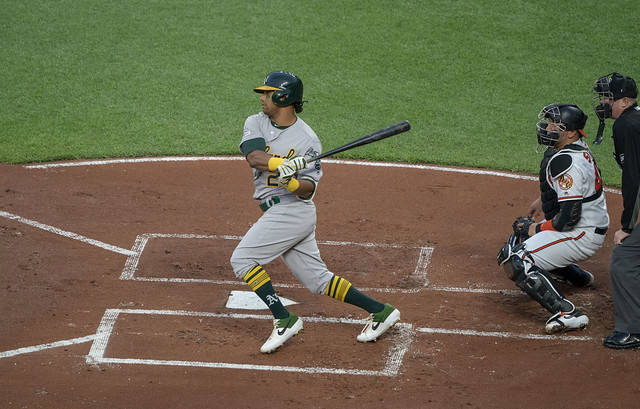
Injuries have limited Khris Davis’ production at DH. (Photo: Keith Allison)

We are lucky to live in the time of Mike Trout, whose 186 wRC+ is tops in baseball, but — seemingly like the rest of the world around us — the game’s current crop of center fielders appears to be going to hell in a handbasket. The position’s average wRC+ of 93 is the lowest for the 2002-2019 period covered by our splits, and translates to “literally half as productive as Trout, relative to the league.” Woof.

Given that, it shouldn’t come as too great a surprise that several contenders — which for this series I’ve defined as teams who are above .500 or have playoff odds of at least 10.0%, a definition that currently covers 18 teams (make up your damn minds already, Rangers) — are getting meager production from the middle pasture (less than 1.0 WAR at the spot), making them eligible for a spot among the Replacement Level Killers. As the July 31 trade deadline approaches, there’s an urgency to patch that problem, particularly given that the August waiver period during which they can tweak the roster is no more. Even so, I’m less concerned about these teams’ eventual solutions, whether via trades or internal options, than in pointing out the problems. I’m a real hit at parties.

At the other end of the defensive spectrum, and at the very last stop in this series, we’re in an age where relatively few teams have devoted the designated hitter spot to a single batter. Just three teams have given their DHs enough plate appearances at the position to qualify for the batting title (3.1 PA per team game), and just three contenders have given a single player even 200 PA at DH. With the position’s production from AL teams at a modest 103 wRC+, eight points below last year and the third-lowest mark of the 2002-19 period, it shouldn’t be too surprising that several contenders are enduring Killer-type situations. Given that defensive competence doesn’t matter a bit, this shouldn’t be too hard to fix, and yet here we are.

Replacement Level Killers: Center Fielders
Rk Team AVG OBP SLG wRC+ Bat BsR Fld WAR
26 Phillies .215 .285 .368 71 -16.5 2.3 -3.8 -0.3
25 Cubs .244 .298 .381 74 -14.5 -0.6 -0.8 -0.1
24 Indians .226 .290 .401 78 -12.5 2.3 -5.4 0.1
17 Giants .244 .281 .407 78 -12.3 2.4 1.6 0.7
16 Nationals .239 .304 .409 83 -9.5 3.2 -1.4 0.7
All statistics through July 25. Rk = WAR rank among all 30 teams.

Note that I’m waving off the Nationals here. Rookie Victor Robles has been a mild disappointment with the bat (90 wRC+), but even so, he’s been worth 1.1 WAR overall even considering his modest -0.8 UZR, and even better than that if we swap in his 10 DRS. It’s Michael Taylor’s -0.5 WAR in 69 PA at the spot that’s pushed them below the threshold, and given that he’s safely stashed in the minors, this is one area the Nationals don’t have to worry too much about. Read the rest of this entry »


A Different Way of Looking at Home Run Rate

Recently, I’ve been pondering the strange way I think about HR/FB ratio. On one hand, it’s a way to explain away a hot or cold stretch from a hitter. When Joc Pederson got off to a blazing start this year, I looked at his HR/FB, a spicy 33.3% through the end of April, and told myself it was a small sample size phenomena. That’s the first way I use HR/FB for hitters — as a sanity check.

At the same time, HR/FB is something we’ve all used to explain someone’s power. Joey Gallo is powerful, obviously. How do we know that? Well, he hits the ball really hard, which gets expressed by more of his fly balls turning into home runs. Gallo had a 47.6% HR/FB at the end of April, and even though I didn’t expect that to continue, I was willing to accept high numbers for Gallo’s HR/FB much more easily than I was for Pederson.

This leaves HR/FB in a weird spot. It’s a number we use to see if players are getting lucky or unlucky relative to average, but it’s also a number we use to look for underlying skill. Problems arise when it’s unclear what is noise and what is signal. Is David Fletcher unlucky to have a 5.4% HR/FB? Surely not — he’s a contact hitter. Is Jose Ramirez unlucky to have a 6.5% HR/FB? I assume so, but I only assume so because he hit 39 home runs with a 16.9% HR/FB last year. What if last year was the outlier, not this one?

Another way to think about this conundrum is that HR/FB contains an inherent contradiction we have to work around mentally. Putting fly balls as the bottom of the ratio implies that all fly balls are created equal, and that’s clearly untrue. Gallo is unloading on the ball, crushing many of the fly balls he hits into orbit. Fletcher, meanwhile, sports one of the lowest average exit velocities in the game. Even though a home run counts the same for each, the population of fly balls is tremendously different. How do we handle this contradiction? Read the rest of this entry »


The 2019 Replacement-Level Killers: Corner Outfielders

The A’s corner outfield spots could use an upgrade, with Chad Pinder often pressed into service in left. (Photo: Keith Allison)

Traditionally, the outfield corners are home to heavy hitters. This year’s crop of right fielders has combined for a 110 wRC+, one point ahead of first basemen for the current major-league high as well as the highest mark at the position since 2011. The left fielders’ collective mark of 106 is the majors’ third-highest, one point ahead of that of third basemen, and the position’s second-best mark since 2011.

Even so, several contenders — which for this series I’ve defined as teams who are above .500 or have playoff odds of at least 10.0%, a definition that as of today currently covers 17 teams — are getting meager offensive production at one corner or another, by which I mean receiving less than 1.0 WAR at the spot, which makes them eligible for a place among the Replacement Level Killers. As the July 31 trade deadline approaches, they may want to do something about that, particularly since there’s no August waiver period during which they can tweak the roster. Having said that, I’m somewhat less focused on these teams’ eventual solutions, whether via trades or internal options, than I am in pointing out the problems.

Also, note that I’ve ruled out including the Angels among the left fielders, since the mid-June return of Justin Upton, who had been sidelined for nearly three months by turf toe, has already provided the team a substantial upgrade; even while slumping lately, he’s accounted for 0.3 of the team’s 0.6 WAR in 25 games, a 2.0 WAR pace over 162.

Read the rest of this entry »


The Changing Landscape for Flat Ground Throwing

Spend any time in a big-league ballpark in the hours before first pitch, and you’ll likely see a pitcher standing in short right or left field, throwing a flat ground. He’ll start his delivery just inside the foul line, feet planted on green grass. His catcher will be around 45 or 50 feet away, half-crouched in the shallow part of the outfield usually reserved for soft line drives. The pitcher will wind and deliver eight or nine times, usually at something like 80% effort, before huddling with his catcher and perhaps a coach or two. Then, gloves loose in their hands, the men will walk back to the dugout to continue their pregame routines.

That scene plays out hundreds of times a day in ballparks across the country. But the practice of throwing flat grounds has come under scrutiny recently, as coaches and front office personnel increasingly worry about the risk of an injury. Over the last few months, I asked a dozen or so players, coaches, and executives about flat grounds and how they’re used. After those conversations, I’m confident in two things: One, most teams who’ve thought hard about the practice have concluded that it has a neutral effect at best and could potentially be harmful. And two, that flat grounds probably aren’t going away anytime soon.

First, the case for flat grounds. For the most part, pitchers I asked told me that they just want to get a better sense of how individual pitches feel coming out of their hands. For that, they insisted, it doesn’t matter whether you’re throwing off a mound or on the field, and faced with the choice between schlepping out to a bullpen mound or simply stepping from the dugout into short right or left field, they prefer the latter. Many discounted immediately my theory that the lack of a drop-down from the mound interrupts upper-half timing based on the moment the front foot hits the ground. “I’ve been throwing flat grounds all my life,” said Marco Gonzales, “and I’ve never noticed a difference.”

But a number of coaches I spoke to expressed variations of the same concern: That practicing pitches on flat ground when they will eventually need to be thrown off a mound gives players bad information about what their repertoire will actually look like in-game.

“We’ve found that the feel guys get for the plate isn’t accurate [while throwing flat grounds],” said the Mariners’ Brian DeLunas. “For sliders and split-fingers especially, you’re just not going to get the same break. I have guys out there who’ll try to throw those pitches, and they’ll be like, damn, this pitch isn’t working! But if your slider isn’t breaking on a 50-foot throw, that’s actually good, because it really should be breaking in the last 15 or so feet.”

There are also elements of standard pitching deliveries that have in-game consequences but simply can’t be practiced on flat ground. “With a flat ground,” said Carl Willis, the Indians’ pitching coach, “the risk is that because you’re not able to get as much extension [on the front half], the consistency of work can suffer. Sometimes you’ll see a guy lose his posture as he comes down the slope, and you want to be able to maintain that posture throughout games. The only way you can really know it, and feel it, is to practice it on the mound.”

But the argument for flat grounds has never been that they replicate an in-game environment. The case is that they’re convenient, and require substantially less effort — and therefore presumably create less wear-and-tear for tired arms — than throwing full-speed off a mound. But is that last claim actually true?

In 2017, Driveline Baseball released a study (building off of a 2014 article in the American Journal of Sports Medicine) that suggested that, holding velocity constant, flat ground pitching generates about 6% more stress on elbows and shoulders than throwing off the mound. Critically, the study also found that stress does not decrease linearly with reduced effort, which means that if pitchers are throwing at 80-90% velocity on flat ground, the stress on their arms is likely about the same as it would be throwing full speed off the mound. Internal studies reaching similar conclusions have led the Mariners, at least, to try eliminating the practice altogether throughout their system (though with limited effect). Other teams have not gone quite as far, despite acknowledging the public evidence.

“If you’re talking about these guys throwing high-effort, it’s a proven fact that flat grounds can be more harmful at the same rate of speed than on the mound,” said Oakland’s pitching coach Scott Emerson. “But if you slow it down, it’s ok. They mostly just use it for target practice. And I’m just using it to see how the pitches look coming out of their hands. Nothing more than that.”

“In my experience, the flat ground can take a little bit of stress off of the arm for guys who are trying to recover,” said Willis. “That’s simply because they’re not working down the slope. That foot plant [which comes 4-6 inches above where it would off the mound] does hinder some extension a little bit, but if you can maintain that delivery, sometimes it tends to help with the recovery, coming back to make your next start.”

To my ear, the persistence of the practice league-wide in the face of reasonably sound evidence that its main theoretical benefit (the lower effort required) isn’t actually a benefit at all seems less about arm stress than convenience.

Most big-league teams carry 12-13 pitchers, and most big-league parks are equipped with just five outdoor mounds: two in the bullpen for each team, and one in the center of the diamond. If teams insisted that their pitchers throw exclusively off of mounds, they’d still only have two mounds to use (the mound on the field being, of course, in use for batting practice, and the remaining four divided between two teams). That would add an element of coordination to a pre-game period already rife with competing priorities for players’ time. “Besides,” one coach told me, “most of our players just aren’t going to walk their asses the 150 yards from the dugout to the bullpen to do their work.”

There’s also a degree of inertia: flat grounds persist because they’re something players have always done. This starts in amateur leagues, where the imbalance between mounds available and players using them is even more stark than in the pros, and where there is even less knowledge of the potentially harmful effects. Gonzales’s response to my question, quoted above, was typical of player responses for this story. Most reacted to my questions about flat grounds as if I had asked them if they put their pants on one leg at a time in the morning, or why they eat breakfast before lunch; they just do, and don’t think much about it. “I’d love it if we had six or seven mounds so we could do all our work there,” said Emerson. “But we don’t. For a lot of our guys this is just a part of their daily routines.”

But as conservative as baseball can be about its traditions and routines, the last two decades of constant self-evaluation and reinvention by coaches and front offices demonstrates that even long-held practices can change when they’re no longer deemed useful. “I don’t think that clubs have really thought hard enough about the risks to flat grounds,” said Bobby Evans, the former Giants’ general manager. “I think the assumption is that it’s just a warmup, when it might really be something that can put players at risk of injury. I want to know more.”

I do, too. There’s a benefit to allowing players to continue long-established routines, to be sure, and it’s probably one I underrate as an external observer of the game. But the evidence for flat grounds as a practice seems flimsy, and I’m not sure I’d be all that invested in it even if the evidence were good. At the very least, I’d welcome the opportunity to learn more about its biomechanical effects. For now, I’m with DeLunas: “Can you imagine a golfer going to the range and spending their afternoon hitting the ball with the back of the club over and over? They would never, ever do that. So why do we?”

The wonderful David Laurila contributed reporting by interviewing Cleveland’s Carl Willis.


Predicting the 2019 Trade Deadline

With just a week to go before the trade deadline, it still isn’t entirely clear which teams will endeavor to make additions for a pennant run, and which teams will cash in their 2019 chips to play for another year. In the American League, nine of 15 teams have at least an outside shot at the postseason, with seven clubs having a legitimate chance. The National League is even more competitive, with every team but the Marlins possessing some chance at the playoffs, and eight clubs having a reasonable path to the postseason.

Below, we’ll go through the trade scenarios for the teams considering moves. Keep in mind, much of these proposed swaps are simply a framework for how a deal might look. Also important to keep in mind? Most of these predictions will be completely incorrect! Please consume the deals below responsibly, and use this as a preview of what teams need, want, and might do over the next week. Unless any of the predicted deals happen; in that case, I expect to receive full credit.

First, some things that won’t happen:

Star Pitchers Are Staying Put

The Tigers aren’t likely to get the kind of offer they want for Matthew Boyd, who has given up 15 homers in his last eight starts. The Mets aren’t going to get the young stars they want for Noah Syndergaard. Cleveland seems less likely to deal Trevor Bauer now that they are back in the race. Zack Greinke and Robbie Ray probably aren’t going anywhere. Even Caleb Smith of the Marlins, or Brad Keller and Jake Junis of the Royals, seem destined to stay put.

The big question remaining is San Francisco, which brings us to a few things that will (maybe) happen: Read the rest of this entry »


Let’s Make Some Trades: The 2019 Edition

Going into the trade deadline last year, I put on my Dictator of MLB hat and made some trade deadline moves of my own. Upon further review, it turned out that my declarations while wearing a magical, virtual hat were not binding on any team; I was unable to force those trades to actually happen. While I have not obtained the desired legal authority over the last calendar year, it was a fun exercise, so I am reviving it ahead of next week’s deadline.

The basic rules are simple. I can’t guarantee that every trade will be thought of as fair by every reader — indeed, I can guarantee the opposite — but I did make a real effort to at least construct trades that were plausible. That is, except for the very last section, where I am explicitly trying to make wild trades, spitballing how a team could pull off a trade that ought to be impossible.

The Milwaukee Brewers acquire P Marcus Stroman from the Toronto Blue Jays for SS Mauricio Dubon, OF Trent Grisham, P Aaron Ashby, and 2B Travis Shaw

Brandon Woodruff’s injury throws a monkey wrench into the works for the Brewers, and with one of the weaker rotations among first-tier playoff contenders, something’s gotta give. While Stroman has expressed a desire to go to the Yankees, the Brewers ought to have more motivation, unless James Paxton is secretly injured. Brice Turang is the shortstop horse to bet on in the Brewers system, and Dubon is sufficiently close to the majors to tempt the Blue Jays, who have seemed to prefer near-major league ready prospects for reasons that elude me. Grisham would give Toronto a near-future bat who is increasingly intriguing, and Ashby would fulfill the team’s need to have every player in the minor league system related to a former major leaguer. Shaw isn’t here to actually add much, but instead to give Toronto an opportunity to rehab his value, and clear the way for Keston Hiura for good. Read the rest of this entry »