Lauren Roberts/Salisbury Daily Times / USA TODAY NETWORK
With Instructional League underway in Arizona (casts look of disappointment toward Florida) and Fall League rosters likely about two weeks out, the time has come to line the coffers with data and re-worked scouting reports in preparation for another round of farm system audits. Especially at the up-the-middle positions, defense is both very important and also a bit of a black box for readers, as there aren’t many publicly available minor league defensive stats and so much of evaluating defense is visual. I’ve recently been working on a video deep dive on the position players currently graded as 50 FV prospects or better, specifically to evaluate their defense in detail. Here I’ve taken a pass at the shortstops, providing video supplements for the prospects who I’ve evaluated in the 55 FV tier and above. I’ve made changes to their defense and arm tool grades over on The Board as a result of this exercise, and highlight the instances where this has caused a change to the player’s overall FV grade in the analysis below.
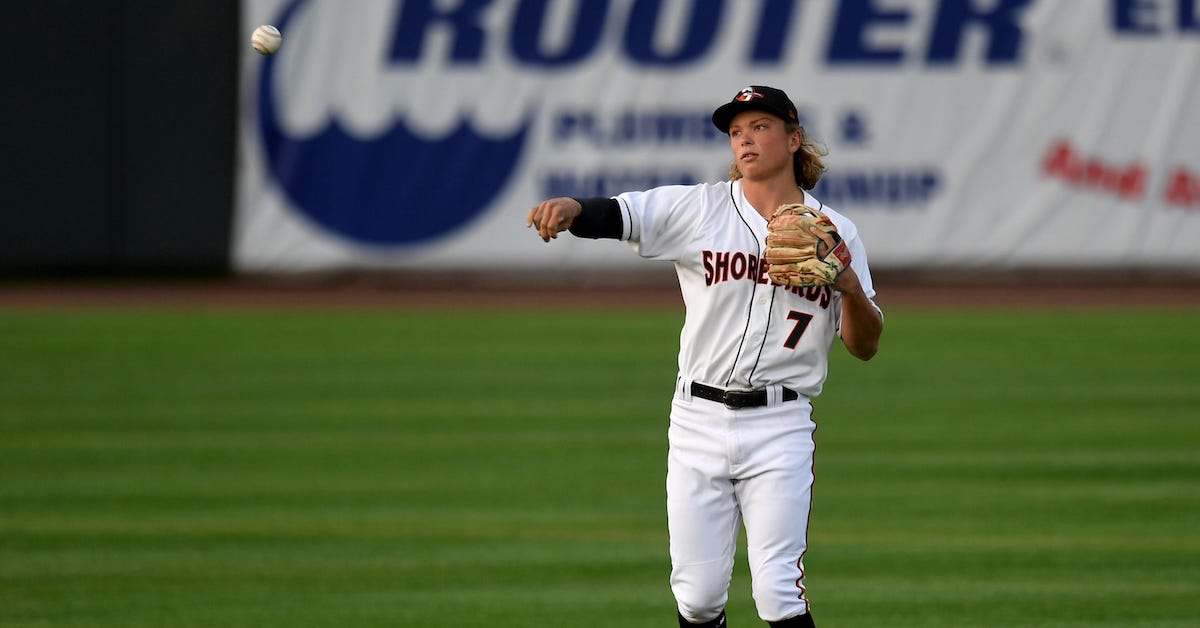
I’ve cut the videos in such a way that you can see each shortstop making similar plays one right after another. The videos feature plays to their left where I want to see them flip their hips and throw, plays that show the extreme end of their range, backhand plays in the hole to their right, plays coming in on the grass, and double play attempts. The fewest balls in play I watched for an individual player was 36 (Colson Montgomery and Dyan Jorge) and the most was closer to 70 (Jackson Holliday, Carson Williams and Marcelo Mayer). Read the rest of this entry »
In the 1991 comedy King Ralph, an American lounge singer becomes the King of England when the entire royal family is electrocuted in a freak photography accident. Despite its Academy Award-winning screenwriter and a cast of well-respected actors, the film fell flat, making it an apt comparison for the 2023 Mets, although that’s not why I bring it up today. After a series of unfortunate and unexpected injuries, Aaron Civale finds himself a key cog with the Rays and, therefore, in the race for the AL East crown. Tampa Bay’s rotation doesn’t have much in common with the British monarchy (there’s far too much turnover and not nearly enough silly hats), but just like Ralph Jones, Civale wouldn’t be in this position if so many others in front of him hadn’t bit the dust.
On the other side of the equation, the Guardians entered the season under no pressure to trade Civale. On Opening Day, their postseason odds sat at 44.7%. Two-thirds of the FanGraphs staff picked them to make the playoffs, myself included. Now, this is the Guardians we’re talking about, so high postseason odds won’t stop them from trading a talented, young player, but Civale was set to make only $2.6 million this season, and he’s arbitration-eligible for two more years. Cleveland had little incentive to trade him unless the offer was too good to refuse. Considering his injury history, his 4.92 ERA last season, and the oblique strain he suffered this April, the chances of such an offer materializing seemed slim. Read the rest of this entry »
Do you remember the springtime? We were so young and carefree, so full of hope. We hadn’t even breathed in our first lungfuls of Canadian wildfire smoke. Pitchers were full of hope, too. They’d spent the whole offseason in a lab, or playing winter ball, or maybe just in a nice condo, trying to figure how to get better.
Amazingly, a lot of them settled on the exact same recipe for success: start throwing a cutter. You couldn’t open up a soon-to-be-shuttered sports section without reading an article about some pitcher whose plan for world domination hinged on whipping up a delicious new cut fastball. Now that we’re in the dog days of summer, it’s time to check and see how those cutters are coming along. Are they browning nicely and just starting to set? Or have they filled the house with smoke, bubbling over the sides of the pan and burning down to a carbonized blob that needs to be scraped off the bottom of the oven with steel wool?
I pulled data on every pitcher who has thrown at least 400 pitches in both 2022 and ’23, focusing on the ones who are throwing a cutter at least 10% of the time this year after throwing it either infrequently or not at all last season. These cutoffs did mean that we missed some interesting players like Brayan Bello and Danny Coulombe, but we’re left with a list of 25 pitchers.
So did their new toys turn them into peak Pedro? The short answer is no. Taken as a whole, they’ve performed roughly as well as they did last season. As you’d expect from any sample, roughly half our pitchers got better, and half got worse. Of the pitchers who improved from last year to this year, I don’t think I can definitively say that any of them reached new heights specifically because of the cutter. Read the rest of this entry »
How in the world can you explain a team like the Rays? There are a lot of strange and seemingly magical things going on there, but let’s focus on just their starters. They churn out top-of-the-line dudes like no one’s business. Shane McClanahan is nasty. Tyler Glasnow looks unhittable at times. Jeffrey Springs went from zero to hero and stayed there. Zach Eflin is suddenly dominant. They can’t seem to take a step without tripping over a great starter.
They’re also always hungry for more. Whether it’s bad luck, adverse selection, or something about their performance training methods, the Rays stack up pitching injuries like few teams in baseball history. Of that group I named up above, only Eflin hasn’t missed significant time in 2023, and both McClanahan and Springs are out for the rest of the year. The Rays not only have all these starters, but they also traded for Aaron Civale at the deadline, and they’re still short on arms.
They did what anyone would do: point at a random reliever in the bullpen and tell him he’s now an excellent starter. Wait, that’s not what anyone else would do? Only the Rays do that? You’re right, at least a little bit; surely you recall the Drew Rasmussen experiment from 2021. That one was a big hit until Rasmussen tore his UCL this year. Read the rest of this entry »
“Dr. Neal ElAttrache” is up there on the list of three-word phrases you don’t want to see near a pitcher’s name. Not quite as bad as “Federal grand jury,” “Devoured by wolverines,” or “Drafted by Colorado,” but up there. Tampa Bay Rays ace Shane McClanahanvisited the estimable orthopedic surgeon on Monday to get a tight left forearm checked out, and the results were not to his liking. ESPN’s Jeff Passan reported Tuesday afternoon that McClanahan is “highly unlikely” to return this season, in the words of Rays manager Kevin Cash.
Over Tampa Bay’s most recent run of success, the Rays have set great store by their pitching, and more recently by their rotation, which ranks third in the majors in WAR. But that success has come amidst a sweeps-week Grey’s Anatomy special in the medical department. McClanahan will be the biggest loss yet, as he leads Rays starters in innings and was one of the team’s All-Star representatives last month. The question, as always, is whether Tampa Bay can hang on, and what “hanging on” looks like for a club that’s already headed backwards. Read the rest of this entry »
When trades occur that aren’t quite big enough to merit their own post, we sometimes compile our analysis into a compendium like this, where we touch on a number of transactions at one time. In this dispatch, I’ll cover the Rays’ trades for upper-level depth (pitchers Manuel Rodríguez and Adrian Sampson from the Cubs, and catcher Alex Jackson from the Brewers), as well as the Mariners/Orioles swap of Logan Rinehart and Eduard Bazardo.
The Rays acquired Adrian Sampson, Manuel Rodríguez, and $220,000 of international free agent bonus pool space from the Cubs for minor league pitcher Josh Roberson. Sampson, 31, was originally the Pirates’ 2012 fifth round pick. He made the big leagues with the Mariners in 2016 and then began to hop around the fringes of various rosters, which is part of what led to his 2020 jaunt to the KBO before a return to MLB with the Cubs. He made 19 starts for the Cubbies in 2022 as a long-term injury replacement, but he has missed most of 2023 due to a knee surgery from which he only recently returned. Sampson has been sitting 90-91 mph during each of his last two minor league starts. He does not occupy a 40-man roster spot and should be considered injury replacement depth for the Rays. Read the rest of this entry »
While some of the biggest names available did not find new homes on Tuesday, a whole lot of relievers are wearing new duds. So let’s get down to business.
With all the relief trades made by the White Sox, Middleton must have felt a bit like the last kid taken in gym class this weekend. This has been the year he’s put it all together, thanks to a much-improved changeup that has become his money pitch, resulting in hitters no longer simply waiting around to crush his fairly ordinary fastball. He’s a free agent after the season and certainly not meriting a qualifying offer, so the Sox were right to get what they could.
I’m mostly confused about this from the Yankees’ standpoint. He does upgrade the bullpen, which ranks below average in our depth charts for the first time I can recall. But unless they really like him and hope to lock him up to a contract before he hits free agency, I’m not sure what the Bombers get out of tinkering with their bullpen a little when the far more pressing problems in the lineup and rotation went unaddressed. As for Carela, he’s been solid in High-A ball this year, but he really ought to be as a repeater. Just how much of a lottery ticket he is won’t be better known until we see if he can continue his improvement against a better quality of hitter. Read the rest of this entry »
Every year, the Rays and Guardians pull off a neat magic trick. They piece together an impressive starting rotation by using a few awesome pitchers they’ve developed, some mid-level guys who pitch way above their pedigree, and a few slots of the rotation that mostly look like scrubs but churn out solid value anyway. The Rays like to sprinkle in some cheap veteran acquisitions that turn out to be better than we all thought, too. When the inevitable heat death of the universe occurs, I half expect Cleveland and Tampa Bay to be locked in the 12th inning of a 2–2 game, so consistent are their developmental pipelines.
The 2023 season has put some stress on the Rays’ side of that equation, though. Their top-end starters have been excellent. Shane McClanahan and Zach Eflin have both provided great bulk, Tyler Glasnow has been fantastic since returning from injury, and Taj Bradley is promising despite a rough start to the season (but is headed to Triple-A to make room for Civale). But injuries have wreaked havoc on their depth this year: Jeffrey Springs, Drew Rasmussen, and Josh Fleming have all hit the 60-day IL, with only Fleming likely to return this year.
Something else strange is going on down on the Gulf Coast, too: the Rays’ bullpen has been atrocious. I half expected Google Docs to underline that sentence as incorrect, because this is part of the Tampa Bay mythos: pick some random relievers, sprinkle in some crazy arm angles, and bam: top-five bullpen. But instead it’s been a bottom-five bullpen, and that makes the starters’ jobs much harder. The Rays have fallen out of first place in the AL East, the Blue Jays are lurking not far behind; something had to change. Read the rest of this entry »
Strength up the middle is important to any contender, but with so many teams still in the hunt for a playoff spot, it’s no surprise some of them are have some weak spots. Perhaps it’s easier for a team to convince itself that the metrics aren’t capturing the entirety of a weak-hitting player’s defense if they’re playing a premium position, which seems to be the case at both catcher and center fielder.
While still focusing on teams that meet the loose definition of contenders (a .500 record or Playoff Odds of at least 10%), and that have gotten about 0.6 WAR or less out of a position thus far — which prorates to 1.0 WAR over a full season — this year I have incorporated our Depth Charts’ rest-of-season WAR projections into the equation for an additional perspective. Sometimes that may suggest that the team will clear the bar by a significant margin, but even so, I’ve included them here because the team’s performance at that spot is worth a look.
As noted previously, some of these situations are more dire than others, particularly when taken in the context of the rest of their roster. Interestingly enough, two of the seven teams below the WAR cutoff for right field also make the list for left field: one because it’s far below, and the other because it’s right on the line. I’m listing the capsules in order of their left field rankings first while noting those two crossover teams with an asterisk. As always, I don’t expect every team here to go out and track down upgrades before the August 1 deadline, but these are teams to keep an eye upon. Unless otherwise noted, all statistics are through July 26, but team won-loss records and Playoff Odds are through July 27. Read the rest of this entry »
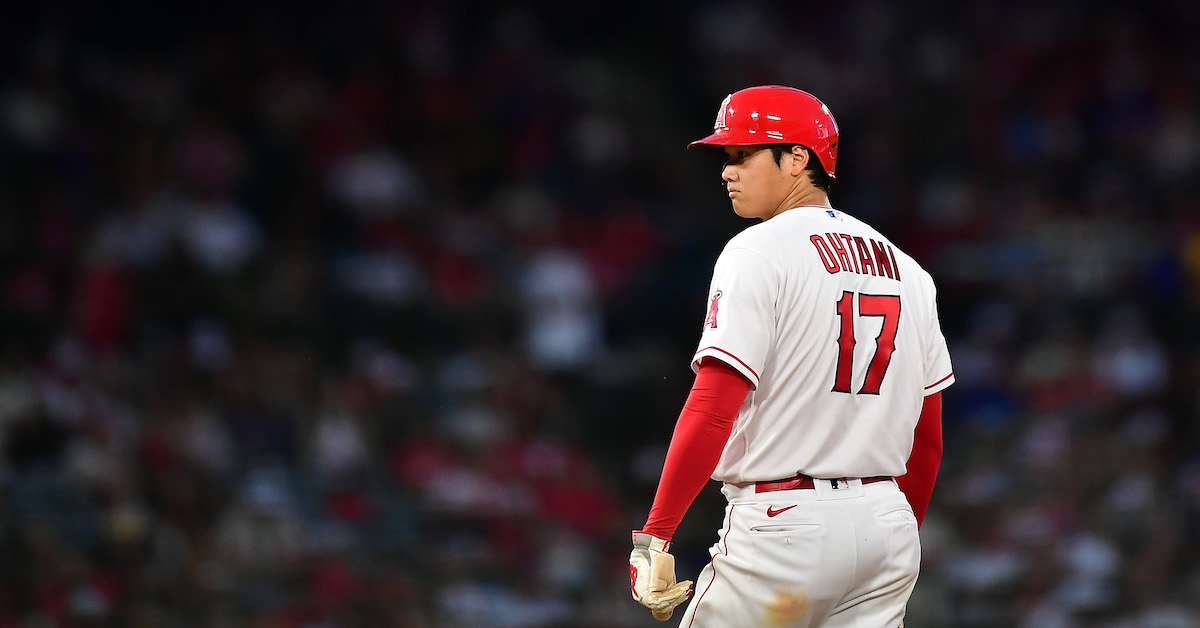
With the August 1 trade deadline fast approaching, the question on every baseball fan’s mind is: Will the Los Angeles Angels trade Shohei Ohtani?
Or at least, it was the question on every fan’s mind. On Wednesday evening, Sports Illustrated’s Tom Verducci reported that the 52-49 Angels have pulled Ohtani off the trade market.
What this piece presupposes is: What if they hadn’t?
We compiled this whole thing before Verducci’s report (and the Angels’ subsequent trade for Lucas Giolito), and we’re going to run it as a thought exercise because we aren’t about to let Arte Moreno ruin our fun. That Ohtani is reportedly no longer available perhaps suggests that the real offers Perry Minasian and Co. received were underwhelming. So what would it take to pry Ohtani loose?
Othershave taken that question for a spin, and now it’s our turn. Eleven members of the FanGraphs staff agreed to act as the GMs of opposing clubs and put their best proposal forward in an effort to land the two-way star. You’ll find those offers below. Teams are listed in descending order of their FanGraphs playoff odds. Prospect-eligible players have their Future Value grades noted in parentheses; you can find full scouting reports and tool grades for prospects and recent graduates on The Board.
Probably the last thing Arte Moreno wants to do is trade Shohei Ohtani to the team next door, but if he were willing to, I’d like to think this package from the Dodgers might look acceptable.
I used the 2021 Max Scherzer/Trea Turner blockbuster as a template, though in this case the All-Star hitter and All-Star pitcher being acquired are one and the same. In that deal, the Dodgers sent the Nationals starting pitcher Josiah Gray (55 FV), catcher Keibert Ruiz (55 FV), starting pitcher Gerardo Carrillo (40 FV) and outfielder Donovan Casey (not ranked) — and in that case they got an extra year of control (that of Turner) for the package. Here, with the competition so heavy, I’m going to have to include more talent and concede that extra club control while hoping that I at least get the inside track on retaining Ohtani once he hits free agency.
With All-Star catcher Will Smith in place and still with two years of club control, and with Dalton Rushing at High-A and likely to crack the Top 100 Prospects list next year, I’m headlining my package with Cartaya, a 21-year-old catcher who placed 28th on the Top 100 list this spring but who admittedly is having a rough first taste of Double-A. From the team’s wealth of pitching prospects, I’m tabbing Stone, who has scuffled in his three starts for the Dodgers this year but looks like a mid-rotation starter in the making, and Frasso, who was acquired in the Mitch White trade last summer and currently boasts a 32% strikeout rate at Double-A. I’m not opposed to swapping either of these pitchers out for Ryan Pepiot, Michael Grove, or even Emmet Sheehan, all of whom have more major league experience but probably lower ceilings.
I’m also including Busch and Deluca. Busch is a hitter with no clear defensive position (he can spot at second base); if this deal goes through, the Angels will have the DH slot open. Deluca is a fifth outfielder and depth piece, somebody with a big league future but not an overwhelming one. – Jay Jaffe
In this league, teams are often wary of the risk associated with trading potential long-term pieces for a rental. However, much like the Diamondbacks, Orioles, and Reds, the Tampa Bay Rays have plenty of prospect depth and young big leaguers to pull from. And while it sounds like Yandy Díaz will be able to avoid an IL stint for his recent groin injury, it isn’t totally clear when the team’s most productive hitter will be able to rejoin a lineup that is trying to reclaim its spot atop the AL East. That, plus a pitching staff thinned by injuries, makes it clear that reinforcements are in order and should be pursued aggressively. Thus, the Rays should propose the following deal: Taj Bradley, Kyle Manzardo, and Ian Seymour for Shohei Ohtani, Carlos Estévez, and Gustavo Campero.
Bradley is an obvious headliner for an organization that will need pitching following Ohtani’s departure. The Rays right-hander can be inserted near the top of the Angels rotation, and any deal between these two teams would most likely have to include him. From Tampa’s perspective, a rotation of Ohtani, Shane McClanahan, Tyler Glasnow, and Zach Eflin (Eflin left Wednesday’s start with left knee discomfort, though his initial MRI results were encouraging) would be the best in the American League and would provide sufficient justification for trading away a talented, controllable pitcher such as Bradley. Eflin’s injury hurts, but a playoff top three of Ohtani, McClanahan, and Glasnow is tempting. Manzardo is directly blocked in the majors by the likes of Díaz and the combination of Luke Raley and Harold Ramírez. He’s an upper minors first baseman and is expendable in the short-term. You build up prospect depth for moves like this. Lastly, Seymour is facing a 40-man roster crunch coming off Tommy John surgery but has potentially electric stuff. He’d have more of an opportunity to stretch out as a starter in an organization like the Angels.
Adding Ohtani the pitcher would extend an already good rotation, but the big premium here is at the plate. In the last two months, the Rays’ have run a 99 team wRC+, and the lineup suddenly looks closer to average than elite. Ohtani would help bolster an offense that has struggled against right-handed pitching – he boasts a 195 wRC+ and 27 home runs against right-handers, though he’s not exactly shabby against southpaws. In addition to Ohtani, Estévez would bolster a bullpen that has lost countless relievers to significant arm injuries. He’s under team control through 2024, and unlike other Rays relievers, he isn’t even a project. Lastly, Campero is a late-blooming catching prospect who could provide offensive impact at what might be the only weak position in the organization. Despite Edgar Quero being traded to the White Sox and opening up a promotion, he is still blocked by Logan O’Hoppe. – Esteban Rivera
More than just about any other team, the Orioles are in an enviable position when it comes to the Ohtani talks, able to trade what amounts to expendable, close-to-the-majors talent — and they don’t even have to touch Jackson Holliday.
This isn’t to disparage Ortiz (the 51st-best prospect in baseball), Cowser (the Orioles’ no. 6 prospect, who dominated Triple-A before his call-up), or Hall (the team’s no. 9 prospect), all of whom have what it takes to contribute at the major league level. Rather, the three are replaceable on the big league roster.
Ortiz was the best-ranked of the three prospects midseason, but he can’t consistently earn playing time on a roster that’s got Gunnar Henderson, Jordan Westburg, Ramón Urías, Adam Frazier and Jorge Mateo covering second, third, and short — Ortiz has just 34 big league plate appearances despite a 141 wRC+ in Triple-A.
Cowser is currently on the big league roster, though he’s off to a slow start with a 45 wRC+ in 42 PA. Of course, the Orioles wouldn’t trade him because of that, but his opportunities will probably dwindle when Cedric Mullins is back from the IL, and Heston Kjerstad (regarded as the better prospect and also capable of playing first base) is also knocking on the door.
Hall is the only pitcher in the proposed deal and also the biggest unknown; he’s been down in Sarasota working on regaining his velocity and just pitched for the first time at any level since June 14 in a game on Monday. But his strikeout stuff has been tantalizing when in the majors; he’s struck out more than a third of the opponents he’s faced in his 16.2 big league innings.
Ultimately, the always-straddling-the-line Angels would find themselves with three players they could have in the majors immediately or at least imminently. Ortiz could take over at second base for the struggling Luis Rengifo right away, and Cowser could take an outfield spot and a few half-days in the Ohtani-less DH spot. Even with his velocity in peak form, Hall carries significant relief risk, but he could shore up a bullpen corps that has Carlos Estévez, Matt Moore, Jacob Webb, and José Soriano as its only really trusted options.
And, of course, Ohtani would give a boost to an Orioles lineup that’s solid (11th in the majors in OPS) but lacks a truly terrifying bat, and bolster a middling rotation (15th in the majors in ERA) that’s currently relying on a breakout from Grayson Rodriguez as its best hope for a step forward. The O’s could easily accommodate the kind of six-man rotation that Ohtani’s been accustomed to, particularly with Rodriguez’s innings being monitored anyway. – Jon Becker
I’m really hitting the gas here because I think Texas is the place where a two-month audition would be most meaningful to a club’s chances of signing Ohtani this offseason. Take him to a Cowboys game, romance him with what Texas has to offer at the cost of a slightly longer plane ride home, and remind him about the income tax rates in the Lone Star State relative to California.
I’m okay with coughing up Carter here because it looks like Leody Taveras has actually arrived. I’m personally kind of lukewarm on Carter (more on that here), but based on the types of players the Angels tend to acquire, I bet they’re not. The internet hype around Carter makes the optics of this deal with him at the center pretty attractive for the Halos.
Ditto for Leiter and Rocker, two marquee names Arte Moreno already knows. Leiter will probably be a solid big league starter, but I don’t think the Rangers would feel burned in a serious way by moving him within the division. Rocker I had evaluated as a reliever before his recent injury, and he seems fine to give up as a sweetener for the most talented player on the planet (he was the last guy I added to this offer).
Before you puke because this is too much to give up, remember that I’m essentially getting two players here. Texas doesn’t really have room for Justin Foscue on a star-studded big league infield, so he can go. Again, Foscue’s a good player, but he and Dustin Harris would both appeal to Anaheim’s statistical sensibilities in a way I’m eager to leverage because he’s superfluous to the Rangers for as long as the trio of Marcus Semien, Corey Seager, and Josh Jung is hitting. Aside from the rehabbing Rocker, this entire offer is composed of near-ready players who can help make Los Angeles’ rebuild go more quickly. Texas would have Earth’s hottest ticket for three months, with the hope that Shohei likes the way the wind blows through his hair in Arlington and signs up for more. – Eric Longenhagen
Would the Toronto Blue Jays be bold enough to trade one of their cornerstones — a player with two-plus years of team control remaining who was born in Canada, no less — for a rental plus a former top prospect who has thus far fallen short of his potential? Probably not, but the idea has more merit than you might think. If I were Toronto GM Ross Atkins, I might very well get Angels GM Perry Minasian on the horn and ask if he would consider dealing Shohei Ohtani and Jo Adell for Vladimir Guerrero Jr.
Far-fetched? Assuming Minasian picked up the phone, not necessarily. Here is why the Angels might agree to the trade:
First and foremost, it seems unlikely that the Anaheim-based club will be able to re-sign Ohtani this winter, which makes trading him a good idea. That said, while the yield from a deadline deal would provide more bang for the buck than draft-pick compensation, it’s not as though a Juan Soto-like package is in the offing. Not for a player about to become a free agent. For that reason, acquiring a 24-year-old All-Star who could immediately replace Ohtani in the middle of the lineup is safer than betting on prospects who may or make pan out. It would certainly be more palatable to the fanbase. Rather than jumpstart a rebuild, why not retool and continue to (or at least try to) contend?
Here is why Toronto might propose the trade:
The Blue Jays came into the season with high expectations, and this would be a win-now move that could propel them to the World Series. Not only would the lineup get stronger, the starting rotation would as well. Their postseason odds would go up meaningfully, and a one-two-punch of Ohtani and Kevin Gausman is something no team would want to face in October. The short-term gain is obvious.
As for the long-term, this would indeed be a risky move for the Jays. Even so, the potential upside goes beyond a short-term, flags-fly-forever World Series run. Toronto is a multi-cultural city that Ohtani could easily fall in love with over the coming months, greatly increasing the chances that he’d choose to call Ontario home for years to come. As for Vladdy Jr., his wRC+ has fallen in each of last three seasons, dropping from 166 to 132 to this year’s 121. As a first baseman, is his long-term value going to be worth what he’ll be paid in Canadian or American dollars? Adel would be the wild card in this deal. At worst, the Blue Jays would have a depth piece who is under team control for several more seasons as consolation should Ohtani sign elsewhere. At best, Adel becomes the player many once envisioned. It’s certainly possible. – David Laurila
The Phillies aren’t a favorite to land Ohtani, but after a couple of trades with the Angels at last year’s deadline that worked out well for both sides, maybe these two clubs can figure something out. After all, this is Dave Dombrowski we’re talking about. He pulled off the Miguel Cabrera trade. He pulled off the Chris Sale trade. He pulled off the Yoenis Cespedes trade – twice. Philadelphia might seem like a long shot for Ohtani, but no one is a long shot for Dombrowski.
The Phillies don’t have the big-name headliner the Angels are looking for – they aren’t selling low on Andrew Painter – but they can sweeten the deal with an extra top 100-type prospect. The Angels want two? The Phillies can give them three: Mick Abel, Griff McGarry, and Justin Crawford. That’s two starting pitchers who could join the rotation by 2024 or 2025 and a center fielder of the future. On top of that, if L.A. is nervous about a deal centered around young pitching, Philadelphia can throw in William Bergolla. He’s only 18, but the young shortstop has plate discipline and contact skills beyond his years.
The Angels could also use some big league talent, so the Phillies can entice them with Ranger Suárez and Bryson Stott. Suárez has a lower FIP than almost everyone in the Angels’ rotation (including Ohtani), and he’s under team control for two more years. Stott is another young, talented infielder to pair with Zach Neto, and he won’t reach free agency until 2029.
Finally, it’s time for the cherry on top. One of Dombrowski’s most valuable skills as an executive is convincing ownership to spend, so Philadelphia can definitely take on a bad contract. Anthony Rendon is a bit too much to ask, even for Dombrowski, but how about David Fletcher? You have to think Perry Minasian would love the chance to erase a mistake from early in his Angels’ tenure.
Altogether, Philadelphia is offering high-upside prospects, controllable big leaguers, and a bit of financial freedom. Other teams have the high-end prospects to beat this offer, but it’s the best the Phillies can do without throwing in the entire IronPigs roster, the rights to the Phanatic, and the clubhouse kitchen sink. It’s not Jackson Holliday, but it’s a whole lot better than a compensatory pick. – Leo Morgenstern
If I’m the Giants, I’m still reeling from 2021’s early playoff exit after a 107-win season, 2022’s utterly underwhelming swoon, and this past offseason’s Aaron Judge and Carlos Correa near-misses. Given recent history, the front office must be especially hungry to make a deep postseason run, and with the Judge and Correa budget largely unspent, they might also be ready to open up the checkbook for Ohtani this winter. But why wait?
To get the Angels interested, let’s start with Kyle Harrison. The left-hander breezed through the lower minors and debuted with Triple-A Sacramento this spring at the age of 21, which is more than six years younger than the average pitcher at that level. He’s experienced some growing pains this year in the hitter-friendly Pacific Coast League, but it’s really the first resistance he’s encountered in his young career. The Angels are already short on arms before dealing Ohtani, so a high-ceiling, near-ready pitching prospect could be a welcome centerpiece, as much as it would pain the Giants.
It’s too bad catching isn’t a big need for the Angels. The Giants seem inclined to hang on to switch-hitting rookie catcher Patrick Bailey, but Joey Bart or Blake Sabol could have been of interest if it weren’t for Matt Thaiss and Logan O’Hoppe.
Where the Giants can address another need is in the infield. There isn’t much in the way of infield depth behind 22-year-old Zach Neto. The Giants, meanwhile, are getting career-best years (or close to it) from Thairo Estrada, Wilmer Flores, LaMonte Wade Jr., and J.D. Davis, and have all but Davis under team control through at least 2025. Casey Schmitt – a versatile defender with some pop who debuted at the age of 24 in May – fits this deal well.
Power-hitting 21-year-old first baseman/corner outfielder Victor Bericoto, who just got the call to Double-A Richmond, rounds out the deal, giving the Angels another player with pretty clear potential to make a big league impact.
Three top-25 prospects is a scary haul to give up for two months of any player, especially with Harrison involved. But offer much less and Farhan Zaidi can expect to be outbid. If they’re able to keep Ohtani in San Francisco long-term, the cost to get him in the door will be soon forgotten. – Chris Gilligan
Arizona Diamondbacks Angels Receive: SS Geraldo Perdomo, CF Druw Jones (50 FV) Diamondbacks Receive: DH/SP Shohei Ohtani
I was assigned Kim Ng of the Marlins in the Effectively Wildversion of this exercise. (It went very badly, thanks for asking.) So I called shotgun on Arizona for the reboot before the podcast went live. I figured the Diamondbacks were an ideal trade partner: They have needs at both DH and in the rotation, and their playoff fate is very much up in the air, so Ohtani could make as big a difference there as anywhere. The D-backs play in a park where Ohtani could put up truly hilarious offensive numbers, and they’re a fairly big-market team (even if they don’t always spend that way) with an up-and-coming core that could benefit from the additional shine. Plus, this would be a perfect time to cash in on Druw Jones, who’s one of the few prospects with enough star power for the Angels to sell to the public as an appropriate return. At the same time, he’s not too good to be untouchable from Arizona’s perspective. Jones is currently on the shelf with a hamstring injury, and questions are starting to pop up about whether he’ll reach the lofty ceiling that was projected for him out of the draft. Maybe he’ll straighten things out and get back on track, but the Diamondbacks could opt to move him rather than risk him losing “half the return of a blockbuster trade” value.
Then I listened to the podcast and Ginny Searle, playing Diamondbacks GM Mike Hazen, nailed it. The final offer: Jones, Brandon Pfaadt, Drey Jameson, and Yu-Min Lin. I think that’s the perfect pitch, from Arizona’s perspective, and sure enough it won the whole thing. Now I not only have to land Ohtani for my beloved Snakes, I have to do it through different means.
So I’m going to start with Jones and add Geraldo Perdomo. You want pizzazz? How about one of the biggest stars in the minor leagues, the no. 2 overall pick a year ago? And on top of that, how about a 23-year-old shortstop who’s under team control through 2027, has a .389 OBP, and made the All-Star team this very year? If Ohtani is A-Rod, this is your Alfonso Soriano. Plus, it bears repeating, Druw Jones. Does that leave a gaping hole in my own infield? Yes. But if I have Ohtani I can figure it out later. – Michael Baumann
The Yankees haven’t shown nearly as much faith in Oswald Peraza as they have in Anthony Volpe, often passing over the former for veterans. Why is anyone’s guess, but Peraza would be extremely appealing to the Angels. His burgeoning 60-grade defense could slot in nicely next to Zach Neto up the middle for years to come. He’s no slouch with the bat, either: In 645 Triple-A plate appearances, he’s slashed .260/.337/.463 for a 106 wRC+, in line with his 108 mark in 118 major league PAs thus far.
High-floor, big league-ready talent? Check. Near-ready high-ceiling prospect? Jasson Domínguez fits the bill. The switch-hitting outfielder, already in Double-A at just 20 years old, has tremendous pop and speed despite some swing-and-miss to his game. If he doesn’t stick in center, it could spell trouble for his overall value. But the upside is power rarely seen at a premium up-the-middle spot, and Domínguez’s physicality just might be what it takes to unseat Mike Trout in center as the latter begins to decline defensively.
Another high-ceiling play is right-hander Chase Hampton, who we had as the Yankees’ 33rd-ranked prospect coming into this season after glimpsing a velo increase and a new cutter/slider in spring training. He’s taken his new tools and run with them, earning a promotion to Double-A after his first 47 pro innings came with a 40.5% strikeout rate in High-A.
Rounding out the deal is Clarke Schmidt. After posting a 6.00 ERA through his first 10 starts this year, the former first-rounder has refined his new cutter and come into his own; over his last 10 starts, he’s pitched to an even 3.00 ERA. While his FIP hasn’t changed much, the recent success is due to a newfound ability to limit hard contact: his barrel rate has shrunk 3.8 percentage points and his hard-hit rate has dropped 6.5. The cutter is especially improved — it’s averaging 1.2 extra inches of cut and 1.3 of drop since his 10th start.
If the Yankees make the out-of-favor Peraza the headliner, they could easily shift DJ LeMahieu over to third, where for the time being, he could approximate the youngster’s value. Ohtani, meanwhile, could slot right into Schmidt’s spot, and they could even go to a six-man rotation — as the Angels have — upon Nestor Cortes‘ return. As for Ohtani’s spot in the lineup, Giancarlo Stanton will have to spend more time in right field in order to free up the DH spot. But Big G hasn’t been a huge negative in the field; on a per-inning basis, he’s placed 341st out of 444 fielders with at least 100 innings under their belts in fielding run value. Plus, since joining the Yankees, he’s hit six points of wRC+ better when he’s been in the field. This deal — and its ripple effects — should ensure the Bombers another playoff spot. – Alex Eisert
What would it take for the Reds to make a play for Shohei Ohtani? When Effectively Wild played the Ohtani trade game last week, that was the question I tried to answer, assuming the role of Nick Krall to Ben’s Perry Minasian.
My proposal, which ultimately didn’t win out, was Christian Encarnacion-Strand, Edwin Arroyo, Brandon Williamson, and Lyon Richardson for Ohtani. Benasian turned it down, but I wanted to take another crack at making an argument for my offer.
I think this type of offer is realistically the best the Reds would do in this situation. It would be absolutely shocking to see Elly De La Cruz or Matt McLain move in a trade, so I can’t just throw one of them in to land Ohtani. Whether it’s justified or not, the Reds simply aren’t going to spend much money under the current ownership regime, so there’s no chance of Ohtani being extended. They’re also not going to trade away too much talent that they’ll have to replace later.
Encarnacion-Strand is still looking for a final defensive home, but the power is real and while ZiPS isn’t quite sold on him overall, especially as a starting third baseman, it sees him as having some .500 slugging percentage seasons in the majors. He’s also in the big leagues, and even if he turns out not to be the highest upside offensive player offered for Ohtani, I wouldn’t be surprised if he’s the safest bat we would see in an offer. I think this is important to the Angels; whether or not Ohtani’s gone for good, I don’t think this is a team with the stomach for a full rebuild. Williamson and Richardson fit along these lines. Neither has a super high ceiling, but both have a pretty high floor, as well as the ability to contribute quickly to a retooled Angels team.
Arroyo, on the other hand, does have a decent ceiling and was on our preseason Top 100, though his FV has slipped since then. His inclusion ensures the Angels get significant value for an Ohtani rental. The team is very short on middle infield prospects now that Zach Neto has graduated from eligibility, and there’s a long-term hole that Arroyo could fill here.
Is it enough? I’m not sure, but either way, I’m not going to try to do a bad Nick Krall impression again anytime soon. – Dan Szymborski
The Mariners will almost certainly be in the running to sign Ohtani this offseason once he hits free agency. The chants of “Come to Seattle” that rained down during the All-Star game made the fans’ hopes quite clear, and the Mariners would be remiss if they didn’t make a competitive offer for the generational talent this winter. But what about the 2023 season? The M’s have hovered around .500 for nearly the entire year, never creeping more than three games over that mark or falling more than five games below it. That has put them on the AL playoff bubble, though the strength of their pitching staff indicates they’ve underperformed a bit. Pushing all their chips in for a remote shot at a repeat postseason appearance would be a pretty big risk, though for Ohtani, it might be worth it.
The Mariners send: RHP Bryce Miller, RHP Emerson Hancock, CF Jonatan Clase, 2B Michael Arroyo.
Any trade package from the Mariners needs to start with one of their young starting pitchers. The Angels have struggled to develop impact talent on the mound and the Mariners are swimming in young pitchers with plenty of team control. Logan Gilbert and George Kirby are probably off the table, so the M’s offer would be centered around one of Bryce Miller or Bryan Woo. I like Woo a little better than Miller because his secondary pitches seem a little more developed, but Miller has the best graded pitch between the two of them in his fastball.
Emerson Hancock has been a little inconsistent at Double-A Arkansas this year, but he’s a nearly big league-ready starter with a deep repertoire and enough prospect shine to be a nice complement to Miller. He’d be ready to contribute to the Angels rotation as soon as September. Clase has the big athletic tools that the Angels have so often coveted in prospects and he had a phenomenal start to the season in High-A Everett, posting a 197 wRC+ in 21 games there. He’s come back down to earth after getting promoted to Double-A, though his combination of power and speed should be enticing for the Angels.
Finally, with Cole Young looking like he’s on the fast track through the Mariners system and Colt Emerson and Tai Peete getting drafted this year, it seems like Michael Arroyo is getting buried on Seattle’s middle infield depth chart. That shouldn’t affect the way the Angels value him, and he has the potential to become the second-best prospect in this deal, though he’s still a little raw around the edges. He’s currently posting a 116 wRC+ as an 18-year-old at Single-A Modesto. – Jake Mailhot