Archive for Teams

Powerhouse Dodgers’ Bullpen Misadventures Stand Out

Six in a row, 10 out of 11, 16 out of 19, 27 out of 35 — however you slice it, the Dodgers have been steamrolling everything in their path lately. They haven’t lost a series since dropping two of three to the Giants April 29 to May 1, and now own the NL’s best record (42-19) by a margin of 7.5 games. Their +96 run differential is nearly equal to the sum of those of the league’s second-ranked Cubs (+53) and third-ranked Diamondbacks (+46). Their offense owns the league’s highest wRC+ by a wide margin (117 to the Cubs’ 109), and their rotation owns the NL’s best ERA (2.88) and FIP (3.46) while also the most innings per start (5.89).

Which brings us to their bullpen. Sure, it hasn’t been a dumpster fire on the order of the Nationals’ (6.81 ERA, 5.08 FIP) or Orioles’ (5.84 ERA, 5.66 FIP), but there are only so many teams who can be that lucky. Through Monday, the Dodgers’ bullpen ranked 10th in the NL in ERA (4.71) and ninth in FIP (4.48). The former number doesn’t even account for the fact that the unit has allowed 43% of the runners inherited from the starters to score, the league’s second-worst mark; include all inherited runners and the rate falls to 39%, third-worst. While their relievers’ 7.6% walk rate is a league low, their 22.2% strikeout rate is the second-lowest, and their 1.37 homers per nine is mid-pack. Their clutch score — a measure of whether a player or team has done better or worse than expected in higher-leverage situations — of -2.54 is second-to-last in the NL, ahead of only the Nationals.

As you can see from those numbers above, the offense and rotation have largely papered over the bullpen’s problems. The week-long span from Sunday, May 26 through Saturday, June 1 — during which Dodger relievers combined for a 7.08 ERA and 6.64 FIP in 20.1 innings — illustrates the point in dramatic fashion:

  • Sunday, May 26 vs. Pirates: Caleb Ferguson entered with a seven-run lead and turned it into a four-run lead, though the Dodgers still won, 11-7.
  • Monday, May 27 vs. Mets: Joe Kelly entered with a five-run lead and failed to retire any of the three hitters he faced, the highlight of whom was a two-run homer by Adeny Hechavarria, the owner of a career .346 slugging percentage and a total of 29 homers compiled in eight seasons. When Kelly’s successor, Dylan Floro, got into trouble, manager Dave Roberts called upon Kenley Jansen for a five-out save, which he converted in the 9-5 win.
  • Read the rest of this entry »


Pitchers Plan, and Mike Trout Laughs

Imagine being a pitcher who has to face the Angels this year. It’s not hard to figure out which batter you most need to prepare for. When the Angels played the Cubs last night, Albert Pujols batted third, which is a lot less imposing in 2019 than it was in 2008. Shohei Ohtani had the night off, which meant that Tommy La Stella was the best non-Trout bat in the lineup. He’s having a good year, as Jay Jaffe noted, but unfortunately for him, he’s still Tommy La Stella. Cesar Puello batted fifth, and hey, good for him. Still, though — the scouting report was probably just Mike Trout written in various fonts over and over again.

It’s safe to say that every game the Angels play, the opposing team has spent a lot of time trying to work out a way to get Trout out. Los Angeles has a robust 109 wRC+ this year among non-pitchers, which sounds good until you realize that non-Trout Angels have a 100 wRC+. The team is scuffling — two games below .500 in a division where you might need 100 wins to topple the Astros, and potentially a little lucky to be there given their BaseRuns record. The pitching staff is essentially made of duct tape and fervent prayers — Ty Buttrey leads the staff in both fWAR and RA/9 WAR, and their starting rotation looks like a horror story told to kids to keep them from becoming Angels fans.

Amidst this chaos, this unending deluge of mediocrity, Mike Trout is putting together another masterpiece of a season. It’s boring to say, almost — his 180 wRC+ is both the fourth-highest in baseball and the lowest Trout has recorded in the last three years. Being one of the best players in baseball is old hat for him. Still, he’s improving his craft incrementally, slowly shoring up weaknesses and adding to strengths. His unintentional walk rate, a gaudy 19%, is the highest of his career. His strikeout rate, a minuscule 16%, has never been lower. Trout’s 2019 might be the best he’s ever hit, a crazy thing to say about undoubtedly the best player in baseball.

Baseball is largely a game of failure and limitations, which makes talking about Trout’s plate discipline feel somewhat surreal. Consider this — Trout has started making contact with basically everything he swings at in the strike zone. His zone contact rate of 94.9% is sixth in baseball and the highest of his career. That’s strange, because for the most part, guys who make contact with everything are contact hitters who sacrifice power to put the ball in play. David Fletcher and his .137 ISO top the list.

This makes a rough kind of sense — hitting everything you swing at in the strike zone means you are probably putting some tough pitches in play, and cutting down on your swing to make more contact means those swings generally have less behind them. That, at least, is the logic that constrains mortals. Mike Trout started hitting everything in the strike zone, and he’s still slugging .600. That slugging percentage might be selling Trout short — he has the highest xSLG (a Baseball Savant statistic that predicts slugging percentage from angle and speed of hits) of his career, a gaudy .643.

What does making contact with every pitch in the strike zone look like? Well, in 2018, Trout was great, but he was great while being only very good against high and outside pitches. Take a look at the upper righthand corner of this chart, the percentage of swings he made contact on by zone in 2018:
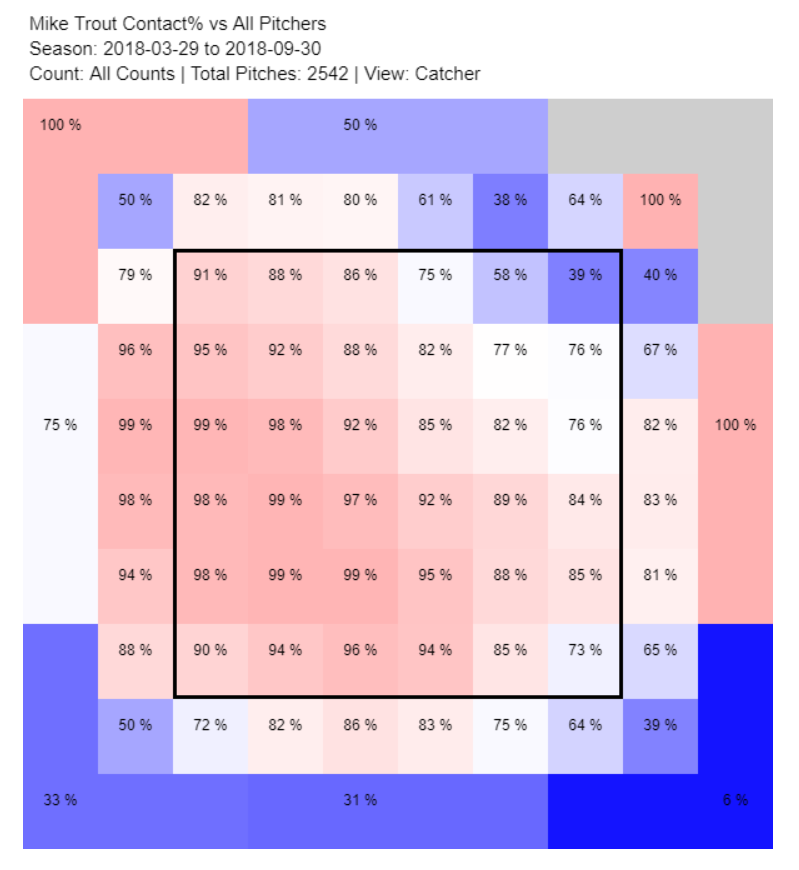
Pitchers know about this marginal weakness, and they do their best to exploit it. The book on Trout is to get him high and away. Take a look at where pitchers are attacking him in 2019:
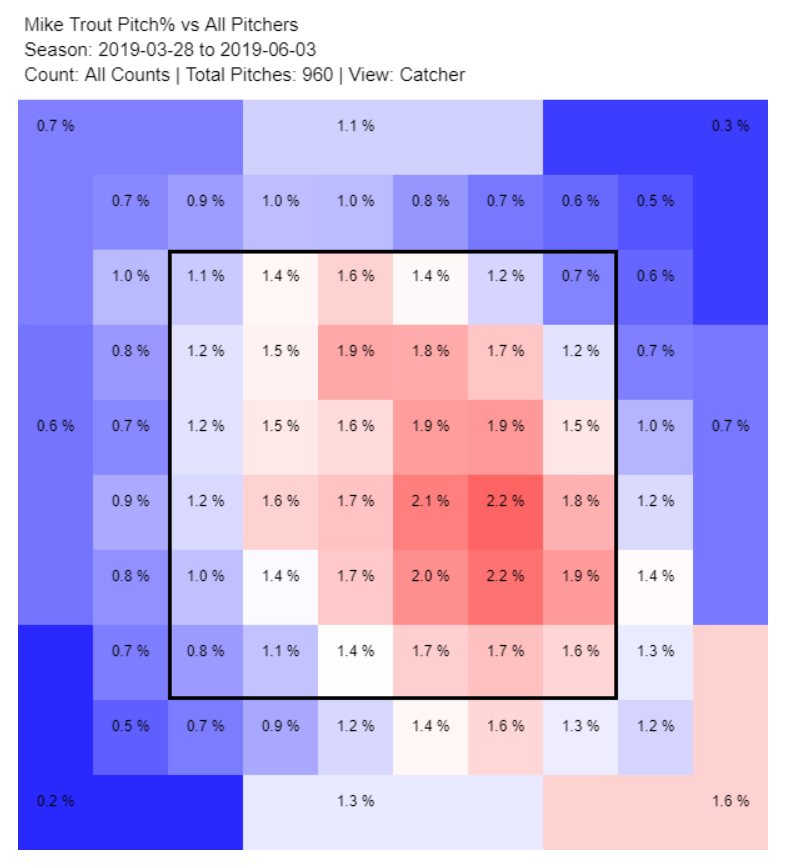
That’s good pitching right there. Find out where a hitter is most likely to get bad results, and aim for that spot. Maybe their focal point is a little too low, but the general idea of throwing away is certainly easy to see. Major league pitchers are tremendously skilled, and they spend countless hours perfecting their craft. That should work out to their advantage, right? Well, bad news, pitchers — this is Mike Trout we’re talking about here. Look at his contact rate in 2019:
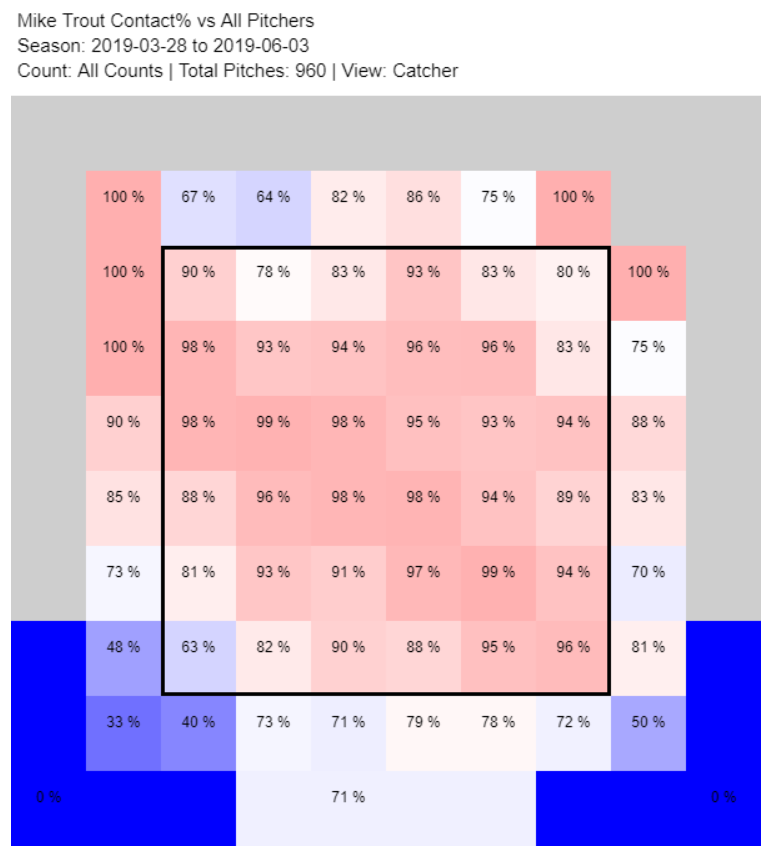
It would be one thing to protect a weak point in your swing with some defensive hacks. Plenty of good hitters punch outside pitches the other way, sacrificing power for contact on pitches that are hard to drive. Again, though, Mike Trout isn’t “plenty of good hitters.” He’s the best hitter in baseball. Trout is punishing outside and high pitches in 2019, doing a tremendous amount of damage when he puts the ball in play:
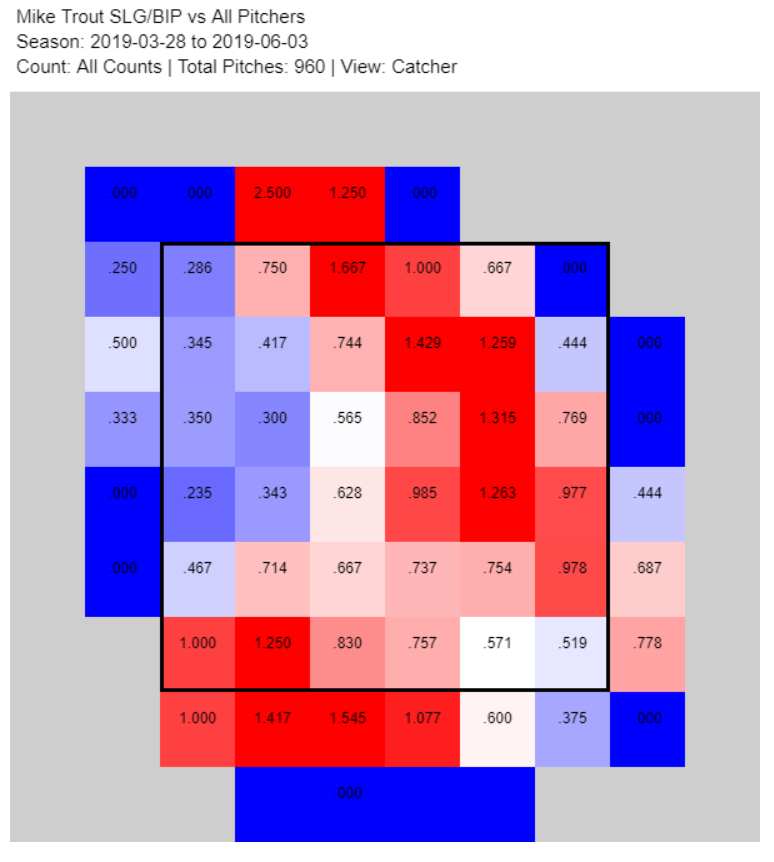
You’re reading this chart right — Trout is now getting his greatest production on balls in play in the very part of the strike zone where pitchers are attacking him most. That, in a nutshell, is what pitching to Trout is like. You might think you’re attacking a weakness, doing your research to put yourself in an advantageous position. Trout’s better at adapting than you are; he’s better than everyone. He reacts to your changes faster than he can be solved.

Pitch location isn’t the only part of Trout’s plate discipline pitchers have focused on this year. They’ve changed how they attack him on the first pitch of a plate appearance, and Trout is yet again using that to his advantage. For years, the book on Trout was that he was patient on the first pitch to the point of somnolence; he basically never swung at first-pitch breaking balls, for instance. Over the past few years, Trout has turned this trend around, becoming increasingly aggressive on the first pitch — he swung at 19.7% of first pitches in 2017 and 18.3% in 2018, the two highest rates of his career.

To combat this trend, pitchers are going out of the zone on first pitches more than they ever have. Trout is seeing strikes on 47% of first pitches, down from his career average of 55% and below the major league average of 51%. This adjustment was largely out of self-preservation. Trout slugged 1.061 with a .485 batting average when he put the first pitch into play last year. He hit five home runs on first pitches, a career high. Sticking with get-me-over first pitch fastballs was no longer an option.

In classic Trout fashion, though, he’s turned pitchers’ adjustments into another tool in his tool belt. Now that pitchers throw him fewer first-pitch strikes, he’s simply swinging less. He’s down to a 17% swing rate on first pitches this year while still swinging at 27% of pitches in the zone. He’s also missing less — he’s swung and missed at five first pitches this year, a 2% rate that would be his lowest since 2015, the last year of his extreme passivity on first pitches. Between this improved swing discipline and pitchers avoiding the zone like the plague, Trout is falling behind in the count 52.9% of the time this year, a career low and 5.2% below last year’s level.

2019 is arguably Mike Trout’s finest batting season so far. His xwOBA of .473 is the highest it’s ever been and 30 points higher than his wOBA, suggesting that he’s been unlucky this year to put up “only” a 180 wRC+, the third-highest of his career. He has the highest walk rate in baseball and a strikeout rate in the lowest 21% of qualified batters. He’s getting on base at the highest rate in his career despite the lowest BABIP in his career (excluding his brief 2011). The two changes pitchers have made to how they approach him this year sure don’t seem to have worked.

Pitchers will try to make other adjustments. They’ll start challenging him in the strike zone more on the first pitch — maybe with offspeed pitches, something that pitchers mostly haven’t tried yet. They’ll aim inside, where Trout’s power is down this year. They’ll continue to hunt holes in his game, small edges that they can use to blunt Trout’s effectiveness.

But until I see some evidence to the contrary, I don’t think it will matter. Pitchers can adjust all they want, try any gambit they’d like. For the most part, it seems like adjusting to beat Trout only plays into his hands. Someday, Mike Trout will grow old. He’ll slow down, get worse at recognizing pitches, stop instilling terror into opposing pitchers the way he does now. That day still feels infinitely far off, though. For now, he’s three steps ahead, putting up unreal numbers while shrugging off regression. Pitchers can plan all they want. Trout won’t stop laughing his way around the bases any time soon.


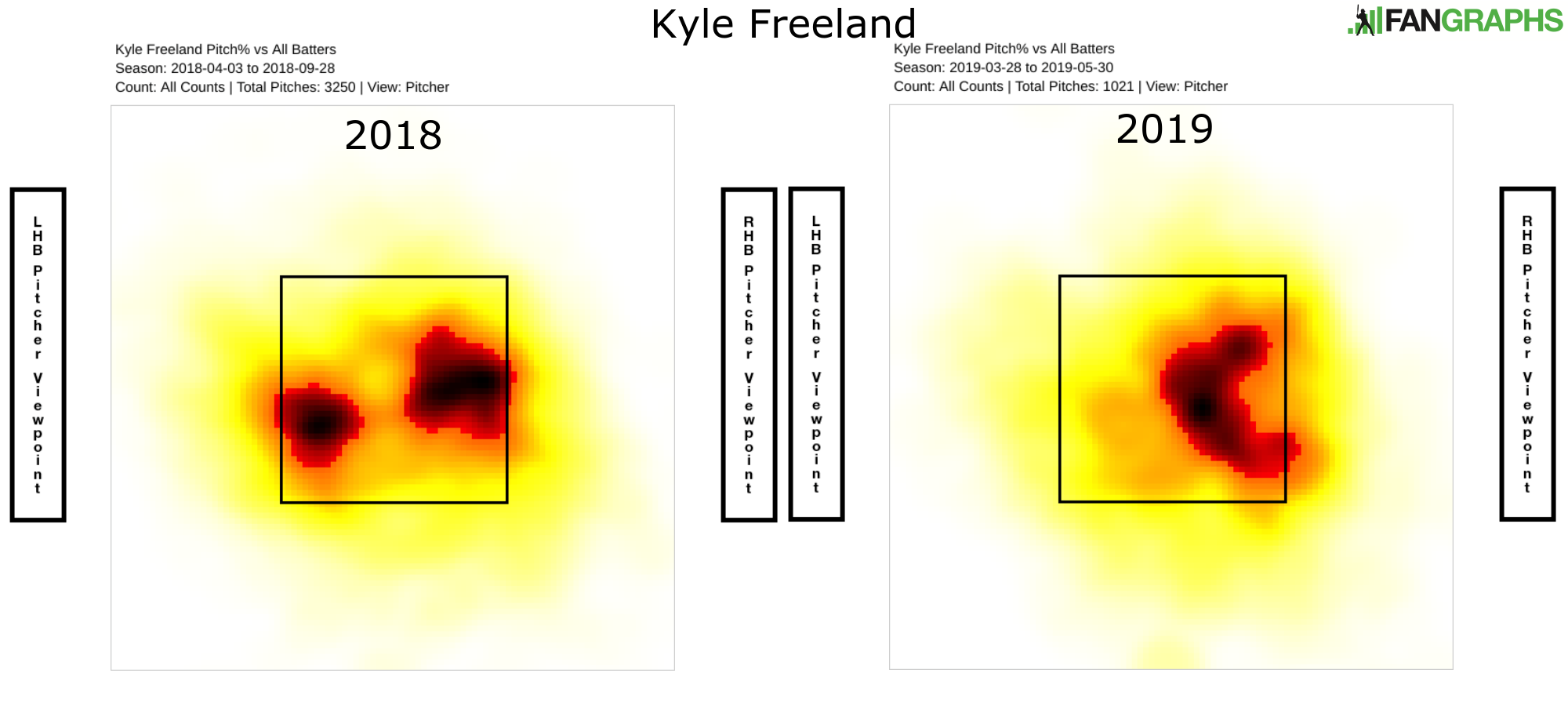
Regression Didn’t Come for Kyle Freeland

A year ago, Kyle Freeland had a very good season. For some, it was almost too good. Here at FanGraphs, Freeland put up a 3.67 FIP, and playing half his games in Colorado meant a 4.2 WAR in over 200 innings and one of the 10 best pitching seasons in the National League. Freeland’s ERA was even better than his FIP, and with a 2.85 mark, his RA/9WAR was 7.5, the fifth-best mark in all of baseball. The distance between his ERA and FIP likely created a gap between those who believed Freeland was one of the best pitchers in baseball and merely a good one. The latter group thought that Freeland was in for some regression this year. After a rough two months, including time on the injured list, Freeland has been dispatched to the minors. That’s not regression. Allow me to explain.

Before being sent down, Freeland had a 6.37 FIP, a 7.13 ERA, and had given up 16 homers in 12 starts after giving up 17 in all of 2018. After last season, it’s possible some were expecting another sub-three ERA, but doing so would have been unrealistic. Expecting some regression might have meant that Freeland’s BABIP would go up from the .285 where it was a year ago and his LOB% would go down from 83%. Those numbers wouldn’t affect his 3.67 FIP, but it might take his ERA closer to his FIP. Maybe Freeland’s 8.5% HR/FB would creep up closer to average, leading to a higher FIP and ERA. In fact, projections considered many of those factors and forecast Freeland for a roughly average season with an ERA and FIP around 4.50. If regression had come for Kyle Freeland, that might have been what it looked like. If Freeland were pitching just like last season, we might expect a similar FIP and worse ERA. The problem is that Freeland isn’t pitching like he did last season. This isn’t regression (or reversion). This is Kyle Freeland being not as good of a pitcher as he was a year ago.

Freeland is a command lefty who excelled last season by pitching to his spots. In late 2018, Jeff Sullivan wrote about how good Freeland’s command had been all season, using multiple heat maps. We’ll engage in a similar exercise below, showing Freeland last year and this year. First, here are all of his pitches in 2019 compared to all of his pitches last season:

Read the rest of this entry »


Alex Cobb, Ryan O’Rourke, and Carl Willis on How They Settled on Their Splitters

Pitchers learn and develop different pitches, and they do so at varying stages of their lives. It might be a curveball in high school, a cutter in college, or a changeup in A-ball. Sometimes the addition or refinement is a natural progression — graduating from Pitching 101 to advanced course work — and often it’s a matter of necessity. In order to get hitters out as the quality of competition improves, a pitcher needs to optimize his repertoire.

In this installment of the series, we’ll hear from three pitchers — Alex Cobb, Ryan O’Rourke, and Carl Willis — on how they learned and developed their splitters.

———

Alex Cobb, Baltimore Orioles

“I started throwing it in high school. When you’re that age, you’ll see things on TV and try to replicate them — kind of like Backyard Baseball. I thought a splitter sounded cool, so I split my fingers on the baseball, got some action on it, and got some good results with it. Read the rest of this entry »


Down Goes Frazier When it Comes to Defensive Metrics

Clint Frazier has made significant contributions to a banged-up Yankees team that sits atop the AL East with a hefty 38-20 record, but his performance in Sunday night’s game against the Red Sox in the Bronx was the stuff of which nightmares are made. You know, the kind in which you not only can’t stop doing that thing you’re not supposed to do, but you’re doing it in directly in front of 40,000 people emotionally invested in your success or failure, not to mention the millions more watching on television all around the world. The 24-year-old right fielder misplayed three balls in the late innings that helped to blow open a close game, the latest manifestations of his ongoing defensive woes.

Frazier’s misadventures began in the seventh, with the score 3-2 in favor of the Red Sox following a battle between former Cy Young-winning southpaws David Price and CC Sabathia. With reliever Luis Cessa on the mound, one out, and Michael Chavis on first base following a forceout, Frazier failed to keep Eduardo Nunez’s single in front of him. The ball rolled all the way to the wall, resulting in a two-base error that scored Chavis:

Read the rest of this entry »


Bruce Not-So-Almighty Heads to Philly

Jerry Dipoto broke a nearly two-week trade drought over the weekend, sending outfielder Jay Bruce and everyone’s favorite player, cash considerations, to the Philadelphia Phillies. In return, the Mariners received 1B/3B/OF prospect Jake Scheiner.

As with most Mariners, Bruce started the season with impressive power numbers, hitting seven home runs in the team’s first 13 games. There was a period earlier this season when home runs represented seven of Bruce’s nine hits, an unusual balance even for a one-dimensional power hitter in these home run-filled times. As a fan of unusual baseballings, I will cheerfully admit that I was kind of hoping for that to continue. At one point in April, Bruce held a .204/.298/.673 line. To put that into perspective, only four seasons in history among qualified batters have featured a SLG-OBP difference greater than 300 points.

Largest SLG/OBP Differences
Year Player Team SLG-OBP
2001 Barry Bonds Giants .348
1921 Babe Ruth Yankees .334
1920 Babe Ruth Yankees .316
2001 Sammy Sosa Cubs .300
1994 Jeff Bagwell Astros .299
2019 Christian Yelich Brewers .294
2019 Joc Pederson Dodgers .293
1927 Lou Gehrig Yankees .291
1995 Albert Belle Indians .289
1994 Matt Williams Giants .288
1927 Babe Ruth Yankees .286
2019 Josh Bell Pirates .286
1930 Al Simmons Athletics .285
1998 Mark McGwire Cardinals .282
1932 Jimmie Foxx Athletics .280

Bruce’s flirtation with a 400-point difference early was way more fun to me than the usual “Joe So-and-So is on pace for 324 homers!” stuff. A race to topple Mark Reynolds for Mendoza Line-superiority in home runs (32) and slugging percentage (.433) could have been my song of the summer. Unfortunately, Bruce’s homer-pace slackened and he started hitting the occasional single. That has been enough to turn his 2019 into a more typical “middling power hitter” tune.

While I don’t think that anyone believed the Mariners were even close to being the best team in baseball — save for a couple of excited Mariners fans in my Twitter timeline — a 13-2 start gave Seattle some hope for a more interesting summer than expected. After all, this is a team that was forecasted to be on the dull side, but more blandly mediocre than unfathomably terrible. The best recent comparison would be the 2014 Milwaukee Brewers, another team that just wasn’t very good, but after a blazing 20-7 start and a 6 1/2 game lead, had enough of a cushion to be relevant into late summer.

Instead, Seattle unwound their hot start with impressive speed. Since the 13-2 start, the team’s gone 12-35, essentially ending any potential for a shocking run at the AL West title. To find a worse 47-game run for the Mariners, you have to look back to 1980, during the Dark Times of Seattle history. Bruce Bochte led the team in homers that year, crushing…uh…13 dingers, and the starting shortstop was the actual Mario Mendoza.

Once the 2019 version of the team was out of contention, the question became when Seattle would start selling rather than if. Bruce was always one of the best bets to go quickly if another team needed his services, not having been acquired by Seattle because of any burning desire to have him on the roster but as a balancing act to make the money in the Edwin DiazRobinson Canó trade satisfy both sides of the transaction. The Mariners may not have planned to give Daniel Vogelbach a serious look, but the Kyle Seager injury had a domino effect on the roster, sending Ryon Healy to third and Bruce and Edwin Encarnacion to first, opening up a spot for Vogelbach. The early demotion of Mallex Smith resulted in Mitch Haniger playing center field with more regularity, and that defensive combination allowed the team to fit Vogelbach, Bruce, Encarnacion, and Healy into the lineup simultaneously.

That gave the Mariners a lot of homers, but it turned out to be a not-so-good development for the team’s fielding. Through Monday morning, the Mariners are last in the majors in DRS (-50 runs) and UZR (-35 runs). Amusingly, Ichiro still leads M’s outfielders in UZR, at 0.2 in 10 innings.

Once everyone started shuffling back to their proper positions, Bruce was demoted to a semi-platoon role. He now follows another veteran acquired as salary makeweight from the Mets trade, Anthony Swarzak, out of town.

Bruce is a better fit with what the Phillies need. While the team’s left-handed hitters have combined for a wRC+ of 98 in 2019, it’s largely because of the existence of Bryce Harper. Odúbel Herrera’s arrest for domestic violence and uncertain return left the team in search for some left-handed hitting outside of Harper, and an extra outfielder. Ideally, Nick Williams would have been the best option to get increased playing time, but he has had an abysmal 2019, hitting .159/.205/.232 with a single homer as a part-timer. One can argue, probably correctly, that Williams likely has higher upside than Bruce, but things have changed in Philadelphia in the last couple of years. A team in contention and a rebuilding team ought to look at risk in different ways.

Bruce will likely continue in the semi-platoon role, as a fourth-outfielder who spells the regulars and plays a corner against a tougher righty when Scott Kingery isn’t in the lineup. Citizens Bank is a place where Bruce’s power, his only real remaining strength at this point, will shine. He is no longer the young semi-star he was in his early days with the Reds, but at this point of Bruce’s career, nobody’s really expecting that anymore. As a role player for the Phillies, Bruce will do his part to help the team hang onto first place.


Daniel Vogelbach Is Hitting Right (We’ll See About Left)

On May 8, Kyle Seager hurt his left hand. This was bad news for Seager and for the Mariners, but good news for Daniel Vogelbach. With Seager out, Ryon Healy moved from first to third base, covering for Seager; Edwin Encarnación, in turn, moved into the first base slot vacated by Healy, and Vogelbach — who had not previously had a path to much playing time — became the Mariners’ primary designated hitter. Since then, and despite a mixed May that dropped his wOBA from a terrific .481 through April 30 to a diminished but still distinguished .385 after the weekend’s action, Vogelbach has shown all the power that his brawn has always promised and the plate discipline that has always been his calling card to boot. His .313 ISO is now ninth in the game, and behind only Joey Gallo and George Springer in the American League.

Let’s start with the power, both because there aren’t too many people who can do the damage Vogelbach does when he really connects with a baseball, and because it provides a clue to what’s changed this year. When Vogelbach connects, as he did on May 27 at the expense of José Leclerc, the camera tends to pan so far up that it’s clear the operator, like everyone else in the ballpark, has no idea where the baseball is or where it’s going to land. All that is clear, for the few long seconds the ball is airborne, is that it’s gone an awfully long way. After this bomb (only the third in the history of the park to hit the third deck, and the first since Carlos Delgado did it way back in 2001), the Mariners put up a traffic cone and taped over the seat. That’s just fun to watch. Read the rest of this entry »


Sunday Notes: Mets Prospect Stephen Nogosek Is a Mule Deer on the Mound

Stephen Nogosek got one step closer to the big leagues when he was promoted from Double-A Binghamton to Triple-A Syracuse On May 24. The next rung on the ladder is New York, and the 24-year-old right-hander will be bringing more than a four-pitch mix with him when he arrives at Citi Field. He’ll bring a mule-deer mindset, as well.

Nogosek was a Duck before becoming a Met. In between, he was Red Sox property, having been selected by the AL East club in the sixth round of the 2016 draft out of the University of Oregon. Thirteen months later, he was included in the trade-deadline deal that brought Addison Reed to Boston. The address change didn’t shake him up so much as wake him up.

“I was asleep on this bus,” explained Nogosek, who was with high-A Salem at the time. “We were our way to Winston-Salem, and Adam Lau nudged me and said, ‘Hey, you just got traded.’ I was like, ‘Whatever,’ and fell back asleep. When I kind of woke up a little, I was like, “OK, did I really get traded?’

Shenanigans were certainly possible — teammates can’t always be trusted on such matters — but this was no tomfoolery. Once the cobwebs cleared, Nogosek learned that he would indeed be receiving his paychecks (meager as they are in the minors) from another organization. Read the rest of this entry »


Finding Cody Bellinger’s Weakness

It doesn’t take an ardent reader of FanGraphs or a great appreciator of advanced statistics to understand that Cody Bellinger is having an incredible season. Twenty home runs and a .377 batting average will get you noticed by anybody and everybody. However, appreciating the type of work and the numbers available at this site might aid in understandings and enjoying just how good Bellinger has been. Devan Fink wrote about it here not too long ago. Mike Petriello added his insight. Travis Sawchik’s analysis is out there. Sam Miller offered some context and so has Ginny Searle. If you favor more traditional outlets, Andy McCullough of the LA Times is on the case as well. Rather than build on the already good work of others, let’s take up a different task: Let’s try to get Cody Bellinger out.

As a pitcher, strike one is incredibly important. When pitchers get to 0-1 this season, batters are putting up a 63 wRC+, but if the hitter gets ahead 1-0, those swinging the bat have the advantage and put up a 128 wRC+. So what happens when a pitcher gets ahead of Cody Bellinger? It doesn’t matter at all. This season, Bellinger is putting up a 207 wRC+ in the 111 plate appearances when he falls behind on the first pitch. That mark slightly undersells the “advantage” of trying to get ahead of Bellinger, as he’s 10-for-18 on the first pitch with four homers, a triple, and two doubles. There really aren’t any counts where pitchers gain an advantage and keep it throughout a plate appearance against him.

Cody Bellinger By Count
Through* PA wRC+ Rank
0-1 111 207 1
1-0 108 186 28
0-2 38 169 2
1-1 99 183 4
2-0 54 194 68
1-2 61 108 14
2-1 66 202 26
2-2 55 129 19
3-2 36 284 2
*Numbers include PA results after the designated count has been reached.

Getting to a 1-2 or 2-2 count is better than not, but he’s still been one of the best in the game in those counts, and his 127 wRC+ with two strikes ranks fourth in baseball this season. Bellinger has been pretty close to the same great hitter in any count. When the count has been 0-2 this season, he has just one swinging strikeout on pitches outside of the zone, and on the 15 pitches in the zone, he’s swung at 13 and only whiffed twice with five fouls and three hits in six batted balls. Read the rest of this entry »


The Twins Have Crushed Their Way to Overdog Status

While many of the division races in baseball look quite similar to those in 2018, the AL Central has gone topsy-turvy. The Indians, despite a lackluster offseason, looked to be the clear favorite, with the Twins the only realistic threat to their recent dominance. That has turned out not to be the case, with Cleveland hanging around .500 as we enter the third month of the season and Minnesota holding a 9 1/2 game advantage, the largest divisional lead in baseball. I’d like to say I saw this coming, but I did not, and if I claimed otherwise, readers would no doubt out me as a filthy, filthy liar.

What was my complaint about the Twins? While they were considerably busier in the offseason than their rivals on the Cuyahoga, I was disappointed that they didn’t do more. Nelson Cruz was a solid short-term addition, and players like Marwin Gonzalez, C.J. Cron, and Jonathan Schoop all improved the depth of the team’s talent base, but I thought they should have been even more aggressive in their winter investments. Joe Mauer’s contract came off the books, and in a division with only one real 2019 rival, my belief was that it would be a mistake to start the season with a lower payroll than in 2018. Just one year before, the Twins aggressively pursued Yu Darvish and while that would clearly not have been a boon for the team that season, it represented them really pushing chips with the high-rollers when the opportunity presented itself.

But it has turned out that the need for a Bryce Harper or a Manny Machado or a Patrick Corbin wasn’t so pressing after all. Jake Odorizzi‘s continued development and Martin Perez’s unexpected velocity have a lot to do with it as well, but the Twins wouldn’t be where they are if a change in their offensive philosophy hadn’t paid off in spades. Read the rest of this entry »