Archive for Teams

Gary Sanchez is Killing the Ball

The Yankees snuck into first place in the AL East by dint of last weekend’s series win over the Rays, and they’ve since widened their lead to two games by steamrolling the Orioles in Baltimore, bashing 13 home runs during their four-game sweep — four of them by Gleyber Torres in a pair of multi-homer games, and three by Gary Sanchez, on Monday, Tuesday, and Wednesday. Neither was in the lineup for Thursday afternoon’s contest, but both came up big while pinch-hitting in the ninth inning of a tie game, with Torres walking and scoring the winning run, aided by Sanchez’s single.

Of Sanchez’s three homers, the biggest of in terms of significance — if not distance — was Monday’s three-run shot off Mychal Givens, which broke a 7-7 tie and sent the Yankees to victory in a game they had once trailed, 6-1:

That one had an estimated distance of 389 feet. If it’s distance you crave, here’s Wednesday’s massive 440-footer off Dan Straily:

Read the rest of this entry »


Indians Drop CarGo, Retain Baggage From Offseason

When the Indians signed Carlos Gonzalez on March 19, it had the feel of a student buying an off-brand version of Cliff’s Notes at the Starbucks cash register to thumb through on the way to the final exam. It’s not that the team didn’t do their homework on the 33-year-old outfielder specifically — there’s a reason he was still a free agent at that late date. It’s that they went into the season looking particularly ill-prepared with regards to their outfield picture. The poor play of Gonzalez and the team’s other options isn’t the only reason why Cleveland finds itself looking up at the Twins in the AL Central standings, but it has contributed to a team-wide offensive decline that ranks as the majors’ largest.

The 2018 Indians, who went 91-71, were a very good offensive team. The 2019 Indians, who finished Wednesday 25-23, are not:

The Indians’ Offensive Decline
Year RS/G HR BB% SO% AVG OBP SLG wRC+
2018 5.05 216 8.8% 18.9% .259 .332 .434 104
Lg Rk 3 4 5 1 2 3 4 6
2019 3.92 51 10.4% 24.2% .224 .310 .366 78
Lg Rk 13 13 2 9 13 12 14 13

That 26-point drop in wRC+ is the majors’ largest.

Team-wide Changes in wRC+, 2018-19
Team 2018 2019 Dif
Indians 104 78 -26
Blue Jays 101 76 -25
Marlins 83 67 -16
Reds 95 79 -16
Pirates 96 84 -12
Tigers 84 72 -12
Nationals 101 90 -11
Athletics 110 101 -9
Red Sox 110 103 -7
Giants 82 77 -5
Orioles 87 83 -4
Yankees 111 107 -4
Rockies 87 84 -3
Padres 84 85 1
Rays 105 106 1
Dodgers 111 113 2
White Sox 92 94 2
Angels 100 104 4
Brewers 99 103 4
Mets 95 100 5
Royals 88 93 5
Phillies 91 97 6
Braves 97 106 9
Cardinals 98 107 9
Mariners 101 110 9
Diamondbacks 88 100 12
Cubs 100 113 13
Rangers 90 108 18
Astros 110 132 22
Twins 95 119 24

Note the 51-point swing in wRC+ among the AL Central’s top two teams. Where the Indians’ scoring has dropped by 1.13 runs per game relative to last year, the Twins’ has increased by exactly the same amount (from 4.56 to 5.69). At 32-16, they lead the Indians by 6.5 games; our playoff odds give them an 80.2% chance of winning the division to the Indians’ 19.8%

Roster turnover is a major reason for the Indians’ fall-off. Most notably, they lost Michael Brantely (124 wRC+) to free agency, as well as the oft-injured Lonnie Chisenhall (129 wRC+, albeit in just 95 PA due to time lost to strains in each calf), and in-season pickups Melky Cabrera (102 WRC+ in 278 PA) and Josh Donaldson (140 wRC+ in 60 PA). They also traded away Edwin Encarnacion (115 wRC+), Yandy Diaz (115 wRC+), Yan Gomes (101 wRC+), and Yonder Alonso (97 wRC+). In all, that’s eight of their 10 most productive bats (50 PA minimum), with Jose Ramirez (146 wRC+) and Francisco Lindor (130 wRC+) — two of the top hitters in the league — the holdovers. More on them shortly.

The trades have been a mixed bag, at least in the short term. Encarnacion and Diaz were part of a three-way deal that yielded Carlos Santana from the Mariners and Jake Bauers from the Rays. Santana, who spent 2010-17 with Cleveland before signing a free agent deal with the Phillies, has been the team’s best hitter (.291/.409/.491, 136 wRC+), more or less on par with Encarnacion (.254/.368/.514, 140 wRC+) but with more regular play at first base instead of DH. The 23-year-old Bauers, who hit just .201/.316/.384 (95 wRC+) as a rookie last year, has hit for a higher average but been less productive overall (.227/.312/.360, 79 wRC+) while Diaz has blossomed in Tampa Bay (.256/.339/.500, 124 wRC+). Alonso has fizzled with yonder White Sox (65 wRC+), as has Gomes for the Nationals (69 wRC+). That said, the Indians’ overall level of offensive production at catcher is virtually unchanged, as Roberto Perez’s gains have been offset by the struggles of backup Kevin Plawecki. In a lower profile move, the team dealt light-hitting backup infielder Erik Gonzalez for 25-year-old outfielder Jordan Luplow, who had managed just a 72 WRC+ in 103 PA in Pittsburgh; though he’s struck out in 34.2% of his 73 PA for the Indians, his 105 wRC+ (.242/.301/.500) is good for third on the team.

The Indians signed only one free agent to a major league contract this past winter, namely lefty reliever Oliver Perez — I swear, this isn’t the punchline from a decade-old Mets joke — on a one-year, $2.5 million deal. Of the position players they signed to minor league deals, Hanley Ramirez hit just .184/.298/.327 (69 wRC+) in 57 PA before getting his walking papers. Matt Joyce didn’t even make it to Opening Day; he was released on March 19, when the Indians signed Gonzalez, who hit just .210/.282/.276 (50 wRC+) in 117 PA; he managed just two home runs, and was striking out at a career-worst 28.2% clip.

By the time the Indians signed Gonzalez, it was already clear that they were considerably undermanned in the outfield. On February 1, I tried to match unsigned free agents from our Top 50 list with teams that had obvious needs, noting that according to our depth charts forecasts, the team’s left fielders ranked 29th in the majors in WAR, and their right fielders 28th; between those two positions, the bulk of the playing time was earmarked for Luplow, Tyler Naquin, Greg Allen, and Bradley Zimmer, the last of whom was (and still is) recovering from July 2018 surgery to repair a torn labrum. None of them had produced at anything close to an acceptable level last year, and aside from Luplow, none has done so this year, though in both cases, we’re not talking about huge sample sizes:

Cleveland’s Unproductive Corner Outfielders
Player 2018 PA AVG OBP SLG wRC+ 2019 PA AVG OBP SLG wRC+
Jordan Luplow 103 .185 .272 .359 72 73 .242 .301 .500 106
Tyler Naquin 183 .264 .295 .356 72 96 .278 .316 .378 80
Jake Bauers 388 .252 .201 .316 95 170 .227 .312 .360 79
Greg Allen 291 .257 .310 .343 75 42 .105 .167 .158 -18
Bradley Zimmer 114 .226 .281 .330 63 N/A N/A N/A N/A N/A

I’ve included Bauers here because while he was expected to be the team’s regular first baseman, he’s started there just six times, compared to 24 in left field and four in right. Note that aside from him, we’re not talking about spring chickens. Naquin is 28 years old, Allen and Zimmer are 26, and Luplow is 25. While one can find reasons why the Indians might remain committed to each of those players or find them potentially useful — Allen is a speedster who can play center field, Luplow a pull hitter with plus power and the only natural righty swinger in this mix, Naquin an above-average hitter in his most substantial taste of major league action in 2016, Zimmer a 2014 first-round pick who was on top 100 lists as recently as 2017 — none of them projected well, as the aforementioned rankings suggest, and as a group, they made for a high-risk portfolio. Thus, I suggested that Adam Jones, a much-needed righty bat, could provide a boost despite coming off a subpar season (98 wRC+, 0.5 WAR). The Indians ignored my sage advice (they always do, alas), and he went unsigned until March 11, when he landed with the Diamondbacks on a one-year, $3 million deal. Thus far, he’s hit .265/.323/.476 (110 wRC+) with nine home runs, a total that would lead the Indians. Oops.

Jones’ production is a reminder that not every late-signing free agent has struggled out of the gate, but Gonzalez, who as a lefty fit into the mix less well, certainly did. While the Indians tried him as a middle-of-the-order bat, the production wasn’t there; among players with at least 100 PA, his 50 wRC+ put him in the fifth percentile, while both his 86.6 mph average exit velocity and .286 xwOBA put him in the 18th. Still, it’s a jarring sight to see yesterday’s cleanup hitter become today’s just-released free agent, particularly with Naquin having recently hit the IL due to a left calf strain. Zimmer is set to begin a rehab assignment next week, which leaves room for 24-year-old rookie Oscar Mercado, a 45 Future Value fourth-outfielder type who placed 12th on the team’s list this year, to get a look.

As for the rest of the lineup, center fielder Leonys Martin, whose acquisition I praised last July 31 thanks to his newfound ability to elevate the ball, has returned from the life-threatening infection that felled him after he played just six games for the Indians. While he showed some pop in April (five homers, 93 wRC+), he has scuffled mightily in May (one homer, 60 wRC+). Second baseman Jason Kipnis, who is coming off a pair of subpar offensive seasons (81 wRC+ in 2017, 89 in ’18) but was good enough defensively to still post 2.1 WAR last year, has been dreadful (.218/.301/.336, 70 wRC+).

Which brings us to Lindor and Ramirez, the twin engines of this lineup, and two of the majors’ six most valuable players by WAR last year (7.6 for the former, 8.0 for the latter). Lindor, who set additional career highs with 38 homers and a 130 wRC+, missed the team’s first 19 games due to a right calf strain, but has largely returned to form (.296/.349/.513, 119 wRC+). Ramirez, who outdid Lindor with 39 homers and a 146 wRC+ while spending most of the 2018 season as an MVP candidate, has the majors’ seventh-lowest wRC+ out of 170 qualifiers (60) via an abysmal .196/.296/.302 line. As Devan Fink noted just two weeks into the season, his struggles actually date back to last August, and appear to coincide with his attempts to beat the shift while batting left-handed. Focusing only on 2019 stats, he’s been shifted against in 57% of his left-handed plate appearances but just 35% of his right-handed ones. Shift or no, he’s been pulling the ball less, going opposite field more often, and as he’s done it, his average fly ball distance has fallen dramatically:

Jose Ramirez’s Batted Balls, 2018-19
Split GB FB Pull Oppo Avg FB Dist HR/FB Avg FB Dist Pull HR/FB Pull FB wRC+
2018 L 32.1% 46.4% 47.6% 20.6% 329 19.1% 356 52.0% 212
2019 L 32.0% 46.6% 42.3% 24.0% 311 4.2% 326 16.7% -17
2018 R 36.4% 44.8% 55.5% 18.1% 309 8.7% 320 12.5% 45
2019 R 30.4% 52.2% 37.0% 34.8% 301 8.3% 314 25.0% 17

From the left side, which constitutes 62% of Ramirez’s plate appearances, his average fly ball distance has decreased by 18 feet, and his rate of home runs per fly ball is just a quarter of what it was last year. He’s dropped eight feet while batting righty, where his home run rate is basically unchanged (we’re talking about a sample of just 24 fly balls). Note the 30-foot gap when he pulls the ball on the fly, which is central to the Indians’ offensive philosophy, as Travis Sawchik pointed out last year. In 2018, 26 of his 50 pulled fly balls as a left-hander went over the wall, but this year, it’s just two out of 12; from the right side, the percentage has risen, but in smaller sample sizes (from four out of 32 to two out of eight).

How much of Ramirez’s struggles are mechanical versus psychological or philosophical, I can’t say, but his fall-off has been precipitous, and the Indians’ dearth of solid bats to help the lineup withstand his slump sticks out like a sore thumb. The play of Mercado and the return of Zimmer aside, any influx of offense will have to either come from within or by trading from a farm system that’s generally considered to be in the upper half of the league but is currently lacking in near-ready help.

Note that while the team has lost starting pitchers Corey Kluber and Mike Clevinger to injuries until at least next month, the rotation still ranks among the AL’s top five in both ERA (4.03) and FIP (3.97), while the bullpen (3.04 ERA, 3.69 FIP) is in the top three in both categories. The pitching has kept this team competitive. The Indians are in danger of missing the postseason for the first time since 2015 due to an offense whose gaps were entirely foreseeable.


Mario Impemba Transitions from Tigers TV to Red Sox Radio

Mario Impemba is part of the broadcast team in Boston now. The former TV voice of the Detroit Tigers is scheduled to work 51 regular-season games with Joe Castiglione in the Red Sox radio booth this year. The new job is different in more ways than one.

The last time Impemba did radio on a full-time basis was in 2001 when he called games for the Anaheim Angels. He did do a handful of radio games during the 2016 season — Detroit’s broadcast teams flip-flopped a few times that year — but television has long been his comfort zone. No big deal. While the mediums are different animals, the 56-year-old Detroit-area native is making a smooth segue.

“It’s kind of like riding a bike,” Impemba told me in late April. “It was seven years in Anaheim, and prior to that I did eight years in the minor leagues, so I cut my broadcasting teeth in radio. Transitioning back isn’t a big challenge. At the same time, I’m shifting abruptly after doing one medium for [17] years. It took a few games of telling myself, OK, you can’t just say ‘groundball to short; one out.’ On radio you have to describe the mechanics of the play.”

Much like the athletes making the plays being described, broadcasters have honed their skills through years and years of repetition. Be it a grounder to third or a fly to right, there is no shortage of familiarity with what’s happening between the white lines. Read the rest of this entry »


Rafael Devers Is Still a Work In Progress

Generally speaking, doing more of one thing means doing less of another. A positive development can come at the expense of some other attribute and unintended consequences can make that positive thing decidedly less so. It’s one thing to strike out less often. Putting more balls in play provides the potential for positive outcomes. It’s another thing to strike out less often and walk more often. Doing those things in concert can have a great effect on getting on base and not making outs, which is almost always the point of every plate appearance from a hitter’s perspective. Sometimes, doing both doesn’t lead to positive results, and Rafael Devers found that out the first month of the season. Instead of going back, though, he’s moved forward and is hitting better than ever.

The 2018 season wasn’t a great one for Devers statistically. He wasn’t terrible, posting a slightly lower than average 8% walk rate and 24% strikeout rate, as well as better than average power with a .193 ISO, but a .281 BABIP meant a .240 batting average a sub-.300 on-base percentage and a below-average 90 wRC+. In his 2017 debut, Devers’ numbers were mostly the same, but a .342 BABIP meant a 110 wRC+. The Statcast data indicates that the difference between 2017 and 2018 was mostly luck, and Devers’ batted ball profile in terms of ground balls, line drives, and pulled balls were all pretty similar in 2017 and 2018, giving credence to Devers being a bit lucky in 2017, with 2018 his natural level if all else remained the same.

Devers wasn’t content with remaining the same, so he spent the offseason working on his weight and now focuses more on not striking out and incorporating video of pitchers in his preparation. While all those changes are admirable, they failed to make a difference the first month of the season. On April 25, Devers had completed 101 of his 201 plate appearances this season. True to his word, Devers struck out a lot less, lowering his strikeout rate down to 16% on the season and saw his walk rate rise to 12%. Devers also saw his BABIP rise to .338 so the lowered strikeouts and increased walks caused his batting average to stand at a healthy .276 with a very good .370 OBP. Unfortunately, Devers had yet to hit a home run and only had six doubles, leaving his ISO at a meager .069 and his wRC+ right at 90, the same as where it was the previous season. Read the rest of this entry »


Koji Uehara Hangs It Up


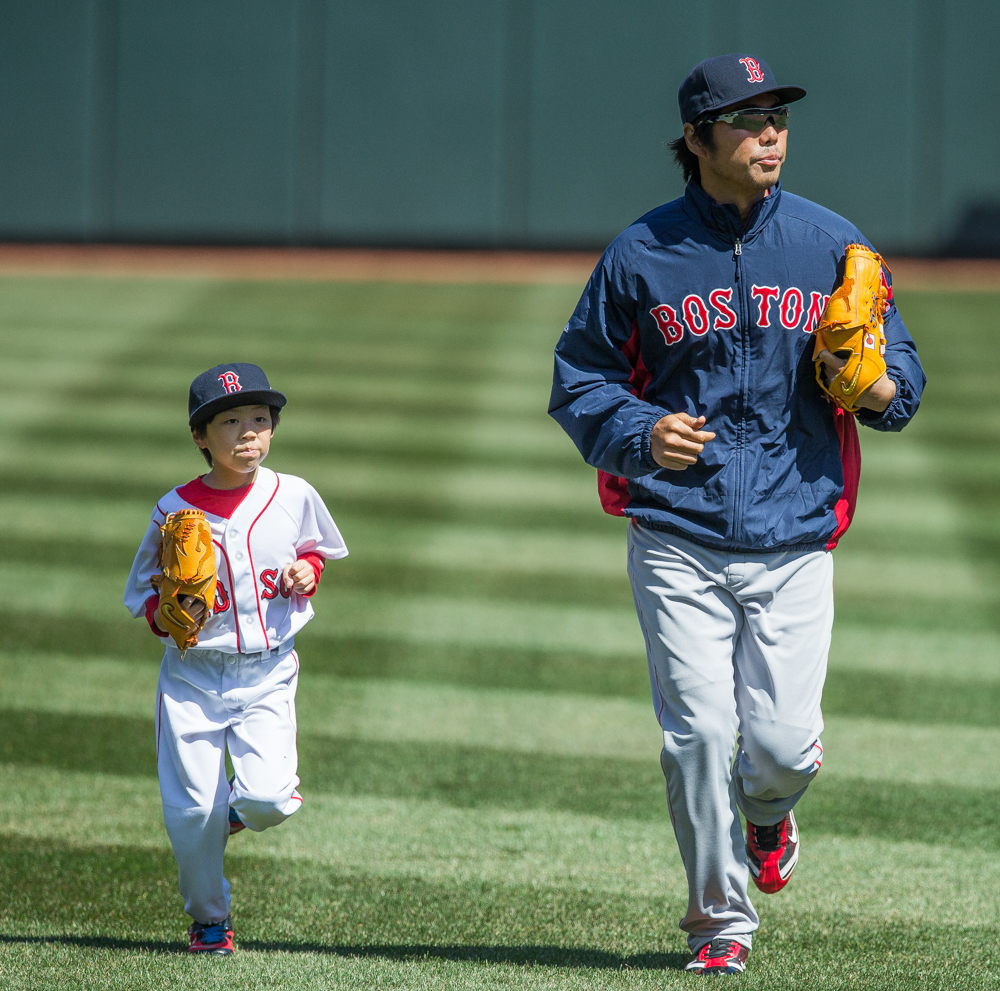
A World Series champion in 2013, Koji Uehara has called it quits.
Photo by Keith Allison.

On May 20, Koji Uehara announced his retirement from professional baseball. The news was significant for several reasons. First, it was announced during the season. Uehara admitted that he “already decided that I would quit this year, and in my mind I felt three months would be make or break.” He also cited that his fastball just doesn’t have enough to compete in NPB anymore and remarked that him being in the organization would reduce chances for other youngsters. It sounds like, all-around, Uehara has resigned to his fate of being a very old man by baseball standards. It’s sad to hear, but that’s just reality.

Second, it simply feels like an end of an era. The man pitched professionally since 1999. Sure, most major league fans weren’t familiar with him until he signed with the Baltimore Orioles in 2009, but even then, he was 33 years old. Personally, I became familiar with Uehara from his dominance in Japan and his exceptional 2006 World Baseball Classic performance (which is never to be forgotten by Korean baseball junkies like myself).

To understand Uehara’s career, it’s essential to look at his time in Japan. His interest in going to the big leagues goes all the way back to his amateur days. As an ace of the Osaka University of Health and Sports Sciences, Uehara was courted by the then-Anaheim Angels. It was said that the Angels prepared an amount of 300 million yen (just below $3 million in current currency rate) for the righty. Uehara was intrigued by it, but the Yomiuri Giants, who had coveted him for a long time, managed to convince him to stay in Japan, selecting him in the 1998 NPB Draft. Among the notable names selected in the event were other future big leaguers Kosuke Fukudome, Kyuji Fujikawa, and Daisuke Matsuzaka.

In 1999, his first professional season, Uehara set NPB ablaze with ridiculous numbers. As a 23-year old fresh out of college, the righty went 20-4 with a 2.09 ERA and 179 strikeouts versus 24 walks in 197.2 innings. He also threw a whopping 12 complete games (!) in 25 starts. He had the most wins and strikeouts and the best winning percentage and ERA, making him the quadruple-crown winner among all pitchers. He, of course, won the 1999 NPB Rookie of the Year, a Golden Glove, Sawamura Award (the NPB’s equivalent of the Cy Young Award), was named to the Best Nine, etc. Basically, Uehara had an entrance of the ages. Here’s a peek at his dominance from that season:

As a starting pitcher, he didn’t reach the same kind of brilliance he showed as a rookie, but he was still great. In 2002 for instance, he won another Sawamura Award by going 17-5 with a 2.60 ERA and 182 strikeouts versus 23 walks in 204 innings. He also garnered some stateside attention in fall 2002. In the first game of the MLB-NPB exhibition series, Uehara struck out reigning NL MVP Barry Bonds thrice. His pitching prowess also impressed former AL MVP Jason Giambi. “He had a great forkball,” he said. “He threw it hard enough that you couldn’t sit on it, and he made quality pitches all night.” Read the rest of this entry »


Yordan Alvarez Has Figured Out This Baseball Stuff

What does ZiPS have for Yordan Alvarez’s translation?

Is Alvarez for real?

Do the Astros need to call up Alvarez right now?

Scattered within my weekly chat questions about cat and chili, there were quite a few questions revolving on Yordan Alvarez, who has spent the first two months of the 2019 season traumatizing minor league pitchers. So naturally, instead of answering the questions, I greedily saved the Alvarez talk for an article on the subject.

Prior to this season, Alvarez was ranked seventh in Houston’s farm system by Eric Longenhagen and Kiley McDaniel on the strength of his raw power potential. Ranking seventh on the Astros says more about the team’s organizational strength than any negative about Alvarez; he’s not someone who would appear in a Fringe Five column. While with a lot of minor league outfielders, you try to see if they can stick in center as long as possible, this was never a realistic option for Alvarez, who is cut from the massive slugger template.

But if you thought he was a one-dimensional type of hitter, a Pedro Cerrano type, you’d be wrong. While it’s not believed that he’ll maintain high batting averages in the majors, I think he might hang onto better averages than many think. For one, he has an efficient, easy swing and is willing to use the entire field, making him less likely to be subject to shift abuse than some other sluggers in the majors. Just to illustrate, here’s Alvarez’s spray chart in the minors in 2019 compared to Max Kepler, a more pull-heavy left-handed hitter.

Alvarez has kept his swinging strike rate under 10% in the high minors, and in the early going, he has cut off about a quarter of his 2018 strikeout rate. His walk rate has also edged higher; Alvarez is a hitter who eats what he hunts. ZiPS uses play-by-play data to estimate a version of xBABIP that I refer to as zBABIP (you don’t win the Kewpie doll for guessing what the z stands for). Alvarez won’t keep the .424 BABIP that’s currently driving his .400 batting average in the minors, of course, but the hit data suggests he may keep quite a lot of it. Read the rest of this entry »


The Best Bieber

The list of players who have struck out 15 batters without allowing a walk in a shutout is a small one. So small that I can list them here in chronological order: Van Mungo, Luis Tiant, Dwight Gooden, Roger Clemens (twice), Kerry Wood, Randy Johnson, Pedro Martinez (twice), Erik Bedard, Clayton Kershaw, Max Scherzer, Vince Velasquez, Jon Gray, and Shane Bieber. The Cleveland right-hander became the first pitcher since 2016 to accomplish the feat when he struck out 15 Orioles over the weekend. Perhaps the effort comes with a caveat because it was Baltimore, although the club’s 24% strikeout rate is middle of the pack and there are five teams with a wRC+ lower than the 83 currently sported by the Orioles. Bieber surprised with a strong performance last season and he looks even better this year thanks to some changes he’s made to miss more bats.

Bieber came into the league as a command artist. He doesn’t have a great fastball, but he locates it well and has a very good slider. This is what Eric Longenhagen had to say about Bieber heading into last year:

Bieber works away from righties, using his fastball and slider in sequence very effectively. He locates his slider in a spot that is equal parts enticing and unhittable, and this trait runs through a lot of the pitchers who exceed scouting expectations and make a big-league impact with just solid stuff. It’s an above-average pitch on its own but garnered an elite swinging-strike rate last year. The stuff, alone, projects to the back of a rotation, but Bieber’s ability to locate gives him a chance to be a mid-rotation arm. It’s possible he has elite command and becomes something more.

Last season, after walking seven batters in 13 minor league starts, Bieber came to the majors and continued his stingy ways by walking only 23 batters in 114.2 innings. His 3.23 FIP was great, but a .356 BABIP meant his ERA was considerably higher at 4.55 and probably raised concerns that his fastball was a bit too hittable despite good command. Nine of his 13 homers came against the fastball, and batters had a 146 wRC+ against the pitch a season ago while he threw it nearly 60% of the time. Bieber paired that fastball with a nasty slider and solid curve. He threw an occasional changeup, but it wasn’t a very good pitch. Read the rest of this entry »


Luke Weaver, Retooled and Reimagined

The book on Luke Weaver was written before he had played a game of professional baseball. Great changeup, good fastball, no third pitch. I mean “the book” metaphorically here, but I also mean it literally. Here’s Eric Longenhagen on Weaver before the 2017 season:

“Those who have questioned Weaver’s upside (myself included) did so because, in college, he lacked a good breaking ball. Weaver’s fringey curveball remains so today, but he’s a good athlete who has developed plus command and added an average cutter to his repertoire in pro ball.”

Cardinals fans got two years of data to back up that assessment — a scintillating 2017 (3.17 FIP, 28.6% K-rate) and a frustrating 2018 (4.45 FIP, fewer strikeouts and more walks) were worth a combined 2.7 WAR, but between underperforming his FIP and losing his rotation spot in the second half of 2018, Weaver felt like a surplus arm. The changeup and sneaky good fastball were as good as advertised, but batters consistently teed off on his curve. When Weaver and top catching prospect Carson Kelly were sent to the Diamondbacks in exchange for Paul Goldschmidt, it felt like a needed change of scenery for both of them.

If the book on Weaver was written while he was still in college, it’s a safe bet that he’s had time to read that book. He has worked towards developing a better breaking ball more or less every offseason of his pro career, and 2019 was no exception. This time, though, he had technological help. He bought a Rapsodo, a portable pitch-tracking camera, and used it to work on his curve. He took his cutter (or is it a slider?) out of mothballs, telling David Laurila he was picking up the hybrid pitch after years of being mainly fastball/change/curve.
Read the rest of this entry »


It’s Time for Michael Pineda to Change His Approach

Michael Pineda has always had a bit of a weak spot in his pitching profile. From his debut in 2011 until his 2017 ended with Tommy John surgery, he threw 680 innings while allowing 91 total home runs. That translated to a 1.20 HR/9, putting Pineda in the bottom 20th percentile in the league among pitchers with at least 650 innings pitched.

Despite the eye-catching rate, the home runs were a manageable issue; Pineda’s FIP in those years was a fine 3.60. More than avoiding home runs, Pineda needed the health he enjoyed between 2015-16 to be an average starter. Even setting aside the Tommy John, his time in the majors is riddled with stints on the disabled list for a variety of maladies. Now in 2019, with the health of his arm finally restored, the home run issues looms larger.

After his first nine starts of the year, Pineda is leading the majors in home run rate among qualified pitchers with a 2.49 HR/9. Following his last start, he became the first Minnesota Twins pitcher to allow at least three home runs in consecutive outings since Bartolo Colon in 2017.

This is still a small sample, and Pineda’s home run rate will probably go down as he keeps pitching. However, given his previous home run issues, the recent spike merits a closer look.

First, let’s examine his fastball. Of the 13 home runs he has allowed this year, six have been against fastballs in the middle or upper part of the zone. Pineda has always liked to throw his fastball in the zone, challenging hitters with good gas, and he has been doing exactly that this year. Read the rest of this entry »


Michael Chavis Has Provided Unexpected Punch

When the Red Sox called up Michael Chavis on April 19, they were 6-13 and had no shortage of troubles. Every member of their rotation save for David Price was regularly being lit up like a pinball machine, and their no-name bullpen was shaky as well. Reigning AL MVP Mookie Betts was hardly himself offensively, and both Jackie Bradley Jr. and Steve Pearce were impossibly cold. Amidst all of that, the team’s hole at second base was just one more problem, albeit similar to last year, when even replacement-level play in the absence of the injured Dustin Pedroia did little to prevent them from winning a franchise-record 108 games as well as the World Series.

Just over one month since Chavis’ arrival, the Red Sox are now over .500 (25-22). Their pitching has come around, as has Betts, and their leading hitter in terms of both slugging percentage (.592) and wRC+ (156) is Chavis, a 23-year-old righty-swinging rookie with “a bit of a beer-keg physique” (h/t Baseball Prospectus), one who had never played second base before this season. His nine homers (in 113 PA) is tied with J.D. Martinez for second on the team behind Mitch Moreland’s 12. He homered in Boston’s wins both Sunday against the Astros and Monday against the Blue Jays. Here’s the former, in which he drove a Wade Miley cut fastball 420 feet, a towering shot over the Green Monster:

Long blasts are hardly a rarity for Chavis. Despite his late arrival, he’s tied for fourth in the majors with six homers of at least 420 feet, and he had another estimated at 419 feet. His average home run distance of 426 feet ranks seventh among players with at least 50 batted ball events (he has 68). Monday’s 389-footer off of the Blue Jays’ Edwin Jackson was just his second homer shorter than 400 feet.

Two months ago, Chavis barely registered as a player likely to make an impact on the 2019 Red Sox, in part because he had just eight games of Triple-A experience to that point along with 100 games at Double-A. Our preseason forecasts estimated he’d get just 14 big league plate appearances. Now he’s one of the players who has helped to salvage their season. So what gives? Read the rest of this entry »