Archive for Teams

Daily Prospect Notes: 4/8/2019

These are notes on prospects from lead prospect analyst Eric Longenhagen. Read previous installments here.

Luis Robert, CF, Chicago White Sox
Level: Hi-A   Age: 21   Org Rank: 4   FV: 55
Line: 2-for-4, HR, 2 HBP

Notes
Off to hot start, Robert has multi-hit efforts in each of his first four games and has already stolen three bases and homered three times. After watching LouBob a lot last year (first while he rehabbed multiple injuries, then in the Fall League), I grew concerned about how his bat path might limit the quality of his contact (he sometimes struggled to pull pitches he should have) or his rate of contact, which we don’t have a large-enough sample to properly assess because of his injuries. So far, the pull-side stuff hasn’t been founded, as all but two of Robert’s balls in play so far this year have been to the right side of the field, and those were both pop-ups to the second baseman. He’s one of the more physically-gifted players in pro baseball.

Darwinzon Hernandez, LHP, Boston Red Sox
Level: Double-A   Age: 22   Org Rank: 2   FV: 45
Line: 5 IP, 2 H, 4 BB, 0 R, 10 K

Notes
We do not think Hernandez is a long-term starter and instead think he’ll be an elite bullpen arm. His fastball often sits in the upper-90s when he’s starting so it should at least stay there if he’s moved to relief and, though his feel for it comes and goes, his curveball can be untouchable at times. Maybe the strong early-season performances of Matt Barnes, Brandon Workman, and Ryan Brasier has stifled some of the disquiet about the Red Sox bullpen, but in the event that they need an impact arm, I think it’s more likely to be Hernandez than a piece outside the org. Some of this is due to the quality of the farm system, but Hernandez might also just be better than a lot of the options that will eventually be on the trade market. Read the rest of this entry »


Jacob deGrom is Picking Up Where He Left Off

Jacob deGrom’s 2018 will go down in history as one of the best pitching seasons of all time. There’s almost no way it couldn’t — pitchers don’t put up sub-two ERAs very often, and they record sub-2 FIPs even less frequently. By those stats alone, deGrom had the seventh-best ERA and eighth-best FIP since integration. Adjust for the run-scoring environment, and he falls all the way to ninth. Simply put, deGrom was sublime in 2018.

After a season of such historic magnitude, we’d be crazy to not expect regression. Everything broke so well for deGrom in 2018 that he could pitch every bit as well in 2019 and end up with meaningfully worse results. Indeed, ZiPS and Steamer both projected deGrom’s ERA to increase by essentially a run this season. Despite that, both projected him to put up the second-best ERA and FIP among starters, behind only Chris Sale. When you’re as far ahead of the pack as deGrom, you can significantly regress and still be one of the best.

It isn’t just projection systems that peg deGrom to come back to earth — the broad sweep of history suggests it as well. No matter how you slice it, pitchers who record a season like deGrom’s decline the next year. Want to focus on ERA? There have been 26 times since 1947 when a pitcher qualified for the ERA title and had an ERA below two. Excluding 2018 deGrom and 1966 Sandy Koufax (he retired after 1966 and so didn’t have a next season), these pitchers averaged a 1.77 ERA. The next year, they recorded a 2.78 ERA. Read the rest of this entry »


Tyler Anderson, Steven Brault, and Mike Leake on Learning Their Changeups

Pitchers learn and develop different pitches, and they do so at varying stages of their lives. It might be a curveball in high school, a cutter in college, or a changeup in A-ball. Sometimes the addition or refinement is a natural progression — graduating from Pitching 101 to advanced course work — and often it’s a matter of necessity. In order to get hitters out as the quality of competition improves, a pitcher needs to optimize his repertoire.

In this installment of the series, we’ll hear from three pitchers — Tyler Anderson, Steven Brault, and Mike Leake — on how they learned and developed their change-of-pace pitches.

———

Tyler Anderson, Colorado Rockies

“In high school, I tried to learn how to pitch by watching other people. And I was doing all kinds of stuff. I was dropping down, throwing from all arm angles, throwing sliders. Then I got to college. At the University of Oregon, they preached fastball-changeup. Not only that, in the fall you weren’t allowed to throw breaking pitches; you had to go fastball-changeup only. Then, just before the season started, you could start mixing in curveballs and sliders.

Tyler’s Anderson’s changeup grip.

“Before that, I’d thrown a palm ball. Honestly. I would hold it in my palm and throw a palm ball. It was slower. My dad knew about it from back in the day — it’s an old-school pitch — and mine was actually pretty good. It didn’t have a lot of spin, and as you know, limited spin creates drop. Mine would drop a lot, but it was too hard to control. Read the rest of this entry »


Chris Davis Continues His Free-Fall

If there’s one player whose 2019 season is off to a more conspicuously inauspicious start than Nationals reliever Trevor Rosenthal, who has yet to retire a batter through four appearances (including one on Sunday), it’s Orioles first baseman Chris Davis, who has yet to record a hit. Like Rosenthal, Davis’ run of futility has actually carried over from his previous season. He’s now approaching the major league record for consecutive hitless at-bats by a non-pitcher, held by Eugenio Velez (0-for-46 in 2010-11), and is putting the rebuilding Orioles in an awkward position given his huge contract, which could become the largest sunk cost in major league history.

Already known for his all-or-nothing extremes, which included him hitting 53 homers in a season (2013) and striking out 219 times (2016), the now-33-year-old Davis appeared to find the bottom last year, when he hit .168/.243/.296 for a 46 wRC+ while striking out in 36.8% of his plate appearances, numbers that all ranked dead last among the majors’ 140 qualifying hitters. Whether it was mechanical flaws, eyesight troubles, medication issues (he has a therapeutic use exemption for an ADHD drug, an issue that led to a 25-game suspension in 2014, when it wasn’t properly addressed), or mental struggles, Davis and the coaching staff weren’t able to find the answer to his problems. Including slightly subpar defense (-1.7 UZR), his -3.1 WAR tied for the majors’ sixth-lowest mark since 1901. He closed the season while stuck in a 1-for-39 skid, with a September 14 double off the White Sox’s James Shields his only hit after his second plate appearance on September 5. He went hitless in his final 21 at-bats, with 14 strikeouts (he walked twice and was hit by a pitch within that span). In an act of mercy, the Orioles — who were on their way to 115 losses, the third-highest total of the post-1960 expansion era — didn’t play him in their final eight games, preventing Davis from digging an even deeper hole. Read the rest of this entry »


Sunday Notes: Griffin Canning Has an Artistic Thumb Print

Griffin Canning on is on the fast track after a delayed start. Drafted 47th-overall by the Angels in 2017, the righty didn’t made his professional debut until last April. By June he was taking the mound for the Triple-A Salt Lake Bees. That’s where the 22-year-old UCLA product is to begin the current campaign, one rung below the majors, with a chance to reach Anaheim in the not-too-distant future.

When the call-up comes, Halos fans can expect to see a pitcher who combines power and pitchability. His approach to his craft is a mixture of art and science.

“I think you can find a middle ground on the two,” said Canning, who ranks fourth on our Angels Top Prospects list. “For me it’s moe of an art — I’ve kind of always thought you can be born with it — but at the same time, you can use those science tools to help you get better.”

When I talked to him during spring training, I asked the youngster what type of artist he envisions himself as. I wasn’t looking for a Monet or van Gogh comp, but I was wondering about his thumb print on the mound. Read the rest of this entry »


José Ramírez Is in a Quarter-Season Long Slump

In my short time so far at FanGraphs, there have been a couple of underlying similarities between the player profile-style pieces that I have written. All three of them have been about under-the-radar pitchers, whether it be about Chase Anderson or Dan Straily or Jimmy Yacabonis, and all three articles have focused on their individual pitches or repertoires.

Today, I will take a different tact. First, it’s about a hitter, and second, this hitter is not, by any means, “under-the-radar.” José Ramírez slashed .270/.387/.552 in 698 plate appearances last year, producing a total of 8.0 WAR, a figure that ranked third in all of baseball. Ramírez even had a solid case at the American League MVP award, finishing third behind Mookie Betts and Mike Trout. That’s really good! That’s better than really good; it’s elite. Ramírez has truly been one of the best players in baseball over the last three years now, and we should all appreciate that.

The problem is, though, José Ramírez actually hasn’t been good lately. And I’m not just talking about his slow start to the 2019 season (11 wRC+ in his first 20 PA); Ramírez’s slump has actually been quite long. Over his last 40 games, dating back to August 21 of last season, Ramírez has slashed .170/.298/.279 across 178 plate appearances. His 60 wRC+ during this stretch was the 17th-lowest in the major leagues, among 228 players with at least 100 plate appearances. That puts him in the undoubtedly-not-elite 7th percentile. Just to add insult to injury, this excludes the 2018 postseason, in which Ramírez did not record a single hit and managed just one walk across 12 plate appearances, good for a .000/.083/.000 line. Read the rest of this entry »


Trevor Rosenthal Reaches for Infinity

Last month, in the wake of Bryce Harper’s signing with the Phillies, I took stock of the Nationals and raised an eyebrow at the limited fixes administered to a bullpen that has required annual midseason makeovers, and that last year tied for 25th in the majors in WAR (0.6). General manager Mike Rizzo’s big offseason moves regarding the unit were to sign Trevor Rosenthal, who missed all of 2018 due to Tommy John surgery, and Kyle Barraclough, who pitched to a 4.20 ERA and 4.98 FIP with the Marlins. So far, it hasn’t gone well, to say the least. The unit as a whole has an 11.02 ERA through five games.

Barraclough has only been charged with one run allowed in 3.1 innings, but he’s also allowed five out of five inherited runners to score. That’s no good, but it’s nothing compared to the travails of Rosenthal, a 28-year-old righty who, during his Cardinals tenure, pitched to a 2.99 ERA and 2.60 FIP while saving 121 games from 2012-17.

On March 30 against the Mets, Rosenthal entered a tied game in the eighth inning and proceeded to allow back-to-back singles to Wilson Ramos and Jeff McNeil, then walked Amed Rosario (a tough thing to do given the kid’s 4.9% walk rate last year) and served up a two-run single to J.D. Davis. Manager Davey Martinez gave him the hook in favor of Barraclough, who immediately balked in a run, and two outs later, allowed a two-run double by Pete Alonso. Thus, four runs were charged to Rosenthal, who didn’t retire a batter.

Undeterred, Martinez called on Rosenthal again the next day with the Nationals trailing the Mets 5-2 and runners on the corners courtesy of mid-March signing Tony Sipp. Facing Rosario again, Rosenthal threw just one pitch, which the 23-year-old shortstop lined for an RBI single. Sean Doolittle relieved Rosenthal and allowed back-to-back singles, the second of which scored Rosario. Another day, another outing with a run allowed but no out for Rosenthal. Read the rest of this entry »


Corbin Burnes Spins to Win

The first week of baseball is a wondrous time to be a baseball fan. It’s also a weird time to be a baseball writer. On one hand, baseball is happening, and that’s a relief after the long dark night of the offseason. On the other hand, not that much baseball has happened, and most of the seemingly noteworthy stories are small-sample noise. Give me an early-season take (Tim Beckham is great! Sandy Alcantara is a top-10 pitcher!), and I’ll likely dismiss it as a fluke. One performance this week, however, made me sit up and take notice. Corbin Burnes struck out 12 batters on Sunday, and the way he did it should have Brewers fans, and baseball fans in general, salivating.

At first glance, Burnes’ start against the Cardinals is a textbook case of not reading too much into a single start. He struck out 12 batters and walked only one, which is obviously incredible. On the other hand, he gave up three home runs and only lasted five innings, producing a what’s-going-on split of a 6.53 FIP and 0.00 xFIP. If I were a betting man, though, I’d wager that the strikeouts are more predictive than the home runs. Why? Corbin Burnes’ fastball was absolutely ludicrous, and in a way that you can’t fake.

Most of the things that happen in a baseball game are contextual. Did a pitcher strike a lot of hitters out? Well, consider who was batting. If it’s a bunch of high schoolers or the 2019 Giants outfield, that’s an extenuating circumstance. Did he give up a lot of home runs? A ton of factors go into that. One thing that isn’t contextual is a pitch’s spin rate. The batter doesn’t influence it. Pitch selection doesn’t influence it. It doesn’t take long to stabilize. It’s basically as clean as it gets in baseball statistics — you throw the ball, and you get your results.

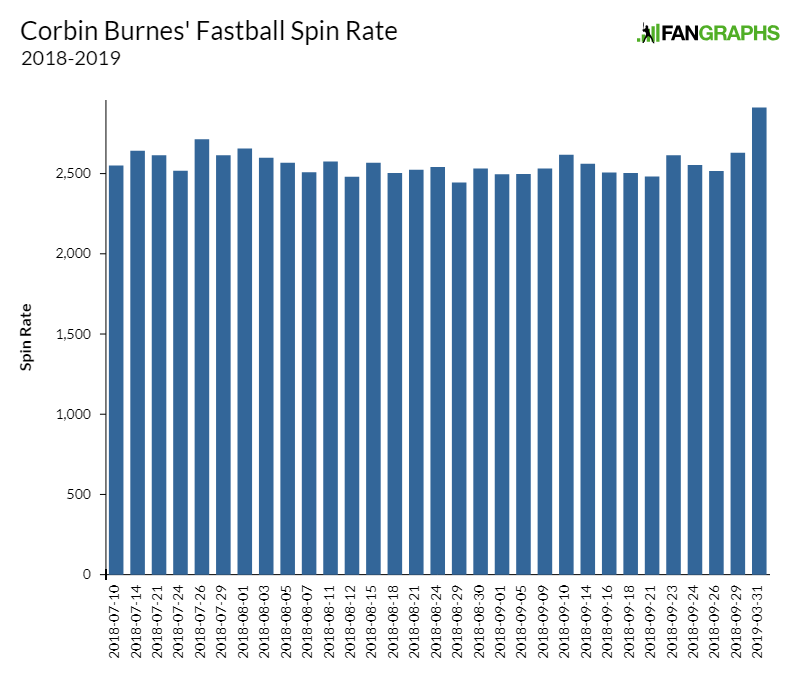
When Burnes threw the ball on Sunday, the results were off the charts. Burnes fired 61 four-seam fastballs on Sunday. His velocity was down a tick or so from last year, when he worked out of the bullpen — nothing unusual about that. His spin, on the other hand, was wholly new. Burnes averaged 2912 rpm, and it’s hard to explain how crazy that is. It was nearly 150 rpm higher than last year’s league leader in average spin rate, Luke Bard. The fastball that Burnes spun most slowly, at 2660 rpm, would have been good for the second-highest fastball spin rate in baseball last year.

Burnes has always been a high-spin pitcher (11th in baseball among pitchers who threw at least 100 fastballs in 2018), but this is an entirely different level. Spin rates vary from start to start, but not like this. In fact, Burnes made thirty appearances last year, and the gap between the highest spin rate he recorded and the lowest was 270 rpm. Sunday’s start was 200 rpm faster than last year’s highest rate. Graphically, that looks pretty absurd, like so:

Read the rest of this entry »


The Yankees Have Turned into a Walking MASH Unit

As a part of the FanGraphs staff predictions for this season, I picked the Boston Red Sox to win the American League East, and the New York Yankees to pick up a wild card slot. All 32 of us picked the Yankees to make what would be a third consecutive trip to the postseason. And our preseason projections pegged the Bronx Bombers for 99 wins, the best record in baseball, and a whopping 66.4% chance of winning the American League East. The Yankees – on paper, at least – were and are good.

But life, they say, is what happens when you’re busy making other plans. The Yankees have started slowly, yes, but a 2-4 record is hardly alarming when you’re less than a week’s worth of games into a 162-game season. More worrisome is the fact that the Yankees’ injured list is suddenly beginning to resemble an All-Star team in its own right. First, newly extended center fielder Aaron Hicks went from tweaking his back in Spring Training to receiving two cortisone shots to an indefinite injured list stint with a lower back strain. That’s not good, seeing as Hicks is the second most valuable center fielder in the American League since 2017, behind some guy named Mike Trout. Still, the Yankees are deep, and they could plug Brett Gardner into center field without suffering a major catastrophe.

If this had been the team’s only major injury, the team might have been fine, especially on the back of what was projected to be an elite starting rotation. But also-newly-extended ace right hander Luis Severino joined Hicks on the shelf late in Spring Training after suffering rotator cuff inflammation, and isn’t expected back until May. Shoulder problems, including rotator cuff injuries, are notoriously finicky in pitchers, and while there’s no reason to believe Severino’s injury is more serious that we know, we also don’t know how the hard-throwing right-hander will fare after returning from the injury, particularly after not having had a single Spring Training start. With C.C. Sabathia’s farewell tour on hold after offseason heart surgery, the Yankees’ rotation suddenly started to look a little thin.

But no matter. The Yankees still had a fearsome lineup and perhaps the best bullpen ever, right? But then Dellin Betances’ spring training fastball clocked in the high-80s, and it wasn’t long before a shoulder impingement was diagnosed as the cause of his missing velocity. So Betances joined the list of the Yankees’ walking wounded.

Of course, why should the pitching staff have all of the fun? On the same day, two lynchpins of the Yankees’ fearsome lineup – outfield adonis Giancarlo Stanton and sophomore third-sacker Miguel Andujar – both suffered significant, and potentially long-term, injuries. Stanton suffered a left biceps strain whilst swinging and missing in just the team’s third game of the season, and Andujar suffered a small tear of his labrum diving into third base in the same game. By the end of the team’s second series of the year against the Tigers, Troy Tulowitzki had joined the injured list as well with a calf strain.

How bad are the Yankees’ injuries? Right now, including Tulowitzki, New York has 11 players on its injured list; no other team has more than eight. Here’s the complete list, with 2019 Depth Charts projected WAR:

That’s 18.6 projected fWAR on the injured list at one time, which is more than the 2019 projected WAR for the entire Orioles team. That might also be understating the value of these players; they posted a combined 26 WAR in 2018. Some of these injured list placements were expected; after all, both Gregorius and Montgomery are still recovering from Tommy John surgery and aren’t expected back until midseason, and outfielder Ellsbury fell into a temporal vortex and likely will never be heard from again. Still, that’s a contending team’s starting third baseman (Andujar), starting shortstop (Gregorius), the replacement for the injured starting shortstop (Tulowitzki), starting left fielder/designated hitter (Stanton), and starting center fielder (Hicks), along with its No. 1 (Severino) and No. 4 (Sabathia) starters, and primary setup reliever (Betances), all injured at once.

That’s a lot of WAR for any team to lose, even the Yankees, even temporarily; the team is missing the equivalent of one and a half Mike Trouts. So in some ways, it’s a minor miracle that even after losing that much talent, the team is still projected to win 95 games. In fact, owing to the Red Sox’s nightmarish West Coast trip, the Yankees’ odds of winning the division have remained relatively steady since Opening Day, though they have dipped slightly.

The good news is that the Yankees’ pitching staff is well equipped to weather the storm. Johnny Loaisiga and Domingo German have both impressed as replacements for Sabathia and Severino. Even without Betances, a bullpen featuring Adam Ottavino, Zack Britton, and Aroldis Chapman is still fearsome, even if Chad Green has been hittable in the early going. James Paxton and Masahiro Tanaka have been great. Sabathia is expected back before the end of April, with Betances back around the same time. Severino’s return is somewhat murkier, but projected around May or June. In short, the Yankees should still spend the bulk of their season with their pitching at least largely intact.

The larger problem is one you wouldn’t have anticipated going into the season: the offense. And unlike the pitching staff, help isn’t arriving any time soon. Stanton hopes to be back in early May barring a setback, but Andujar is without a timetable and still may require season-ending surgery. All of a sudden, an infield without a place for D.J. LeMahieu to play regularly just a week ago is deploying Tyler Wade as its starting second baseman. Didi Gregorius won’t be back until the second half.

With so many big bats missing, the result is about what you’d expect. The Yankees gave up just six runs in their most recent three-game set against the Detroit Tigers, but scored only five and dropped two out of three. Tuesday, a lineup featuring D.J. LeMahieu batting fifth managed just one run against Jordan Zimmermann; Wednesday, the team struck out 18 times against a Tigers pitching staff that ranked just 24th in pitcher WAR, 25th in FIP, and 26th in strikeout rate in 2018.

The second wild card gives the Yankees a considerable margin for error, as does their depth. It might all prove to be fine. That said, with Tampa Bay, a deep and talented team in its own right, off to a 5-1 start, and the Red Sox healthy, the Yankees might not have the luxury of treading water until their injured players return if their goal is to win the division. Aaron Judge and Gary Sanchez can’t carry the offensive load by themselves, and Greg Bird is himself injury-prone. Clint Frazier is talented, but untested and coming off a concussion that ruined his 2018. Unless the team is willing to use heavy doses of Mike Tauchmann and Tyler Wade moving forward, the Yankees may have no choice but to start looking for offensive help from outside the organization.


Randal Grichuk Joins the Extension Parade

This spring, Randal Grichuk is following Mike Trout. The outfielder whom the Angels drafted with the 24th pick in 2009, one slot before they chose a player who’s already in the conversation for the greatest of all time, is the latest to agree to a long-term extension. It’s significantly less than Trout’s 12-year, $430 million pact, of course, but Grichuk nonetheless guaranteed himself a substantial payday by agreeing to a five-year, $52 million deal with the Blue Jays, covering the 2019-23 seasons. That’s not too shabby for a player who was viewed as a fourth or fifth outfielder when he was acquired from the Cardinals in January 2018.

As the Blue Jays have steered themselves into rebuilding mode by shedding the likes of Jose Bautista, Josh Donaldson, J.A. Happ, Russell Martin, Troy Tulowitzki, and others over the past 18 months, either via trade or free agency, the now-27-year-old Grichuk has emerged as more than just a backup. Last year, he started 84 games in right field, another 25 in center — largely when Kevin Pillar, who coincidentally was traded to the Giants on Tuesday, the same day that Grichuk’s deal was announced, missed time with a shoulder sprain — and one in left field. Despite hitting just .106/.208/.227 in 77 plate appearances before missing all of May due to a right knee sprain, he set a career high with 25 homers while posting his highest on-base percentage (.301), slugging percentage (.502), and wRC+ (115) since his 2015 rookie season. Read the rest of this entry »