Archive for Teams

The White Sox Extend Eloy Jimenez

Yesterday, White Sox right fielder Eloy Jimenez, our eighth overall prospect on this year’s Top 100, joined this week’s extension palooza (now featuring prospects!), signing a precedent-smashing extension before he’s even spent a day in the major leagues.

An important point here is that the White Sox appear to have leveraged service time manipulation to their advantage, as noted by Ken Rosenthal, though they’re far from the first club to have done so. Since Chicago could have gained a seventh year of control by leaving Jimenez in the minors for 15 days, the six-and-two structure means that he only gave up one year of potential free agency from what was otherwise his best (and only) alternative to taking this deal. There’s no way to know exactly how much money or how many years this saved the White Sox, but it basically took one season from the free agent column and moved it into the arbitration column, so the figure is likely in the millions. Since this exact set of circumstances could be changed in the next round of CBA negotiations, it was opportunistic of the White Sox to use this negotiating chip while they still had it.

But that doesn’t take away from the fact that this deal is predicated, at least in part, on some disingenuous public posturing from a club in the middle of a rebuild that isn’t going that well. They’re essentially holding their best prospect, and their fans, hostage, all to squeeze a little more value out of a potential franchise player in a far-off year. General manager Rick Hahn gave a non-answer last August when, during a sixth straight season in which the club was more than 15 games out of first place, Jimenez clearly warranted a call-up but was left in Triple-A. Manager Rick Renteria casually compared Jimenez to Ken Griffey Jr. last week when he was sent to minor league camp. Astros pitcher Collin McHugh shined a light on the motivations behind the situation after Jimenez was optioned. If Jimenez is on the Opening Day roster, I’m sure we’ll get some chuckles and shrugs when Hahn or Renteria are asked how he magically became major league-ready less than a week after they’d announced that he wasn’t.

Jimenez originally signed for $2.8 million in 2013, so that money plus the roughly $1.6 million he would get making the league minimum in 2019-2021 obviously wasn’t going to create a set-for-life situation, especially after agent/buscon fees and taxes. The sort of player he has turned into (a big corner hitter who has gotten bigger and more corner-y in recent years) isn’t in demand in free agency or elsewhere, unless that player is making close to the league minimum or is hitting like J.D. Martinez. In our most recent Top 100 prospect list, we made a graph of Jimenez’s likely WAR outcomes over his cost-controlled years, using the empirical baseline of past 60 FV hitters:
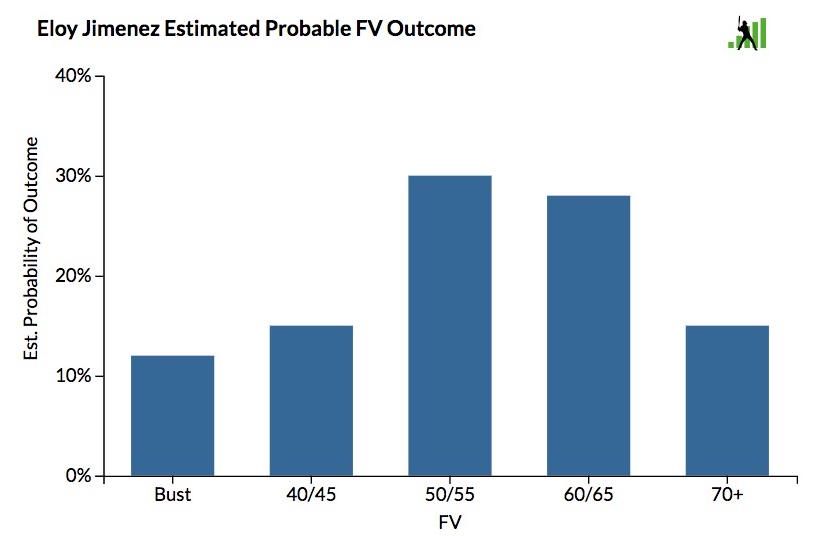
Moving left to right, the percentages are 12%, 15%, 30%, 28% and 15%. The weighted average of Jimenez’s team control-years WAR is 15.5, putting him in the middle to lower end of the 60/65 group, which jives with our 60 FV grade. We basically think he’s a perennial three-win player with a chance for a season or two of production higher than that, and about a 25% chance of turning into a role player or one who fizzles out quickly (the bottom two tiers).

Craig Edwards’ research pegs a 60 FV hitter as being worth $55 million, but Jimenez is near the top of that range and research from Dan Aucoin pegs that value at about $60 million. That would cover the first seven seasons with no deal, so $43 million guaranteed with a chance at $77 million over eight years suggests that both sides did well, with Jimenez taking somewhere between a $10 million and $20 million discount (roughly a third) to get the money guaranteed, but losing little of the upside. If Jimenez captures the full value of the deal (eight years, $77 million), that figure is very close to his present asset value over eight years, or the median value of what he’s worth over that term.

The White Sox assume some risk that Jimenez ages very quickly and turns into a DH in his arbitration years, but they’re in a rebuild and things will have gone pretty poorly in other ways if that happens. Jimenez could be leaving some money on the table if he does indeed turn into J.D. Martinez, but I’m generally of the mind that right-handed hitters with heavy builds at age 22 to take the median payout, especially if they haven’t had a huge payday yet. I just wish these sorts of shenanigans weren’t what got them there.

Juan Soto Is Extreme

It’s not a news flash that Juan Soto was great in 2018. The simplest of statistics could tell that story. His OBP started with a 4. His slugging percentage started with a 5. He had 22 homers in a mere 116 games. However, the real hype starts when you dig into the numbers a little more. Juan Soto was 19, and he walked 16% of the time in the big leagues while putting up a 146 wRC+. People are making historical comparisons because that’s the only way to appreciate such a tremendous feat. No one in history has put up a better batting line before their 20th birthday, and the only people to come close are Mel Ott, Tony Conigliaro, and Ty Cobb. When you put it that way, maybe we’re underselling how great Soto’s 2018 was.

I’m not writing today to remind you of how good Soto’s 2018 was (like, really good though! Really good!). Instead, let’s talk about the approach he used to generate those numbers. Here’s a leaderboard of the 10 best hitters in baseball by wOBA last year, minimum of 450 PA. I’m using wOBA instead of wRC+ for compatibility with data further along in the article:

Best Hitters in Baseball, 2018
Player wOBA
Mookie Betts 0.449
Mike Trout 0.447
J.D. Martinez 0.427
Christian Yelich 0.422
Max Muncy 0.407
Alex Bregman 0.396
Juan Soto 0.392
Jose Ramirez 0.391
Aaron Judge 0.391
Nolan Arenado 0.391

Well, that’s about what you’d expect. Ten great hitters, or potentially nine great hitters and Max Muncy, depending on how you feel about him. Paul Goldschmidt was eleventh if you want to leave Muncy out of this. That alone is already amazing. What makes it really impressive, however, is that Soto did it all against fastballs. I’m going to throw another leaderboard at you. Read the rest of this entry »


Rays Extend Rookie Brandon Lowe

Late Tuesday night, Ken Rosenthal reported that the Tampa Bay Rays had agreed to a six-year, $24 million contract extension with 24-year-old second baseman and outfielder Brandon Lowe. Lowe is our 46th overall prospect, the top one in the 50 FV tier, and the No. 5 prospect in a loaded Rays system.

According to the Tampa Bay Times’ Marc Topkin, the deal also includes two club option years, which, along with incentives, could bring the total value to $49 million; if those options are exercised, Lowe will be 32 when the deal ends. Lowe will now obviously be making much more during his pre-arb seasons than he would have with standard contract renewals, but the possibility of overarching changes to baseball’s compensation structure in the next CBA currently make it impossible to evaluate the latter parts of the deal on Lowe’s end.

If he becomes the type of player I expect him to be — Lowe has power, walks at an above-average clip, and plays several positions including a passable second base, all of which makes me think he’s a two to three win player — a $4 million average annual value would make Lowe a bargain for the Rays. Based on Craig Edwards’ work at our site (and Driveline Baseball’s recent attempt to refine that research), 50 FV position player prospects like Lowe should be valued at $28 million, quite close to the value of his deal, excluding of the team option years. The AAV of the two option years, which would encompass Lowe’s age-31 and 32 seasons, is $12.5 million, almost exactly what D.J. LeMahieu received this offseason (age 30, two years, $24 million), and LeMahieu has been what we’d call a 50 in prospect parlance, as he was on average about a two win player during his tenure with Colorado. Read the rest of this entry »


Astros Pay Alex Bregman Now To Avoid Paying Him Later

Coming on the heels of Mike Trout’s humongous contract extension, news broke that Alex Bregman and the Astros had agreed to an extension of their own worth $100 million, with Mark Berman first to report the deal. While the Trout contract is the biggest of all time, the Bregman deal is not without intrigue. Bregman, who was still a full year away from arbitration, is the first star-level player to sign a pre-arb contract extension in nearly five years. The last player at or above Bregman’s level of production to sign a contract like this was Trout, who signed his six-year, $144.5 million contract back in 2014.

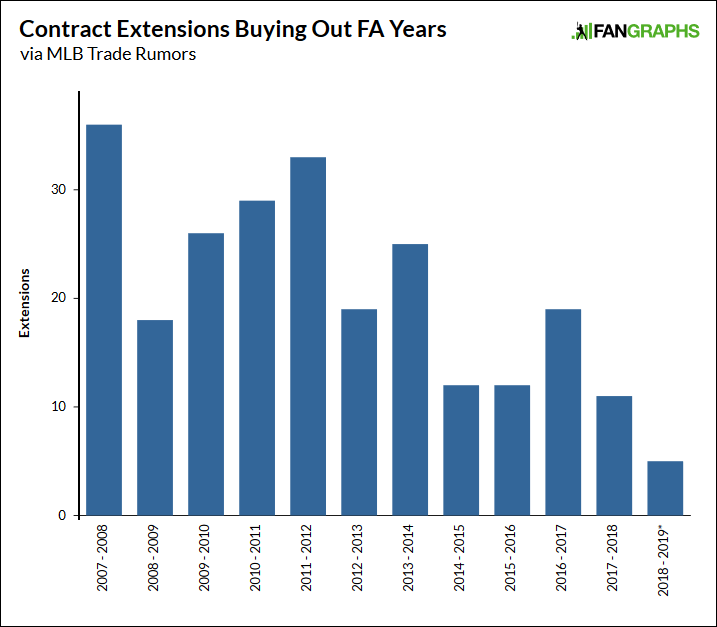
Since 2014, the number of contract extensions buying out free agent years has decreased. When Luis Severino signed his deal earlier this offseason, Jeff Sullivan ran the numbers on the quantity of extensions by offseason, providing this graph.

In the five years leading up to the 2014 season, there were about 25 or so extensions per season, and in the five years since, the numbers have dropped in half. Since Severino signed, we have had Jose Leclerc, and now Alex Bregman, but those extension figures aren’t going up a ton this year. It isn’t just that the number of extensions have gone down; the quality of players signing those extensions has declined as well. We saw Trout’s big deal ahead of the 2014 season; the year before, Buster Posey, who was Super-2 arbitration eligible, signed an even bigger contract covering more seasons. It was Andrew McCutchen the year before Posey. Matt Carpenter and Jason Kipnis, who were several years older than Bregman but also coming off very good years, signed six-year deals with options guaranteeing themselves around $50 million each. Read the rest of this entry »


Houston Rewards Pressly’s Liftoff with Two-Year Deal

It wasn’t the biggest extension announced yesterday — it wasn’t even the biggest Astros extension announced yesterday — but Ryan Pressly’s two-year, $17.5 million deal with Houston, which was first reported by Chandler Rome, was a big deal for Pressly, a big deal for Houston, and a big deal for relievers. The deal will pay Pressly $2.9 million in 2019, his final arbitration year, then $8.75 million in each of 2020 and 2021. There’s a vesting club option for 2021, as well. It’s believed to be the biggest extension ever signed by a reliever not expected to close games for his team (that’s still Roberto Osuna’s job, at least for the time being) and is a tremendous accomplishment for a player who had a 4.70 ERA (with a 4.36 FIP) as recently as 2017.

But of course that 2017 performance isn’t what the Astros are paying for. They’re paying for what he did in Houston last August and September (which is strike out 32 men and walk just three in 23.1 innings pitched) and what they think he can do for them going forward (which is presumably more of the same). Héctor Rondón, Joe Smith, Collin McHugh, and Will Harris are all expected to become free agents at the conclusion of the 2019 season, and locking Pressly up now means the Astros will have one less thing to worry about next winter. For Pressly, this deal gives him the job security that has absolutely never been a guarantee in the years since he signed with the Red Sox as an 11th-round pick back in 2007.

The conventional wisdom is that relievers are inherently volatile — with a few, Mariano Rivera-shaped exceptions — and so giving them multi-year contracts is the kind of thing you only do when you’re competing for their services on the open market. You certainly wouldn’t expect to see a forward-thinking team like the Astros locking up a reliever with such a short track record of success — during his time in Minnesota at the beginning of 2018, Pressly had a 3.40 ERA and a 2.95 FIP — for two additional years when they’re competing against nobody but themselves. Read the rest of this entry »


The Yankees Sign Gio Gonzalez for Minimal Risk, Money

Back in 2011, the Yankees had a lot of fun after signing two aging starters to minor league contracts, when they brought on Bartolo Colon and Freddy Garcia. Colon was deemed to be done by many. He went so far as to get a stem cell injection in his shoulder to give it another go. Garcia had a so-so season in 2010 and was working with significantly diminished stuff from his prime, but the two combined for 4.8 WAR, helping the Yankees on the way to a division title. Eight years later, New York has signed Gio Gonzalez to a minor league deal. He will earn $3 million if he reaches the big leagues, with incentives based on games started. He has the ability to opt-out on April 20 should he not receive a major league assignment. The circumstances that led to signing Gonzalez now, and Colon and Garcia then, are different, but the best-case scenario might be the same: big bang for the buck from a veteran arm.

Normally, there are five starting pitchers in a set rotation; two of the Yankees’ are injured this spring. Luis Severino, the staff ace, has an inflamed rotator cuff and is expected to be out until May. CC Sabathia is recovering from angioplasty and right knee surgery, and is projected to return sometime in April. That leaves two spots open beyond the cast of James Paxton, Masahiro Tanaka, and J.A. Happ.

The Yankees already have depth arms with major league starting experience in Domingo German, Jonathan Loaisiga, and Luis Cessa. German and Cessa in particular are having pretty good springs, but we all know that spring training can be a bit of a mirage. Those three combined for 1.8 WAR last year, which isn’t inspiring. But they are young and have shown flashes of promise, so it is possible that they could break out this year. For now, they are talented question marks. And even if the Yankees decide to carry two of the three, they would still face issues when it comes to rotation depth. As we’ve seen from the 2016 Dodgers, anything could happen to human beings who throw baseballs for living. Read the rest of this entry »


Effectively Wild Episode 1350: Season Preview Series: Astros and Tigers

EWFI
Ben Lindbergh and Sam Miller banter at length about Mike Trout’s extension, why he may have wanted to stay with the Angels, what makes him different from other players, and why he’s underpaid despite his record contract, then preview the 2019 Houston Astros (44:38) with The Athletic’s Astros beat writer Jake Kaplan, and the 2019 Detroit Tigers (1:15:05) with Detroit Free Press Tigers beat writer Anthony Fenech.

Audio intro: Heatmiser, "Why Did I Decide to Stay?"
Audio interstitial 1: Neil Finn, "Astro"
Audio interstitial 2: John Doe and The Sadies, "Country Club"
Audio outro: Flamin’ Groovies, "The First One’s Free"

Link to Ben’s Trout extension article
Link to Sam’s Trout extension article
Link to Sam’s article about Trout on every team
Link to story about MLB considering raising minor-league salaries
Link to Banished To The Pen’s team preview posts
Link to preorder The MVP Machine

 iTunes Feed (Please rate and review us!)
 Sponsor Us on Patreon
 Facebook Group
 Effectively Wild Wiki
 Twitter Account
 Get Our Merch!
 Email Us: podcast@fangraphs.com


Mike Trout Leaves Money On the Table Again

Mike Trout is a better player than Bryce Harper and Manny Machado combined. He’s been more than twice as valuable as each of those players in their young careers. And yet Mike Trout is about to agree to a contract that, per ESPN’s Jeff Passan, will pay him like he’s one of the greatest players of this generation instead of potentially being the greatest player of this century, and one of the greatest baseball talents of all time. As first reported by Passan, Mike Trout and the Angels have agreed to a 12-year deal worth $430 million, with Bill Shaikan reporting the deal will come in at $426.5 million. Because Trout was already owed $66.5 million over the next two seasons, the contract is functionally a 10-year extension worth $360 million. Trout is essentially accepting something similar to the Harper/Machado deals two years in advance. This is not the first time Trout has made this choice, which is very much a personal decision, but it is one that has cost him potentially hundreds of millions of dollars.

In 2014, Trout was coming off an eight-win season, which itself came on the heels of two 10-win campaigns. His 29.2 WAR mark through his age-22 season was the best in baseball history. Before he signed a six-year, $144.5 million contract giving away three free agent seasons, Dave Cameron wrote about the potential for a contract extension, and expected a figure more than $100 million higher. When Trout actually signed, Cameron followed up:

You don’t need another 1,500 word explanation of why this is a hilarious steal for the Angels. Trout would have made something like $50 to $60 million in arbitration had he gone year to year, so the Angels are basically getting three free agent years for $85 to $95 million. This doesn’t come anywhere near Trout’s value, and Trout has left an enormous amount of money on the table. Even if his goal was to reach free agency again and sign a second monstrous contract, he still is worth so far more than the roughly $30 million per year he signed away three free agent years for.

That bargain five years ago made the current one possible. Because Trout had two more years left until free agency (instead of entering the market last offseason), he was limited to the Angels when it came to contract partners. Because the Angels’ risk of losing Trout wasn’t going to present itself for another two seasons, any new contract with him was going to come with a discount. In this case, the discount meant signing a deal like Harper and Machado’s instead of one like Alex Rodriguez’s.

After Harper and Machado signed their contracts, I attempted to compare the two deals because it can be difficult to put a 13-year deal and a 10-year deal for differing amounts into proper context. The present-day values of each contract is below, with the numbers translated into a 10-year deal, and Trout’s contract listed with just the extension (2021-2030), as well as with the two years Trout was already guaranteed (2019-2030). The numbers have been updated now that we know Trout is paid $36 million the next two seasons and $35.45 million each year beginning in 2021.

Present-Day Value of the Mike Trout Contract
Total Value Present-Day Value 10-Year Equivalent
Bryce Harper $330 M $220.8 M $305 M
Manny Machado $300 M $217.4 M $300 M
Mike Trout (2021-2030) $360 M $225.5 M $311 M
Mike Trout (2019-2030) $426.5 M $289.6 M $400 M

The Angels appear to have looked at Mike Trout and said, “We know we owe you about $65 million over the next few seasons. Keep that and we will give you the Harper/Machado contract right now.” Trout said yes, and now the Angels have one the best players in baseball history locked in for his age-29 through age-38 seasons. Even when you factor in the two years Trout is already owed, that $400 million is significantly below his value, assuming that Machado and Harper are worth $300 million. Those two years left until free agency meant a massive discount for the Angels.

When we call this deal a bargain, we can look at Mike Trout’s contract relative to Harper and Machado’s, and know that Trout is only receiving a little more money despite being a lot better. We can also look at potential future value. I love to look at comps and try to get a sense of a player’s future, but comps aren’t really fair for Mike Trout because there are barely a handful of players who even come close to his level of play. Consider Trout’s career trajectory by year, and the number of players ahead of him by WAR.

Mike Trout By Age
Age Season Trout WAR Players Better Since 1901
Through Age-20 10.8 Mel Ott
Through Age-21 21 NA
Through Age-22 29.2 NA
Through Age-23 38.5 NA
Through Age-24 48.2 NA
Through Age-25 55.1 Ty Cobb
Through Age-26 64.9 NA

Ty Cobb the only comp for Mike Trout. Ty Cobb! Trout ranks third right now through age-27 even though he hasn’t even played the season yet, and he needs just four wins to pass Cobb and Mickey Mantle. He’s already surpassed the average Hall of Famer. Maybe you think that the early start to Trout’s career inflates the numbers. Even taking away his first two seasons, from age-22 through age-26, the only players with more WAR are Mantle and Cobb. Even just looking at the last three years, which includes an injury-shortened 2017 campaign, only Babe Ruth, Mantle, Rogers Hornsby, Jimmie Foxx, Lou Gehrig, Tris Speaker, Alex Rodriguez, and Cobb are ahead of Trout. If Trout plays like any of those players, he’ll cost something like $4 million to $5 million per win over the last 10 years of the deal. If we wanted to conservatively estimate the current value of a win on the free agent market at $9 million without any inflation, Trout wouldn’t need to age like one of the 10-best players in history — aging like the 50th would still be a good value.

The deal is such a slam dunk for the Angels that it feels a little silly to talk about what it means in baseball terms. The Angels get to keep one of the best players in history. They can now plan for the future knowing they have Trout. It would have been fun to see what an all-in Angels team would’ve looked like in 2020 with Trout a pending free agent, but hopefully this deal means we get to see the fun of a franchise that is secure in its star ensuring that that star gets a ring. After all, Mike Trout in the playoffs is good for baseball.

When it comes to adjusting the biggest contracts in baseball history for inflation, this one is a little tough to assess. We have that $430 million, but we also have that $363.5 million that doesn’t kick in until 2021. To provide some historical context — as I did for Machado and Harper earlier this offseason and later updated — I’ve included two Trout contracts below. The first is the $426.5 million figure representing the total value of the money owed to Trout; the second is Trout’s extension, assuming 5% inflation in the following two seasons.

Biggest Contract in MLB Adjusted to 2019
Player Year Years Total Value ($/M) 2019 Adjustment ($/M) AAV 2019 ADJ ($/M)
Alex Rodriguez 2001 10 $252 M $592 M $59.2 M
Alex Rodriguez 2008 10 $275 M $448 M $44.8 M
Derek Jeter 2001 10 $189 M $444 M $44.4 M
Mike Trout 2019 12 $426.5 M $426.5 M $35.5 M
Giancarlo Stanton 2015 13 $325 M $393 M $30.3 M
Manny Ramirez 2001 8 $160 M $376 M $47 M
Albert Pujols 2012 10 $240 M $358 M $35.8 M
Bryce Harper 2019 13 $330 M $330 M $25.4 M
Ken Griffey, Jr. 2000 9 $116.5 M $330 M $36.6 M
Mike Trout (extension only) 2021 10 $360 M $327 M $32.7 M
Prince Fielder 2012 9 $214 M $319 M $35.4 M
Robinson Cano 2014 10 $240 M $310 M $31 M
Manny Machado 2019 10 $300 M $300 M $30 M
Kevin Brown 1999 7 $105 M $297 M $42.5 M
Joey Votto 2014 10 $225 M $290 M $29 M
Mark Teixeira 2009 8 $180 M $290 M $36.2 M
Joe Mauer 2011 8 $184 M $289 M $36.1 M
Mike Hampton 2001 8 $121 M $284 M $35.5 M
Clayton Kershaw 2014 7 $215 M $277 M $39.6 M
Todd Helton 2003 9 $141.5 M $277 M $30.8 M
Jason Giambi 2002 7 $120 M $276 M $39.4 M
Carlos Beltran 2005 7 $119 M $263 M $37.6 M
Nolan Arenado 2019 8 $260 M $260 M $32.5 M

When stacked up against comparable players and comparable contracts, Mike Trout was a humongous bargain in his last contract and will be one in his the next, but if we can play devil’s advocate a little, it’s tougher to determine how much Trout actually cost himself. Let’s say he had been a free agent last offseason like he would have without a contract extension. What would his contract have been? There’s a reasonable argument for 15 years and $600 million. Look at the Alex Rodriguez contract above. In another two years, might $500 million been on the table? That might have been what Trout was looking at, but what if last year the market didn’t quite develop as he had hoped, and he ended up with just $500 million? What if the top offer had only been $400 million after 2020? Does that seem so far-fetched given the way these past two offseasons have progressed?

Trout is now set to make around $460 million for the remainder of his free agent years. He jumped the gun twice and took a discount. The value he will provide will far exceed the money he is set to earn. It’s possible, however, because of the way spending has progressed, that Trout has actually cost himself little to no money by signing these extensions. Mike Trout was always going to be a bargain; we have a hard time wrapping our heads around the number he’s really worth. He’s the best player in baseball, and simultaneously the most underrated one. That’s a ridiculous feat, but with Mike Trout, we’ve grown accustomed to ridiculous feats.


Part of Bryce Harper’s Contract May Not Actually Be That Useful

It has been a few weeks now since Bryce Harper’s contract with the Phillies was finalized, and we’ve all mostly moved on with our lives.

I live in the Washington, D.C. area, and most people around here aren’t happy that Harper left for Philadelphia; many were more upset about where Harper chose to sign than the idea of him leaving at all. I was recently listening to local sports talk radio discussing the Harper signing. They did not make the most glowing comments about the city of Philadelphia, and they couldn’t believe that any player would sign a 13-year contract to play there. They were also taken aback by the full no-trade clause and the lack of opt-outs in the deal.

I’ll give them the latter; the lack of opt-outs in Harper’s contract was indeed a surprise to many. But as for the full no-trade clause, it’s not really as impactful as one might otherwise think.

I present to you Article XIX, Section A, Subsection (1) of the Collective Bargaining Agreement, otherwise known as the 10-and-5 rule:

The contract of a Player with ten or more years of Major League service, the last five of which have been with one Club, shall not be assignable to another Major League Club without the Player’s written consent.

Basically, what this is saying is that after a player has accrued 10 years of major league service time, while also spending at least five years with their current organization, they have full no-trade rights. While people made a huge deal about Harper’s willingness to stay in Philadelphia for 13 years, the biggest indication of that willingness did not come through the no-trade clause at all. It’s something that he would have gained after his fifth season with the club. It’s only significant for the first five years of his contract, years during which the Phillies probably had no desire to trade him anyway. And even if the Phillies wanted to trade him, they might have trouble trying to unload his contract either way.

Just for fun, let’s consider how like it is that the Phillies would want to trade Harper within the first five years of his contract.

To start, the first five seasons are likely to be his best five seasons in the deal. He’s only just heading into his age-26 season, so 2019 through 2023 would only take him through age 30. Looking at the basic baseball player aging curve, these are likely to be the most productive seasons of Harper’s contract and potentially of his career.

Here’s how ZiPS projects Harper to produce through 2023:

ZiPS Projections For Bryce Harper, 2019-2023
Year G AB BA OBP SLG HR RBI OPS+ DR WAR
2019 149 516 .271 .407 .537 35 109 146 -4 4.7
2020 147 507 .268 .408 .540 35 109 147 -5 4.7
2021 145 498 .263 .405 .532 34 106 144 -5 4.3
2022 141 482 .266 .409 .529 32 101 144 -5 4.2
2023 136 466 .262 .406 .519 30 96 141 -6 3.8
SOURCE: Dan Szymborski’s ZiPS projections

Harper is projected to hit a total of 166 home runs, maintain an OBP above .400, and produce nearly 22 WAR. Clearly, if Harper even comes close to meeting these projections, there’s no way that the Phillies would want to trade him. That production is exactly what they were looking for when they signed him.

But what if Harper gets injured? Or worse, doesn’t play well?

That would make things a little bit more complicated. Harper’s contract won’t just disappear, and that itself makes him pretty much untradable anyway. Only teams like the Yankees, Red Sox, and Dodgers would likely be willing to take on a contract of that size, and if Harper is not producing or is injured, there’d likely be even less of a desire to want to take on the final eight-plus seasons of his deal.

There is one other scenario in which the Phillies might want to trade a good Bryce Harper. Similar to the Marlins and Giancarlo Stanton (who was in the midst of his $325 million deal), the Phillies could see their rebuild go awry. In this unlikely event, the Phillies might want to shed Harper’s salary and try to trade him. New York, Boston, and Los Angeles again would make sense as Harper’s likeliest potential suitors; another team could theoretically jump in, but his market would still be limited. After all, it was the Yankees that took on Stanton’s huge contract when the Marlins decided they didn’t want it. Still, it is a scenario that Harper — who told The Athletic’s Meghan Montemurro, “[F]or me, it’s about being somewhere for a long period of time, making my family, digging my roots, for the good, for the bad.” — was likely keen to guard against.

Here’s a breakdown of Harper’s payment structure, as outlined by Baseball-Reference:

Bryce Harper’s 13-Year, $330 Million Contract
Age Year Contract
26 2019 $11,538,462
27 2020 $27,538,461
28 2021 $27,538,461
29 2022 $27,538,461
30 2023 $27,538,461
31 2024 $27,538,461
32 2025 $27,538,461
33 2026 $27,538,461
34 2027 $27,538,461
35 2028 $27,538,461
36 2029 $23,538,462
37 2030 $23,538,461
38 2031 $23,538,462
SOURCE: Baseball-Reference

The yellow line designates the season in which Harper would have earned his 10-and-5 rights. In a world where he did not have a no-trade clause and the Phillies tried to trade him before reaching those rights, an acquiring team would be on the hook for eight years and $208 million. Of course, the Phillies could kick in some money, but if Harper was so undesirable that they felt it was necessary to dump him, it might not even be worth dealing him. They’d have no leverage, limited suitors, and an aging, expensive star.

This does not mean that Harper shouldn’t have tried to include a no-trade clause in his contract, however. Harper obviously plans to stay in Philadelphia for all 13 years, and this just adds extra protection so he can achieve that goal.

But in a world where there wasn’t a no-trade clause in Harper’s contract, the odds that the Phillies would have traded him before he reached his 10-and-5 rights seem to be minuscule, which would seem to suggest that Harper’s no-trade clause was mostly just a matter of form.


Drew Ferguson Talks Hitting

Last week’s ‘Talks Hitting’ interviews featured a pair of prominent big-leaguers. Daniel Murphy and Nolan Arenado have combined to make seven All-Star teams over the past five seasons. Today we feature a far-less-accomplished player. Drew Ferguson, a 26-year-old outfielder currently in camp with the San Francisco Giants, has yet to make his major league debut.

Ferguson has a finance degree from Belmont University, but his true passion is the biomechanics of hitting. He can definitely swing the bat. In 316 plate appearances last year — all but 24 at the Triple-A level — Ferguson slashed .304/.432/.443. He did so in the Houston Astros organization, from which the Giants selected him in December’s Rule-5 draft.

———

David Laurila: I understand that you have a strong interest in analytics.

Drew Ferguson: “I’ve been interested in analytics for many years — dating all the way back to high school — but numbers can only tell you so much. From a player development standpoint, it’s more about the biomechanics of the swing. How does the body move? What are we trying to do as hitters? What are the angles of the pitch versus the swing? What is a good approach based on your swing, based on the pitcher’s repertoire?”

Laurila: Hitting analytics are obviously becoming a big part of the game.

Ferguson: “100%. A lot of [hitting] is intuitive to players — guys describe things in different ways — but with the technology we have to describe a swing … I was just talking to one of my teammates about how angles are going to line up. For example, your posture and the direction of your swing can tell you that you should probably hit four-seam fastballs at the top of the zone easier than a sinker at the bottom of the zone. You can see that by looking at video, and at the metrics of your swing. Read the rest of this entry »