Archive for Teams

Anthony Rizzo’s Dramatic Turnaround

It’s been overshadowed by the controversy surrounding his overly aggressive slide into home plate against the Pirates on Monday — a slide ruled legal by the umpires and replay officials at the time but later deemed interference by Major League Baseball, and dissected here by Craig Edwards — but Anthony Rizzo has turned the corner. Following a frigid March and April, he’s put together one of the majors’ hottest performances in May. In fact, he’s made one of the most drastic month-to-month turnarounds of any hitter thus far this year. His performance is worth a closer look.

Before we go there, though… to these eyes, Rizzo was in the wrong on the aforementioned slide into catcher Elias Diaz, just as he was last year, when he slid into Austin Hedges. I don’t have anything substantial to add to Edwards’ detailed breakdown of both plays, except to say that the three-time All-Star is going to wear the black hat for a spell as one of baseball’s villains. Perhaps he’s unpopular at the moment, but one play shouldn’t prevent us from noticing the other 99.9% of his season.

Though he homered off the Marlins’ Jose Urena in his second plate appearance on Opening Day, Rizzo went just 3-for-28 with a walk in the season’s first six games. After a bout of lower back tightness forced him to the bench for three straight games, the 28-year-old first baseman was placed on the disabled list for the first time in his career. He took an 0-fer in his return on April 17 against the Cardinals, and while he collected three hits in his second game back, the slump persisted. He finished April hitting a ghastly .149/.259/.189 for an NL-low 32 wRC+ in 85 plate appearances. The homer off Urena was his only extra-base hit for the March/April period (which I’ll hereafter refer to just as “April”), and he walked just four times (4.7%) while striking out 15 times (17.5%) — that from a player who walked more than he struck out last year (13.2% to 13.0%).

Inserted into the leadoff spot by manager Joe Maddon in an attempt to jump-start a flagging offense that had scored just 13 runs in its previous six games, Rizzo flipped the calendar to May in dramatic fashion, homering on the first pitch he saw from the Rockies’ Jon Gray on May 1. He homered again versus the Rockies the next day, and added another, against the Cardinals, on May 5. After an 0-for-5 on May 6, he entered Wednesday having reached base safely in 18 of his last 19 games, with four more homers and an active 11-game hitting streak.

Read the rest of this entry »


The Continuing Evolution of Justin Verlander

One of those baseball facts that might stick with me forever is that, after getting traded from the Mariners to the Astros, Randy Johnson put up a 1.something ERA. Specifically, including the playoffs, Johnson appeared in 13 games with Houston, and his ERA was 1.42. To be that dominant, in that era, under those circumstances, after having struggled before the deal — well, I don’t know what else there is to explain. I haven’t forgotten about it for 20 years. I’m sure I’ll remember for at least 20 years more.

We’re living in the middle of a similar fact. One that’s gone on longer, one that must be considered even more impressive. After getting traded from the Tigers to the Astros, Justin Verlander has put up a 1.something ERA. Specifically, including the playoffs, Verlander has appeared in 23 games with Houston, and his ERA is 1.36. In Verlander’s most recent start, against the Yankees, he allowed one run. That’s right on his season average — he’s allowed 12 runs over 12 starts. After allowing seven runs in the season’s first month, he allowed five in the second. Hitting Verlander of late has been more or less impossible.

Verlander was traded last summer, and was immediately good. We’ve already gone through a bunch of stories examining his turnaround, highlighting, especially, the improvement of his slider. That was a common conversation last fall — the one about how Verlander got better by making use of Houston’s slow-motion cameras. Yet Verlander only continues to grow. He remains, you could say, a work in progress, and he’s made a further adjustment in 2018 to get the most out of the pitches he has.

Read the rest of this entry »


The Astros’ Quiet Catching Advantage

CLEVELAND — In the seventh inning on Friday at Progressive Field, Astros starting catcher Brian McCann did not come out for his scheduled at-bat. Instead, fellow catcher Max Stassi appeared out of the third-base dugout as a pinch-hitter. Astros manager A.J. Hinch had elected to pinch-hit for his starting catcher with another catcher to face Indians left-hander Tyler Olson, owner of considerable splits. We don’t often see a manager pinch-hit for his starting catcher, but the decision worked: Stassi singled.

The Astros have not exactly made it a regular practice, but it was the eighth time they have pinch-hit with a catcher for a catcher this season in order to gain the platoon advantage. But the Astros are one of the teams that has regularly tried to do this with the left-handed McCann and right-handed Stassi and Evan Gattis. (With McCann going on the DL on Tuesday, the Astros’ aggressive catcher platooning will be placed on hold, probably.)

In an age where managers try to leverage handedness as often as possible, catchers have the lowest platoon advantage (41.4%) among all non-pitchers, according to research assistance from Sean Dolinar. Shortstop is next (42.8%) and is the only position that doesn’t enjoy a platoon advantage the majority of the time. What they share is status as specialized, glove-first positions:

Platoon Advantage by Position
Position PA Platoon Adv %
P 1572 40.1%
C 5883 41.4%
1B 6359 61.7%
2B 6328 60.8%
3B 6275 53.5%
SS 6173 42.8%
LF 6318 59.8%
CF 6244 51.9%
RF 6304 54.7%
DH 3137 50.7%
PH 1568 67.5%

If a club is looking for a position from which to extract more value by facing more opposite-handed pitchers, catcher is the untapped positional market.

Read the rest of this entry »


The Manager’s Perspective: Bob Melvin on Umpires

Bob Melvin has plenty of experience interacting with umpires. The Oakland A’s skipper was a big-league catcher from 1985 to 1994, and he’s since gone on to manage 2,127 games over 15 MLB seasons. He knows what makes the men in blue tick, including what buttons can and can’t be pushed when arguing a call — an event which happens far less frequently since the introduction of replay review.

In the second installment of this series — we’re hearing from a different manager each week, generally focusing on a specific subject — Melvin talks about his relationship with umpires and the ways in which that dynamic has changed in recent years.

———

Bob Melvin: “I feel I have a good relationship with umpires. I was a catcher and you kind of build good relationships with umpires. Of course, since I’ve been managing, there has been some turnover — there are some younger guys I wasn’t with as a player — and you’re constantly trying to build relationships. You also have to hold them accountable and stick up for your team at times.

“You have to look at things from their shoes, too. They have a tough job, and there are certain days where you’re not as good as you can possibly be — I’m no different — so there is definitely a balance to strike. You have to hold them accountable but not go too far. I wouldn’t say there are any guys that I don’t get along with, to where you’d maybe see that in ejections.

Read the rest of this entry »


Anthony Rizzo, Joe Maddon, and the Dangerous Play

Over the last decade, Major League Baseball has taken steps to make the game safer for players on the field, not only instituting a seven-day disabled list for concussions but also crafting a pair of somewhat nuanced rules in order to avoid unnecessary collisions both on the pivot at second base and also at home plate.

On Monday, Anthony Rizzo seemed possibly to violate those rules, barreling to the plate in order to prevent Pirates catcher Elias Diaz from throwing to first to complete a double play. Rizzo ultimately succeeded: his collision with Diaz caused an errant throw, allowing two runners to score and turning a likely Cubs victory into a sure thing as the team went up 5-0 in eighth inning.

Did Rizzo actually do anything wrong, though? To answer that question, we actually have to consider two separate rules. To begin, let’s go with MLB’s slide rule first. The rule addresses the allowable — or, as they call it, bona fide — slide, which requires that a runner:

  1. Begins his slide (i.e., makes contact with the ground) before reaching the base;
  2. is able and attempts to reach the base with his hand or foot;
  3. is able and attempts to remain on the base (except home plate) after completion of the slide; and
  4. slides within reach of the base without changing his pathway for the purpose of initiating contact with a fielder.

Here is Rizzo’s slide.

https://gfycat.com/HatefulAgonizingAustralianfreshwatercrocodile

Read the rest of this entry »


Finding the Next Edwin Díaz

This is Jake Mailhot’s fourth post as part of his May Residency at FanGraphs. A lifelong Mariners fan, Jake now lives in Bellingham, Washington, just a little too far away from Seattle to make it to games regularly, which is sometimes for the best. He is a staff editor at Mariners blog Lookout Landing. He can be found on Twitter at @jakemailhot. Read the works of all our residents here.

Among the various career arcs in professional baseball, the conversion from starting pitcher to reliever is one of the more common ones. It’s a last resort for aging veterans and a tried-and-true way to get the most out of middling starters. But when a talented prospect is moved to the bullpen, there are bound to be questions. It has been generally understood that a starting pitcher is more valuable than a relief pitcher, so teams are usually more conservative with their prospects, often letting them at least try to work things out as a starter before pulling the plug. But in an era when relievers are throwing more innings than ever before, a high-octane reliever might prove to be more valuable than just another starter.

Back in 2016, the Mariners moved one of their best pitching prospects from the rotation to the bullpen. Edwin Díaz took to the conversion quickly and was in the majors a few weeks later, completely skipping Triple-A. He was soon installed as the Mariners closer and has been one of the best relievers in the majors since. His already excellent fastball velocity received the usual boost from shorter stints on the mound, and his slider has developed into a plus-plus pitch.

It was a risky move for the Mariners. Instead of letting the 22-year-old try to develop his changeup in the rotation, they shifted him to the bullpen and aggressively promoted him because the major-league team needed bullpen help desperately.

I wondered if any other teams had tried something similar. Below you’ll see the results of a very specific query: every relief pitcher who has thrown at least 10 innings in the majors and had been a starting pitcher in the minors as recently as last year. To narrow the field even further, these pitchers all recorded fewer than five innings pitched in Triple-A and have posted an average leverage index greater than 1.25 when entering the game.

Recently Converted Minor-League Starters
Name IP K% BB% ERA FIP
Jordan Hicks 27.2 14.2% 14.2% 1.63 4.02
Brad Keller 22.1 14.6% 7.9% 2.01 3.46
Justin Anderson 15.2 30.9% 13.2% 3.45 4.20
Seranthony Domínguez 11.2 35.1% 0.0% 0.00 1.14

It’s an interesting list. Jordan Hicks, the man with the fastest fastball in all the land, sits atop it with almost 27 innings pitched and just 16 strikeouts to his name. Then we have a Rule 5 pick, Brad Keller, who has recently been in the mix for high-leverage innings in the Royals bullpen. Moving on. Justin Anderson wasn’t a highly regarded pitching prospect in the Angels organization, but he has added more than 6 mph to his average fastball velocity out of the pen and given Mike Scioscia another option in his constant closer carousel. This article was almost about Anderson. But the final name on the list is far more intriguing — and not just because of his 80-grade baseball name.

Read the rest of this entry »


How Shohei Ohtani Could Help the Angels’ Platoon Problem

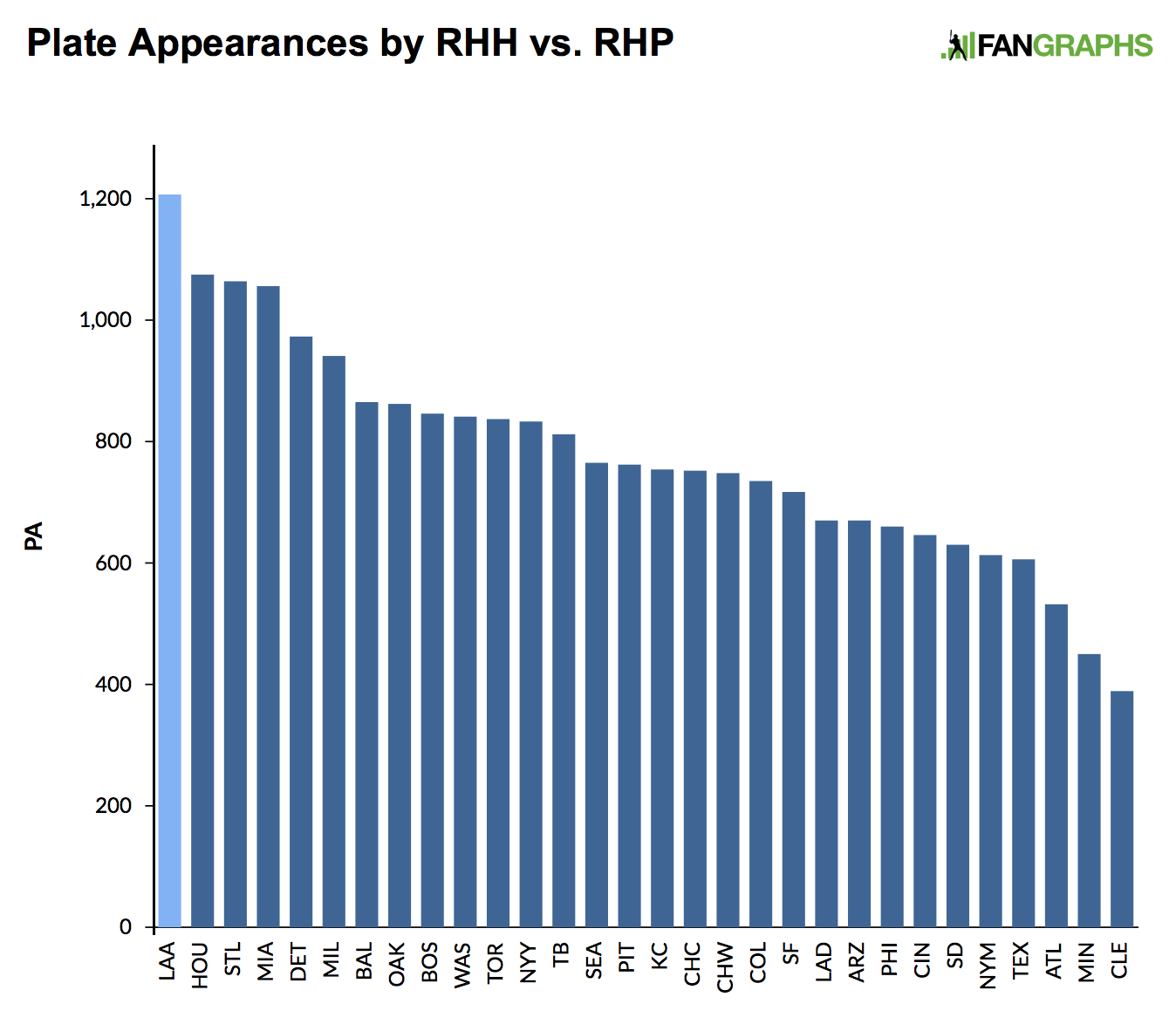
Every bit of value counts for the Angels, who share a division with probably the majors’ best team and who possess a 29.9% chance of making the postseason as of right now. Even slight improvement would be more meaningful to the Angels than most teams. And there’s perhaps a way the Angels can better employ the game’s most interesting and only two-way player in Shohei Ohtani to gain a little more value.

The Angels rank dead last in platoon advantage, their batters facing opposite-handed pitchers just 37% of the time, according Baseball Reference. The MLB average is 53%. The Indians, thanks in large part to switch-hitting stars Francisco Lindor and Jose Ramirez, lead baseball in holding the platoon advantage at a 69% clip.

The Angels have recorded the most right-on-right plate appearances (1,207) of any club this year, with the Astros representing the next-closest team (1,075).

Despite their right-handed-heavy lineup, the Angels actually rank second in baseball in right-on-right wRC+ (123) and ranked fifth last season (101). Having Mike Trout helps paper over many cracks — including platoon disadvantages — but there are only three Angels regulars who are better than league average against righties: Trout, Andrelton Simmons, and Justin Upton. As a whole, the Angels rank third against righties with a 109 wRC+, while they ranked in the middle of the pack with a wRC+ of 98 versus them last season.

Read the rest of this entry »


Top 25 Prospects: Chicago White Sox

Below is an analysis of the prospects in the farm system of the Chicago White Sox. Scouting reports are compiled with information provided by industry sources as well as from our own (both Eric Longenhagen’s and Kiley McDaniel’s) observations. For more information on the 20-80 scouting scale by which all of our prospect content is governed you can click here. For further explanation of the merits and drawbacks of Future Value, read this.

All the numbered prospects here also appear on THE BOARD, a new feature at the site that offers sortable scouting information for every organization. Click here to visit THE BOARD.

White Sox Top Prospects
Rk Name Age High Level Position ETA FV
1 Eloy Jimenez 21 AA RF 2019 65
2 Michael Kopech 21 AAA RHP 2019 60
3 Luis Robert 20 R CF 2020 60
4 Alec Hansen 23 AA RHP 2020 50
5 Zack Burdi 22 AAA RHP 2019 50
6 Zack Collins 22 AA 1B 2018 50
7 Dane Dunning 22 AA RHP 2018 50
8 Dylan Cease 22 A+ RHP 2020 45
9 Micker Adolfo 21 A+ RF 2021 45
10 Jake Burger 21 A 3B 2020 45
11 Blake Rutherford 20 A+ LF 2020 45
12 Ryan Cordell 26 AAA RF 2018 40
13 Carson Fulmer 22 MLB RHP 2018 40
14 Gavin Sheets 21 A+ 1B 2020 40
15 A.J. Puckett 22 A+ RHP 2019 40
16 Luis Gonzalez 22 A RF 2021 40
17 Seby Zavala 24 AA C 2020 40
18 Luis Alexander Basabe 20 A+ CF 2020 40
19 Ian Clarkin 23 AA LHP 2019 40
20 Spencer Adams 21 AA RHP 2019 40
21 Tyler Danish 22 MLB RHP 2017 40
22 Jameson Fisher 23 AA LF 2019 40
23 Aaron Bummer 24 MLB LHP 2018 40
24 Jordan Stephens 24 AAA RHP 2019 40
25 Danny Mendick 24 AAA SS 2019 40

65 FV Prospects

Signed: July 2nd Period, 2013 from Dominican Republic
Age 20 Height 6’4 Weight 205 Bat/Throw R/R
Tool Grades (Present/Future)
Hit Raw Power Game Power Run Fielding Throw
30/50 70/80 50/70 45/40 45/50 60/60

Jimenez was largely compared head-to-head with now-Yankees SS Gleyber Torres as the top talents in the loaded 2013 July 2nd class. Both players signed with the Cubs, then later were traded as headliners in blockbuster trades for Aroldis Chapman and Jose Quintana, respectively.

Read the rest of this entry »


Players’ View: Learning and Developing a Pitch, Part 10

Pitchers learn and develop different pitches, and they do so at varying stages of their lives. It might be a curveball in high school, a cutter in college, or a changeup in A-ball. Sometimes the addition or refinement is a natural progression — graduating from Pitching 101 to advanced course work — and often it’s a matter of necessity. In order to get hitters out as the quality of competition improves, a pitcher needs to optimize his repertoire.

In the tenth installment of this series, we’ll hear from three pitchers — Zach Britton, Pedro Martinez, and Brandon McCarthy — on how they learned and/or developed a specific pitch.

———-

Zach Britton (Orioles) on His Sinker

“In 2007, I was in short-season Aberdeen and my pitching coach, Calvin Maduro, tried teaching me a cutter. It kind of developed from there. No crazy story, really. It’s just that, with my arm action, the ball never cut. It went straight down like a sinker. He said, ‘Keep doing what you’re doing,’ and over the years I started throwing it more and more, and getting comfortable with it.

“A lot of guys throw cutters the way I grip my sinker, and others actually throw their curveball like that. Again, it’s arm action. I’ve shown it to guys and they haven’t been able to do it, so I can only assume it’s the way I throw.

Read the rest of this entry »


Things You Learn When the Mets Bat Out of Turn

On May 9, the Mets batted out of turn against the Reds. You probably know this. Actually, you might have known this and then forgotten it already. May 9 was a while ago. A lot has happened since May 9. Like, just in baseball, a lot has happened. Why even talk about it further?

Because May 9 was also not that long ago. In the context of humankind’s march through history, for example, it’s basically yesterday. In the context of the universe, it’s like a second ago. In the context of the universe, our whole lives are no longer than the snap of a finger. So, from that point of view, any discussion of baseball is absurd. From that point of view, why not discuss the Mets batting out of order on this first day back from a long weekend?

So much of baseball is routine. We learn from the repetition, but sometimes we glean something new when the seams get pulled apart. Batting out of turn isn’t entirely new, but it is unusual: according to Retrosheet, it had happened just six times in the last decade prior to the Mets’ foul-up. In case you missed it live, the lineup the Mets shared with the media looked like this:

The trouble was that the lineup actually given to the umpires and Reds manager Jim Riggleman had Wilmer Flores and Asdrubal Cabrera flipped.

Shortly after the game itself began, Flores came up to bat and struck out. Riggleman said nothing. They tell you to say nothing unless something good happens. Then Cabrera came up and doubled, after which Riggleman pointed out the mistake. Rule 6.03(b) is one of baseball’s more complicated rules, but the gist of it is, if a team bats out of turn and the other team notices in time, it’s an out. Once Cabrera’s at-bat commenced, it legalized Flores’ previously illegal at-bat, which meant that Jay Bruce ought to have batted after Flores. Because Bruce was the proper batter, he was called out — poor guy. Cabrera’s double was wiped from the books. The Reds would win on an Adam Duvall walk-off solo home run in the 10th. One could argue it would have been good for the Mets to have scored a run in the first.

It was silly and embarrassing, but it also showed us some things. These are a few of those things.

Read the rest of this entry »