Archive for Rockies

Dispatches From the GM Meetings: Matt Arnold, Paul DePodesta, Chaim Bloom
Rhona Wise-Imagn Images

The General Managers Meetings are currently taking place in Las Vegas, and as always, FanGraphs is on hand to report on what the executives have to say. We’ll hear from a number of them this week, beginning with a trio of National League execs, Matt Arnold of the Brewers, Paul DePodesta of the Rockies, and Chaim Bloom of the Cardinals.

———

MATT ARNOLD — MILWAUKEE BREWERS

Brewers hitters had both a low strikeout rate and a relatively high walk rate this season; they ranked top five in both metrics. How was that achieved, and to what extent was it a focus?

“I think it was achieved by Murph letting people know, ‘You better put the ball in play and you better not chase,’” Arnold replied, crediting National League Manager of the Year Pat Murphy. “He’s relentless about that. Those are good things that we were able to execute this year, and it’s easier said than done. It starts with the players buying in and Murph enforcing that in the dugout, making sure our guys have that as a focus: the ball-strike, the ball in play. Having those types of skills in your pocket can lead to better at-bats and better outcomes.”

Needless to say, it’s not all Murphy. Milwaukee’s hitting coaches play a role as well.

“It’s a combination of all of them,” Arnold agreed. “Our coaches do a really good job of that. They want our guys to focus on getting a good pitch to hit, and again, while it’s easier said than done, we’ve done a good job of that. We try to focus on it as much as we can in our [minor league system] Marrying your scouting and player development is also super important. We try to communicate it with both of them.”

Jackson Chourio had a perfectly acceptable 20.5% strikeout rate, but also a 5.1% walk rate that ranked lowest on the team. How does he take the next steps to better fit that mold?

“He’s so young, and so athletic, and so talented,” Arnold said of the team’s 21-year-old phenom. “He’s got every ingredient to do it. He’s already doing it at a pretty high level. Whatever he does beyond this is even more special. The sky is the limit for this kid.”

———

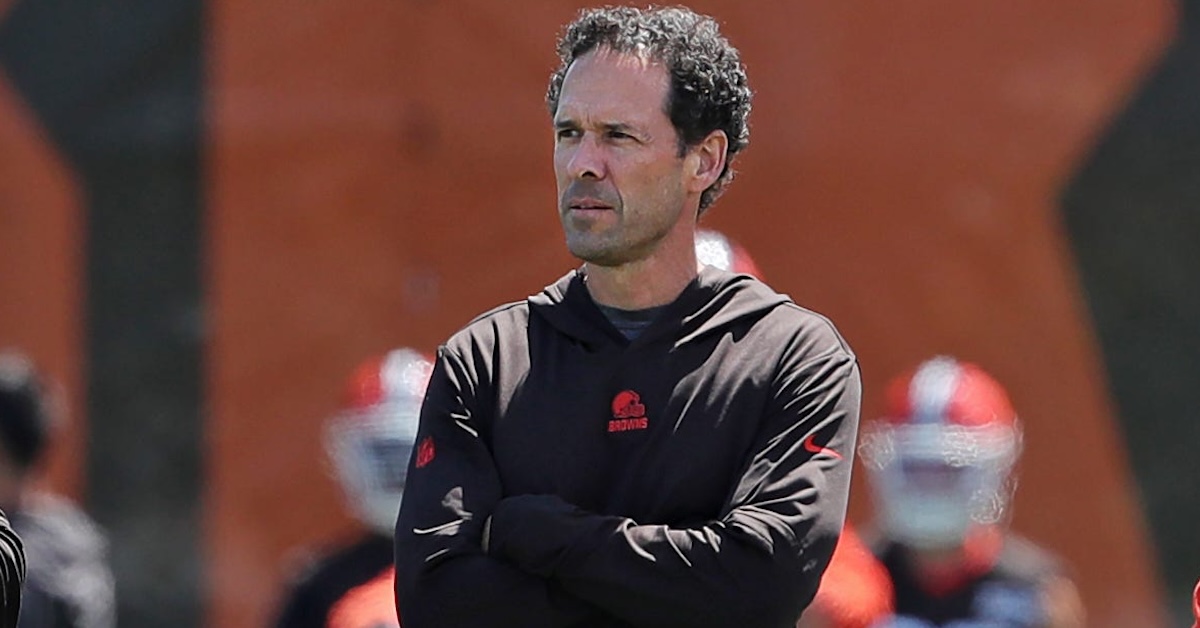
PAUL DEPODESTA — COLORADO ROCKIES

Colorado’s new top executive is inheriting a team whose hitters had both a high strikeout rate (second-worst in the majors) and a low slugging percentage (tied for sixth worst). If he had to pick one or the other, which is more in need of improvement?

“I would say it’s not the combo we want,” said DePodesta, stating the obvious. “And it won’t ultimately be one or the other. I said earlier what we want our identity to be, in Colorado especially, but… put it this way: If that’s a dial from one to the other, it’s not necessarily going to be one or the other. We need to find the right combination for us.”

Following up, I asked the well-traveled exec if he has an idea of which direction that combination might trend.

“I do, but I probably won’t share it,” he replied. “For us, it’s how we go about scouting and developing, or even setting up a major league roster. So yeah, ultimately it will be proprietary, what we feel is going to work well for us.”

And then there is the organization’s longest-standing question: What is the best way to pitch effectively in Colorado? Is there an actual answer to be found?

“We’ll find out,” DePodesta said. “I’m encouraged. There have been plenty of successful teams in Colorado. When I was in San Diego in 2007, 2008, 2009, and obviously the teams that Buddy [Black] had in 2017 and 2018, those teams were very successful. There were teams that had winning records on the road.

“My approach, at least as of today, is that I know it’s not impossible,” he added. “It’s been done. Are there things we have to consider that other teams don’t? Probably so. Are there adjustments we’re going to have to make that will look a little different than everybody else? Probably yes, but I’m confident that it’s not impossible. We’re going to figure something out.”

One more follow-up seemed in order. Given the Rockies’ reputation of lagging behind other organizations in terms of analytics, are there maybe things that have been overlooked?

“That I don’t know,” said DePodesta, who has spent the last decade working in the NFL as the chief strategy officer of the Cleveland Browns. “I’m looking forward to diving in deeper to the organization and figuring out all the things they have tried. I have a handful of ideas right now, but I would imagine they’re pretty naïve. Coors Field has been around since 1995 [and] they’ve tried a lot of things. I don’t have to reinvent the wheel. I want to understand what all of those things were and what they felt worked, and what didn’t. I don’t want to try things a second time if they’ve already tried them.”

———

CHAIM BLOOM — ST. LOUIS CARDINALS

Cardinals pitchers didn’t strike out a lot of batters this year; they were second worst in the majors. How much of a concern is that?

“It’s definitely a concern,” replied Bloom, who succeeded John Mozeliak as St. Louis’ president of baseball operations at the conclusion of the regular season. “It’s not the only thing that matters, but it does matter. Having stuff that can beat people in the strike zone, that can miss bats — both in and out of the strike zone — is really important. It’s hard to have an elite staff without being able to do that. It’s not something you want to chase at the expense of throwing strikes — you’re not trying to put people in positions where they can’t succeed, or stay healthy — but it’s super important.”

How close is Liam Doyle to helping out in that respect?

“He’ll tell us that as the season unfolds,” Bloom said of the 21-year-old southpaw whom the Cardinals drafted fifth overall this year out of the University of Tennessee. “We gave him a little taste of [pro ball] at the end; he got his feet wet a little bit. Obviously, a first full season will tell you a lot. A first full season in and of itself is a big developmental step for guys, because they haven’t been asked to pitch that regularly for that long. But he came in and showed everything you want to see. He got after his work. He showed openness, a desire to get better, a willingness to listen. There is obviously some work to do before we can call him a big leaguer, but we’re really happy with the pitcher we got.

“The player will move himself,” added Bloom. “The player tells you where he should be. If you try to force something that’s not there, you usually end up paying a price. You might end up picking the pieces up from that for quite some time. When a player is ready and you give him that opportunity, he can carry it. It’s really just what the game is telling us, letting the player’s performance and his progress on the mound carry the day.”

Balls in play are less of an issue when you have a strong defense, which St. Louis largely had in 2025. Just how strong depends on the numbers you favor. I asked Bloom if he could explain how the Cardinals led all teams in Outs Above Average, yet were well below average in Defensive Runs Saved.

“That is a bigger conversation than one we could have here today,” Bloom said. “There are some differences between those metrics, some differences in [how they] get calculated that might disproportionally help or hurt certain types of players. Sometimes those things… they usually will even out year over year. I’ve seen specific players where that might not be the case, because of certain things that the player does or doesn’t do well that some metrics favor — or don’t — but typically over the course of time, they tend to [even out].”

What does it say about the 2025 Cardinals specifically?

“I’d be hesitant to draw too much of a big picture about specific players or player seasons,” Bloom responded. “If it persists over two or three years, then we can look at it as a trend and see if there is something underlying.”
FanGraphs Weekly Mailbag: November 8, 2025

Kamil Krzaczynski-Imagn Images

Happy first Saturday of the offseason, everyone. To celebrate the occasion, you get two mailbag columns this week! The first ran on Monday and wrapped up a thrilling World Series. In today’s edition, we’ll move on from the Fall Classic and answer your questions about several teams that finished in last place this season. We’ll also cover small-market teams and some of the structures that are in place to encourage them to spend more on their rosters.

The first question we’ll answer today is about a player we’ve featured before in this column. In fact, some are calling him the Patron Saint of the Mailbag, an honor second only to his status as the worst major league player ever.

But before we continue, I’d like to remind you all that this mailbag is exclusive to FanGraphs Members. If you aren’t yet a Member and would like to keep reading, you can sign up for a Membership here. It’s the best way to both experience the site and support our staff, and it comes with a bunch of other great benefits. Also, if you’d like to ask a question for an upcoming mailbag, send me an email at mailbag@fangraphs.com. Read the rest of this entry »


Looking Toward the Future, the Rockies Are Begging for the Past

Jeff Lange-USA TODAY NETWORK

Most major league baseball organizations think more or less the same way. They vary on tactics and strategy, in competency, in resources, and in culture, but for the most part everyone agrees on how to win a baseball game. This leads to some groupthink and a lot of same-y executive hires.

The Giants have bucked the trend, turning back the clock to hand the reins to an ex-player who’s long on cultural cachet and short on expertise. He, in turn, made a delightfully unorthodox choice for field manager. I look forward to seeing if these iconoclasts can hold their own.

Not to be outdone, the Colorado Rockies have gone even further off the board for their new head of baseball operations, as they are reportedly nearing a deal to hire Paul DePodesta for the position. I’ll be as blunt as I can be: It’s one of the weirdest executive hires in decades, from an organization that’s at least a full step behind its rivals to start. With all the best will in the world, unless DePodesta’s appointment heralds a complete change in organizational structure and philosophy, it is almost certainly doomed to fail. Read the rest of this entry »


2026 Contemporary Baseball Era Committee Candidate: Dale Murphy

Malcolm Emmons-USA TODAY Sports

The following article is part of my ongoing look at the candidates on the 2026 Contemporary Baseball Era Committee ballot. Originally written for the 2013 election at SI.com, it has been expanded and updated. For a detailed introduction to this year’s ballot, use the tool above. An introduction to JAWS can be found here.

It took four position changes — from catcher to first base, then left field, right field, and finally center field — and parts of five major league seasons for the Braves to figure out where the 6-foot-4 Dale Murphy fit. Once they did, they had themselves a franchise centerpiece, a wholesome, milk-drinking superstar whom Sports Illustrated profiled for its July 4, 1983 cover story by proclaiming, “Murphy’s Law is Nice Guys Finish First.”

The title was a reference to the slugger helping the Braves to an NL West title the previous year, their lone playoff appearance during the 1970-90 stretch. “Here’s a guy who doesn’t drink, smoke, chew or cuss,” wrote Steve Wulf. “Here’s a guy who has time for everyone, a guy who’s slow to anger and eager to please, a guy whose agent’s name is Church. His favorite movie is Frank Capra’s It’s a Wonderful Life. He’s a wonderful ballplayer.” Let the record show that Wulf did unearth some dirt on Murphy, noting that he once got a speeding ticket for doing 35 in a 25-mph zone… while running late to speak to a church group.

Murphy won the first of his back-to-back MVP awards in 1982 as well as the first of his five consecutive Gold Gloves, and made his second of seven All-Star teams. He would spend most of the 1980s as one of the game’s best players. Alas, knee problems turned him into a shadow of the player he once was while he was still in his early 30s, and he played his final game in the majors at age 37. Read the rest of this entry »


Sunday Notes: Willie MacIver Caught a Guy Named Riley Pint

Willie MacIver has caught a lot of power arms since entering pro ball in 2018. Some were in Sacramento this season — the 28-year-old University of Washington product spent a chunk of the summer with the Athletics, backing up Shea Langeliers — but none of those hurlers stand out as having the best raw stuff he’s been behind the dish for. That distinction belongs to a former Colorado Rockies farmhand whose brief major-league ledger includes a 22.09 ERA and a 22.7% walk rate over five appearances comprising three-and-a-third innings.

“I caught a guy named Riley Pint,” said MacIver, citing the right-handed flamethrower whom the Rockies drafted fourth overall in 2016 out of an Overland, Kansas high school. “To this day, he has the best stuff I’ve ever seen. I caught him from Low-A all the way through Triple-A, so I was on the ride with him the whole time.”

That ride isn’t necessarily over. Pint is just 27 years old, and while he missed the 2025 season with an injury, the arm is indeed special. MacIver caught him as recently as 2024, and it’s being Pint, and not recent teammate Mason Miller, who he cited speaks volumes.

“When we were in Low-A, it was 102 [mph] all over the place,” MacIver told me. “Then he started throwing a sinker. We were at Driveline together and he was throwing sinkers that were registering as left-handed curveballs on the TrackMan. He could make the ball move like nothing else. His sinker would be like negative-eight, and then he would throw a true sweeper that was Morales-like with the horizontal, but at 87 [mph]. Read the rest of this entry »


Sunday Notes: Jack Dreyer Is a Dodger With a Sneaky Heater and a “Bad Slider”

Jack Dreyer has been one of the top performers on a Los Angeles Dodgers pitching staff that includes no shortage of better-known hurlers. Amid relative obscurity, the 26-year-old rookie left-hander has logged a a 2.98 ERA and a 2.95 FIP over 46 appearances comprising 57-and-a-third innings. Moreover, only Yoshinobu Yamamoto has been worth more WAR (3.5) than has the 2021 non-drafted free agent out of the University of Iowa (1.3).

Our lead prospect analyst was early to the bandwagon. When our 2025 Dodgers Top Prospects list was published in late April, Eric Longenhagen described Dreyer as “incredibly deceptive,” adding that his whippy arm action delivers a fastball that has “20 inches of due north vertical break as it explodes toward the plate.”

The southpaw’s signature pitch wasn’t seen as plus during his injury-marred Iowa Hawkeyes days.

“In college, I was always told that I have average spin rate, so I can’t really throw my fastball at the top of the zone,” recalled Dreyer, who missed much of the 2019 season with a shoulder injury, then all of 2021 after undergoing Tommy John surgery. “I was told that I had a very average fastball. I kind of believed that, but then I got to the Dodgers and they were like, ‘No, actually, your stuff is really, really good. You can live at the top of the zone because of how your pitch moves.’ So, that’s kind of how I’ve adapted my pitching, using heaters at the top, which opens up my other pitches.”

Dreyer’s secondaries comprise a curveball that he’s thrown at a 10.8% clip this season, and a “bad slider” that he’s thrown far more frequently at 45.2%. More on the latter in a moment. Read the rest of this entry »


A Conversation With Colorado Rockies Third Base Prospect Kyle Karros

Allan Henry-Imagn Images

Kyle Karros has quietly emerged as one of the most promising prospects in the Colorado Rockies system. Since being drafted in the fifth round two years ago out of UCLA, the 23-year-old third baseman has slashed .303/.393/.455 with a 134 wRC+ over 1,000 plate appearances. His numbers this season are in that same ballpark. Over 305 plate appearances, the bulk of them with the Double-A Hartford Yard Goats — he was promoted to the Triple-A Albuquerque Isotopes on July 18 — Karros is slashing .297/.398/.463 with a 142 wRC+.

As our lead prospect analyst Eric Longenhagen wrote back in January, the son of former Los Angeles Dodgers slugger Eric Karros “needs to develop power.” The progeny’s right-handed stroke produced 15 home runs a year ago, and this season he has left the yard six times. Given his 6-foot-5, 220-pound frame, there is a pretty good chance that he will tap into his power with more experience. Longenhagen recently updated Karros to a 40 FV prospect while ranking him 14th in the Rockies system.

On the eve of his becoming an Isotope, Karros discussed his approach to hitting, as well as his baseball relationship with his father.

———

David Laurila: How would you define yourself as a hitter?

Kyle Karros: “I’ve really bought into being a complete hitter first, and allowing power to just come naturally. I’ve kind of always put an emphasis on not chasing homers. Doubles are my game. I also feel like you grow into home runs. You learn what counts you can take advantage of. You get more efficient with your swing. But right now — this year, especially — I’ve bought into really controlling the zone. I think what allows me to do that is having a right-center type of approach. That allows me to let the ball travel a little deeper. If I’m on a fastball to right-center, that puts me on offspeed where I’m able to pull and elevate.”

Laurila: Is letting the ball travel more new to this year? Read the rest of this entry »


Sunday Notes: Dustin May Has Become a Better Person Through Adversity

When the Red Sox acquired Dustin May from the Dodgers at Thursday’s trade deadline, they brought on board a starter with a pair of elbow surgeries in his rearview. The 27-year-old right-hander had Tommy John in 2021, then needed to have a flexor tendon repaired in 2023. Boston also brought on board a pitcher who has matured admirably since he was drafted 101st overall in 2016 out of a Justin, Texas high school.

“As a pitcher, I haven’t changed a whole lot,” May told me prior to the trade. “My stuff is pretty comparable to what it was before. But off the field, I’ve changed a lot. A lot of life changes have happened through the surgeries — a lot of good things — and I feel like I’ve definitely improved as a person and as a husband.

“We’re all very blessed, and talented, to be here,” he added. “Stuff can be taken away from you in an instant, and you can have no control over it. No matter how hard you work, or what you put into it, life can come at you very fast at times.”

A serious health scare last summer is an example. May suffered a torn esophagus that required emergency surgery. Less scary, but nonetheless troublesome, was his not bouncing back from TJ as well as he’d hoped. Read the rest of this entry »


Yankees Bolster Bullpen With David Bednar, Jake Bird, and Camilo Doval

Mark J. Rebilas, Darren Yamashita and Kelley L Cox-Imagn Images

As Thursday’s 6 PM deadline approached, the New York Yankees finally made their big bullpen moves, first trading for closer David Bednar from the Pittsburgh Pirates and sending back catcher Rafael Flores, catcher Edgleen Perez, and outfielder Brian Sanchez. Bednar, with a year of arbitration remaining next season, has allowed a 2.37 ERA and a 1.96 FIP while striking out 51 batters and walking only 10 in 38 innings this year.

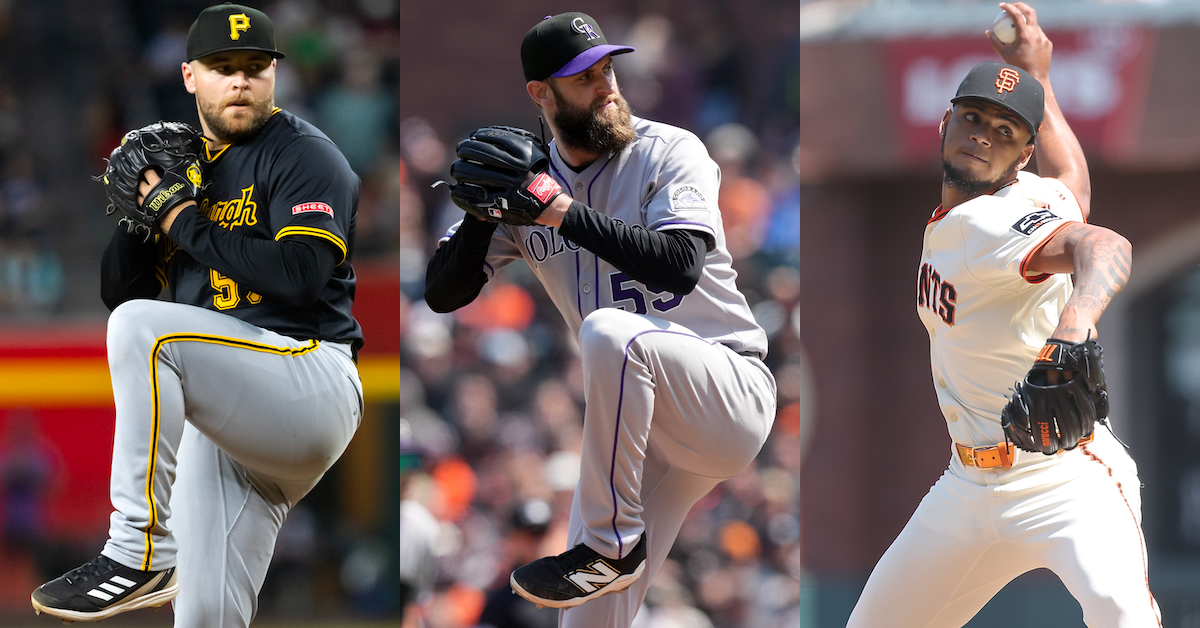
Also donning (non-purple) pinstripes is Jake Bird, whom the Yankees acquired from the Colorado Rockies in exchange for second baseman Roc Riggio and left-handed starter Ben Shields. Bird, in his fourth year with the Rockies, has a 4.73 ERA for the season, but a much sunnier 3.45 FIP, and he has struck out nearly 11 batters per nine innings, easily the best mark of his career.

But that wasn’t quite enough for the Yankees, and as the clock approached the top of the hour, they picked up Camilo Doval from the San Francisco Giants for three prospects: catcher-third baseman Jesus Rodriguez, right-handed starter Trystan Vrieling, and first baseman Parks Harber. Read the rest of this entry »


The Wednesday Minor Moves Roundup

D. Ross Cameron, Kamil Krzaczynski, Mark J. Rebilas-Imagn Images

Not every deadline trade is a dramatic one, but that’s OK — teams need to make low-key moves, too. Do you think James Bond saved the world every day? No! Some days, he had to do paperwork. Some days, he had to go to the dentist, or take the car to the gas station to vacuum up the leftover Cool Ranch Doritos crumbs on the floor after they spilled out on his drive from Baltim… I mean Bristol. So let’s catch up on some of Wednesday’s smaller moves.

The Seattle Mariners acquired left-handed reliever Caleb Ferguson from the Pittsburgh Pirates for right-handed starter Jeter Martinez

The Mariners have been operating with a shortage of southpaws this season, with Gabe Speier mostly being the only lefty on the active roster. Speier’s been good, holding lefties to a .609 OPS this season, but he can’t pitch in every playoff game, and Andrés Muñoz, who handles lefties quite well, generally doesn’t make his entrance before the ninth inning, so a depth-targeted upgrade to give the team another option down the stretch and during October makes a lot of sense. Caleb Ferguson has shed some strikeouts this year as he’s more heavily integrated his sinker into his repertoire, but he’s compensated for that loss by shedding a walk per nine from last season and becoming one of the hardest pitchers in baseball to make good contact against. Of all the pitchers with at least 30 innings this season, only Adrian Morejon has allowed a lower hard-hit percentage. Ferguson gives the Mariners a second lefty in the ‘pen they can count on, something they couldn’t really say about Joe Jacques or Tayler Saucedo. Read the rest of this entry »