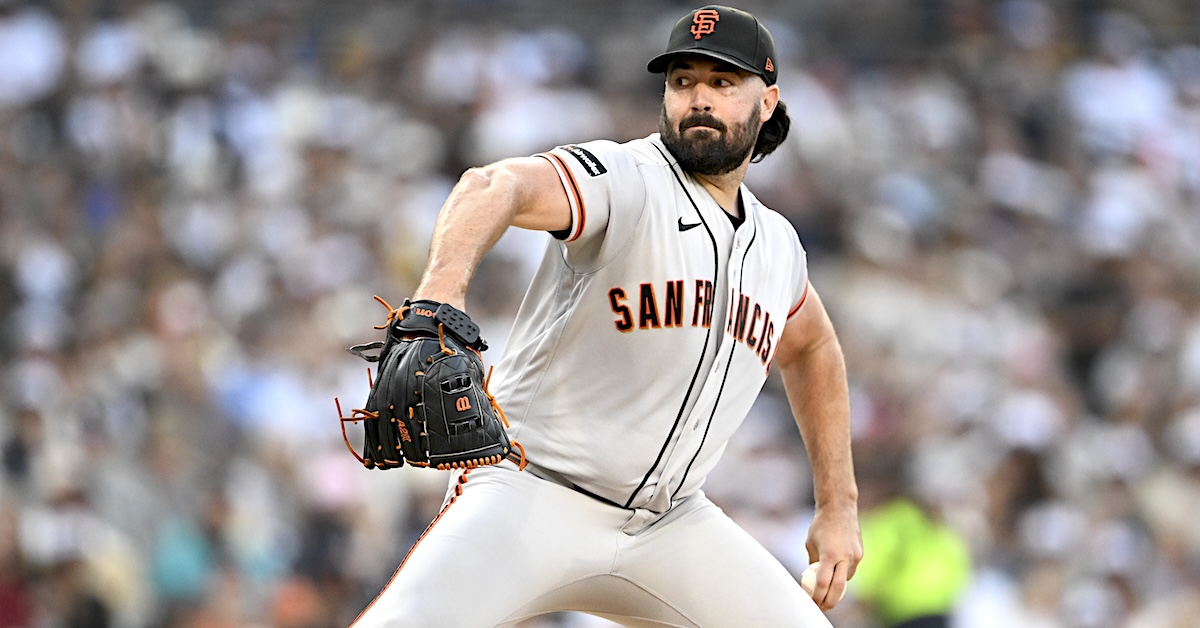
The Padres added some sorely needed starting pitching on deadline day, bringing in left-hander Robbie Ray from the Giants in exchange for a pair of prospects, right-hander Miguel Mendez and shortstop Joniel Hernandez. Ray, 34, has put up a 3.08 ERA and a 4.36 FIP across 21 starts in 2026, with 15 homers allowed, 57 walks, and 107 strikeouts over 122 2/3 innings. In 11 Double-A starts this year, Mendez has a 4.93 ERA but a 3.21 FIP with more than a strikeout per game. He’s yet to allow a home run in 2026. Hernandez signed out of Cuba back in January as an international free agent and, at age 17, is running a .927 OPS in the Dominican Summer League.
The 2021 AL Cy Young winner is not the only coveted starter heading to San Diego. In addition to Ray, the Padres also acquired right-hander Casey Mize from the Tigers just minutes before the 6 PM ET deadline. (We’ll cover the Mize trade in a separate post.)
San Diego spent the first two months of the season pleasing most of the baseball world by sticking its thumbs in the eyes of the playground’s big dog, the Los Angeles Dodgers. Wresting first place for spells in the early going, the Padres hit their high-water mark on May 18, when they stood at 29-18 with a half-game lead earned by besting the Dodgers in the opener of a three-game series. Los Angeles took the final two games, though, and the Padres haven’t been serious threats for the NL West since then. After dropping 10 of 11 games in late May, they’ve been preoccupied just trying to keep above the .500 mark. But just as things looked their bleakest, the Friars turned things around. Having won eight of their last nine games, the Padres entered Monday just a game behind both the Diamondbacks and Phillies for the final wild card spot, quieting any whispers that they’d be sellers at the deadline. Read the rest of this entry »
As we analyzed what various teams were likely to do at the deadline, the Orioles were one of the toughest teams to peg. Just a few games under .500 and within shouting distance of the final American League Wild Card spot, Baltimore had a lot of ways to approach the rest of their season. While the Dean Kremer and Taylor Ward deals signaled the club’s intention to sell, the decision to trade Adley Rutschman to Boston not only confirmed Baltimore’s direction for the rest of this season, but also arguably changed the course of the franchise. It’s the end of an era, and a bitter pill to swallow for a fan base barely a half decade removed from “playing badly for Adley.” Not surprisingly, Elias’s claim from exactly four years ago that the competitive window was open in Baltimore (“it’s liftoff from here“) has made the rounds again on social media today.
If it’s any consolation for O’s fans, the prospect package from the Red Sox is quite a haul. In exchange for Rutschman (along with catcher Jake Rogers and cash), the Orioles have acquired prospects Anthony Eyanson, Enddy Azocar, and Kyson Witherspoon, along with catcher Carlos Narváez and a player to be named later or cash. That’s two Top 100 prospects, including a guy in the top 30, and a pitcher who could enter that orbit as well. Let’s touch on each of them individually and then muse a bit about what this means for Baltimore’s system and the franchise overall. Read the rest of this entry »
The first reaction to this deal can only be one of astonishment, on multiple levels. The trade itself is audacious, from both teams’ perspective. Even with his trade value and reputation at a low ebb, Rutschman’s talents are gigantic, and the return reflects that.
But this trade’s on-field impact pales in comparison to What It All Means. Rutschman, the no. 1 overall pick in the 2019 draft, was the Orioles’ franchise player as they emerged from nearly a decade in the wilderness to become (if only briefly) a power player in the AL East. Seeing Rutschman in any other team’s colors will be weird enough to inspire the heebie-jeebies. Read the rest of this entry »
I know, I know. I, too, wish the Tampa Bay Rays had traded for Tarik Skubal. But they didn’t, and it’s not in their nature if we’re being honest. The Rays aren’t the type to trade for one big hammer. They prefer to one-red-paperclip it, and that’s exactly what they’ve done this deadline. First, they traded forFreddy Peralta. Now, they’ve added some sorely needed offensive help by acquiring Liam Hicks from the Marlins in exchange for prospects Jacob Kisting, Adrian Santana, and Brayden Taylor, as Jeff Passan first reported.
The Tampa Bay side of this equation is pretty simple. Their catching duo of Hunter Feduccia and Nick Fortes hasn’t been good enough. Fortes has been reasonable as the righty half of a platoon, but Feduccia has scuffled to an 82 wRC+ even getting good platoon matchups. Catcher probably wasn’t the weakest part of their lineup – frankly, there are a lot of holes to patch here – but it was definitely an area of need. If the Rays are going to keep a hold on the AL East, they’ll have to score more runs in addition to continuing to pitch well, and playing a good hitter at catcher is a good way to start.
Hicks was a late bloomer who didn’t debut until last year at age 26, but he has a long track record of plus offense from behind the plate. He hit throughout his minor league tenure but never received a call-up because of questions about his defense. The Marlins took him in the Rule 5 draft in December 2024, plugged him in as the big half of a platoon, and let him cook. His defense was predictably weak – so weak that he ended up rotating between catcher, first base, and DH – but the bat played right away. Read the rest of this entry »
Taylor Ward walked his way back across the country.
In a trade on Monday ahead of the 6 PM ET deadline, the Orioles sent Ward to the Mariners in exchange for Alex Hoppe and two minor league pitchers, Brock Moore and Harrison Kreiling. Ward leads the American League in walks (second in the majors only to James Wood) and satisfies Seattle’s need for a right-handed bat to even out a lopsided lineup. Baltimore in turn gets a trio of work-in-progress arms to aid in what appears to be a bit of a reset.
Ward has completely reinvented himself at the plate in 2026 after being traded to Baltimore over the offseason. For years in Anaheim, the outfielder profiled as a three-true-outcomes hitter, mixing slug-and-whiff with a discerning eye to produce at an unspectacular, but above-average clip. Last year, he mashed 36 homers and struck out 26.4% of the time, good for a 117 wRC+.
This year, Ward has an identical 117 wRC+ but has gotten there in a fundamentally different way. His walk rate has leapt from an already strong 11.3% last year to 17.2% this year — fourth best in the majors. He also cut his strikeout rate to 20%, giving him one of the best BB/K ratios in the majors at 0.84. The tradeoff has been a massive drop in ISO, to a career-low .100. A year after slugging 36 homers, Ward is pacing for 10.
Back in June, Ben Clemens wrote a great piece outlining the how and why for Ward’s changes in 2026. The how is he’s simply stopped swinging. Ward has always had a great eye, but this year he’s combined it with an aggressive form of discipline. His 34.3% swing rate is among the lowest in the league. He doesn’t swing at balls (15.3% is the lowest in the majors), and he doesn’t swing at strikes (51.8% is second lowest). He doesn’t swing when ahead in counts or behind. He doesn’t swing at the slow and bendy stuff, and he doesn’t even swing at middle-middle fastballs. Pitchers have yet to figure out how to throw him strikes consistently, and Ward has forced them into deep counts that have generally worked in his favor.
The why is Ward is swinging much slower this year. His 68.4-mph average bat speed ranks in the bottom 10% of the majors and is down from an already-slow 69.5-mph average swing last year — one of the largest drops of 2026. As Ben notes, this slower swing has meant being later on fastballs and less likely to pull the ball in the air. That’s capped Ward’s power potential and forced him toward this new, extreme approach. It’s not all bad, though. This slower swing has kept Ward from whiffing, and his 5.9% swinging strike rate is a career low, helping him spoil pitches in those deep counts. He’s also squaring up the ball at a career-best 34.2% of swings. He’s hitting a lot more high-quality low line drives to all fields and supplementing his walks with a .310 BABIP (compared to .257 in 2025).
Ward is an ideal fit for the Mariners. Their lineup has been mediocre in 2026, with a 101 wRC+ a year after finishing second in the majors with a 113 wRC+. While they’ve hit better and worse depending on the month (definitively “worse” the last six weeks), they’ve always struggled to hit lefties. Their 91 wRC+ against southpaws is 25th in the majors. They seemed to identify this as a weakness in the offseason, bringing in one of the game’s great lefty mashers in Rob Refsnyder. But Refsnyder has a 33 wRC+ and -1.0 WAR this year while battling a pair of knee injuries. Between that performance, the cratering of Cal Raleigh, and a generally lefty-heavy lineup, the Mariners have been highly susceptible to aggressive bullpening from opposing managers. More than a few teams have reworked their pitcher schedules to force the Mariners onto the weak side of their platoon.
Enter Ward: He has a 141 wRC+ against lefties this year and a 130 wRC+ for his career. He’s walked in 20.3% of his plate appearances against lefties in 2026 while only striking out in 18.8% of them. He’s not limited to a strict platoon, with a 108 wRC+ against righties both this year and for his career. This gives the Mariners an ideal mix of an everyday bat while also someone they can slot into the top of their lineup — likely the very top of their lineup — against lefties.
It’s not quite clear where Ward will play defensively. He’s been a left fielder exclusively since 2022, but the Mariners already have Randy Arozarena playing left in the midst of a career-best season, and they have Dominic Canzone in right, also having a career year. Neither is particularly good defensively, though Ward doesn’t represent a clear upgrade himself, with -1 OAA in 2026 and -3 OAA going back to last year. My sense is Ward will do a good amount of DHing while occasionally spelling Arozarena and Canzone in the corners.
With this trade, the Mariners are signaling that the 2026 season is not lost yet, which wasn’t quite clear after they dealt starting pitcher Luis Castillo to the White Sox over the weekend. “Disappointing” is an understatement for their season to date, one they began as arguable favorites in the American League. They’ve reached the deadline at 55-58, having already fired a hitting coach and with fans clamoring for more heads to fall.
Still, they remain just three back in the league’s worst division and two back of the Wild Card. I wrote just last week that the Rangers had taken over the top odds to win the AL West, then proceeded to get swept over the weekend by the Astros, who have snatched the top odds for themselves. Neither team is too formidable, with the Astros having one of the worst pitching staffs in the league and the Rangers displaying a more general mediocrity. The Mariners have far and away the best Pythagorean record in the division at a mere +3 run differential. A week or two of hot play is all it would take to make them favorites again. That seems likelier now with Ward in the lineup.
Hoppe is the most imminently relevant pitcher in the deal. He’s posted a 5.79 ERA as a rookie out of the Seattle bullpen this year while bouncing back and forth between Triple-A. There is some clear upside, as he has a 2.88 FIP with a solid 27.6% strikeout rate, and he’s also allowing just 0.64 HR/9. He throws a four-seamer that averages 97.9 mph and an impressive, biting slider that’s generated whiffs on 41% of swings this year. At 6-foot-6 with over the top arm action, Hoppe often looks the part of a future bullpen ace, even if his command has limited him to a fringe big leaguer thus far.
Moore, 26, is a righty reliever who dominated Single-A hitters this year with a 58.2% strikeout rate and a 5.5% walk rate in 16 innings. Since being promoted to Double-A, however, his long-standing issues with command have returned, now with a less impressive 33.7% strikeout rate and a 16.3% walk rate. Brendan Gawlowski noted Moore’s boom-or-bust potential in our Mariners Top 25 Prospects List this year:
“Moore touches triple digits and his slider flashes plus, but he’s a stiff athlete with a big head whack and bigger control problems.”
Kreiling, 24, was a 17th-round pick by the Mariners out of Nebraska in 2024, and he underwent Tommy John surgery before making an appearance professionally. He returned to the field this year and has made four starts, with 16 strikeouts and one walk in 10 2/3 innings. His fastball sits between 94-96 mph from a clean, moderate-effort but repeatable delivery. He also throws a cutter, a changeup, and a projectable slider. Brendan notes that Kreiling, who went unranked on the preseason prospects list, will likely receive a 35+ grade in the future, though he profiles as a reliever going forward.
It’s an ultimately a fine deal for a decent rental bat. The Mariners help even out their lineup while dealing from their strength of fringy arms with great stuff. And the Orioles get some fringy arms who could help them now and later.
Look, the Mets should not be the focus of this article. It’s trade deadline day, and we should be talking about the contenders, not the teams disassembling themselves in order to distribute their useful pieces throughout the league. But the Mets are the day’s big sellers. They’ve gotten 3.7 WAR from their bullpen this season, and they’ve traded away Huascar Brazobán and Brooks Raley, who’ve combined to provide 49% of that WAR. They’re sending Ben Rortvedt back to the Dodgers.
And so we have to start with the Mets: The last-place, 19-games-below-.500, 0.1%-playoff-odds-down-from-79.5%-on-Opening-Day Mets. Freddy Peralta is gone. A.J. Minter is gone. Luke Weaver (who provided 30% of that bullpen WAR on his own) is gone. And the Mets are not done selling. The other names being kicked around include Clay Holmes, Luis Robert Jr., and even Francisco Alvarez. It’s not a great year for the Mets, is the point. Let’s get to the trades.
Huascar Brazobán to the White Sox, Gabe Davis and Zach Franklin to the Mets
Brazobán is, at age 36, having the best season of his career. He’ll hit arbitration next year and be under team control until 2030. Since his debut in 2022, Brazobán has always put up good enough numbers. He’s never run an ERA- above 94 or an FIP- above 100. The Mets got him from the Marlins at the deadline in 2024, and he turned into a pumpkin the rest of the way, running a 5.14 ERA and a 4.31 FIP. However, he’s been great for New York for the past two seasons.
Last year, the Mets had Brazobán effectively ditch his four-seamer, cutter, and slider, and rely solely on his sinker and changeup. It’s a great combination. The two pitches have extreme arm-side run, and they come in at 96.1 mph and 90.7 mph, respectively. He does one thing really well – throw hard pitches that bore in on the hands of right-handed batters – so they’re having him do just that one thing. Over the past two years, righties have a .231 wOBA against Brazobán. Among the 219 pitchers who have faced at least 250 righties in the past year, that’s the fourth-lowest wOBA. The White Sox are getting a righty killer, which is great because this season, they’ve allowed a .320 wOBA to righties, tied for the seventh-highest mark in baseball (though we should note that their bullpen is better, running a .309 wOBA against righties, which is 19th highest).
This season, for whatever reason, Brazobán’s stuff is also working against lefties. Their wOBA against him has dropped from .379 in 2025 to .253 this year. As a result, across 46 appearances and 52 2/3 innings, he’s posted a 2.56 ERA and a 3.34 FIP. He’s on pace to set a career record for appearances, innings pitched, ERA, xERA, xFIP, and WAR. There’s definitely some luck involved here. He is running an absurd .206 BABIP and the second-lowest strand and HR/FB rates of his career. He doesn’t have great command. The Mets did not pay much for Brazobán in 2024, and he spent time in the minors in each of the last two years. Now they’re selling high and flipping him for prospects right before he starts to cost money. That may be cold comfort for Mets fans, but it’s a good trick if you can make it work. The White Sox bullpen ranks seventh by ERA and 15th by FIP this season. We should definitely expect some regression from Brazobán, but even so, he really could help them.
Now let’s talk return. The White Sox selected Davis out of Oklahoma State in the fifth round of the 2025 draft. He didn’t put up eye-popping numbers in college, but this year, the 22-year-old had a 2.63 ERA and a 2.67 FIP at High-A while striking out 30% of the batters he faced. That earned him a promotion to Double-A, where his numbers have cratered to the tune of an 8.31 ERA and a FIP to match. He hasn’t yet gotten a writeup here at FanGraphs. James Fegan slotted him in as one of the “Other Prospects of Note” in the 2025 White Sox Top Prospects list. His name was fifth under the label “Relievers Who Have a Little Something.” As such, I’m going to relay notes that Eric Longenhagen sent to me on Davis verbatim:
Coming out of his sophomore year at Oklahoma State, Davis was a big prospect and a potential first-round pick. He was a 6-foot-9 reliever who was expected to move into their rotation and, if things went well, be drafted pretty high. Instead, he struggled to throw strikes and was relegated to the bullpen again pretty quickly; his ERA was up near six for the season, and he went in the fifth round. The White Sox boldly sent him out to High-A as a starter and things went well enough that he was promoted to Double-A at the end of May, where he has struggled. This is definitely an arrow up guy, though. He’s added two ticks to his fastball, sitting 96 mph, and has touched 100 as part of a four-pitch mix. None of his secondary pitches is missing bats at a great rate, whether he’ll actually throw strikes enough to remain a starter is also unclear. But for now it’s good that he’s starting to give his cutter, slider, and changeup reps that they didn’t have in the college bullpen, and we’ll see if those improve. The Mets tend to be pretty good at improving their pitching prospects, so this is an exciting (if older) dev project for them. 35+ FV.
Zach Franklin, as Eric told me, is “more of a fully baked reliever.” He’s a 27-year-old righty with a very short arm action, almost like a catcher’s. James ranked him 20th in the White Sox organization last year. This year, Franklin has a 4.37 ERA and a 5.23 FIP in Triple-A, though we should note that his xERA and xFIP are both much lower. That’s because he’s put up an absurd 22% HR/FB, allowing nearly three homers per nine innings. Franklin is giving up all those homers for a reason: More than half the time, he throws a four-seamer with a bunch of rise. It’s racks up tons of whiffs, but when batters make contact, they hit it in the air (and this year, a long, long way). He also throws a slider and a splitter, and they rack up even more whiffs than the fastball. He’s striking out nearly a third of the batters he’s facing at Triple-A. But, as Eric notes, Franklin’s slider is closer to average, and he struggles to command the splitter. Still, Eric assigned Franklin a 40 FV, saying he “could come up tomorrow and be fine, definitely part of New York’s mix next year.”
I should end by mentioning that Eric told me a similar thing about New York’s return that I said about Brazobán: “It’s a good sign for the White Sox that they developed two lesser draft picks into desirable assets.” I don’t know if this is a trade where everybody wins. I worry that Brazobán could turn into a pumpkin just like he did when the Mets traded for him in 2024, but this is a trade involving a trio of players whose organizations have helped them find a new gear.
Brooks Raley to the Phillies, Luke Gabrysh and John Spikerman to the Mets
After four years with the Mets, Raley is bound for his sixth big league team. It would be hard to overstate just how good he was during his time in New York. After the better part of four years – he missed nearly all of 2023 due to Tommy John surgery – he’ll end his tenure with a 2.31 ERA and a 3.08 FIP. He’s a classic sinker-slider guy, and as a 38-year-old with a fastball that averages just over 90 mph, he is also a classic crafty lefty. This year, Raley is running a 1.96 ERA that’s more than a full run below his 3.10 FIP. He’s probably not going to keep stranding nearly 80% of his baserunners, but he’s outpitched his FIP in each of the past five seasons, so even though he may be out over skis just a bit, he might not be due for a sudden crash.
Raley is just a rental, but he makes all the sense in the world for a win-now Phillies team that has really struggled against left-handed hitters. Their relievers have allowed a .338 wOBA against lefties, the fifth-highest mark in baseball this season. Raley’s .235 wOBA against lefties is now the best in the Philadelphia bullpen. José Alvarado was supposed to be Philadelphia’s premier lefty out of the ‘pen, and he’s putting up the lowest hard-hit rate of his career, but everything else has gone wrong. His overall ERA is 5.71. He’s allowed a .329 BABIP and 1.38 home runs per nine innings. Even if you believe Alvarado is due for things to go his way (and his 3.39 FIP certainly makes that argument eloquently), you probably don’t want to bet your season on it, and Raley can help the Phillies right now.
Before we get into the return, I should note that Eric and I disagree on Luke Gabrysh. Specifically, Eric is only willing to put a 60 grade on his name. That’s alright; I don’t mind being the high man. Gabrysh is a 23-year-old righty whom the Phillies selected out of Saint Joseph’s in the 15th round of the 2024 draft. He’s posted a 5.14 ERA and a 5.22 FIP at High-A this season despite striking out 29% of the batters he’s faced. That’s because he’s also walking 11% of them and allowing homers to 4% of them. Gabrysh hasn’t made one of our Phillies top prospects list yet, so as we haven’t written him up before, here’s everything Eric told me about him:
Gabrysh is sitting 95-97 as a starter but ceding hard contact more than you’d think given how hard he throws. His fastball simply lacks movement often enough that it’s hittable. He currently has a cutter and slider that aren’t all that well demarcated, but he can really spin both of them. Another likely reliever, though there’s a little more variance here than Davis/Franklin because of the spin element, which is just better than either of that more-proximate-to-the-bigs duo two can offer.
John Spikerman – and here Eric and I agree: 70-grade name – came in at no. 28 on last year’s Phillies list but didn’t earn a ranking on this year’s. “Spikerman was once a center field prospect with strikeout issues,” Eric wrote, “and is now a corner outfield prospect with strikeout issues after spending the majority of his 2025 time in right.” The 23-year-old switch-hitter is running a 116 wRC+ in High-A this season, but is doing it in odd fashion. He’s dropped his strikeout rate to just under 23% and raised his walk rate to just under 20%. He has no home runs. He’s also dealt with injuries the last couple years. He played in just 62 games last year and is currently at 32 this year. Maybe the Mets think he’ll show something more when he gets healthy, but Eric has him as a fifth-outfielder type with a hit tool that might not scrape average.
In all, Spikerman seems like a flyer, while Gabrysh is a bit of a project. Maybe the Mets believe in his ability to spin the ball and figure they can help him find a fastball, or maybe they think he can focus on the cutter. Regardless, in Raley, the Phillies are getting a proven rental who can definitely help them down the stretch.
Ben Rortvedt to the Dodgers, Chayce McDermott to the Mets
Technically, this is a trade of minor leaguers, but both of these players have seen the majors often enough. You could be forgiven for not knowing that Rortvedt had ever left the Dodgers. He played well enough down the stretch for them last year, and not only did he appear during their World Series run, he batted .429 in his four postseason games. In fact, he’s had quite a journey, and I’m just going to quote from MLB Trade Rumors’ Steve Adams here because I don’t have the heart to break it down myself:
The Dodgers clearly like Rortvedt as a depth catcher…The Dodgers tried to keep him around as a depth option for 2026. Shortly after the 2025 season ended, they signed Rortvedt to a $1.25MM deal to avoid arbitration and then put him on waivers, hoping he would clear and stick around as non-roster depth.
However, that plan didn’t work, as the Reds claimed him. The Reds put him back on waivers in February and the Dodgers re-claimed him. When they tried again to get him though waivers shortly thereafter, the Mets claimed him. The Mets were then able to get him through the wire unclaimed around Opening Day.
You could argue that few players have ever known with such fine precision exactly how much their club really values them. The Dodgers liked Rortvedt enough to give him more than a million bucks but not enough to put him on the 40-man roster and avoid risking losing him off waivers twice. The Mets clearly found their affection for Rortvedt limited as well. With Alvarez, Luis Torrens, and Hayden Senger in front of him on the depth chart (and the recently claimed Shawn Ross somewhere in the mix), there wasn’t much room for Rortvedt. He’s put up an 86 wRC+ in Triple-A – better than Senger – but this is pretty much found money for the Mets. They pick up a spare catcher off waivers, wait six months, then trade him back to the team that waived him in the first place. It’s not the kind of move you’d expect from a team that started the season with World Series aspirations, but it is the kind of move you’d expect from a team that’s nearly 20 games under .500.
The Dodgers would like Rortvedt back because Will Smith has been out since early June with an inflamed disc in his neck and will need another three or four weeks to get back to Los Angeles. In the meantime, Dalton Rushing has played great, but his backups have been troubling. Chuckie Robinson is back in Triple-A after hitting for an .087 batting average in eight games, and Eliezer Alfonzo is batting a relatively gaudy .167. Steamer may think that Rortvedt can only hack a 70 wRC+ over the remainder of the season, but that’s a lot better than the numbers Robinson and Alfonzo have put up, and he’s got twice as much big league experience as those two combined. Still, there’s no guarantee that he’ll actually make it to Los Angeles, because the Dodgers finally have their dream scenario: They’ve got Rortvedt and they’re not required to put him on the 40-man.
A fourth-round pick by the Astros in 2021, the 27-year-old McDermott was a top 100(ish) prospect as recently as last year. He came in at 109 with a 50 FV on last year’s post-spring training Top 100 list, but his limited time in the majors has been disastrous. He’s made seven appearances over the last three years, and given up at least one earned run in six of them. He now has a career 12.00 ERA and a 8.74 FIP.
The Orioles DFA’d McDermott in April, and the Dodgers picked him up. He’s made two big league appearances, but I’m more interested in his minor league numbers. He has a 4.10 ERA across 32 appearances at Triple-A for the Dodgers this season, and he’s gotten there in wild fashion. He’s striking out 36% of the batters he faces, but he’s walking 18% with a 19% HR/FB. He’s running a 36% whiff rate. He’s throwing six pitches, and five of them have whiff rates over 30% (he’s only thrown six curveballs, and nobody’s swung at one yet). I don’t know how to square that with the fact that in his brief time in the majors, he hardly whiffed or struck out anybody.
McDermott is a lefty who averages 96 mph on his fastball, but the pitch is allowing a .401 wOBA in Triple-A this season. It does not appear to have a great shape. Moreover, he’s definitely not pitching like a reliever yet. Presumably, there’s a version of McDermott that could miss some bats in the majors, but he’d have to refine his pitch mix and start hitting the strike zone. The Dodgers have enough pitching in their system that a project like this isn’t worth their time, at least not when they can get another crack at Rortvedt.
Put it all together, and in these three trades, the Mets have snagged four pitchers and an outfielder. With the exception of Franklin, all of those players represent a project of some sort. Davis touches 100, but he’ll have to refine his command and work on his secondaries. Gabrysh has velocity too, but his fastball lacks shape. Spikerman’s hit tool is suspect, and he might not stay in center. McDermott also lacks control and needs to either figure out his fastball or find a new approach. If there’s a takeaway here, it’s that the Mets are betting on their pitching development machine to keep on humming. Stay tuned for more Mets sales.
Even with rookie Chase DeLauter putting together a strong inaugural campaign, the Guardians have gotten less from their outfielders on the offensive side of the ball than all but a few other contenders. Ahead of Monday’s deadline, they acquired outfielder Jo Adell from the Angels in exchange for catching prospect Jacob Cozart, a move that appears to be a half-measure unless they can fit Adell into the short side of a platoon and limit his defensive exposure.
Currently 57-56, three games behind the AL Central-leading White Sox and occupying the American League’s third Wild Card spot, the Guardians have scored just 3.95 runs per game this year with a 93 wRC+, both of which rank as the league’s second-lowest marks. A lack of offense from their outfielders has contributed significantly to that problem:
The Atlanta Braves made a couple of minor moves over the weekend, adding pitchers Rick Mahler and Bruce Sutter, with the purpose of buttressing th…wait a second…
[Szym double-checks spelling]
The 1986 2026 Atlanta Braves made a couple of minor trades in recent days, acquiring pitchers Tyler Mahle and Brent Suter to shore up their pitching depth as we enter the season’s homestretch. Suter, who turns 37 in a few weeks, had a 4.12 ERA but a 3.65 FIP in 41 games for the Los Angeles Angels, who are apparently still a baseball team. Mahle is having his first full, healthy season in years, but has generally struggled otherwise in San Francisco, posting a 5.19 ERA and a 4.38 FIP for 0.8 WAR in 18 starts for the struggling Giants.
In return for Suter, the Braves are shipping infielder Nacho Alvarez Jr. to the Angels. After getting scattered playing time in the majors in 2024 and 2025, and putting up a disappointing .216/.296/.330 line in that span, he has spent the entire regular season with Triple-A Gwinnett, with his .664 OPS on the year providing ample explanation for why he didn’t pop up on the Braves roster at all this year. He did have at least one big highlight this season, getting Mexico onto the scoreboard first in its WBC game against Great Britain with a homer off Jack Anderson.
Heading to San Francisco for Mahle is reliever Anthony Molina, a name you might recognize from being on the fringes of Colorado’s roster the last few seasons. He’s only appeared in three games for the Braves this season, but has put up a 3.64 ERA/4.01 FIP for Gwinnett. Read the rest of this entry »
The Chicago White Sox are in a position to buy at the deadline for the first time in Chris Getz’s three seasons as GM. And Getz sure is getting his money’s worth. First Luis Castillo, then Huascar Brazobán, and now an outfielder: Brenton Doyle, late of the Colorado Rockies.
Doyle, 28, is not so much a unique player as the most extreme sustainable version of the all-glove/no-bat center field archetype. He’s making $3.1 million this year as a first-year arbitration guy, and he’s under team control through 2029. Getz parted with quite a bit to get him: right-handed pitcher Mason Adams and shortstop prospect Carlos Vielma.
Doyle was a fourth-round pick out of Division II Shepherd University; he’s that school’s only big leaguer in the past 50 years, but the name fits because he plays center field like a border collie. From Doyle’s debut in 2023 to the end of last season, he led all outfielders in FRV with 44. Pete Crow-Armstrong, Jacob Young, and Ceddanne Rafaela have been better on a per-inning basis, but that’s the kind of rarefied air Doyle has been playing in. Read the rest of this entry »
Exercising your brain via puzzles and brain teasers is a good way to stay sharp. Studies repeatedly show that solving difficult problems and applying critical reasoning skills build patterns and help fight off some of the effects of aging. So congratulations to me and to the Phillies front office – and to you, since you’re reading this article. Philadelphia acquired Luis Arraez in a deadline deal on Monday, and now we all have to wrack our brains around where the team is going to play him.
The full trade, as reported by Bob Nightengale: The Giants send Arraez and reliever Caleb Kilian to the Phillies in exchange for pitchers Ramon Marquez and Marty Gair. The main attraction in this foursome is Arraez, who has rejuvenated his career in a Giants uniform after a few years in the wilderness. He signed with the Giants because they were one of the few teams who wanted him to play second base, as opposed to first base, the spot where he’d spent most of his time in recent years. That experiment has gone exceedingly well, and Arraez has also recaptured some of his offensive spark. The result is his best season, as measured by WAR, with two months left to go.
His appeal to the Phillies is straightforward at a base level: They need to add some good hitters, basically. Their lineup has a lot of big names, but it also has a depth issue. Prior to the Arraez trade, five of their everyday starters had below-average offensive lines on the season, and that doesn’t count Bryan De La Cruz, who has hit well in eight games with the team. Philadelphia is on course to score its fewest runs per game (by a lot) since before Bryce Harper signed with the team in 2019; in other words, this is the worst Phillies offense of the current era. Read the rest of this entry »