JAWS and the 2020 Hall of Fame Ballot: One-and-Dones, Part 5

The following article is part of Jay Jaffe’s ongoing look at the candidates on the BBWAA 2020 Hall of Fame ballot. For a detailed introduction to this year’s ballot, and other candidates in the series, use the tool above; an introduction to JAWS can be found here. For a tentative schedule and a chance to fill out a Hall of Fame ballot for our crowdsourcing project, see here. All WAR figures refer to the Baseball-Reference version unless otherwise indicated.

Batch five hundred thirty-seven — no, wait, it’s just batch five, the rest of that was my daughter’s drawing — of my completist series features a pair of hard-throwing relievers who took a long time to get a shot at the majors, and even longer to become closers. Not much went right for either of them as Mets, and by the time they crossed paths in Arizona, both had seen better days, but somewhere in the middle of all of that, they became All-Stars. We could quibble as to whether they should be on this ballot, but why not celebrate two guys who made the most of their relatively brief careers?

2020 BBWAA One-And-Done Candidates, Part 5
Player Career WAR Peak WAR JAWS W-L S IP SO ERA ERA+
Heath Bell 7.1 8.8 8.0 38-32 168 628.2 637 3.49 112
J.J. Putz 13.1 12.9 13.0 37-33 189 566.2 599 3.08 138
SOURCE: Baseball-Reference

Heath Bell

It took Heath Bell until he was nearly 27 years old to reach the majors, and he turned 31 before he claimed the closer’s job. Big-bodied (6-foot-3 and as much as 275 pounds) and with a big personality, he radiated joy on his best days, showing his exuberance with his signature sprints to the mound, making three straight All-Star teams, converting 41 straight save opportunities at one point, and netting a big deal in free agency — not too bad for a guy who was a 69th-round draft pick by the Devil Rays. Read the rest of this entry »


Boar’d to Death: When Baseball and the Wild Boar Cross Paths

Early in the 2019 season, Yoenis Céspedes suffered a mysterious injury on his ranch. Described as a “violent fall,” there had been some discrepancy in exactly how the Mets outfielder suffered a fractured ankle (this while still rehabbing from surgery on both heels). According to fresh reports on the matter in the New York Post, he broke his ankle by stepping in a hole while trying to “sidestep a boar.” The story was confirmed by the Mets, as well as officials from MLB and MLBPA.

There have been many questions in response to this information, such as “Why?” and “How?” and “Again, I ask you… why?” But these put the wrong information in focus. Instead, we must look at the historical context of Céspedes’ misstep, and attempt to understand that the paths of men and boars do not easily cross; and yet, even in this niche of the natural world, baseball has a legacy.

We may not know what draws typical ballpark wildlife, the lost squirrels and panicking cats, to our infields and outfields. But we do know that their slashing claws and snapping mandibles have been on display in the realm of big league baseball for generations. With nature’s fury finding its way into man-made structures, it seems unwise to venture out into the domain that birthed it. Beyond our city limits and past the closest tree line, the creatures that spill into our stadiums are in their natural habitat, and that much more eager (and able) to kill or maim.

Boars have about the same reputation as dinosaurs: Their vision is based on movement. They are produced in formidable sizes (a male tusker can be 36 inches tall and weigh over 400 pounds). They can cause damage and be the bane of farmers. An August 23, 1911 report in the Oroville Daily Register warned that valley-dwelling boars are even more dangerous than those that live in the mountains and come equipped with “death-dealing tusks.” Read the rest of this entry »


Is the Cost of a Win in Free Agency Still Linear?

It’s no secret that free agency has changed over the last decade. As more teams have embraced analytics by focusing on paying for future, rather than past, performance, and owners have pinched pennies, we’ve seen slower winters, and in the case of last offseason, teams paying significantly less for a win on the open market. This offseason has seen a welcome return of activity, with good players receiving top-dollar contracts. When we consider the health of free agency for players, the big deals seem to grab a lot of attention, as with Gerrit Cole, Anthony Rendon, and Stephen Strasburg‘s this season, and Manny Machado and Bryce Harper’s a year ago. Mega-deals create the impression that all is well, and the size of those deals can have an outsized affect when calculating dollars per win, as in my piece yesterday on the cost of a win in free agency. But the players who don’t receive those big contracts deserve a bit more attention because it is possible that as free agent spending has shifted, the money teams are paying for wins may no longer be linear.

When we talk about the linear cost of a win, we’re talking about there being a uniform amount teams are generally willing to pay per win on the free agent market; if the cost of a win is $9 million, a three-win player gets $27 million, a two-win player gets $18 million, and a one-win player receives $9 million. And while we recognize the three-win player doesn’t actually receive a one-year deal worth $27 million, when the money is spread over a multi-year deal and the presumed decline from aging is factored in, the wins paid for over the life of the contract come out in roughly that manner. For example, Hyun-Jin Ryu is projected to be roughly a three win player in 2020. But over the course of four seasons, he is likely to be worth closer to nine wins; he signed a contract for $80 million, which comes out to right around $9 million per win. Not every case fits so neatly, but Ryu is one example.

The question now is whether the above is still true. In 2017, Matt Swartz examined the seasons through 2016 and found that the cost of a win was still linear. Since then, a narrative has emerged of slightly lesser players getting squeezed. Heading into the 2017 season, Travis Sawchik discussed baseball’s embattled middle class as players appeared to be getting frozen out of free agency. He followed that up in 2018 after another slow winter provided more evidence of a market in dire straights. Providing further support, the crowdsourced contract estimates our readers provide as part of our annual Top 50 Free Agents exercise have generally overshot free agent contracts under $40 million the last few years. Read the rest of this entry »


FanGraphs Audio: Ben Clemens Offers Hot Takes on the Hot Stove

Episode 876

On this edition of FanGraphs Audio, Ben Clemens shares his impressions of the Winter Meetings, before we discuss a recent piece of his exploring free agency, and which types of teams are actually keeping the hot stove burning. Ben also shares which rosters have him the most excited for the 2020 season, and the answers may surprise you. Lastly, we discuss the latest updates from the realm of sign-stealing, and Ben discourages you from committing financial crime. 

Don’t hesitate to direct pod-related correspondence to @megrowler on Twitter.

You can subscribe to the podcast via iTunes or other feeder things.

Audio after the jump. (Approximate 44 min play time.)


The Washington Nationals Were Not Magical, Merely Awesome

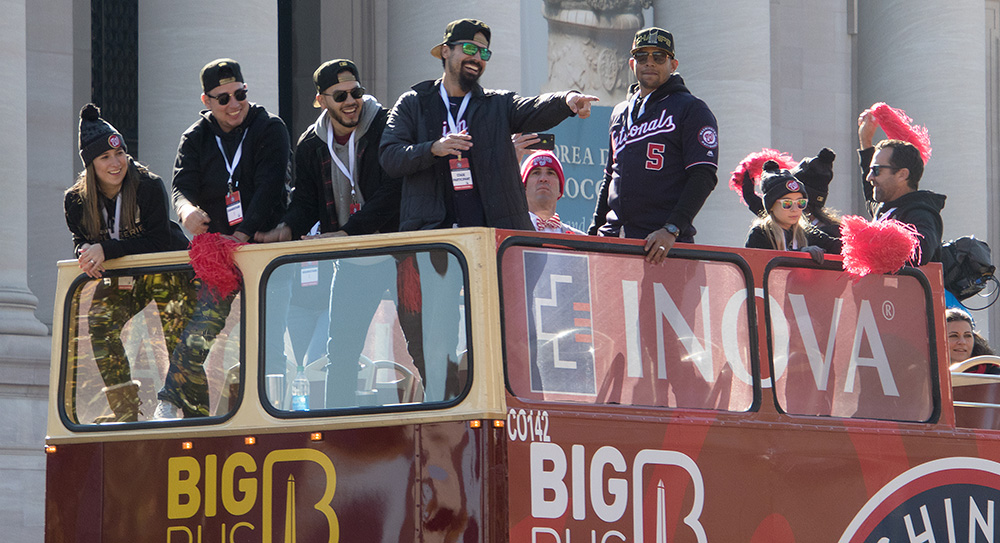
The Nationals relied heavily on their stars to win the franchise’s first World Series title. (Photo: David)

“We must be willing to let go of the life we planned so as to have the life that is waiting for us.” – Joseph Campbell

If someone tells you the Washington Nationals had a storybook season, they’re wrong. The tale of the 2019 Nats is one of science, not magic, one in which they had a team led by superstars and were designed to roll over the opposition in the playoffs. Robbed by fate of the Bryce Harper Hollywood ending in 2018, the Nats moved on from their franchise player, and even at the lowest point of the season, they always projected to have an excellent chance of making the playoffs. Facing teams with better regular season records, Washington leveraged the club’s strengths to even the odds and grabbed the franchise’s first championship. Read the rest of this entry »


MLB’s Current Sign-Stealing Saga Carries Echos of the Game’s PED Problems

A new avenue to pursue a competitive advantage, a gray area as to whether it’s considered cheating, a paper ban that goes unenforced, bad behavior spreading around the league through player movement, executives shocked — shocked! — that such behavior is happening on their teams, a commissioner sounding out of touch as he publicly downplays the severity of the problem, once-celebrated achievements now tainted… if the outlines of baseball’s current sign-stealing scandal sound familiar, it’s because they’ve followed a pattern similar to that of the performance-enhancing drug problem that enveloped the game in the 1990s and early 2000s. Of course, there are key differences between the two, but both found Major League Baseball well behind the curve and struggling both to catch up and regain credibility on the issue.

That thought came to mind on Tuesday, as the sign-stealing saga took a new turn when The Athletic’s Ken Rosenthal and Evan Drellich reported that in 2018, the Red Sox used their video replay room in an attempt to decipher opponents’ sign sequences, a practice that proliferated after instant replay reviews were introduced in 2014, one that was broadly prohibited but generally unenforced until 2018. Three members of the 2018 Red Sox told The Athletic that multiple teammates used the team’s video room, which was just a few steps from the home dugout, to break down opponents’ signs. Unlike the bang-on-a-trash-can system Rosenthal and Drellich reported the Astros having used in 2017, the Red Sox did not directly communicate to batters what pitch was coming, instead relaying that information through the dugout to the baserunner and then to the hitter.

While the efficacy of either system is still murky, both the Astros and Red Sox flouted the rules, and both went on to win the World Series in the year they did so, coincidentally beating the Dodgers. While rumors have circulated regarding other teams’ usage of replay rooms and other means to steal signs electronically, thus far the substantiated allegations have been limited to those two clubs, who share a common denominator: Alex Cora, who as bench coach of the Astros in 2017 is said to have played a key role in their sign-stealing system, and who left following that season to manage the Red Sox, a job he still holds. Read the rest of this entry »


The Cost of a Win in Free Agency in 2020

After a few cold, dreary, quiet hot stove seasons, free agency picked up its pace this winter. While Manny Machado and Bryce Harper got $300 million deals last offseason, it took until nearly spring to get those contracts finalized. This offseason, we’ve seen Gerrit Cole, Stephen Strasburg, Anthony Rendon, and Zack Wheeler sign for more than $100 million, and with the new year just eight days old, only a handful of decent free agents remain. While large deals and total spending near $2 billion have captivated us this offseason, it’s worth exploring what has made this winter different from years past. Is it just timing? Is it this class of free agents? Have teams changed their spending habits? Is the cost of a win still linear? A useful tool when examining those issues it to try to determine how much teams are paying for a win above replacement in the free agent market.

While putting dollar figures on players isn’t the most feel-good task, it’s helpful for framing conversations about costs in free agency. From the front office perspective, it helps to determine which free agents are good values and a worthy investment of resources compared to other free agents and veteran players. It also helps frame the value of younger players who have yet to reach the full six years of service time necessary to hit the market by showing the alternative cost to obtaining similar production. On the player side, these types of valuations tend to show how underpaid players are prior to reaching free agency, given the low cost of their tremendous on-field value compared to similarly productive free agents.

There are a variety of ways to go about determining how much teams are paying per win on the free agent market. Matt Swartz, having found that projections tended to overweight free agent player production and playing time when considered in the aggregate, instead considered actual production of past results to determine how much teams were paying for a win. He also used all players with at least six years of service time to account for players aging over the course of a contract. He acknowledged that there might be issues with including players on extensions. To be clear, Swartz wasn’t wrong about the way he formulated his dollars per win, but another approach can be helpful, and, if we are to look at the current offseason, necessary. Read the rest of this entry »


Kiley McDaniel Chat – 1/8/20

12:28

Avatar Kiley McDaniel: Hello from ATL! Scout and special guest puppy Poe are within arms distance. Went to the UK/UGA hoops game last night because there is no offseason to scouting elite prospects. Eric and I have been pumping out prospect lists and NYM may go up as early as tomorrow. STL and ATL are both largely done.

12:28

Avatar Kiley McDaniel: My iPhone decided to pitch a fit this morning so it just got restored and I probably lost a bunch of files but in the scheme of things I probably needed to delete most of those since I was out of space anyway

12:29

Avatar Kiley McDaniel: As always, you can find all of our prospect information at the prospects home page from the prospects menu across the top of the site

12:29

Avatar Kiley McDaniel: and many of your questions can be answered at THE BOARD: https://www.fangraphs.com/prospects/the-board/2020-prospect-list/summa…

12:29

Avatar Kiley McDaniel: (which has included some key MLB Draft rankings changes/additions in the last week)

12:30

Avatar Kiley McDaniel: which includes new 2020 RHP Nick Bitsko:


Kiley McDaniel
@kileymcd


Had a loud East Coast Pro outing where he started 94-96 and flashed a plus hook, usable changeup at 6’4/220 having turned 17 a month before. Hit 95 for the first time right after turning 16. Moved to our 2020 rankings: #17 overall, 3rd best HS arm for now fangraphs.com/prospects/the-…

Some @MLBDraft news: HS RHP Nick Bitsko from Eastern PA will graduate early, which will make the @UVABaseball commit eligible for the 2020 #MLBDraft. Potential top 10 pick this June.
7 Jan 2020

Read the rest of this entry »


Rangers Add Chirinos, Make Massive Positional Upgrade

Last night, the Texas Rangers made another nifty signing in their humble but effective winter. Robinson Chirinos, coming off a career season in his Houston sojourn, will return to his roots this spring. He inked a one-year deal worth $5.75 million, with a $6.5 million team option for 2021; the contract also includes a $1 million buyout if the Rangers choose not to exercise the option.

Chirinos is one of those players who’s both older and better than you think. A career part-timer until 2018, the 35-year-old has quietly emerged as one of baseball’s best hitting catchers at an age most players fade into retirement. He has a very modern offensive game: He’s content to work the count, draw a few walks, take a few more strikeouts, post the occasional Insta, and smack a dinger every 10 days or so. He’s finished with a wRC+ above 100 in each of the last five campaigns, and among catchers with at least 1,000 plate appearances over the last three years, only seven have been better with the stick:

Best Hitting Catchers 2017-19
PA wRC+
Yasmani Grandal 1632 117
Omar Narváez 1099 115
Willson Contreras 1381 115
Gary Sánchez 1345 115
J.T. Realmuto 1703 113
Kurt Suzuki 1006 113
Wilson Ramos 1164 112
Robinson Chirinos 1172 111
Buster Posey 1461 109

If all of that sounds like a way to avoid talking about his glove, guilty as charged. Per our framing metrics, Chirinos is one of the worst receivers in the league. This is not a minority view either, as Baseball Prospectus’s framing numbers track very similarly. He’s given away nearly 50 runs over his career from his framing alone, and while he improved a bit last season, he’s very much a bat-first option behind the plate. Read the rest of this entry »


The Count Is King (Even After Accounting for Batter Skill)

Here’s a big, boring truism you surely don’t want to read an article about: as a pitcher, it’s better to be ahead in the count than behind. Good, great, fine. Thanks for the information, Ben, but let’s move along. We all know that, there’s no need to further prove it.

But wait! Here’s another truism that complicates the first one. Better hitters get ahead in the count more often. Mike Trout gets to 1-0 a lot more frequently than Billy Hamilton does — in roughly 48% of his plate appearances, as compared to a mere 36.8% for Hamilton.

So here’s a fact presented without context: major league hitters, as a whole, had a .363 wOBA after 1-0 counts and a .270 wOBA after 0-1 counts. Get ahead, hit better. But here’s some context, which at least slightly confuses the issue. The average wOBA of a batter reaching a 1-0 count was .322. In contrast, the average wOBA of 0-1 batters was .317. Better batters, in other words, really do reach advantageous counts more often. If you don’t account for that, you’ll probably end up over-valuing getting ahead in the count. Read the rest of this entry »