Memorial Day as a Natural Checkpoint

At some point during the baseball season, it’s no longer “early.” I think you know exactly what I’m talking about. When an unexpected team starts out hot — a la the Mariners, who started 2019 on a 13-2 tear — the response of most rational baseball fans is that “it’s early.” For Seattle, the idea that it was far too early to evaluate the true talent level of the team was absolutely correct. From April 12 on, the Mariners are 10-26 and have sunk to last place in the AL West. Natural regression happened.
Because of the randomness and variation that often does occur during small samples within the marathon baseball season, it’s an old adage to avoid checking the league standings until Memorial Day. Clearly the idea behind this theory is that around Memorial Day, every team has played at least a quarter of their season. With that in mind, the results we have witnessed thus far become significantly more meaningful, and it’s no longer “early.”
I decided to set out and check this theory. Just how accurate are the standings on Memorial Day? Is there hope for a team like the Nationals, who have struggled thus far but still remain a talented squad on paper, to come back? Let’s break down the general trend while also talking about some of the biggest outliers (in both directions) in recent memory.
My process for this study was fairly simple. I collected every team’s record on Memorial Day from 2010 to 2018 and compared it to their record at the end of the season. This gave me a sample size of 270 baseball seasons, all of which occurred in relatively recent memory. I plotted the results in a scatterplot, and here it is:
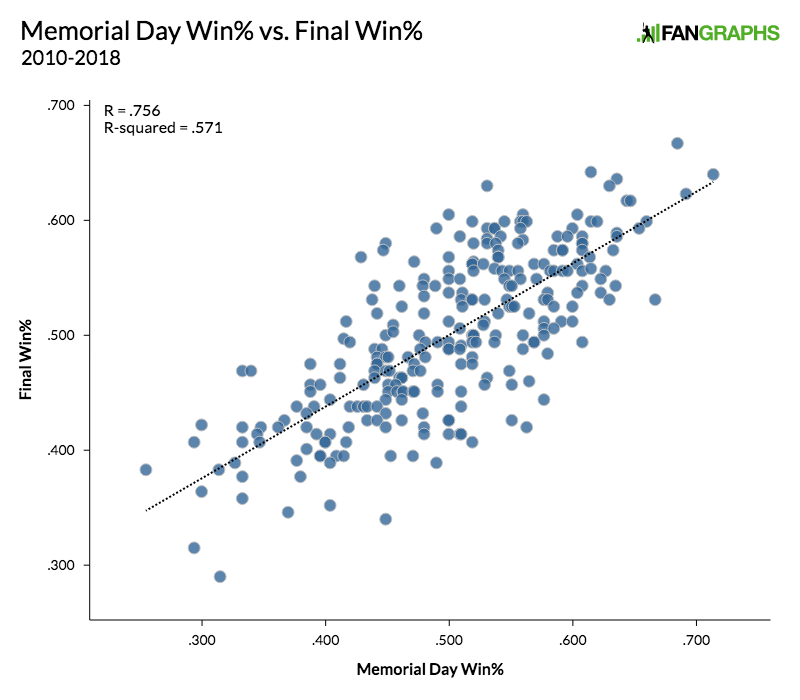
There’s a pretty strong linear correlation here, evidenced by our r-value of 0.756. The r-squared value tells us that the regression equation for Memorial Day winning percentage accounts for 57.1% of the variability in the end-of-season winning percentage. This means that 42.9% of the variability is still unaccounted for, so while Memorial Day certainly tells us something about a team’s end-of-season record, there’s still so much that can change between now and October. This conclusion is what I’d expect. Read the rest of this entry »