Alright, Dodgers bullpen! This is what we’ve been training for. They hit our guy. This is not a drill. I know it was an accident. I know it would have been the world’s worst time to throw at a hitter, down by a run in the fourth inning, a runner already on base, ahead in the count with the platoon advantage, unprovoked. But none of that matters right now. It’s time to look tough.
Everybody crowd up against the fence like you can’t wait to burst through the door. Time to posture. Strike a pose. This moment right here? This is the reason we watched The Warriors so many times. It’s time to get mean. It’s time to maybe, possibly, not really but you never know just in case, shove somebody a bit. We’re ready to jog out there. We’re ready to flex. Everybody ready for a fight?
Below are two changeups. Can you tell which one is better?
First up is Griffin Jax’s power changeup. He throws it over 92 mph; at two inches of induced vertical break (IVB) and 15 inches of arm-side run, it almost resembles a filthy left-handed slider:
Second is Hunter Gaddis straight change, floating up to the plate with 10 inches of IVB at an average velocity of 78 mph:
So, which one would you take? That’s a bit of a trick question: By whiff rate, these two pitches are virtually identical. Jax’s changeup ranks second in all of baseball with a 57.3% whiff rate; Gaddis’ is right behind him in third. Stylistically, they’re opposites; by the results, they are indistinguishable.
If you were creating the perfect fastball or the perfect slider in a video game, it’d be a straightforward process. Crank up the velocity, max out the vertical break, and those pitches will generally improve in a roughly linear fashion. Not so with changeups. Pitch models struggle to accurately grade these pitches because their quality can’t as easily be captured by velocity and movement in a vacuum. The Cole Ragans changeup, for example, gets a roughly average grade by Stuff+ despite performing like the best changeup in the sport over the last handful of seasons. It’s slow, and it barely moves — what makes it so good?
Ben Lindbergh and Meg Rowley discuss the Rafael Devers trade in depth, covering why Boston made the move, the resulting fan frustration, and the Giants impact. Then (57:56) they cover bad news about Christian Montes De Oca, John Brebbia, and Johnny O’Brien before bantering about Shohei Ohtani’s return to the mound, the Rays rotation, Charlie Morton’s turnaround, Patrick Corbin, why the Astros are still good, Aaron Boone, and tennis-style boundary reviews.
When I volunteered to write about the Aaron Civale-for-Andrew Vaughn swap, I thought I was going to be covering the most interesting trade of the month. At the very least, I thought I’d be putting out the most interesting trade write-up of the day. It’s not that Civale and Vaughn are huge household names, but you don’t often see notable major leaguers traded for one another in June. Trade season isn’t supposed to have started yet! I looked back through the FanGraphs archives to find pieces with the “trade” tag that dealt with June transactions. I found six others:
Then, of course, there’s one you’re reading right now. Of those seven June trades we’ve covered, four took place before the last week of the month: the two from 2019 and the two from the past 72 hours.
Do I feel slighted that mine is no longer the biggest trade story of the month, the week, or even the day? That through no fault of my own and no fault of my editors’, my story has been relegated to a secondary position? No, not really. But if I did, I’d be able to relate quite well to Civale. Last week, the Brewers informed the right-hander he’d be moving to the bullpen. Civale was understandably upset. He’s in his free agent walk year, and moving to a long relief role could diminish his earning potential in the offseason. What’s more, aside from one postseason appearance last fall, he has never worked out of the bullpen in his professional career. Above all else, he remains a perfectly capable back-end starting pitcher. He didn’t cost himself a rotation spot with his poor performance; the Brewers simply had five superior options. Read the rest of this entry »
Four weeks ago, I announced a fun little summer project we’re doing here at FanGraphs: A fan exchange program in which you give up your own team to follow another for one week, and share your thoughts and feelings in the interest of science. It’s like study abroad, except you don’t have to leave your home and you don’t spend the next semester annoying your friends with stories about how convenient public transit was in Vilnius.
It’s not too late to participate. The rules (such as they are) can be found here. If you’re unwilling or unable to follow your suggested team, feel free to pick another. And if you’ve been meaning to participate but haven’t completed the entrance survey, you can find that here.
If you have questions or concerns (with this project, not, like, generally), you can find me on Bluesky or reach me via email at baumannwrites@gmail.com. I’m so grateful that more than 1,000 of you have already signed up; I hope everyone has fun and learns something new.
It was an exciting weekend of baseball, with nine series ending in a sweep, but that was all overshadowed by the unexpected trade of Rafael Devers on Sunday night.
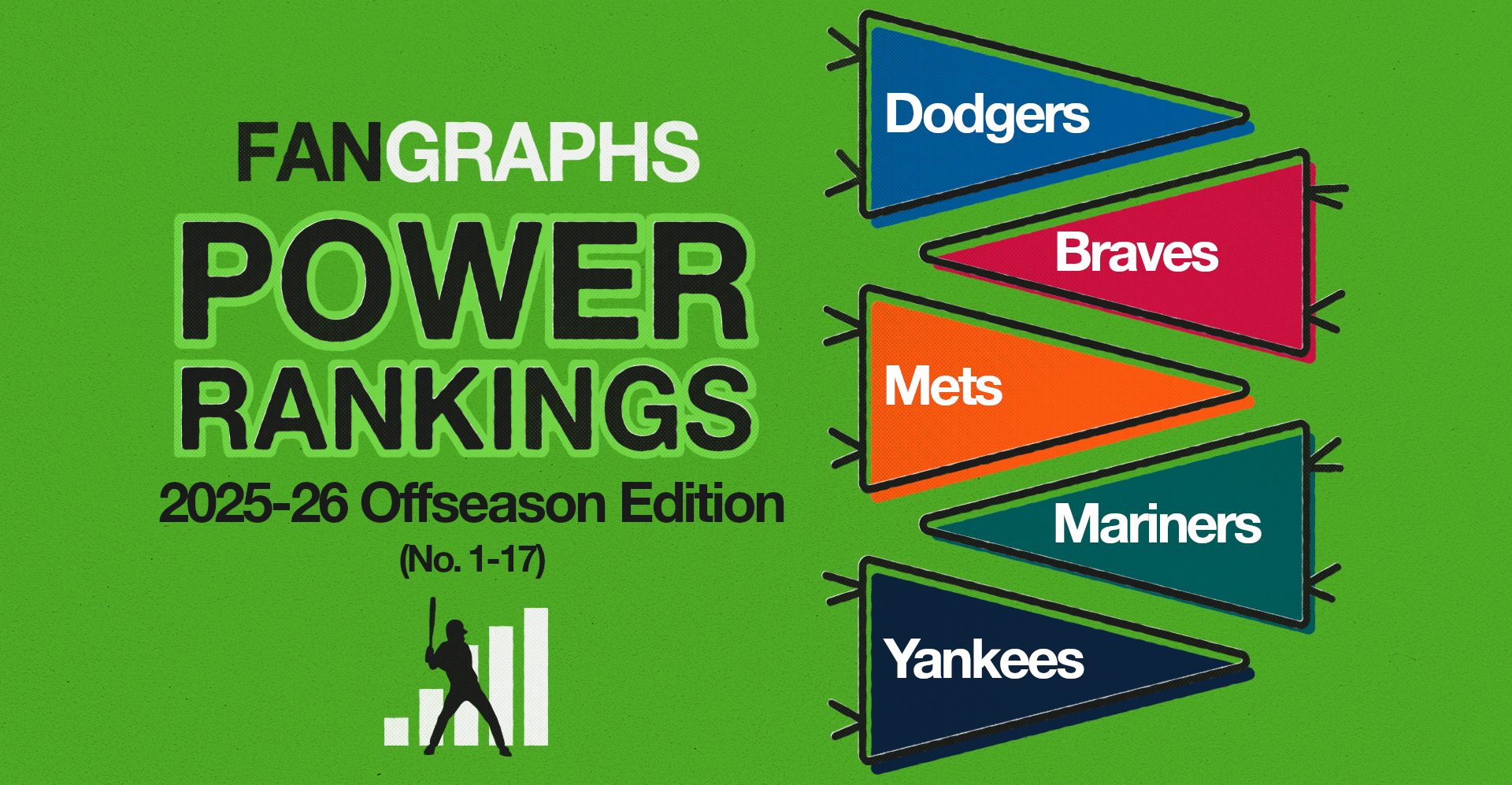
Last year, we revamped our power rankings using a modified Elo rating system. If you’re familiar with chess rankings or FiveThirtyEight’s defunct sports section, you’ll know that Elo is an elegant solution that measures teams’ relative strength and is very reactive to recent performance. To avoid overweighting recent results during the season, we weigh each team’s raw Elo rank using our coin flip playoff odds (specifically, we regress the playoff odds by 50% and weigh those against the raw Elo ranking, increasing in weight as the season progresses to a maximum of 25%). The weighted Elo ranks are then displayed as “Power Score” in the tables below. As the best and worst teams sort themselves out throughout the season, they’ll filter to the top and bottom of the rankings, while the exercise will remain reactive to hot streaks or cold snaps.
First up are the full rankings, presented in a sortable table. Below that, I’ve grouped the teams into tiers with comments on a handful of clubs. You’ll notice that the official ordinal rankings don’t always match the tiers — there are times where I take editorial liberties when grouping teams together — but generally, the ordering is consistent. One thing to note: The playoff odds listed in the tables below are our standard Depth Charts odds, not the coin flip odds that are used in the ranking formula. Read the rest of this entry »
The Royals’ rotation was a key reason last year’s team made the playoffs for the first time since 2015, with the one-two punch of Seth Lugo and Cole Ragans leading the way. It was the first full season in the majors for Ragans, whose five-pitch mix helped him dominate hitters en route to an AL All-Star selection and a fourth-place finish in the Cy Young voting. Unfortunately, his follow-up season hasn’t gone so smoothly, and after landing on the injured list with a groin strain in May, Ragans has now been diagnosed with a rotator cuff strain and figures to miss significant time.
A 2016 first-round pick who underwent two Tommy John surgeries before debuting for the Rangers in ’22, Ragans enjoyed a meteoric rise in ’23, after his average fastball velocity jumped from 92.1 mph to 96.5. Not until he was traded to the Royals in a June 30, 2023 deal centered around Aroldis Chapman did he finally stick in a rotation (he had a nine-start trial in 2022), but once he did, the results were revelatory. He posted a 2.64 ERA, 2.49 FIP, and a 31.1% strikeout rate in 12 starts totaling 71.2 innings post-trade; his 2.4 WAR ranked 12th in the majors from July 1 onward. On the strength of an impressive fastball-changeup combo accompanied by a knuckle curve, slider, and cutter, he solidified his spot among the majors’ top pitchers last year. He made 32 starts and finished second in the AL in FIP (2.99), strikeouts (223), strikeout rate (29.3%), and WAR (4.9); seventh in innings (186.1 innings); and eighth in ERA (3.14). Read the rest of this entry »
Jacob Misiorowski didn’t just flummox the Cardinals. Sure, when the 23-year-old right-hander made his big league debut in front of 26,687 very pumped Milwaukee fans last Thursday night, he confounded the St. Louis lineup until a leg cramp and a lightly rolled ankle ended his evening after five no-hit innings. But he also baffled Statcast. “Sinker,” read the graphic at the bottom of the screen when Misiorowski rocketed a 100-mph four-seamer into the bottom of the zone for the first pitch of the game. His changeup often went down as a sinker, his curveball went down as a cutter, and his slider was sometimes classified as a cutter and sometimes as a four-seamer.
The classifications were working perfectly by the end of the game, but even early on, you can’t really blame Statcast here. For one thing, it didn’t have a baseline expectation to work from because this was Misiorowski’s debut. For another, all of these pitches really did look like fastballs. I don’t just mean that in a jokey way. I mean it very, very literally. Nearly every pitch Misiorowski throws really does look like a fastball; I was planning on writing about it before I even learned about the Statcast side of things. “That’s how I throw,” he said after the game. “Every pitch is trying to throw 100%.” Read the rest of this entry »
The San Francisco Giants are acquiring Rafael Devers from the Boston Red Sox for Jordan Hicks, Kyle Harrison and more, according to sources familiar with the deal.
That’s the kind of blockbuster you don’t see every day. Rafael Devers is the best healthy Red Sox hitter. The Sox are above .500 and in the thick of the AL playoff hunt. They’re desperate for offense – though they came into the year with more hitters than spots, injuries to Alex Bregman, Triston Casas, Wilyer Abreu, and Masataka Yoshida have left them scrambling for depth. Abraham Toro has been batting high in the order of late. Romy Gonzalez is their backup DH. And they just traded their starting DH – hitting .271/.400/494, good for 14 home runs and a 145 wRC+ – for salary relief? We’re going to need a deeper dive.
Let’s start with the return. The Sox sent Devers and his entire contract – 10 years and $313.5 million at time of signing, with about $250 million and 8.5 years left on it today – to the Giants. In exchange, they got a wide mixture of players. There’s a major leaguer, Jordan Hicks. There’s a recently graduated prospect, Kyle Harrison. There’s a well-regarded hitting prospect, James Tibbs III. There’s another, further away prospect, pitcher Jose Bello. Finally, there’s that sweet, sweet financial flexibility, something the Sox are no stranger to.
If you look at baseball completely in the abstract, with bean-counting surplus value as your only guiding light for evaluating a trade, this one looks reasonable enough. Devers is under contract for a lot of years at a lot of dollars per year, and projection systems consistently think that he’ll generate low WAR totals for his salary in the back half of his deal. Harrison was a top 25 prospect not so long ago. Tibbs was a first round draft pick last year. Bello is an interesting lottery ticket. Hicks – okay, Hicks might have been a salary offset. But the point is, it’s likely that if all you care about is WAR accrued per dollar spent, the Sox come out ahead on this deal for most reasonable models of surplus value. Read the rest of this entry »