Effectively Wild Episode 1567: What We’ll Miss Most This Season

EWFI
Ben Lindbergh, Meg Rowley, and Baseball Prospectus editor-in-chief Craig Goldstein banter about Ben’s latest bad dream about baseball writing and the Toronto (or Pittsburgh?) Blue Jays’ last-minute relocation. Then they conduct the first of two drafts that will be presented on back-to-back episodes, beginning by selecting five things apiece that they’ll miss about “normal” baseball during the shortened 2020 season. (Next time, they’ll draft five things apiece that they’re excited to see.)

Audio intro: Pulp, "You’re a Nightmare"
Audio outro: The Black Keys, "Sit Around and Miss You"

Link to the large baby
Link to Sam on booing the Astros
Link to Ben on the best and worst 60-game spans
Link to FanGraphs 60-game leaderboards
Link to Zach Kram on WAR in 2020
Link to Ben Clemens on Chico

 iTunes Feed (Please rate and review us!)
 Sponsor Us on Patreon
 Facebook Group
 Effectively Wild Wiki
 Twitter Account
 Get Our Merch!
 Email Us: podcast@fangraphs.com


The Blue Jays Are in Search of a Temporary New Home

The Buffalo Blue Jays? The Pittsburgh Blue Jays? The Biggio-Bichette-Vlad Jr. Traveling Sons of All-Stars and Motor Kings? One way or another Canada’s only Major League Baseball team will be the Toronto Blue Jays in name only during the 2020 season. That’s the upshot of a decision handed down by the Canadian government on Saturday, not because of anything the Blue Jays or MLB has done wrong, but because the United States has done such a poor job of containing the spread of COVID-19 that letting teams travel across the international border between the two countries has been deemed a public health risk. It’s a decision that’s left the Blue Jays and the rest of baseball scrambling for alternatives given that the team opens the season on July 24, with its home opener scheduled for July 29.

Already it was clear that one of the substantial logistical hurdles for any league attempting to play its games in the midst of a pandemic — the wisdom and morality of which are questionable at best, but a topic for another day — is the variation in local laws and mandates, particularly when it comes to quarantine rules and guidelines. Until late last week, the defending champion Nationals weren’t sure they could play at Nationals Park because of a directive for those in close contact with individuals diagnosed with COVID-19 to self-quarantine for 14 days, and a similar situation with respect to the Dodgers in Los Angeles is still being untangled.

But while those situations may tilt in favor of the teams — testifying either to the outsized importance of sports within our culture or to a misplacement of priorities (take your pick) — that’s not the case with regards to the Blue Jays. With the U.S. regularly breaking single-day records for new coronavirus cases, and the U.S.-Canada border already closed to nonessential travel through at least August 21, on Saturday the Canadian government denied the Blue Jays permission to play home games in Toronto, which the same day reported just 43 new cases of COVID-19 infections. The Blue Jays had previously received an exemption allowing them to host their summer camp at the Rogers Centre with players and staff operating under a strict “modified quarantine” in which they were collectively isolated at the facility, which includes a hotel. Read the rest of this entry »


Jay Jaffe FanGraphs Chat -7/21/20

2:03
Avatar Jay Jaffe: Good afternoon, and welcome to my almost-Opening Day chat. As I’ll be part of a group chat later this week (Dodgers-Giants, 10 ET on Thursday night), I’m going to work a bit short here.

2:03
Avatar Jay Jaffe: First a bit of housekeeping while the queue fills…  My latest piece on the Blue Jays’ quest to find a temporary new home, is here https://blogs.fangraphs.com/the-blue-jays-are-in-search-of-a-temporary…

2:04
Avatar Jay Jaffe: A very cool thing that Dan wrote about the odds that somebody hits .400 in this short season is here https://blogs.fangraphs.com/toppling-ted-the-60-game-season-and-the-40…

2:04
Avatar Jay Jaffe: And a very cool thing that Sean and Dave did behind the scenes, showing the best 60-game stretches in a variety of categories since 1974, is here https://blogs.fangraphs.com/instagraphs/whats-the-best-that-could-happ…

2:06
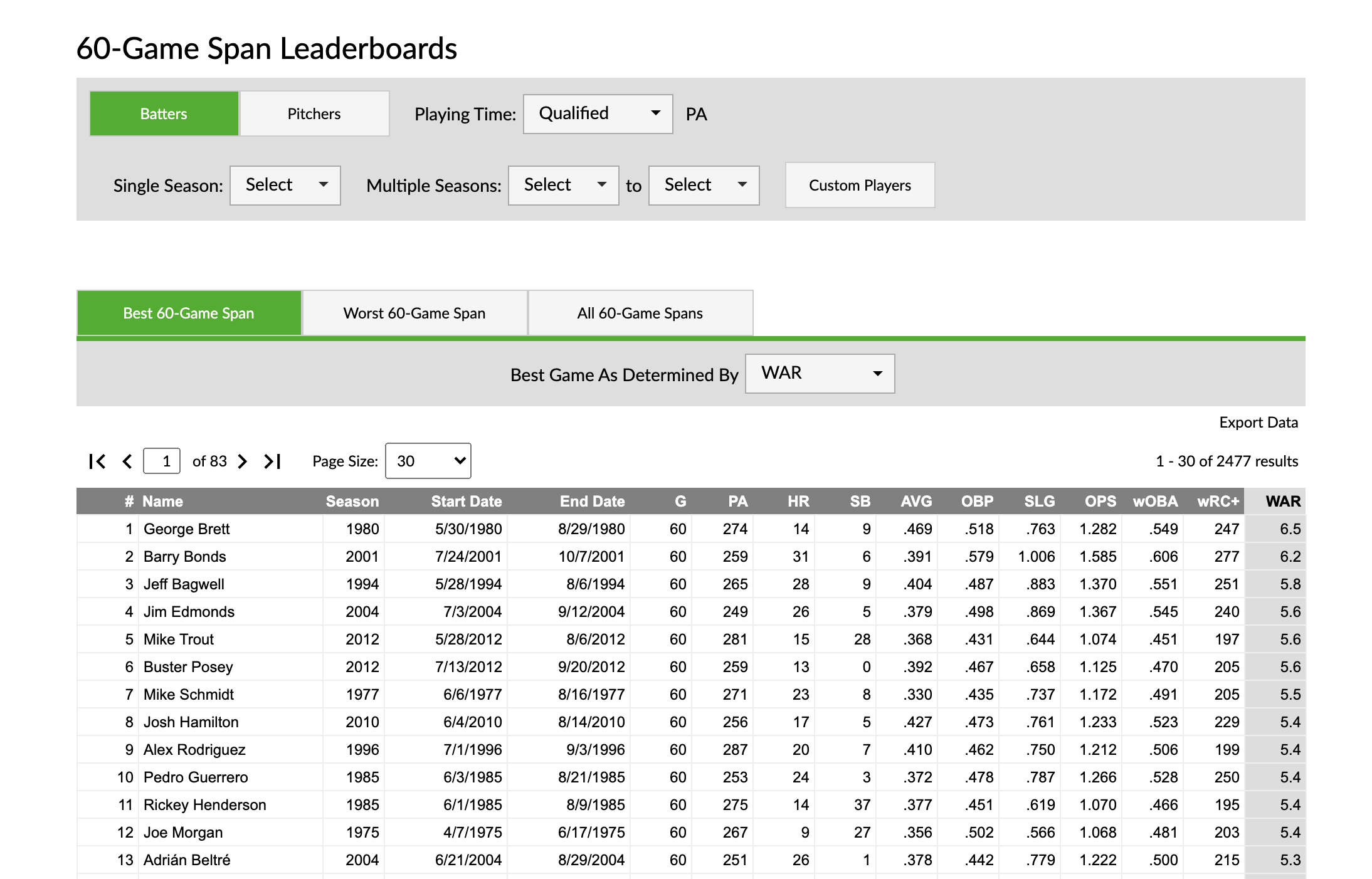
Avatar Jay Jaffe: Via that last one, did you know George Brett had a 60-game stretch in 1980 when he hit .473/.522/.751 (the record for batting average in that span)? You do now. Some guy named Barry holds the records for the other two metrics.

2:06
Avatar Jay Jaffe: and now, onward…

Read the rest of this entry »


Toppling Ted: The 60-Game Season and the .400 Batting Average

One of the ways that the baseball of yesteryear was different from baseball today was the importance of batting average. With a pitching philosophy that envisioned lots and lots of balls being hit into play and no gauntlet of modern relief pitchers to face, far more at-bats ended with a ball being handled by a defensive player. In 2019, 63% of plate appearances ended with a ball being hit into play. In 1919, that figure was 81%. With half as many fieldable balls, it’s hardly a shock that league batting averages have declined. The effect would be even larger, too, but batting average on balls hit into play was higher in 2019 (.298) than in 1919 (.282).

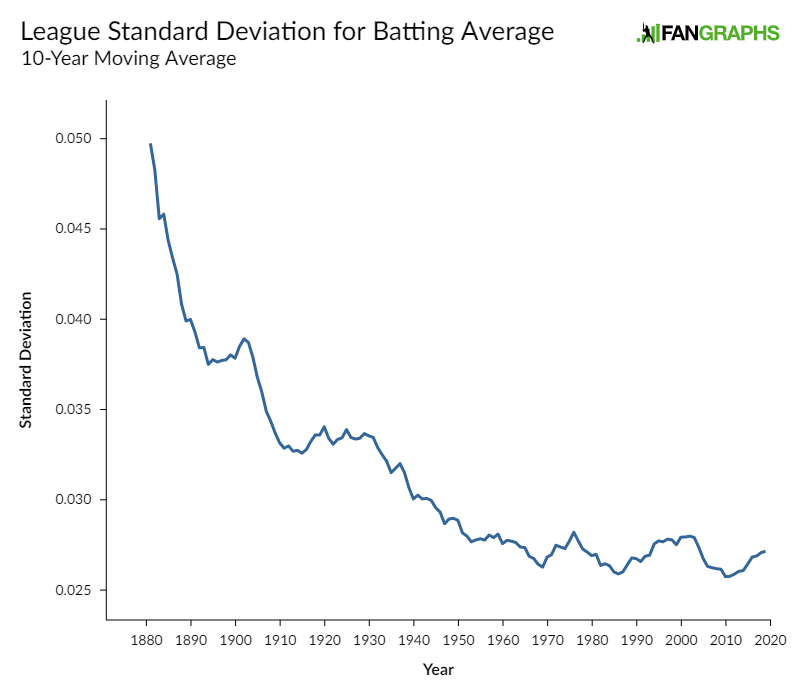
Hitting .400 was never an easy feat, but it wasn’t some wild, once-in-a-lifetime occurrence when it did happen. The .400 mark has been eclipsed 34 times in major league history, give or take (the number varies depending on just what you consider a major league team in the wild world of 1870s baseball). Ted Williams hit .406 in 1941 and that was it, the last time a major leaguer hit .400 over a season. It’s more than just the lower league batting averages. Baseball’s .252 batting average in 2019 was still higher than in 17 seasons before 1941. Baseball has trended in a more competitive direction and as a league becomes more competitive, you generally expect the differences between players to shrink. That’s true for batting average, too. Just look at the simplest measure of dispersion, standard deviation:

The standard deviation has gotten smaller as time has progressed. Using this simple method, Ted Williams’s .406 in 1941 was 4.46 standard deviations better than the mean batting average of .262 (z-score). A z-score of 4.46 in 2019 only represents a .370 batting average. Nobody’s hit that mark recently, either, but .370 certainly doesn’t feel like anywhere near the same hurdle.

Since it’s the obvious next question, here are the best batting averages by Z-Score. Again, there are more robust ways to look at this, but we’re scrawling on envelope-backs, not landing astronauts on the moon:

Best Batting Averages by Z-Score
Season Name Batting Average Z-Score
1977 Rod Carew .388 4.86
1980 George Brett .390 4.75
1941 Ted Williams .406 4.46
1887 Tip O’Neill .435 4.22
1909 Ty Cobb .377 4.22
1910 Nap Lajoie .384 4.20
1985 Wade Boggs .368 4.18
1910 Ty Cobb .383 4.17
1999 Larry Walker .379 4.16
1988 Wade Boggs .366 4.16
1913 Ty Cobb .390 4.13
1939 Joe DiMaggio .381 4.12
1957 Ted Williams .388 4.12
1911 Ty Cobb .420 4.12
1924 Rogers Hornsby .424 4.11
1974 Rod Carew .364 4.06
2004 Ichiro Suzuki .372 4.05
2002 Barry Bonds .370 4.05
1904 Nap Lajoie .376 4.03
1916 Tris Speaker .386 4.03
2009 Joe Mauer .365 4.01
1987 Tony Gwynn .370 4.00
1971 Joe Torre .363 3.99
1917 Ty Cobb .383 3.98
1970 Rico Carty .366 3.96

Read the rest of this entry »


FanGraphs Prep: Is Context King?

This is the eighth in a series of baseball-themed lessons we’re calling FanGraphs Prep. In light of so many parents suddenly having their school-aged kids learning from home, we hope that these units offer a thoughtfully designed, baseball-themed supplement to the schoolwork your student might already be doing. The previous units can be found here.

Overview: A short unit centered on understanding the difference between context-neutral stats and context-specific stats. Both tell us very different things about what happens on the field. What’s the difference between them and how do we use them?

Learning Objectives:

  • Identify and apply a run-expectancy matrix.
  • Explain the difference between context-specific and context-neutral statistics.
  • Evaluate which type of statistic to use in a given situation.

Target Grade-Level: 9-10

Daily Activities:

Day 1

At the end of 2019, Pete Alonso led all of baseball with 53 home runs. But all those home runs weren’t created equally. Thirty-one of them came with no runners on, while the remaining 22 were hit with at least one runner on base. Should those two- and three-run home runs count for more than all those solo shots? That’s the question at the center of our lesson today: Should we take the game context into account when evaluating players? Not to spoil anything, but the answer is both yes and no. Read the rest of this entry »


FanGraphs Live! Tuesday: OOTP Brewers

Deadline deals, streaking Pirates, and more — it’s time to decide where to improve the team in this week’s look at the OOTP Brewers. Read the rest of this entry »


2020 Positional Power Rankings: Bullpen (No. 1-15)

This morning, Jason Martinez took us through the back-end of the bullpen rankings. Now, we conclude the player rankings (a summary will run tomorrow) the same way most great baseball games do: with elite bullpens.

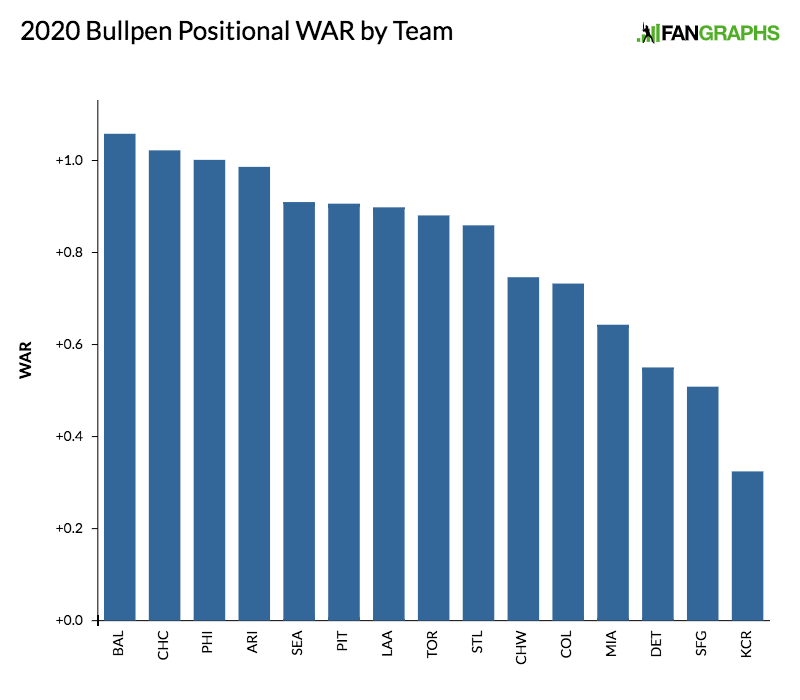
A substantial caveat for readers: There are some positions for which there is a cleaner, wider gap between the top teams and the bottom, where we can more definitively say that some teams are better than others. For instance, it’s clear the best center field situation belongs to the Angels because of Mike Trout, and that Cleveland belongs at or near the top of the shortstop hierarchy because of Francisco Lindor. Relief pitching is not one of these positions. Sure, we have the bullpens ranked, and you can see their statistical projections above and below, but notice the margins here, and that they’re even thinner than usual because of a shortened season, and recall how volatile relievers are generally. Winning a single, close, coin-flip game is more significant this year than ever before, which means bullpen performance will simultaneously be as meaningful and as volatile as ever.

I’m interested in the benefits of stocking bullpens with pitchers who have varied release points, as well as mechanical looks and repertoire shapes that are different from one another, so I’ve included rudimentary overlays of some of each team’s reliever release points to hopefully give visual learners a more concrete idea of what I’m talking about, while also highlighting which teams seem to care more about having varied looks than others. Read the rest of this entry »


What’s the Best That Could Happen in 60 Games?

While researching his latest article, Ben Lindbergh of Effectively Wild and The Ringer asked me and David Appelman if we had data for the most WAR accrued over any given 60-game stretch for a player since 2002 (Hint: It’s Barry Bonds). One question begets others, like who had the worst WAR over 60-games since 2002 (poor Ryan Doumit). The next thing we knew, we had literally millions rows of data, so we decided to make a leaderboard out of them so you can use the data we found.

Creating a quirky leaderboard for this equally quirky baseball season takes database resources and developer time. Your continued support and Membership allows us to afford those resources and create a leaderboard you won’t find anywhere else. If you haven’t already, please consider becoming a FanGraphs Member or donating to the site, so that we can continue to create awesome tools to answer your (and Ben’s) baseball questions.

The Basics

  • We have 60-game rolling stats for batters.
  • We have 12-game rolling stats for pitchers. By default we only show 12-game spans that have all been starts.
  • The rolling stats are delineated by season, so each span of games occurs within the same season.
  • This is an extension of the data engine behind our rolling graphs on the player pages, except pivoted into a leaderboard.
  • Unfortunately, the length of the rolling stats are fixed to 60 or 12 games, and can’t be changed to other values.
  • Since these are rolling stats, you can have spans that have fewer than 60 or 12 games. This typically happens at the beginning of the season or if a player didn’t play enough games over the course of the entire season.
  • We include data from 1974 to 2019.

Read the rest of this entry »


2020 Positional Power Rankings: Bullpen (No. 16-30)

Yesterday, we covered the good and the bad of the league’s rotations. Today, we turn our attention to the relievers.

Between the piggybacking, the Opener, and whatever other new strategies managers decide to test out, the 2020 version of the bullpen likely won’t be quite the same as in years past. But it will probably still feature a lot of good comeback stories, a fair number of injuries (and disappointments), and pitchers you’ve never heard of who can throw the baseball very, very hard. One of the things that makes baseball so interesting is that new talents and triumphs emerge every year, especially in a place as volatile as the bullpen.

You should take that into account, then, when assessing these rankings. Every bullpen can be good; every bullpen can be bad. And the gaps this year are sometimes rather narrow — the Reds (a contending team) and the Orioles (a… not contending team) are projected for basically the same WAR from their relievers. Things widen out at the extremes, with the Rays and Yankees both forecast to be worth about 2.0 WAR, while the Royals are due for just 0.3, but it isn’t hard to imagine some bad injury luck or a hot run shaking things up before the season’s done. Of course, some teams need a lot more things to go right than others, and those teams tend to reside here. If a squad finds itself wistfully hoping for an oft-injured closer to stay healthy, or a rookie’s surprisingly good season to repeat, or for a few too many guys to take a step forward, or pitch like they did when they were young, then it’s probably a bullpen ranked in the bottom half of the league. Unless, somehow, it proves not to be. Read the rest of this entry »


Ben Clemens FanGraphs Chat – 7/20/20

Read the rest of this entry »