The White Sox Playoff Road Is Parallel to the Luis Robert Expressway

For the Chicago White Sox and their fans, this past winter was a very different experience than other recent offseasons. While the team more than dipped its toes into the waters of the Manny Machado sweepstakes after 2018 — seemingly signing every free agent who was a relatives, friend, or neighbor of the eventual Padres third baseman — that effort was a targeted strike at a free agent of rare quality. Outside of that chase, the Sox, still in their rebuilding phase, were not particularly aggressive when it came to adding talent in free agency. Kelvin Herrera was the only player signed who received a contract guaranteeing $10 million, and the White Sox are probably second-guessing that one.

This winter changed this tale. The 2019 White Sox were surprisingly competitive throughout the first half of the season and were within a game of .500 as late as early July. Any unrealistic playoff hopes were dashed by a 7-17 July, but that was still the only month of the season during which the team lost at least three more games than they won. This was a mediocre team, but a mediocre team that was at least playing watchable baseball for most of the season. In the end, the team added 10 wins to their 2018 total of 62.

Of note is that the White Sox didn’t net these 10 games from having a bunch of top prospects graduate to the majors. Of the team’s top 30 prospects from last year, only Eloy Jiménez made a positive impact on the team’s win total in 2019. And even Jiménez’s impact was relatively small, as on-base and defensive struggles kept his WAR to a merely adequate 1.9. The White Sox could legitimately point to their improvements and claim that the best was very much yet to come. Read the rest of this entry »

Ben Clemens FanGraphs Chat – 3/2/20

Read the rest of this entry »


Trevor Bauer Might Have Conducted Another Experiment

In April of 2018, Trevor Bauer conducted an experiment. While he never admitted it, he mysteriously threw the ball with significantly more spin for an inning. Given Bauer’s repeated insistence that adding pine tar or some other equivalent foreign substance could increase his spin rate by 200-300 rpm, and the fact that his spin rate was almost exactly 300 rpm higher in the first inning as compared to the rest, he might as well have winked.

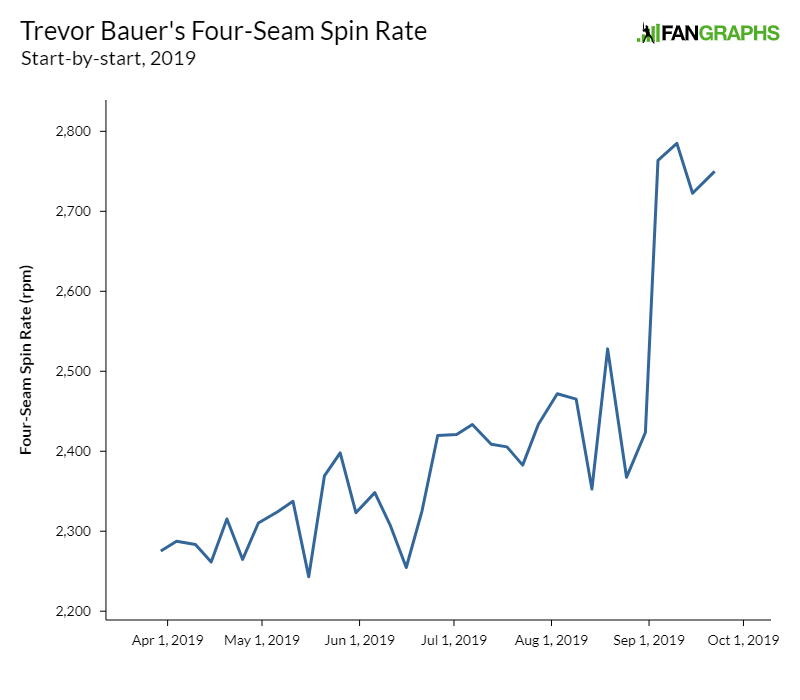
So, uh, let’s talk about last September. The following graph is Bauer’s average four-seam fastball spin rate by game:

Now, I’m not a baseball scientist. But short of Alan Nathan and Meredith Wills and David Kagan, those are in short supply. So I thought I’d conduct a non-rigorous but still curious investigation of these September starts to see if I could get to the bottom of what happened.

Let’s get something out of the way first: my base case, before I started investigating, is that Bauer got back into the sticky stuff. The jump is just so clean, so consistent within each game, that it doesn’t look at all accidental. In a single earlier game, on August 19, Bauer seemingly discovered some spin, posting his then-highest single game average spin rate, just over 2500 rpm. For the rest of 2019, however, he lived between 2250 and 2500 rpm. Then, like magic, every single pitch Bauer threw in September had a spin rate higher than 2500 rpm.

What could cause this, if it isn’t some type of sticky substance? It’s a long shot, but maybe Bauer started cutting the pitch. What does that mean? If you already know, you can skip this section, but I’ll go over it quickly. Picture a tire rolling down the road. Now, picture that same motion by a ball in air, with no road in the way. That’s transverse spin. Picture the baseball with that tire-style spin, with the car in reverse, and you have a 100% spin efficiency fastball. Read the rest of this entry »


The Mets Have a Mismatched Outfield Once Again

It’s only March 2, but between Yoenis Céspedes‘ media blackout, J.D. Davis‘ shoulder scare, and Brandon Nimmo’s irregular heartbeat, the Mets’ outfield has already enlivened the spring with a fair bit of drama and a few eye-catching headlines. Thankfully none those events has turned into a worst-case scenario, and as Opening Day approaches, the unit looks to be a potential source of strength on a contending team — though as ever, it could be a challenge to fit all of the parts together.

Indeed, assembling the pieces into a coherent whole has been a perennial shortcoming for the Mets, even before Brodie Van Wagenen took the reins as general manager; this team hasn’t had a true two-way center fielder — as opposed to a misplaced corner who could outhit his mistakes in the middle pasture — since the heyday of Ángel Pagán, if not Carlos Beltrán. Last year’s roster, the first one assembled by Van Wagenen, had such a surplus of infielders that its six most common outfield configurations (from among 27 different permutations in all) involved at least one infielder who had little major league experience as a flychaser:

Mets’ Most Common Outfields, 2019
LF CF RF Games Started
Jeff McNeil Brandon Nimmo Michael Conforto 27
J.D. Davis Juan Lagares Michael Conforto 26
J.D. Davis Michael Conforto Jeff McNeil 17
Dominic Smith Michael Conforto Jeff McNeil 16
J.D. Davis Brandon Nimmo Michael Conforto 10
Jeff McNeil Juan Lagares Michael Conforto 8
Brandon Nimmo Juan Lagares Michael Conforto 7
Yellow = Infielder with 13 or fewer MLB games in outfield prior to 2019.

Coming into 2019, McNeil had never played the outfield in the majors and had just eight games of minor league experience there, while Davis’ outfield resumé amounted to five major league games plus 31 in the minors, with Smith notching 13 in the majors and 26 in the minors. One had to scroll down to the team’s seventh most commonly-used configuration to find a trio of seasoned outfielders playing in the same unit. The mismatches contributed to ongoing defensive woes, as the team ranked 13th in the NL in defensive efficiency (.677), 14th in UZR (-12.8), and last in DRS (-86). Read the rest of this entry »


Jay Jaffe FanGraphs Chat – 3/2/20

Read the rest of this entry »


Helping Paul Sewald Help the New York Mets

One area of potential weakness for the 2020 New York Mets is their bullpen. Even the seemingly strong backend of Seth Lugo, Dellin Betances, and Edwin Díaz leave more questions than answers. Lugo has been the most stable, but he may be competing for the fifth spot in the rotation. The Mets took a chance on Betances, who pitched in one game last season before going down again with a “freak injury” — what he’ll be capable of in 2020 is anyone’s guess. Díaz, whom the Mets traded for back in December 2018, and who was once one of the most dominant closers in baseball, ended up becoming a major liability for the bullpen.

The supporting cast of Brad BrachRobert Gsellman, and Justin Wilson present some uncertainty as well. Brach pitched well after being released by the Chicago Cubs, but projects for less than a win. Gsellman is an average reliever, and Wilson is an injury concern after missing 10 weeks in 2019 with elbow soreness.

And if things do go south for the bullpen, the Mets’ reinforcements are limited. Among them is 29-year-old righty Paul Sewald, who might be an option in 2020, but there are some adjustments he’ll have to make before he can be a meaningful contributor. As it stands, Sewald may not even make the 2020 Opening day Roster. Sewald possesses good command of his three-pitch arsenal, which consists of an average four-seamer and changeup, with an above-average slider. Sewald mainly goes to the fastball and slider, with some changeup cameos from time to time:

Read the rest of this entry »


Another Extension Season Is Upon Us

Last winter, a whopping 33 contract extensions were signed between the end of the World Series and early April, nearly as many as the previous two offseasons combined. In all, over $2.2 billion in new money was guaranteed to these 33 players, with seven of those extensions crossing the nine figure mark. It was the largest total outlay for contract extensions in a single offseason in baseball history, beating the previous record set during the 2011-2012 offseason.

Perhaps the most interesting thing about the rash of extensions signed last year was the diversity of the types of players teams extended. Established stars like Mike Trout, Paul Goldschmidt, and Chris Sale all signed massive contracts befitting their status as legitimate stars. Then there were players like Nolan Arenado, Xander Bogaerts, and Jacob deGrom, all members of the most common group of players to sign extensions: young, established players on the verge of hitting free agency.

In recent seasons, we’ve seen more and more players sign long-term contracts before reaching arbitration, like Alex Bregman, Blake Snell, and German Márquez all did last year. The newest frontier for contract extensions moves even earlier on the arbitration timeline. Some teams are now extending their top prospects before or not long after they make their major league debuts — Eloy Jiménez, Ronald Acuña Jr., and Brandon Lowe all fell into that category last year. Read the rest of this entry »


Effectively Wild Episode 1508: Season Preview Series: Nationals and Royals

EWFI
Ben Lindbergh and Sam Miller banter about Twins reliever Zack Littell’s powerful affinity for cruise ships and bidding for baseballs from a baseball movie, then preview the 2020 Washington Nationals (12:39) with the Washington Post’s Sam Fortier, and the 2020 Kansas City Royals (40:26) with The Athletic’s Alec Lewis.

Audio intro: Frankie Ford, "Sea Cruise"
Audio interstitial 1: Yo La Tengo, "Season of the Shark"
Audio interstitial 2: Cold War Kids, "Royal Blue"
Audio outro: John Cale, "Ski Patrol"

Link to Littell story
Link to first Knives Out auction
Link to second Knives Out auction
Link to Ben on champions standing pat
Link to Fortier on Kieboom
Link to story on Parra
Link to Lewis on John Sherman
Link to Lewis on Matheny
Link to Lewis on Keller
Link to Lewis on Staumont
Link to order The MVP Machine

 iTunes Feed (Please rate and review us!)
 Sponsor Us on Patreon
 Facebook Group
 Effectively Wild Wiki
 Twitter Account
 Get Our Merch!
 Email Us: podcast@fangraphs.com


FanGraphs Audio: Jon Tayler’s Phone Makes Noises

Episode 880

FanGraphs’ tweeter in residence Jon Tayler joins the program to discuss mascots, his Red Sox fandom, Boston’s decision to trade Mookie Betts, and to remember some guys who played baseball in the AL East in the mid-90s. He also encourages you, the listener, to say hello at FanGraphs’ Spring Training meetup on Friday, March 13, and to please wash your hands regularly.

Don’t hesitate to direct pod-related correspondence to @megrowler on Twitter.

You can subscribe to the podcast via iTunes or other feeder things.

Audio after the jump. (Approximate 56 min play time.)


Sunday Notes: Red Sox Prospect Jarren Duran is a Speedy, Intense Anomaly

My first ever conversation with Jarren Duran took place prior to spring training when the Red Sox held their annual rookie development camp. Things started off clumsily. The speedy outfield prospect has a certain intensity about him, and his responses to my initial inquiries came couched with edgy caution.

Duran has a 50% ground-ball rate since turning pro, and when I noted that worm-killing isn’t exactly de rigueur in today’s game, his reply was a terse, “Yeah, but I can’t beat out a fly ball. That would be a waste of my speed, so why not use the tool that I have?”

Fair enough. Duran has plus-plus wheels — he swiped 46 bags last season — and he profiles as a table-setter as opposed to a bopper. Even so, is a willingness to stay on the ground really in his best interest?


“I’m willing to accept any ball that will give me a hit,” Duran proclaimed. “Ground balls. Line drives. Even fly balls. I’m just trying to make hard contact.”

Again, fair enough. But it’s not as though the 23-year-old Long Beach State product is wholly without pop. The 2018 seventh-round pick did leave the yard five times between high-A Salem and Double-A Portland, and he’s by no means built like a beanpole. Plus, fence-clearing ability is a quality any hitter should aspire to. Right?

Bobby Dalbec is the big guy, the home run hitter,” Duran said of his muscular minor-league teammate. “I’m the little guy who gets on for the bigger guys.” When I pointed out that he’s bigger than Mookie Betts, Duran shrugged and deadpanned, “He’s got more power than me.” Asked if power is something he’s hoping to grow into, his response was an equally-shrug-worthy, “If it comes it comes. If it doesn’t it doesn’t.” Read the rest of this entry »