The Boston Red Sox and Washington Nationals kicked off trade deadline season in earnest on Saturday night, when Boston sent left-handed pitcher Connelly Early to the Nats for corner infielder Curtis Mead.
Most consequential trades this time of year involve a contender swapping one or more prospects for an established big leaguer. Not so this one. At the time of the trade, the Red Sox and Nationals were in similar positions in the standings: The Sox were 53-50, seven and a half games out of the division lead, but half a game up in the AL Wild Card race. The Nats were 53-52, eight and a half games out of first place in the NL East, but only two games out of a Wild Card spot. Both teams are playing with house money: Boston on account of being 14 games under .500 less than five weeks ago, and Washington on account of… everything that’s happened since the start of the 2020 season.
And there’s little difference between Early and Mead in terms of age or team control: Mead is 25, and barring substantial changes in the next CBA, he’ll be arbitration-eligible after the 2027 season and under team control through 2030. Early is one year younger and one year behind Mead on the journey to both of those milestones.
As we approach August, now is a good time to take a fresh look at the farm systems of some of the clubs we expect to be buyers at the trade deadline. These teams are both contending for a playoff berth and in clear need of a significant upgrade, the kind that will likely require parting with a top farmhand or two. We’ll begin today with the Atlanta Braves. In tandem with an evaluation of the team’s needs and deadline posture, we’ve updated Atlanta’s Top Prospect list to account for the graduations of Didier Fuentes and JR Ritchie, incorporate the new draftees, and reflect a number of promising developments on the farm. If you were solely to evaluate a farm system by its performance relative to expectations, the Braves have a case for the top spot in the league, and that newfound depth looms as a key factor in the club’s playoff push.
The Situation
For a while, the Braves seemed poised to boat race the NL East. The club went 40-20 over the first two months of the season and built a 10-game lead over the Phillies. The Mets, also projected to be strong contenders in the division, languished even less threateningly in dead last. Read the rest of this entry »
Ben Clemens: I’m going to let the queue fill up with just a few more questions because I got a late start on posting this, but I’m going to be ready to go in a few minutes.
12:01
Ben Clemens: In the meantime, a good rule of thumb in these discussions is that I’m going to end up answering questions about a lot of players. But probably not about the same player many times, if that makes sense
12:02
Ben Clemens: So plan on long answers to some of these, longer than my normal chat format for sure.
12:03
Ben Clemens: And of course, if you’re not asking a question about trade value, I think you’ve found the wrong place. I have a weekly chat on Mondays that is a great place for all kinds of off-topic stuff, or baseball-related but not trade value related
12:03
Ben Clemens: This particular chat is supposed to be about this article series that I just spent weeks and weeks making. So yeah, not answering your question if it’s like, how bout them Cards. we can talk about that later
As is tradition at FanGraphs, we’re using the lead-up to the trade deadline to take stock of the top 50 players in baseball by trade value. For a more detailed introduction to this year’s exercise, as well as a look at the players who fell just short of the top 50, be sure to read the Introduction and Honorable Mentions piece, which can be found in the widget above.
For those of you who have been reading the Trade Value Series the last few seasons, the format should look familiar. For every player, you’ll see a table with the player’s projected five-year WAR from 2027-2031, courtesy of Dan Szymborski’s ZiPS projections. The table will also include the player’s guaranteed money (exclusive of any signing bonus), if any, the year through which their team has contractual control of them, last year’s rank (if applicable), and then projections, contract status, and age for each individual season through 2031 (assuming the player is under contract or team control for those seasons, or has a player or vesting option). Last year’s rank includes a link to the relevant 2025 post. Thanks are due to Sean Dolinar for his technical wizardry. At the bottom of the page, there is a grid showing all of the players who have been ranked up to this point.
A note on these rankings: At the top of the list, I’ve tried to group like with like, but that’s not always possible when you’re talking about the very best couple of players in baseball. I’ve noted this in the text, but there’s one tier of players today where I think all three have roughly equal value, and another where I feel strongly that the top guy is the best of the bunch. I’ll note the places where I disagreed meaningfully with the people I spoke with in calibrating this list, and I’ll also note the players whose value my contacts disagreed about. As I mentioned in the Introduction and Honorable Mentions piece, I’ll indicate tier breaks between players where appropriate, both in their capsules and bolded in the table at the end of the piece. Read the rest of this entry »
Since the draft concluded last week, the two of us have been working to add the newly-minted pro players to their team lists (you can find them here), move this year’s graduates to their own tab on The Board (which you can find here), and make a sweeping update to our Top 100 Prospects List. Below you’ll find the updated list, followed by notes on who moved and why via a rundown of the clusters of players that formed around similar profiles throughout the rankings. As a reminder, we rank however many players we have graded as 50 FV or better in our Top “100,” and as of this update, that’s 111 guys. Players whose grade have changed have a “↑” or “↑↑” in the trend column of the table, with the latter designation noting cases where the re-evaluation is quite dramatic; players dealing with full-season injuries are indicated with a bandaid.
If you want more information about these players, please head over to The Board, where you can find full scouting reports, tool grades, pitch repertoires and more. We proactively added a few players to the Graduates tab who are quite close to reaching the at-bat or innings pitched graduation threshold, or who have obviously spent enough days on the active big league roster to have exhausted prospect eligibility. Lastly, you can see the real-time farm system rankings here, with the rankings from before the graduates were pulled off and the draftees were added here. Read the rest of this entry »
As is tradition at FanGraphs, we’re using the lead-up to the trade deadline to take stock of the top 50 players in baseball by trade value. For a more detailed introduction to this year’s exercise, as well as a look at the players who fell just short of the top 50, be sure to read the Introduction and Honorable Mentions piece, which can be found in the widget above.
For those of you who have been reading the Trade Value Series the last few seasons, the format should look familiar. For every player, you’ll see a table with the player’s projected five-year WAR from 2027-2031, courtesy of Dan Szymborski’s ZiPS projections. The table will also include the player’s guaranteed money (exclusive of any signing bonus), if any, the year through which their team has contractual control of them, last year’s rank (if applicable), and then projections, contract status, and age for each individual season through 2031 (assuming the player is under contract or team control for those seasons, or has a player or vesting option). Last year’s rank includes a link to the relevant 2025 post. Thanks are due to Sean Dolinar for his technical wizardry. At the bottom of the page, there is a grid showing all of the players who have been ranked up to this point. Read the rest of this entry »
There’s still a chance Tarik Skubal pitches for the Detroit Tigers in the postseason this year.
Trading Skubal before the 2026 deadline makes sense for the Tigers. I think that’s pretty well established. Detroit has a losing record, less than one-in-three odds to make the playoffs per our odds, and one of the best players in the league on an expiring deal. This is the ideal trade deadline scenario.
But things have become more muddled in recent weeks. The Tigers are hot, having gone 25-16 since June 1. They finally look like the team we projected to win the AL Central before the season began. Still, they’d need to go 9-2 to even reach the deadline with a .500 record, underscoring the depth of the hole they dug early in the year. With less than two weeks before this crucial decision point, the Tigers have stumbled upon a universal truth: Being alive is complicated.
The Tigers’ season started well enough. They snuck out of April with an even 16-16 record and a positive run differential. They even began May by taking two of three from the Rangers. But on May 4, Skubal landed on the IL with loose bodies in his elbow, the latest in a string of injuries to the rotation. They lost that night and began a brutal 4-21 stretch that saw them sink to the worst record in baseball by the end of the month.
It wasn’t really the absence of Skubal that was the issue, as Jay Jaffe wrote at the time. In May, their batters posted a league-worst 69 wRC+ — nobody hit fewer homers, and only the Angels struck out more. When the offense did manage a lead, it was quickly given up by a shallow bullpen, which turned in 24 meltdowns in May. There aren’t many enjoyable brands of losing baseball, but slogging through a 1-0 game only to implode at the end is among the most frustrating. Attention understandably turned to Skubal’s return, and his seemingly inevitable departure at the deadline.
Then the calendar flipped to June. The Tigers began the month with a sweep of the first-place Rays, scoring 25 runs on 10 homers in three games, and they haven’t cooled since. Their 109 wRC+ in the last 41 games is top 10 in baseball, and their 72 homers are the most of any team. The lineup now has one of the best trios in the majors. Dillon Dingler (4.6) and Kevin McGonigle (4.0) each rank in the top 10 by WAR, and Riley Greene (2.8) ranks in the top 30. Colt Keith is on a hot streak, smacking eight homers since June 1 after going the first two months of the season without hitting any. The Tigers also just got Gleyber Torres and his 127 wRC+ back from an oblique injury on Monday. It’s suddenly a good, competitive lineup.
The bullpen has also been better of late. Their 3.19 ERA since June 1 is fifth in the majors. It’s a shallow group, and the end of games can still feel a bit dicey while closer Kenley Jansen runs a walk rate (14.7%) nearly double his career mark (7.9%). But the offense finally scoring a few runs has helped alleviate some of the pressure. In May, the Tigers bullpen faced the sixth-highest Leverage Index when entering games; since June 1, they’ve faced the lowest of any team. Again, it’s not a great bullpen, and this is likely the area the Tigers will want to address at the deadline assuming they add. But they’re asking less of them these days.
A competitive lineup and bullpen is all the Tigers should need with their rotation, which has allowed the fewest runs in the majors over this hot stretch. But that’s where the narrative of this article and the Tigers’ season recently became more complicated. Casey Mize pitched on Sunday, looking to continue his breakout season (his 2.79 ERA and 2.62 FIP would each be career bests), but he left the game early with the same groin tightness that’s landed him on the IL twice this year; he’s now day-to-day. Jack Flaherty pitched on Monday, hoping to build on a month-long hot streak (a 2.67 ERA and 3.25 FIP in seven starts since the beginning of June); he pitched poorly and was placed on the injured list with right flexor inflammation after the game. On Tuesday, Framber Valdez couldn’t make it out of the first inning in what ended up being an 11-2 blowout loss to the Cubs; he’s not known to be hurt, but he’s having the worst full season of his career, with a 4.57 ERA and 4.16 FIP in 20 starts.
Still, this has been one of the best rotations in the majors all season, even as they’ve dealt with injuries and inconsistency. They could still be that going forward… assuming Skubal remains their ace. He’s been great. He had solid numbers in seven starts before the IL stint (2.70 ERA and 2.11 FIP), he’s had solid numbers in seven starts after the IL stint (2.97 ERA and 3.66 FIP), and I assume he’ll have solid numbers the rest of the year, regardless of who he’s pitching for. He has been a little homer-prone, allowing 1.09 per nine innings, compared to 0.71 between 2022 and 2025. But his stuff and command metrics look the same as ever, and he hasn’t given up more hard contact or barrels overall. I’ll give him the benefit of the doubt and assume it’s a sample-size blip, though it’ll certainly be something teams assess ahead of the deadline.
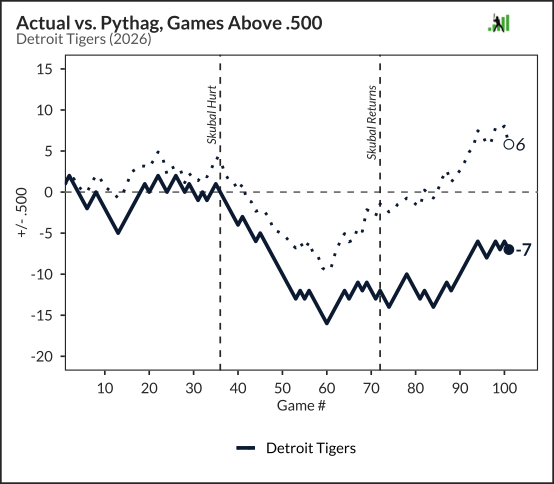
Again, while Skubal’s absence wasn’t the Tigers’ main issue in May, we can see they’ve largely played like a playoff-bound team the days he’s been on the active roster:
We can also see the Tigers have maybe been a bit unlucky to this point. They are six games under their pythagorean record — the largest discrepancy in the majors this year. That’s driven in part by a 10-17 record in one-run games. In games decided by more than one run, they’re an even 37-37 with a +31 run differential; they’re 20-12 with a +62 run differential since June 1. And so the Tigers seem to be better than their record would indicate, and they are indeed gaining ground. But at 6 1/2 back of the Guardians and White Sox in the Central, and five back of the Red Sox for the third Wild Card, they’re running out of time to make this a legitimate playoff push.
The Tigers must weigh what that long-shot postseason push is worth. They have a young, team-controlled core that could be competitive for years to come. Trading Skubal could obviously help add to their future ambitions. They also don’t technically need Skubal to get to the 2026 postseason. They’d still have an above-average rotation without him (depending on the health of Mize and Flaherty), and some of the players they’d get back in a trade could potentially help them this year. Plus, even if they do get to October with Skubal, it doesn’t guarantee they’ll advance — the Tigers lost both games he pitched in last year’s ALDS. Holding on to such a potentially valuable trade chip only to narrowly miss the postseason or suffer an early exit could generate some hard feelings and hot seats.
Still, this is a legitimate chance for the Tigers. This is the bird in the hand. It’s a fairly important bird, too. Skubal probably doesn’t have the longevity in Detroit to be considered the “best” pitcher in franchise history, but he’s the rare, era-defining player — one still largely in the prime of his career. This is the type of chance a front office typically builds toward, not away from. A late-season comeback and a deep playoff run on the shoulders of a franchise icon has to be worth something beyond long-term efficiencies in team building. And the Tigers will likely extend Skubal a qualifying offer this offseason, meaning they’d at least receive an extra draft pick should he sign elsewhere (assuming the system remains the same under the new CBA, of course). Sure, their midseason stumble raises questions about the team’s potential in 2026, but it should also raise questions about its potential in 2027 and 2028 and 2029. Nothing is guaranteed in baseball, especially when a player like Skubal walks out the door.
As is tradition at FanGraphs, we’re using the lead-up to the trade deadline to take stock of the top 50 players in baseball by trade value. For a more detailed introduction to this year’s exercise, as well as a look at the players who fell just short of the top 50, be sure to read the Introduction and Honorable Mentions piece, which can be found in the widget above.
For those of you who have been reading the Trade Value Series the last few seasons, the format should look familiar. For every player, you’ll see a table with the player’s projected five-year WAR from 2027-2031, courtesy of Dan Szymborski’s ZiPS projections. The table will also include the player’s guaranteed money (exclusive of any signing bonus), if any, the year through which their team has contractual control of them, last year’s rank (if applicable), and then projections, contract status, and age for each individual season through 2031 (assuming the player is under contract or team control for those seasons, or has a player or vesting option). Last year’s rank includes a link to the relevant 2025 post. Thanks are due to Sean Dolinar for his technical wizardry. At the bottom of the page, there is a grid showing all of the players who have been ranked up to this point. Read the rest of this entry »
As is tradition at FanGraphs, we’re using the lead-up to the trade deadline to take stock of the top 50 players in baseball by trade value. For a more detailed introduction to this year’s exercise, as well as a look at the players who fell just short of the top 50, be sure to read the Introduction and Honorable Mentions piece, which can be found in the widget above.
For those of you who have been reading the Trade Value Series the last few seasons, the format should look familiar. For every player, you’ll see a table with the player’s projected five-year WAR from 2027-2031, courtesy of Dan Szymborski’s ZiPS projections. The table will also include the player’s guaranteed money (exclusive of any signing bonus), if any, the year through which their team has contractual control of them, last year’s rank (if applicable), and then projections, contract status, and age for each individual season through 2031 (assuming the player is under contract or team control for those seasons, or has a player or vesting option). Last year’s rank includes a link to the relevant 2025 post. Thanks are due to Sean Dolinar for his technical wizardry. At the bottom of the page, there is a grid showing all of the players who have been ranked up to this point. Read the rest of this entry »
At last we reach the end of my annual series spotlighting the weakest positions on contending clubs. While still focusing upon teams that meet that loose definition of contenders (Playoff Odds of at least 10% when this series began), I’ve also incorporated our Depth Charts’ rest-of-season WAR projections into the equation for an additional perspective. Sometimes that may suggest that the team will clear the bar by a significant margin, but even so, I’ve included it here because the team’s performance is worth a look.
At the other positions in this series, I have used 0.6 WAR or less thus far — which prorates to 1.0 WAR over a full season — as my cutoff, but for the designated hitters, I’ve limited the list to the teams below zero, both to keep the length manageable and to account for the general spread of value. In the fifth full season of the universal DH, 0.2 WAR represents the current median, with 11 teams below zero, 12 between zero and 1.0, and just seven with 1.0 or more, with only five reaching 2.0. DHs as a group have hit .244/.325/.422 for a 106 wRC+ this season, down four points from last year’s final mark, the highest since the adoption of the universal DH.
It does appear that an increasing number of teams are investing more playing time in a single DH. From 2022 (the first full-length season with the universal DH) to ’25, the number of players reaching 450 plate appearances in the DH role increased from three to four to seven to nine; this year, they’re on pace for nine, as well. That said, all but one of the teams on this list are the ones that haven’t found that special someone to take the lion’s share of the plate appearances. Read the rest of this entry »