In 2025, I once again had an opportunity to interview numerous people within the game. Many of their words were shared in my Sunday Notes column, while others came via an assortment of Q&As, feature stories, and my Old Scouting Reports Revisited series. Here is a selection of the best quotes from this year’s conversations, with the bolded lines linking to the pieces they were excerpted from.
———
“Guys are thinking about the game in totally different ways now, and sometimes we lack the art. We lack focusing on the art. We’re thinking like robots instead of thinking like a human, and trying to make decisions based on another human being in a box. That’s the challenge of pitching.” — Max Scherzer, Toronto Blue Jays pitcher
“You see a lot of guys trying to chase that perfect swing. That’s hard to do when you have a guy throwing 99 and it’s running 20 inches, or sinking 20 inches. My thought is just, ‘Go up there and get the bat to the ball.’ Keep it that simple. Don’t try to chase the perfect swing.” — Kevin McGonigle, Detroit Tigers infield prospect
“We can measure the swing — most, if not all of it — and because we can measure it, we can track it. We can see if it is changing. What we can’t measure… actually, we can, but we’re not allowed to put eye-tracking glasses on players in-game. You don’t know what’s actually happening in the brain when it comes to decision-making.” — Dillon Lawson, Boston Red Sox hitting coach
“I remember Bill James saying that a player’s value is in his uniqueness. How unique is he to the pool of players? The decision-making process in today’s game, with the variety of different tools we have, allows us to better identify that uniqueness. Instead of looking at a pitcher and simply saying, ‘He’s a small righty,’ we can know why he is so effective. We can identify the valuable qualities within that uniqueness.” — Jerry Dipoto, Seattle Mariners, president of baseball operationsRead the rest of this entry »
I never pitched in Little League, but I remember many of the lessons our coach imparted to this day. Most specifically, I remember him harping on “hard in and soft away.” This was silly. Nobody on my team could throw a curveball, and even from my youthful perspective, no one could throw anything hard either. We all mostly struck out or walked; pitchers with command were pretty much untouchable in my small-town East Tennessee league. But we’re losing the plot here – as it turns out, that advice is omnipresent in baseball, from little leagues to the majors.
I’ve always been enamored with this simple and yet fascinating rule of thumb. Why does it work? Does it work, even? What’s so special about “in” and “away” relative to pitch speed? I’ve never quite found a satisfactory way to classify it. But while I was taking a look at contact point data last week, I came up with an idea for how to measure this. When you look at the data, the evidence has been there all along.
I focused on the “hard in” aspect of the adage, because major leaguers throw so many different secondaries that honing in on what “soft” meant seemed impossible. To that end, I devised a quick test to see how conventional wisdom behaves in practice. I defined “inside” and “outside” pitches by removing the middle third of the plate, then extending out nine inches past the edge of the strike zone in both directions. I looked at sinkers and four-seamers thrown in these areas to define “hard in” and “hard away.” Read the rest of this entry »
I am not a Mariners fan. I have never been a Mariners fan. I have no intention of becoming a Mariners fan. But the first major league game I ever attended was, in fact, a Mariners game. Here’s what I remember from that game: It took place on July 30, 1998 in the Kingdome. It lasted 17 innings and stretched into the following day. We were sitting on metal bleachers, pretty high up. I knew that some of the big names on the Mariners that year were Ken Griffey Jr., Alex Rodriguez, Randy Johnson and Jay Buhner. I spent most, if not all, of the game reading a book because I absolutely did not care about baseball. That’s it. I know that isn’t much, so here’s some photo proof that I was actually there:
Me and my brother at a Mariners game on July 30, 1998. Our parents are seated directly behind us. The other people in the photo are family friends.
I’m the nine-year-old girl on the left and the only one not wearing Mariners gear. Again, I have never been a Mariners fan. The kid next to me is Roger, my 13-year-old brother (yes, that oversized manchild was really only 13, I triple-checked the math). He was the reason we were at the game and the reason I could name a whopping four Mariners. Read the rest of this entry »
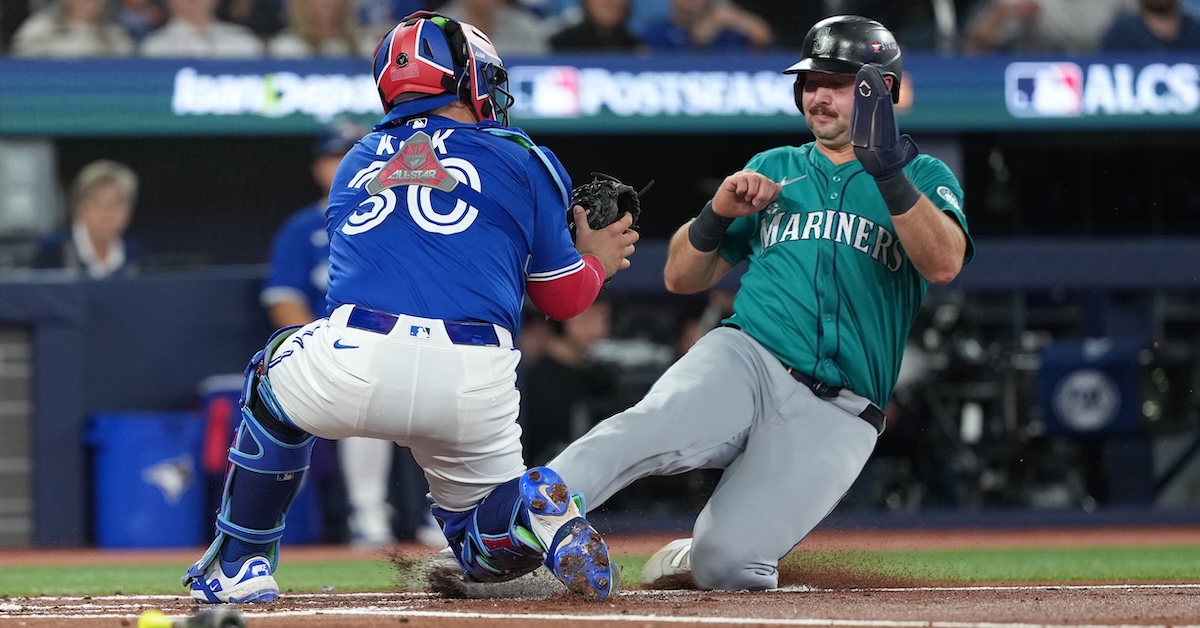
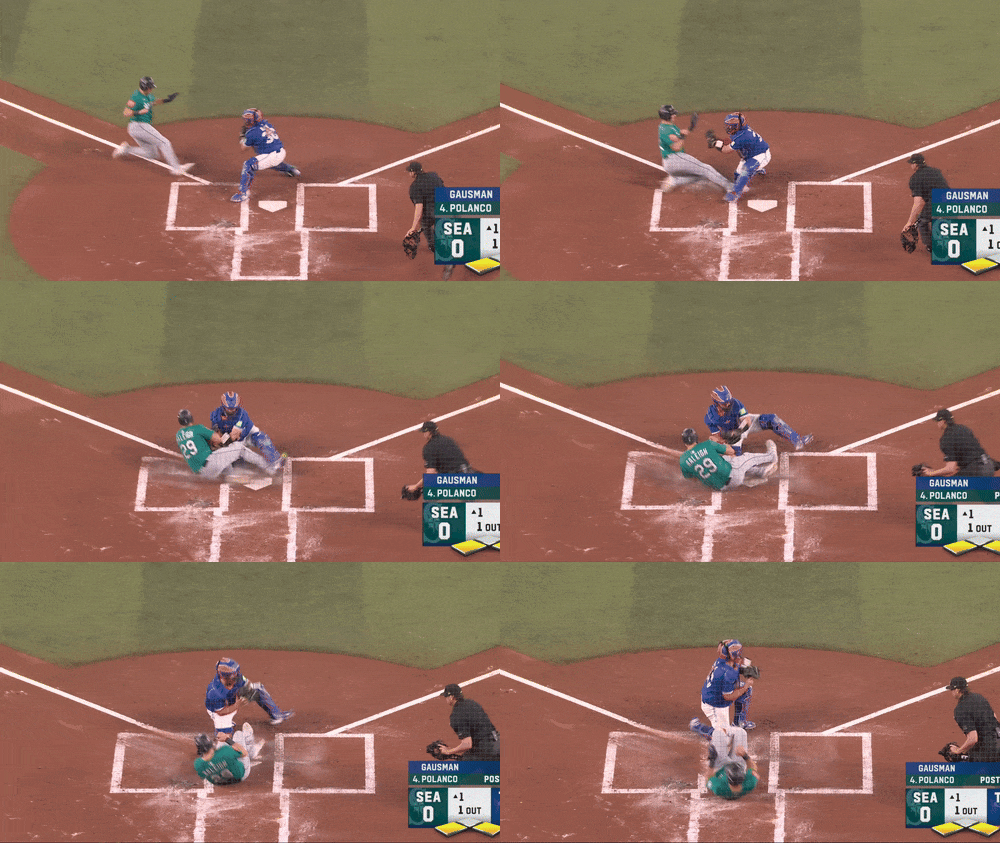
It was really close. On Sunday, in Game 1 of the American League Championship Series, in the top of the first inning, with one out and runners on first and third, once and future hero playoff hero Jorge Polanco hit a bouncer to the third baseman. The runner on third was going on contact, but the runner on third was Cal Raleigh, and while relatively quick for a catcher, the Sultan of Squat is not exactly known for his speed. Had the ball been hit anywhere other than directly at a corner infielder, he might have beaten it easily. Instead, Addison Barger’s throw beat Raleigh to the bag by at least three metres (the game was in Canada, after all). But it was still really close.
The throw arrived in plenty of time, and it was by no means off target. To make sure he ran no risk of hitting the runner, Barger wisely threw the ball toward the right side – the first base side – of catcher Alejandro Kirk’s body. The throw wasn’t high either, but it did arrive at shoulder height. Raleigh was running as hard as he could, and in the time it took Kirk to swing his catcher’s mitt from high on his right side to low on his left side, he’d closed the distance to roughly one metre. Then Kirk made an important decision. With Raleigh bearing down on him, he chose not to keep swinging the glove down and toward the plate. He reached out for a high tag and swept the left side of his body out of the way in the same moment. Self-preservation undoubtedly played a role in the decision. It cost him valuable centimetres (God, this feels wrong), and it very nearly allowed Raleigh to sneak his right cleat between Kirk’s legs and onto home plate before his torso crashed into the mitt. For the briefest of moments, the two catchers looked like colliding galaxies, smashing then spinning together as their gravitational fields intertwined:
In real time, the play went from looking like a sure out to an impossibly close call. Maybe Raleigh got his foot in there and maybe he didn’t. The call on the field was out, and unbelievably, the Mariners declined to challenge it. The video never got dissected by the replay room in New York. The chief marketing officer of Zoom Communications, Inc. surely wept. Read the rest of this entry »
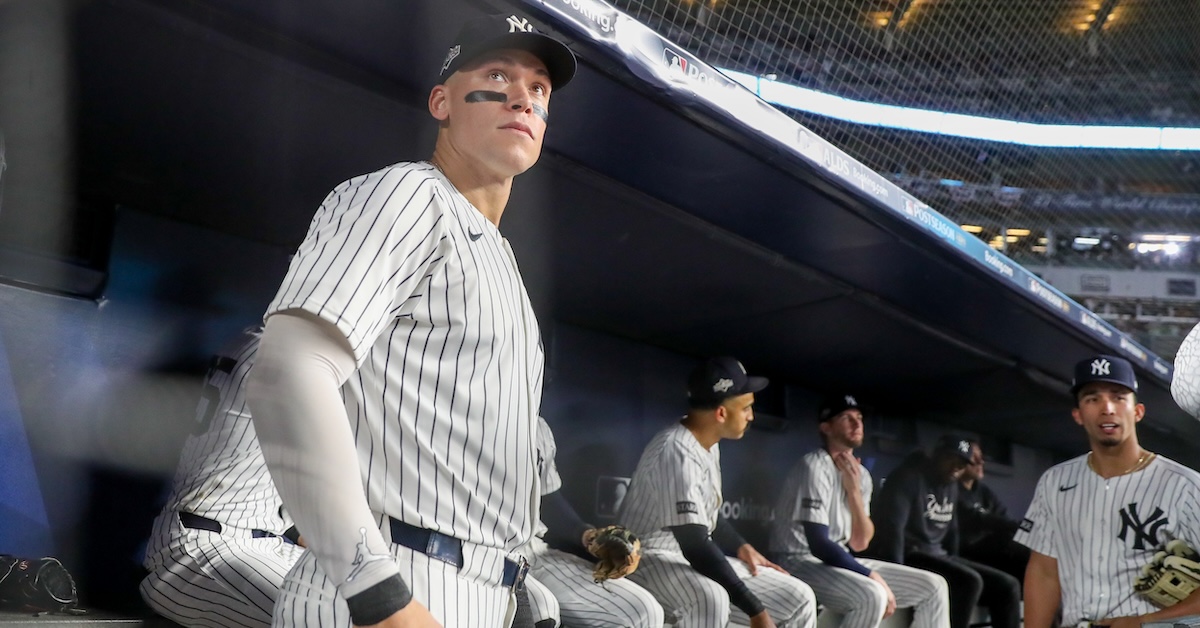
NEW YORK — About 45 minutes after the “best team” that Aaron Boone has ever managed was eliminated from the playoffs, several of its members sat in the clubhouse drinking a few small beers. The mood was wistful, the somber finality of it all floating through the very same air that less than a week earlier had reeked of celebratory champagne.
They had just lost the American League Division Series to the Blue Jays in four games, and for the most part, it wasn’t all that close. Despite an all-time great postseason performance from Aaron Judge following yet another all-time great regular season from him, New York was thoroughly outplayed by Toronto. Boasting the most annoying opposing lineup in baseball, the Jays peppered pitchers with their all-fields approach and their refusal to swing and miss. Theirs was a Boomer’s more-than-platonic ideal of an offense – they had the lowest strikeout rate (17.8%) and the highest batting average (.265) in the majors this season — but it wasn’t a true throwback. The Blue Jays weren’t dependent on the long ball, but they were more than capable of hitting home runs, as we all saw during the ALDS. As a team, Toronto slashed .338/.373/.601 for a 168 wRC+ across the four games. Yankees pitchers struck out 23.7% of the hitters they faced during the regular season but just 14.9% of the Blue Jays who batted in the series.
“They beat us this series,” Boone said. “Simple as that.”
Yet even as the Yankees accepted their fate, that they had played their last baseball game of the season, they were still trying to understand how it all went wrong. Hadn’t they addressed their shortcomings from a year ago, when they lost to the Dodgers in the World Series? They lengthened their lineup, improved their baserunning, and enhanced their rotation during the offseason, and then ahead of the trade deadline, they made more moves designed to shore up their defense and bolster their bullpen. Some of those deals didn’t pan out, but many of them did. Read the rest of this entry »
Even the best pitchers in baseball lose a game once in a while. Just ask Tarik Skubal. I’m sure you’ve read about it a hundred times by now, but the Mariners have won all three of their games this year where Skubal was the opposing starter. Seattle was the only team to hand him multiple losses during the regular season, and the Tigers dropped Game 2 of the ALDS — technically a no-decision for Skubal — less than a week ago. Now, thanks to his team’s roaring come-from-behind victory in Game 4, Skubal is lined up to start tonight’s decisive Game 5, giving him an opportunity to finally beat the Mariners this year.
I’ll give a warning upfront: This article is going to lean pretty heavily on batter-pitcher matchup stats; we’ll be examining some extremely small samples. But I think it’s an interesting investigation into the strategy that unfolds between familiar foes during a short postseason series.
What I really wanted to know is whether the Mariners had a specific approach that made them so successful against Skubal this year. As I mentioned, Skubal faced the Mariners twice during the regular season. On April 2, in Seattle, he allowed three runs in 5.2 innings; he gave up six hits and three walks while striking out eight. On July 11, he faced them again, this time in Detroit, and allowed four runs in five innings; he gave up just four hits and two walks while striking out five. His Game 2 start this past Sunday was his best yet: He surrendered two runs on five hits and one walk in seven innings while notching nine strikeouts. The two home runs off the bat of Jorge Polanco were his undoing. Read the rest of this entry »
SEATTLE — Every year, pitchers and catchers report for spring training, and just as spring represents a reawakening in the natural world, spring training provides a reawakening for every team, a fresh start, full of renewed optimism. No matter the team, fans across the league allow themselves to dream a little, to believe that this year might be the one.
You could be my silver springs
Blue-green colors flashin’
I would be your only dream
Your shining autumn, ocean crashing.
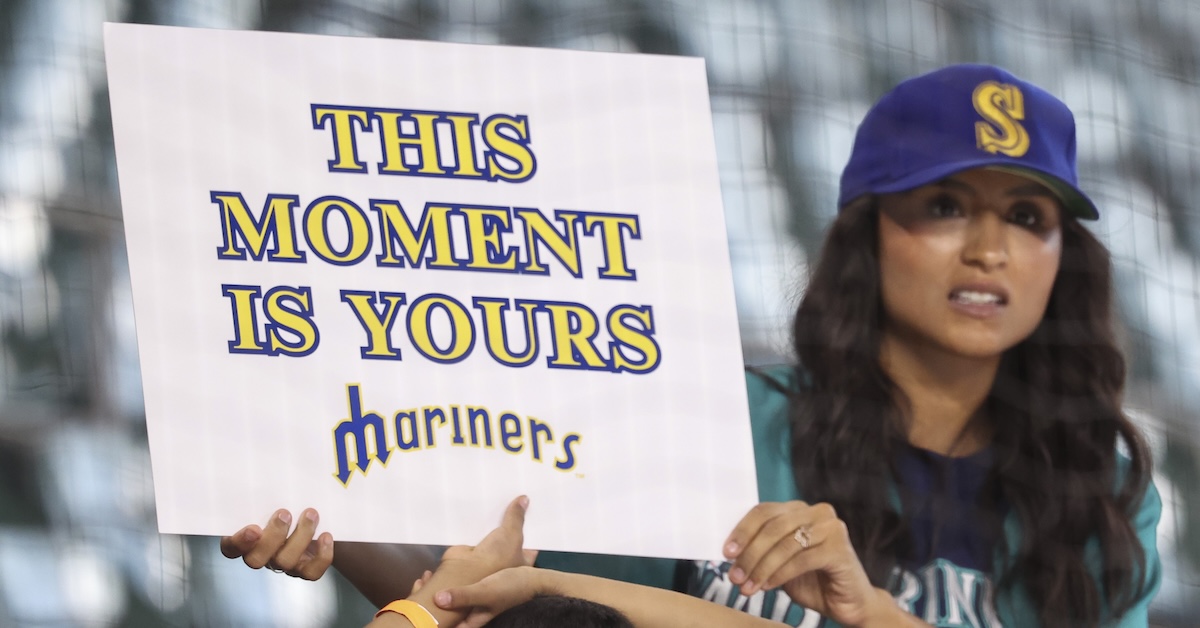
But for 29 teams, the season will end in heartbreak. For some teams that heartbreak might come as early as June or July, for others in August or September, and a few will experience the agony of October sorrow. Over the last several years, the Seattle Mariners have unwittingly built a tradition of remaining very much in the playoff hunt until the final week of the regular season, only to miss the cut by a harrowingly thin margin. They did make the playoffs in 2022, ending a 20-year postseason drought, but they struggled to cross that threshold again. Instead, they fell into a familiar rhythm, playing hard until the very end, but then their season was over. Their time was up.
Time cast its spell on you, but you won’t forget me
I know I could have loved you, but you would not let me.
This season is different. The Mariners not only secured a place in the postseason, but they also won the AL West for the first time since 2001. In doing so, they eschewed the Wild Card Series and advanced directly to the best-of-five Division Series, which begins on Saturday against the Tigers in Seattle. And all it took was a little witchcraft. Read the rest of this entry »
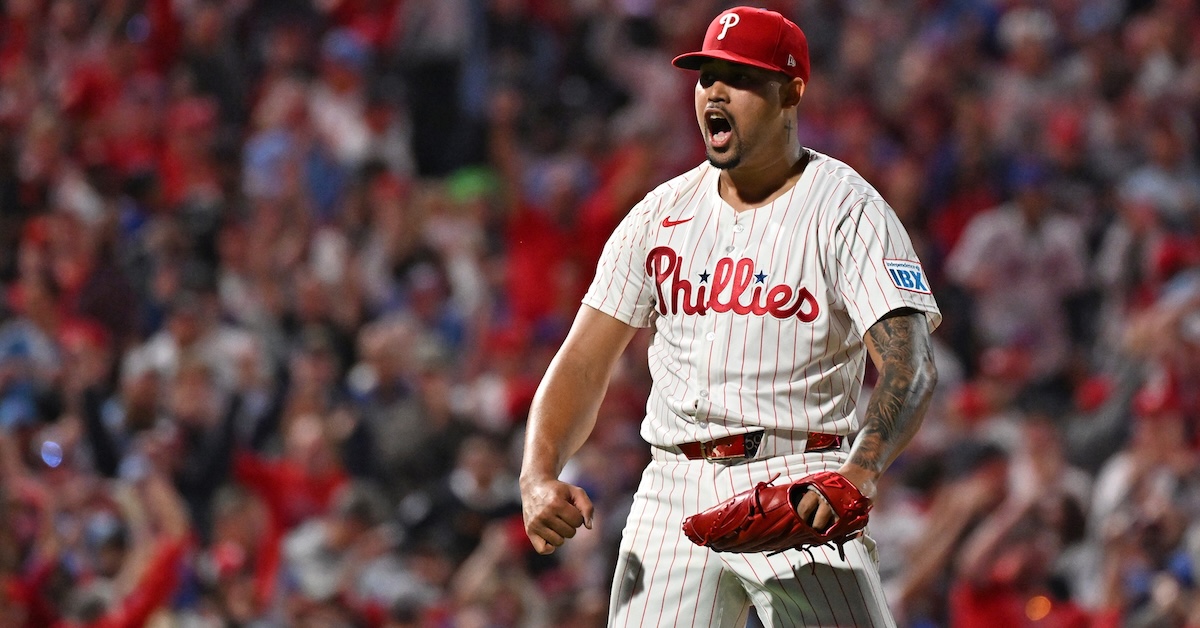
PHILADELPHIA — Let’s get one thing clear off the top: A splitter is not a fastball. Any confusion about this topic is understandable, seeing as the full government name of the pitch is “split-finger fastball.” Don’t be a captive to the inflexibility of language. The splitter is lying to you about its very nature.
The origin story of the splitter begins in 1973, when a Cubs minor leaguer named Bruce Sutter was recovering from offseason elbow surgery and struggling to regain his fastball velocity. A pitching instructor named Fred Martin approached the sore-armed 20-year-old with a new pitch. This would be a variation on the familiar forkball, held with index and middle finger spread as far apart as possible in order to impart downward movement.
But while the forkball came out of the hand with an identifiable knuckleball action, Martin had Sutter grip the baseball ever so slightly forward, getting similar action with fastball-like spin. Read the rest of this entry »
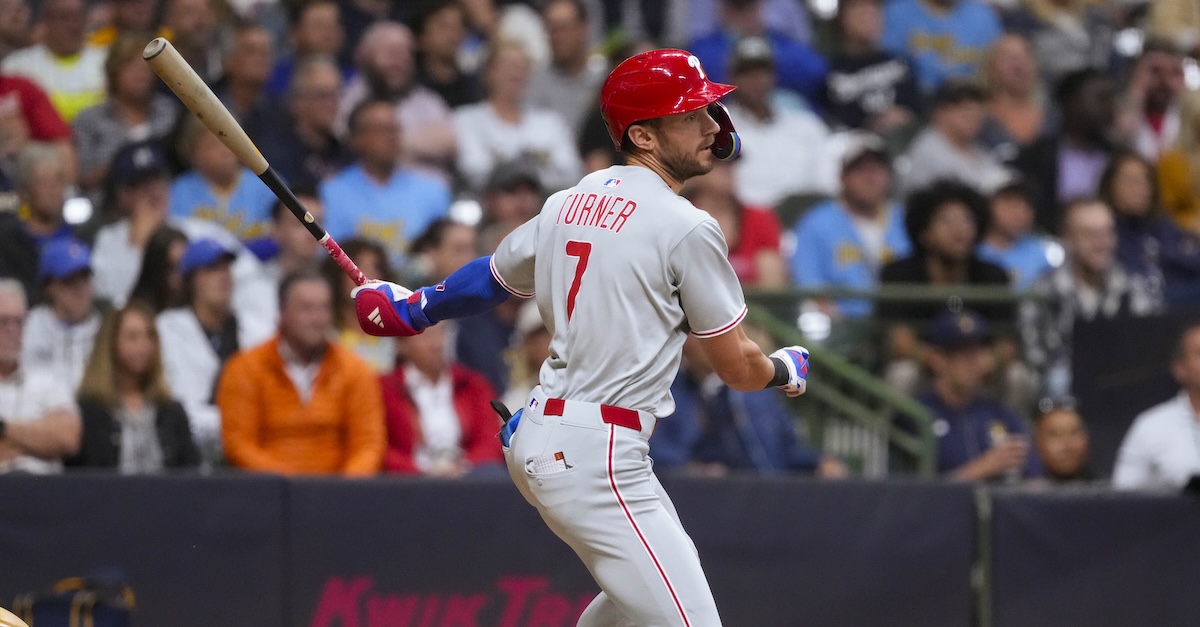
Does anybody want to win the National League batting title? Granted, with all these statheads devaluing batting average and instead offering fancier stats that identify more productive hitters, batting titles ain’t what they used to be. Nonetheless, with less than three weeks to go in the regular season, it bears noting that just one NL qualifier has a batting average of .300 or better, namely Trea Turner — and he just landed on the injured list.
The 32-year-old Turner left Sunday’s game against the Marlins in the top of the seventh inning after running to first base, where he was safe on a throwing error by shortstop Otto Lopez. He felt his right hamstring “grabbing on me,” as he described it afterwards, and was replaced by a pinch-runner. An MRI on Monday showed that he’d suffered a Grade 1 hamstring strain — thankfully not as serious as the Grade 2 left hamstring strain that knocked him out of action for six weeks last season; the Phillies think he could be back after just a 10-day IL stint. Even so, the move came on the same day that the team also placed third baseman Alec Bohm on the IL due to a cyst in his left shoulder; suddenly the Phillies are down half an infield. Luckily for them, they now own an nine-game lead in the NL East.
Thanks in large part to a 4-for-5 night on Friday, Turner is currently hitting .305/.356/.458 (125 wRC+). That’s the highest his batting average has been since June 17 (.308); he was as low as .281 as recently as August 13 but had been on fire over the past four weeks, batting .420/.448/.620 (197 wRC+) since then to overtake Will Smith (who at the time led the NL at .312), Xavier Edwards (.308), Freddie Freeman (.300) and everyone else vying for the title. Turner already has a batting title, having led the NL with a .328 mark in 2021. Read the rest of this entry »
The Mariners entered the season with a starting rotation that was the envy of nearly every other team in baseball, with four young homegrown pitchers in Logan Gilbert, George Kirby, Bryce Miller, and Bryan Woo, and Luis Castillo as the veteran ace to lead the group. Our preseason projections had Seattle’s rotation as the seventh best in baseball, only held back by its lack of depth behind the top five starters. Three of those young starters appeared on Ben Clemens’ midseason Trade Value list, ranked 23rd (Kirby), 34th (Woo), and 36th (Gilbert). The M’s rotation has been the key to their success over the last few years, but lately, that same highly regarded group has been the weakest link for the Mariners as they fight to maintain a playoff spot.
Since the All-Star break, Seattle’s rotation has put up a 4.55 ERA and a 4.27 FIP, 19th and 16th in the majors, respectively. It’s been even worse over the last 30 days: a 4.94 ERA (20th) and a 4.66 FIP (21st). Kirby has allowed seven or more runs in two of his last four starts, and was knocked around for 10 hits and eight runs (seven earned) in two innings in his start against the Rays on Wednesday. Castillo has allowed five or more runs in three of his last four starts. Gilbert suffered through an ugly six-run blowup in Philadelphia a few weeks ago. Miller is sporting a 5.63 ERA since being activated off the IL on August 19. Even the metronomic Woo had his streak of 25 starts of at least six innings snapped on August 27.
These problems becomes even more stark when you compare their performance inside the confines of the extremely pitcher friendly T-Mobile Park to their struggles on the road. This season at home, the rotation is putting up a 3.40 ERA and a 3.82 FIP, fourth and ninth best in the majors, respectively. On the road, those marks drop to a 4.69 ERA (26th) and 4.44 (22nd). The Mariners have a 32-40 record on the road this year, and these pitching issues are a big reason why.
All of these struggles are showing up in the standings, too. The M’s are 22-22 during the second half, but since a 9-1 homestand to start the month of August, they’re 7-14, with four of those seven wins coming at home. Seattle has had two long East Coast road trips during this stretch, which have included sweeps by the Phillies and Rays, and a combined 3-12 record with three more games to play in Atlanta this weekend. Despite all this, the M’s currently hold the final AL Wild Card spot, just 1.5 games ahead of the Rangers and 3.5 games behind the Astros in the AL West.
It’s worth noting that three of the Mariners’ starters have spent a significant amount of time on the IL this year: Kirby was sidelined during spring training with a shoulder injury and wound up missing nearly two months of the season; Gilbert missed all of May and half of June with a flexor strain in his elbow; and Miller has had two separate IL stints due to inflammation in his elbow stemming from a bone spur. Seattle’s starters have thrown the most innings in baseball since the beginning of the 2022 season, and it’s possible that heavy workload over these past few years is catching up with them.
Here’s how the performance of the team’s five starters has changed from the first half to the second half:
Mariners Starters, First & Second Half Performance
First Half
Second Half
Player
IP
ERA
FIP
K-BB%
IP
ERA
FIP
K-BB%
Luis Castillo
108.1
3.41
3.89
13.1%
47
5.17
4.61
17.0%
George Kirby
54
4.50
3.82
19.8%
50.2
4.44
3.28
15.6%
Logan Gilbert
61
3.39
3.01
29.3%
42.2
4.22
3.56
26.2%
Bryan Woo
114.2
2.75
3.45
19.6%
55
3.60
4.08
21.1%
Bryce Miller
48.2
5.73
4.47
7.4%
16
5.63
7.39
10.9%
It’s at least a little encouraging to see that the peripherals for Kirby and Gilbert look solid during the second half, even if their top line results have suffered. There are some red flags for Woo and Castillo, however; the former is 20 innings past his previous career high set last year and the latter is showing some worrying signs of fatigue. I think it’s worthwhile to take a closer look at Kirby, Gilbert and Castillo, and try to see what might be causing their issues and if there’s any hope of a turnaround in the final month of the season.
It’s been a really up-and-down season for Kirby. Maybe because of the shoulder injury, he’s never really looked like he’s settled in since being activated off the IL. The biggest clue he hasn’t been feeling like himself is his walk rate. From his debut in 2022 through the end of 2024, Kirby had exactly two starts where he allowed three walks; this year, he’s already had five starts where he’s allowed three walks. His walk rate has nearly doubled, though when it’s going from 3.0% to 5.9%, it’s still an above-average mark compared to the league.
I have a hunch that his command issues stem from a pretty significant change to his arm angle. Kirby had been throwing from a pretty standard three-quarters arm slot for his entire career, but it suddenly dropped eight degrees this year. I’m not sure if that change in mechanics stemmed from his shoulder injury — it’s possible he’s compensating for a still slightly damaged shoulder by dropping his arm slot, or that his body found a new “natural” arm slot during his rehab. Whatever the cause, the new mechanics have had a pretty dramatic effect on the characteristics of his pitches. Here’s what a few of Kirby’s key physical metrics look like for his four-seam fastball:
George Kirby, Fastball Characteristics
Year
Velocity
Arm Angle
Vertical Release Angle
Vertical IVB
Vertical Approach Angle
Vertical Dead Zone Delta
Stuff+
2023
96.1
36.0°
-1.9°
15.2
-4.5°
+0.2
99
2024
96.0
37.1°
-1.7°
15.8
-4.3°
+0.3
103
2025
96.1
29.4°
-1.2°
13.5
-4.2°
-1.5
88
His heater lost some raw carry (IVB), but it gained a much flatter approach angle and now sits well outside the fastball “dead zone.” The results the pitch is generating haven’t changed all that much; Kirby is still garnering a whiff more than a quarter of the time, and the expected wOBA allowed off of his fastball is right around his career norms. But he’s throwing the pitch in the strike zone just 51.6% of the time, down from 53.2% last year and 58.0% in 2023.
Along with a flatter fastball, a lower arm angle has given Kirby’s entire arsenal a lot more horizontal movement. His slider is moving three inches more to his glove side and his curveball has an extra inch of break. His sinker and splitter both have a bunch more arm-side movement as well. That break has definitely benefitted his breaking balls, as both are running career-high whiff rates. Kirby has struggled to find a consistent breaking ball he can use to earn those swings-and-misses, and it finally looks like he’s got two of them.
Unfortunately, the new arm slot seems to have caused Kirby to ditch his splitter. He added that pitch in 2023 in an effort to find an offspeed offering to use against left-handed batters, and it’s been an important piece of his arsenal since then. He was throwing his split like normal in May when he first returned from his shoulder injury, but quickly ditched it after his second start in favor of a changeup. The new offspeed pitch is coming in a little harder than the splitter, with less drop and more arm-side break. Batters are having trouble putting the new changeup in play with any authority — it has a .155 expected wOBA — but its 11.1% whiff rate leaves a lot to be desired when compared to the near 30% whiff rate the splitter had.
It’s fair to wonder if all these changes to his mechanics and pitch shapes have caused Kirby’s usually pinpoint command to waver a bit as he gets used to his new norm. It’s also possible that he’s just been the victim of some really poor luck; his peripherals all look pretty solid, with his 3.56 FIP nearly a run lower than his 4.47 ERA. All his other ERA estimators — a 3.52 xFIP, a 3.69 SIERA, and a 4.10 xERA — point to some improvement to come as well.
Kirby isn’t the only starter on the Mariners whose mechanics have undergone a dramatic change this year: Gilbert has dropped his arm angle from a high, over-the-top delivery to a three-quarters arm slot. Mikey Ajeto detailed this change in a piece for Baseball Prospectus back in June, writing:
Gilbert’s fastball has gotten flatter, and his splitter steeper. Now his fastball is flatter than the average fastball, and his splitter is not only steeper than the average splitter, it’s getting forkball depth. Now he’s throwing strikes again with his fastball, and his splitter is one of the deadliest two-strike pitches in MLB.
Among all pitchers with at least 100 innings pitched, Gilbert leads the way in strikeout rate at 34.2%. And like Kirby, his ERA is half a run higher than his FIP, though his issue is a little easier to pinpoint. His 2.64 xFIP tells you almost everything you need to know: Gilbert is allowing far too many home runs despite all those swings and misses.
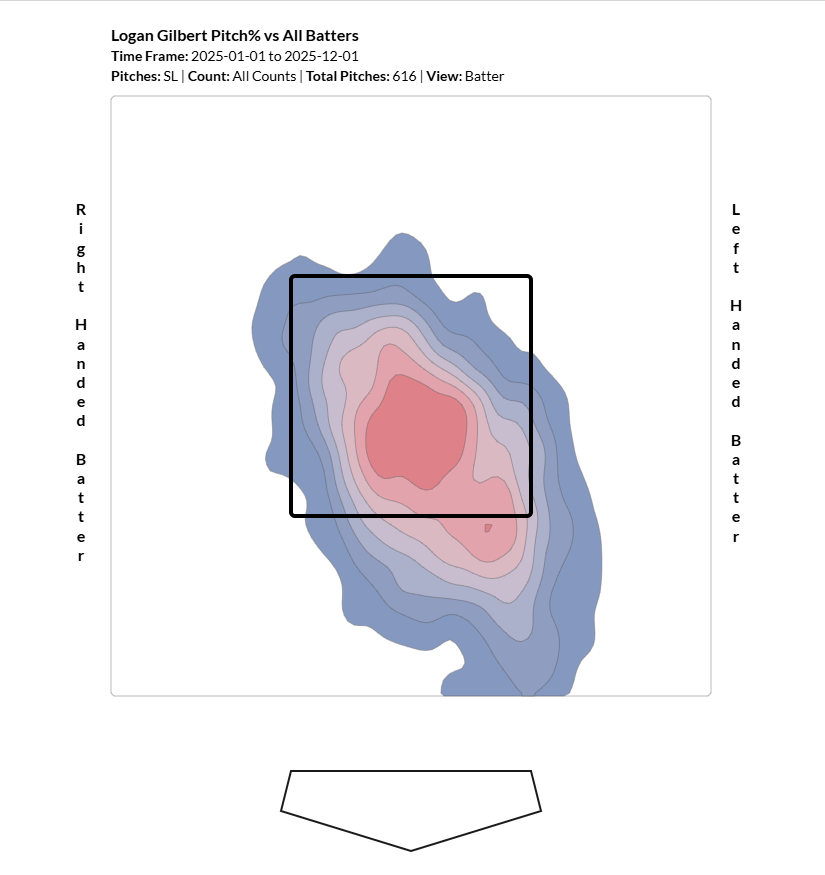
Interestingly, it’s not his fastball that’s the culprit. The flatter approach angle has helped him tone down the damage allowed off his heater. Instead, it’s Gilbert’s slider that’s causing some of these issues. The breaking ball is still generating plenty of whiffs, but when batters put the pitch in play, they’re crushing it. He’s allowed a .719 slug and a .445 expected wOBA with the breaker, which means that even though batters whiff against it more than a third of the time, it’s returned a negative run value this year.
Like the rest of his repertoire, the slider’s physical shape has changed with Gilbert’s lower arm slot. It’s a near perfect gyro slider, but this year, it has slightly less drop and a bit less horizontal break. We’re talking a half inch difference in both directions, but that could be enough to throw off Gilbert’s location with the pitch. Here’s a heat map of his slider locations this year:
Right down the heart of the plate isn’t the ideal location for a slider. If he’s throwing his breaking ball expecting it to drop an extra half inch, those locations could make a little more sense. He just hasn’t made the adjustment to his target yet and continues to leave those breaking balls in a very dangerous part of the zone.
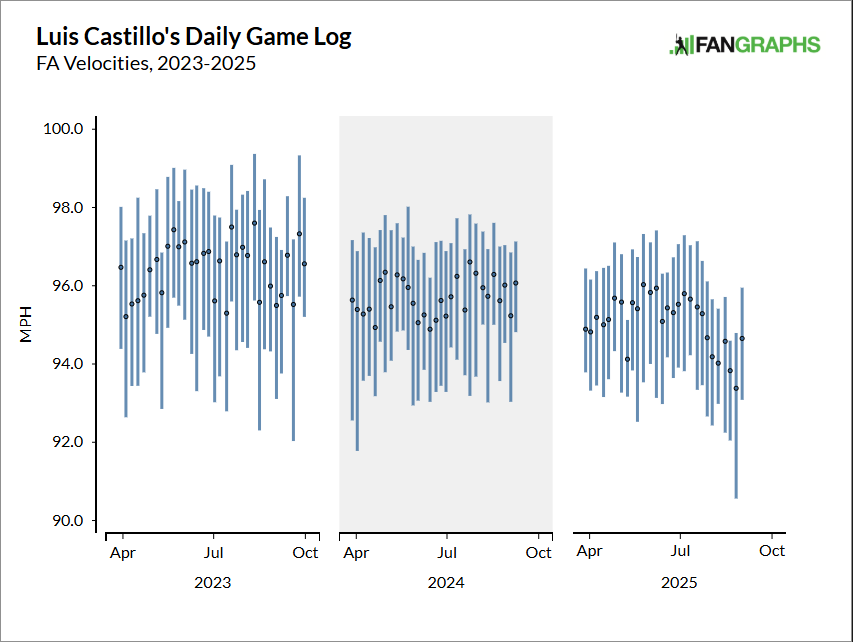
As for Castillo, the issue is pretty easy to spot:
Castillo’s fastball velocity was right around 95 mph for most of the season, not too dramatically different from where it was last year and in 2023. But in August, his fastball was suddenly averaging 94 mph, and his ERA ballooned to 7.31 with the diminished velocity. Castillo’s heater has been his primary weapon since joining the Mariners, a pretty significant change from his time with the Reds, when his changeup was his best pitch. With Seattle, he has emphasized the hard stuff at the expense of the offspeed pitch, but that’s become a liability in these last seven starts with the lost velocity:
Luis Castillo, Fastball Batted Ball Metrics
Time Period
Velocity
wOBA
xwOBA
Hard Hit%
Barrel%
Prior to July 28
95.2
0.323
0.375
51.7%
14.6%
After July 28
94.2
0.620
0.361
61.1%
16.7%
Batters were already hitting Castillo’s fastball pretty well earlier in the season, but he was mostly mitigating the damage. Since his July 28 start, however, his fastball has been getting crushed. He’s responded by throwing his sinker and slider a bit more often, but his sinker gets hit almost as hard as his four-seamer without the potential for swings and misses.
Castillo has been a durable and very effective starter for most of his career, but he’s suddenly facing a future with a diminished version of one of his best weapons. I’m not sure simply changing up his pitch mix to feature more sinkers is the answer either. I think he’s going to need to lean on his secondary pitches a lot more heavily to succeed; his slider is an excellent breaking ball and his changeup is largely unchanged from its peak with Cincinnati. I’m not sure if Castillo can make a switch to his approach in time to salvage the rest of this season, but I’m sure it will be one of the top priorities for the Mariners’ pitching lab this offseason.
For all their recent issues, the Mariners rotation still possesses a tremendous amount of talent. Both Kirby and Gilbert seem like they’ve been victims of some bad luck even as they try to navigate new pitching mechanics. Woo has continued to look fantastic despite running up against some workload concerns. Castillo and Miller have some big question marks going forward, and you’d think that one or both of them would be relegated to the bullpen in a potential playoff series. And for what it’s worth, our Depth Charts projections think the Mariners will have the third-best rotation in baseball for the remainder of the regular season. They’ll need all that talent to show up over these next few weeks as they fight for their spot in a tight AL playoff race.