Archive for Daily Graphings

The Brewers Have Defied The Odds

All season, the Milwaukee Brewers were a band propped up by a stud lead guitarist. The drummer was often off-beat, the singer was pitchy, the rhythm guitarist was clearly only in the band because he was the singer’s kid brother, and the bass player was … well actually, the bass player was pretty sweet, too. But man, could that lead guitar shred. He was the reason the band could book any gig in town, the standout performer every night. His name was Christian Yelich, and on September 10, he fell off the stage — or rather, he fouled a pitch off his kneecap, and suffered a season-ending fracture. As Jay Jaffe wrote at the time, the injury dampened what were already somewhat long playoff odds for the Brewers. But the band pressed on, undeterred by the loss of their star. And lo and behold, they’ve sounded incredible.

On September 5, our playoff odds put Milwaukee’s chances of reaching the postseason at just 5.6%. Those were worse odds than in-division rivals St. Louis and Chicago, and also put them at lower Wild Card odds than New York and Arizona. They won five straight games before losing Yelich, but that still only raised their chances to 25%. Yelich had already accumulated 7.8 WAR, and was in excellent position to win a second-straight MVP award, and he fell out of the picture. Without him, the Brewers had just one other 4 WAR player, and just six 2 WAR players. That lack of starter-quality depth placed them in the back half of all the teams in baseball.
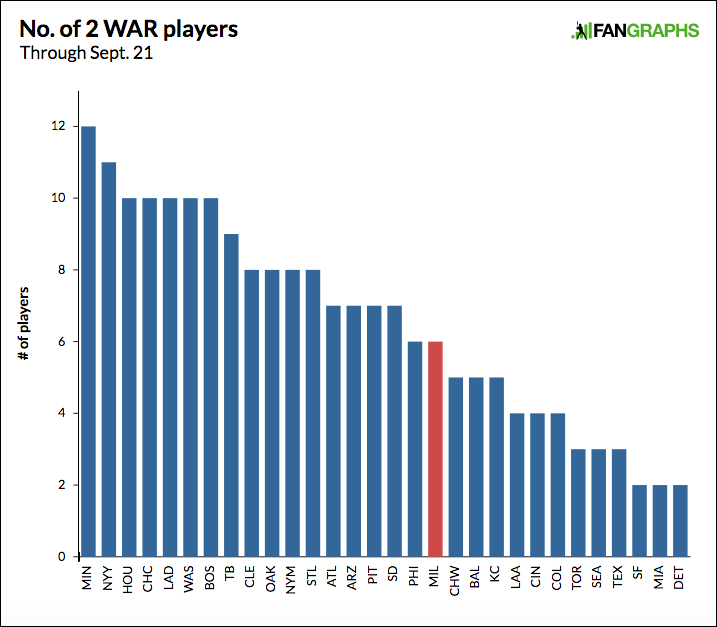
Every team with fewer 2 WAR players than the Brewers has been firmly out of the playoff race for weeks, and a number of teams in front of them — including Boston, Pittsburgh and San Diego — have been out of the race for a while as well. No contender was more poorly equipped to lose a star player for final month of the season than Milwaukee. At least, that was the way it appeared.

That five-game win streak the Brewers were riding when Yelich hit the IL? It ultimately turned into seven games. They finally lost in St. Louis, but rattled off four more wins after that. Then came another loss, this time at San Diego, followed by four more victories. Overall, the Brewers are 15-2 since September 6. In that time, they’ve raised their playoff odds from 5.6% to 97.1%. It’s one of the best runs any team has put together this season, and given the circumstances, it’s come from one of the last teams one would expect.

A portion of the Brewers’ success can certainly be credited to the competition they’ve faced over this stretch. Of their last 17 games, 11 have come against the Marlins, Padres and Pirates. September is a very fortunate time to run into two last place teams and a third non-contender, but to be fair, the Brewers pushed them around exactly the way they should have. They won 10 of those 11 matchups, outscoring their hapless opponents by a jaw-dropping 60-23 margin. Playoff teams are supposed to look dominant against inferior competition, and that’s exactly what Milwaukee was. Their recent hot streak also included three wins in a row over the Cubs and two victories in three games over the Cardinals, the two most direct obstacles to their postseason hopes. Read the rest of this entry »

Checking in on Justus Sheffield

On the surface, Justus Sheffield’s developmental journey looks pretty smooth. He was a first-round pick back in 2014. He’s been a consensus top 50 or so prospect since the Obama administration — never much higher than that, but only rarely lower (Eric and Kiley had him ranked 60th overall and first in the Mariners system preseason; he’s since dropped to 109th and seventh respectively). His velocity has not materially changed. He’s suffered a few bumps and bruises, but nothing ever sidelined him long. Twenty-three years old now, he’s cracked a big league rotation right on schedule for a high school draftee of his caliber.

Statistically, he’s been consistent as well. With the exception of a very poor early season spell this year, he’s maintained an ERA under 3.40 at every minor league stop. His strikeout numbers have almost always hovered just above a batter per inning, his walk totals around 3.5/9. He typically generates more grounders than flies. Every year, a new level; every year, the same successes.

Yet Sheffield’s path has actually meandered a bit. As a high schooler, the lefty was seen as an athlete who would have no trouble throwing strikes and a guy who could develop three plus pitches. Two years into his career, he effectively pocketed one of them, shelving his curve in favor of a hard slider. He also grew quite a bit soon after the draft. Between the added weight, a new pitch mix, and a difficult delivery to repeat, his control suffered and whispers about a bullpen role grew louder even as he continued missing bats. His velocity, while stable in the aggregate, has periodically fluctuated on either side of the low-90s. We’ve learned that Sheffield’s fastball has a very low spin rate (more on that later).

He also got traded twice. On the one hand, Sheffield has had the opportunity to hone his craft under the tutelage of two of the sport’s finest pitching development staffs. On the other, those same clubs ultimately decided to work with different pitchers. As he’s matured, and as his fastball looks less like a bat-misser and his changeup remains a work in progress, he’s increasingly relied on his slider. The soothing consistency in his production belies a conflict between the quality of that slider and the reality that he must throw something else eventually. How that conflict resolves itself will shape his ultimate role.

The bullpen has long been the logical end point here. As a starter, Sheffield sits in the low-90s, touching 95 or a tick better at his strongest. In relief, he’d throw even harder. Pair increased velocity with a slider that earns a whiff nearly a quarter of the time he throws it, and you’ve got a late-inning reliever. Lefties, even ones with serviceable changeups, usually peak as eight-inning guys out of the pen. But on paper, Sheffield’s cocktail is good enough to close. Read the rest of this entry »


Sunday Notes: Luke Carlin Caught Greg Maddux and Trevor Hoffman

Luke Carlin learned a lot in his rookie season, and the lessons began in full force when he made his MLB debut on May 10, 2008. Adorned in the tools of ignorance and a San Diego Padres uniform, Carlin caught both “The Professor” and a closer who entered to the sound of “Hell’s Bells.”

An orientation session with the former preceded his first game. It was then that the Northeastern University graduate discovered that being familiar with Greg Maddux is one thing; understanding how he went about schooling big-league hitters is another.

“When I got called up, Buddy Black was like, ‘Hey, make sure you talk to Greg, because you’re going to catch him on Saturday,’” recalled Carlin. “So I had a day or two to get with Greg, but the funny thing was, everything I’d learned about game-calling and reading swings was basically useless until I started watching video with him. He had a simple, deliberate process. Greg was patient with me, making sure that I was on his page as much as possible.”

Carlin, who now manages in the Cleveland Indians system, used military and football analogies to describe Maddux’s tactical-planning acumen. And going into a game with nuanced knowledge of his opponent’s strengths and weaknesses was only part of his M.O. Read the rest of this entry »


Kyle Lewis’s Strong First Impression

For teams that have been eliminated from playoff contention, September is a time for youngsters and debuts. Giving prospects a few weeks of major league experience is one of the great side effects of expanded rosters during the last month of the season. The Mariners have been auditioning their young talent since June — they’ve rostered 67 different players this season, a major league record — but the group of September call-ups were exciting nonetheless. After the Arkansas Travelers were eliminated from the Texas League playoffs, the Mariners promoted a group of four players from their Double-A affiliate: Donnie Walton, Art Warren, Justin Dunn, and Kyle Lewis.

Dunn and Lewis were the headlining names of this squad. Dunn had been ranked towards the back of a few top-100 prospect lists after his breakout last season. Lewis was a much bigger surprise. A first-round draft pick in 2016 — Jerry Dipoto’s first draft after taking over as Mariners GM in late 2015 — Lewis’s professional career was derailed almost as soon as it started. A nasty collision at home plate practically destroyed his knee after just 30 games in the minors. That injury sapped him of much of his athleticism and mobility for more than a year and he wasn’t fully healthy again until 2018. In that time, he tumbled down prospect lists and soon became an afterthought in an organization desperate for talent on the farm. Read the rest of this entry »


Gerrit Cole Is Meeting Old Expectations

We probably don’t need to re-litigate the trade that sent Gerrit Cole from the Pirates to the Astros two years ahead of free agency. This post isn’t about what the Astros did to transform Cole or what the Pirates failed to do. This post is, to a certain extent, about who Gerrit Cole was, and who he is now, but it is less about how he’s changed and more about how he’s the same.

Every pitcher makes adjustments to try and get better and be more effective at getting hitters out. Some work better than others. Pitchers make these changes while staying in the same organization or while jumping to a different team. Injuries can sometimes derail development, as can trying strategies that just don’t work out. We know Cole wasn’t great with the Pirates in 2016 and 2017, and he’s been great with the Astros in 2018 and 2019. Hopefully this post serves as a reminder of how great Cole was in 2015 and how what he’s doing now is meeting incredibly lofty expectations his performance set for himself five seasons ago.

In 2015, Cole put up a 2.66 FIP, a 2.60 ERA, and 5.1 WAR, ranked 10th among all pitchers and first among pitchers 25 years old and younger, beating out Madison Bumgarner, Sonny Gray, Shelby Miller, and Carlos Martinez. Cole was just 24 years old at the time. To find some age-based comparisons, I looked at 24-year-old starters since 1990 within half a win of Cole. Read the rest of this entry »


The 2019 NL Cy Young Voter Guide

Over in the American League, there’s a pretty clear top tier of Cy Young contenders in Justin Verlander and Gerrit Cole, followed by a solid group of candidates likely to garner down-ballot support. In the National League, there looks to be a top tier of Max Scherzer and Jacob deGrom followed by a cascading set of secondary candidates, but that first look doesn’t quite tell the entire story.

To provide some idea of the statistical disparities voters must contend with when making their decision, I looked at our FIP-based WAR as well as the RA9-WAR also available here at FanGraphs, Baseball-Reference’s WAR, and Baseball Prospectus’ WARP. I included for consideration any player in the top five of any of those lists. That search returned nine pitchers for the potential five slots on a Cy Young ballot. Those players are listed below, with a mix of traditional and advanced statistics:

NL Cy Young Candidates
Max Scherzer Jacob deGrom Stephen Strasburg Walker Buehler Patrick Corbin Hyun-Jin Ryu Sonny Gray Mike Soroka Jack Flaherty
IP 166.1 190 196 171.1 191.2 168.2 170.1 169.2 182.1
K% 34.8% 31.6% 29.6% 28.4% 28.4% 22.1% 28.9% 19.9% 29.5%
BB% 4.8% 5.7% 6.7% 4.4% 8.1% 3.6% 9.6% 5.7% 7.2%
HR/9 0.87 0.90 1.06 0.95 0.99 0.80 0.85 0.69 1.23
BABIP .323 .288 .277 .291 .290 .279 .258 .274 .250
ERA 2.81 2.61 3.49 3.15 3.10 2.35 2.80 2.60 2.96
ERA- 62 63 77 75 69 56 62 58 69
FIP 2.36 2.79 3.29 2.87 3.35 3.11 3.38 3.43 3.62
FIP- 52 64 72 65 74 71 74 78 83
WAR 6.5 6.2 5.3 5.0 4.9 4.4 4.3 4.0 4.1
Blue=1st, Orange=2nd, Red=3rd

We have Scherzer and deGrom in first and second by about a win over the next-best candidate, with deGrom pitching tonight. After those two, we have a lot of innings from Stephen Strasburg and Patrick Corbin, and fewer innings, but better peripherals, from Walker Buehler. After those three, we have four candidates who haven’t thrown a ton of innings, but all have much lower ERA’s than FIPs. As for how these candidates came to be considered, here are their WAR totals:

NL Cy Young Candidates’ WAR
Max Scherzer Jacob deGrom Stephen Strasburg Walker Buehler Patrick Corbin Hyun-Jin Ryu Sonny Gray Mike Soroka Jack Flaherty
WAR 6.5 6.2 5.3 5 4.9 4.4 4.3 4 4.1
RA/9 WAR 6 6.6 5.6 3.8 5.6 6.1 6 6.1 6.0
BRef 6 6.3 5.7 2.1 5.9 4.5 5.7 5.7 4.9
BPro* 6.0 7.2 7.8 5.4 5.6 5.0 5.2 4.7 6.2
wAVG 6.2 6.6 6.3 4.5 5.4 4.9 5.1 4.9 5.3
Blue=1st, Orange=2nd, Red=3rd
wAVG takes WAR plus the average of RA9-WAR and BRef WAR plus BPro and divides the total by three.
*Baseball Prospectus was updated late Friday to include Thursday starts for Flaherty and Soroka and those numbers have since been updated here.

Read the rest of this entry »


Which Hitter is Most 2019?

When you think of 2019 baseball, there’s probably a definite picture in your mind. Contact is rare but dangerous. Home runs fly out of the park at record levels on fly balls, and line drives are smashed left and right. Strikeouts are abundant, baserunners scarce. And when those runners do get on, they don’t steal very frequently, leading to a station-to-station game.

That’s a great aggregate — but who do you picture when you picture 2019 baseball? Maybe you see Mike Trout or Christian Yelich in your mind’s eye, but that’s not really right. They might be the best of 2019, but they’re certainly not the embodiment of 2019. Yelich and Trout don’t have strikeout problems that sap their on-base percentage. They hit for average and for power; heck, Yelich ended his season batting .329, and it’s not out of the question that he’ll win the batting title. That’s about as far from typical 2019 as it gets.

Not only that, but they’re both fast boys, even if Trout doesn’t steal as much as he used to. Yelich was on pace for a 50/30 season before his season-ending injury, and the fact that it would be the first such season in history should tell you that he’s not anything approaching average. Trout and Yelich are the face of baseball in 2019, but they’re not a fair representation of it.

If it’s not the game’s stars, could it be some kind of boom-or-bust slugger, a watered-down version of Nelson Cruz who sends balls out of the park often enough to offset a cover-your-eyes strikeout rate? Oakland’s Khris Davis, the .247 batting average king, is having too down of an offensive year to qualify, but what about Justin Smoak, another true-outcome-centric batter who would just as soon take a walk as swing at a pitch? He’s not really representative either! He walks 16.3% of the time, double the league average — that’s clearly no good.

To answer this specifically and arbitrarily posed question, I settled on some rules. I chose average, on-base percentage, slugging percentage, walk rate, strikeout rate, home run rate, and stolen bases per plate appearance as the statistics that I’ll use to define average. You could make an argument that including all triple-slash stats is focusing too much on batting lines, or that some batted ball data should be folded in, but for me, those don’t stand up. Read the rest of this entry »


The Marlins Extend Their Shortstop

On Wednesday, Miguel Rojas and the Miami Marlins agreed on a two-year extension, covering Rojas’s final year of salary arbitration and a year of free agent eligibility. The exact financial terms are undisclosed, but it appears that the contract’s guarantee is roughly in the $10-million range. The Marlins also get an option to get a third year from Rojas in 2022.

Miami currently stands in last place in the National League in WAR for hitters at 2.3. Your offense doesn’t reach those depths of sadness without being able to point your fingers at a lot of players, but Rojas is one of the few in the lineup who doesn’t shoulder a share of the blame. As of Thursday morning, Rojas has hit .285/.335/.383 in 2019, good for 1.9 WAR. He hasn’t been able to leverage the hitter-friendly environment for a boost in home runs — at five homers, he looks an easy bet to miss 2018’s total of 11 — but he has established himself as a top-tier defender this season. Read the rest of this entry »


The Athletics’ Shrewd July Is Paying Dividends

Another year, another Oakland surprise.

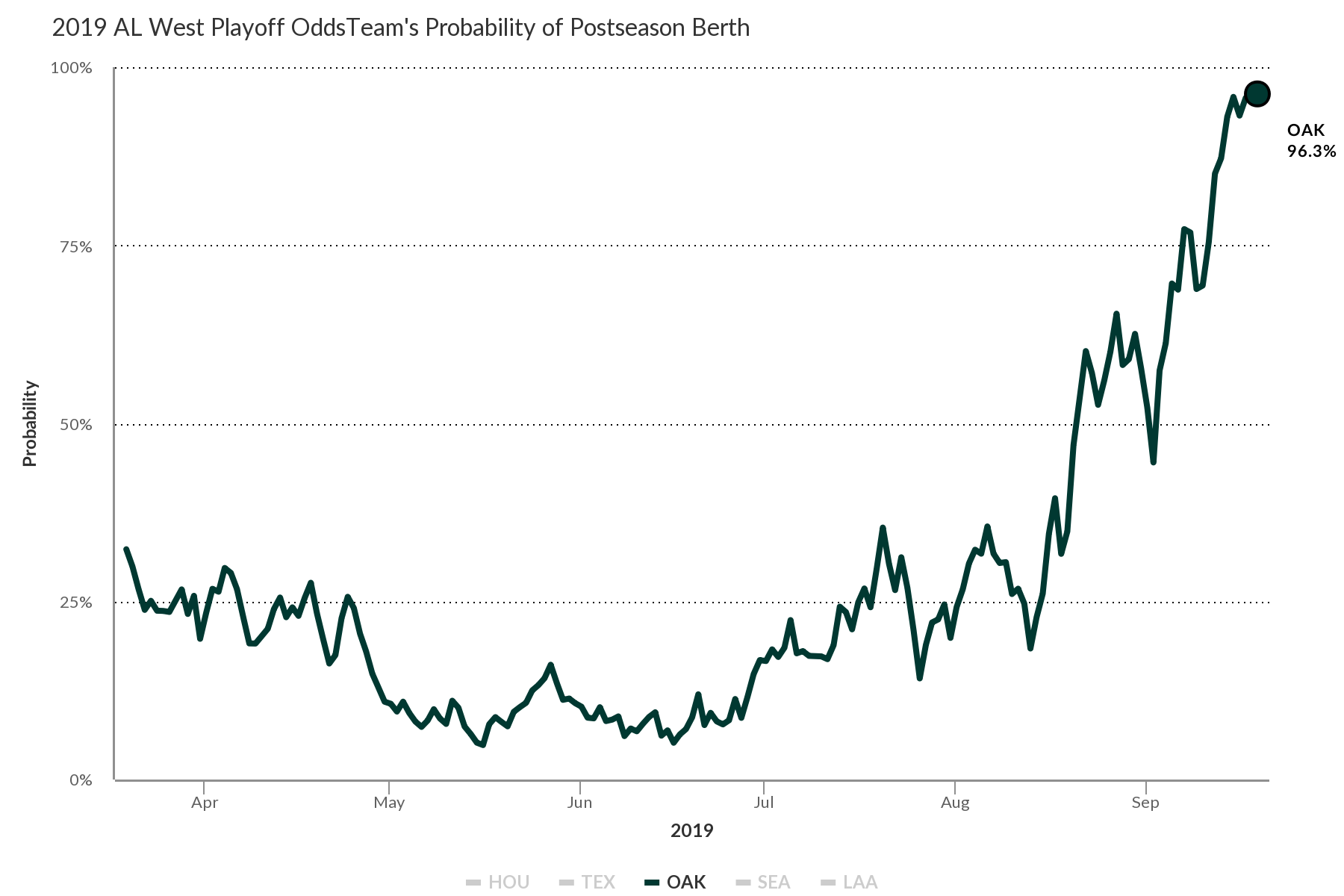
In July, I wrote about how the Athletics deserved your attention, again. After starting the season 29-28 through the end of May, the A’s got hot. The team is 62-33 since, tied with Houston for the best record in the American League in this stretch. As the team racked up wins, their playoff odds grew, increasing from 10% on June 1 to 96% today. This is a trend you like to see if you’re an A’s fan:

Oakland is still not quite a lock to make the playoffs, but with a two-game lead over the Rays for the first Wild Card spot and a two-and-a-half game lead over the Indians for a playoff spot overall, you have to like their chances.

Incredibly, the 2019 A’s are behaving almost exactly like the 2018 A’s. As I mentioned in my July piece, coming into games on June 1, both the 2019 and 2018 squads were 29-28. After a scorching 68-37 finish, the 2018 team ended their campaign with 97 wins, the exact pace the 2019 A’s are on now.

Earlier this week, I wrote about Kolby Allard being the best pitcher traded at the trade deadline by WAR. Today, though, I want to talk about the team that has added the most post-August pitching value via July trades. It’s hard to think that Oakland would be in this position today without the contributions of three July additions.

For most of this season, the A’s needed pitching help, even despite generally positive results from the group of arms they rostered on Opening Day. Frankie Montas was suspended 80 games after testing positive for a PED in June, Sean Manaea spent the majority of the year on the Injured List recovering from shoulder surgery, and top pitching prospects Jesus Luzardo and A.J. Puk weren’t promoted to the majors until fairly recently. (They’re both in bullpen roles, partially out of necessity and partially because the rotation upgrades have been solid.) As a result, the A’s made three trades for pitchers in July: a deal with the Royals for Homer Bailey, another, separate deal with KC for Jake Diekman, and a deal with the Reds for Tanner Roark. Read the rest of this entry »


The Irresistible Pull of a Yastrzemski in Fenway

A Yastrzemski hit a home run in Fenway Park on Tuesday night, and if you’re any kind of student of baseball history, you might have felt some goosebumps. Two hundred miles away in the Yankee Stadium press box, I certainly did, because I’m old enough to remember the final years of the career of Carl Yastrzemski, a former Triple Crown winner and inner-circle Hall of Famer who retired in 1983 while owning the all-time lead in games played (3,308, since surpassed by Pete Rose) and the number eight spot on the all-time hit list (3,419, now ninth). I also recall the flicker of promise that was his son’s professional career in the mid-1980s, and the sad news that he passed away in 2004 at the too-young age of 43. With all that in mind, I can’t help but pull for Mike Yastrzemski, a 29-year-old rookie who on May 25 of this season became the first grandson of a Hall of Famer to play in the majors.

I was hardly alone. By all accounts, the youngest Yaz — who lists at nearly the same size (5-foot-11, 180 pounds) as his grandfather (5-foot-11, 175 pounds) and swings from the left side — was welcomed with open arms for his Fenway debut. He strolled across the outfield grass with “Poppy Yaz” prior to the game, receive a warm ovation upon coming to the plate to lead off the contest, and, in the fourth inning, sent a Nathan Eovaldi fastball 401 feet to center field:

The home run made Yastrzemski the first Giants rookie in 47 years to reach 20 homers (Dave Kingman did it in 1972) and just the second Giant to hit 20 in the past four seasons (Kevin Pillar beat him by 16 days). The blast and the hoopla that surrounded his debut were the highlights of what became a grueling, 15-inning, 24-pitcher September slog; it lasted five hours and 54 minutes, which in single-game terms is about as long as his grandfather’s career. Yastrzemski made a strong effort to bring it to an end earlier by leading off the 14th inning with a ground-rule double, his only other hit in eight trips to the plate. His Giants teammates stranded him, though they did go on to win, 7-6. Read the rest of this entry »