Archive for Daily Graphings

The 2019 Replacement-Level Killers: Catcher

Josh Phegley hasn’t been great as the A’s starter, either at the plate or behind it. (Photo: Keith Allison)

In a race for a playoff spot, every edge matters. And yet all too often, for reasons that extend beyond a player’s statistics, managers and general managers fail to make the moves that could improve their teams, allowing subpar production to fester at the risk of smothering a club’s postseason hopes. In Baseball Prospectus’ 2007 book It Ain’t Over ‘Til It’s Over, I compiled a historical All-Star squad of ignominy, identifying players at each position whose performances had dragged their teams down in tight races: the Replacement Level Killers. It’s a concept I’ve revisited on several occasions, both at BP and beyond; last year, I brought it to FanGraphs in an expanded format. With the July 31 trade deadline looming, it’s once again time to point out some of the bigger holes at each position among contenders, and it’s worth noting that this time, there’s no August waiver period for teams to fall back on.

When it comes to defining replacement level play, we needn’t be slaves to exactitude. Any team that’s gotten less than 1.0 WAR from a position to this point might be considered fair game, even if in some cases that means an above-average starter and ghastly backups. Sometimes, acceptable or even above-average defense (which, of course may depend upon which metric one uses) coupled with total ineptitude on offense is enough to flag a team. Sometimes, a team may be well ahead of replacement level, but has lost a key contributor due to injury; sometimes, the reverse is true, but the team hasn’t yet climbed above that first-cut threshold. As with Supreme Court Justice Potter Stewart’s definition of hard-core pornography, I know replacement level when I see it. Read the rest of this entry »



Changes in WAR and Playing Time Based on Age Since 1980

In my piece last week discussing the age-related demographics of the Trade Value Series, I included multiple graphs showing how baseball has changed over the years with respect to the quality and quantity of the contributions of younger and older players in the game. This is is one of the graphs from that piece:

This graph, and the others like it in the post, did a good job of showing age-related changes. But I thought there might be interest in the data underlying those graphs, data that would have been much too cumbersome to include in the piece. Below is the data that drove those graphs; it even breaks the ages down into smaller subsets. The numbers in all of the headers below represent player ages.

Read the rest of this entry »


Root, Root, Root for the Home Team: Tales from a KBO Cheer Squad

Left to right: Lee Da-Yeon, Bae Soo-Hyun, Jeong Young-Seok, and Yun Yoanna (Photo by Sung Min Kim/FanGraphs)

In an interview with Great Big Story, Kerry Maher, a Youngsan University professor and Lotte Giants superfan, described the difference between Major League Baseball and the Korea Baseball Organization (KBO) fan atmospheres like this: “To me, MLB is like an opera and the Lotte Giants in the Sajik [Stadium] is rock ‘n’ roll.” For those who have experienced sitting in the stands of both leagues’ ballparks, it probably seems like an apt comparison.

If you’ve followed my work, you’re likely aware of the KBO’s cheering culture. As I wrote when I interviewed several foreign-born players currently playing in the KBO, the league’s fan experience can strike those who aren’t from Korea as somewhat unusual compared to the quieter crowds of MLB. For starters, each KBO team has their own cheermaster and cheerleaders. Last week, I went over to the Incheon SK Munhak Stadium to talk to the SK Wyverns’ cheermaster and three of their cheerleaders. Read the rest of this entry »


Sunday Notes: San Francisco’s Shaun Anderson is an Anomaly Who Attacks

A few bumpy outings aside, Shaun Anderson has had a solid rookie season with the San Francisco Giants. Since debuting in mid-May, the 24-year-old right-hander has won three of five decisions, and on six occasions he’s gone at least five innings while allowing just a pair of runs. Overall, he has a 4.87 ERA and a 4.37 FIP in 12 starts.

Anderson is comfortable on a big stage. He pitched in the College World Series while at the University of Florida, and last summer he took the mound in the All-Star Futures Game. The former Gator came into this year ranked eighth on our Giants Top Prospects list.

He was originally Red Sox property. A third-round pick in 2016, Anderson was shipped to San Francisco thirteen months later, along with now-19-year-old righty Gregory Santos, in exchange for Eduardo Nunez. The days-before-the-trade-deadline deal brought Boston a player who helped them win a World Series — Nunez has since been DFA’d — while San Francisco got an up-and-comer who doesn’t fit a conventional mold.

College relievers rarely become big-league starters, and this is an era where pitchers typically pump gas and miss a lot of bats. Anderson is an anomaly in both respects. The erstwhile closer has a pedestrian 92/93mph heater, and he’s punching out just 5.7 batters per nine innings.

Asked about his approach, Anderson described it as “attack.” Undaunted by big-league hitters in the box, he’s all about mixing and matching, and working down in the zone. Read the rest of this entry »


David Fletcher, Anachronism

The list of batters who go down in the count 0-1 least often mostly makes sense. Mike Trout and Cody Bellinger are in the top five, due to a combination of their sterling batting eyes and pitchers staying away from them. Justin Smoak, Mike Moustakas, and Anthony Rizzo comprise the rest of the top five, and even if they don’t quite have the fearsome power of Bellinger and Trout, they have enough power that pitchers often pitch them carefully. Smoak has the lowest ISO of the five at .205. Pitchers are being rationally cautious.

Number six on the list will make you question what you think you know about first strike rate. David Fletcher, the Angels infielder, is number six, and he couldn’t look any more different than the guys ahead of him. I don’t mean physically, though that’s true as well — at 5-foot-10 and 175 pounds, Fletcher isn’t an imposing power presence. No, what I mean is that Fletcher plays baseball in a style that can best be described as a throwback. Not only that, he’s succeeding, putting together a second consecutive solid major league season despite a game that would look more at home in the 1980s than in 2019.

If Tyler O’Neill is one extreme of the game, David Fletcher is the other. Think of a stereotype about baseball in 2019, and Fletcher probably defies it. Strikeout rates inexorably on the rise? Fletcher is striking out 8.3% of the time this year, the lowest rate among qualified hitters. Big swings and big whiffs? Fletcher makes contact on a dizzying 92.1% of his swings. The world gone mad for home runs and power? Fletcher’s .126 ISO is 12th-lowest in baseball this year, and that comes largely from his 20 doubles; he hits home runs on 5.6% of his fly balls, the sixth-lowest rate in the majors.

It’s easy to read the headlines in 2019, to see Pete Alonso hitting balls to Andromeda and Christian Yelich crushing home runs on nearly a third of his fly balls, and think that the only way to succeed in baseball is via home runs. There’s some truth to that, honestly — as pitchers throw harder and harder, stringing together a series of hits gets increasingly challenging, and a home run lets the offense skip all of that. That’s not a rule, though — it’s merely the path of least resistance. Read the rest of this entry »


The Trade Value Series Skews Young (Again)

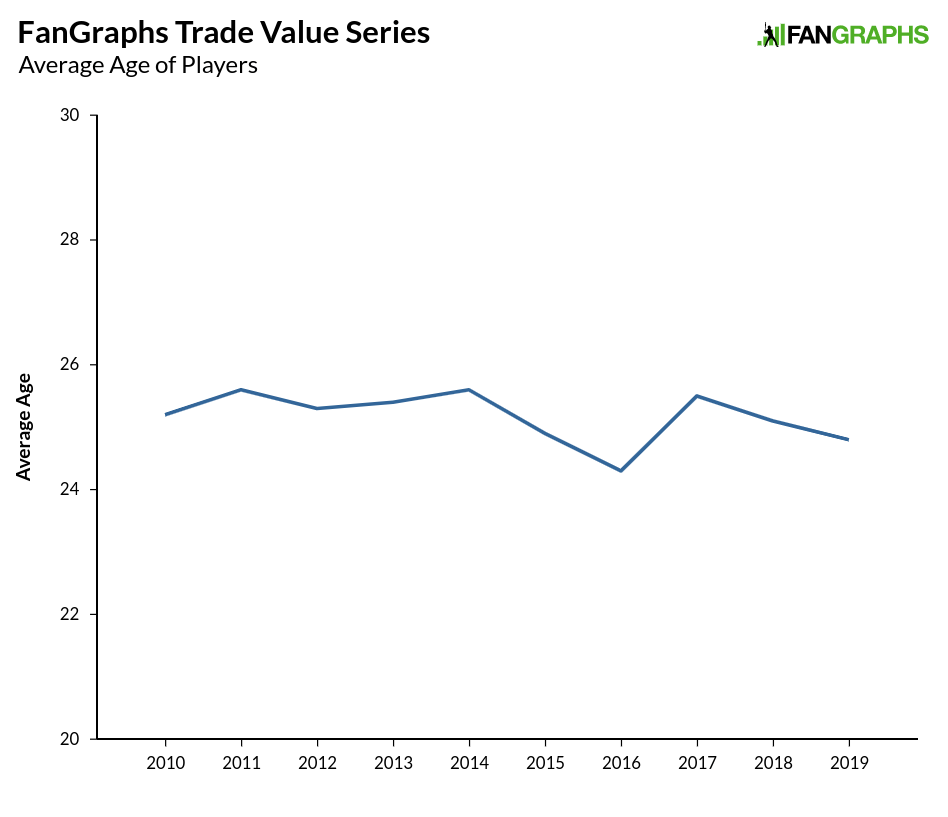
Today, we wrapped the 2019 Trade Value Series. The series always offers a number of a interesting insights into the industry’s thinking leading up to the deadline, and serves as a reminder that younger players tend to have considerably more trade value than their older peers. There are multiple reasons for that phenomenon. First, younger players are cheap. Owners and players have agreed to a system that pays players around half a million dollars for the first three seasons of their major league careers, followed by another three or four years of arbitration during which salaries increase gradually, but are only guaranteed for a single season at a time, limiting risk for teams. Then, after six full seasons in the big leagues, players hit the free agent market, where every team is welcome to bid for a player’s services. As a result, players who reach free agency tend to have much higher salaries than their younger teammates. It stands to reason when determining trade value, then, that, assuming an equal level of play from a younger and an older player, teams would value the younger player more highly because said player is cheaper.

The logic above can be seen pretty clearly in this year’s Trade Value Series, as well as those of the past decade. The graph below shows the average age of the players featured in the Trade Value Series over the last 10 years, with the first eight installments of the exercise conducted by Dave Cameron and the last two performed by Kiley McDaniel.

Read the rest of this entry »


This Week’s Prospect Movers

Below are some changes we made to The BOARD in the past week, with our reasons for doing so. All hail the BOARD.

Moved Up

Ronny Mauricio, SS, New York Mets:
We got some immediate feedback on Monday’s sweeping update, which included more industry interest in Mauricio. The average major league swinging strike rate is 11%. Mauricio has a 12% swinging strike rate, and is a switch-hitting, 6-foot-4 teenager facing full-season pitching. It’s common for lanky teenagers to struggle with contact as they grow into their frames, but Mauricio hasn’t had that issue so far.

Oneil Cruz, SS, Pittsburgh Pirates:
One of us was sent Cruz’s minor league exit velocities and they’re shockingly close to what Yordan Alvarez’s have been in the big leagues. Of course, there remains great uncertainty about where Cruz will end up on defense, and hitters this size (Cruz is listed at 6-foot-7) are swing and miss risks, but this is a freakish, elite power-hitting talent.

Marco Luciano, SS, San Francisco Giants:
This guy has No. 1 overall prospect potential as a shortstop with 70 or better raw power. He belongs up near Bobby Witt, who is older but might also be a plus shortstop while we’re still not sure if Luciano will stay there.

George Valera, OF, Cleveland Indians:
Valera is torching the Penn League at 18 and a half years old, and we’re not sure any high school hitter in this year’s draft class would be able to do it. His defensive instincts give him a shot to stay in center field despite middling raw speed, and his swing should allow him to get to all of his raw power, so it becomes less important that his body is projectable. He would have been fifth on our 2019 draft board were he playing at a high school somewhere in the U.S., so he’s now slotted in the between JJ Bleday and C.J. Abrams on our overall list. Read the rest of this entry »


The A’s Deserve Your Attention, Again

On this date one year ago, the baseball season was in the midst of its brief halt for the All-Star Game in Washington, D.C. For the Oakland Athletics, it felt as if the season was just getting started. Through the end of May, the team had merely been average, at least by the most traditional statistic: win-loss record. On May 31, the A’s were 29-28. But a 68-37 record (a 105-win pace) over their final 105 games turned a decent season into an excellent one. The A’s finished 97-65, the franchise’s best record since 2002, en route to capturing the second AL Wild Card spot.

In 2019, the Athletics are writing the script to a sequel. On May 31, the team was again 29-28, but since that time, their 26-13 record is the second-best in the American League and the fourth-best in baseball overall. During this stretch, their pitching has been remarkable:

Best Pitching Staffs Since June 1
Team Innings ERA FIP xFIP K% BB% WAR
Nationals 331.0 3.43 3.67 4.07 24.9% 7.0% 6.8
Athletics 351.2 3.63 3.93 4.58 19.9% 6.5% 6.5
Dodgers 358.1 3.09 3.67 3.68 26.2% 6.2% 5.9
Rays 379.2 4.08 3.85 3.82 25.8% 7.2% 5.6
Indians 331.0 3.70 4.10 4.09 26.6% 7.6% 5.2

Read the rest of this entry »


Yankees Trade for Terrance Gore and His Unusually Poor Stolen Base Numbers

Terrance Gore’s job is to come into games as a pinch-runner and steal bases. He might want to do more, but at the major league level, baserunning is his calling. Entering this season, Gore had totaled one hit, one walk, and one HBP in his career, including the postseason. Despite almost never reaching base, Gore has 32 career steals and had been caught just five teams before this year. Of his 61 appearances before 2019, 55 have come in September, when rosters are larger, or in the playoffs, when fewer pitchers are required. The Royals gave Gore a shot at slightly more playing time this year, but ultimately designated him for assignment. After he cleared waivers, he was traded to the New York Yankees for cash considerations, so Gore might once again loom large in September and the postseason.

What’s weird about Gore this season is that his stolen base numbers aren’t very good. He’s 13-of-18 on steals, and while that might be just fine for most players, when stealing bases is a huge part of your job, it’s really not that great. His sprint speed is one of the best in the game, so it’s pretty curious that he’s been caught stealing five times. Maybe teams are onto him, though that never stopped him before. Let’s take a closer look.

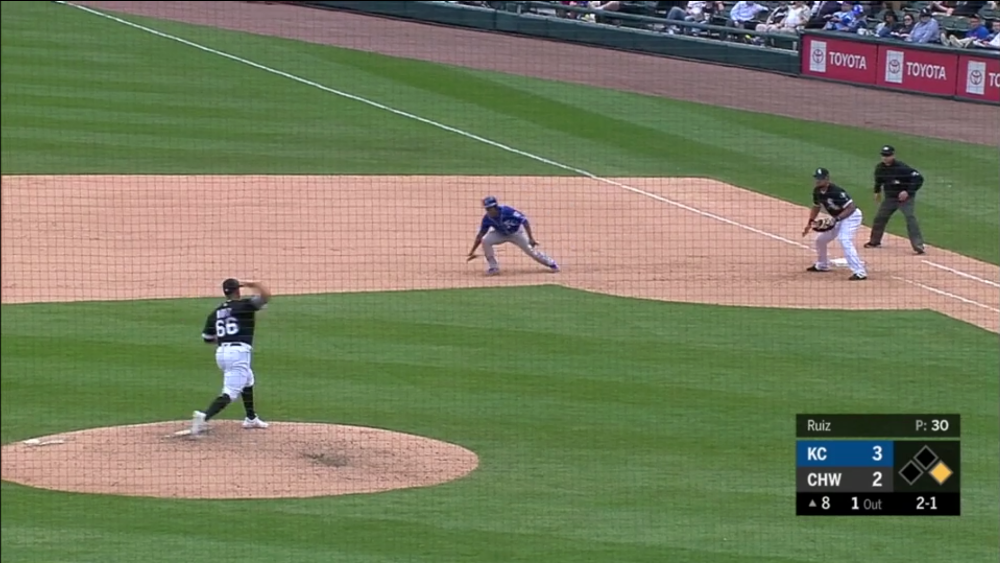
Gore’s first caught stealing happened on April 17 in the eighth inning. He didn’t get caught stealing so much as he got caught leaning as the photo shows below.

Gore’s next misadventure on the basepaths happened against the Yankees on April 21. Second one same as the first. Read the rest of this entry »


The Rangers Should Make a Major Minor Move

In a year not otherwise flowing with surprises on the team level, the Texas Rangers have been a big one. A 50-46 record isn’t one that’s dominating the American League or the AL West but it’s good enough that if the season ended today, the Rangers would finish 16 games ahead of their preseason ZiPS projections on a seasonal basis. One of the players most responsible for Texas’s surprise prediction-rebellion is Mike Minor. At 8-4 with a 2.73 ERA — even his 3.82 FIP is just fine in 2019’s Sillyball environment — Minor made his first All-Star Game. From missing two seasons with shoulder problems to becoming a successful Royals reclamation projection to growing into a solid No. 2 starter to being named an All-Star, Minor’s emergence has been one of the best stories in baseball in 2019. And sports being cruel sometimes, the Rangers may very well be best-served by allowing Minor to wear another uniform in the denouement.

Coming into 2019, the computer’s reasons for Rangers skepticism were straightforward: Texas had some interesting, top-tier talent but also a stunning lack of depth around the diamond. Not a single Ranger had a three-WAR season in 2018 and the team’s WAR leader, Jurickson Profar, was an Oakland Athletic. Even the team’s most interesting talent had questions, whether it was Joey Gallo‘s batting average, Jose Leclerc‘s sustainability, Rougned Odor alternating between being Jeff Kent and Clark Kent, or Nomar Mazara’s puzzling lack of development. On some level, ZiPS wasn’t wrong, as the Rangers still lack depth, but it missed out on the magnitude of their good performances. Mike Minor and Lance Lynn look like pitchers you’d actually like pitching in a playoff game, Joey Gallo has spent much of the season challenging the Alomar Line instead of the Mendoza, and Hunter Pence is having one of the wildest, out-of-nowhere offensive comebacks that I can remember.

So, given all these happy surprises, which have led to real playoff contention, why should they explore a Minor trade? Read the rest of this entry »