Archive for Daily Graphings

Where are the 60 Home Run Hitters?

There have been a lot of homers in baseball this season. Perhaps too many, as Jay Jaffe wrote back in June. At its current pace, the majors will average 227 home runs per team, clobbering the 2017 mark of 204 and coming in way ahead of last year’s 186 mark. When Barry Bonds broke the single-season home run record in 2001, the major league team average was 182. When McGwire and Sosa dueled, it was 169. When Roger Maris broke Babe Ruth’s record, the team average was 152. So how is it that we have a 50% increase in home runs from the time Maris hit 61, and a 22% increase over last year, and yet still don’t have a player likely to hit 60 homers?

Here are this year’s home run leaders through Tuesday’s games along with their projected total, their current pace based on team games, and the number of homers per 700 plate appearances (which will be more important later):

MLB Home Run Leaders
Name PA HR Projected Pace HR/700 PA
Cody Bellinger 401 34 50 57 59
Christian Yelich 388 33 47 56 60
Mike Trout 402 30 48 51 52
Peter Alonso 394 30 45 52 53
Edwin Encarnacion 377 28 44 49 52
Josh Bell 408 27 39 47 46
Hunter Renfroe 304 27 43 47 62
Franmil Reyes 314 26 40 45 58
Max Muncy 381 25 38 42 46
Freddie Freeman 426 25 38 42 41
Mike Moustakas 382 25 38 42 46
Jorge Soler 395 25 37 42 44
Through July 16, 2019

Projections, which are admittedly somewhat conservative, expect there to be one 50-homer hitter at the end of the year (Cody Bellinger), as well as a handful of players with at least 40 homers. Even if we go by pace and the hitters hit exactly was well as they have up to this point, Bellinger and Yelich will have great seasons but fall a few homers shy of 60. Yelich and Hunter Renfroe are the only players on a 60-homer pace if they were to get to 700 plate appearances. While all the home runs being hit might make it seem like a 60-homer season should happen, the sheer number of homers in the game don’t actually dictate what the league leader might do. The graph below shows the average number of home runs by team per year along with the home run leader for that season: Read the rest of this entry »

Tyler O’Neill is Everything All at Once

On an extremely superficial level, Tyler O’Neill looks like any other high-level prospect bouncing between the minors and the majors. After posting a 107 wRC+ in his first shot at Triple-A in 2017, he’s been excellent there over the past two years, putting up a combined 143 wRC+ in 427 PA. He’s been above-average in parts of two seasons in the majors — a 121 wRC+ over 232 PA. If the Cardinals didn’t have such an outfield logjam, he might have earned more major league playing time; indeed, the team traded Tommy Pham last summer in an attempt to find more plate appearances for O’Neill and Harrison Bader.

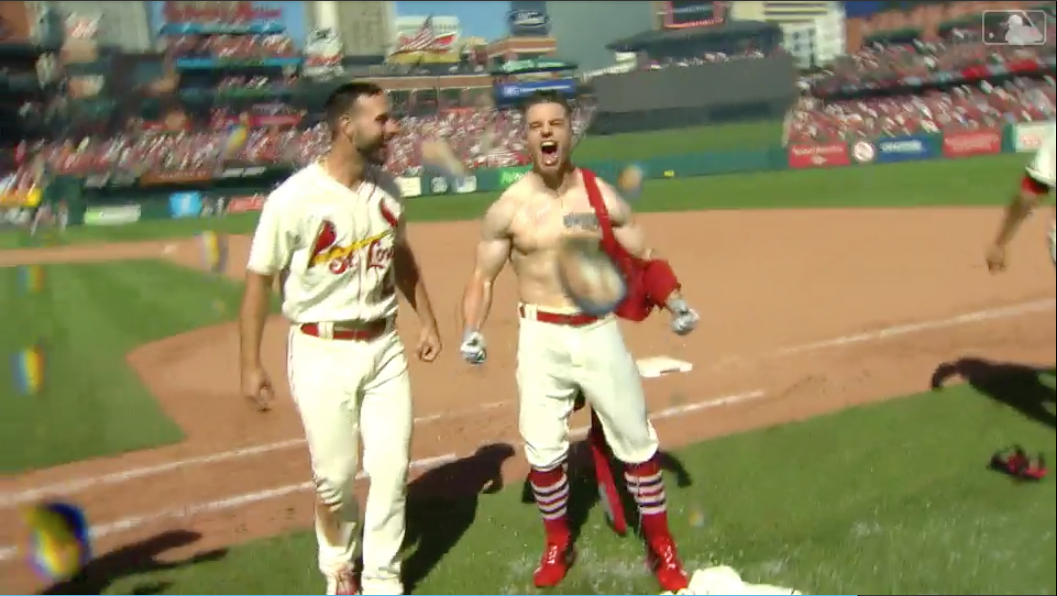
Look even slightly closer, though, and the narrative of O’Neill as average baseball player falls apart. Here is O’Neill, after his teammates tore off his jersey and undershirt following a walk-off home run. Even through the water droplets on the camera lens, his bulk is obvious:

How average can someone with biceps the size of most human beings’ legs be? Read the rest of this entry »


Justin Turner Talks Hitting

Justin Turner jumpstarted his career following a swing change prior to the 2014 season. The Los Angeles Dodgers third baseman has spoken on the subject several times, with no shortage of stories chronicling his journeyman-to-slugger evolution.

That doesn’t mean that Turner doesn’t have more to say about hitting. He still has plenty to share on the intricacies of his craft, both philosophically and as they pertain to his own experience. When it comes to a good thing, there’s always room for more.

The conversation that follows took place this past Sunday.

———

David Laurila: Do you see hitting as more or an art, or more of a science?

Justin Turner: “Honestly, I think it’s both. When you’re talking about the mechanics of the swing, and the position you’re trying to get in, there is definitely science involved. You need to understand how your body works — or, if you’re working with someone else, understanding how their body works — in order to get into the best position to have consistent success.

“Then, when you’re in the box, you have that cat-and-mouse game with the pitcher you’re going to face three or four times. How is he going to attack you? How is he going to approach you? That’s more of the art of hitting.”

Laurila: Doing what feels natural isn’t always going to be optimal. Is that accurate?

Turner: “Usually, what’s natural is what’s comfortable. You definitely want to feel comfortable in the box, but sometimes when you get into bad habits, comfortable isn’t always the right answer. I think there’s a time for feeling uncomfortable, to get yourself out of some unwanted habits you have. If that makes sense.”

Laurila: Can you elaborate? Read the rest of this entry »


Adam Wainwright’s Recent Resurgence

Adam Wainwright wasn’t supposed to be pitching this season. After a 13-year run that had become increasingly injury-plagued since 2015, he was contemplating retiring at the end of 2018. His five-year contract extension, which had been paying him almost $20 million annually, was expiring at the end of the year and he had spent the majority of the season on the injured list with elbow inflammation. At 37 years old with a very successful and storied career under his belt, no one would have questioned him if he had hung up his spikes.

Wainwright returned to the mound for four starts in September and rediscovered his feel for pitching, even if his results didn’t exactly match. He allowed 12 runs in just over 22 innings in the final month of the season despite posting a 3.21 FIP during that stretch. Instead of a last-minute retirement tour, those four games became the building blocks for his resurgence this year.

It turns out the Cardinals weren’t ready to part with Wainwright either. They re-signed him to a one-year, incentive-laden contract with a $2 million base salary. With Carlos Martinez injured and then sent to the bullpen, Michael Wacha ineffective and also relegated to relief, and Alex Reyes not yet ready for prime time, the Cardinals have had to rely on Wainwright a little more than they were supposed to. Read the rest of this entry »


Concussions Have Pushed Francisco Cervelli’s Career to a Crossroads

It’s been a strange couple of weeks for Francisco Cervelli. The 33-year-old Pirates catcher, who hasn’t played since May 25 due to a concussion, was quoted as saying earlier this month that he was giving up catching due to the toll of multiple concussions, but on Saturday, he refuted that report. Either way, his career appears to be at a crossroads, and his situation serves to remind us just how vulnerable catchers are to such injuries.

Cervelli — whose surname means “brains” in Italian, hence the nickname “Frankie Brains” — began the season in a slump and was hitting just .193/.279/.248 when, in a game against the Dodgers, Joc Pederson’s broken bat struck him in the mask:

He was placed on the seven-day injured list, and after undergoing several rounds of tests, wasn’t cleared to resume baseball activities until late June. It was the sixth documented concussion of the catcher’s 11-year major league career; he suffered one with the Yankees in 2011, two with the Pirates in 2017, and two last year. While he served primarily as a backup during parts of seven seasons (2008-14) with New York — a period that included a near-full season exile to Triple-A and a 50-game Biogenesis-related PED suspension — he’s been the Pirates’ primary backstop since arriving in a November 2014 trade for reliever Justin Wilson, one that rates as quite the heist given that Wilson’s 1.5 WAR in his lone season in the Bronx (though Yankees general manager Brian Cashman did flip him to the Tigers for Chad Green and Luis Cessa, a move that’s still paying dividends). Read the rest of this entry »


Ronald Acuña, Free Swinger

Ronald Acuña had Steve Cishek right where he wanted him. He had worked the count to 3-0, and with a man on first base, Cishek was in a tough situation. The Cubs led by only two, and that put Cishek in quite the bind. Walk Acuña, and the tying run would be aboard with no one out. Give him a pitch to hit, and the game could be tied in a single swing. Acuña waited, Cishek dealt, and the result:

Cishek, no doubt, made the exact pitch he was hoping for. Still, it was a tremendously aggressive swing from Acuña, at a pitch that he couldn’t do much with. No real harm done — Acuña walked on the very next pitch. Cishek, as it turns out, was wild that day — he’d walked Freddie Freeman before Acuña, and he walked Nick Markakis after him to load the bases. All three scored, and the Braves won. Still, what was Acuña doing swinging there? Cishek had thrown seven straight balls to start the inning. The Braves weren’t punished for Acuña’s aggression, but the swing seemed a bit out of place. Read the rest of this entry »


Jimmie Sherfy and a Fair Chance

Bucky Jacobsen represents one of the rarest flavors of big leaguer: the rookie who succeeded and yet never got a second chance. An old 28 when he debuted in 2004, Jacobsen hit .275/.335/.500 in 42 games. His beefy build, bald head, and big bat made him a hero in Seattle; to this day you’ll occasionally see “Jacobsen” jerseys around the ballpark.

But those 42 games constituted the entirety of his career. A knee injury ended his season prematurely and recovery from surgery sidelined him for most of 2005. The Mariners released him that summer and he was out of the game completely two years later.

Such a quick rise and fall was naturally disorienting. In a recent Corey Brock profile at The Athletic, Jacobsen described the nagging feeling that he’d unjustly lost something: “To have success in the big leagues and then not be allowed to continue that? That felt unfair.”

We all know what it’s like to fall just short of our dreams; the Triple-A veteran who plateaus at the highest level is an easy guy to empathize with. But there’s something just as sad about the guys who get their chance, succeed, and fade away, like the dream itself never mattered.

***

When you’re on the fringes of a big league roster, you develop a few peculiar rooting interests. You certainly want to play — you need to play, need to show why you deserve your spot on the team. But, if you’re a reliever of a certain stripe, some outings are more dangerous than others. You can call it the Goldilocks Theory of a big league audition.

If you’re the last man in the bullpen, you don’t really want to see the starter struggle. If the starter struggles, then the team needs someone to soak up innings. That person will be you, and in 2019, the inning sponge tends to get wrung out in Triple-A. Read the rest of this entry »


Zack Wheeler’s Injury Is Latest Dent in Mets’ Deadline Plans

Adding injury to the ongoing insult that is their 2019 season, the Mets have placed Zack Wheeler on the 10-day injured list due to what the team described as shoulder fatigue and what the pitcher himself defined as impingement. The 29-year-old righty’s condition has been described by sources as “not a serious concern,” and the timing still leaves open the possibility that the pending free agent could return before the July 31 trade deadline and demonstrate his fitness for potential suitors. Nonetheless, the news puts a significant dent in whatever plans the Mets may have to retool amid a season gone awry.

Back in January, after signing free agents Jed Lowrie, Wilson Ramos, and Jeurys Familia, as well as trading for Robinson Cano and Edwin Diaz, rookie general manager Brodie Van Wagenen boldly told reporters, “I look forward to showing people that we’re a team to be reckoned with. Let’s not be shy on wanting to be the best and I fully expect us to be competitive, to be a winning team. Our goal is to win a championship and it starts with the division. So come get us.” Last Friday, with the Mets 40-50 as they began the second half — fourth in the NL East, 13.5 games out of first place, and second-to-last in the Wild Card race at seven games out — Van Wagenen conceded, “They came and got us.”

Ouch. As the trade deadline approaches — and this year, there’s only one deadline, with no August waiver period during which teams can buy time for injured players to heal — it’s time for Van Wagenen to break up this non-dynasty. In a market light in frontline starting pitching, Wheeler figured to be an attractive rental option due to his combination of performance (more on which momentarily) and price (he’s making just $5.975 million). He’s drawn attention from the Braves, Brewers, Red Sox, Yankees, and probably other teams as well. Read the rest of this entry »


You May Wish to Reconsider Nick Pivetta

In 2018, Nick Pivetta struck out 27.1% of the 694 batters he faced. That’s not as impressive a figure as it would have been 10 years ago, but it was still the 14th-best such figure in the game last year, and caused me to write a piece last November called “You May Wish to Consider Nick Pivetta” in which I implored you, the FanGraphs reader, to consider Nick Pivetta. It’s been eight months since that piece was published, and Pivetta has faced 295 more batters. It’s time to re-consider Nick Pivetta, and see whether his performance has rewarded your close scrutiny.

The reason I’m writing about this now is not because the answer to that question is yes — it is, in fact, emphatically no, in the sense that Pivetta’s performance this season has mostly been bad and has occasionally been awful — but because Pivetta strikes me as representative of a type. In particular, Pivetta strikes me as representative of a player who shows us just enough to dream on, just enough to see signs of a breakout, that we read into those signs and give them more credit than they perhaps deserve. Nick Pivetta strikes me as representative of our optimism as observers.

So let’s talk about Pivetta — what made us dream, and what’s happened to that dream as this 2019 season has worn on. (All stats are through July 13.) Pivetta’s stand-out pitch is his curveball, a massive breaker that spins (2872 rpm, fifth in the majors this year), dips (7.2 inches of horizontal movement, 14th), and dives (-9.7 inches of vertical movement, ninth) with the very best of its kind. That’s the pitch that Pivetta learned to use differently against righties and lefties in 2018, much to his credit, taking an offering that had been predictably in the bottom left corner of the zone regardless of count or opponent and putting it in on right-handers’ hands (even when behind in the count), and down and in to lefties. Here’s what that looked like:

Read the rest of this entry »


Jose Leclerc, Evan Marshall, and Tony Watson Discuss Their Atypical Changeups

Pitchers learn and develop different pitches, and they do so at varying stages of their lives. It might be a curveball in high school, a cutter in college, or a changeup in A-ball. Sometimes the addition or refinement is a natural progression — graduating from Pitching 101 to advanced course work — and often it’s a matter of necessity. In order to get hitters out as the quality of competition improves, a pitcher needs to optimize his repertoire.

In this installment of the series, we’ll hear from three pitchers — Jose Leclerc, Evan Marshall, and Tony Watson — on how they learned and developed their changeups.

———

Jose Leclerc, Texas Rangers

“I was around 10 years old when I started throwing it — 10 or 12 — and I thought it was a regular changeup. When I was playing Little League, nobody told me that it wasn’t really a changeup. I just kept throwing it, kept throwing it, and when I signed my contract with the Rangers, the pitching coach told me, ‘That’s not a changeup.’ I said, ‘That’s how I hold my changeup.’ He said, ‘No, that’s a slider.’ But I kept throwing it, kept throwing it, and it was good.

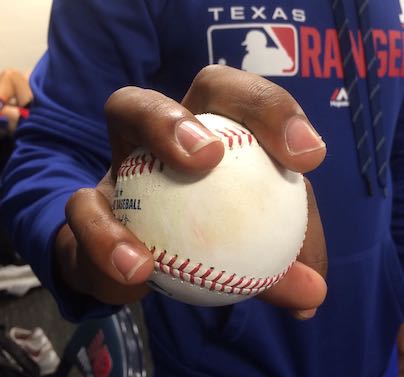
Jose Leclerc’s changeup grip.

“It’s a changeup grip, but I throw it like a football and it moves kind of like a slider. I don’t know why. I’ve tried to show it to my compañeros — to my teammates — and they can’t do it. Sam Dyson; he asked me to show it to him. A few others did, as well. Some of them could kind of throw it, but they couldn’t command it like I do.

“I throw it the same now as when I was a kid. Everything is the same. It is better, though. I throw harder now, so there’s more movement. But what it is … I call it a cut-change. It’s just something natural that I have. I don’t how I do it. For real.” Read the rest of this entry »